It Doesn't Have To Be Right…

… it just has to sound plausible


49 Comments

Do magazines and their editors really shape sf?

The history of science fiction is filled with powerful editors who determined how the genre progressed – in fact science fiction was born in a magazine and would not have existed but for its editor, Hugo Gernsback. After my post on the Hugos, Paul Kincaid’s review of a couple of year’s best anthologies, a discussion of that review on the latest Coode Street Podcast, and a discussion this morning on Twitter, I decided to do a little research.

I have it in my head that the written science fiction we see within the community is a product of a small group of people with much greater than average leverage. Not just the editors of the magazines, who chose what fiction to publish, but the editors of the Big Three magazines – Asimov’s, Analog and F&SF. There are also the editors of the year’s best anthologies, who get to choose each year which stories are the “best”, and so set the variety of sf that will be emulated in later years. And those year’s best editors generally pull from a limited number of sources – the Big Three magazines, especially.

So you get this incestuous and self-perpetuating relationship, in which a handful of sources supply the best stories of the year because only those handful of sources are used to provide stories. And this all feeds into the awards, and thus back into the genre, and so provides it with direction… Except that direction only really appeals to that small group who read the Big Three magazines and vote for the Hugo…

But do the numbers actually back up this scenario? How wide is the net cast by year’s best editors and the awards? Who is really shaping science fiction?

Dozois apparently doesn’t look much further than the Big Three magazines and high-profile anthologies. Which makes this the most purely commercial selection of stories.

Horton’s anthology is fantasy and science fiction, unlike the other two. This may explain why he casts his net much wider than the other two, but it’s still a surprisingly wide spread of venues.

Hartwell & Cramer appear to like tor.com a lot, but they’ve also picked stuff from some very obscure venues. NewCon Press does quite well, and there’s even a story from Irish sf magazine Albedo One. Engineering Infinity has also done well in all three anthologies – in fact, with Eclipse 4 and Life on Mars as well that makes Jonathan Strahan the most successful editor at publishing “year’s best” stories.

However, I have to wonder how much of this is driven by author-name-recognition. Even in the obscure venues, it’s well-known authors who get pulled out – in the Dozois, for example, it’s Alastair Reynolds in Voices from the Past, an ebook-only charity anthology.

The only outlier in the Hugo shortlists is Panverse Three – and that’s a story by Ken Liu, who is plainly a favourite of Hugo voters.

Again, that same Ken Liu story from Panverse Three. The presence of GigaNotoSaurus is a surprise.

It definitely seems as if there is a second tier of magazines after the Big Three – currently it’s only tor.com and Clarkesworld, but perhaps another online magazine will make the jump to Tier 2 in a year or three. Nonetheless, Asimov’s continues to dominate the year’s best anthologies and awards shortlists, as it has done for several decades. F&SF has, I suspect, slipped a little – in the anthologies, though not in the awards – but original print anthologies seemed to do well in 2011. There’s more online fiction than in previous years, but it’s still very much slanted towards print.

The pie charts do suggest that a handful of names have undue influence in science fiction. And the smaller that group, the narrower the range of genre fiction that rises to the top. If sf is becoming more fantastical, more concerned with mining its own tropes rather than doing anything interesting with them, then perhaps it’s because that’s what this group values…


14 Comments

Turn that frown upsidedown

I’d sort of promised myself I wasn’t going to post anything negative here any more, because everyone likes the upbeat, everyone likes the happy. But then I went and spoiled it with a whinge about the Hugo Awards – but then I’ve whinged about them every year since starting this blog. However. Positive, er, stuff. I mean, I’ve read some excellent novels so far this year, I’ve seen some bloody good films, I’ve heard some damn fine albums and even watched some amazing live performances by bands. There’s good stuff there to celebrate. It doesn’t always have to be a total downer.

Except…

So much of the positive shit you see plastered across the Internet is just so brainlessly uncritical. Certainly praise where praise is due – but I see so much of it that’s just plain undeserved. I don’t see myself as a negative person (stop laughing), just a realistic one. Sturgeon’s Law may be glib, asinine and way too easy to overuse / misuse, but it wouldn’t have survived this long if there wasn’t some truth to it. But you’d think it was the 10% that was shit sometimes from the way people carry on…

As a result, it’s easy to over-react and be overly negative. And, sometimes, doing that means the important stuff gets overlooked. It’s good that so many on the Hugo shortlists were not white males. But don’t pat yourself on the back just yet, Hugo nominators; because you also put a stupid April Fool fantasy story on the shortlist.

Having said that, it’s not like I don’t celebrate the good stuff when I encounter it. See, here’s a positive review of Kim Stanley Robinson’s 2312. And here’s an even more positive one of Gwyneth Jones’ The Universe of Things. And here’s a few words about my choices of the best books, films and albums I encountered during the first six months of the year. My tastes are perhaps not entirely mainstream – science fiction! death metal! weird Polish and Hungarian movies! – but I like to think I value quality and can recognise it when I see it (stop laughing).

There is no recipe, no programme of umpteen steps. Changing things takes stick and carrot. And occasionally a bloody great huge cluebat. It doesn’t happen overnight. When, that is, it happens at all. I like to think I’m doing my bit – not just on this blog, or in reviews on SF Mistressworks and Daughters of Prometheus. But in my fiction too. Not that I’ve been entirely successful – I’ve yet to break into any of the big short fiction markets (except for Postscripts). And a common response to my stories is “what happens next?” Er, nothing. It’s finished; the rest is up to you. Anyway, resolution is so bourgeois. Just like quotation marks around speech (small joke there).

I had a point to this post but I can’t for the life of me remember what it was. It wasn’t “be nice”, because being nice to everyone and about everything only devalues it. Nor was it “be negative”, because if the wind changes you’ll be stuck like that and then no one will be your friend. Be honest – that’s certainly important. Yes, above all, be honest. But I think I shall, as my pulled-out-of-thin-air point to this post, use something said by astronaut Gus Grissom, though it later proved to be horribly ironic:

Do good work.


57 Comments

The Hugos are broken, science fiction is broken, everything is broken

Last Sunday saw Hugo Awards handed out to several people for producing, or so the award would have us believe, the “best” of their category in the previous year. It’s complete nonsense, of course. The Hugos, despite half-hearted changes implemented over the years, are based on a model of fandom which hasn’t existed since the 1960s. What are “fan writers”? What are “fanzines”? Once, the profiles of these might have been high enough in the sf community for worldcon members to know what they are and vote intelligently on them. There’s a reason pro writers are winning the fan writer Hugo now – people know who they are. And despite having a World Wide Web for twenty years, the Hugos still have no idea how to deal with online content.

I’ve never understood why there are Hugos for best dramatic presentation. Television and movies have seperate fandoms and their own set of awards, genre or otherwise. I’ll concede that television show writers are more likely to value a Hugo win than a Hollywood director – but neither use the award in their marketing, or make any mention of it. Besides, the best dramatic presentation -short form award has turned into a best episode of Dr Who award. This year it went to Neil Gaiman for added squee.

The magazine Hugos are completely broken and have been for years. They’ve tried to patch it up, with their ever-mutating definition of semiprozine, but the whole award is based on a concept that hasn’t pertained since the early 1970s. There is no real market of pro genre magazines. There are a tiny handful of titles, with greatly shrunken circulations. But there is a thriving scene of non-pro magazines. Why should the Hugos exclude those venues that don’t pay for submissions? They might still publish excellent fiction. And then there’s the whole print vs online thing. But then, why should a magazine deserve an award? For publishing the best fiction? There are the three short fiction categories for that. To reward the editor for consistently picking the best fiction? There’s an editor – short form Hugo for that. For the magazine’s design? There are no Hugos for design.

Then there’s the short fiction categories. What is the point of the novelette? There’s the short story, and that’s pretty obvious. There’s the novel, likewise an obvious category. And something in between, longer than a short story but not as weighty as a novel: the novella. Back in the day, some novels were as short as novellas – the only distinction was that they were published as if they were novels, as separate paperbacks referred to in their marketing as novels. With the increasing growth in the ebook market, some of these distinctions are beginning to blur anyway. The category is at the discretion of the publisher or self-pubbed author – they’ll decide whether the $1.99 30,000-word story they’ve written is a novel or novella. And I see no reason to ignore their decision.

It doesn’t help that the Hugo Awards claim to be global yet are clearly only American. The worldcon, the membership of which nominates and votes on the awards, takes place in the US four out of every five years, and even when abroad the shortlists are often dominated by American works. Works published globally are eligible for the Hugo (now; it wasn’t always the case), but it means little as the voters are chiefly US-based. Online publication of short fiction has confused matters somewhat – so much so that the BSFA Awards, which are for works published in the UK, have given up insisting on British-only publication for their short fiction category. As for ebook-only publication…

This week also saw the publication of an excellent review of the annual best of science fiction anthologies in the LA Review of Books by Paul Kincaid. See here. Paul makes a number of interesting points, but the chief one is that the genre has become so inward-looking that it’s now more concerned with trope mining than it is with the real world. Sf has locked itself within its own toy box, and is happy to just play with the toys it finds there. The review led to an excellent discussion on Twitter, with Paul, Jonathan McCalmont, Rose Fox, Paul C Smith and myself (there may have been others – we didn’t hashtag the discussion and I’m having trouble finding the tweets).

From what I remember, the chief point made was that sf seems to have lost confidence in the future because it has lost confidence in the present. Certainly there’s very little to celebrate in the present – climate change, climate change denial, rampant neoliberalism, oligarchism, the increasingly anti-science bent of public discourse, etc. – but should we really be celebrating as the best that sf which refuses to acknowledge it? Science fiction has always had a place for escapism, thanks to its pulp origins, but to elevate such stories above those that actually comment on the real world is pure cowardice. But then look at what won the Hugo for best novel this year – Jo Walton’s Among Others, a book whose message appears to be “sf fans are special people”…

I don’t actually agree that sf has chiefly been a tool for commenting on the real world – there’s no way in hell you can fit EE ‘Doc’ Smith’s works into that – but some of the best works of the past were clearly more about the time they were written than they were about the time they were set. Such as Joanna Russ’ The Female Man. And not just the good ones either – cf Robert Heinlein’s The Puppet Masters. It’s often been said there’s a steep learning curve to science fiction, that it’s a difficult mode of fiction to begin reading. Being self-referential only makes it worse, far worse. When literary writers have a go at sf, their efforts often appear old-fashioned, because they’re working from first principles, they’re not basing their works on the genre’s past use of tropes. It also makes their books much more accessible to non-genre readers – Rogers’ The Testament of Jessie Lamb, Ishiguro’s Never Let Me Go, Litt’s Journey into Space, James’ The Children of Men, Jensen’s The Rapture, Mitchell’s Cloud Atlas, etc.

One of the nicest things to appear in a review of Adrift on the Sea of Rains was the comment “while the story is science fiction it is written as if it were not” (see here). True, the novella is not about the future but about an alternate past, but it doesn’t make use of science fictional tropes per se. The Apollo programme was real (although my extension of it is invented, of course); the Bell is a well-known element of Nazi super-science mythology. I’ve positioned the novella as sf because I think of myself as a sf writer – or rather, someone who writes in a sf mode. Perhaps I shouldn’t have done.

In one respect, I’m as guilty as those writers on the Hugo shortlists in that I’m not inventing futures which are about the present. That’s because I’m fascinated by the technological achievements of the mid-twentieth century, so they’ve been appearing more often in my fiction. Not just the Apollo programme, but also the bathyscaphe Trieste‘s descent to Challenger Deep, Project Manhigh, the submersible Ben Franklin‘s 2300 kilometre underwater journey in 1969… Despite the Cold War and Mutually-Assured Destruction, the optimism of those times I find very striking. (See also my The future we used to have posts (snarky captions notwithstanding).) All that invention and engineering was going to make the world a better place. In the US, they believed they had the better toys and so would eventually defeat, or cow into submission, the Soviets. In the USSR, they believed they had the better political system and so would eventually subsume all other nations. Neither was proven correct. But the time and money and effort they spent improving their lot was phenomenal. Better living through engineering. We don’t do that anymore. And so our science fictions reflect that lack. Or rather, they should. Complain that sf is all escapism these days, and readers will respond, “what’s wrong with escapism?” Well, it doesn’t fix anything, for a start. That was one of sf’s characteristics in the past, that it posited thought experiments, that it could show the impact of something – good or bad – happening, that it could inspire people to do things.

Sf can use the past, or alternate versions of it, to discuss the present. Saying “we could have done this” is as valid as saying “why did we do that?”. And, at least, it has the benefit of being more realistic – the Bell, notwithstanding. True, readers would have to be of a certain age to remember the Apollo missions, but at least most people are aware of them and their achievements. (Though not everyone, as indicated by an astonishingly stupid Twitter exchange which did the rounds when Neil Armstrong’s death was announced.)

Sf seems to be not only ignoring the real world of people and politics and economics and society and such, but also the real world of science. It invents universes about which we can flit in a matter of moments. Perhaps it takes hours, weeks or months, but we can reach other stars and other worlds. Which are, of course, habitable – if not already inhabited. The real universe is not like that, of course. There is only one place in the entire universe where we will ever be at home, and we are there now. Even Low Earth Orbit, less than 200 kilometres straight up, is about the most benign environment for humans not on Earth, and we can’t survive there without technological assistance, and not for long even with it. Trips beyond LEO are technologically possible – we did it once, we have the engineering to do it again and go further – but they will never be safe or comfortable or timely. And when we get where we going, will it have been worth the trip?

This is not to say all sf is like this. It’s a wide field, with many books and many writers in it. Two novels this year, for example – Kim Stanley Robinson’s 2312 and Alastair Reynolds’ Blue Remembered Earth – have made a point of treating the universe realistically. Ken MacLeod’s recent novel, Intrusion, and Bruce Sterling’s The Caryatids from a couple of years ago, made a real effort to engage with the world as it might be in the near-future. Kelley Eskridge’s Solitaire and Gwyneth Jones’ Life did something similar. Adam Roberts uses the genre to satirically comment on the present. There are doubtless others…

But then I look at the award winners of recent years… A bloated paean to a theme-park vision of the Blitz… the infamous Mormon whale rape novella… a novella about a man who built a bridge which, for no apparent reason, is written as fantasy… a TV series based on a re-imagining of the War of the Roses…

Sf is broken, it refuses to acknowledge we’re in the twenty-first century – yes, I put my hand up, I’m guilty; but at least I write about the real twentieth century. And then I look around and see that not all science fiction is broken. But the non-broken sf… the various awards seem to be ignoring it.

So something is clearly broken somewhere.


1 Comment

Sylvow, Douglas Thompson

Sylvow, Douglas Thompson
(2010, Eibonvale Press, £6.99, 304pp)

Back in the day, fix-up novels were relatively common in science fiction. Authors would cobble together a bunch of stories, sellotape a framing narrative in place, and pass off the finished product as a novel. In most such books, the joins were sadly obvious. If there’s a term for the reverse – a novel which comprises standalone excerpts that have been published as short stories – I’m not aware of it. Nonetheless, it’s a fair description of Douglas Thompson’s second novel, Sylvow. Eight of the book’s seventeen chapters have previously seen print: in Ambit Magazine, Dream Catcher, and the British Fantasy Society’s New Horizons and Dark Horizons. While those chapters read perfectly well as short stories, they are also very much of the novel.

Sylvow is a story in many parts about a small group of people who all live in the invented city of Sylvow. However, the city, and the lives of its inhabitants, are slowly being invaded by Nature run rampant. Leo disappeared into the deep woods which ring Sylvow years before, and sends irregular letters commenting on, among other things, Nature’s campaign of conquest. His estranged wife Vivienne takes up with Anton, who had a nervous breakdown but was cured by Franco, and now works as a forest ranger. Franco’s wife Claudia is a vet, and she sees at first hand how the animal and insect kingdoms are responding to Nature’s war on humanity and civilisation. Franco meanwhile is having an affair with Veronika, a young Goth patient.

According to the background notes at the rear of the book, the city of Sylvow is a fusion of Glasgow, Osnabrück and Novogrudek. Certainly it seems at times to have a Middle European air, and the novel’s cast all possess names more common in continental Europe than in the British Isles: Franco, Veronika, Claudia, Vittorio, Nikolaus… Yet there are references to very British institutions and cultural artefacts. It gives Sylvow a somewhat unsettled feel – further exacerbated by Thompson’s prose style, which at times reads Ballardian and at others like the work of an East European fantasist. There are a variety of voices in Sylvow, but not all feel entirely suitable. Yet this too seems in keeping with the story Sylvow tells. Its narrative is episodic, and nominally linear, but not everything in the novel makes sense, or is capable of being understood.

Thompson aims high, but does not always hit his target. He is better when focussing on the surreal than he is at the quotidian. When read as a novel of disconnect, of humanity’s failed attempts to understand, or come to an accommodation with, Nature and her needs, Sylvow works very well indeed. Many of the passages set in the forest showcase some lovely writing indeed. As a novel of the relationships between people, Sylvow is perhaps less successful. The easy familiarity between family members, and between friends, often feels forced, as if Thompson were trying for the mannered tone of Mittel-Europa fiction but instead found himself writing the banal dialogue of a transatlantic mainstream novel. Nonetheless, despite the uneven read, despite its occasionally patchy nature, Sylvow is an intriguing blend of genres. With this novel, and his debut Ultrameta, Thompson has certainly shown he is a name to watch. Once he manages to write mainstream with the same facility he writes surrealism and genre, he’s sure to produce something special.

This review originally appeared in Interzone #233, March-April 2011.


15 Comments

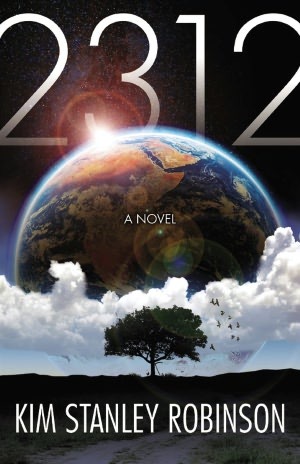
300 years from now is 2312

I’ve been saying for a while now that science fiction doesn’t need improbable spaceships and magic technology in order to generate sense of wonder. There’s plenty of wonder in the universe as we know it, once you accept its vast size and implacable hostility. So the prologue of Kim Stanley Robinson’s 2312 comes as a real pleasure to read. It is set on Mercury, and describes a sunrise as seen from the terminator. The world is in fact inhabited, and most of its inhabitants live in a city, called Terminator, which travels around the world on rails, forever staying within the twilight zone.

Mercury is not the only planet in the Solar System that has been settled. Mars not only has a thriving colony but has also seceded from Earth control. As indeed have the many moons and asteroids which have been colonised – and which now form the Mondragon, named for the Mondragon Corporation, a federation of workers cooperatives in Spain founded in 1956. Venus too has also been settled, and it is the fate of the human settlement of Venus which partly drives the plot of 2312.

Such a near-ish future scenario, with its strict adherence to realistic science, and plausible and clever extrapolation of technology and society, seems guaranteed to appeal to me. So it feels a little churlish to complain that 2312 falls a smidgen short of being a truly great science fiction novel.

Alex, one of the Mondragon movers and shakers, has died (of old age) and it is up to her friends to see that her plan continues. These friends include Swan Er Hong, Fitz Wahram, Inspector Genette, and others. The nature of Alex’s plan is only gradually revealed to Swan, though she is happy to involve herself. This initially requires travelling to Titan with Wahram. As they travel about the Solar System, the two fall in love, despite not seeming to suit each other particularly well. As they travel, Swan learns that Alex’s plan is a response to a secret conspiracy with unknown aims.

2312 is a novel comprising episodes spaced along a timeline in which a mostly-hidden conspiracy gradually reveals itself and its objectives. There is, for example, the destruction of Terminator. There is the discovery of qubes (quantum computers) in human form – rather than surgically-embedded qubes in humans, such as Swan’s companion Pauline. (Qubes are not artificial intelligence per se, though something like it emerges from their complexity.) There is the destruction of a travelling asteroid terrarium (a common means of transport about the Solar System) and the deaths of all those travelling within it. There is the reseeding of Earth with the fauna which had populated the terraria. There is a covert civil war on Venus.

In truth, the conspiracy is the weakest element of 2312, and not every event seems linked to the story it powers. The reseeding of Earth, for example, is clever and exciting, but doesn’t feel like part of the same narrative which sends Swan and Wahram gallivanting about the Solar System. And the resolution of the conspiracy, when it’s revealed in a disappointingly offhand fashion, feels like an after-thought rather than the resolution of a dramatic narrative.

Yet the Solar System of 2312 is a fascinating place. It feels like a valid extrapolation in ways that many nearish-future science fictions – such as James SA Corey’s poor Leviathan Wakes – do not. To some extent, this emphasis on world rather than plot does make the novel feel somewhat like a travelogue. But 2312 is not a plot-driven novel. It is dramatic in discrete moments, and it is sense of wonder, the continuity of the characters’ perceptions and the deepening relationship between Swan and Wahram, which chains those moments into a linear narrative. 2312 is like its terraria, it is a small world put together from elements of the real world, and in which a life unlike those we can experience ourselves can be lived. It’s no surprise then that the conspiracy which opens with the destruction of Terminator feels like a feeble counterpoint to the journey on which Robinson takes the reader.

As a genre novel – ie, a narrative reliant on plot for its backbone – 2312 is somewhat unsuccessful. As a science fiction in a more general sense, a personalised exploration of an invented universe, with its Dos Passos-seque “extracts” and “lists”, 2312 is superb. It may well be Robinson’s strongest work since the Mars trilogy. I wouldn’t be surprised to see it on a few shortlists next year; and I’d be disappointed if it wasn’t nominated.


3 Comments

Starcombing, David Langford

Starcombing, David Langford
(2009, Cosmos Books, $14.95, 223pp)

David Langford is a British institution. I picture him as resembling a faculty building in a concrete-and-glass university campus of the 1950s, possessing neither Gothic grandeur, nor the ivy-clad and leather-elbowed academic elitism of a red-brick. And certainly not the imposing belligerence of a Brutalist edifice. Rather, an unassuming but welcoming façade, one which would not look out of place in a city-centre precinct, one which speaks of learning that is open and available to all. Within the building, with its foyer lined with twenty-eight Hugo Awards, is a labyrinth of passages. Small signposts indicate the ways of “science fiction”, “literature”, “nuclear physics”, “Thog’s Masterclass”, “Harry Potter” and other areas of knowledge. The corridors are quiet, and those who pad their lengths do so silently. Every so often, a door can be heard softly closing. There is an atmosphere of erudition and wit – the halls are thick with it. And it is said, in hushed tones of course, that in the labyrinth can be found a vast library, containing many legendary arcane tomes. The library is searchable too, by means of an elegant user interface programmed by the man himself.

At semi-irregular intervals, Langford issues prospectuses. Starcombing is the most recent. It contains eighty-five articles, drawn from a variety of sources – Foundation, SFX, The New York Review of Science Fiction, Nature and Nature Physics, assorted fanzines, and even some previously unpublished pieces. The earliest is from 2000, and the latest from earlier this year. They are arranged chronologically. An author’s note describes Starcombing as a sequel to both Up Through an Empty House of Stars (2003) and The Sex Column (2005), both previous collections of Langford’s writings.

Starcombing is a book in which one should wander around; a plan is not necessary. Nor, in this labyrinth a thread, narrative or otherwise. Alternatively, there is the index, which signposts the route directly to whatever is sought. Some might consider that cheating… because this is a book in which aimlessness is an advantage, in which dipping in and out is a valid use of it. The articles Starcombing contains are short, often no more than a page or two. They can be read as and when desired. Not that Langford’s writing needs to be taken in small doses. On the contrary, his writing has always made it appear as if his learning and humour came easily to him.

Highlights of Starcombing include ‘Maps of Minnesota: Stalking John Sladek’, a piece from The New York Review of Science Fiction in 2001 about tracking down Sladek’s unpublished stories and poems for a posthumous collection; three previously unpublished essays from 2004 on James Branch Cabell, John Myers Myers and Thorne Smith for a project which was abandoned by its editor; an essay on HG Wells from Fortean Times; and four short-short stories from Nature and Nature Physics. I suspect I am not alone in wishing Langford would write more, and longer, fiction. Much of Starcombing comprises Langford’s column from SFX and, while they are entertaining, their nature, intended audience and shortness weighs against them. If I have one complaint, it’s that the contents page does not give the origin of the various articles; it is only given as bulleted note after each piece.

Those familiar with Langford’s writing will know what to expect from Starcombing, and probably already have their copies on order. Those who have yet to read Langford should begin immediately, and Starcombing provides as good as introduction as any of his non-fiction collections.

This review originally appeared in Interzone #224 September-October 2009.


2 Comments

Whippleshield updates

Whippleshield Books continues in its mission to take over the world, although at its current rate this may take a millennium or two. At present, I could probably afford a couple of pebbles from the beach on the desert island where I plan to build my secret hideout in an inactive volcano…

Book two of the Apollo Quartet, The Eye With Which The Universe Beholds Itself, is coming along. Back at the beginning of July, I posted a blurb on the Whippleshield Books blog here. And at the beginning of this month, I posted the first 500 words as a teaser – see here. This book is  turning out to be a bit more ambitious than Adrift on the Sea of Rains. I’ve yet to decide if that’s good or bad, but it’s certainly resulted in more research than I’d expected.

Book three might be titled Then Will The Great Ocean Wash Deep (Above My Head For Ever). It’s a bit unwieldy, even without the part in brackets, so it could change. For the record it’s from a Homeric Hymn to Apollo. And it does sort of fit the plot. I’ve not started writing it yet, but I like to have a title as a focus for when I do begin. Even if I decide on a different title later…

The title for book four, however, is definitely fixed. It will be All That Outer Space Allows. One of my favourite films is Douglas Sirk’s All That Heaven Allows, which is why I chose it. At least it’s not a Lowryesque title like books two and three.

I have also published the first in what I hope will be a series of extremely limited chapbooks. The story Wunderwaffe was originally published in the e-anthology Vivisepulture published by Anarchy Books, and was described by Pornokitsch as “exceptional”. There are only a dozen copies available. Or rather, there were. I’ve sold some already. If you want one, get in there now.


41 Comments

5 tropes science fiction and fantasy should really stop using

These speak for themselves, I think.

1. rape as lazy characterisation
You want to show your villain is a Bad Man, so you have him rape a woman. You want your fluffy princess to become a feisty amazon, so you have someone rape her. No no no no no no no. Do not treat women like this, not even in fiction. And when Mr Fantasy Author responds, “that’s what it was like in the Middle Ages, you moron”, but also quite happily replies with “it’s a made-up fantasy land, you moron” when the accuracy of his Middle English has been questioned, then I would suggest that Mr Fantasy Author is the real moron. If you’re going to make shit up, don’t make up regressive sexist shit.

2. the lone gunman
Thousands have died, perhaps millions, and it’s all the fault of one man (it’s almost always a man). He deliberately gave the order, or pressed the button, that resulted in all those deaths. He’s a monster, and he acted in a vacuum, according to motives of his own. He’s not part of a political or religious movement, he’s not the general of a conquering army. He is the lone gunman, the lone psycho. Like the corporate executive, in a Hugo-shortlisted space opera, who hires gangsters to seal the exits of an asteroid city with a population of 1.5 million, and then subjects them to a fate worse than death by infecting them with an alien virus… just to see what will happen. If your plot depends on one person acting like an inhuman monster, you need to rethink your plot.

3. post-catastrophe man is an animal
Thirty years ago, we were waiting for them to drop the big one and then we’d all be scrabbling for survival among the radioactive ruins. Now it’s more likely that climate crash, or nation-state failure, will do for us. Either way, our current way of life will be toast. So, of course, once this happens the men will all run rampant, rape all the women, steal everything, and kill anyone they don’t like the look of. This, at least, is what fiction tells us. We will not try and rebuild our communities, we will not recognise that cooperation increases our chances of survival. It’s every man for himself, and the women are chattel. Of course, our present ruling classes want us to believe this – they need law and order to maintain their rule, so they want us to believe that without law and order we will turn into brainless animals. In Davide Longo’s The Last Man Standing, a middle-aged couple break into the protagonist’s house and steal all his food and clothing. Regressive, but relatively plausible. They also shit all over his furniture. Why? Why would anyone stealing food to survive also shit on their victim’s furniture? If you have characters in your post-apocalypse novel raping women and shitting on beds, do “select all”, followed by “delete”.

4. the tart with a heart
It’s not just that it’s a horrible cliché centuries past its sell-by date. Think what it says about your invented world. If prostitution exists, or even flourishes, then it is not an equal society. It is patriarchal. And that makes it sexist. Is the human race – one half of it, at least – doomed to be sexist until the heat death of the universe? Biological apologists are no better than creationists. Leave regressive crap like this where it belongs – in religious books.

5. artificial people are not people
Humanity finally manages to create a race of artificial human beings. And promptly enslaves them. No no no no no no no no no. If they’re human, they’re human. They will have the same rights as everyone else. We did the slavery thing centuries ago, it was wrong and we know it was wrong… so why would we do it again? This goes for AIs too. If it’s sentient, it’s not a tool. And if you should find yourself writing a sex slave character, take your manuscript and burn it. And do not write another word until you know better.

ETA: I have added “as lazy characterisation” to the first point as it was rightly pointed out to me that it originally read as though I felt rape should never appear in fiction, when it was my intention that its use as lazy shorthand characterisation should be avoided. Rape should be written about, and as a man I am not in a position to say otherwise. I apologise for any confusion, and take to heart everything written by Kari Sperring in her response here.


8 Comments

A British sf masterwork? Implosion, DF Jones

The SF Encyclopedia makes no real comment on the works of Dennis Feltham Jones, preferring instead to précis his novels. He is perhaps best known for his first novel, Colossus, which was filmed as Colossus – The Forbin Project. Implosion, from 1967, is his second novel.

An unnamed Eastern Bloc country develops a substance which renders women sterile. Because the nation’s premier is the illegitimate son of a British diplomat, he chooses to use this powder on the UK. Two years later, fully eighty percent of British females can no longer ovulate. The country’s population begins to fall, and is calculated to hit around five million by the mid-1980s. A government with far-reaching powers and a mandate to fix the problem is voted into power. All the fertile women are put into camps to become baby machines. Children are put in National Schools, where they are kept safe from harm and educated to as high a level as possible. Villages are demolished, and towns abandoned, when their populations fall below sustainable levels.

In charge of all this is John Bart, the Minister for Health and Regeneration. His wife Julia proves to be one of the rare fertile women, and is packed off to a camp. Meanwhile, the government tightens its grip on the country. After a raid on the lab which developed the powder, the Brits reverse-engineer it but can find no cure. They publish the formula, so that now everyone has it. Naturally, other countries soon find themselves in the same situation.

Meanwhile, Julia has come to realise that the regime in the fertile women’s camps has turned nasty. Women are whipped for the slightest infraction, such as smoking (even when not pregnant). She escapes… and discovers that the world outside is very different to what she had been told. She finds her husband, who is still the number two man in the government, and likely soon to be the number one, and learns that he is now shacked up with her twin sister. The twins turn on one another, Julia gets sent back to the camp, and that’s that. Except Nature has one final trick up her sleeve…

There’s a very 1960s British po-faced earnestness to Implosion. The characters are exemplary – Bart himself is young and noble and brilliant at organisation and making decisions. His wife is beautiful and loving and a true soulmate. Or at least, she starts out like that. Even their lady who does is a treasure. The prime minister is a hearty man of the people, straight-talking and more than willing to do the necessary. The Britain of the story appears pretty much the same as the Britain of 1967. Even though it begins in the early 1970s, the currency is still pounds, shilling and pence.

Implosion reads like a novel in which the author had a good idea and then set out to show clever he was in solving it. Its politics are simplistic, as is its view of the British people. The Barts are very much the “right sort”, and what few working class people do make an appearance are viewed with all the patronising indulgence of the privileged. Implosion is not a cosy catastrophe – there’s more brandy drunk than tea, for one thing – but it is peculiarly English. Perhaps it could be called a “Mayfair catastrophe”. That’s what it feels like, a black and white 1960s television Play for Today with a cast speaking in cut-glass accents, while around them the world they don’t much care for slowly falls apart…

So, not a British sf masterwork, then.

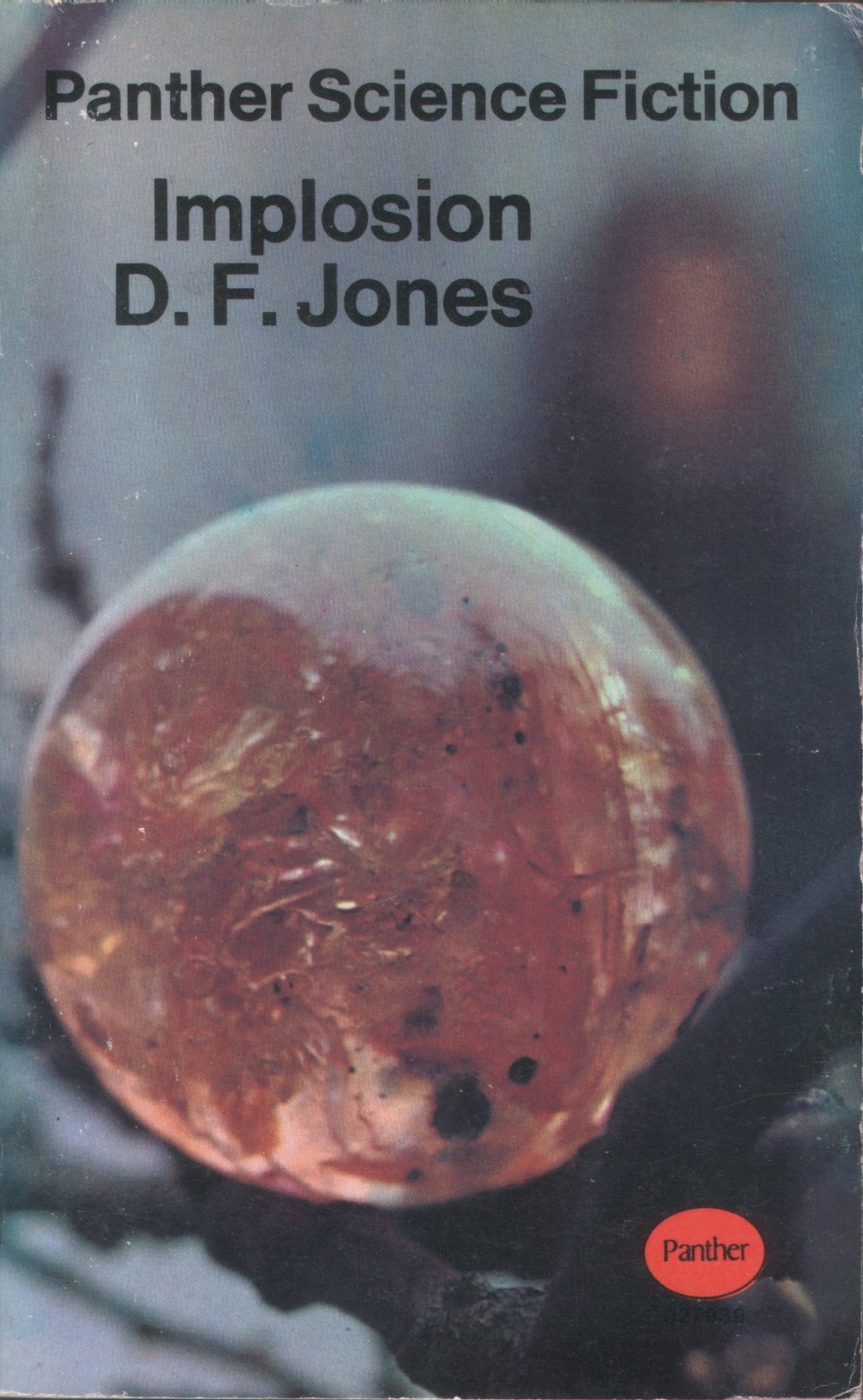
(And no, I’ve no idea what that blobby thing on the cover of the book is supposed to represent.)


Leave a comment

Robopocalypse, Daniel H Wilson

Robopocalypse, Daniel H Wilson
(2011, Doubleday, $25.00, 347pp)

Daniel H Wilson has a PhD in Robotics. He is also the author of How to Survive a Robot Uprising, among other books. He’s the go-to guy when American television needs an expert on robots. Almost every book he has written has been optioned – including this one, Robopocalypse, his first novel for adults. In fact, the film rights were sold before the book was even published.

This is a well-worn narrative, and it’s the story of the book rather than the story in the book which often generates more interest. When six-figure sums are bandied about for a genre novel, its quality is beside the point. Such books cannot depend on genre readers to recoup their outlay. They have to break out – and an author with celebrity status is needed provide the slingshot required. Robopocalypse will be a successful book, but not from any quality intrinsic to it as a novel qua novel.

So it should come as little surprise that, as a novel qua novel, Robopocalypse is not a satisfactory read. Sometime in the near-future, a scientist accidentally unleashes an Artificial Intelligence. Over a period of a couple of years, this AI, Archos, reprograms all the world’s robots to turn on human beings, and so a war begins. Robopocalypse opens with a human combat team finding a device, built by the robots, which appears to contain eyewitness accounts to various incidents which took place during the Robot War. These incidents become the chapters of Robopocalypse, and each one is introduced with a blurb from the device’s discoverer.

This novel, then, is not a narrative but a collection of vignettes which, together, create a story-arc of sorts. Some of these vignettes are more successful than others. When the story is set in the US, Wilson handles his voices well, though there is a tendency to lionise his protagonists. However, one series of chapters is set in London, and it appears Wilson learnt his British accent from watching Guy Ritchie films. Another features a mild-mannered technician in Tokyo who later proves to be a genius. These are not ordinary people, though the structure of Robopocalypse would have you believe they are representative of the human race.

Given the author’s credentials, the one area in which you’d expect Robopocalypse to shine would be its science and technology. But even these elements were so clearly written with an eye toward cinematic visuals they often appear implausible. Automated cars in New York, for instance, go on a killing spree. But this makes little or no sense – the computing power necessary to turn a car into a weapon which can target moving pedestrians simply wouldn’t be built in. Wilson also has a tendency to project emotions onto the robots, as if anthropomorphisation would make them a more implacable enemy. Being a roboticist, he should know better.

Robopocalypse is a novel powered by two things, both external to the text. It reads as though it has been written to facilitate its transformation to another medium, the cinema. Hence the soundbites and pithy blurbs which open each chapter. Likewise the framing narrative, which implies a level of rigour the novel too often exceeds: the claimed sources for each chapter – CCTV footage, recorded interview, etc. – do not possess the level of detail or insight the writing displays. However, it is not all bad. Some parts of Robopocalypse are quite effective, and Wilson does a good job of describing the collapse of US society and the destruction of the nation’s infrastructure. Having said that, there’s little point, to be honest, in reading the book. Spielberg is all ready working on the film adaptation. You might as well wait for that: the visuals are likely to remain unchanged, but at least the story-arc will have been distilled down into something much more potent and satisfying.

This review originally appeared in Interzone #236, September-October 2011.

Note: the film mentioned in the review is due to be released in 2014, but as yet no cast members have been attached.