Jupiter magazine’s next issue, #30 Hermippe, is due to be published any day soon. It contains my Jupiter Quartet of poems… and I can’t think of a more appropriate place for them to appear.
Category Archives: my fiction
Some personnel news
M-Brane SF has announced the table of contents for #21, due out 1st October, and which includes my story ‘Human Resources’. It’s another near-future science fiction story, although set in a slightly different world to ours. Apart from that minor difference, and the, er, “brain-hacking”, everything in it is real.
Don’t forget to buy a copy.
August updatification
First the good news: M-Brane #19 is now available here, containing my story ‘Through the Eye of a Needle’. I wrote it as a socialist story, although I’m told some readers, especially American, might interpret it as anti-socialist. You could always see for yourself…
This month’s VideoVista is also up, containing my reviews of Gentlemen Broncos


The bad news is that, annoyingly, I’ve not managed to get started on my summer reading project – see here. So I’ll begin the first quintet this month. It’ll be the Bold as Love Cycle first, I think.
I also have plenty of writing to get done, too. A handful of stories that have been mashing in the bottom drawer, and need a second draft. A couple more that need the first draft finishing. Then there’s the “newer” space opera novel project, which needs the first three chapters completing. And speaking of space opera, I did sort of promise myself that I’d try and write a proper space opera story this month, so let’s hope inspiration strikes there.
I have a couple of books lined up for reviews, which I need to get done. The first one, Veteran
Ah well. Looks like it’s going to be a busy month.
Giving it away
If you look at the Fiction tab on this blog, you’ll see I’ve not sold a great number of short stories. Of those published stories, I’ve made three available online as PDF files – many months after they were originally published, of course. A fourth story, a flash fiction piece, I self-published on my Space Books blog as part of my Apollo 40 celebration (albeit somewhat delayed).
At the beginning of July, I decided to put copies of those four stories up on feedbooks.com, a site for free ebooks. You know, just to see. Would anyone read them? Would I get any comments?
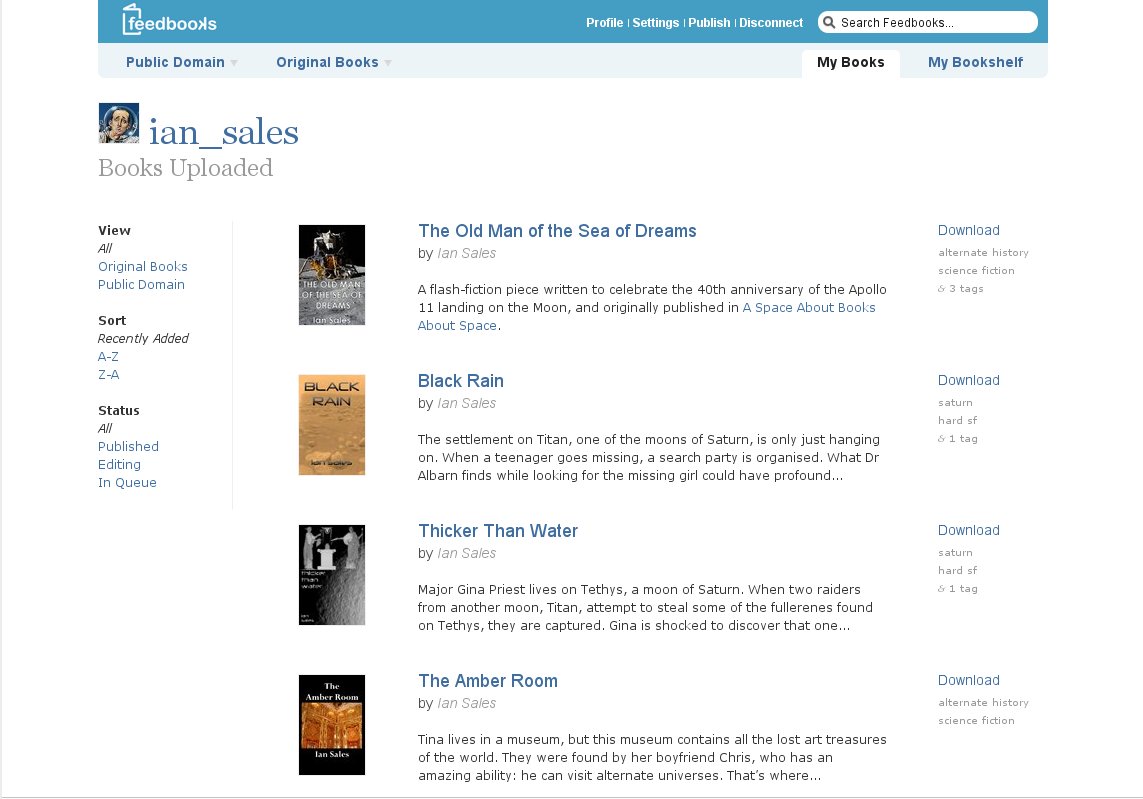
The first has certainly happened. But not the second. No comments, but a large number of downloads. In fact, the respective popularities of the four stories has surprised me quite a bit…
Since the first of July, the stories have had the following number of downloads:
- Thicker Than Water – 288 downloads
- The Old Man of the Sea of Dreams – 394 downloads
- The Amber Room – 884 downloads
- Black Rain – 1,756 downloads
Black Rain has been the most popular by quite a margin – more than double The Amber Room. But if I had to rate my own personal satisfaction with the stories… then Black Rain is the one I’m least satisfied with. So I’m slightly boggled by the mismatch between my own expectations of a short story and readers’ responses to it. If I did something right in Black Rain, I don’t know what it is…
While I published my stories on feedbooks.com more as an intellectual exercise than as a serious self-publishing strategy, I’m happy with the results. I’ll to continue to re-publish my fiction there – a suitable length of time after each story was initially published, naturally.
Sales in print again
M-Brane SF has posted the table of contents of its August issue, #19 here. Included in it is my story, ‘Through the Eye of a Needle’, which, despite its description as a “dystopia”, I actually consider to be optimistic sf… No, really. The other stories sound pretty damn interesting, too.
Another review of ‘Killing the Dead’
Gav at NextRead has reviewed my story ‘Killing the Dead’ from Postscripts 20/21 ‘Edison’s Frankenstein’ as part of his Shorty Story Month.
He says it’s “a quick clever tale that asks a serious question about what is important to humanity when travelling across the stars for journeys that will take unknown generations to complete”.
See the full review here.
By Jove!
Issue 28 of Jupiter SF is now available, containing another one of my Euripidean Space stories, ‘A Cold Dish’. Go on, you know you want a copy…
Somebody out there likes me…
…or rather, likes one of my stories. Tangent Online has reviewed Postscripts #20/21 ‘Edison’s Frankenstein’ here, and it’s a mostly positive review of the anthology/magazine. Steve Fahnestalk says of my story ‘Killing the Dead’ (you have to scroll about halfway down the page):
“I particularly liked this story as it was pure SF that couldn’t happen in a different context; that is, the reasons for the terrorism could only exist at that time in that place, and the arguments for and against made perfect sense in context; as well, the Inspector’s conclusions were in keeping with his personality and his role aboard ship. Highly recommended.”
Which I’m particularly happy about… because if you can change the setting of an science fiction story and it still works, then it’s not science fiction. And I write science fiction.
The “Highly recommended” is very nice, too.
w00f! A story sold
My story ‘Barker’, a re-imagining of the flight of Laika, the first dog in space, as an American man, has been bought by New Horizons, one of the British Fantasy Society’s two journals.
New Horizons is biannual, and my story will appear in the December 2010 issue.
Don’t forget that Postscripts #20/21 ‘Edison’s Frankenstein’ is currently available from PS Publishing. It contains my story ‘Killing the Dead’.
And keep an eye open for Jupiter #28, due in April, which will contain the second of my Euripidean Space stories, ‘A Cold Dish’.
People of Fact in Fiction
There’s an interesting article on the Aqueduct Press blog regarding the use of real – dead or alive, historical or celebrity – people in fiction. This has apparently been kicked off by AS Byatt’s comments on Man Booker Prize winner, Wolf Hall by Hilary Mantel. Byatt has said in an interview that it is “appropriation of others’ lives and privacy”, and “I really don’t like the idea of ‘basing’ a character on someone, and these days I don’t like the idea of going into the mind of the real unknown dead.”
As a writer of science fiction, how relevant is this to me? After all, sf is set in the future, right? In space. With aliens. It’s not real.
Well, yes it is.
Science fiction is as real as any other genre. Sf is not just spaceships and robots. Sf is not divorced from, or irrelevant to, the real world.
I don’t have a problem with fiction writers using real people in their stories. I’ve done it myself. I’ve even had it done to me – I’ve been horribly dismembered in at least two stories by writer Jim Steel.
But I do have a problem with writers who confuse their fact with fiction.
On my Space Books blog, I’ve reviewed a number of books about the space race. And some of them have been written in a style which dramatises their subject, makes it more immediate, a more readable book and not a dry academic tome. It is presented almost as if it were fiction. When the non-fiction author describes what a person is thinking or feeling, with no citation or quote to show that this is what the person has said they thought or felt, then the author is writing fiction. But since their book is presented as fact, they’re misleading the reader. I think that is wrong.
But for a fiction writer to use fact? It doesn’t even require the “ironic distance” discussed in the Aqueduct Press piece. The text itself is fiction, and is pretty much always labelled as such. There may be other clues in the story – especially if it is alternate history.
Take, for example, my own flash story ‘The Old Man of the Sea of Dreams’ (available here). The story has three characters: Stuart A Roosa, Gerald P Carr and Paul J Weitz. It mentions two other people by name: Neil Armstrong and Iven Kincheloe. All five are real people. Three of them are still alive.
The story describes Apollo 20, a mission to the Moon which never took place. So it’s alternate history. This might not, of course, be obvious to everyone. The US went to the Moon eight times, and landed twelve men on its surface. That it happened is known to everyone. The details of each mission may not be. So a lunar landing with Stuart Roosa and Gerald Carr could conceivably be misread as fact, if a reader didn’t know the names of the twelve men who walked on the Moon.
Even the line “Apollo 20, the first mission to visit the dark side of the Moon” only really signals that ‘The Old Man of the Sea of Dreams’ is alternate history to someone who knows that the last Apollo mission was Apollo 17 (Apollo 18 was actually the Apollo-Soyuz Test Project), and that no Apollo mission visited the dark side of the Moon.
But ‘The Old Man of the Sea of Dreams’ is clearly labelled as “fiction”.
I could have invented astronauts for the story – Commander Stu Bobbington and Lunar Module Pilot Gerry Freddison. I didn’t have to use real ones. I could have crewed Apollo 20 with entirely made-up people.
But.
I used real people because I find it interesting when fiction intersects the real world. ‘The Old Man of the Sea of Dreams’ is intended to read as feasible – its plausibility rests on its feasibility. By referencing real people, I bolstered its feasibility. Iven Kincheloe really did die in 1958. He was a test pilot, and had been selected in 1957 – along with Neil Armstrong – for the USAF Man in Space Soonest programme. Conspiracy theories have been built on less.
I didn’t make a serious attempt to capture the characters of Roosa and the others – it’s a 1,000 word story, after all. Some might consider that an unfair appropriation of their names. In fact, I’d originally written the piece with Jack R Lousma as the LMP – he was the most likely candidate for Apollo 20. But I had to read out the story and Roosa and Lousma sounded too similar, so I replaced Lousma with Carr, who was actually the planned LMP for Apollo 19.
When I made the change, I didn’t rewrite the dialogue. As I said, the story is not an attempt to present real versions of the people. I’ve no idea if they talked the way I portrayed them. I don’t especially care. It’s their career baggage which interested me, and which added an additional dimension to my short story.
‘The Old Man of the Sea of Dreams’ is not the first time I’ve used real people in a piece of fiction. Another features World War I soldier-poet Wilfred Owen (it will be published next year). I’m sure there’ll be other stories – some have to be told from the viewpoint of a real person; some real people need to have stories told about them. I see no reason why a writer should limit themselves by only using invented characters.
Of course, that doesn’t mean you shouldn’t research – the character needs to resemble the real person, or the reader won’t recognise them for who they are. You can’t just appropriate their names – Roosa’s career mapped perfectly onto the plot of ‘The Old Man of the Sea of Dreams; I didn’t simply pick a random member of the astronaut corps. And besides, the final line simply doesn’t work if I’d used a made-up name instead of Neil Armstrong. My Wilfred Owen story references his poetry and writings, and the plot hinges on the fact that he did not survive World War I.
There should be no limits on fiction. Start telling writers what they can and cannot do, and the readers will suffer as well. Imagination works best when it is unfettered.
 It Doesn't Have To Be Right...