It Doesn't Have To Be Right…

… it just has to sound plausible


Leave a comment

Moving pictures, #11

Here’s more of those silvery round things with the moving pictures cunningly encoded on them. To date, I’ve watched 520 of the 1001 Movies You Must See Before You Die, although many of them I’d seen before I came across the list and decided to make an effort to complete it. (Again, asterisked ones are on the list.)

amourAmour*, Michael Haneke (2012, France) I bought this the moment it was released since I think Haneke is one of the most interesting directors currently making films, but I never actually got around to watching it until recently. I’m not sure why. I think it was perhaps because I’d bounced out of Funny Games the first time I tried to watch it and was afraid I’d do the same with this. I needn’t have worried. A retired couple in Paris, the wife suffers a stroke, and then surgery for a blocked artery goes wrong and leaves her semi-paralysed and confined to a wheelchair, the husband finds it increasingly harder to cope. Haneke doesn’t do cheerful films, but this is a completely cheerless one. Good, but not his best.

Tsotsi*, Gavin Hood (2005, South Africa). The title character is a young hoodlum in Soweto who steals a woman’s car, only to discover her baby in the back. He strips the car but keeps the baby, but soon realises he doesn’t know how to look after it. So he terrorises a young woman he sees at a public water pump into helping him. Meanwhile, the police are hunting for the car thief, and Tsoti’s friends have taken up with the local gangster. No one is really likeable in this film, they’re mostly thugs; but Hood manages to make the title character sympathetic. There’s an especially telling scene where he attacks a disabled ex-miner, but then realises that preying on the weak and helpless is no way to live. Worth seeing.

Stachka*, Sergei Eisenstein (1925, Russia). AKA Strike. This is Eisenstein’s first full-length film, made the same year, but before, Battleship Potemkin. It’s pure propaganda, but I was surprised to see how many modern film techniques, such as jump cuts and montages, that Eisenstein uses. The film depicts a strike in a factory in pre-revolutionary Russia, and its suppression by the capitalist owners and tsarist authorities. It’s pretty brutal in places and, sadly, less than a century later, its premise is not one we can consign to the dustbin of history.

Taza, Son Of Cochise, Douglas Sirk (1954, USA). Sirk made a handful of brilliant films, but he also made a lot of crap ones. This is one of the latter although, to be fair, it was slightly better than I expected – and it is subversive for a western as it’s told entirely from the Native American side and it shows them trying to seek peace with the US. Well, not all of them. The title character, played by Rock Hudson, certainly is, he’s trying to stick to the treaty his father signed, and he even becomes the first officer of the “Indian police”. But one of the other members of the tribe is not so willing to bend over backwards – the Americans have forced the tribe to move onto a reservation, for example – and kicks off a rebellion. The film’s heart may be in the right place, but it’s hard to ignore that so many of the cast are whites playing Native Americans.
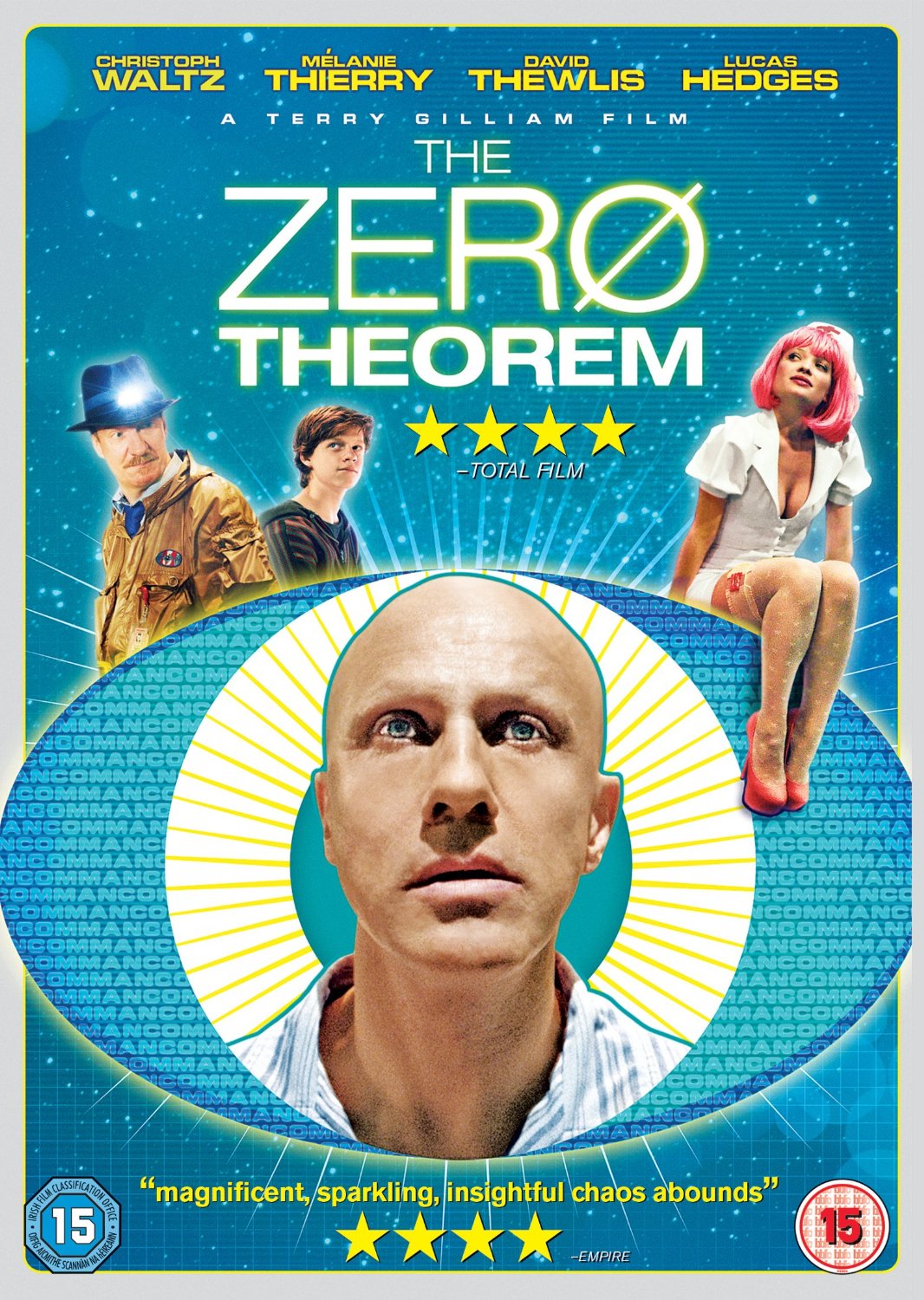
zero_theoremThe Zero Theorem, Terry Gilliam (2013, UK). It’s been a while since Gilliam made a film that blew me away – in fact the last few have been pretty lacklustre, and I think his most interesting piece in the last two decades has been a documentary on his failed attempt to make a film about Don Quixote. The Zero Theorem has been called a return to form, a phrase which always make me suspicious. I’ve seen mostly positive reviews of the film, which, unfairly, had led me to expect something as good as his earlier masterpieces. It’s not. The metaphor used for the “entity crunching” doesn’t make much sense and Bainsley feels like the sort of character only a dirty old man would think is necessary. But David Thewlis plays his part well, and Matt Damon’s wardrobe is quite amusing.

The Discreet Charm of Bourgeoisie*, Luis Buñuel (1972, France). This is one of the those films that slowly sucks you into its somewhat off-kilter world. It starts unremarkably enough: two couples turn up to another couple’s house for a planned dinner party, only to discover they’ve got the wrong day and the husband is away that night. So they take the wife to a nearby auberge with a good reputation, but it’s closed. They persuade the maître d to let them – only to learn the proprietor died that day, which is why the restaurant is closed. The film then follows the three couples as they arrange other dinner parties, including one with a contingent of military officers, a party that turns into a play on a stage… and it all becomes increasingly surreal as the film progresses. I had not expected to like this film as much as I did.

Lady For A Day, Frank Capra (1933, USA). Capra later remade this in 1961 as Pocketful Of Miracles, with Bette Davis and Glenn Ford – that was, in fact, Capra’s last feature film. An old woman who sells apples on the street to make ends meet has a daughter she gave away when young and who is now living in Spain. And who now wants her aristocratic Spanish fiancé to meet her mother who, she believes, is well-to-do and lives in a posh hotel. Fortunately, a local gangster considers the old woman is his good luck charm and is happy to help out. So they turn the old woman into the “lady” her daughter believes her to be, rent a big penthouse and organise a big bash… but it doesn’t go quite according to plan. Fortunately, everything works out… The very definition of a feel-good film.

Ponyo, Hiyao Miyazaki (2008, Japan). I find many of the Studio Ghibli films unbearably twee and this one is little different. The title character is a magical fish, who falls in love with a young boy who captures her and so returns to land as a young girl. So it’s basically The Little Mermaid. But Ponyo’s father is not happy, not just with her betrayal but with the humans’ pollution of the ocean. Happily Ponyo’s mother, the Goddess of Mercy, saves the day.

Sansho_Dayu_DVDSansho Dayu*, Kenji Mizoguchi (1954, Japan). Feudal Japan, and a manorial estate managed by the titular character has a slave labour force, among which are the children of a disgraced governor. Once the children reach adulthood, they manage to escape – at least the man does, the woman gives herself up to distract their pursuers. The young man goes looking for his mother, who was sold into slavery elsewhere. En route, he runs into his old mentor, who gives him a letter to prove his identity as he wants to appeal to the Chief Advisor. After proving his bona fides, the young man is made governor of the province containing the manor which Sansho manages. The young man tells Sansho he is outlawing slavery, Sansho retaliates, but the young governor’s soldiers prevail. Slow, but affecting.

Brüno, Larry Charles (2009, USA). If I thought Sacha Baron Cohen playing Borat in redneck country, USA, was stupidly dangerous, then playing Brüno, a camp and very dim fashionista, in Jerusalem is, well, I’m surprised he got out alive. And I certainly hope the interview with the terrorist group leader was faked. Other parts clearly weren’t – especially those where he interviews celebrities after moving to LA. Much like the earlier film, there were some moments of comic genius – the velcro suit was classic; some of the cinema verité parts were scary; and other bits weren’t so good. Although I did think it held together better overall than Borat.

The Lost Weekend*, Billy Wilder (1945, USA). Ray Milland is such an alkie he hangs his bottles of whisky out of the window on a piece of string so his brother doesn’t find them. Or his girlfriend, Jane Wyman, for that matter. Milland claims to be a writer but he’s not written a word. When his brother leaves him alone in the flat for a weekend, he finds the money left to pay the housekeeper, and goes on a binge. I’m completely mystified as to why this is considered a classic, it was pure temperance propaganda, and so overwrought I’m surprised Milland’s liver didn’t spontaneously explode. I don’t think Lowry need have worried about this movie, his novel is hugely superior.

imposterThe Imposter, Bart Layton (2012, UK). In 1994, a thirteen-year-old boy disappeared from a Texas town. Three years later, a teenager in Spain claimed to be that boy, and the family flew him to the US and welcomed him into their home as their missing son – even though this teenager spoke with a French accent, was seven years older than the missing boy, and had brown eyes and dark hair instead of blue eyes and blond hair. It took a suspicious private investigator to realise something was wrong. The teenager turned out to be a con man, who had been impersonating other children for years. A very odd documentary, it’s quite astonishing the family were blind to the differences – although, as a few in the film suggest, they might have been keen to welcome the imposter to hide the fact they murdered the missing boy.

Gion Bayashi, Kenji Mizoguchi (1953, Japan). I hadn’t planned on watching this, as I hadn’t actually put it on my rental list. But it was part of a double set with Sansho Dayu, and I only discovered this when I received the disc and thought, hang on, I don’t remember this one… And, after all that, I enjoyed it more than I did Sansho Dayu. A teenage girl has left her uncle, who was supposed to look after her but instead tried abusing her, and instead up at an okiya and asks the geisha, a friend of her late mother, to take her on as an apprentice. The geisha initially refuses, but then agrees after getting a loan for the cost of tuition from her old tutor. But when the teenager, shortly after graduating from geisha school, fights off a client, it jeopardises an important business deal and she and the geisha are ostracised. Set just after WW2, the Japan depicted is on the cusp of change – the okiya and the geishas are traditional, but most of the men wear Western clothing and are involved in engineering. Really enjoyed this one.
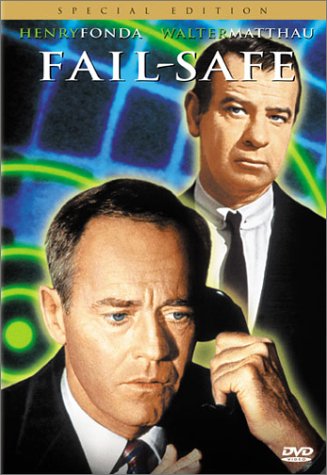
failsafeFail-Safe, Sidney Lumet (1964, USA). This film was adapted from the novel of the same title, which also inspired Kubrick’s Dr Strangelove, and was released in the same year as Kubrick’s film. An unidentified plane crosses the DEW line, fighters are sent to intercept – these are the days of SAGE, by the way – and squadrons of “Vindicator” bombers head off to their rendezvous points to await the order to attack the USSR with their nuclear bombs. The UFO proves to be an off-course airliner, but the stand-down message gets garbled when sent to one of the Vindicator squadrons. Which promptly heads for Soviet airspace at supersonic speeds to drop an atom bomb on Moscow. The US president is understandably upset at this, and the USSR premier is understandably sceptical that this is actually a horrible accident. WW3 must be averted. The film was all a bit intense, Walter Matthau’s hawkish political advisor character was annoying, the Vindicator bombers were actually B-58 Hustlers… which meant the interior shots of their cockpits was all wrong… And, well, I can understand why Dr Strangelove was more successful.


5 Comments

Moving pictures, #10

And 2014 continues to be the year of the films and I continue to get my money’s worth out of Amazon film rentals. Seriously, would you find the movies I’ve been watching on Netflix? I think not. Annoyingly, this month I discovered that my “region-free” Blu-ray player isn’t actually region-free – well, not for Blu-ray discs, only for DVDs. And apparently unlocking them is a lot more difficult than it is for DVDs. So it looks like I’ll have to buy myself a new properly region-free Blu-ray player… But on with this instalment of films seen…

Again, films from 1001 Movies You Must See Before You Die are asterisked, although I’ve since found a rival list which actually has more films on it I’ve seen and which I think belong on such a list. And I’ve just checked the list the above links to, which is where I got the list I’m using from in the first place – and the bastards keep on changing it. They’ve added more 2013 films – and so must have dropped others to make room for them. So how exactly are you supposed to see all the films on the list if they keep on changing it? Argh.

Dogville, Lars von Trier (20036, Denmark) Notable chiefly for being the film in which von Trier used black box theatre staging – ie, no scenery, just chalk lines with labels, and only a handful of props. Nicole Kidman plays the girlfriend of a mobster who runs away, seeks sanctuary in the titular small mountain town, where she performs everyday task as payment for sanctuary. But the tasks get more and more onerous, until she’s treated like a slave and then actually assaulted. I enjoyed the film up until the point where the violence started and Kidman was abused. It seemed… unnecessary. Von Trier had already made his point.

nicole-kidman-dogville

Whisky Galore!*, Alexander Mackendrick (1949, UK). This was based on a novel by Compton MacKenzie, who also wrote the screenplay, which was in turn based upon a real incident. In 1941, the SS Politician was wrecked off the coast of the Outer Hebridean island of Erisday, and the islanders looted it of its cargo of whiskey. In the film, the SS Politican becomes the SS Cabinet Minister, and Eriskay becomes Todday. There are a couple of sub-plots, including a romance, but the bulk of the film is concerned with the battle of wits between the islanders and the authorities over the missing whiskey. Mildly amusing. There is apparently a sequel, Rockets Galore! (1957), which sounds much more kind of thing (but at £145 for the DVD, I’ll not be buying it any time soon…).

The Blair Witch Project*, Daniel Myrick & Eduardo Sánchez (1999, USA) I’d managed to avoid seeing this for fifteen years, and would happily have done so for another fifteen… if it hadn’t been on the 1001 Films list and if I hadn’t found a copy for £1 in a charity shop. But at least I can now say I’ve seen it. The found footage concept might well have been fresh and exciting back in 1999, but it’s been used, if not over-used, so much since that you end up treating the film as if it were filmed normally. And in that regard The Blair Witch Project does not score well. It is mostly dull, the scares are driven chiefly by the reaction of the cast rather than the situation they’re in, and the ending falls completely flat. There were apparently nine million sequels, but I shall not be bothering with them.

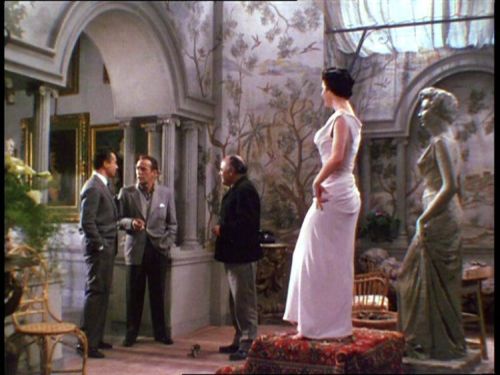
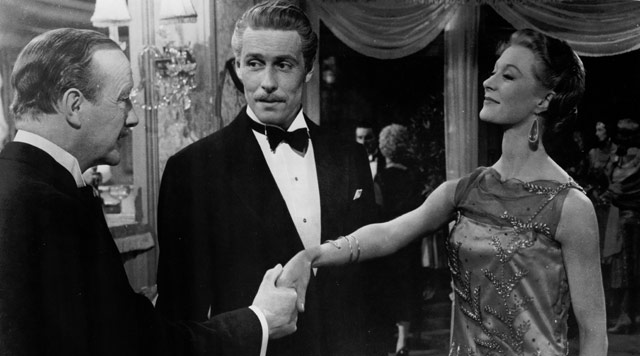
The Man Who Loved Redheads, Harold French (1955, UK) This popped up on one of those “people who bought this also bought…” things when I was buying a DVD and it was very cheap and looked mildly interesting, so I bunged it on my order… It’s based on a Terrence Rattigan play and is very silly for much of its length, but there’s a surprising and quite interesting twist at the end. A man spends his entire life seeking a lost love – a young woman he met as a teenager – and encounters women who look like her at various points in his life, all played by Moira Shearer. It’s all very terribly terribly – he’s in the Civil Service and a baronet or something – although one of Shearer’s incarnations is a shop girl and it’s played smartly.

manwholovedreadheads03

The Gleaners and I*, Agnès Varda (2000, France), is one of those documentaries where the film-maker slowly inserts herself into the subject being filmed. It begins by studying people who hunt for edible vegetables among those rejected by farmers, such as potatoes that are too small, or too oddly-shaped to sell to their corporate masters… but it soon moves on to film homeless people in and around French cities. And as Varda involves herself with these people, so she begins to sympathise with them and their attitudes. I had not expected to like this, but I thought it really good. I think I’d like to see more films made by Varda.

The Great White Silence*, Herbert G Ponting (1924, UK) Scott took Ponting with him on his ill-fated expedition to the South Pole in 1910 as the expedition’s photographer, and this documentary was put together from the footage Ponting shot with a cinematograph. There is straight footage of Scott and his fellows as they leave New Zealand and sail to Antarctica, set up camp, and explore the surroundings. The footage of Scott’s fatal attempt on the pole itself is done using stand-ins as Ponting remained at the main camp with the rest of the expedition. There is also some quite effective model work. The whole is a fascinating, and quite affecting, record of Scott’s expedition. Apparently, it was not a commercial success at the time and Ponting died a pauper, but it has been subsequently re-evaluated and has taken its place as one of the great documentaries of all time. Recommended.

The-Great-White-Silence-30562_1

Wadjda, Haifaa al-Mansour (2012, Saudi Arabia) Not only is this the first film made in Saudi Arabia to be entered for international competition, but it was also written and directed by a woman, a Saudi national woman. That’s quite an achievement. The story, about a girl who rebels against societal expectations by demanding a bicycle, is perhaps nothing new but it’s handled well, the cast are uniformly good – especially Waad Mohammed in the title role – and it makes some pointed observations about Saudi society (so much so, in fact, I’m a little surprised the Saudi authorities allowed it – they’re not exactly known for their liberal tendencies).

Star Trek Voyager – Season 1 (1995) Having worked my way through all seven seasons of Star Trek: The Next Generation and Star Trek: Deep Space Nine, it was more or less inevitable I’d eventually find myself doing the same for Star Trek: Voyager. Initially, DS9 was considered the best of the franchises, but it seems time has been kinder to Voyager than it has to the other two. While Voyager’s set-up was just a reboot of the original Star Trek series, and its central casting all come out of, er, Central Casting, with their “back-stories” and “character conflicts”… But it actually hangs together quite well, and the format does give the series a lot more freedom in terms of story-of-the-week. But, of course, this is 1990s television drama, so there has to be at least one story arc… And Voyager falls back on the Trek staple of the omniscient aliens who, well, they’re only omniscient as far as the plot dictates, and then they’re not. Still, you don’t watch Trek for rigour, scientific or dramatic. Actually, I’m not sure what you do watch it for…

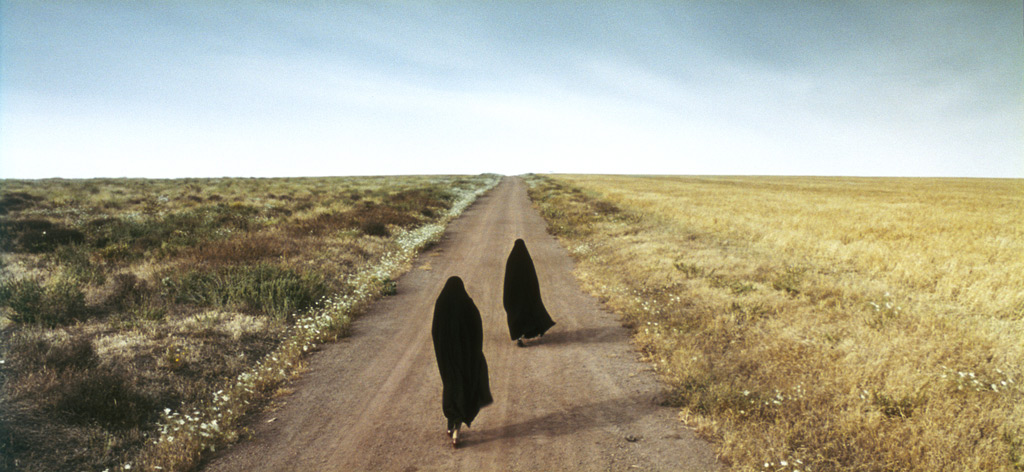
Women Without Men, Shirin Neshat & Shoja Azari (2009, Iran), is set in Iran but was actually filmed in Morocco, as director Shirin Neshat has been banned from visiting Iran since 1996. It takes place in 1953, during the US-led coup which put the shah back in power – which the Americans engineered because prime minister Mosaddegh has nationalised the Iranian oil industry. The film follows four women during this period, a prostitute, the wife of a general (ie, part of the secular elite), and an unmarried woman  and her religious friend. It’s been likened to Haneke’s The White Ribbon, but I can’t see it myself. Yes, Women Without Men is an excellent film, although a recurring image of the women walking along a road in the open country seems more The Discreet Charm of Bourgeoisie than it does Haneke to me.

women-without-men-route-vers-la-retraite

Suspiria*, Dario Argento (1977, Italy) I am not much of an Argento fan, I prefer Brava – though I’ve only seen a small handful of movies by either director. On the strength of this film, I see little reason to change my mind. It has its moments, and the mise en scène is… interesting, all Dutch angles and saturated colours and ersatz Expressionist set designs. A young woman joins a strange ballet school, but it appears to be haunted and lots of strange events occur, including a rain of maggots while the pupils are readying themselves for bed, a few gruesome deaths, and the frequent appearances of a mysterious heavy-breather. It was a fun film, but I’m a bit baffled as why it should be on the 1001 films list.

Festen*, Thomas Vinterberg (1998, Denmark). This is not a film to watch if you’re feeling misanthropic. A large and affluent Danish film gather at the country hotel they own to celebrate the sixtieth birthday of the patriarch. During the celebratory dinner, one of the sons accuses his father of sexually abusing him as a child, and of abusing his twin sister – who has committed suicide in the hotel shortly before the celebration. The family try to laugh off the son’s accusation, but as the weekend progresses the family begins to fall apart. This was the first film made according to the Dogme 95 rules, so it’s made entirely with hand-held cameras and natural lighting, which gives the picture a somewhat grainy look throughout. An excellent film.

Sweet Sweetback’s Baadasssss Song*, Melvin van Peebles (1971, USA) I may have an incorrect number of s’s in the title of this film, but I’m pretty sure I’ve got the right number of a’s. A young African American, Sweet Sweetback, working in a brothel is “volunteered” to be arrested as a suspect in a murder – they know he’s innocent, but the police need to arrest someone to appease the community, and plan to release Sweet a few days later for “lack of evidence”. But the police also arrest a Black Panther, who the police beat up, but he’s defended by Sweet and the two manage to escape. Sweet goes on the run, heading for Mexico, and en route has several adventures, including a run-in with a gang of Hells Angels. There’s a definite amateur feel to the film, but the use of montage was done extremely well – and not something you saw in films of that period.

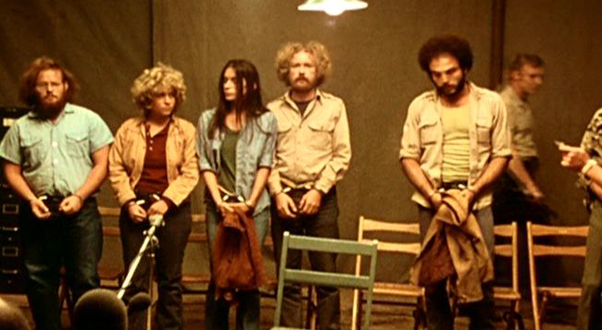
Punishment Park, Peter Watkins (1971, USA) Watkins is a documentary maker, and while Punishment Park is both fictional and more than forty years old, it could easily be a documentary of twenty-first century USA. Hippies, draft-dodgers and other political undesirables are taken out into the desert, charged and sentenced at a kangaroo court in a marquee tent, and then given a choice – a full sentence served in a federal prison, or three days in “punishment park”. This later requires them to cross 53 miles of California desert without food or water in three days, while being chased by armed police and National Guard. If they make it, they can go free. Despite, or perhaps because of, it’s faux-documentary presentation, this was a brutal film. A bit too talky in places, and some of the dialogue felt a little too… not staged, but not natural either, but the sort of dialogue where characters explain their thoughts and feelings and attempt to do the same for others – the sort of dialogue that only appears in fiction, in other words. Nonetheless, an excellent film, and was that really ought to be on the 1001 films list.

punishmentpark

Man of Marble*, Andrzej Wajda (1976, Poland) I saw the sequel to this, Man of Iron, before I was aware of this film. But when Second Run – who I heartily recommend, they have released some amazing DVDs – released Man of Marble, I immediately bought a copy. I like Polish cinema, some of my favourite films are from Poland, and a number of directors I greatly admire are Polish… but Wajda was one I’d mostly missed out, for some unknown reason. I’m now rectifying that. The title of this film refers to a statue of a worker who became a national hero after breaking a record for laying the most bricks in a working day during the building of a new socialist town. A film student is making a documentary about him for her thesis two decades later, but what she discovers – that it was all created and managed as propaganda; and what prompted the hero’s later fall from grace – means it becomes increasingly difficult for her to make her film. Man of Marble follows both the film student and the brick-layer, swapping effortlessly between the two decades. Like Man of Iron, it felt like a television series edited into a single long episode, but with high production values; but that worked in its favour. I really liked this film. And I can’t disagree with its presence on the 1001 Films list.


1 Comment

Moving pictures, #9

Yet more moving pictures watched by Yours Truly. The plan to watch those 1001 films before I die continues apace, although perhaps if the title of the list is to be believed I should slow down a bit… Nah. Once I’m done, I’ll just set about making a list of my own, or find another list – 1001 East European Films To See Before You Die, or something… (Incidentally, I’ve marked films from the 1001 films list with an asterisk.)

Silk Stockings, Rouben Mamoulian (1957, USA) Another Fred Astaire / Cyd Charisse musical, with a plot taken from an earlier film starring Greta Garbo, Ninotchka (1939) – yes, the “Garbo laughs!” film – about a Soviet envoy sent to Paris to bring back three missing attachés, only to be seduced by the decadent West herself – not its political freedoms, I hasten to add, but its lingerie. It’s all very silly, Charisse’s accent is not even remotely convincing, and most of the songs are forgettable. The three attachés are mildly amusing – especially Peter Lorre – but then they are played as clowns. Even as a Charisse/Astaire vehicle, this film fails on many levels. It’s as fluffy as candy floss and that’s what it’ll turn your brain into when you watch it.

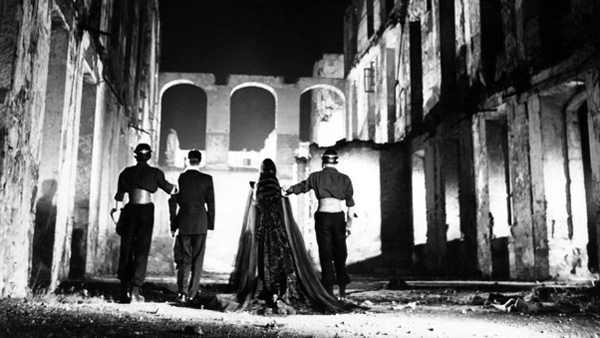
Orphée*, Jean Cocteau (1950, France) Cocteau’s re-working of the Orpheus myth works amazingly well, although it starts off somewhat dubiously, with rive gauche types in the Café des Poètes being all beatnik and full of themselves. But once the viewpoint settles on Orphée and follows him, with the princess, to the ruined chateau, and then the following morning back to his home and wife, Eurydice, the film starts to pick up… and pretty soon it turns fascinating. Some of Cocteau’s optical tricks are a bit feeble, even for 1950, but they’re effective all the same. I’d like to watch the other two films in the trilogy now, please.

orphee

Starship Troopers: Invasion, Shinji Aramaki (2012, Japan) I still think Verhoeven’s film was a superb treatment of Heinlein’s novel, and while the second Starship Troopers film was dull, the third at least made an effort at satire – it was, admittedly, cheesy as hell, and pretty ham-fisted, but in a good way. However, most people it seems only care about power armour and killing bugs, and think life is like the Vietnam War which was of course cool. They are stupid people, and this is a film made for them. It’s an all-CGI follow-on that uses the same characters and production design as Verhoeven’s masterpiece but has all the subtlety and intelligence of a FPS. It even includes a gratuitous female nude scene. In a CGI film. This is Starship Troopers for spotty oicks who really need to get out of their basements every once in a while.

Meet Me In St Louis*, Vincente Minnelli (1944, USA) Given that this film is set in St Louis, and all the characters are resident in the city, you have to wonder about the title. Teenager Judy Garland’s family is set to move to New York, but she fancies the boy next-door… so they sing a bit, the other kids get into a few scrapes, and eventually papa sees the errors of his ways and they all stay in St Louis. Yawn.

Funny Games, Michael Haneke (1997, Austria) I’ve had this for a while, and had tried watching it last year but had given up halfway through. Not because it was bad, but because it was too uncomfortable. I finally got around to giving it another go and managed to make it all the way through to the end – and it was still really uncomfortable. Mostly it’s the motive-less violence. The two young men who invade the family home are creepy, and their smug condescension only makes their violence even more unsettling. On the other hand, the moments when the film breaks the fourth wall are genius – although I remain ambivalent about the remote control rewind bit, as it seems a bit too much. Finally, if you’ve not watched any Haneke, why not?

but-you-want-a-plausible-ending

47 Ronin, Carl Rinsch (2013, USA) Keanu Reeves in a CGI-heavy treatment of a story that’s so popular in Japan it is its own genre, Chūshingura. Reeves plays a half-Japanese, half-English man, who is treated like a lowly servant, but secretly happens to be a master swordsman. Or something. Apparently the film lost $152 million, making it second only to The 13th Warrior as the most expensive box office bomb ever. That takes real talent with such a well-known story, but I suspect Reeves’ presence helped.

Cat People*, Jacques Tourneur (1942, USA) I have no idea how this film ever got made – I mean, with an elevator pitch that goes “a woman thinks she’s descended from a race of people who turn into cats when sexually aroused”, it’s hard to imagine any producer, even back in 1942, greenlighting the movie. But then things were different back then – Cat People was written and produced by Val Lewton, who ran RKO’s horror unit, and he was given free rein providing the films did not exceed $150,000 each to make, and didn’t run longer than 75 minutes. Lewton’s supervisors, however, provided the films’ titles. I can’t actually remember much of the plot of the movie, although it’s considered a classic of its type.

Cave Of Forgotten Dreams*, Werner Herzog (2010, Canada/UK) Herzog’s documentaries are as odd as his fictional movies, but he has a real talent for picking fascinating topics. And so he does here: Chauvet Cave in France, site of the oldest cave-paintings so far discovered, some of them dating back 32,000 years. Admittedly, the film was doubly fascinating as I’d just finished reading Kim Stanley Robinson’s Shaman, which was itself inspired by the paintings in Chauvet Cave. And now that I’ve seen it, I want to get the Blu-Ray version.

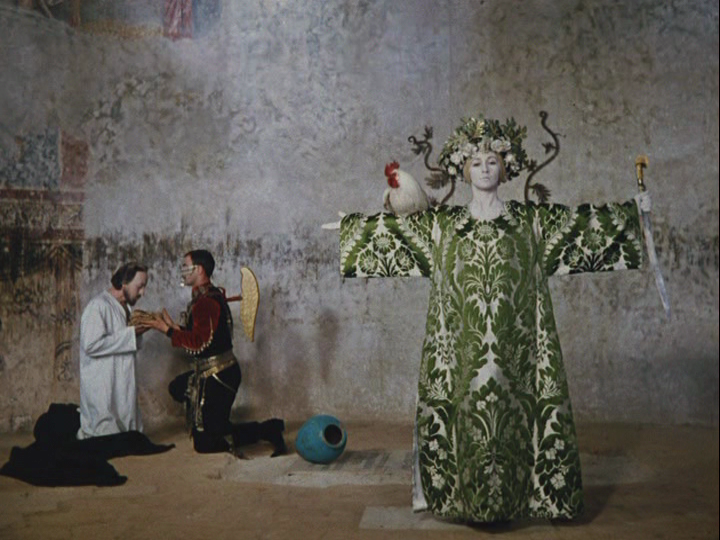
The Colour of Pomegranates, Sergei Parajanov (1968, USSR) This was a rewatch, and while the film is an astonishing spectacle, I still have no idea what it’s about. I’m also surprised it’s not on the list of 1001 films. Nominally about the life of eighteenth-century Armenian poet Sayat Nova, the film comprises a series of tableaux intended to represent episodes from his life (although Sayat Nova is actually played by a woman, Sofiko Chiaureli, who played a further five parts in the film). The Colour of Pomegranates is impossible to describe, you really have to watch it. After watching it for the first time, I bought the other three films by Parajanov available on DVD in the UK – Shadows Of Forgotten Ancestors, Ashik Kerib and The Legend of the Surami Fortress – but he made several more and they really ought to be made available too.

Pomegranates_snapshot

Nashville*, Robert Altman (1975, USA) I’ve never much of an Altman fan, perhaps because I came to cinema after the elements which made his films stand out had become commonplace, such as over-lapping dialogue, semi-improvisation and multiple narratives. The film follows the lives of various musicians in the titular town, most of which have somewhat clichéd story-arcs. Apparently, the actors all wrote their own songs, which probably explains why they’re so bloody terrible. I mean, I’m not a fan of country and western, but the music throughout Nashville is really bad. I’m puzzled why this film should make the 1001 films list but The Colour of Pomegranates doesn’t – in fact, Nashville is one of six Altman films on the list, so I guess the list-maker was a fan… although they don’t appear to be that much of a cineaste…


6 Comments

Moving pictures, #8

2014 seems to be turning into the year of films. According to my records, I’d watched more films by the end of June 2014 than I had during all twelve months of 2013. Which is unfortunate, as I’m supposed to be a writer and a book reviewer, not a film critic. Oh well. Normal service will resume… soon, I hope.

johnny_guitarJohnny Guitar, Nicholas Ray (1954, USA) Sterling Hayden plays the title character, a gunslinger who has swapped his revolvers for a guitar. He drifts into town and poles up at a saloon owned by Joan Crawford, who proves to be an ex-lover. But it’s Crawford’s character who’s the focus of this film, not the eponymous musician. She’s banking on a planned railroad making her very rich. The town worthies aren’t happy with this – they think they should profit. So they drum up some citizen outrage on a pretext (the blatantly-wrong accusation that a regular of the saloon had held up the stagecoach), and good old Wild West “justice” subsequently ensues. This is one of those films where the plot is driven by a bunch of people behaving like complete shits for no good reason, particularly the character played by Mercedes McCambridge. An interesting twist on the Western genre, and Crawford plays a good part – but it’s still very Hollywood.

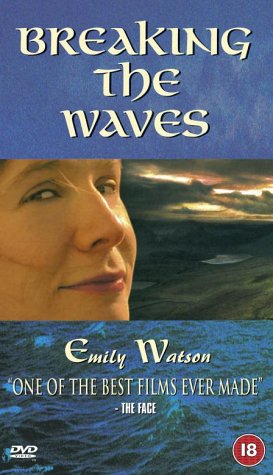
breakingBreaking The Waves, Lars von Trier (1996, Denmark) I think this is only the second film by von Trier I’ve seen – and the first was Melancholia (2011), which looked beautiful but the climax was complete tosh. Like Melancholia, Breaking The Waves centres on a young woman, here played by Emily Watson. She marries a Norwegian oil rig worker, played by Swede Stellan Skarsgård, despite the reservations of her close-knit strictly Calvinist Highlands community. Soon after, Skarsgård is paralysed in an accident on the rig. Confined to a hospital bed, he persuades Watson to have sex with other men and then recount the details to him. Eventually, the village finds out about this… Watson is good, managing to convey a child-like simplicity and devotion to God which pretty much makes the story. The film is split into chapters, each of which opens with a well-known song from the 1970s, the decade in which the film is set… but there was something a little off about them, as if they were played by cover artists trying hard to sound like the original artists. It was slightly weird. Nonetheless, I think I’ll add some more von Trier to the rental list.

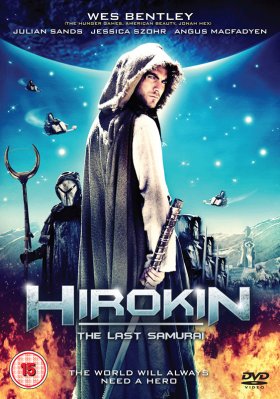
hirokinHirokin : The Last Samurai, Alejo Mo-Sun (2012, USA) There was a trailer for this on a rental DVD I watched and it looked sort of interesting. So I checked it out, discovered it was a couple of quid on Amazon and bunged it on the end of an order. I was robbed. It really is truly dreadful. I should have guessed – it’s a sf film and it has Julian Sands in it. Though Sands has appeared in a number of good films, none of them were genre. In fact, his presence in a genre film is a good indication it will be shite. As this one was. The writer/director had obviously seen Dune and decided it needed more Star Wars in it. Sort of. On a desert world conquered by humans and ruled by evil dictator Sands, Wes Bentley plays a rogue human who takes up with one of the indigenous aliens – who look just like humans, except when they hold their hands up and you can see black veins on their palms. Anyway, Sands’ stormtroopers are searching for the aliens’ rebel leader and take Bentley’s partner prisoner. He has to fight to the death for her, but fails (she dies, not him). He sort of joins the rebels, learns how to fight samurai-style in the most ineptly-choreographed fight scenes I’ve ever seen, and then goes off to overthrow Sands. Or something, Watching this film, I could only wonder who’d been daft enough to invest it – people with far too much money… and either an appalling taste in films or a complete inability to recognise shite, obviously.

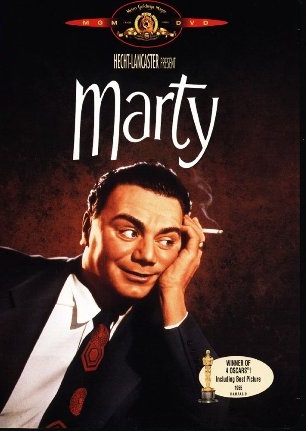
martycdcoversccfrontMarty, Delbert Mann (1955, USA) Ernest Borgnine plays a butcher who lives with his mother, but he’s getting on a bit and everyone tells him it’s time to get married. And I mean everyone. But he’s not had much luck with the ladies. One night at a local dance hall while on the pull, he bumps into shy schoolteacher Betsy Blair, whose date has dumped her after running into a much prettier friend. The two spend time together, and discover a mutual attraction. But afterwards, his mother tells Borgnine that Blair is not good enough and his friends tell him that Blair isn’t pretty enough. So even though he promised to call her the next day, he doesn’t. But then he changes his mind, and decides he liked her very much so it’s up to him and not his mother or friends. He calls her. (And they all lived happily ever after.) Marty won the Oscar for Best Film in 1955, and it’s a nice enough film, a well-observed drama with a good cast. Interestingly, Blair had been blacklisted for Communist sympathies, but her husband Gene Kelly lobbied for her to get the role, and he had enough clout in Hollywood to swing it.

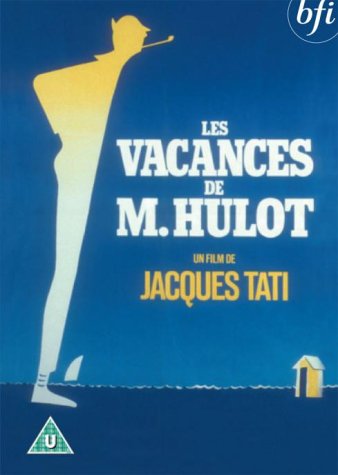
hulotLes Vacances de M. Hulot, Jacques Tati (1953, France) My first Tati. The title character goes on, er, holiday. To the seaside. It’s sort of like Mr Bean, but the humour is more gentle and Hulot himself is a normal – if clumsy – human being. The plot is a series of set-pieces set in the town Hulot is visiting, most involving the other residents of the hotel in which he is staying. There’s an extended sequence with a horse and another with a shed full of fireworks… In fact, the more I think about the film, the more it strikes me how much of a rip-off of it that Mr Bean was. Although perhaps Mr Bean’s makers would claim it was an homage. Anyway, Tati’s is a good film and definitely worth seeing.

bombersBombers B-52, Gordon Douglas (1957, USA) I bet you can’t guess what this film is about. Go on, try. Yup, it’s about Boeing B-52 Stratofortress jet bombers. They first flew in 1955, and are still bombing the shit out of brown people even today. However, they’re complicated aircraft, and USAF clearly felt they might need more technical ground staff to keep them flying – hence Bombers B-52, starring Karl Malden, Efrem Zimbalist Jr and Natalie Wood. Zimbalist is an officer and a pilot, Malden is a tech sergeant and he hates Zimbalist. So when Zimbalist starts dating Malden’s daughter, Wood, Malden is understandably peeved. He decides to resign from USAF. But they’re getting these hot new B-52 bombers in and Zimbalist, who can’t understand why Malden hates him (neither, to be honest, do we), wants Malden to stay on. They go on a test flight, some fancy new equipment bursts into flames – bit of a design flaw there – and fills the B-52 with smoke. Everyone bales out, except Zimbalist, who’s piloting the aircraft. He brings it in to a safe landing. Meanwhile, rescue helicopters have found all of the crew except Malden. So Zimbalist steals a chopper and goes looking for him. And finds him. The two have to survive overnight in the wilds of California and become best buddies, and so Zimbalist is free to marry Wood. The end. There’s some good aerial photography in the film, though.

madamedeMadame De…, Max Ophüls (1953, France) This is around the third or fourth film by Ophüls I’ve seen and, I think, the best of them. The title character, whose surname is never given, is the wife of a French general and has a busy social calendar. To fund her activities, she sells a pair of diamond earrings given to her by her husband. She pretends to have lost them, but the jeweller to whom she sold them tells the general and he buys them back… and gives them to his mistress. But the mistress then sells them to pay off some debts, and they’re bought by an Italian count, played by director Vittorio De Sica, who then meets Madame de…, enters into a relationship with her, and gives her the earrings as a token of his love… The film is set, I think, around the turn of last century, and it’s the focus on appearances which drives the plot – and leads to its resolution. Apparently, Ophüls originally planned to shoot the entire film through reflective surfaces, such as mirrors, which would have been cool but the producers nixed the idea – which is not to say the end result is a disappointment. I’ve yet to fully appreciate Ophül’s films (unlike those of other directors mentioned in this blog post), but Madame De… is the first of his films I’ve watched which persuades me it’s worth seeing more of his movies.

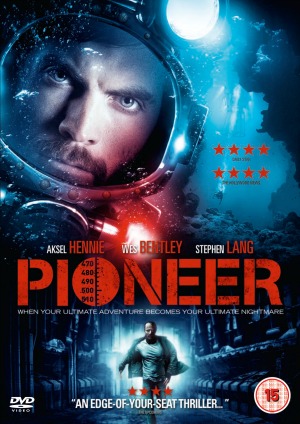
PIONEER_DVDPioneer, Erik Skjordbærg (2013, Norway) I’d been keen to see this film since first learning of it last year. But it had a stupidly limited release in the UK – my nearest showing was 8 pm on a single Friday night in Leeds, an hour away by train. The film is set in the early 1980s in Norway, just as the country is starting to develop its oil and gas resources. The Norwegians have accepted US help in putting together the saturation systems needed for divers to work at depth. But something goes wrong on a test dive, a Norwegian diver dies, and his brother, also a diver and present when the accident occurred, tries to figure out what’s going on… I was really looking forward to this movie since saturation diving is not a topic often covered in films. And the underwater photography in Pioneer is actually quite stunning… But the rest of the film felt like a routine thriller – Bentley glowers menacingly, Aksel Hennie bounces from mysterious scientist to mendacious politician to grieving sister-in-law… While the film certainly has that stark realism the Scandinavians do so well – and Hollywood does so badly – the plot does seem disappointingly ordinary. On the other hand, as far as I could tell its subject was handled accurately.

palmbeachThe Palm Beach Story, Preston Sturges (1942, USA) This has to be one of the silliest films I’ve ever seen. It definitely puts the “screwball” in “screwball comedy”. The film opens with a quick montage of shots which shows a man and a woman overpowering their twin brother and sister, who are about to get married, and taking their places at the wedding. Some time later, life isn’t so rosy, so hubby Joel McCrea decides to head south to look for work and be less of a burden on wife Claudette Colbert. She goes looking for him and manages to wangle a free ride on a train with a bunch of drunken hunting lodge-members… before being rescued by eccentric millionaire Rudy Vallée, who is very taken with her. McCrea then turns up, so Colbert pretends he is her brother… prompting Vallée to propose to Colbert – and Vallée’s ex-wife Mary Astor to propose to McCrea… Happily, there are those twins from the opening montage. While there’s plenty of fast-paced wit and snappy one-liners in The Palm Beach Story, the story is so ridiculous it spoils it all.

gertrud-dvdGertrud, Carl Theodor Dreyer (1964, Denmark) This was a rewatch – I’d originally seen the film on rental DVD, but was later bought a copy of it and Ordet for my birthday. The film is based on a play from 1906 and Dreyer gives it a very theatrical staging. It’s his last movie, and on the strength of it I’m keen to see more. Nina Pens Rode, in the title role, is the wife of a prominent lawyer who is about to be given a position in government. But she wants a divorce – she even has a lover, composer and pianist Baard Owe. But the pianist has made another women pregnant and so cannot go with Gertrud. There’s a luminous quality to this film, one that’s emphasised by its staginess. Rode is especially good in the title role, dominating every scene she’s in with a quiet strength… as is clearly evident in the coda in which Gertrud looks back on the events of the film from thirty years later and sees no cause to regret her actions all those years earlier. A film that’s just bubbling under my top ten movies.

cap_americaCaptain America: The Winter Soldier, Anthony & Joe Russo (2014, USA) I’ve no idea why I continue to watch MCU movies, perhaps it’s just foolishness – I see the hype and promotion and stupidly believe it. Or something. To be fair, I did quite enjoy Captain America: The First Avenger, with its weird Nazi science and silly spoof of the title character. But this sequel is set in the present day, and despite the massive hype and the many positive murmurings I’ve heard, is just complete bobbins. It turns out that SHIELD has been controlled by Hydra, the Red Skull’s organisation from the first film, ever since Operation Paper Clip shortly after WWII. And no one ever noticed. In fact, the only reason Cap discovers this is because SHIELD tries to kill him. Even Nick Fury doesn’t know – and he created SHIELD! The Red Skull, of course, died at the end of the first film, but his chief scientist, played by Toby Jones, survived, and he’s now the brains behind Hydra. Well, not “brains”, as he’s uploaded himself into a load of 1960s mainframe computers. Which are located in a seemingly-abandoned underground computer centre at an old SHIELD base, an underground computer-centre that appears to have no security. Not very clever that. The rest of the film is some nonsense about an unkillable assassin, there’s more explosions and fight scenes than you can shake a very large stick at, and as the movie progresses you can actually feel your brain cells dying off one by one.

allthatheavenAll That Heaven Allows, Douglas Sirk (1955, USA) My high opinion of this film is no secret. I love it so much, in fact, I bought the Criterion blu-ray edition, despite already owning it on DVD. So I was bit fucked off to discover that the blu-ray is region-locked. And unlocking my blu-ray player is going to involve some faffing around with firmware or something. Argh. So I watched the DVD edition packaged with the blu-ray instead. And… it really is a beautiful film. The more I watch it, the more I love it. It’s not just that it looks so good, but also that it’s a pitch-perfect satire of middle-class American society. The grown-up kids, who behave like actual kids, are spot-on – although the daughter’s beau, played by David Janssen, seems somewhat out of his depth – and the part where they buy their mother Jane Wyman a television set, as if that’s all she needs now she’s a widow, is pure genius. I’ve watched All That Heaven Allows two or three times in recent months – partly for research for Apollo Quartet 4, of course – and my appreciation remains undimmed. Even the hokey bits – the deer! – don’t turn me off. I love the film so much, I even tracked down a copy of the novel it’s based on – and it wasn’t easy to find.


2 Comments

Moving pictures, #7

If it weren’t for rental DVDs, I’d have been in a cultural vacuum this past couple of months. All that sportsing on television. Just when one ended, another began. And it’s still going on. It’s interminable. And, truth be told, so were some of the films I’ve watched over the past few weeks. But not all of them.

There’s books too, of course; though obviously I don’t get through as many of those per month. And I’m reluctant to write about every book I’ve read because a) I’m not a book blogger, b) not all of them are worth writing about, and c) quite a few of them are for review anyway – either for SF Mistressworks or for Interzone. Having said that, I really ought to write about books that have blown me away… except they seem to have been in somewhat short supply this year.

But, films. Movies. Moving pictures. Cinema. I continue to get my money’s worth from Amazon rental (Lovefilm as was), and if I chuck the occasional twenty-first century Hollywood blockbuster on my rental list because everyone’s talking about them, I usually end up wondering what all the fuss was about. But then, I do have an odd taste in movies. I recently had another look at my ten favourite films and made a few changes to it – and now it looks like this: 1 All That Heaven Allows, Douglas Sirk (1955, USA), 2 Alien, Ridley Scott (1979, UK/USA), 3 Fahrenheit 451, François Truffaut (1966, USA) 4 The Second Circle, Aleksandr Sokurov (1990, Russia), 5 Mięso (Ironica), Piotr Szulkin (1993, Poland), 6 The White Ribbon, Michael Haneke (2009, Austria/Germany), 7 Dune, David Lynch (1985, USA), 8 Divine Intervention, Elia Suleiman (2002, Palestine), 9 Star Trek: The Motion Picture, Robert Wise (1979, USA), 10 Rio Bravo, Howard Hawks (1959, USA)… but it’ll likely change. It seems to do so every year or two anyway. Which is, I guess, a sign of a healthy list of favourites…

Anyway, on with the last few weeks’ worth of viewing:

Thor: The Dark World, Alan Taylor (2013, USA) Perhaps they should have just called it Thor: The Dark Film, because this is not a film to watch on a television on a summer evening. There were these dark shapes doing something in darkness, and it was all to do with Christopher Ecclestone in trollish make-up being evil. Or something. I don’t know, I couldn’t honestly give a shit. Marvel have mangled Norse mythology so much it’s frankly embarrassing they continue to use names like Thor and Loki. And the Marvel Cinematic Universe is a huge step backwards in terms of both comic rigour (not hugely adhered to, in the first place) and blockbuster cinema. Comic fans, they have taken something you admire and made something dumb of it. Do not celebrate that.

bogart_barefoot

The Barefoot Contessa, Joseph L Mankiewicz (1954, USA) An archetypal rags-to-riches story, told after the fact by laconic screenwriter Humphrey Bogart, who was there at the start and also there at the end. Ava Gardner plays a flamenco dancer who catches the eye of a Wall Street millionaire (that’s all they were back in those days, millionaires) who dabbles in movies. Turns out she’s photogenic and she becomes an international film star… and then marries an Italian count. But it all ends very badly. A Hollywood melodrama, with a nice voice-over by the Humph but very little substance.

The Hunger Games: Catching Fire, Francis Lawrence (2013, USA) This series baffles me. The games themselves are clearly the core of the story, and the dystopian world exists to justify their existence… but the obvious plot – that Katniss becomes some sort of rebel figurehead due to her success in the games (and no, I’ve not read the books) – seems to be taking so long to get moving you spend most of the time waiting for a whole marching band’s worth of shoes to drop. Instead you get a bunch of caricatures carefully plodding through a plot which refuses to engage with its central theme. But then, when the most memorable thing in a film is, ooh! Her dress is on fire!, it seems churlish to complain about thematic depth…

Nights Of Cabiria, Federico Fellini (1957, Italy) Truth be told, the best parts of this film are the beginning and the end. It opens with Cabiria, a Roman prostitute, being pushed into a river and then being saved from drowning; and finishes with her stumbling onto a group of happy young people playing music after her fiancé has admitted to trying to kill her for her money. And yet, despite that, this is not a dour movie. Cabiria, played by Giulietta Masina, is irrepressibly optimistic, and it rubs off. It feels like a happy film, like a corner is forever about to be turned… even though it never does, even though Nights Of Cabiria is never as grim as Cabiria’s profession would suggest. This could be Fellini having his cake and eating it, but I prefer to think it’s the character of Cabiria rising above the material. Not my favourite Fellini film, but a good one.

Mildred Pierce, Todd Haynes (2011, USA) This is actually a five-part mini-series, adapted from the James M Cain novel of the same name, as was the 1945 Joan Crawford film also of the same name. I’ve always wanted to like Haynes’ films more than I end up doing, but this one proved excellent from start to finish. Kate Winslet plays the title character, and she’s very good in the role. Haynes also manages to portray a convincing 1940s Los Angeles, and it’s certainly a less glamorous one than in the Crawford film. Recommended.

Mrs Miniver, William Wyler (1942, USA) Despite being an American film, this is set in the UK. Although Mr Mininver is American (Walter Pidgeon). It’s about a housewife during WWII, played by Greer Garson, and to be honest I remember almost nothing about it. Garson was, I seem to remember, very good, if somewhat terribly terribly… but I have zero memory of the plot. I think their house got bombed? If you’re looking for cinema verité about the Second World War, this is not the film to get.

the-act-of-killing

The Act of Killing, Joshua Oppenheimer (2012, Denmark) The “elevator pitch” for this did not deserve to work – or rather, in the real world it should not have worked. But it did. The director took a team to Indonesia and interviewed those responsible for the huge numbers of killings of “communists” (over half a million) between 1965 and 1966, and asked them to re-enact those killings. The film starts by interviewing one of the gang leaders during that time, Anwar Congo, before exploring the Indonesian paramilitary organisations known as “preman”, especially the largest one, Pancasila Youth. The scenes acted out by Congo and his associates turn increasingly strange as they explore through cinema conventions what they did and how it affected them. That Congo at the end has an epiphany as a direct result of his re-enactments – what he did, he now realises, was bad – feels like too neat an ending, almost a cliché, and yet the murders committed by the preman back in the 1960s, and the stuff they get up to even now, are anything but trite and should not be forgotten.

Stranded, Roger Christian (2013, Canada) You see a crap straight-to-DVD sf film these days, and chances are it was made in Canada. Most are best avoided. Like this one. Christian Slater – whose career is clearly no longer what it once was – stars as the commander of a base on the Moon. A meteor strike damages the base shortly before the crew of four are about to rotate out. One of the meteorites contained some alien gunk, which impregnates the sole female character and overnight she becomes nine months pregnant. Then whatever it was she was carrying vanishes, I think it was an alien which was impersonating another member of the crew but by that point my brain was dribbling out of my ears.

The Second Circle, Aleksandr Sokurov (1990, Russia) This was a rewatch, and it’s probably my favourite Sokurov film (and, of course, one of my ten favourite films). The subject matter and cinematography perfectly complement each other, which is not always true of his movies (another in which it does is Confession, but that’s also incredibly slow and long). A young man travels to Siberia to bury his father, and he has to deal with his loss as he deals with the local bureaucracy. I’ve tried to work out why this film appeals to me so strongly – I have an aversion to films with father-son narratives as I find Hollywood’s use of the trope typically stretches from the banal to the inane. But The Second Circle seems to me to give due emotional weight to its topic – it’s a father-son narrative that’s about grief and loss, not disappointment or approval. It is, in other words, real. Too many Hollywood films by male directors feel like they can be reduced to the director (or perhaps the writer) acting out in disguised form the issues they had with their own fathers; but this is one of the few movies that tackles the subject head-on and does it with intelligence. Oh, and why aren’t all of Sokurov’s films available in UK editions, eh? For example, he’s made a quartet of films about “the corrupting effects of power”, and one of them, the third, has never been released in this country.

goldencoach

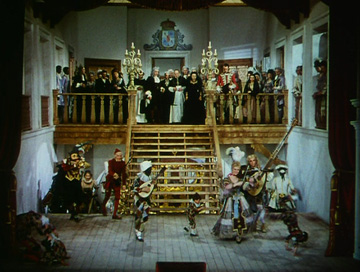
The Golden Coach, Jean Renoir (1952, France) This was unexpected; I mean, I’ve seen several of Renoir’s films and they’re excellent – La Règle du jeu, La Grande Illusion, Partie de campagne… So I had high expectations for The Golden Coach. But it turned out to be a dodgy Hollywood-style historical film, with none of Renoir’s wit, a mostly wooden cast, and the only real touch of Renoir was the start, which was framed as the beginning of a play on a stage, but as the camera moved onto the stage, so it all opened out into a cinematic world. Avoidable.

Le Voyage dans la Lune, Georges Méliès (1902, France) I was surprised to discover this was only around fifteen minutes long, and that its story is quite mad. Though, to be honest, the documentary about Méliès also on the DVD was more interesting than the film. But at least I can now say I’ve seen it (and you can too, in fact, as there’s loads of versions of it on YouTube).

The Lego Movie, Phil Lord & Christopher Miller (2014, USA) I’d heard lots of good things about this, even from normally sensibly people – so, despite it not being my thing at all, I borrowed it from a friend. There were a couple of laugh out loud moments, and more references to sf films than you could shake a reasonably-sized stick at… but in places it felt a bit by-the-numbers and, sigh, it all boiled down to a son and his relationship with his father. Even bloody toys can’t escape the father-son Hollywood narrative. Mildly entertaining.

Incidentally, if you’re wondering why I watch some of the films I’ve written about, it’s because I’m working my way through this list of 1001 Movies You Must See Before You Die. It’s not an especially good list – lots of spelling mistakes, for a start – and I’m finding many of films that I don’t think belong on it, and some not on it that I believe should be. To date, I’ve seen 494 of them – most of them as rental DVDs, but some of them are proving hard to source…


4 Comments

Moving pictures, #6

I’m not entirely sure what happened to June. It seemed to pass really quickly, without me getting much done. And July is looking like it might go the same way. But I have watched a lot of films – if only because of that damned f**tball. So while I scramble to catch up with various ongoing projects – including something a little more intelligent to post on this blog than just lists of books and films – here is a, er, list of films wot I have watched recently.

Sherlock Jr, Buster Keaton (1924, USA) Keaton is a cinema projectionist and dreams himself the hero of the film he’s showing, a murder-mystery among the wealthy, and, of course, there’s a nubile daughter, who Keaton wants to impress. There are some good gags in this, but none that matched the train journey in Our Hospitality (see here).

Wages Of Fear, Henri-Georges Clouzot (1953, France) The oil well is on fire, and the only way to put it out is using lots of nitroglycerine, but that’s stored a couple of hundred miles away at the company HQ, and the only way to get it to the wellhead is by truck. Which is, of course, really really dangerous – if not suicidal. But that’s okay because there’s loads of desperate men trapped in the nearby town, who have no jobs and not enough money to leave… The film takes a while to get going, but the drive over the mountains with two trucks full of explosives is pretty good.

Faust, Aleksandr Sokurov (2011, Russia) If Tarkovsky’s film often seem glacially-paced, then Sokurov’s are geological. But, like Tarkovsky’s, they’re also beautifully shot and observed. The title pretty much tells you all you need to know about the story of this film. The mise en scène looks fantastic, and the moneylender (ie, the devil) is horrible and creepy… a film to savour.

faust

Moscow Elegy, Aleksandr Sokurov (1987, Russia) Sokurov and Tarkovsky had been friends since film school, and this documentary was put together – from footage by Chris Marker, Tarkovsky himself (behind the scenes footage from both Nostalgia and The Sacrifice), and excerpts from Tarkovsky’s films – to be shown on Tarkovsky’s birthday in 1982. Interference by the Soviet authorities led to delays and, sadly, Tarkovsky died before the film premiered. Despite all the Tarkovsky footage in this, there’s no mistaking it for a Sokurov film. This is one of three documentaries on The Andrei Tarkovsky Companion, which I bought when it was released… and I see it now goes for around £88.

Lincoln, Steven Spielberg (2012, USA) I know only what most non-USians know about Lincoln, and this film pretty much covers all those – Civil War, emancipation, assassinated in a theatre, peculiar beard. It’s a dull film for the first half, but Lincoln proves a surprisingly pragmatic president – ie, openly buying votes to push his amendment through Congress. Things pick up a little in the second half, and despite it being an historical conclusion, Spielberg manages to wring some tension from the final vote scene. Having said all that, this is very much by the numbers American History 101. Day-Lewis plays a good part, but all those historical forces feel of the moment rather than the endgame of a long political struggle. Meh.

Make Way for Tomorrow, Leo McCarey (1937, USA) Old retired couple’s house is repossessed by the bank, leaving them homeless, and the grown-up kids are pretty adamant they don’t want the old folks dumped on them – though, in the end, one takes the father and another takes the mother. And they really are an unpleasant family. While this film may be 84 years old, not a fat lot appears to have changed since then. But when you have a welfare state with state pensions and council houses, old people don’t get left on the street to die as they are in some allegedly civilised countries…

Black Moon Rising, Harley Cokliss (1986, USA) A straight-to-DVD thriller notable only for the astonishing mullet worn by Linda Hamilton during the first half-hour (happily, it proves to be a wig). Tommy Lee Jones is a top thief, working for the government, but a job goes wrong, and he has to hide the stolen computer tape in an experimental 300 mph supercar invented by Richard Jaeckel. But then Hamilton’s gang of car thieves, run by shady billionaire Robert Vaughn, steals the supercar, and Jones must get it back.

blackmoon

Tristana, Luis Buñuel (1970, Spain/France) Catherine Deneuve plays an orphan who is adopted by a wealthy don in 1960s Toledo, who treats her like a daughter, but the moment she turns nineteen, he decides she’s his mistress. Meanwhile, she falls in love with a man nearer her own age, runs off to live with him, is taken ill, which results in her losing a leg, and she eventually ends up back with her don. An odd film, it played like an historical melodrama, but didn’t look like one.

The White Ribbon, Michael Haneke (2009, Austria/Germany) This is probably my favourite Haneke film, and it’s beautifully put together. A series of mysterious incidents in a German village just prior to World War I cause the villagers to turn on each other, but Haneke refuses to explain who is responsible or why. Beautifully photographed and really quite unsettling.

Golem, Piotr Szulkin (1979, Poland) That Szulkin box set was definitely a good buy. There isn’t a duff film in it, although this is perhaps the least interesting. In a future much like the ones Szulkin has depicted in his other films – ie, grim and dystopian – clones are used to fill out the workforce, and are treated very badly. But one clone may actually be a man – he’s not sure as he can’t remember, and the scientists are too clear on the matter either, as they may have got confused between the clone and the original human.

Mięso (Ironica), Piotr Szulkin (1993, Poland) I suspect this film is going to make my best of the year – which is a little perverse as it’s a 26-minute television short included as an extra feature in the Piotr Szulkin box set I bought earlier this year – and the actual films in the box set are all very good and worth seeing. But Mięso (Ironica) is in a class of its own. It’s a lecture on the history of Poland under Communism, using the availability of meat and meat products as illustration. It’s filmed in an outdoor meat market, by a cast who are clearly not actors, and in many cases are holding the script in their hand, or need prompting by others. There are also a number of dance routines, including one in which half a dozen riot police dance off against half a dozen Roman Catholic clergy in full regalia. In one scene, a woman in a wheelchair tries to position herself before the camera, but the cobbles are so slippery that by the time she’s in place she’s too knackered to speak.

Mięso (Ironica) (1993) 4 - 007

The Seventh Continent, Michael Haneke (1989, Austria) Another favourite by Haneke, and allegedly inspired by true events. A middle-class Austrian family, after spending much of the film going about their lives, suddenly tell everyone they are emigrating to Australia. They then eat a large feast, smash everything they own, and then commit suicide. Like The White Ribbon, it’s deeply unsettling, but this time the lack of explanation plays off against the prosaic nature of what has gone before.

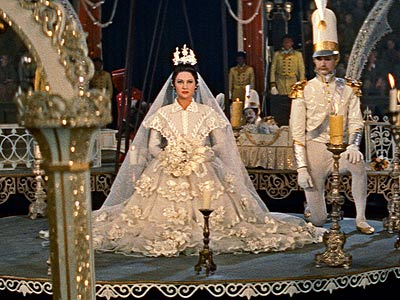
Lola Montès, Max Ophüls (1955, France) This has one of the strangest framing narratives I’ve come across in a mainstream film. Lola Montès is a circus performer, enacting scenes from her life, with the help of the other circus performers and narrated by ringmaster Peter Ustinov. As each new chapter in her life begins, the view fades from the circus ring to a flashback of the actual events. It’s all very colourful, sumptuous even, but Montès is not a sympathetic protagonist and not even the well over-the-top staging prevents interest from flagging. Apparently, this flopped on release, and was butchered by the studio in an attempt to save it. I saw the restored version, and it clearly should have been left alone – but I think I understand why it did so badly back in 1955…

lola-montes--max-ophuls


6 Comments

Moving pictures, #5

I hate f**tball, so I’ve watched a whole bunch of films recently – because there’s bugger-all but f**tball on telly. Some of you might have spotted this. I can’t complain too much, however, because it has led to me making a substantial dent in my To Be Watched pile. Yes, I have a TBW pile as well… although it is orders of magnitude smaller than the TBR pile. Having said that, an additional three DVDs join it each week from Lovefilm. Anyway, I’ve been watching two films a night since the f**tball began, and some of them have been very good indeed…

blowupDVDBlow-up, Michelangelo Antonioni (1966, UK) David Hemmings – a very young David Hemmings – is a hip and trendy fashion photographer in swinging London – one of the models who poses for him is Veruschka, for instance. Hemmings has a pet project, a book of his non-fashion photographs, and while out looking to buy a junk shop he finds a small park whose peacefulness appeals to him. He takes some photos… including of a couple trysting. The woman – a very young Vanessa Redgrave – is upset at being photographed, but Hemmings won’t hand over his film. Later, he learns why. The man was about to be murdered. Beautifully-shot, tense, and yet typically Antonionian. There’s a good reason why it’s a classic film.

cracksCracks, Jordan Scott (2009, UK) You know Dead Poets Society? And Mona Lisa Smile? This is more of the same, the only difference being Eva Green plays the inspirational teacher, it’s set in the 1930s, at a girls’ boarding-school, the special snowflakes are members of a diving team, and it’s about the daughter of Spanish royalty who joins the school and the team… and upsets its delicate balance. Green, as usual, seems a little unhinged, the direction and photography are polished (Jordan Scott is Ridley Scott’s daughter), and it all hangs together… but it feels a bit like a Sebastian Faulks novel: well-crafted, nice sense of time and place, but all a bit bland and unmemorable.

PartyGirlPosterBajaParty Girl, Nicholas Ray (1958, USA) The title refers to Cyd Charisse, who plays a chorus girl at a nightclub in 1930s Chicago, but the film is really about Robert Taylor, who plays an accomplished lawyer all the gangsters use when they get into scrapes. He’s still married, but she agrees to be his mistress – but later, when he decides he’s had enough of representing scumbag gangsters, Capone-like Lee J Cobb threatens Charisse in order to make Taylor play ball. There’s little that’s original in the film, though it’s well-shot – as you’d expect from Ray – and Charisse puts on a couple of entertaining routines (though she never seems to quite light up the screen). Cobb just munches his way through the scenery. Apparently, Party Girl is now a cult film, though I can’t quite see it myself.

starcrash-dvdStarcrash, Luigi Cozzi (1978, Italy) This is the film that contains the immortal line, “Imperial Battleship, halt the flow of time!” And the rest of it is pretty dumb too. How to describe how bad this film is? Caroline Munro, in what is pretty much a bikini, plays the best pilot in the galaxy; her sidekick is the best navigator in the galaxy; they are smugglers. But they’re caught by the Imperial authorities, who want them to track down the emperor’s son, who has crash-landed on a world controlled by the evil Count Zarth Arn. First they are arrested and then sent to prison, but they escape. Munro is teamed with a crap but chatty police robot, and together they find the emperor’s son – played by David Hasselhof – and… The production design owes more to Barbarella than Star Wars, but with none of the appeal of either. The plot makes no sense. Hasselhof actually out-acts everyone else in the film – and that includes Christopher Plummer, who plays the emperor. This is a film that is so bad, it goes through bad, out the other side into good, and then through that… into cult classic. Watch it at your peril.

mcconnellThe McConnell Story, Gordon Douglas (1955, USA) The biopic of a Korean war ace who became a test pilot at Edwards Air Force Base. It’s not the best example of its type. Alan Ladd in the title role never seems quite driven enough, although the aerial photography is pretty cool. McConnell starts out as an army medic, persuades his superior officers to send him to flight school, but only makes it as a navigator – which is what he does throughout WWII. After the war, he’s invited into the newly-formed USAF to train pilots on jets. He ends up in Korea, and becomes the first US jet air ace. Afterwards, he’s assigned to Edwards AFB, where he flight-tests a new version of the North American F-86 Sabre. Apparently, McConnell was killed in an aeroplane crash before the film premiered, so they had to reshoot the ending. Toward the Unknown and Strategic Air Command are much better films of this type.

waroftheworldsWojna Swiatów – Następne Stulecie, Piotr Szulkin (1983, Poland) Or War of the Worlds – The Next Century. I forget where I stumbled across mention of this film, but it was enough to prompt me to buy a Piotr Szulkin DVD box set… and it’s proven an excellent purchase. I mentioned Ga, Ga. Chwała Bohaterom from the same boxed set in an earlier post (see here), and this film is just as bleak and black as that one – if not more so. Iron Idem is a TV broadcaster, but his boss wants him to discuss only material approved by the conquering Martians. Reluctantly, he agrees. But then the Martians trash his apartment and take away his wife – because, the Martians’ goons tell him, they want him to love the Martians. Eventually, they pile one too many indignities on him and he cracks. At a charity concert, he appears on-stage and rants at the audience, telling them to rise up against the invaders. But his speech is never broadcast – and later, after the Martians have left, without its soundtrack the footage is used as evidence he was a collaborator. It’s not difficult to see who or what Szulkin is targetting, and he gives it the blackest possible spin. There’s a grimy and desolate realness to Szulkin’s films. I’m beginning to think he’s better than Żuławski…

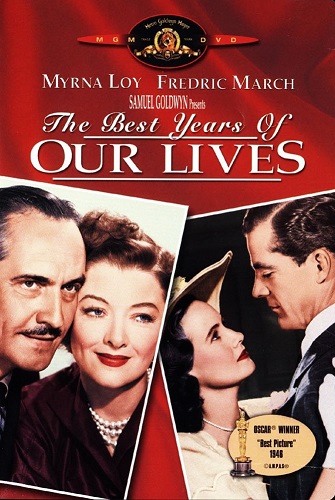
bestyearsThe Best Years of Our Lives, William Wyler (1946, USA) Three men return to their home town of Boone City after fighting abroad in WWII. One was born on the wrong side of the tracks, but finished the war a captain is the USAAF. Another was a wealthy banker, but is now an Army sergeant. The third was the boy next-door, who fought at the Battle of Midway aboard a carrier, and lost both his arms below the elbow when his ship was sunk. They do not get the heroes’ welcome they expect. The captain learns the woman he married days before being sent to fight is now a night-club singer and used to a life-style he can’t provide – because the only job he is qualified for is the one he held before joining the Army: soda fountain jerk. The banker returns to his bank, only to learn his bosses put the bank’s earnings above the needs of its customers… which seems to him to be against all he fought for. The sailor meanwhile is afraid his childhood sweetheart will reject him because he is disabled. It all makes for a pretty damning indictment of the US public’s response to the war. Don’t be fooled by the cheery/romantic DVD cover art. Incidentally, Harold Russell, who plays the sailor, is the only person to win two Oscars for the same role – one as Best Supporting Actor and one awarded for being an inspiration to disabled people.

Like_Someone_in_Love_2D_dvdLike Someone in Love, Abbas Kiarostami (2013, France) There’s something about Kiarostami’s elliptical approach to story-telling I find very interesting. It makes him one of the more interesting directors currently making films. It’s almost perversely anti-Hollywood… which is another reason why his films appeal. Like Someone in Love is not dissimilar to Kiarostami’s other films in this regard, even though it’s set in Japan, with a Japanese cast and Japanese dialogue. A young student pays for her tuition by working nights as a call girl. One night, she visits the apartment of an old professor, but he would sooner cook her dinner and she’s so tired she falls asleep. The next day, he drives her to college, where he meets her boyfriend – who mistakes him for her grandfather. The old man then drives the pair of them – the boyfriend to the garage where he works, the young woman to a book shop. Kiarostami has set films chiefly inside moving vehicles before – but the ending to this film feels more Haneke than it does Kiarostami. Speaking of which, I’m waiting for someone to do a boxed set of all Kiarostami’s films, just as they have for Haneke…

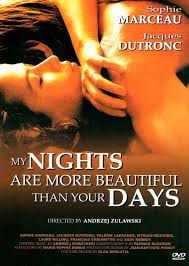
mynightsMy Nights Are More Beautiful Than Your Days, Andrzej Żuławski (1989, France) Żuławski, unlike Szulkin, is plain bonkers – and this film is a perfect illustration of why. Superficially, it seems like a fairly typical amour fou romance, something the French do well, and often, with Sophie Marceau as the object of Jacques Dutronc’s obsession. (Marceau was in a relationship with Żuławski at the time.) But Dutronc’s character has a brain disease and is losing his memory, so he spends all the time obsessively speaking strings of words in order not to forget them. And Marceau is a clairvoyant in a high-end carnival act, in which she is hypnotised, tells members of the audience things they’d rather not hear, and then does a striptease. The two hook up, spend a lot of time having sex, while the rest of the cast wander in and out of the story, mostly uttering gnomic dialogue but occasionally advancing the plot. I really liked the other films by Żuławski I’ve so far seen, but this one was disappointing – perhaps because despite the characteristic Żuławski bonkerosity (er, no pun intended), it felt too generic…

Our Hospitality posterOur Hospitality, Buster Keaton (1923, USA) There’s a list of 1001 Films You Must See Before You Die and while there’s a lot on it that plainly doesn’t belong there – Argo? WTF? – I’ve found it a reasonably good source for titles of older classic movies I’d not seen. I’d have preferred it if the list wasn’t full of spelling mistakes and mangled titles, however – it does suggest not that much thought was put into it. Anyway, I know of Buster Keaton, of course; and I’ve probably seen one or two of his films years and years ago. But this one was new to me and… It was good, it made me laugh. The stunts were clever, the story – a pastiche of the Hatfield-McCoy feud – well-played, and the train ride was near-genius. Worth seeing.

obi oba dvdO-Bi, O-Ba. Koniec Cywilizacji, Piotr Szulkin (1985, Poland) Another one from the Szulkin box set, and it’s just as grim as the other two. Nuclear war has done for the world, all but one thousand people who managed to reach safety in an underground shelter beneath a protective dome. They were told that an Ark would arrive soon to rescue them, and despite the authorities repeatedly telling them there is no Ark, they still believe it. The film’s protagonist is relatively high up in the power structure – he certainly knows there’s no Ark coming – and he’s looking for a way out with his girlfriend. And sooner rather than later, as he knows the dome is about to fail. He has some silverware stashed away and he trades these for food – the utensils can be stamped into tags, which are used as currency in the shelter. Eventually, he learns of a hangar, and a plane stored in it. But when he tracks it down – and this is one of the best scenes in the film – he discovers that the richest man in the shelter has been cannibalising the aircraft’s aluminium fuselage to make currency. The ending is perhaps not the most original ever, given the set-up, but it’s cleverly framed. Good stuff.


2 Comments

Moving pictures, #4

Another dash through across the silver screen. Here are some of the more notable films I’ve watched recently.

The Best of Everything, Jean Negulesco (1959, USA) Three women are employed at a New York publishing house. One makes the jump from secretary to reader to editor. The first half of the film is one of those beautifully-photographed 1950s melodramas, with some lovely shots of the New York of the time. Disappointingly, the second half trades that in for soap opera office politics.

best-of-everything-02

Elysium, Neill Blomkamp (2013, USA) Rich people live in the lap of luxury in the eponymous space habitat, while everyone else suffers in abject poverty on Earth – but that’s as far as the social commentary goes. This is really just another implausible actioner with a nice line in visuals and a bad handle on the laws of physics.

Ga, Ga – Chwała Bohaterom, Piotr Szulkin (1986, Poland) Barking mad sf film, in which an astronaut lands on another world… which proves to be just like this one, except they treat their heroes somewhat differently. Not so much black comedy as fulginous.

Head-on, Fatih Akin (2004, Germany) Marriage of convenience between young Turkish-German woman and older Turkish-German man, so she can live the life she wants away from her traditional family, turns sour when the pair fall in love and he accidentally kills an ex-lover of hers. Not the most sympathetic of lead characters, but the actors playing them carry the film. Excellent.

Argo, Ben Affleck (2012, USA) You know when Canada rescued those US hostages from Iran back in 1980? Well, it wasn’t Canada that did it, it was the CIA. Yes, Americans. The whole film feels like a petulant grab to correct misplaced credit decades after the fact. And we’ll not mention the stupid race-against-time at the end to get the hostages out of the country…

The Killers, Robert Siodmak (1946, USA) Classic noir told through flashback, which explains why a pair of killers drove into town and killed garage mechanic Burt Lancaster. Turns out Burt used to be involved with a bad crowd, who pulled off a payroll robbery which turned nasty. Ava Gardner vamps it up, but I thought Rita Hayworth was better in Gilda (also released in 1946).

Villa Amalia, Benoît Jacquot (2009, France) Pianist Isabelle Huppert walks away from her life and settles down in the eponymous run-down villa in Italy. Beautifully shot, elegantly told. There something about the feel of the film which reminds me of François Ozon’s Under the Sand.

VILLA AMALIA un film de Benoit Jacquot

The Bank Dick, Edward Cline (1940, USA) WC Fields inadvertently catches a bank robber, is employed as the bank’s security guard as reward, and promptly cocks that up – much as he does everything. Mildly amusing, though not a patch on Laurel & Hardy.

Follow The Boys, Eddie Sutherland (1944, USA) Hollywood stars entertain the troops at training camps throughout the US during WWII, plus back-story showing how it all came about (entertaining the troops, that is, not WWII). Lots of cameos by big names. WC Fields is genuinely funny, Orson Welles puts on a magic act that clearly relies on camera trickery, and there’s a good tap dance in the rain from star of the film George Raft.

The Ugliest Woman In The World, Miguel Bardem (1999, Spain) Near-future thriller about a female killer which seems to have been inspired by so many other films it makes it difficult to remember what you’re watching. The premise is iffy – ugly young woman undergoes experimental gene therapy, which turns her beautiful… so she murders a contestant in the Miss Spain beauty pageant, takes her place, and proceeds to kill the other contestants. But the film is so odd, it sort of hangs together.

The Neptune Factor, Daniel Petrie (1973, Canada) Stone-faced grump Ben Gazzara is captain of a model submersible which is menaced by magnified tropical fish while searching for an underwater habitat lost during a seaquake. Oh, and there’s a giant crab too. They manage to find a pair of survivors, although how they didn’t get squished by the pressure is never explained. Jacques Cousteau it’s not.

bscap0001pk


2 Comments

Moving pictures, #3

More culture splashed across the silver screen… although it’s a pretty loose definition of “culture” for some of the films I’ve seen over the past few weeks. More and more, I find myself avoiding recent Hollywood product (and I use the term “product” deliberately) in favour of arthouse or classic Hollywood films.

Rio Lobo, Howard Hawks (1970, USA) I freely admit Hawks’ Rio Bravo (1959) is one of my favourite films, and certainly my favourite Western, and I was aware Rio Lobo is often considered to be little more than Hawks having another bash at that earlier film. Like Rio Bravo, it stars John Wayne as a sheriff, who must defend a town against a cattle baron’s henchman and… The difference here is that Wayne was a Union officer and the film opens with an ambush by Confederate troops on a gold train he’s responsible for. Later, he meets the Confederate captain who commanded the ambush in a POW camp and the two become friends… and later allies against the evil cattle baron. A solid Hollywood western, but not a patch on Rio Bravo.

bautravail

Beau Travail, Claire Denis (1999, France) I forget why I put this on my rental list, possibly I’d seen it on some list of top films or something. I’d seen a few by Denis before, and while they were good I can’t say they’d blown me away. But Beau Travail… It’s set in Djibouti among soldiers of the French Foreign Legion, and is framed as the memories of a sergeant after the fact. A new recruit joins the troop and the sergeant becomes envious of his looks, ability and popularity. He tries to kill him by sending him out into the desert with a faulty compass, but the legionnaire survives. The film ends with the sergeant dancing, representing his suicide after failing to adjust to civilian life. It is quite brilliant. I’m pretty sure Beau Travail is going to make my best of the year. It’s also the third film I can think of that’s lifted from good to near-genius by an unexpected dance scene, the other two being François Ozon’s Water Drops On Burning Rocks (2000) and Werner Herzog’s Bad Lieutenant: Port of Call New Orleans (2009).

Star Trek: The Next Generation Season 7 (1993, USA) So I finally got around to watching the final season of Next Gen, and now a week or two later I have very little memory of it all. I think I spent most of the time marvelling at how much make-up Marina Sirtis and Gates McFadden were wearing. The plots of the individual episodes were, I seem to recall, rather dull and it all felt very formulaic and “the [tech] does the [tech] with the [tech]”. There were, as usual, some totally cringe-worthy episodes and, surprisingly, one featuring Lwaxana Troi that didn’t make me want to claw my eyes out (it was a bit barf-inducing, though). Ah well, seen them all now. Seen all of DS9 as well. Voyager next, I guess. Sigh.

Outpost 11, Anthony Woodley (2012, UK) The Second World War is apparently approaching its centenary and three men at a listening outpost – listening to Russian radio traffic (er, they were our allies during WWII) – are slowly driven mad by something strange out in the ice and cold. Everything looks a bit steampunk (er, the Victorian Age ended nearly forty years before WWII), the acting is terrible, and the pacing is abysmal. A film to avoid.

Gilda, Charles Vidor (1946, USA) Glenn Ford is a gambler in Buenos Aires shortly after WWII. He ends up working at an illegal casino – though you’d never guessed it was illegal from all the glitz – as floor manager. Some months later, the casino owner goes away on a trip and returns with Rita Hayworth, his wife. Cue smouldering hatred between Ford and Hayworth. Meanwhile, the casino owner is neck-deep in a cartel among tungsten mine owners. A quality Hollywood noir this one. Hayworth is mind-blowing. Definitely worth seeing.

queen-of-blood-4

Queen Of Blood, Curtis Harrington (1966, USA) This was actually a rewatch, but it’s such a good film it’s worth mentioning again. It’s another US movie cobbled together from footage from two Soviet films – мечте навстречу (Mechte Navstrechu) and Небо зовет (Nebo Zovyot), with additional US-filmed material starring Basil Rathbone, John Saxon, Judi Meredith Florence Marly, and, yes, that is Dennis Hopper. Alien crashlands on Mars, Earth sends rescue mission, they find sole survivor Marly, but during journey back to Earth she proves to be a vampire and kills all of crew except Meredith and Hooper, who kill her. Marly is astonishingly good as the titular alien, Meredith is treated like just one of the crew (a gender-equal future society, in a 1966 film!), and the footage from the Soviet movies is weirdly beautiful. I love this film.

My Neighbours The Yamadas, Isao Takahata (1999, Japan) The cartoony Studio Ghibli film, in other words. The title pretty much says it all – the film is structured as a series of vignettes about the eponymous family. I quite enjoyed it, although the best Ghibli I’ve seen so far is still Only Yesterday, like My Neighbours The Yamadas also directed by Isao Takahata.

Project A, Part 2, Jackie Chan (1987, Hong Kong) When I was living in the UAE, I watched quite a lot of Jackie Chan films – they were readily available there on VCD. It’s nineteenth century Hong Kong and Chan is drafted in as police superintendent in charge of a notoriously corrupt district. With the help of the Marines, he cleans up the  district, battling the local kingpin, an Imperial Chinese spy and his henchmen, and the previous superintendent who has been promoted to a position where he can allegedly do no harm. Also involved are a bunch of Chinese revolutionaries  – which is who the Imperial Chinese spy is after. There’s lots of cleverly-choreographed action, including a brilliant sequence with some chilis, and it’s pretty much a pure hit of Jackie Chan comedy-action. Definitely worth seeing.

20 Million Miles To Earth, Nathan Juran (1957, USA) This was on Film4 one weekend afternoon, so I plonked myself in front of the telly and watched it. My expectations were low and it still failed to meet them. A spacecraft on a mission to Venus crashlands in the sea off Sicily on its trip back to Earth. Some Sicilian fisherman rescue the sole survivor, but a young local boy also finds a specimen jar from the rocket containing a blobby thing, which promptly grows into a Godzillary-type creature and subsequently terrorises the island. This is a B-movie, with a B-movie script and B-movie talent, and notable only because Harryhausen animated the ersatz kaiju. Eminently avoidable.

Gentleman’s Agreement, Elia Kazan (1947, USA) This was a surprise. I forget where I stumbled across mention of it, but it was a good call. Gregory Peck plays a journalist who’s just landed a top gig with a New-York-based magazine. He proposes an article series on anti-semitism, but initially finds it hard to present the subject in a way that will really get it across to readers. Eventually he decides that he will tell everyone he is Jewish, and experience anti-semitism for himself – he’s new in New York, so there’s no one around who’ll know different (except his editor, of course, his mother, and his WASP-y fiancée). And experience it he does. Both conscious and unconscious. The topic is handled intelligently and sensitively. Sadly, I doubt a film like this would be made today.

sonsofthedesert

Sons of the Desert, William A Seiter (1933, USA). Also, by various hands, We Faw Down (1928), Their Purple Moment (1928) and On the Wrong Trek (1936), which were all on the same disc. Sons of the Desert sees Stan and Ollie pull a fast one on their wives in order to attend the titular organisation’s annual bash in Chicago, which their wives have forbidden. Ollie fakes an illness, and the pair are allowed to travel to “Honolulu” to recuperate. Everything goes as planned… Except the ship the pair are allegedly returning on sinks. Just after they’ve lied their way out of trouble on that, the wives sees a newsreel about the Sons of the Desert parade in Chicago… and there are Stan and Ollie whooping it up. We Faw Down is a silent with an earlier version of the plot – Stan and Ollie want to attend a poker game so lie to their wives… only to get caught up in various shenanigans and consequently caught out. I thought it funnier than Sons of the Desert. Their Purple Moment is another silent – this time Stan & Ollie are out for some fun with some of Stan’s saved cash, they end up having dinner in a club with a pair of women (not their wives), but it turns out Stan’s wife has replaced his cash with coupons. Also a good one. Laurel and Hardy only make cameos in On the Wrong Trek, which is actually about another actor back from holiday telling his office mates about the disastrous week he’s just spent on the road to California with his wife and mother-in-law. There’s a quite good musical number, but that’s about all.

Red 2, Dean Pariscot (2013, USA) A bunch of oldies run around like twentysomethings, committing implausible mayhem and I completely forget what the actual plot was about. I’d dismiss this as complete tosh, but the script was pleasantly witty and though it trod a fine line it actually managed to avoid falling into stupid. It felt more like a European action thriller than a Hollywood one (amusingly, it featured a Russian aircraft masquerading as a USAF one, the precise opposite of all those Hollywood Cold War films…). For a beer and pizza night, you can do a lot worse than this film.


Leave a comment

Moving pictures, #2

A choice selection of yet more films watched so far this year – since my last moving pictures post, of course. I’m keeping the descriptions short, or I’d never get this post done…

Under the Skin, Jonathan Glazer (UK/USA, 2014)
My first trip to the cinema this year. I remember not liking the book when I read it a decade ago, but I did like this film. The guerilla filming in Glasgow was especially effective, and Scarlett Johansson was excellent in the lead role. Very unsettling – and a lot of it is left up to the viewer to interpret. It probably requires a bit too much work on the part of the viewer to be commercially successful.
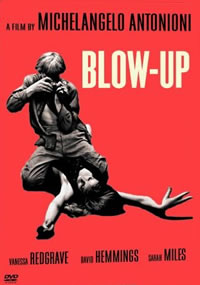
Kin-Dza-Dza, Georgiy Daneliya (USSR, 1986)
I found this for sale on a US site that specialises in Russian DVDs (see here), and it was in an edition which included English subtitles. I’d heard much about the film and always wanted to see it, so I bought a copy. It is… bonkers. But also really good. A Russian construction foreman and an Armenian music student are accidentally transported to a planet in the Kin-dza-dza galaxy, and must figure out how to get home.

Eolomea, Herrmann Tschoche (East Germany, 1972)
This was actually a rewatch – it’s one of the films in The Defa Sci-Fi Collection box set I bought a couple of years ago. A number of ships have disappeared on supply missions to space stations. Professor Maria Scholl becomes suspicious – and more so when one of the space stations falls silent. Meanwhile, rumours that a way has been found to reach fabled exoplanet Eolomea have begun to surface. I love the look and feel of this film, with its 1970s future; but it’s also something Hollywood does badly: an intelligent sf film.

Eolomea_004

My Son, My Son, What Have Ye Done?, Werner Herzog (USA/Germany, 2009)
Sideways look at a police seige of a house where a killer has holed up with hostages. The cops had arrived at the scene to find a murdered woman… and her son then walks across the road and takes the neighbours hostage. Flashbacks show what led to the murder – and it’s the usual off-kilter Herzog stuff. This film was produced by David Lynch, and it does feel very Lynchian, with that sort of fevered supra-reality he used in several of his movies.

Byzantium, Neil Jordan (UK/Ireland, 2012)
Vampires on the run. Gemma Arterton is a young woman in early nineteenth-century England, forced into prostitution by Navy officer Jonny Lee Miller. Years later, dying of TB, she steals Miller’s map to an island that gives a person immortality – by making them a vampire. The all-male vampires aren’t happy but let her go. But when Miller gets his revenge by raping Arterton’s daughter, Aterton takes her to the island… This is all flashbacks as the film’s set in the present day, with Arterton and daughter Saoirse Ronan shacking up in Daniel Mays’ delapidated Byzantium Hotel… and opening a brothel. A polished film, but throughout it felt like one that needn’t have been made.

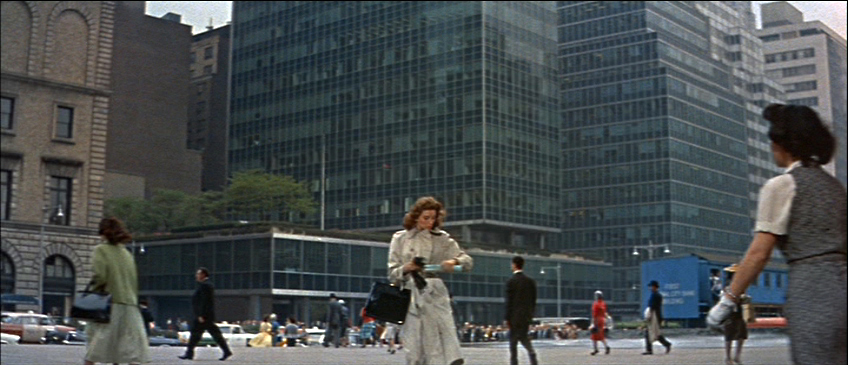
On the Threshold of Space, Robert D Webb (USA, 1956)
A dramatization of the work of Captain Joseph W Kittinger II, with his parachute jumps from stratospheric balloons as part of Project Manhigh. It’s played completely straight – these were important tests, and though highly dangerous they had to be done. In that respect, it’s not unlike William Holden’s Toward the Unknown (see here). I find all this sort of stuff completely fascinating, and if the film doesn’t actually have much of a story it doesn’t matter to me. Besides, I could watch Virginia Leith in anything.

Riders to the Stars, Richard Carlson (USA, 1954)
One of a trilogy of films about the Office of Scientific Investigation, which tries for scientific accuracy but falls flat on its face. OSI satellites have been blowing up once in orbit and they suspect this is due to cosmic rays. (See what I mean.) So they decide to send up a man in a rocket designed to capture a meteoroid… because meteoroids don’t blow up in space. (Um…). The OSI invites a dozen men to their headquarters, not telling them for what, tests them, and selects three – one of whom happens to be the son of the chief scientist. They build their rockets, launch them, two of them blow up, but the third – the scientist’s son, natch – captures a meteoroid… and they discover that the rock’s secret is its carbon shield! (Sigh.)

Test Pilot Pirx, Marek Piestrak (USSR/Poland, 1978)
An adaptation of a story by Stanisław Lem. Pirx has to evaluate a new type of android and is ordered to fly a mission to Saturn. One of his crew will be an android, but he isn’t told which one. It all looks a bit like a 1970s near-future thriller… and then they climb into a spacecraft and fly across the Solar System. The bit where they fly through a gap in Saturn’s rings, and it looks like an ice chasm, is silly; but the rest of it is good.

Something in the Air, Olivier Assayas (France, 2012)
Intense drama set in and around the student riots of 1968. I’ve liked a number of Assayas’ films but this was surprisingly dull.

It’s a Gift, Norman Z McLeod (USA, 1934)
WC Fields, and I don’t think I’ve ever actually seen one of his films before. This is the one where a relative leaves him some money and he uses it to buy property in California. I was surprised at how nasty his character was, although the slapstick bits were funny – well, as Confucius said, the funniest sight in the whole world is watching an old friend fall off a high roof…

To the Stars by Hard Ways (Через тернии к звёздам), Richard Viktorov (USSR, 1981)
The final purchase from that Russian DVD site. I’d seen a version of this previously, a badly-butchered English-dubbed version titled Humanoid Woman. It had never made sense. Now I’ve seen the full three-hour original, I finally understand the story. But it’s still bonkers. In the first half, a strange woman is discovered in a wrecked spaceship and goes to live with a scientist’s family. The second half covers a rescue mission to her planet to save it after rampant capitalism has brought about ecological disaster. Also features the WORST ROBOT EVAH.

TTSBHW_femalien02

Ultramarines: A Warhammer 40,000 Movie, Martyn Pick (UK, 2010)
I’m not a fan of the game so I’ve no idea what possessed me to stick this on my rental list, but I did and… All-CGI with some well-known names providing the voices, and a plot stolen from every modern war film ever. The characters don’t look quite right – their shoulders are in the wrong place – and they move weirdly, and the whole thing is extremely dull and badly-paced. Avoid. Even if you’re a Warhammer 40k fan.

Between Your Legs, Manuel Gómez Pereira (Spain, 1999)
A twisty-turny thriller that aims for Hitchcock but misses and hits De Palma. Javier Bardem is a sex addict who takes up with fellow sex addict Victoria Abril, only to discover that someone has been selling tapes of private phone sex he’d been having with another woman. Abril’s husband, meanwhile, is a detective investigating the murder of a young man, and the evidence is starting to point to Bardem… You know when you get to the twist in a De Palma film and you realise it’s been done before? That. Not bad, though.

Anna Karenina, Joe Wright (UK, 2012)
This adaptation of Tolstoy’s novel is notable because it’s filmed as though it were set inside a theatre, with overt theatre sets becoming the mise en scène of shots. A nice idea in theory but it turns the film into a Sixth Form play. Also, Keira Knightley in the title role. I find her really hard to watch.

La Boulangère de Monceau, Eric Rohmer (France, 1963)
The first of Rohmer’s Six Moral Tales, filmed in black and white on 16mm. A young man falls in love with a woman he passes on the street every day, but when she no longer begins appearing, he hunts for her in the surrounding streets… and stumbles across a bakery where he starts buying something to eat every day. Then he and the girl in the bakery start flirting with each other, and he decides he’ll go out with her since he’s lost the other one… only for her to re-appear. It’s supposed to be a moral dilemma – which girl does he choose? – but it only works because the young man is shallow and self-centred, and the women only exist in relation to him. Later films in the series were much better.

La Carrière de Suzanne, Eric Rohmer (France, 1963)
A group of shallow twentysomethings live it up in Paris, and Suzanne is dragged into their circle. Guillaume ruthlessly exploits her, getting her to pay for things, dropping her and only returning to her when his present relationship ends… But she seems more than willing to put up it, and even gives up her job, the better to be at the group’s beck and call. The film aims for deep truth, but uses shallow characters to explore it. Not entirely sure it’s a workable technique.