
… are now up on Videovista.net. Including my review of 1940s noir-ish potboiler The Big Clock


Category Archives: film review
August updatification
First the good news: M-Brane #19 is now available here, containing my story ‘Through the Eye of a Needle’. I wrote it as a socialist story, although I’m told some readers, especially American, might interpret it as anti-socialist. You could always see for yourself…
This month’s VideoVista is also up, containing my reviews of Gentlemen Broncos


The bad news is that, annoyingly, I’ve not managed to get started on my summer reading project – see here. So I’ll begin the first quintet this month. It’ll be the Bold as Love Cycle first, I think.
I also have plenty of writing to get done, too. A handful of stories that have been mashing in the bottom drawer, and need a second draft. A couple more that need the first draft finishing. Then there’s the “newer” space opera novel project, which needs the first three chapters completing. And speaking of space opera, I did sort of promise myself that I’d try and write a proper space opera story this month, so let’s hope inspiration strikes there.
I have a couple of books lined up for reviews, which I need to get done. The first one, Veteran
Ah well. Looks like it’s going to be a busy month.
A One-Man Job: Moon
I am, I admit, not much of a fan of science fiction films. Too many of them privilege visual spectacle over story, or characterisation, or rigour, or plot logic, or even anything approaching an intelligent take on their subject. So it’s more by accident than design that I find I’ve watched all but one of the films on this year’s Hugo Award for Best Dramatic Presentation, Long Form short list. For the record, the nominees are:
Avatar


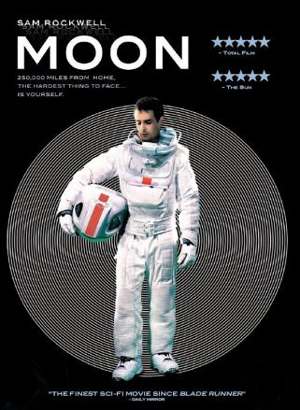 First of all, given the film’s $5 million budget Duncan Jones and his crew did an impressive job. Moon
And yet, the reason there is a moon base on the far side of the Moon in the first place is good science. Sam Rockwell’s character, Sam Bell, is the supervisor of a number of robotic harvesters of Helium-3. In his book Return to the Moon
It’s a clever conceit – although Bell realises his true nature suspiciously quickly, as if the story needed to skip past the discovery phase in order to continue on with the resolution. In retrospect, the only problems I have with the film are niggles such as that. The lack of one-sixth gravity, the size of the moon base, the unnecessarily huge size of the moon rovers (and putting the hatch on top? that’s a terrible design for a vehicle to be used with spacesuits)… It’s a bit like those nuts who think the Apollo lunar landings were faked – when it costs more to maintain the fiction than it would have done to actually do it, then the conspiracy is plainly rubbish. And so with Moon
I think this is worthy of comment because I’m fascinated by the Apollo programme, because I’ve read a number of books, and seen a number of films, on the subject – witness my other blog A Space About Books About Space. Yet I also read science fiction (and review it and write it). I speak the language of science fiction, in other words. And that can operate sometimes like a reverse Sapir-Whorf Hypothesis – as soon as a word is spoken, the concept behind it becomes obvious. Which means I’m likely to focus on the presentation of the conceit, rather than on how the conceit drives the plot…
Happily, Duncan Jones has disarmed most such criticism by consciously referencing other sf films. As you watch Moon


Will Moon
July DVD reviews on line
This month’s VideoVista is up, containing my reviews of Roman Polanski’s English-language debut Repulsion

DVD Reviews – Bad Day and Night Dragon
My reviews of two British low-budget thrillers are now up on VideoVista – Bad Day


DVD reviews
This month’s VideoVista is up with my reviews of 1960s UK potboiler Maroc 7

DVD reviews
This month’s VideoVista is now up, containing my reviews of Russian action film The Interceptor

DVD review online
My review of The Informers, an adaptation of the novel by Bret East Ellis, is now up at VideoVista – see here.
Having seen Less Than Zero, American Psycho, Rules Of Attraction and now The Informers (we won’t count American Psycho 2), I’ve yet to be convinced Ellis’ novels are capable of good film adaptation. All of them have been unsatisfactory in one way or another. Perhaps it’s his characters – they work over the length of a novel, where you at least have the prose; but in a movie they’re simply too unlikeable or affectless to carry a story in such a short period of time.
DVD reviews online
This month’s Videovista is now up with my reviews of Fragments (see here) and Steven Seagal’s The Keeper (see here).
DVD Reviews
This month’s Videovista is now up, with my reviews of Mega Shark vs Giant Octopus (see here) and the new director’s cut of Léon (see here).
 It Doesn't Have To Be Right...