It Doesn't Have To Be Right…

… it just has to sound plausible


4 Comments

Metal scorchio

Every year, I say to myself I’m too old for this shit; and every year, I find myself in a field in Derbyshire listening to some of my favourite bands and having a great time. I say “every year” but Bloodstock 2012 was only my fourth Bloodstock since 2008 (I missed 2009 and 2010). But it has definitely got better every year. And bigger, too.

After packing the Toyota Tardis Yaris with all our gear, the four of us – Craig, Emma, Rowan and myself – headed to the local Asda for our final pre-festival shop. Naturally, this meant beer. And water. And baby wipes. And items for the Bucket o’SnacksTM. We also wanted something to eat on our way to Catton Hall, since it was already lunch time. Annoyingly Asda makes its pork pies with milk, which is not how they should be made. Fortunately, we found some very nice sausage rolls instead which I could eat.

Then it was back into the car and down the M1 and A38 to Catton Hall, Derbyshire. We made good time and, despite leaving a little later than intended, managed to arrive as planned at two pm. Craig had bought himself a collapsible trolley after the difficulties we had last year carting everything from the car park to the camping ground. It proved a wise purchase, although it did mean he had to drag along about 400 kilos of booze and tents. But at least we never needed to return to the car for the entire weekend.

I’d been worrying for weeks beforehand that we’d have torrential rain during the weekend, so Craig had lent me one of his tents – my pop-up tent would probably have been destroyed by the first downpour. In the event, we had blinding sunshine for three days, and a warm slightly overcast Sunday with a couple of weak showers. In fact, Craig managed to get sunstroke on the Friday.

After meeting up with Roger in the car park, we began the long trek to the festival ground entrance and the camping ground. Cat and Sly joined us, and once we had put up our tents – in pretty much the same spot as last year – we headed for the arena.
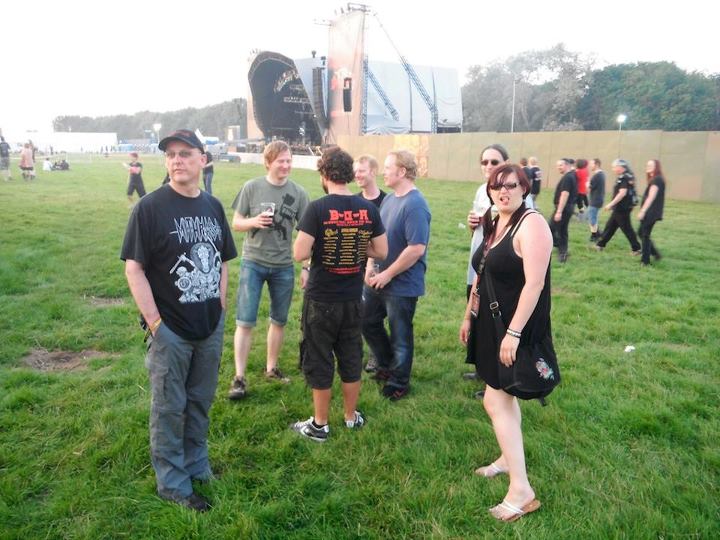
photo: Craig Andrews

First band of the festival was Saturnian, whom we’d seen last year. They were playing on the Sophie Lancaster Stage, which is in a huge marquee. Beer had gone up a little in price since Bloodstock 2011 – £4 for a pint of Bloddstock Ale, or £3.90 for a plastic bottle of Carlsberg. And Monster were no longer sponsors; this year, it was Red Bull, but their presence was very low-key. After Saturnian, we wandered about the arena, which more or less resembled last year’s. Mr Tea’s was there – which pleased Craig, Emma and Rowan greatly, as they’re big tea-drinkers. There looked to be a wide selection of food available, so it was unlikely I’d have to go hungry or subsist on the contents of the Bucket o’SnacksTM.

When we got back to the tents, Roger – who had waited in the car park to meet friends – had arrived and put up his tent. As had Burnie, Gray and Will. I remember the night being really cold. Though the tent I’d borrowed was double-walled, I was using the same Argos sleeping-bag as previous years and it’s not especially effective. I’d taken the precaution of buying a fleece to use as a blanket, and that sort of worked. Fortunately, Thursday was the coldest night of the weekend.

My first two times at Bloodstock were spent mostly drinking or suffering from a hangover. Last year, we’d decided to focus more on the music, and make an effort to see more bands. The same plan was in effect for this year. Emma had marked down those with female members for Femetalism; other bands we decided might be worth hearing from their write-ups in the programme. And then there were those bands we knew and liked and had always planned to watch perform – for me, that would be Alcest, Winterfylleth, Nile, Paradise Lost and Anaal Nathrakh. Which is not an especially large number for a festival lasting three and a half days…

Friday and Saturday were spent almost identically – wandering from stage to stage to hear bands, sitting out in the sun, taking occasional breaks in Mr Tea’s, drinking beer… As per the last year, for lunch I “falafelated” (the falafel wrap, however, was much better this year). Dinner was chips and gravy. I watched Moonsorrow on the main stage, the Ronnie James Dio Stage, and, appropriately, Dio Disciples, who played a bunch of old Rainbow and Black Sabbath tracks (the best ones, of course, from the line-ups with Dio). On the Sophie Lancaster Stage, I watched some of The Commander-in-Chief, a female guitarist, but didn’t much like her semi-operatic vocals. The following act, Swiss band Gonoreas, despite the unfortunate name were quite good. The main attraction that night was French metal shoegazer band, Alcest. They were good, but it’s music to be sitting down for, I think. We did catch a couple of acoustic sets on the Jägermeister Stage, the best of which was Manchester folk metallers Andraste.

At one point during the afternoon, I was in the audience for Pythia’s set on the Sophie Lancaster Stage, but several people had lit up joints and the smell of weed was making me ill. So I left the tent. There were clearly-posted signs saying “No Smoking” in the tent, but dopeheads seem to think that doesn’t apply to them. Cigarette smokers had the decency to smoke outside, but the smell of weed was constant throughout the weekend. That, and the heat, made several of the sets unpleasant to watch. I’d not noticed the dope on previous Bloodstocks. But then Sonisphere had been cancelled the month before and it was suggested a lot of people that would have attended that had come to Bloodstock instead. Perhaps that accounted for it.

Also that afternoon, I chatted with Leon of Mithras at the Zero Tolerance stall and we had what is turning into our annual moan about not being able to make decent money recording music or writing science fiction – or at least the sort of music he records and the sf I write. Later that night, Cat, Sly and myself had a go on the dodgems. The others were, I think, watching a band on the New Blood Stage. Top tip: when on the dodgems, don’t leave your phone in a thigh pocket. I did. Mine now has a small crack on the screen.

We didn’t stay in the arena to see the day’s headliners, Behemoth, but returned to the tents to drink beer. We hadn’t seen Watain either, as they clashed with Alcest. I don’t think we missed much – Leon had described Watain as “black metal for people who don’t like black metal”.

The only acts playing the Ronnie James Dio Stage I really wanted to see weren’t on until the Sunday. I did hear the occasional song by those playing on the Saturday as I wandered about the arena, and I did stay for the first few songs by Machine Head, that day’s headliner. But I saw more bands perform on the Sophie Lancaster Stage. Rising Dream, a Croatian female-fronted power/death metal band were the highlight of the day. I’d wandered in to see who was performing at the beginning of their set, and stayed for the entire performance. Winterfylleth, on the other hand, I’d planned to see. I’d seen them live once before at the Day of Unrest in 2008 (see here). They were good and the tent was packed for their set. I may well pick up a copy of their latest album.

That night, there was the usual Saturday night shenanigans in the camping ground. A group of about a hundred tried some bin jousting, but managed no more than two jousts before security staff came and took away the bins. So they made do with finger-wrestling. It was noisy but good-hearted. There was no re-occurance of last year’s trouble.

Sunday was easily the best day for me in terms of music. And it proved even better than expected. The others were taking their time getting up, so at 10:30 I decided to head into the arena on my own. After a bacon sandwich, I wandered across to the New Blood Stage to see what was happening there. It was the first act of the day, Seprevention, and they were excellent – old school death metal with duelling shredding guitars. I wandered round for a bit more, before returning to the New Blood Stage to watch Aethara, who I also thought very good. By this time, Craig, Emma and Rowan had appeared, so we stayed for So-Da-Ko, though I didn’t like them as much as the two bands I’d already seen. Then it was outside to watch Nile. I’d been warned they weren’t that good live, but I thought they were excellent.

The others settled down in Mr Tea’s but I headed off to the Sophie Lancaster Stage to see Ancient Ascendant. They weren’t bad but their write-up in the programme had suggested they’d be better. I wasn’t especially keen on seeing Anvil on the Ronnie James Dio Stage. Yes, I know it’s meant to be bad, but I’ve yet to be convinced metal and irony mix (no pun intended). Anyway, we staked out an area on the grass pretty much where we’d spent the Sunday afternoon the previous year. After Anvil – who were mildly amusing – it was Paradise Lost. They were good, but I’d seen them in the Corporation in April and they’d been much better then.

I had no plans to watch Dimmu Borgir – I’ve caught them live twice before, despite not being a fan – so after a couple of songs I headed off to the Sophie Lancaster Stage to see Anaal Nathrakh. I’d thought the others had planned to see them too, but it turned out I was on my own (though Craig did turn up toward the end of the set). The tent was packed – and filled up even more after Dimmu Borgir finished their set after halfway through Anaal Nathrakh’s. So much so, in fact, that I found myself slowly being herded further back, and I wasn’t even near the stage to begin with. Anaal Nathrakh were excellent, definitely one of the best performances of the weekend.

And then it was Alice Cooper. I don’t get it – an old man playing music for fifteen-year-olds. His music makes MTV sound edgy. And no matter how you dress it up with a fancy stage show, it still sounds like some insipid Hollywood version of metal. I stayed for a couple of songs and then headed back to the tent. The others stayed. But even they couldn’t manage the whole set. After they turned up at the tents, we sat around and drank beer for a bit. I didn’t get much sleep – there was a group near my tent who larked about all night and kept me awake. One of them was apparently on “gas”, and the rest were loudly egging him on. Next year, I think we’ll camp somewhere a little quieter…

So that was Bloodstock 2012. And great fun it was too. Best bands of the weekend for me were Rising Dream, Anaal Nathrakh, Suprevention, Winterfylleth, Aethara, Nile, Paradise Lost and Alcest. So far, Anthrax have been announced for next year. Hopefully, there’ll be plenty of better bands on the bill by August 2013. And if not, perhaps some of those unknown to me will prove to be really good – as has been the case for the Bloodstock 2011 and Bloodstock 2012.

Finally, I can’t write about Bloodstock without mentioning Metal Meerkat. Craig had recently bought house insurance through comparethemarket.com, and so they’d sent him one of their stuffed toys. It was Vassily, dressed in a t-shirt and leather jacket. Throughout the weekend, Craig and Emma took photos of Vassily in various parts of the arena and camping ground. Craig even took some mpg footage. And he’s edited these together. Enjoy…

4 Comments

Ian’s greatest films

After seeing the BFI greatest films list, I thought it might be an interesting exercise to put together a list of my own. Obviously, I’ve not watched every film ever made, and my tastes probably lean in a certain direction cinematically – I don’t, for example, see the appeal of the films of either Kurosawa or Ozu. Anyway, here – for what it’s worth – is my pick of the fifty greatest films – that I have seen – ever made. I tried to go for a little variety, instead of just listing half a dozen films each by my favourite directors. It’s certainly a more international list than the BFI one.

1. All that Heaven Allows, Douglas Sirk, 1955
2. Mirror, Andrei Tarkovsky, 1975
3. The Colour of Pomegranates, Sergei Parajanov, 1968
4. Divine Intervention, Elia Suleiman, 2002
5. Red Desert, Michelangelo Antonioni, 1964
6. Metropolis, Fritz Lang, 1927
7. Rear Window, Alfred Hitchcock, 1954
8. Autumn Sonata, Ingmar Bergman, 1978
9. No End, Krzysztof Kieslowski, 1984
10= Brazil, Terry Gilliam, 1984
10= Mooladé, Ousmane Sembène, 2004
12. 8½, Frederico Fellini, 1962
13. Red Psalm, Miklós Jancsó, 1972
14. Sunrise: A Song of Two Humans, FW Murnau, 1927
15. The Piano Teacher, Michael Haneke, 2001
16. Alien, Ridley Scott, 1979
17. Passenger, Andrzej Munk, 1963
18= Stalker, Andrei Tarkovsky, 1979
18= 2001: A Space Odyssey, Stanley Kubrick, 1968
20. Imitation of Life, Douglas Sirk , 1959
21. The Holy Mountain, Alejandro Jodorowsky, 1973
22. Aguirre, Wrath of God, Werner Herzog, 1972
23. Delicatessen, Jean-Pierre Jeunet & Marc Caro, 1991
24. Daratt, Mahamat-Saleh Haroun, 2006
25= Lady Chatterley, Pascale Ferran, 2006
25= The Seventh Seal, Ingmar Bergman, 1957
27. Citizen Kane, Orson Welles, 1941
28. On the Silver Globe, Andrzej Żuławski, 1988
29. Things to Come, John Cameron Menzies, 1936
30. Drifting Clouds, Aki Kaurismäki, 1996
31. Fahrenheit 451, François Truffaut, 1966
32. Rio Bravo, Howard Hawks, 1959
33= Underground, Emir Kusturica, 1995
33= The Bothersome Man, Jens Lien, 2006
35. Das Boot, Wolfgang Peterson, 1981
36. La Jetée, Chris Marker, 1962
37. The Man Who Fell to Earth, Nicolas Roeg, 1976
38. High Society, Charles Walters, 1956
39. Russian Ark, Alexander Sokurov, 2002
40. Blade Runner, Ridley Scott, 1982
41. Atanarjuat the Fast Runner, Zacharias Kunuk, 2001
42= Went the Day Well?, Cavalcanti, 1942
42= The Third Man, Carol Reed, 1949
44. Secret Ballot, Babak Payami, 2001
45. Lawrence of Arabia, David Lean, 1962
46. Starship Troopers, Paul Verhoeven, 1997
47= The Right Stuff, Philip Kaufman, 1983
47= The Life and Death of Colonel Blimp, Michael Powell & Emeric Pressburger, 1943
49, It’s a Wonderful Life, Frank Capra, 1946
50. Mulholland Dr., David Lynch, 2001


3 Comments

BFI greatest films

Has no one turned this into a meme yet? Then allow me… At the beginning of the month, Sight & Sound, the magazine of the British Film Institute published its list of the 50 greatest films. It caused a little bit of a stir because Vertigo bumped Citizen Kane from the top spot, a position it’s held for fifty years.

Anyway, meme – you know what to do. Put it in bold if you’ve seen it, italics if you own it but have yet to watch it.

1. Vertigo, Alfred Hitchcock, 1958
2. Citizen Kane, Orson Welles, 1941
3. Tokyo Story, Ozu Yasujiro, 1953
4. La Règle du jeu, Jean Renoir, 1939
5. Sunrise: A Song of Two Humans, FW Murnau, 1927
6. 2001: A Space Odyssey, Stanley Kubrick, 1968
7. The Searchers, John Ford, 1956
8. Man with a Movie Camera, Dziga Vertov, 1929
9. The Passion of Joan of Arc, Carl Dreyer, 1927
10. , Federico Fellini, 1963
11. Battleship Potemkin, Sergei Eisenstein, 1925
12. L’Atalante, Jean Vigo, 1934
13. Breathless, Jean-Luc Godard, 1960
14. Apocalypse Now, Francis Ford Coppola, 1979
15. Late Spring, Ozu Yasujiro, 1949
16. Au hasard Balthazar, Robert Bresson, 1966
17= Seven Samurai, Kurosawa Akira, 1954
17= Persona, Ingmar Bergman, 1966
19. Mirror, Andrei Tarkovsky, 1974
20. Singin’ in the Rain, Stanley Donen & Gene Kelly, 1951
21= L’avventura, Michelangelo Antonioni, 1960
21= Le Mépris, Jean-Luc Godard, 1963
21= The Godfather, Francis Ford Coppola, 1972
24= Ordet, Carl Dreyer, 1955
24= In the Mood for Love, Wong Kar-Wai, 2000
26= Rashomon, Kurosawa Akira, 1950
26= Andrei Rublev, Andrei Tarkovsky, 1966
28. Mulholland Dr., David Lynch, 2001
29= Stalker, Andrei Tarkovsky, 1979
29= Shoah, Claude Lanzmann, 1985
31= The Godfather Part II, Francis Ford Coppola, 1974
31= Taxi Driver, Martin Scorsese, 1976
33. Bicycle Thieves, Vittoria De Sica, 1948
34. The General, Buster Keaton & Clyde Bruckman, 1926
35= Metropolis, Fritz Lang, 1927
35= Psycho, Alfred Hitchcock, 1960
35= Jeanne Dielman, 23 quai du Commerce 1080 Bruxelles, Chantal Akerman, 1975
35= Sátántangó, Béla Tarr, 1994
39= The 400 Blows, François Truffaut, 1959
39= La dolce vita, Federico Fellini, 1960
41. Journey to Italy, Roberto Rossellini, 1954
42= Pather Panchali, Satyajit Ray, 1955
42= Some Like It Hot, Billy Wilder, 1959
42= Gertrud, Carl Dreyer, 1964
42= Pierrot le fou, Jean-Luc Godard, 1965
42= Play Time, Jacques Tati, 1967
42= Close-Up, Abbas Kiarostami, 1990
48= The Battle of Algiers, Gillo Pontecorvo, 1966
48= Histoire(s) du cinéma, Jean-Luc Godard, 1998
50= City Lights, Charlie Chaplin, 1931
50= Ugetsu monogatari, Mizoguchi Kenji, 1953
50= La Jetée, Chris Marker, 1962

I make that 36 I’ve seen out of the fifty. There are also some of my favourite directors on there too, like Tarkovsky, Hitchcock and Antonioni. There are a few I’m surprised not to see, such as Antonioni’s Red Desert; not to mention works by directors such as Kieslowski, Sirk, Lean or Herzog. I also note that only two sf films make the list – 2001: A Space Odyssey and Metropolis.


2 Comments

99 shades of grey

Who needs BDSM when you can have CSM or LM? Who needs fifty shades of grey when you can have so many more shades? Just look at the photo below. That’s the Moon, that is.

And that’s where Adrift on the Sea of Rains, the first book of the Apollo Quartet, takes place. Copies are still available – in paperback, hardback, epub, mobi, or on Kindle in the UK and US. Go on and buy yourself a copy. It’s competitively-priced and it’s very good (see here).

This has been a blatantly commercial post brought to you by Whippleshield Books. Normal service will resume shortly.


3 Comments

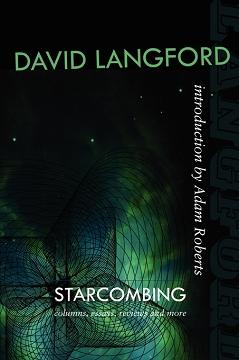
Starcombing, David Langford

Starcombing, David Langford
(2009, Cosmos Books, $14.95, 223pp)

David Langford is a British institution. I picture him as resembling a faculty building in a concrete-and-glass university campus of the 1950s, possessing neither Gothic grandeur, nor the ivy-clad and leather-elbowed academic elitism of a red-brick. And certainly not the imposing belligerence of a Brutalist edifice. Rather, an unassuming but welcoming façade, one which would not look out of place in a city-centre precinct, one which speaks of learning that is open and available to all. Within the building, with its foyer lined with twenty-eight Hugo Awards, is a labyrinth of passages. Small signposts indicate the ways of “science fiction”, “literature”, “nuclear physics”, “Thog’s Masterclass”, “Harry Potter” and other areas of knowledge. The corridors are quiet, and those who pad their lengths do so silently. Every so often, a door can be heard softly closing. There is an atmosphere of erudition and wit – the halls are thick with it. And it is said, in hushed tones of course, that in the labyrinth can be found a vast library, containing many legendary arcane tomes. The library is searchable too, by means of an elegant user interface programmed by the man himself.

At semi-irregular intervals, Langford issues prospectuses. Starcombing is the most recent. It contains eighty-five articles, drawn from a variety of sources – Foundation, SFX, The New York Review of Science Fiction, Nature and Nature Physics, assorted fanzines, and even some previously unpublished pieces. The earliest is from 2000, and the latest from earlier this year. They are arranged chronologically. An author’s note describes Starcombing as a sequel to both Up Through an Empty House of Stars (2003) and The Sex Column (2005), both previous collections of Langford’s writings.

Starcombing is a book in which one should wander around; a plan is not necessary. Nor, in this labyrinth a thread, narrative or otherwise. Alternatively, there is the index, which signposts the route directly to whatever is sought. Some might consider that cheating… because this is a book in which aimlessness is an advantage, in which dipping in and out is a valid use of it. The articles Starcombing contains are short, often no more than a page or two. They can be read as and when desired. Not that Langford’s writing needs to be taken in small doses. On the contrary, his writing has always made it appear as if his learning and humour came easily to him.

Highlights of Starcombing include ‘Maps of Minnesota: Stalking John Sladek’, a piece from The New York Review of Science Fiction in 2001 about tracking down Sladek’s unpublished stories and poems for a posthumous collection; three previously unpublished essays from 2004 on James Branch Cabell, John Myers Myers and Thorne Smith for a project which was abandoned by its editor; an essay on HG Wells from Fortean Times; and four short-short stories from Nature and Nature Physics. I suspect I am not alone in wishing Langford would write more, and longer, fiction. Much of Starcombing comprises Langford’s column from SFX and, while they are entertaining, their nature, intended audience and shortness weighs against them. If I have one complaint, it’s that the contents page does not give the origin of the various articles; it is only given as bulleted note after each piece.

Those familiar with Langford’s writing will know what to expect from Starcombing, and probably already have their copies on order. Those who have yet to read Langford should begin immediately, and Starcombing provides as good as introduction as any of his non-fiction collections.

This review originally appeared in Interzone #224 September-October 2009.


2 Comments

Whippleshield updates

Whippleshield Books continues in its mission to take over the world, although at its current rate this may take a millennium or two. At present, I could probably afford a couple of pebbles from the beach on the desert island where I plan to build my secret hideout in an inactive volcano…

Book two of the Apollo Quartet, The Eye With Which The Universe Beholds Itself, is coming along. Back at the beginning of July, I posted a blurb on the Whippleshield Books blog here. And at the beginning of this month, I posted the first 500 words as a teaser – see here. This book is  turning out to be a bit more ambitious than Adrift on the Sea of Rains. I’ve yet to decide if that’s good or bad, but it’s certainly resulted in more research than I’d expected.

Book three might be titled Then Will The Great Ocean Wash Deep (Above My Head For Ever). It’s a bit unwieldy, even without the part in brackets, so it could change. For the record it’s from a Homeric Hymn to Apollo. And it does sort of fit the plot. I’ve not started writing it yet, but I like to have a title as a focus for when I do begin. Even if I decide on a different title later…

The title for book four, however, is definitely fixed. It will be All That Outer Space Allows. One of my favourite films is Douglas Sirk’s All That Heaven Allows, which is why I chose it. At least it’s not a Lowryesque title like books two and three.

I have also published the first in what I hope will be a series of extremely limited chapbooks. The story Wunderwaffe was originally published in the e-anthology Vivisepulture published by Anarchy Books, and was described by Pornokitsch as “exceptional”. There are only a dozen copies available. Or rather, there were. I’ve sold some already. If you want one, get in there now.


41 Comments

5 tropes science fiction and fantasy should really stop using

These speak for themselves, I think.

1. rape as lazy characterisation
You want to show your villain is a Bad Man, so you have him rape a woman. You want your fluffy princess to become a feisty amazon, so you have someone rape her. No no no no no no no. Do not treat women like this, not even in fiction. And when Mr Fantasy Author responds, “that’s what it was like in the Middle Ages, you moron”, but also quite happily replies with “it’s a made-up fantasy land, you moron” when the accuracy of his Middle English has been questioned, then I would suggest that Mr Fantasy Author is the real moron. If you’re going to make shit up, don’t make up regressive sexist shit.

2. the lone gunman
Thousands have died, perhaps millions, and it’s all the fault of one man (it’s almost always a man). He deliberately gave the order, or pressed the button, that resulted in all those deaths. He’s a monster, and he acted in a vacuum, according to motives of his own. He’s not part of a political or religious movement, he’s not the general of a conquering army. He is the lone gunman, the lone psycho. Like the corporate executive, in a Hugo-shortlisted space opera, who hires gangsters to seal the exits of an asteroid city with a population of 1.5 million, and then subjects them to a fate worse than death by infecting them with an alien virus… just to see what will happen. If your plot depends on one person acting like an inhuman monster, you need to rethink your plot.

3. post-catastrophe man is an animal
Thirty years ago, we were waiting for them to drop the big one and then we’d all be scrabbling for survival among the radioactive ruins. Now it’s more likely that climate crash, or nation-state failure, will do for us. Either way, our current way of life will be toast. So, of course, once this happens the men will all run rampant, rape all the women, steal everything, and kill anyone they don’t like the look of. This, at least, is what fiction tells us. We will not try and rebuild our communities, we will not recognise that cooperation increases our chances of survival. It’s every man for himself, and the women are chattel. Of course, our present ruling classes want us to believe this – they need law and order to maintain their rule, so they want us to believe that without law and order we will turn into brainless animals. In Davide Longo’s The Last Man Standing, a middle-aged couple break into the protagonist’s house and steal all his food and clothing. Regressive, but relatively plausible. They also shit all over his furniture. Why? Why would anyone stealing food to survive also shit on their victim’s furniture? If you have characters in your post-apocalypse novel raping women and shitting on beds, do “select all”, followed by “delete”.

4. the tart with a heart
It’s not just that it’s a horrible cliché centuries past its sell-by date. Think what it says about your invented world. If prostitution exists, or even flourishes, then it is not an equal society. It is patriarchal. And that makes it sexist. Is the human race – one half of it, at least – doomed to be sexist until the heat death of the universe? Biological apologists are no better than creationists. Leave regressive crap like this where it belongs – in religious books.

5. artificial people are not people
Humanity finally manages to create a race of artificial human beings. And promptly enslaves them. No no no no no no no no no. If they’re human, they’re human. They will have the same rights as everyone else. We did the slavery thing centuries ago, it was wrong and we know it was wrong… so why would we do it again? This goes for AIs too. If it’s sentient, it’s not a tool. And if you should find yourself writing a sex slave character, take your manuscript and burn it. And do not write another word until you know better.

ETA: I have added “as lazy characterisation” to the first point as it was rightly pointed out to me that it originally read as though I felt rape should never appear in fiction, when it was my intention that its use as lazy shorthand characterisation should be avoided. Rape should be written about, and as a man I am not in a position to say otherwise. I apologise for any confusion, and take to heart everything written by Kari Sperring in her response here.


8 Comments

A British sf masterwork? Implosion, DF Jones

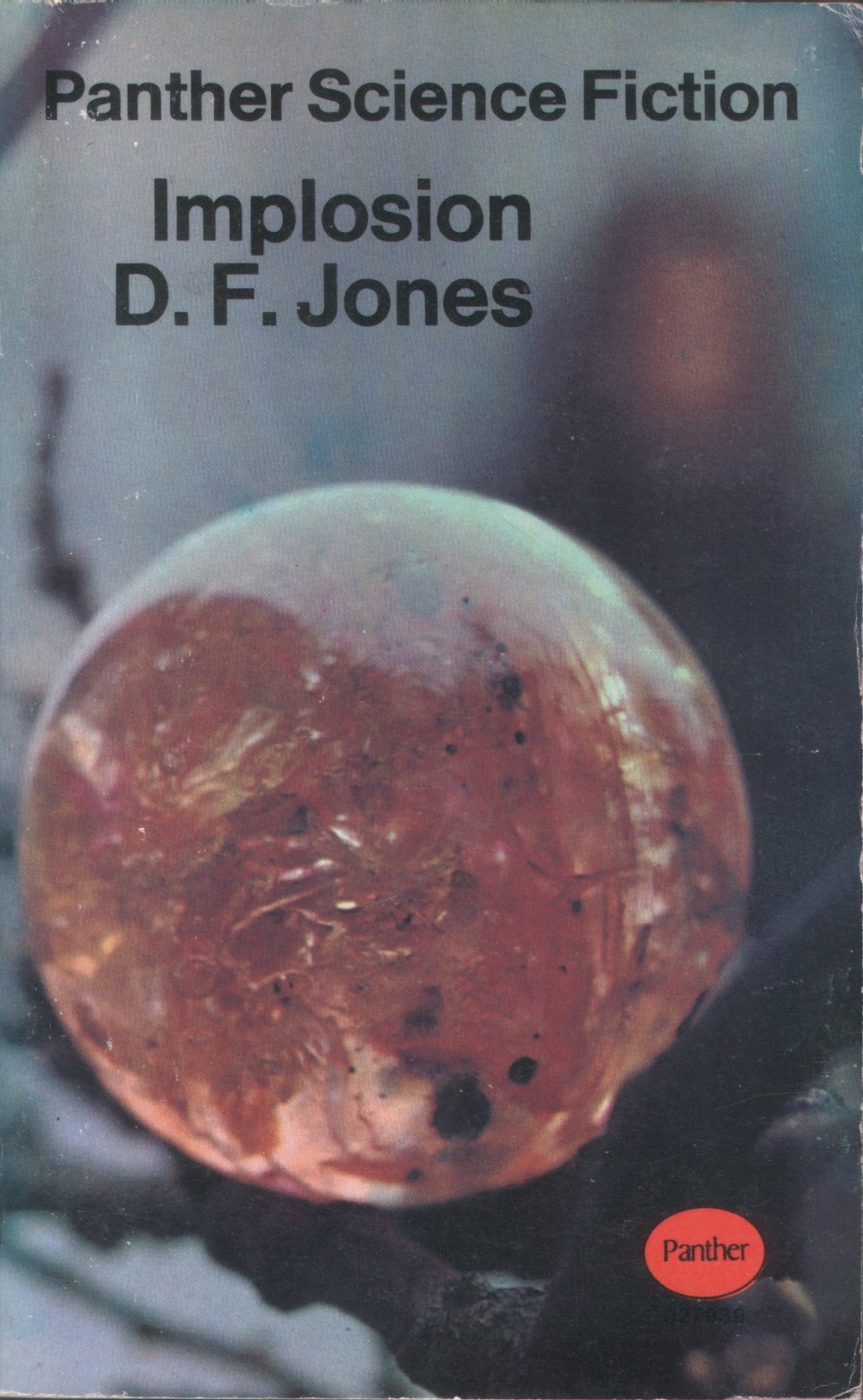
The SF Encyclopedia makes no real comment on the works of Dennis Feltham Jones, preferring instead to précis his novels. He is perhaps best known for his first novel, Colossus, which was filmed as Colossus – The Forbin Project. Implosion, from 1967, is his second novel.

An unnamed Eastern Bloc country develops a substance which renders women sterile. Because the nation’s premier is the illegitimate son of a British diplomat, he chooses to use this powder on the UK. Two years later, fully eighty percent of British females can no longer ovulate. The country’s population begins to fall, and is calculated to hit around five million by the mid-1980s. A government with far-reaching powers and a mandate to fix the problem is voted into power. All the fertile women are put into camps to become baby machines. Children are put in National Schools, where they are kept safe from harm and educated to as high a level as possible. Villages are demolished, and towns abandoned, when their populations fall below sustainable levels.

In charge of all this is John Bart, the Minister for Health and Regeneration. His wife Julia proves to be one of the rare fertile women, and is packed off to a camp. Meanwhile, the government tightens its grip on the country. After a raid on the lab which developed the powder, the Brits reverse-engineer it but can find no cure. They publish the formula, so that now everyone has it. Naturally, other countries soon find themselves in the same situation.

Meanwhile, Julia has come to realise that the regime in the fertile women’s camps has turned nasty. Women are whipped for the slightest infraction, such as smoking (even when not pregnant). She escapes… and discovers that the world outside is very different to what she had been told. She finds her husband, who is still the number two man in the government, and likely soon to be the number one, and learns that he is now shacked up with her twin sister. The twins turn on one another, Julia gets sent back to the camp, and that’s that. Except Nature has one final trick up her sleeve…

There’s a very 1960s British po-faced earnestness to Implosion. The characters are exemplary – Bart himself is young and noble and brilliant at organisation and making decisions. His wife is beautiful and loving and a true soulmate. Or at least, she starts out like that. Even their lady who does is a treasure. The prime minister is a hearty man of the people, straight-talking and more than willing to do the necessary. The Britain of the story appears pretty much the same as the Britain of 1967. Even though it begins in the early 1970s, the currency is still pounds, shilling and pence.

Implosion reads like a novel in which the author had a good idea and then set out to show clever he was in solving it. Its politics are simplistic, as is its view of the British people. The Barts are very much the “right sort”, and what few working class people do make an appearance are viewed with all the patronising indulgence of the privileged. Implosion is not a cosy catastrophe – there’s more brandy drunk than tea, for one thing – but it is peculiarly English. Perhaps it could be called a “Mayfair catastrophe”. That’s what it feels like, a black and white 1960s television Play for Today with a cast speaking in cut-glass accents, while around them the world they don’t much care for slowly falls apart…

So, not a British sf masterwork, then.

(And no, I’ve no idea what that blobby thing on the cover of the book is supposed to represent.)


Leave a comment

Robopocalypse, Daniel H Wilson

Robopocalypse, Daniel H Wilson
(2011, Doubleday, $25.00, 347pp)

Daniel H Wilson has a PhD in Robotics. He is also the author of How to Survive a Robot Uprising, among other books. He’s the go-to guy when American television needs an expert on robots. Almost every book he has written has been optioned – including this one, Robopocalypse, his first novel for adults. In fact, the film rights were sold before the book was even published.

This is a well-worn narrative, and it’s the story of the book rather than the story in the book which often generates more interest. When six-figure sums are bandied about for a genre novel, its quality is beside the point. Such books cannot depend on genre readers to recoup their outlay. They have to break out – and an author with celebrity status is needed provide the slingshot required. Robopocalypse will be a successful book, but not from any quality intrinsic to it as a novel qua novel.

So it should come as little surprise that, as a novel qua novel, Robopocalypse is not a satisfactory read. Sometime in the near-future, a scientist accidentally unleashes an Artificial Intelligence. Over a period of a couple of years, this AI, Archos, reprograms all the world’s robots to turn on human beings, and so a war begins. Robopocalypse opens with a human combat team finding a device, built by the robots, which appears to contain eyewitness accounts to various incidents which took place during the Robot War. These incidents become the chapters of Robopocalypse, and each one is introduced with a blurb from the device’s discoverer.

This novel, then, is not a narrative but a collection of vignettes which, together, create a story-arc of sorts. Some of these vignettes are more successful than others. When the story is set in the US, Wilson handles his voices well, though there is a tendency to lionise his protagonists. However, one series of chapters is set in London, and it appears Wilson learnt his British accent from watching Guy Ritchie films. Another features a mild-mannered technician in Tokyo who later proves to be a genius. These are not ordinary people, though the structure of Robopocalypse would have you believe they are representative of the human race.

Given the author’s credentials, the one area in which you’d expect Robopocalypse to shine would be its science and technology. But even these elements were so clearly written with an eye toward cinematic visuals they often appear implausible. Automated cars in New York, for instance, go on a killing spree. But this makes little or no sense – the computing power necessary to turn a car into a weapon which can target moving pedestrians simply wouldn’t be built in. Wilson also has a tendency to project emotions onto the robots, as if anthropomorphisation would make them a more implacable enemy. Being a roboticist, he should know better.

Robopocalypse is a novel powered by two things, both external to the text. It reads as though it has been written to facilitate its transformation to another medium, the cinema. Hence the soundbites and pithy blurbs which open each chapter. Likewise the framing narrative, which implies a level of rigour the novel too often exceeds: the claimed sources for each chapter – CCTV footage, recorded interview, etc. – do not possess the level of detail or insight the writing displays. However, it is not all bad. Some parts of Robopocalypse are quite effective, and Wilson does a good job of describing the collapse of US society and the destruction of the nation’s infrastructure. Having said that, there’s little point, to be honest, in reading the book. Spielberg is all ready working on the film adaptation. You might as well wait for that: the visuals are likely to remain unchanged, but at least the story-arc will have been distilled down into something much more potent and satisfying.

This review originally appeared in Interzone #236, September-October 2011.

Note: the film mentioned in the review is due to be released in 2014, but as yet no cast members have been attached.


6 Comments

Science fiction traces

I firmly believe that a reading diet of only genre fiction is bad for you. It’s the equivalent of trying to live off junk food. For a writer, it’s even worse, perhaps even dangerous – certainly, it’s detrimental to their career. I used to break up my consumption of genre with modern literary fiction novels, though I’ve increasingly found I much prefer postwar fiction, especially British – Lawrence Durrell, Malcolm Lowry, Paul Scott, and the like. But I do still read some of the better-known modern literary fiction authors, even if their novels have proven somewhat samey in recent years.

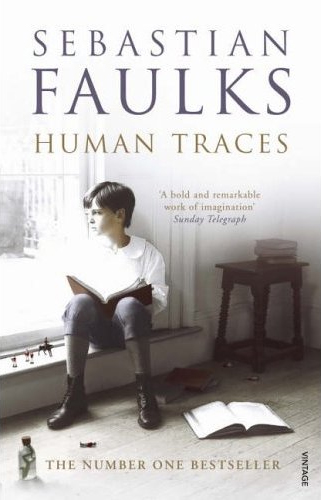
One of those literary fiction novelists is Sebastian Faulks. I recently finished his Human Traces (2005), which is about the early years of psychiatry. Sort of. It begins in 1876, with the introduction as boys of its two main characters, Jacques Rebière in France and Thomas Midwinter in England. The two meet when in their early twenties, become great friends, qualify in medicine, and open a sanatorium in southern Austria. Later, the two disagree over the direction the nascent science of psychiatry should take, beginning a feud which only ends after the First World War.

Human Traces is historical fiction. Its characters are invented but a number of real historical figures make appearances. It is about a variety of mental conditions, their historical diagnoses, and what we now know them to be. (Most asylums in the nineteenth century, for example, were filled with syphilis victims.) But Human Traces also contains at its core a very science-fictional idea.

Some three-quarters of the way through the book, Midwinter proposes a theory to explain why some people hear voices. It is his theory that psychosis is inextricably linked to self-awareness, and that it is the advent of self-awareness which created human beings. Early humans, he contends, heard voices as a matter of routine. In a speech given at his sanatorium, he outlines his theory:

… of how man, after he had learned language, had been able to conjure instructive voices in his head; and of how, after the invention of writing and under the influence of huge population upheavals, the ability to summon such voices had become rarer. (p 497)

This theory had been inspired by a number of things – not the least of which was Midwinter himself hearing voices when younger – but it was on an expedition to Africa that it began to gel:

But how could men without consciousness – a modern sense of time, and cause and other people – have done this? Picture your shepherd far away in the hills with no sense that he is a man, no idea of time in which he can visualise himself and his situation… How does he know he must keep tending his sheep? Why does he not forget what he is meant to do – as an ape would forget? Because under the anxiety of solitude, under the pressure of fear, he releases chemicals in his brain that cause not sweating palms, or racing heart, though perhaps those as well – but the voiced instructions of his king. He hallucinates a voice that tells him what to do. (p 450)

Midwinter contents that language was not a development of self-awareness, that self-awareness did not lead to civilisation; but that language and civilisation both came into being before humanity had consciousness. It was only the development of writing which led to self-awareness. He references a number of mythologies in proof – the Ancient Greeks in conversation with their gods, God speaking to Abraham in the Bible, and so on…

It’s not a conceit which sits well as the core of a realist novel. Nor is it one which really stands up all that well to scrutiny. It’s an interesting idea, certainly, but perhaps better suited to the sort of thought experiment for which science fiction is best suited. We know that writing developed in Mesopotamia around 8000 BCE. It has been estimated that Abraham lived around 1800 BCE, and the Greek pantheon has been traced back to sixth century BCE Greece. So writing had been around for several millennia before the examples Midwinter gives to demonstrate his thesis. And for those thousands of years, if his theory is correct, humanity had not been wholly self-aware…

It doesn’t really work. The weight of history stands against it. However, it would make for an interesting creation myth for a fantasy novel; or, perhaps, first contact could be the trigger from one state to the other for an alien race in a science fiction novel. Aliens of differing degrees, or variable degrees, of self-awareness have been used in sf before – in Peter Watt’s Blindsight, the aliens are not conscious; in the GDW role-playing game 2300AD, one of the alien races increased their intelligence from normally very low levels as their fight/flight reaction.

Having said all that, there’s perhaps an interesting idea to explore at the intersection of Midwinter’s theory and the City Burners. Between 1200 and 1150 BCE, the Late Bronze Age civilisations around the Eastern Mediterranean collapsed. From what little documentary evidence that has been found, raiders from the sea – known as the Sea Peoples or the City Burners – invaded a number of city-states and destroyed them, propelling civilisation back to illiteracy. Imagine if those Sea Peoples had been Midwinter’s unconscious humans, driven by the voices in their heads to destroy those civilisations who, through the widespread use of writing, could no longer hear the voices…

There’s a novel in there somewhere, if someone wants to write it.