It Doesn't Have To Be Right…

… it just has to sound plausible


3 Comments

Reading diary, #42

Well, the promised catch-up with female authors didn’t exactly happen, so 2016 ended with male authors just slightly ahead of female authors. Women will probably take back the lead in 2017. That seems to be the way it works…
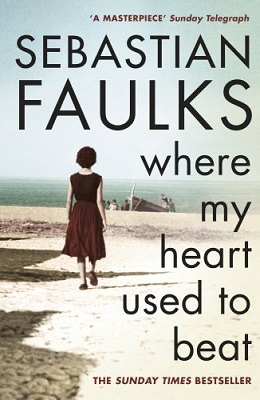
where_my_heartWhere My Heart Used to Beat, Sebastian Faulks (2015). I’ve read each of Faulks’s novels as they’ve hit paperback, and I’ve never really worked out why I fastened onto him as a modern author to read. I think he’s much better than McEwan, who managed a couple of stonkers early in his career, but then Faulks’s career has never really matched Birdsong… although I thought the story of Human Traces danced about a pretty interesting idea… And that same idea sort of crops up in Where My Heart Used to Beat. Faulks has… odd ideas about consciousness, and the historical origin of human awareness. In a science fiction writer, they’d be understandable, if not even defensible. But Faulks writes lit fic. In Where My Heart Used to Beat, which is set in the 1980s, a UK doctor is invited to a small French island to meet a famous neurologist at the end of his life and career. The neurologist wants the doctor to be his literary executor, partly because he commanded his father during WWI and holds a secret about that, and partly because the doctor’s career hints that he might be receptible to the neurologist’s Big Idea. The narrative dips in and out of the doctor’s life, mostly focusing on WWII, when he was involved in the Allied invasion of Italy. During that time, he met a young Italian woman and weas convinced she was the love of his life; but she turned out to be married, and he never really recovered. And it’s the concept of love, and Faulks’s previously trotted-out theory on inter-brain communication, that provides the substrate for Where My Heart Used to Beat. It’s a very readable novel – Faulks’s prose is never less than readable – and a more coherent one that his last couple… but it doesn’t have the… weight of Human Traces, and so its central premise dosn’t in the slightest convince. Faulks produces polished middle-brow material, and he does it well, much better than McEwan – but every time I read one of his novels I find myself wondering why I continue to read him. I still don’t know.
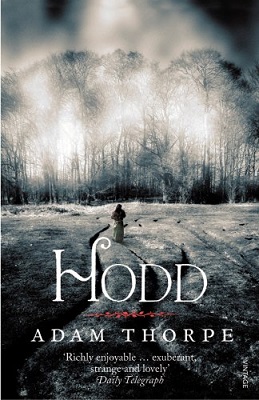
hoddHodd, Adam Thorpe (2009). I have made a habit of picking up Thorpe’s novels when I see them in charity shops and I’m not entirely sure why. True, Ulverton was very good indeed – an English village’s history described through a variety of narrative forms – but the collection Shifts was, to be honest, a bit dull. But I have three or four of his books, and I grabbed this one to read over Christmas. Which I did. I knew it was about Robin Hood, a legendary figure I feel somewhat protective toward, given that I was born in Mansfield, which was once within the precincts of Sherwood Forest (in fact, there’s a plaque in Mansfield which declares the “dead centre” of Sherwood Forest was once at that spot). On the other hand, I’m well aware that Robin Hood is as real an historical figure as Jesus Christ. And, much as I love the 1938 Technicolor movie The Adventures of Robin Hood, starring Errol Flynn in the title role, I know it has as much connection to real actual history as the Bible does – ie, none. Hodd is fiction, and clearly presented as fiction… but it’s also yet another version of Robin Hood. In this case, he’s a heretic who lives in the woods north of Doncaster, and his story is told as a manuscript, found by a British officer in a bombed-out church in Belgium during WWII, written by a ninety-year-old monk who was once “Much the Miller’s son” in Hodd’s band. It’s very cleverly done. There are footnotes by the officer who translated the manuscript, which explain some of the lesser known facts about mediaeval life (and also feature some editorial comments by him). The plot will come as no surprise to those who know the Hood legend, even if it’s only from the Flynn movie, and while Thorpe’s recasting of Hood as Hodd doesn’t seem to asdd all that much to the story, the way the story is presented definitely does. It put Thorpe back in my, so to speak, good books. Hodd is a clever and convincing historical palimpsest of a novel, and it’s a joy to see how well it is put together. Recommended.
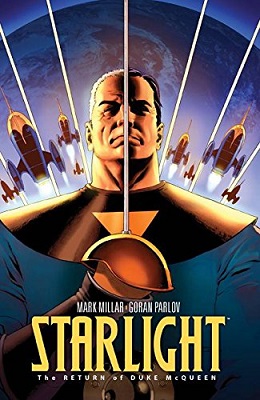
starlightStarlight, Mark Millar & Goran Parlov (2014). So many English-language graphic novels and trade paperback collections involve over-entitled fascists in Spandex costumes. And if it’s not superheroes, it’s noir. Like that’s a new thing. I wanted science fiction. But I spent a good while perusing the English-language shelves of Faraos Cigarer in Copenhagen, and there was very little that appealed. Starlight looked like it might – a test pilot is pulled to another dimension, defeats a planet’s tyrant, Flash-Gordon-fashion, and returns to Earth… only to be disbelieved by all and sundry, and so treated as something of a joke by friends and family. Forty years later, his help is required again, this time to overthrow invaders who have enslaved the world. So back he goes, only to discover his legend has grown to a level he couldn’t possibly match it, especially now he’s four decades older. The brutal occupiers also consider him something of a joke, and the populace too weak to rise up under his leadership. The art has a nice pulp sf sensibility to it, although the story seems unable to decide if its hero is pulp sf hero or a superhero. In fact, that’s not the only thing that’s a little confused, as Starlight tries to gives its story a modern spin while at the same time throwing in references to early sf serials. So, tonally, it’s a bit all over the place. Good in parts, though.
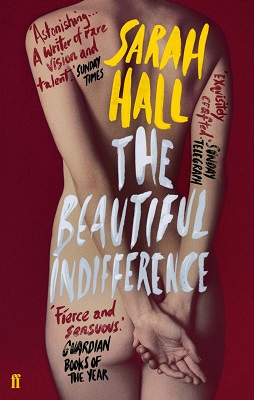
beautiful_indifferenceThe Beautiful Indifference, Sarah Hall (2011). Unlike some people I know, I’m not a fan of Hall’s writing – but then, her writing is very tied to her region – Cumbria – so much so that many of the stories in this collection are written in local dialect, or use local dialect terms. They’re good stories, they’re polished stories. There are seven of them in The Beautiful Indifference, some of which are set in Cumbria, one of which is set in Finland. They’re worth reading, although fans of her writing will get more from them than I did. I found this book in a charity shop, and I’ll continue to keep an eye open for her works, but I do find her prose a bit too much in your face for my taste. I like my fiction distant and bolstered by fact, and I find it hard to accept a facility with local dialect as a substitute for fact. Or rather, I appreciate fiction that includes elements which can be looked up on Wikipedia, and while Hall’s use of Cumbrian dialect is, as far as I know, accurate, it adds only a thin wash of colour to the stories, where a reference to a real event or thing defined in Wikipedia would add depth. But that’s a personal thing. Certainly, Hall is a good writer, and these are some polished pieces of work. Worth reading.
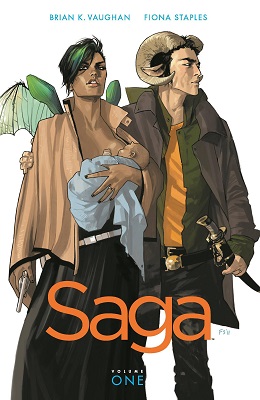
sagaSaga Volume 1, Brian K Vaughan & Fiona Staples (2012). Many people, many many people, have recommended this, and so I had initially avoided it. But there I was in Faraos Cigarer in Copenhagen, and I picked out Starlight as worth a read and all the graphic novels I really wanted were upstairs and by Moebius and in Danish… so I eventually succumbed and bought the first volume of Saga. I could have bought the Danish bandes dessinées by Moebius, of course, or even the hardback volumes of Valerian and Laureline, also in Danish, but it would mean learning a new language to read them, which seems daft when they’re originally French and that’s a language I can actually read (with a dictionary at hand, admittedly). Anyway, Saga… I didn’t like it. I really didn’t. It is allegedly a space opera, but there’s zero rigour to the setting, one side uses magic, there are a race of robots who have human bodies but TVs for heads, and people actually use mobile phones and apps. See, you have a man and a woman, from each side of a generational war – one lot have wings, the others have horns – and they have a child. Er, so why do you need science fiction to tell this story? I guess calling a race war story a “space opera” makes it more palatable to readers. And, of course, it means the story is not “politicized”. FFS. So there you have it: weak title, paper-thin allegory, paper-thin setting, and a total lack of rigour. Nice art, though.

1001 Books You Must Read Before You Die count: 129

1 Comment

Moving pictures, #69

The last Moving pictures post of 2016 (although it’s appearing in 2017), and I’m still slightly boggled by the fact I wrote 69 of these bloody things in twelve months. While I didn’t write about every film I watched, at 6 films on average per post, that’s still a big whole pile of movies. Some of them were good, some of them were bad, and some of them became favourites. Most of them I’m at least glad I watched. Let’s hope the same can be said during 2017.

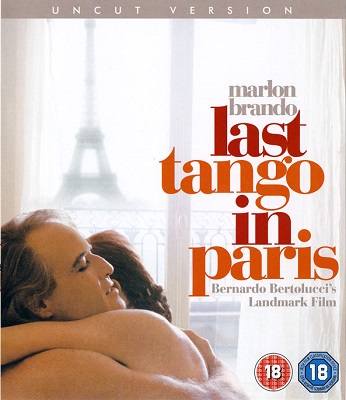
last_tangoLast Tango in Paris*, Bernardo Bertolucci (1972, France). I’m still convinced Bertolucci is just a gifted copyist, and Last Tango in Paris is just Bertolucci doing Nouvelle Vague, but with some very dodgy sex scenes. Okay, so the first clue is Marlon Brando as the male lead, an actor whose appeal continues to mystify me and whose adoption by Hollywood is quite baffling. The only thing to be said in his favour is he has shown a little more critical acumen than his colleagues in choosing the projects he worked on… But Last Tango in Paris is a blot on his copybook. It’s an “erotic drama”, which means there’s lots of simulated sex – and all involved have repeatedly insisted it was simulated – but lots of dodgy sexual politics. Even for 1972. Brando plays an American in Paris who owns a run-down hotel and whose wife has just committed suicide. He falls in with Maria Schneider, a carefree twentysomething Parisian. They have hot sex. Brando sets the rules and gets unreasonably angry when Schneider breaks them – sexual politics, 1972-style. There are lots of intense close-ups, New Wave style, and even that bit where Brando taps Schneider on one shoulder then pops around the other, doesn’t Azanvour do that in Tirez sur le pianiste or am I misremembering? The film sparked controversy on its release, but was a critical and commercial success. I’ve always known of it, of course, it’s like the first big mainstream “dirty” film that everyone of my generation knows about; the second is 9½ Weeks, which I saw back in the 1980s and I’m sure would be a major disappointment if I ever rewatched it. Of course, whatever reputation might have attached to Last Tango in Paris as far as a callow youth was concerned, that no longer holds true for me, and I took the film as I found it. And having seen it, and read up on the actual controversy regarding its making – it pretty much destroyed Schneider, those simulated sex scenes were as near as dammit to rape… it’s hard to consider it worthy of the 1001 Movies You Must See Before You Die list. To be honest, Andrzej Żuławski does it much better with l’amour fou as a theme, and at least manages such stories in a style all his own… Bertolucci, on the other hand, is a bit of chameleon, and while he certainly has an excellent eye – I’m thinking of both The Last Emperor and The Sheltering Sky, but there are many good shots in Last Tango in Paris – I’m not convinced the sum of Last Tango in Paris‘s good bits outweigh the extensive and less than salubrious baggage it carries.

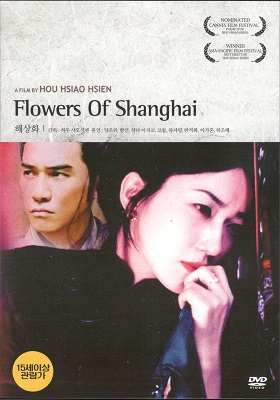
flowers_shanghaiFlowers of Shanghai, Hou Hsiao Hsien (1998, Taiwan). So I bought this “box set” – it was five DVDs in a cardboard box – because I wanted to see two of the films in it. But having now watched four of them, I’ve become a bit of a Hou fan, because he really is very good. Flowers of Shanghai is the most gorgeous-looking for Hou films I’ve seen so far, with perhaps the exception of The Assassin. The film takes place in four late nineteenth century brothels in Shanghai, and is divided into four sections, each named for the central courtesan of that section: Crimson, Pearl, Jasmine and Jade. The film chiefly consists of a static camera focusing on a group of people, courtesans and their most frequent patrons, and so telling the story of their lives and the realtionships between them, some of which are defined by those patrons. Plot-wise, it’s perhaps not the most gripping of stories, but if there’s one thing my travels in Hou territory have taught me it’s that he prefers to lay out his story in the incidentals. The dialogue defines the relationships between the characters, the mide en scène defines the setting, and the story comes out of the interplay between the two. So it’s just as well that Hou scores so highly on presenting his mise en scène, it is in fact one of his strengths as a director. He frames gorgeous shots because he has set up gorgeous shots – and Flowers of Shanghai shows that off to an impressive extent. I’m still not entirely sure why I bought the Hou “boxed set”, given that I’d only seen one of Hou’s films before, but it was a wise purchase. I now count myself a fan of his work and plan to purchase everything else he made – because, of course, only two or three are actually available for rental in the UK…

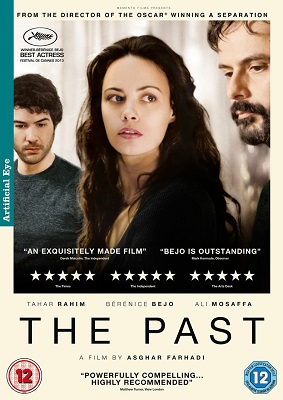
the_pastThe Past, Asghar Farhadi (2013, France). And from a new director I now admire to… well, Farhadi’s About Elly is a brilliant film, a clever drama/thriller and wholly Iranian. I loved it the moment I saw it back in 2013. His Fireworks Wednesday and A Separation were also very good. But The Past is, well, it’s not an Iranian film. It’s a French film. And it suffers as a result. It’s about Iranian immigrants in France, but their concerns, the plot, is all the sort of stuff that would drive a French film. I know the immigrant experience is important, and that documenting it is not only worthwhile but important… But, to a non-native eye I freely admit, The Past did seem to resemble more the experiences of non-immigrants than immigrants. If that makes sense. Perhaps it was a sense that the, er, sensibility seemed suited to the language and setting, when the nationality of the director and cast suggested it should have been otherwise. I firmly believe cinema is a powerful tool for documenting life across the planet, in all its manifest forms, in all its various societies and communities. That’s why I treasure world cinema. It provides an insider’s view. I’m not interested in a French-style drama that just happens to be made by an Iranian director and happens to feature a cast of Iranian extraction, because I’m more interested in seeing life as experienced by Iranians, yes, even Iranians living in France. Perhaps I’m doing The Past a great disservice, perhaps I’m completely missing a huge part of this film, but I’ve seen a number of Iranian films and I’ve seen a number of French films and to my eye this smelt like a French film. Which is not to it was a bad film – Farhadi is bloody good, after all – but I do prefer Iranian cinema to French cinema, and would rather this film had tended to the former than the latter…

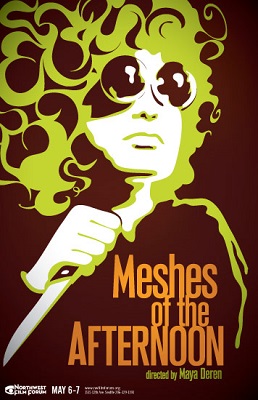
meshesMeshes of the Afternoon*, Maya Deren & Alexander Hammid (1943, USA). Most discussions of avant garde cinema often focus on US avant garde cinema, possibly because most European avante garde film-makers went on to become commercially successful, such as Luis Buñuel. And of those US avant garde films, Meshes of the Afternoon from 1943 is generally noted as one of the most seminal. While on the one hand the experimental films of Bruce Baillie and Stan Brakhage might fit into the commonly-held view of the history of cinema – it was the 1960s! everyone experimented! – but no one really expects the same of two decades earlier. Common sense dictates there must have been people experimenting with film in the 1940s just as much as there were in the 1960s (for the all the latter decades reputation for experimentation, etc.), but popular history tends to elide such experiments. Meshes of the Afternoon, which is on the 1001 Movies You Must See Before You Die list, is one such experiment whose reputation has withstood the test of time. I found a decent copy of Youtube and watched it there. And watching it, well, there’s a lot of Lynch in there, or rather, Lynch was clearly influenced by this film, if not others by Deren. A woman dreams about a hooded figure with a mirror for a face. She follows it along a path, but loses it. She returns home and finds a key. The key morphs into a knife. There are several versions of her sitting at a table. She sees the hooded figure in her bedroom. Some of this is a dream, some of this seems to be a re-enactment of something she dreamed. Unfortunately, I don’t know enough about avant garde cinema, and its history, in order to understand why Meshes of the Afternoon is considered so important. It’s good, certainly; but I’ve no way of judging its historical importance. Given the year… although Buñuel’s Un chien Andalou was released in 1929… there’s clearly some early importance there, and Deren went on to make more films and lecture extensively in film-making. Some of Deren’s other films are available on Youtube – I’ve watched one, At Land, already – and I think she has an oeuvre worth exploring… But with Benning, Bailie, Brakhage and now Deren & Hammid, this is obviously an area of cinema I need to spend a bit more time on…

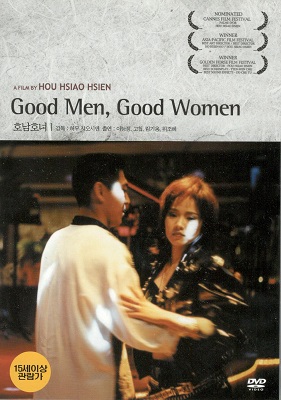
good_menGood Men, Good Women, Hou Hsiao Hsien (1995, Taiwan). That’s the last of the “box set”, so now I’ll have to get me some more Hou DVDs. This is the third film in Hou’s Taiwanese History trilogy, which also includes A City of Sadness (not seen) and The Puppetmaster (see here). Like the second, and possibly the first, it’s a biopic, this time about Chiang Bi-Yu, who left Taiwan in the 1940s to fight the Japanese in mainland China, and after WWII returns to Taiwan, becomes a communist and so comes into conflict with the Kuomintang regime. The film depicts Chiang’s life in black-and-white, but is interspersed with sections in colour documenting the life of the actress who plays Chiang in the film that is Good Men, Good Women… And I have to wonder if this is where Stanley Kwan got the idea for the structure of Center Stage (see here). Both are great films, of course; and it’s no surprise that China, and other areas speaking languages of the Chinese family, should produce movies that are more than kung fu actioners or gorgeous wu xia spectacles, but we rarely get to learn that over here in the UK… So mark both those films down on your list as superior films – even if, er, they’re not actually available in the UK or US.

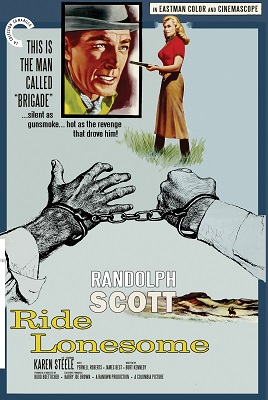
ride_lonesomeRide Lonesome*, Budd Boeticher (1959, USA). I couldn’t find a copy of this in the UK or US, so ended up buying a rip from someone on eBay because the film had passed out of copyright. Fortunately, it proved to be a good transfer – to be fair, most these days for sale on eBay are pretty good transfers. And as I started watching Ride Lonesome I sort of understood why it had made the 1001 Movies You Must See Before You Die list, but then the further into the film I got the less I understood why it had earned its place on the list. Partly that was down to Randolph Scott, the star, who seems a pretty solid centre around which to plot a Western story, but he does, well, have an unfeasibly big head, in fact, he looks a bit like a puppet. Some actors make great Western heroes – Gary Cooper, John Wayne, Jimmy Stewart… Randolph Scott just seems proportioned wrong. As for the story… He plays a bounty hunter, taking a killer to Santa Cruz, Arizona, to be hung. They stop off en route at a desert rest-stop – and the scenes set in and around that are lovely to look at and well played – and pick up a pair of freebooters, and the rest-stop’s widowed female owner, as companions. All of which leads to complications later. The story is not much, but this is a Western. The desert scene cinematography is very good, and I’d love to have seen it in full-on restored Technicolor. Later scenes, in landscape more familiar from Western television series, were less impressive. And the story’s final twist was not quite as unexpected as the story had suggested it might be. A good Western, I suspect, although I’m not so sure it deserves a place on the 1001 Movies You Must See Before You Die list.

1001 Movies You Must See Before You Die count: 842


Leave a comment

2016 in watching

I’ve posted my stats for my reading in 2016 – see here – so now it’s time for my film-viewing statistics… And yet again, I watched a huge number of movies over the twelve-months, partly because I was chasing the 1001 Movies You Must See Before You Die list, and partly because the dayjob gave me mlittle energy or enthusiasm for much else of an evening. (For my best of the year movies, see here.)

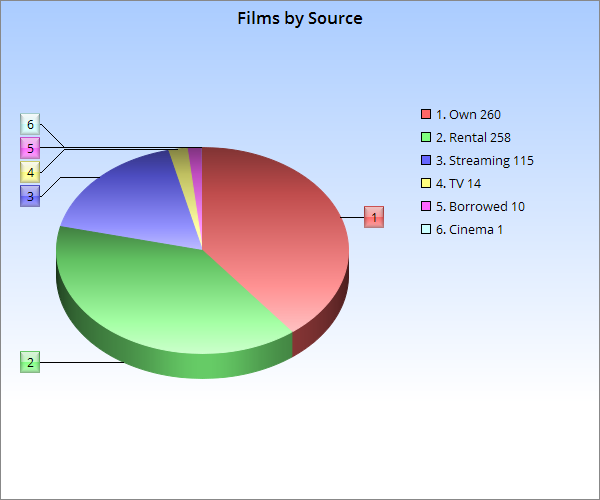
In 2016, I watched 647 films, up by more than 100 from 2015’s total of 544. Of those 647, I saw 574 for the first time, and 140 of them were from the 1001 Movies You Must See Before You Die list. That’s… more than I’d expected. But I did watch a lot of short films, I must admit. Some of the one hundred or so rewatches were films I watched more than once during 2016, for a variety of reasons… Some, such as Tirez le pianiste, a rental film, I felt I hadn’t given a fair viewing so I watched the DVD a second time before returning it. Others, like Lucía, I’d watched on rental and liked so much I bought my own copy, which I then rewatched. And one or two films, I’d stick on and watch over again when I’d had a bit too much wine – so that would be, er, A River Called Titas, which I managed to watch six times between June and December 2016…

In terms of where I found the films I watched, it appears to be a pretty even split between DVDs/Blu-rays I bought myself and DVDs I rented from LoveFilm and Cinema Paradiso:

2016_films_by_source

Given the number of cable channels I have access to, TV’s showing is piss-poor; but Amazon Prime, the only streaming service to which I currently subscribe, did pretty well (the “Streaming” figure does also include a dozen films watched on Youtube; most of those were avant-garde short films).

2016_films_by_genre

I’ve never been that big a fan of science fiction cinema, so the fact it comprises 4% of my total viewing comes as no suprise. On the other hand, I do tend to label most films as “drama”, which is probably why it accounts for around 40% of my viewing. There’s also a significant percentage of short films in there – no doubt a consequence of watching those three DVD collections of Humphrey Jennings’s films.

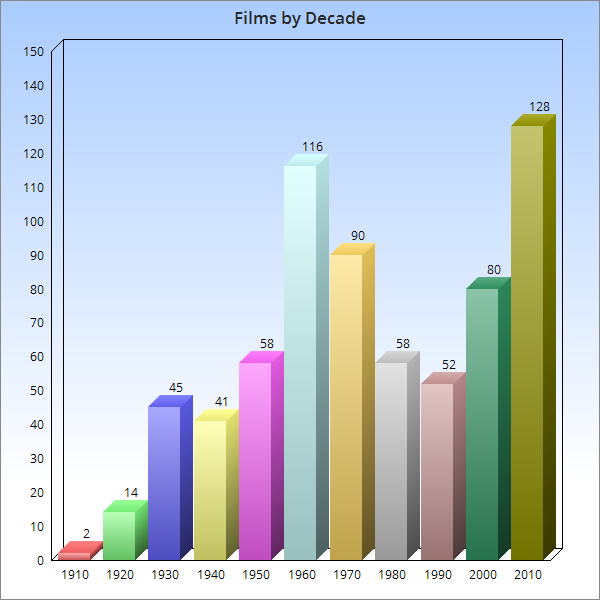
2016_films_by_decade

Despite never actually meaning to, I always seem to end up watching more movies from the current decade than any other… although the 1960s almost matches it. That came as a surprise – I hadn’t realised I’d watched so many films from that decade. The remaining movies are spread somewhat erratically across the decades, although the graph does show I’m watching more classic movies than current ones.

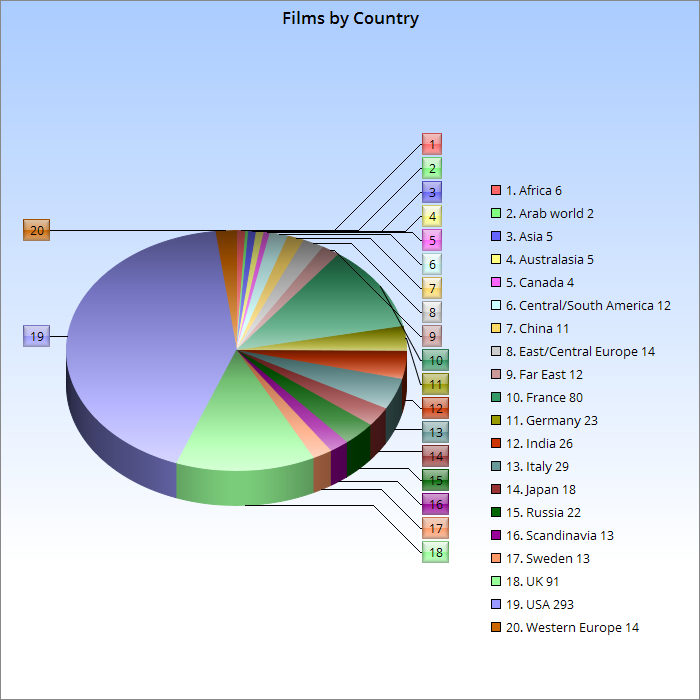
2016_films_by_country

I made an effort in 2016 to watch more movies from countries whose cinemas I had not seen before. And I managed it. But putting them all on a pie chart would make it unreadable, so I had to group a lot of countries into regions/continents. Happily, the US only accounts for 42% of the movies I watched, which is less than the previous year. I plan to reduce it further in 2017. Next highest is the UK, followed by France, Italy, India, Germany, Russia and Japan.

As for the directors I watched most in 2016… the top five looks like this:

  1. Humphrey Jennings – 27 (all those short films in the three DVD collections I bought)
  2. Jacques Demy – 19 (I worked my way through a box set of all his films)
  3. Werner Herzog – 11 (I replaced my two DVD box sets with a single Blu-ray collection, and then worked my way through it)
  4. Ingmar Bergman and Aleksandr Sokurov – 8 each (the Bergmans were all new to me, the Sokurovs were a mix of rewatches and new films)
  5. Jean-Luc Godard, James Benning, Howard Hawks – 7 each (Godard and Hawks were all new to me, the Bennings were a mix of rewatches and new films)

So that’s a Brit, two French, a German, a Swede, a Russian and two Americans. Not a bad mix. Sadly, no women directors. Unhappily, I’ve watched very few films by women directors, and I really should make an effort to watch more – non-US ones, of course (unless they’re avant-garde film-makers, that is).

In fact, there are a number of things I’d like to do in my film watching in 2017. For a start, I plan to watch more foreign-language films, and have already adjusted my rental lists accordingly. I also intend to continue working my way through the 1001 Movies You Must See Before You Die list – and why not, since it’s introduced me to several films and directors who subsequently became favourites. I doubt I’ll ever really finish it, but when it gets too difficult to complete, there are plenty of other such lists I could try – They Shoot Pictures Don’t They have one with 2,000 movies on it (and at first sight, it looks like a more varied list than the one I’ve been using).

Having said all that… if I manage to get some writing done in 2017, then something will have to give, and I’m quite happy for it to be my film-watching. Much as I love movies, 647 in twelve months is a fuck of a lot. If that drops to around 300 this year, I won’t be at all upset… providing I have some actual written fiction to show for it. At the very least, I don’t expect the figure to rise during 2017…


2 Comments

2016 in reading

I’ve already done my best of the year post – see here – but until the year is actually over I never know how I’ve been reading – total number of books, by genre, by decade, by gender, etc… Well, 2016 is well and truly over, and I’ve been doing some number-crunching.

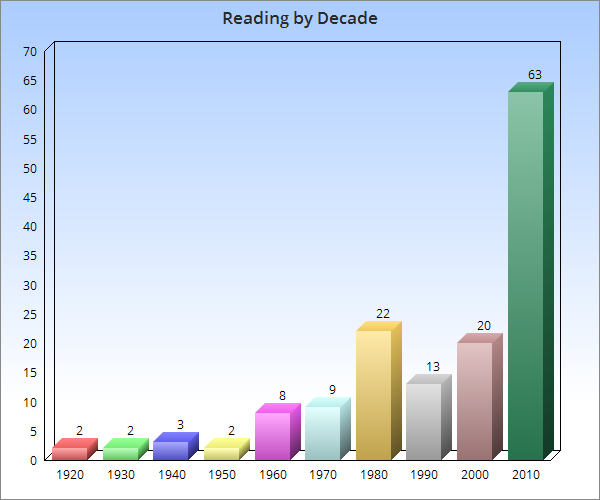
I read 144 books in 2016, just missing my Goodreads Challenge target of 150, and down from last year’s total of 152. I put this down to the fact I picked several weighty books to read during the year, although, to be fair, I don’t think I was reading as much as I did in 2015 anyway. Of those 144 books, the bulk were published this decade – 63, in fact, so slightly less than half. The rest were scattered across every decade from the 1920s onwards. The graph looks like this:

2016_books_by_decade

It doesn’t look much different to 2015, to be honest, although the 1970s scored a little higher then.

For the last couple of years, I’ve been trying to keep my fiction reading split evenly between male and female writers. In 2016, men just pipped women at 34% to 32%. The remainder were anthologies, graphic novels and non-fiction:

2016_books_by_gender

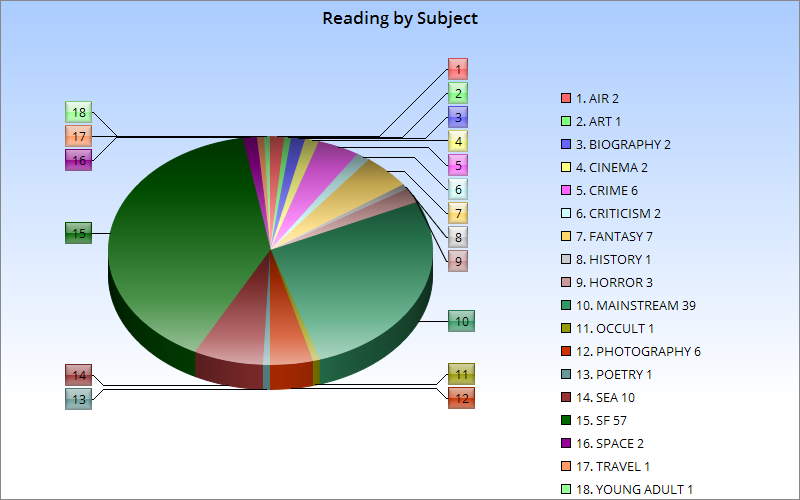
And subject-wise, science fiction still forms the majority of my reading, although it’s less than half at 40% (down from 47% last year). Mainstream takes second place at 27% (up from 23% last year). The single Young Adult title was from my reading of the underwhelming 2016 Clarke Award shortlist.

2016_books_by_subject

At the end of 2015, I’d planned to read more mainstream and less sf in 2016, so that was one target met. But I also wanted to read more non-fiction, particularly criticism, space exploration and deep-sea exploration – but that I failed to do.

I also worked out my reading by nationality of the writer. I discounted anthologies, because while their contents could be from a single nation, many are not. I had expected the US to be the source for much of what I’d read, but it turned out to be the UK – 40% to the US’s 35%. I seem to recall the same happening last year. Next highest was Germany, with 4% (that’ll be those Jenny Erpenbeck books, then). Other nations include: Argentina, Canada, China, Denmark, Norway and Spain, among others.

2016_books_by_country

Compared to 2015’s reading, this is a distinct improvement – not only a few more more countries, but also more titles that weren’t from the UK or US. I plan to read more translated fiction in 2017, so I expect this chart will look very different this time next year.

Reading books, however, is only, er, half the story. Books, after all, do not magically appear out of thin air – well, I guess ebooks do, but I much prefer hardbacks and paperbacks. I didn’t keep every book I purchased in 2016, however – some of those I picked up from charity shops, I donated back after I’d read them. In total, during 2016 I bought 150 books I’d not previously read… which means the To Be Read pile increased by six books, except… I got rid of a few books I’d never got around to reading, and likely never would, so the TBR actually shrank by twenty-two books. (At that rate, it’d take me about 50 years to completely read my TBR.) Of the books I purchased, it’s about a 50:50 split between bought new and bought secondhand, but only 21 were actually first published in 2016. I’ve no plans to change that in 2017 – I certainly don’t choose my reading based on the shiny new, and, to be honest, and a lot of the currently popular genre stuff doesn’t take my fancy at all. So I shall continue explore the oeuvres of those writers I like and seek out books by writers new to me, from whatever decade, whose works are more tuned to my tastes. And, hopefully, I’ll make a bigger dent in the TBR over the next twelve months…


Leave a comment

Moving pictures, #68

Half of the films in this post are from the US, but then one of them I did actually see at the cinema. It’s become a bit of a tradition over the last decade to go see something at the cinema during the Christmas holiday, and that usually means something genre and very commercial… like Star Wars. And this year, it was Rogue One.

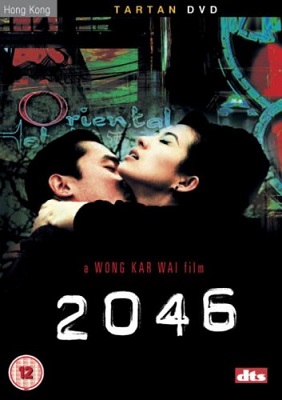
20462046, Wong Kar-Wai (2004, China). I bought this years ago, along with In the Mood for Love, when they were originally released in the UK on DVD – both as special editions in cardboard sleeves. I’ve no idea why. Somewhere I’d come across the director’s name, possibly in Sight & Sound, and picked up his two latest films… and while I’d clearly liked them enough to hang onto the DVDs, I’d not rewatched them until recently. And… my, 2046 is gloriously self-indulgent, isn’t it? It rehashes the plot of In the Mood for Love, with the same actors, but set in the titular year. Kar-Wai sets his scene through the use of neon-soaked montages, a combination of special effects and live photography, and it’s very effective. The actual set dressing is a little dated, although clearly not meant as an entirely serious attempt to present a real 2046 CE. Certainly 2046 is one of those films that doesn’t so much tell a story as provide a feast for the eyes. I’ll be hanging onto my copies of In the Mood for Love and 2046, I think. I also need to watch more Wong Kar-Wai, I think.

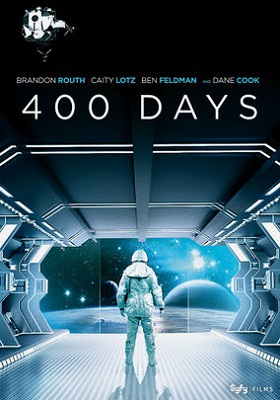
400_days400 Days, Matt Osterman (2015, USA). Some films look good on paper, but fail to live up to their promise. This is a classic example – although it tries hard. Four astronauts are consigned to a simulated space mission for the eponymous period of time in an underground replica of a spacecraft. Rather than build a simulator in a nice controllable environment, like an aircraft hangar, which is what most actual experiments of this type do, in the film they bury their fake spacecraft in a field in the middle of nowhere… Despite this, it all goes well for about 200 days. Then they start to turn psychotic, but that turns out to be caused by a fault in the environmental system. Then someone breaks into the “spacecraft”, and they lose touch with “mission control”. So they climb out of their simulator… and discover a post-apocalyptic world. Apparently, while they were on their mission, an asteroid hit the moon, and a vast quantity of pulverised moon dust dropped into earth’s atmosphere, causing a nuclear winter. However, two of the astronauts think this is all part of the simulation. The other two are not so sure. The film doesn’t resolve itself either way. 400 Days tries hard, but never quite convinces. The simulator in no way resembles a realistic spacecraft, and burying it in a field is just daft. The final scenes try so hard not to resolve the set-up, they end up setting a completely different tone to what’s gone before. This is a film that wants its cake and to eat it too, but manages neither. Avoidable.

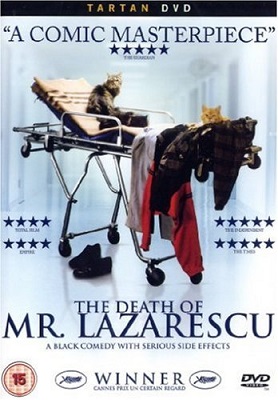
death_lazarescuThe Death of Mr Lazarescu, Cristin Puiu (2005, Romania). Some films, on the other hand, don’t work on paper, and should not work on the screen – but somehow manage to. This is a classic example. An old man with a drink problem and past medical problems needs to go to hospital because he feels ill, but gets taken from hospital to hospital – in Bucharest – by the ambulance, because none of the hospitals will accept him. This is a black comedy. Ten years from now, it could be reality. In the UK. Thanks to scumbag Tories. Lazarescu complains of an upset stomach, and blames it on a prior condition. It gets more serious, his neighbours get involved, an ambulance is called for. And then the ambulance, and the paramedic who is taking care of Lazarescu, is bounced from hospital to hospital. Because he drinks, he is seen as less deserving of medical care – and since when did lifestyle become a barrier to healthcare? What next? Skin colour? Nationality? True, drinkers are more likely to suffer from certain conditions – but that doesn’t make drinking the cause of everything they might suffer. And healthcare for all is healthcare for all. Romania was, nominally, a socialist nation, but seriously who thinks the Ceaucescus were an actual socialist regime? Which is not in the slightest bit relevant, as Romania has an apparently quite efficient health service, it just failed the title character in this case – and more for effect, I hope, than an actual representation of the current state of affairs. Despite that, a good film and definitely worth seeing.

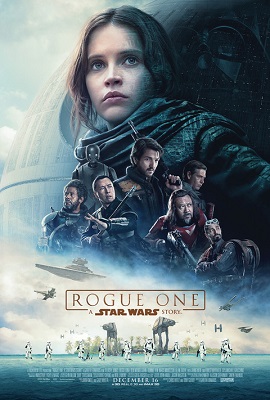
rogue_oneStar Wars: Rogue One, Gareth Edwards (2016, USA). Unlike The Force Awakens, I went into Rogue One with no particular preconceptions – this was not a prequel or sequel or midquel, it was a story set in the same universe as the two Star Wars trilogies. Except, of course, it turned out to be a midquel – although it retconned details I hadn’t even known, given that I’m supremely uninterested in EU Star Wars… Anyway, I took Rogue One as I found it, and I even sort of ignored the various moment of fan service as the sort of dumb frills the story didn’t need but the marketing department had insisted on including. And, as a result… it wasn’t bad. It wasn’t great, by any means. But it wasn’t bad. A science officer who walked away from the empire is tracked down and forced back to work – building the Death Star. Because, of course, the Death Star could only be designed by one man. But his daughter escaped and has become a bit of a freebooter. But now the rebels want her because she’s a link with an extremist group led by Forrest Whitaker and he has an Imperial pilot who has defected and wants to deliver a message to the Rebel Alliance. The message is from the science officer. Cue reluctant hero, lots of heavy-handed Imperial enforcement, and some eye-popping visuals. But, as with all of the Star Wars films, the story logic falls down in several places. We’re supposed to believe the science officer deliberately built a flaw into the Death Star (you know, that bit at the end of the first ever Star Wars film), but, well, couldn’t he have made it a bit fucking easier? And then there’s the Empire’s love of “master switches”, which are usually sited in some totally random place because of course where else would you put it? And an archive of technical plans that isn’t accessible over the network? What use is it, then? It’s like something out of an IBM catalogue from 1988. And how come the rebels could talk to the ships in orbit through the shield, but they couldn’t beam the data out? How does that work? Oh wait, made-up bollocks. Of course. In hindsight, The Force Awakens feels like a canny way to open Disney’s management of the franchise – a giant cheese-fest of fan service with a plot that reiterates the original, and parades all those beloved favourites in all their aged glory across the screen – because, hey, cultural icons turn wrinkly too, or rather, that actors who play them, and get paid to do so, turn wrinkly and, sadly, die. Which, also sadly, ties back into Rogue One and its two turns by CGI actors – Peter Cushing, who died in 1994, and a young Carrie Fisher, who even more sadly died only last month. Neither looked quite real – close enough to be very creepy, anyway. I suspect Rogue One is a good example of what we can expect from Disney in the Star Wars universe: feature-film-length episodes of a long-running series, with a story arc that retcons itself and tangles itself up so completely as it progresses that by 2050 it’s not going to make the slightest bit of sense to even the most ardent of Star Wars nerd. Still, who knows, by then we could have moved past post-truth to a post-narrative world…

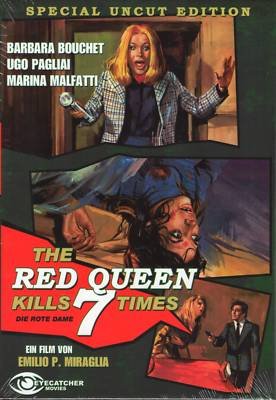
red_queenThe Red Queen Kills Seven Times, Emilio Miraglia (1972, Italy). Is this a giallo? I think this is a giallo. Although it’s more like supernatural horror than a detective story. Two sisters, one blonde and one brunette, do not get on. The blonde accidentally kills the brunette, as you do, when they’re teenagers. Many years later, the father dies and his will is held in probate for a year. Because there’s a family legend that the Red Queen will return and kill seven family members, and look!, people are getting murdered in horrible ways. All the clues seem to point to the brunette sister, who everyone has insisted is living somewhere in the US, but yup, her body is still down in the cellar, where the two surviving sisters hid it. There’s a twist, of course, maybe even two or three. To be honest, I only watched this a couple of days ago as I write this and I’m having trouble remembering the details. Barbara Bouchet, as the blonde sister, is very watchable, but it must have been about two-thirds into the film before I even noticed it was set in Germany (everyone speaks Italian, of course). It’s all very silly, one of those films pretty much defined by the bright-red fake blood they use on, er, films of this type. The final scene, in which Bouchet is trapped in a room in the cellars which begins to fill with water – deliberately, it’s a trap – is a cleare reference to The Phantom of the Opera, or perhaps to one of the zillions of films which ripped off the idea from The Phantom of the Opera, but it does make you wonder why they built a room in the cellars of the castle that could be filled with water… A fun night in, providing alcohol is involved.

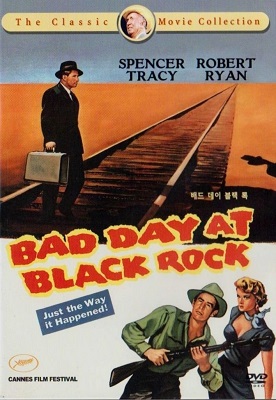
bad_dayBad Day at Black Rock*, John Sturges (1955, USA). This is apparently not available on DVD in the UK or US, which is a surprise. Fortunately, someone on eBay was selling a Korean copy they’d bought for a cheap price – not that I realised it was a Korean release until I received it. But it was an excellent transfer – and it need to be, because this is Technicolor in all its, er, technicolour glory. The film is set in 1946. Spencer Tracy plays a stranger who appears at titular town, looking for a Japanese man. The locals don’t take kindly to his questions. But that’s because they killed the Japanese man during the war, because he was Japanese and they are racist. Parts of the plot of Bad Day at Black Rock were very reminiscent of Rio Bravo from 1959, although that would require a temporal paradox, and, to be fair, the plot of Rio Bravo was so good Howard Hawks used it at least three times himself. However, the film that Bad Day at Black Rock most reminded me of was Violent Saturday, another Technicolor thriller and absolutely gorgeous to see, although Bad Day at Black Rock‘s desert scenery didn’t really lend itself to the format. But it’s a good thriller, sort of noir without being noir, and looks great, even if some of its performances are a bit over-egged (Ernest Borgnine, for example). Some of the 1001 Movies You Must See Before You Die I’ve had to buy legal rips or foreign-language DVDs because they’re not available in the UK or US… and most, I’ve no desire to keep. But this one is a keeper. A good film.

1001 Movies you Must See Before You Die count: 839


2 Comments

Resolutions

At the beginning of every year, it is traditional to document a number of promises you will prove incapable of keeping throughout the following twelve months. But at least you mean well, or you wouldn’t be making such promises. They are, after all, meant to be improving. This is not a bad word, as some seem to think. We should improve ourselves. All the time. And New Year Resolutions (I apologise for the caps) are a good tool for doing so. But. They work better when they’re achievable, when they’re in your own gift, so to speak. It’s true, “I will sell a novel in 2017” could happen, but it’s someone else who makes the purchasing decision, no matter how much you network or self-promote…

And it’s precisely those sorts of personal target I’ve decided to set for my own resolutions in 2017:

  1. I will write more fiction. 2016 was not a productive year for me, thanks to the dayjob. That situation hasn’t changed – if anything, it’s likely to be worse. But I still want to make more time to write fiction. And finish off the third book of my space opera trilogy. I have plenty of ideas for stories, I just need to start putting pen to paper…
  2. I will watch more non-Anglophone movies than English-language ones. This one is relatively easy to implement – I’ve already changed my Amazon rental list so I get sent two world cinema films for every one Hollywood film. I just need to stick to it. I will, of course, continue to write about the films I’ve seen on my blog.
  3. I will read more widely in terms of geography. A few years ago I tried a “world fiction” reading challenge, and read a novel from a different country each month. I managed six months before it fell apart. In 2016, I read Erpenbeck, Mallo, Borges, Calvino, Müller, Blixen, Liu, Knausgård… all translated works. I’d like to read more books from more countries. I have a bunch of Arabic translated fiction sitting on my bookshelves, and a list of authors from various nations I’d like to try – most, sadly, non-genre. So I plan to go for it in 2017. I might even tackle some fiction written in another language (with a dictionary to hand). I’ll still maintain a gender balance in my reading, of course.
  4. I will write more non-fiction. I have… thoughts about science fiction. Some of them I’ve documented on this blog. I have also seen the genre change in the decades since I first started reading it. And those changes have been both good and bad. The “genre conversation” at present is a weak and feeble thing, partly propped up by the marketing departments of assorted genre imprints – I recently saw a small press magazine tweeting requests for support for authors published by a major genre imprint, WTF. The genre is in serious needs of its conversations, and it also needs to hold off on all those five-star reviews… I cannot change this, I do not have that power. But I can start writing about science fiction in a way that I think science fiction should be written about. This, I freely admit, is going to be the hardest resolution to keep.
  5. I will start reviewing again. Thanks to the dayjob I sort of dropped out of reviewing books for both Interzone and Vector. In fact, I sort of dropped out of contributing to pretty much anything. I shouldn’t have let that slide, and promise to get the two reviews I owe done as soon as I can.
  6. I’ll figure out what I’m going to do with Whippleshield Books. I set up Whippleshield Books so I could publish the Apollo Quartet, but I’d always planned to publish material by other writers. Unfortunately, my one attempt to do so – the anthology Aphrodite Terra – was pretty much ignored by everyone. Even the collection I rushed out for the Eastercon in 2016, Dreams of the Space Age, has sold only a handful of copies. Selling, and promoting, books required far more energy and time than I could devote to it last year, and much as I’d like to keep Whippleshield Books running in 2017 I’m not convinced I can give it that time and energy. I certainly don’t want to use it to publish only my own stuff – I have a collection of stories I’d like to see print, for example, but I’d sooner someone else published them.

I think that’s enough for now. I don’t want to get too ambitious. I didn’t even bother with any resolutions for 2016 – oh, except for one, the Reader Harder Challenge. But I promptly forgot about it, and seem to have read 13 of the 24 types of books in the challenge more by accident than by design. Anyway, the above half-dozen above are vague enough I should be able to a) remember them, and b) make a serious attempt at following them.

vintage-library

Of course, no one knows yet what 2017 will throw at us, although Brexit and Trump will certainly have major impacts. And not for the good. But there’s not a fat lot we can do about those since in the twenty-first century democracy apparently no loger means rule by the majority. We are in the hands of the Super Greedy, and they will take it all, even if it kills people, even if it crashes the global economy or the climate. If we survive 2017 more or less intact, it will be in spite of Trump and May, not because of them… And on that cheery note, I need to go finish off my last two Moving pictures posts of 2016…


5 Comments

Reading diary, #41

An odd selection this time around. I normally like to plan my reading but the following were all pretty much random choices, grabbed when I needed a fresh book for my morning commute. Well, all except the last one, of course.

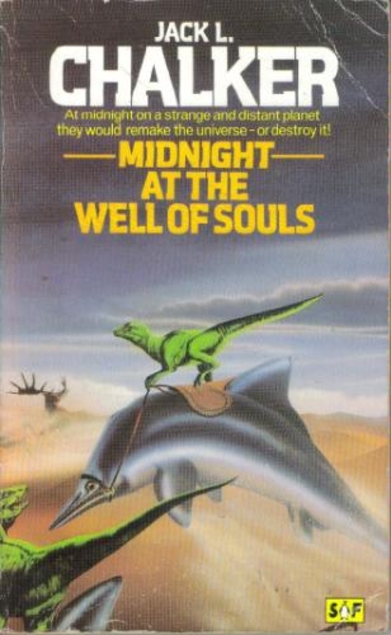
midnight_wellMidnight at the Well of Souls, Jack Chalker (1977). I’ve had this series on my bookshelves for several years and I’m not entirely sure why. I think Chalker was an awful writer, slapdash, fixated on a handful of not very original ideas, and content to pad out the thinnest of stories to trilogy, and longer, length. I don’t think he wrote a single good book, but he does have legions of fans. Which, I guess, makes him much like every other science fiction author. Anyway, Midnight at the Well of Souls is the first book in Chalker’s The Saga of the Well World series, which had reached seven books by the time Chalker died in 2005. A group of archaeological students studying a Markovian ruin on a dead world are murdered by their instructor after he has figured out how to access the Markovian world-computer. He, and the one surviving student, find themselves transported to the Well World. Some time later, spaceship captain Nathan Brazil is transporting a handful of passengers through space when he receives a distress call. It’s from that same world where the instructor murdered his students. And so Brazil and his passengers find themselves also in the Well World. Which is an artificial planet in another dimension or something, and is divided into 1,560 hexagons, each one 355 by 615 kms and containing a completely different ecosphere and associated alien races. Brazil and his passengers are scattered across different hexes, each transformed into a native of that hex. Well, except Brazil isn’t. Because it turns out he’s some sort of immortal, and he knows how to work the Well World’s controlling computer, which is just as well because the aforementioned instructor wants to use the controlling computer for his own ends (and which will in consequence destroy the real universe). So Brazil and allies must trek across half a dozen hexes, having adventures along the way, in order to reach the equatorial wall and the secret entrance to the control room. It’s science fiction by numbers, light on invention, characterisation, rigour and, er, substance. It has all the originality of a basement RPG session by a group of twentysomething nerds. I doubt I’ll be continuing with the rest of the series.

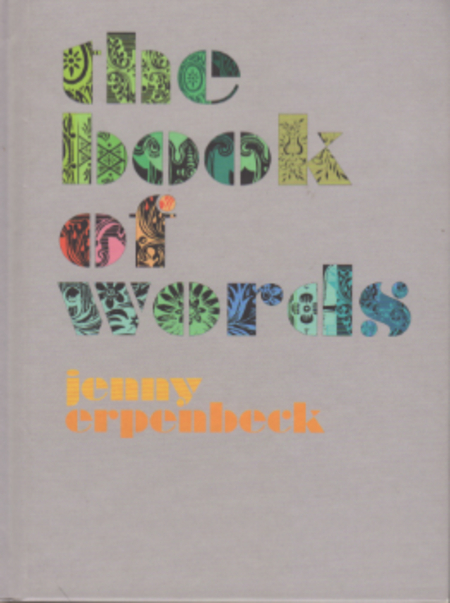
book_wordsThe Book of Words, Jenny Erpenbeck (2005). Words are powerful, though you’d not know it from the bulk of novels written. As the title of this short novel, perhaps even a novella, shows, its story is about words and their uses and the way in which they can create a world for a protagonist and hint to the reader at the context for that world. The narrator discusses words as she describes her childhood in an unnamed country suffering under an oppressive regime, and in which her father works. It’s a completely self-centre narrative, as every word in the book is about the narrator or her world. But what she writes does provide clues to the reality underlying the narrative. The mother is German, and had fled her country for political reasons – mostl likely because she was a Nazi. Though the Germans have contributed to the father’s country, they are not liked. The regime is brutal – the father talks openly about torture, and even describes atrocities committed by some unnamed Germans (one of which is clearly Mengele). The Book of the Words is closer to The Old Child than it is Visitation or The End of Days. It’s not an easy read – and in parts, it is quite gruesome – but it is very clever in the way it doles out information to the reader, aithout breaking the narrator’s character. Erpenbeck has to date published six books, although, I think, only four have been translated into English. My German is probably too rusty to fully appreciate her prose in that language. So can someone publish those other two books in English, please?

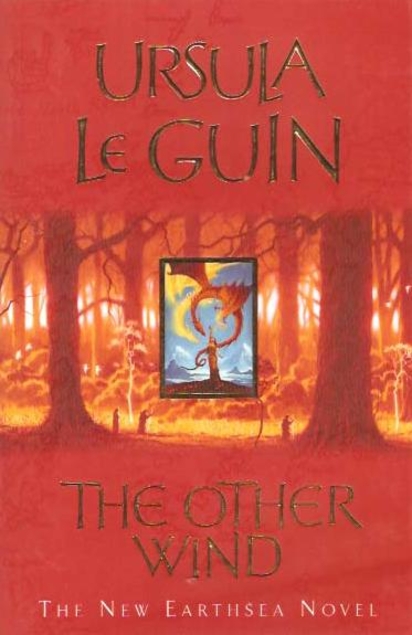
other_windThe Other Wind, Ursula K LeGuin (2001). I have a lot of time for LeGuin’s writing, although I can’t say I’ve enjoyed everything she’s written. I knew The Other Wind was a sequel of sorts to the Earthsea quartet, and I do think those books are very good. Nonetheless, my expectations for The Other Wind were middling, perhaps because I was under the impression it was YA. True, the Earthsea books were published for many years in the UK by Puffin, the children’s imprint of Penguin; but I’ve never really thought of them as YA. The Other Wind is set late in the lives of Ged and Tenar, Ged has long since retired as Arch-mage and no longer has any magic powers. He is visited by Alder, a village magician who has been dreaming about meeting his much-loved late wife at the wall between the land of the living and the land of the dead. Ged advises Alder to consult with Tenar, and their daughter Tehanu, currently on Havnor, advising King Lebannen on recent incursions by dragons. It turns out the dragons are upset because the humans of the archipelago do ont return to the world on dying, but instead gather in the land of the dead. Dragons are apparently trans-dimensional. And all those dead folk are cluttering up their private dimension. It’s a completely new view of the afterlife as presented in the Earthsea quartet, and yet it doesn’t contradict it. There’s a wonderfully elegiac, and yet matter-of-fact, tone to the prose, and a beautifully-drawn cast, from Alder through Tehanu to King Lebannen… but especially the princess from the Kargad Empire who has been sent to Havnor to marry the king. It feels like damning the book with faint praise, especially since the last LeGuin collection I read was a bit dull, but The Other Wind is a thoroughly charming novel. I loved it. It made me want to reread the Earthsea quartet, it made me want to read more LeGuin. Recommended.

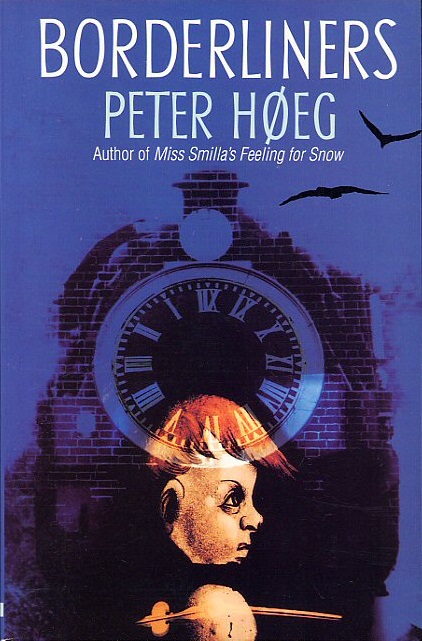
borderlinersBorderliners, Peter Høeg (1995). Høeg’s 1992 novel Miss Smilla’s Feeling for Snow was an international sensation, and rightly so, and was made into a film directed by Bille August and starring Julia Ormond and Gabriel Byrne. Borderliners was Høeg’s next novel (he had published two before Miss Smilla’s Feeling for Snow), and it’s a very different novel. Peter, the narrator, and Katerina and August are all pupils at a private school in the 1970s. All three are orphans – Peter has spent most of his life in children’s homes, Katerina’s parents died shortly before she was sent to the school, and August is on licence after killing his abusive parents. Shortly after his arrival at the school, Peter realises that everything in it is governed by schedule – he thinks of it as governed by time – and he theorises that this generates a particular way of seeing the world, which is what leads to the school’s success (it boasts a prime minister among its alumni). Although the three are not supposed to mingle, and make a secret of their friendship, they pass notes back and forth, meet in odd corners, and generally try to upset the school’s effect on themselves. August proves a handful, as he erupts into violence when threatened. Readers going into Borderliners expecting something like Miss Smilla’s Feeling for Snow will be disappointed – even Wikipedia states that Høeg’s novels tend to defy easy categorisation. Fortunately, I already knew this going in, although it’s certainly true Borderliners doesn’t have the immediate appeal of the earlier novel. Nonetheless, Høeg is an author whose work is worth exploring, I think. And, thanks to my brother-in-law, I now know how to pronounce the author’s name correctly.

iron_tactnThe Iron Tactician, Alastair Reynolds (2016). There are few things as dependable in science fiction as an Alastair Reynolds novella. Even before you turn the first page, you know you’re going to get an entertaining story larded with eyeball kicks and laid on a substrate of some big idea or other. It’s almost the dictionary definition of twenty-first century sf… except, well, the genre now covers so much ground, and is so diverse, that Reynolds’s ur-sf is only one strand among many. Which is a good thing, I hasten to add. The Iron Tactician is about as dictiuonary-definition Reynolds sf as you can get, on the other hand. It’s a sequel of sorts to ‘Minla’s Flowers’ and ‘Merlin’s Gun’. Merlin stumbles across a cold swallowship and decides to see if it has a working syrinx (used to access a NAFAL network created by mysterious aliens). There’s one survivor aboard the derelicxt, and she reveals that the ship traded its syrinx centuries before to a nearby star system locked into a planetary war. So Merlin and Teal head for the planetary system, planning to trade back the syrinx. The locals ask them to perform a task in payment: recover the titular AI from a pirate band, because they need it to win the centuries-long war against their enemies. Of course, nothing is quite as it seems – not the Iron Tactician, nor the the prince who represents the owners of the syrinx, or indeed the syrinx itself. I enjoyed the novella, even though something slightly familiar about it nagged me as I read it. I’m not sure what it was, but something in it felt second-hand and I had not expected it. It’ll probably end up on a coyuple of award shortlists, because genre awards these days are totally corrupt, although I don’t think it deserves to. (No reflection on Alastair or his work, he’s very good at what he does – but I’d hate to think The Iron Tactician is one of the best novellas the genre has produced in 2016, and I know it’s not the best Alastair has written.)

1001 Books You Must Read Before You Die count: 129

3 Comments

Moving pictures, #67

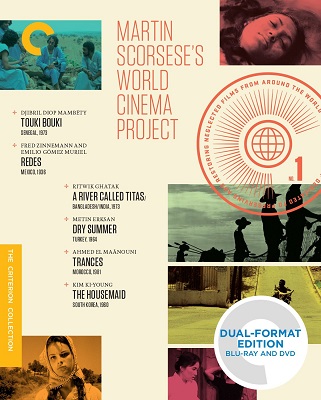
An entirely world cinema Moving pictures: six films, six different countries… and not a single Anglophone one among the lot. Admittedly, as the DVD cover art below indicates, three of the films were from a single box set, the Criterion Martin Scorsese’s World Cinema Project 1, which is definitely worth getting. (No volume 2 has appeared yet, however.)

world_cinemaDry Summer, Metin Erksan (1964, Turkey). During a drought, the tobacco farmer on whose land the local spring can be found decides to keep all the water for his own crops. So he blocks off the irrigation ditches – it all looks like some sort of falaj system – to the other farmers’ fields. Obviously, they’re not happy about this. Nor is the farmer’s younger brother. There are fights, the farmers without water kill the dog of the farmer with water, the falaj is repeatedly attacked and its sluices broken. For all that the film repeats its simple story, and the story is clearly a metaphor for greater struggles, it works well and doesn’t feel stretched or over-long at ninety minutes. Dry Summer apparently won awards at both Berlin and Venice film festivals, and was submitted to the Oscars but not nominated. (Vittorio De Sica’s Yesterday, Today and Tomorrow won.) I’ve seen a few recent Turkish art house films, but this was my first experience of mid-twentieth century Turkish cinema – although not, I suspect, popular Turkish cinema of the time. Worth seeing.

xlXL, Marteinn Thorsson (2013, Iceland). This doesn’t appear to have been released on DVD – I saw it on Amazon Prime – which is a shame, as it’s a pretty good film and worth seeing. Leifur is a member of the Icelandic parliament. He’s also an alcoholic and a womaniser, with a history of public drunken incidents. After his last escapade, starting a fight at a performance art thing, the prime minister tells him he must go into rehab. Leifur resists. The film is told in non-chronological order, with flashbacks and montages, which sort of mimic Leifur’s own drunken memories of his adventures. Because Leifur is a MP, there are several scenes filmed in the area around Reykjavik’s Parliament House… which is a couple of hundred metres away from the Icecon 2016 venue, and the hotel where I stayed… So that was cool, seeing a bit of Reykjavik I actually knew. XL is pretty brutal in depicting Leifur’s antics and their effect on his family and friends. He’s completely in denial, which only makes matters worse. The jump cuts and montages don’t make for easy viewing, and occasionally feel a little overdone, but they certainly help embed the film in Leifur’s POV – and, in fact, there are several scenes, including the opening, which are actually shot from Leifur’s POV. Worth seeing.

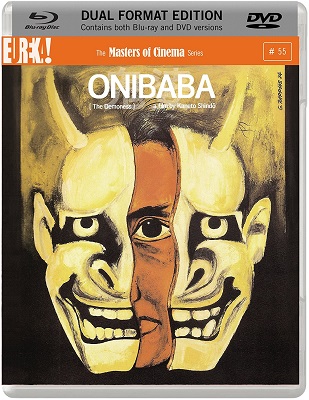
onibabaOnibaba*, Kaneto Shindo (1964, Japan). In forteenth-century Japan, two women live alone in a hut in a meadow of thick reeds. Two soldiers fleeing a battle make their way among the reeds. The women kill them, take their arms and armour, and then throw the bodies into a deep hole in the meadow. The women’s neighbour returns from fighting and admits that the husband of the younger of the two women did not survive. Some samurai enter the reeds, and are killed and robbed by the women. The neighbour and the young woman start a secret sexual relationship. A samurai in a demon mask appears. The older woman kills him. The woman wears the mask to scare her daughter away from the neighbour. After being caught out in a downpour, the woman cannot remove the mask. She reveals herself to her daughter, and the two of them try to remove the mask. Eventually, they succeed, but the older woman’s face is covered in weeping sores… The simplicity of the setting – reeds, rude huts, deep hole – works well with the stark black and white photography. The demon’s appearances (whichn it’s the old woman) are staged well, if a little over-theatrical. A good film, worth seeing.

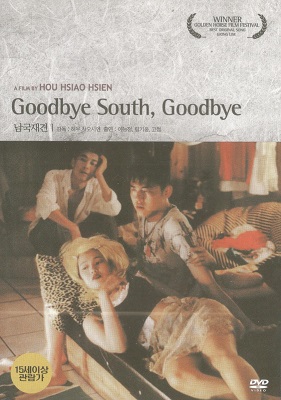
goodbye_southGoodbye South, Goodbye, Hou Hsiao Hsien (1996, Taiwan). I’ve mentioned Hou’s soundtracks before, but this has the best one I’ve heard so far. It’s a mix of techno and rock, and there’s probably more music in this film than there is dialogue. Not that the film needs much in the way of dialogue anyway. A pair of Taiwanese low-lifes get involved with gangsters when they set up a gambling den in Pingxi. This is only first in a series of schemes of dubious legality intended to make the pair money, all of which fail to do so. There are several performances by the nightclub singer girlfriend of one of the pair, and a number of dialogue scenes set in cars as the pair drive about Taipei. There’s not much in the way of plot here – not that there was in Hou’s The Boys from Fengkuei – just a string of incidents that blur one into the other. As mentioned earlier, the soundtrack is excellent, and the cinematography is very much like that in Hou’s other films, with lots of static long shots, often with odd choices for camera placement. I now want more of Hou’s films on DVD.

world_cinemaTrances, Ahmed El Maamouni (1981, Morocco). Apparently, the Martin Scorsese’s World Cinema Project began when Scorsese was working on one of his films in 1981 and he saw Trances on TV. He loved it so much, he tracked down the distributor and director, and arranged for the film to remastered… and here it is, on DVD and Blu-ray (US-only, sadly), in a box set with five other films. And unlike those other films, it’s a documentary. It’s about a Moroccan band called Nass el Ghiwane, which started life in avant garde political theatre, but, at the time of filming, tours the country playing Moroccan folk music (chaabi), and apparently kicked off a new social movement. The film mixes concert footage, interviews with band members and fly-on-the-wall documentary. It’s a film that fascinates due to its topic rather than the way it was put together, although I suspect that’s an occupational hazard for all documentary films. I can understand why Scorsese was attracted to it, as it’s especially good at capturing a moment, and a movement, encapsulated and defined by the music of Nass el Ghiwane. A good film.

world_cinemaTouki Bouki, Djibril Diop Mambéty (1973, Senegal). And another from the Martin Scorsese’s World Cinema Project, this time from Senegal. I’ve seen Ousmane Sembène’s Mooladé, another Senegalese film, which is excellent, but Touki Bouki is a very different film. It’s about men, for a start, and not women – in particular, one young man, and his girlfriend, who dream of a better life, but have neither the money nor the ambition to better their lot. Eventually, they steal some money from a rich man, and use it to buy passage to France. But the man finds he can’t leave, and his girlfriend goes on without him. This is a very brightly-coloured film, especially in the scenes which show animals being slaughtered for food, and which makes them particularly gruesome. I had to look away, they’re far more graphic than you’d see depicted in a film these days. Despite that, it’s a good film and I’ll probably be watching it again in 2017.

1001 Movies You Must See Before You Die count: 838


1 Comment

Unwrapped

Christmas is now over and, as he does every year, Santa brought me some books. But I’d also bought some for myself in the weeks leading up to the festivities and since my last book haul post…

2016-12-29-10-35-22

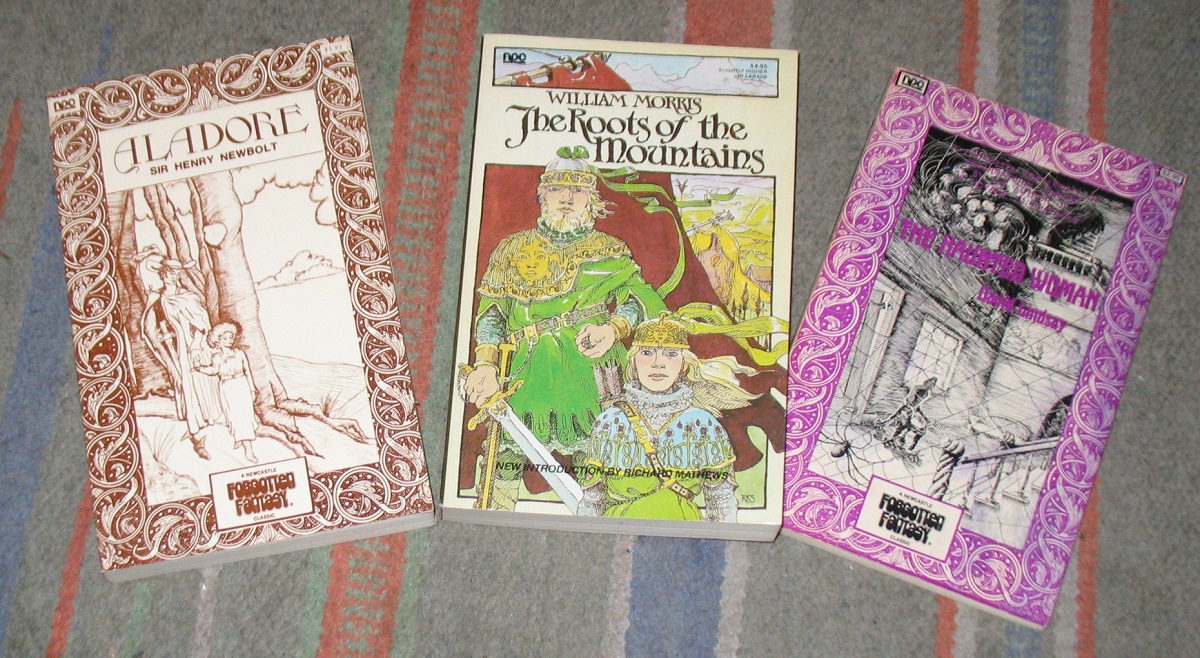
I managed to find a couple more of the Newcastle Forgotten Fantasy books on eBay – The Haunted Woman, Aladore and The Roots of the Mountain – which are numbers 4, 5 and 19 respectively. Still got a way to go yet, however…
2016-12-29-10-36-31

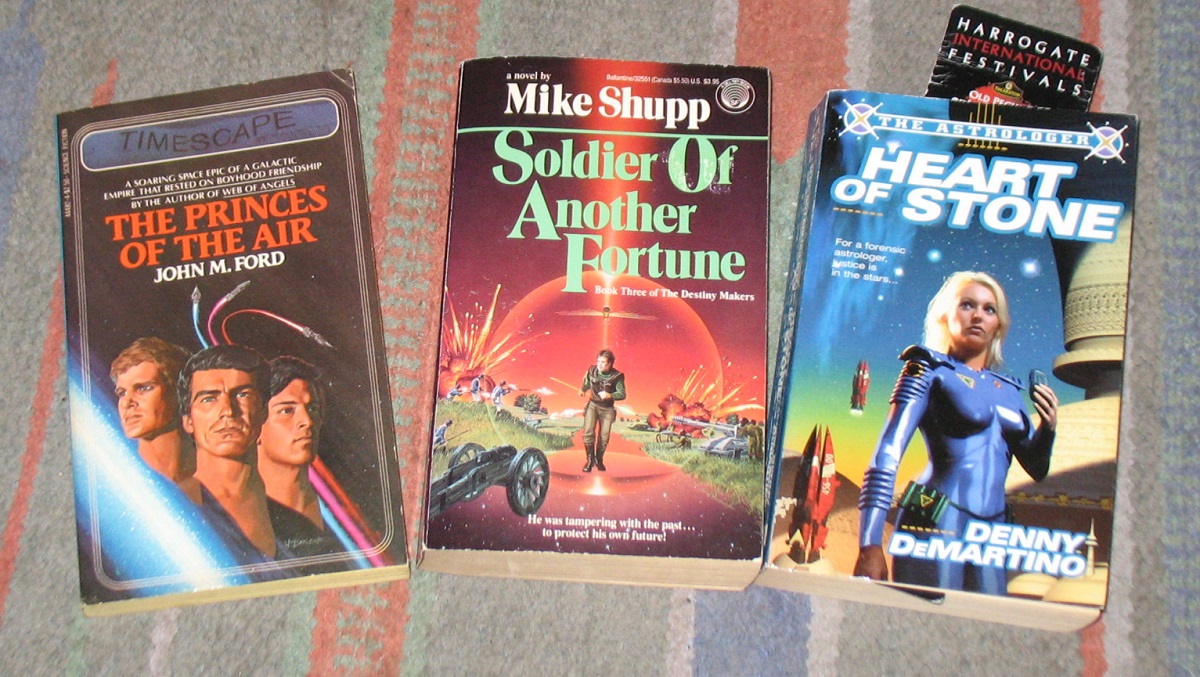
A trio of secondhand sf novels. I’m currently reading Heart of Stone for SF Mistressworks. I have the sequel, Wayward Moon, somewhere as well. Soldier of Another Fortune finally completes my Destiny Makers quintet. I used to correspond with Shupp back in the 1990s, but we lost touch. And The Princes of the Air is a book I’ve often heard spoken of approvingly, but it’s been hard to find.

2016-12-29-10-37-58

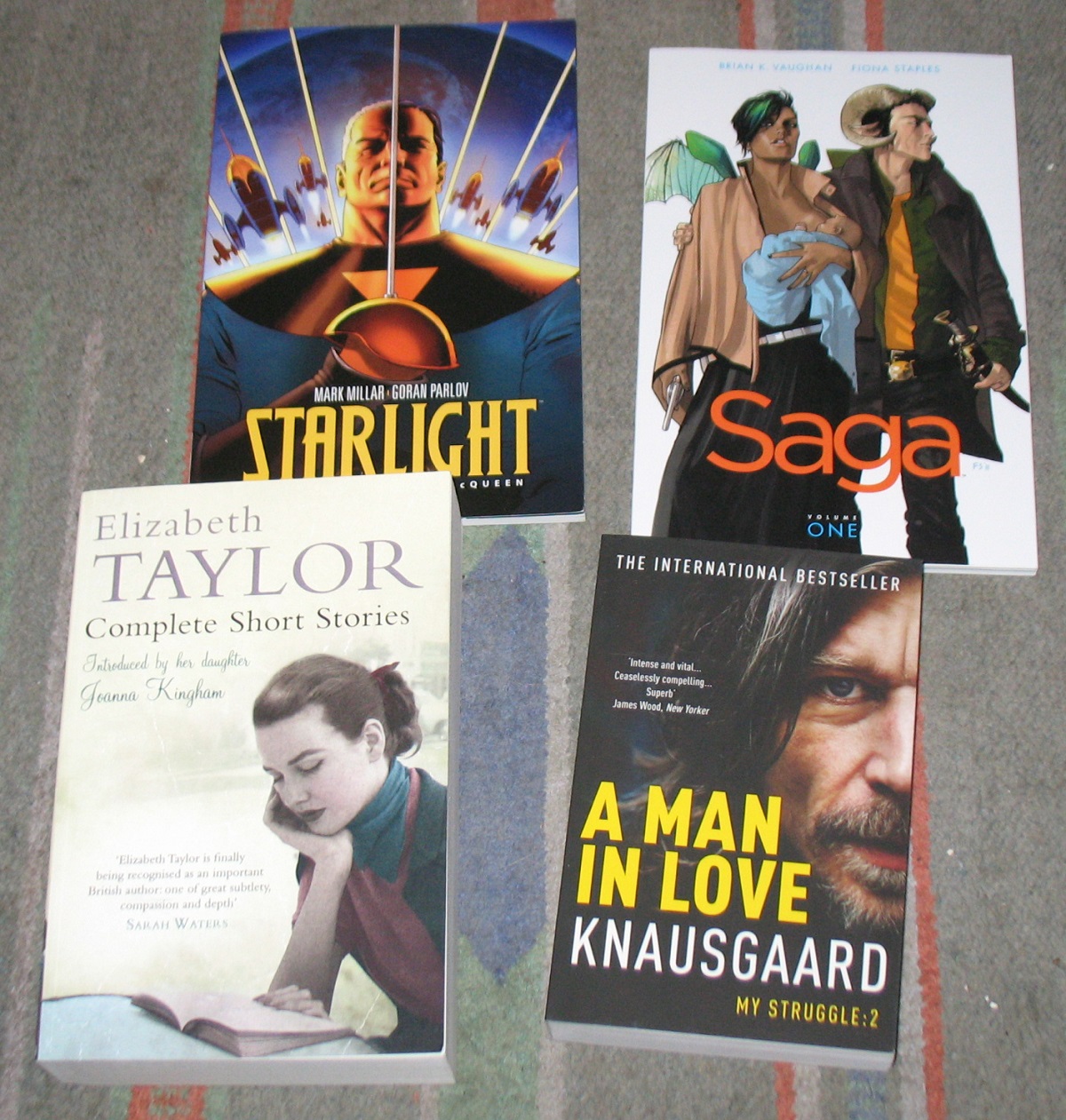
From the Christmas holiday: Santa brought me Elizabeth Taylor’s Complete Short Stories (no, not that Elizabeth Taylor; the writer, not the actress) and the second book of My Struggle, A Man in Love. I bought Starlight and Saga Volume 1 in Faraos Cigarer, the former because it looked interesting and the latter because lots of people have praised it.

2016-12-29-10-41-07

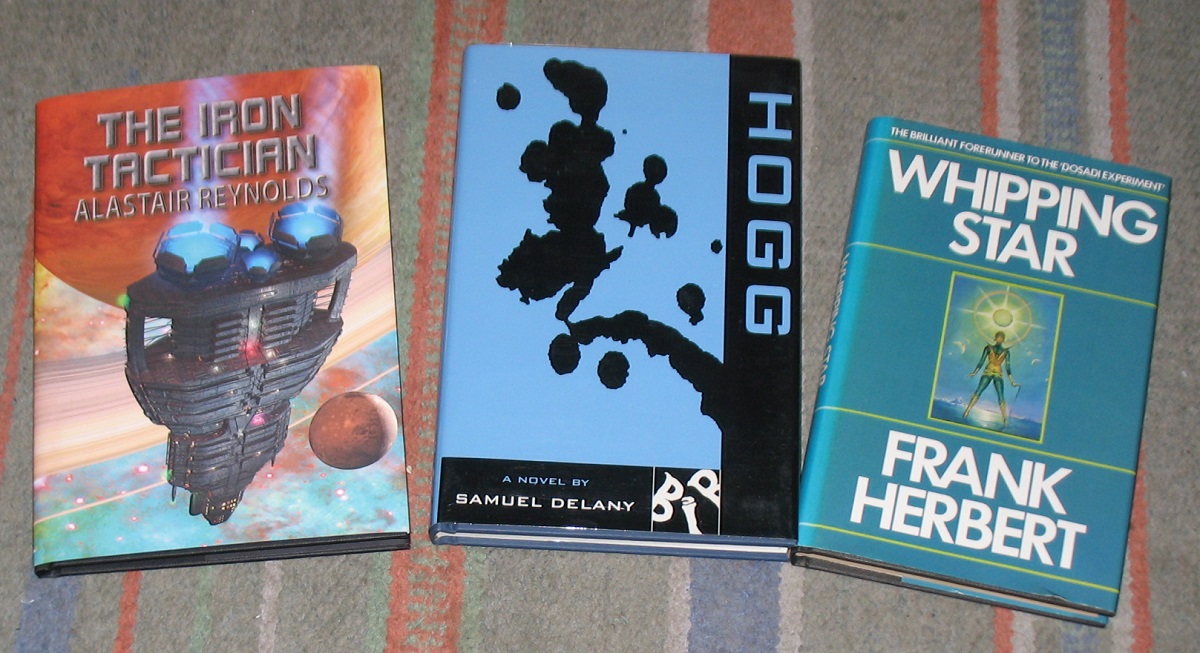
Three collectibles… The copy of Whipping Star is the first UK hardback edition, but it wasn’t published until 1979, nine years after the US first edition (the first UK edition was a paperback in 1972). Hogg I’d wanted for a while but first editions are hard to find. One eventually popped up on eBay. The Iron Tactician is a new signed and numbered novella from NewCon Press.

2016-12-29-10-42-07

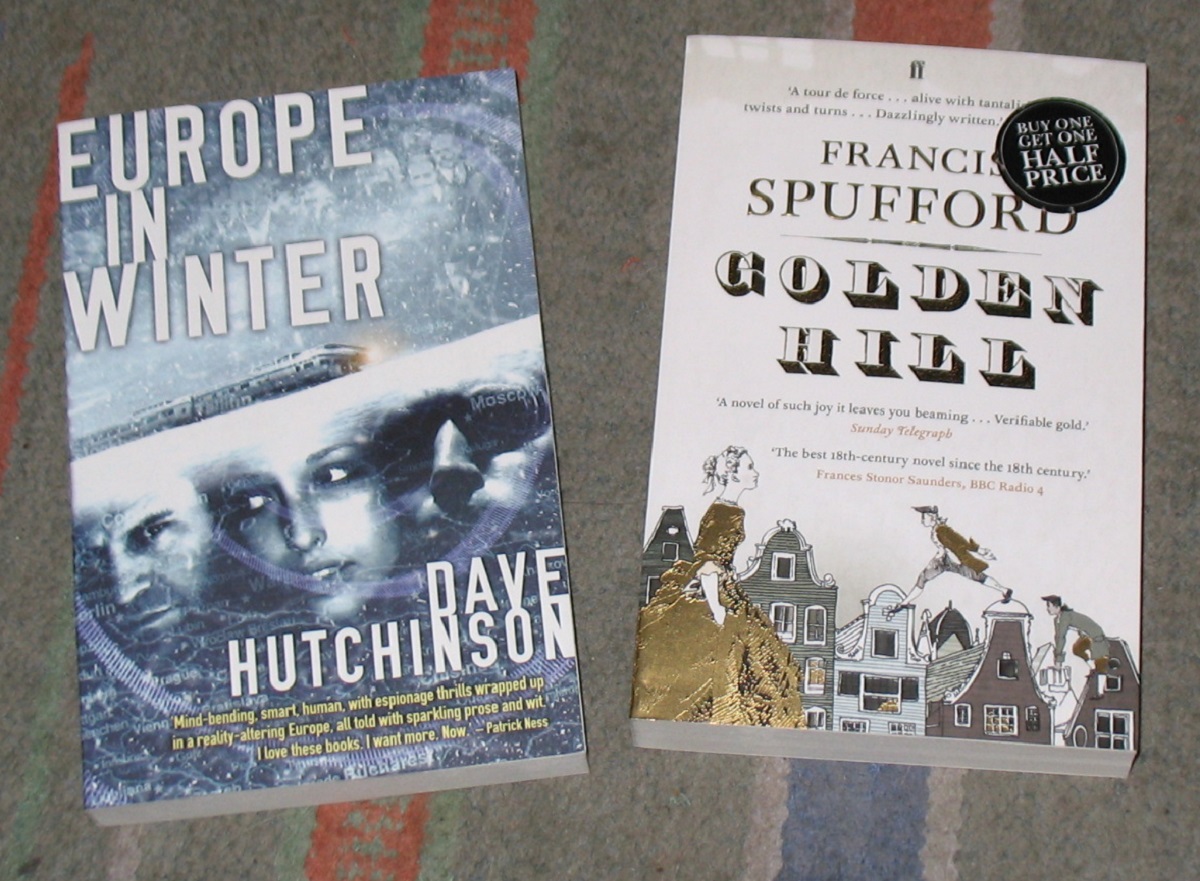
Some new books, just to prove I do read them. Having been impressed by Europe in Autumn and Europe at Midnight, I was certainly going to get a copy of Europe in Winter. Golden Hill I stumbled across in Waterstone’s while purchasing Sebastian Faulks’s latest, Where My Heart Used to Beat (not pictured, because I read it over Christmas and left it with my sister for her to read).


2 Comments

Moving pictures, #66

A mostly far eastern Moving pictures post this time, with films from China, Taiwan and South Korea. Plus some Italian melodrama, a classic piece of Disney, and a recent Hollywood blockbuster which generated a ridiculous amount of stupidity on release.

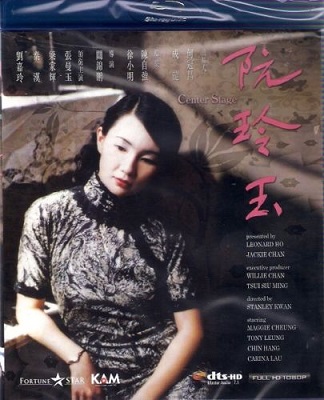
center_stageCenter Stage*, Stanley Kwan (1992, China). I couldn’t find any copies of this film for sale in the UK, and while it had apparently been released in the US at some point, it had also long since been deleted. So I bought a copy from Hong Kong… on Blu-ray. Bizarrely, Hong Kong is region A, because it counts as a “dependency” of, I assume, the US, despite being a British Crown Colony from 1842 to 1997 (region B) and before that part of Imperial China (there were, of course no Blu-ray regions then), and since 1997 a Special Administrative Region of China (region C). Fortunately, I have a multi-region Blu-ray player. As for the actual film… All I knew about Center Stage, AKA Actress, was that it starred Maggie Cheung and was a biopic of a famous actress in the 1930s Chinese film industry. What I hadn’t expected was that the film includes a framing narrative, to which it occasionally breaks, in which Cheung and the director discuss how she will approach the role of the actress, Ruan Lingyu, in the film which is Center Stage. So you have Cheung as Lingyu and Cheung as Cheung. It’s surprisingly effective. Especially since Kwan has made an effort to make the 1930s part of his film as convincing as possible. The end result is a character study of a tragic figure from China’s cinematic history as well as a commentary on that character study, and it’s all carried magnificently by Cheung, who deservedly won a best actress award at the Berlin International Film Festival (surprisingly, the film was not entered for Cannes or the Oscars). The film looks exceedingly good, Cheung looks exceedingly good, and I’m surprised the only edition currently available is a Hong Kong Blu-ray. This really is a film which deserves to be seen more widely.

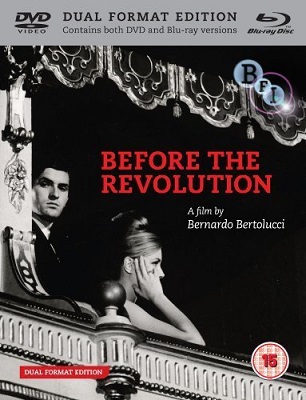
before_revolutionBefore the Revolution*, Bernardo Bertolucci (1964, Italy). Another film I watched solely because it was on the 1001 Movies You Must Watch Before You Die list although, to be fair, Bertolucci’s name was known to me – ever since seeing The Last Emperor at a cinema in Nottingham back in 1987, in fact. But the year, the country, the black-and-white film stock… led me to think Before the Revolution was an Italian Neorealist film – about which I have mixed feelings, inasmuch as I take the films as I find them rather than liking the genre – but Before the Revolution proved to be more Nouvelle Vague than anything else. A pair of young men, carefree to the extent you only see in New Wave films, but one drowns in a swimming accident and the other finds himself attracted to an older woman, an aunt, although I don’t think a blood relative, and it all seemed very Nouvelle Vague… I especially remember one scene, shot through the window of a car which was quite effective, but had more in common with Godard than it did, say, De Sica or Rossellini. Which is not to say that Before the Revolution was a bad film – just that it reminded me of Godard or Antonioni, and not any Italian Neorealist director, and while I much prefer the first two names, I found this a bit of a lacklustre copy. Given Bertolucci’s oeuvre, I suspect him of being a gifted copyist – The Sheltering Sky is a lovely-looking film, albeit not a great adaptation of the novel, but what is it that makes it a Bertolucci film? I wonder if 1900 was as close as Bertolucci got to a personal film, and even that felt like it borrowed from many sourcres. I can’t say Bertolucci has ever impressed me that much – he doesn’t seem to have an individual vision, and those of his films I’ve liked I’ve done so because of the films themselves. I suspect Before the Revolution deserves more attention than I gave it, but after watching a whole bunch of Italian Neorealist films it did seem a bit of a capitulation to the commercial forces they had set out to resist.

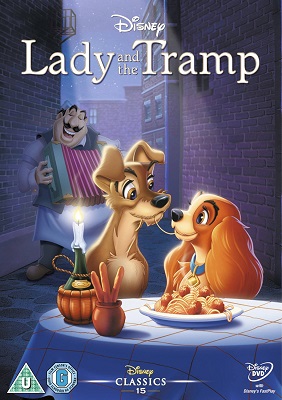
lady_trampLady and the Tramp, Clyde Geronimi, Wilfred Jackson & Hamilton Luske (1955, USA). I know I saw this once as a kid, but when I came to watch it again I realised I’d forgotten a couple of important things about it. One, it was released in 1955, at a time when Disney were on a roll with their feature films; and two, it’s set in 1909. I also keep on thinking it should be called “The Lady and the Tramp”. Which it shouldn’t. Because “Lady” is the name of a female cocker spaniel pup given to the wife in a middle-class US family. All goes well until the wife becomes pregnant, and Lady subsequently comes second in the family’s affections. The Tramp, on the other hand, is a mongrel who lives on the street, and he explains to Lady that when a baby arrives, the dog is no longer wanted. And so it proves. Lady and the Tramp spend time together, a sort of doggy romance. But one of their escapades goes wrong and she’s caught by the local, er, dogcatcher (even though she’s wearing a collar). In the pound, she learns about the Tramp’s other “girlfriends”, and so spurns him on her release. But then a rat sneaks into the house and threatens the new baby, and the two dogs’ successful attempt to kill the rat is misinterpreted by Lady’s owners… although they soon learn their mistake. And the Tramp becomes a member of the family and breeds with Lady. Happy ending. The animation is, as you would expect from 1950s Disney, and Geronimi and Luske, really very nice. The dog’s eye view is also done effectively. But the story suffers because it doesn’t have the fairy-tale quality that Sleeping Beauty and Cinderella, for example, both possess. And, to be honest, I’m not all that taken with animals as protagonists. Lady and the Tramp was better than I was expecting, but I’d class it as an also-ran in the Disney classics category.

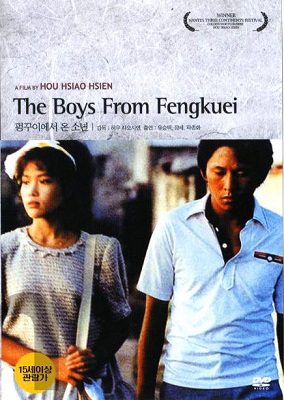
boys_fengkueiThe Boys from Fengkuei, Hou Hsiao Hsien (1983, Taiwan). This is the second film from the Hou “box set”, and much as I was impressed by The Puppetmaster I find this film much more to my taste if not quite as obviously classic film material. If that makes sense. A group of youths in a fishing village leave school with little in the way of education or prospects. They spend of their time gambling and fighting. Three of them head for Kaohsiung, a major city, to look for work. One of the three falls in love with a young woman living in a nearby flat. Nothing quite works out. Like the other Hou films I’ve seen, The Boys from Fengkuei makes extensive use of static camera placement and long shots, which is, I admit, a style of cinematography I like. I like that distance, that sense of the screen as a window on the story… and while I can also appreciate the effectiveness of a close-up, I’ve only really seen it used all that effectively in Truffaut’s Tirez sur le pianiste – in other films, you just don’t notice it, which makes you wonder why they bothered to use it. Hou seems to like static viewpoints, usually carefully-chosen, and while it’s not as obvious, or stagey, a technique as that used by, say Peter Greenaway, it does impact the film. There is a scene, for example, where the “boys” fight, and the fight spills off-screen, so all the viewer sees is an empty alleyway with the noise of a violent fist-fight on the soundtrack. Hou also – and this I admit surprised me – does great soundtracks. I should have guessed from the first film of his that I’d seen, The Assassin, and its really quite wonderful closing credits music. But all of the films I’ve seen by Hou so far have excellent incidental music. Stick him on your list of directors worth seeing, because he surely belongs there. I think he’s becoming one of my favourite directors…

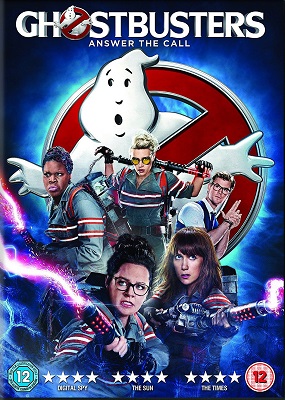
ghostbustersGhostbusters, Paul Feig (2016, USA). And so we come to the explosion of stupidity that was the remake of Ghostbusters. It seemed quite simple – remake Ghostbusters, a mildly amusing 1984 Hollywood comedy with something of a cult following, for the twenty-first century. Put a comedy dream-team on it. Solved. Except the dream-team picked was that responsible for Bridesmaids, a successful twenty-first century comedy… which meant the Ghostbusters central cast would be female. Normal people went, okay, cool, go for it. A handful of right-wing dickheads decided they didn’t like this, and they kicked up a stink. The level of stupidity in their complaints was hard to believe. Especially when you consider that the film about which they were complaining was pretty much fan service from start to finish. The thing about Ghostbusters (3) is that it’s a pretty ordinary film of its type. It has a handful of good jokes, but, as many twenty-first century comedies seem to do, it also relies overmuch on the characters developed by its cast in other films. In other words, if Melissa McCarthy plays the most sensible role in your film, then you have a problem. But when every Ghostbuster-related joke is a fan service, and everything around it is a stable of actresses playing their best-known characters… you don’t have an especially good film. It entertained. Just. But the one thing the film certainly didn’t deserve was the moronic criticism by right-wingers who objected to a female Ghostbusters. It’s such a feeble complaint, you have to wonder at the intelligence of those who supported it. (To be honest, I don’t wonder: I consider them all quite stupid.) If you enjoy the sort of comedies which have been released in the last five or six years, you will enjoy Ghostbusters. If you enjoyed the original Ghostbusters you will probably get added value from the fan service and references. It’s not an especially good film – but to criticise it solely because the central cast are female just makes you a complete fucking idiot.

world_cinemaThe Housemaid*, Kim Ki-young (1960, South Korea). I bought the Criterion box set of Martin Scorsese’s World Cinema Project because it included a remastered version of A River Called Titas (on both DVD and Blu-ray). But there are a further five films in the set, including The Housemaid, a film on the 1001 Movies You Must See Before You Die list and which I’d not been able to find a copy elsewhere. (Eureka! released a UK edition of Martin Scorsese’s World Cinema Project in 2013, but their version only includes three films – none of which are The Housemaid or A River Called Titas; they also called their edition volume 1 but there doesn’t appear to have ever been a volume 2. Bah.) Anyway, The Housemaid, AKA Hanyo… a Korean family hire a housemaid, but over time she gets a little too friendly with the husband. And then next thing you know, she’s pregnant with his child. As is his wife. Which puts him in something of a quandary. Well, at least that sort of quandary experienced by men with zero or low morals. Upset that her child will not be treated in the same way as that of the wife, the housemaid threatens one of the children with poison. and so the housemaid and the wife engage in a downward spiral of threats while the husband makes all the wrong decisions and so makes the situation worse. The Housemaid has been described as horror and erotic horror, although to me it played out like a drama, albeit a somewhat dark one. Worth seeing.

1001 Movies You Must See Before You Die count: 837