It Doesn't Have To Be Right…

… it just has to sound plausible


3 Comments

Moving pictures 2018, #26

I think this might be the most peculiar post of the series so far this year. Okay, it’s two-thirds Anglophone, but only two films of the six could ever qualify as, well, “normal”, and I’m not entirely sure that holds true for one of them – although part of the appeal of the films made by the Archers is their slightly off-kilter aspect…
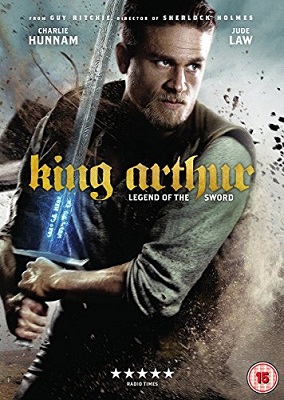
King Arthur: Legend of the Sword, Guy Ritchie (2017, USA). Okay, so anything Ritchie touches never survives the encounter intact, and I knew that was as likely to be true of the Matter of Britain as it was of the Man from UNCLE or the Sherlock Holmes canon. So why was I surprised that Ritchie’s Arthurian Britain features giant elephants, Cockneys and Himalayan mountains? It didn’t help that David Beckham appeared to have been cast in pretty much every role, except the one played by Jude Law. (It wasn’t Beckham, of course, just a bunch of male actors cut from the same cloth and styled the same way as him.) I can’t even remember the plot, only that it took considerable liberties with its source material, even though it managed to include most of the best-known elements. Sword in the stone: check. Merlin: check. Camelot: check. Uther Pendragon: check. Londinium: check. Um, that can’t be right – in the fifth century? Masked army of goons: check. Er, hang on. Ninjas: check. No, wait. Impromptu football match: check. What? Jude Law turning into a giant snake: check. Oh come on, this is just taking the piss. Although I may have dreamt the football match. Basically, King Arthur: Legend of the Sword is a Mockney fantasy film, and if that’s your bag then I suppose it does the job. But it’s not the Matter of Britain. In fact, it’s not even Britain. Bollocks.

Mr Skeffington, Vincent Sherman (1944, USA). I think I’ve always had a certain impression of Bette Davis and the parts she played, despite not following her career or making an effort to seek out her films. And having now seen several of them, I can’t honestly say my impression of her was all that different from the reality. She played brittle women who seemed to have trouble dealing with reality – or at least put on a pretence of being unable to do so, while often being considerably more capable than those around her suspected. So either she can’t cope, or she’s secretly coping. Usually, the story is tragic, and Davis’s character is the most tragic of them all. Despite the title, Mr Skeffington is definitely a Davis vehicle. She plays a socialite whose brother fritters away the family fortune, and so she marries the title character, played by Claude Rains, who is very rich. She never loves him, and she forever has a string of beaus in tow, but she’s never unfaithful. They have a girl, but Davis is not interested and does not bond with her. The two divorce, when Davis learns Rains has been squiring his secretaries about town. Rains and daughter move to Europe. Once she is grown, the daughter returns to the US, but does not get on with her mother, marries and moves to Seattle. The war happens. Davis loses first her fortune – Rains’s fortune was taken by the Nazis – and then her looks when she contracts diptheria. But then it transpires Rains did not die in the camps as previously thought, and has returned to the US… And he still loves Davis. Even better, he is now blind and can’t see her raddled features. Sigh. Davis’s character really is unlikable, right from the start; and her dim brother is even worse. Rains plays the title role with a look of constant silent suffering, which he does very well. But it all gets a bit much as the film moves into its final act, and the mawkishness is so thick you can cut it with a chainsaw. Astonishingly, both Davis and Rains were nominated for Oscars for the film, although Rains only as Best Supporting. One to avoid.

A Canterbury Tale, Michael Powell & Emeric Pressburger (1944, UK). I’m a big fan of the the Archers, and I’d put their Black Narcissus in my top twenty films (despite its somewhat problematic aspects), so naturally I’ve been keen to watch their entire oeuvre, and not just their most celebrated films. A Canterbury Tale is generally well-regarded, if not especially well-known. It’s a war-time piece, made during WWII and featuring soldiers. And actually starring a serving US Army soldier. But it’s also very much a film about England and its countryside. A young woman disembarks from a train in the fictitious Kentish town of Chillingbourne late one night. She is looking for farm work as a member of the Land Army. A British Army sergeant and a US Army sergeant also get down from the train, the latter by mistake. As they head off looking for digs, the woman is attacked by a man in uniform who pours glue into her hair. The police admit this has happened several times but they have no clues to the identity of the assailant. The three decide to team up to solve the mystery. Which involves the local landowner and the nearby Army camp. It’s a trivial mystery, when it comes down to it, and if the motives of the perpetrator prove somewhat confused they’re at least pure. And spectacularly ill-timed, even though the incidents are entirely the result of the Army camp having been built nearby. I was reminded while watching a film of a documentary I’d seen about hop-picking in Kent in the first half of last century. Hordes of East Enders used to head down there for a few weeks every year to pick the hops. They’d stay in crude huts and were paid a pittance, but for most of them it was the nearest they had to a holiday. Mechanisation completely killed off the practice. Anyway, A Canterbury Tale… the three leads are sympathetic and engaging, the mystery is resolved without anyone getting hurt, and each of the leads’ character arcs ends the film on a happy note – literally, in the case of one, who had always dreamt of playing a church organ and gets to play Canterbury Cathedral’s during a service to mark his division’s departure for the front. Worth seeing.

Demonlover, Olivier Assayas (2002, France). I’ve been following Assayas’s career since first watching his film Irma Vep back in 2000, but Demonlover has been a hard one to track down. It doesn’t appear to have ever been given a sell-through release in the UK, although DVD editions from other European nations are commonplace (and yes, the UK is part of Europe; and Brexiteers are fuckwits). Having now seen it, I can understand why a UK label might have been reluctant to issue it in this country, although, to be fair, it’s pretty tame and now, sadly, badly dated. Connie Nielsen plays the CEO of a French computer game company. She is trying to acquire the rights to a Japanese hentai series. The title refers to the US company she turns to for handling distribution in the US, which is run by Gina Gershon. But Demonlover, the company, are under threat from their main competitor, Mangatronics. Meanwhile, Nielsen finds evidence linking Demonlover to the Hellfire Club, an online BDSM website. At which point, as the Wikipedia plot summary has it, “the narrative structure of the film more or less breaks down”. It’s tempting to think Assayas was channelling David Lynch while making Demonlover, but it never quite manages Lynch’s levels of strangeness. And for all his utter weirdness, Lynch somehow managed to maintain narrative coherence in his films. If Demonlover feels like an exercise in pushing boundaries, it’s not narrative boundaries. The plot is built around online porn – not just of the animated variety, but also the fringe parts of BDSM – but it all feels very dated. Which it shouldn’t really, when you think about it: a film set in the first couple of years of the twenty-first century will no doubt look like a film set in the first couple of years of the twenty-first century, except… everything except the presentation of the Web in the film could be two, three, five or seven years old. Which makes the Internet parts of the film stand out. Nielsen is good in the title role, Gershon I’m not so sure about. Demonlover is a film, I think, that needs more than one watching, but I’d prefer a better quality transfer than the one I saw.
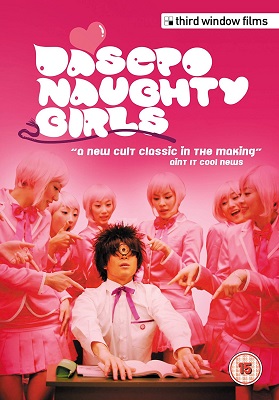
Dasepo Naughty Girls, E J-yong (2006, South Korea). I probably shouldn’t have to explain that this was recommended by David Tallerman. Five minutes in, and I texted him to say, “this film looks like someone on drugs tried remaking Grease“. Happily, it settled down a little after that, although it was still completely bonkers. It takes place in the Useless High School, among the students of one class. The main character is “Poor Girl”, who carries a stuffed toy on her back called “Poverty”. Another student, called Cyclops, has, er, only a single eye. Poor Girl’s mother has invested heavily in a pyramid-selling scheme – literally, the product is a plastic pyramid – and so to make ends meet Poor Girl becomes a prostitute. One of her clients is a mobster who enjoys dressing up as a schoolgirl, and the two become friends. Meanwhile, Anthony, a rich boy in the class, falls in love with Cyclops’s sister, Double Eyes, who is transgender. Anthony and Poor Girl become friends. She fancies him, but he doesn’t return the sentiment. He also has a secret in his background. There are a couple of musical numbers, including the opening credits, but it’s not really a musical. And not really like Grease at all. It is completely mad, however, and a lot of fun. Worth seeing.
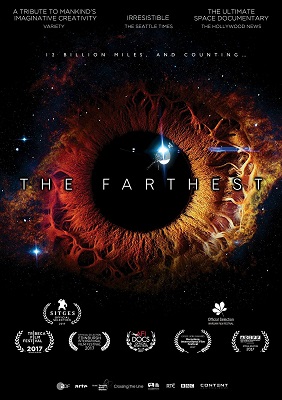
The Farthest, Emer Reynolds (2017, Ireland). I was browsing for documentaries on Cinema Paradiso to add to my documentaries list, when I stumbled on this one. Its subject matter is something that interests me: space probes. In this case, Voyager 1 and Voyager 2. I used to think space probes were boring and much preferred reading about crewed space exploration – and it’s true that the engineering required to keep human beings alive in space I find fascinating… But space probes hold a fascination all their own too. They are machines built to operate in an inimical environment for decades, and for which our ability to direct and control becomes subject to greater and greater time lags, such that operating them becomes totally divorced from reality. The two Voyager probes are, of course, the furthest – or even farthest – travelled human-made objects. And one of them will come back a few centuries from now as a giant fuck-off spacecraft and threaten the Earth. But not to save the whales, that was a different giant fuck-off spacecraft. Anyway, The Farthest consists of lots of talking heads, archival footage and some very pretty CGI. And it really is fascinating stuff. It must be really weird discovering something completely unknown millions of kilometres and many hours after the actual moment of discovery, almost vicarious, but The Farthest manages to evoke something not so very different. Excellent stuff.

1001 Movies You Must See Before You Die count: 908


Leave a comment

Reading diary 2018, #8

I don’t seem to be reading much current science fiction these days. Well, okay, I read three of the four novels shortlisted for the BSFA Award, and I recently bought four of the six novels shortlisted for the Clarke Award (I already owned one, and am not really interested in another.) And yes, I’ve read the first two books of NK Jemisin’s Broken Earth trilogy, which has been the most lauded genre series of the last couple of years… But no current science fiction here, I’m afraid.

Pack My Bag, Henry Green (1940, UK). I stumbled across Henry Green’s writing a couple of years ago. I’d seen mention of him somewhere as a forgotten great writer in British twentieth-century literature, although at the time I saw this he had been re-discovered, not that I knew; but anyway I stumbled across an omnibus of three of his novels – Loving · Living · Party Going – and I read the first of these (actually the last published of the three) and, er, loved it. So I read more. And yes, he is indeed one of the best writers this country produced in the first half of last century. Pack My Bag is his autobiography, written in 1940 at the age of 35, after Green had volunteered for the Auxiliary Fire Service and was convinced he would not survive the war. (He actually survived, and died an alcoholic in 1973, having published only nine novels.) Pack My Bag is something Green banged out to assuage fears he might be forgotten and, quite frankly, I’m in awe of his talent. He led a privileged life, a minor member of the aristocracy, educated at Eton and Oxford – I can’t decide whether to despise him for his background, admire him for his writing, or grudgingly admit he was uncommon for his class – unpopular at school, and far too thoughtful; he left Oxford without graduating, to go work in his family’s bottling factory in Birmingham. Yet his wife was a member of his class, and a distant cousin too; and though he was clearly very intelligent, as a member of the upper classes he was the beneficiary of what is considered to be a top-notch education… and yet he admits the masters at Eton were hired for their sporting prowess and not their knowledge of their subjects, which in many cases was hugely deficient, and it would not surprise me if that has held true in the century since; and at university, he brags that his studies take up no more than six hours a week. Green is perfectly aware of what he is saying as he writes this – he is not a man afraid of burning bridges, or biting the hand that feeds him, or other such aphorisms.

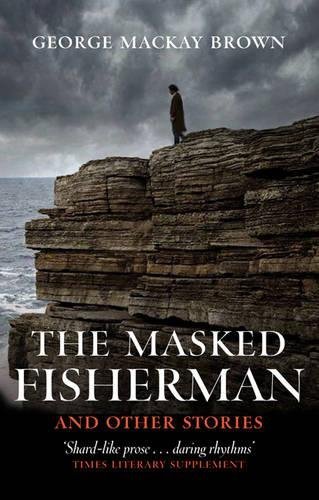
The Masked Fisherman, George Mackay Brown (1989, UK). Someone on Twitter recommended Brown a couple of years ago, and so I’ve kept an eye open for his books in local charity shops ever since. Which is how I stumbled across Beside the Ocean of Time (see here), which I thought good; and why I later picked up this book when I found it in a charity shop. It’s a collection of twenty-two very short stories, some of which work very well and some of which didn’t seem to work at all. Some barely qualify as stories. They’re all set in Brown’s home ground, the Orkneys, and they take place between the eleventh and twentieth centuries. They’re not arranged chronologically, but jump about. The title story is historical, and reads more like a fable than a short story. Another, about a mean old lady who leaves a surprising bequest, feels a bit out of place. A short story about the town’s first lamp-lighter is especially good. Another about a writer researching his past also stands out. Some of the stories seemed less… lyrical than I had expected, not that Brown’s prose is ornate, it’s typically very plain but it’s also very evocative. And in a few places here, that felt slightly lacking. However, the more by Brown I read, the more by Brown I want to read. So I’ll continue to keep eye open for his books.

The Blaft Anthology of Tamil Pulp Fiction Vol 2, (2010, India). This was a reward for a kickstarter – although maybe not from that particular website – for volume three (as was volume one, but there’s no sign of it yet; I’m still not convinced “kickstarters” – crowd-funding, that is – are actually viable or sustainable, but that’s an argument for another day). Anyway, in India – and in this case, the Tamil-speaking parts of it, such as Tamil Nadu – penny dreadfuls of a sort still exist. They are printed on extremely cheap paper and sold at newsstands or by boys at traffic lights. Authors who specialise in these Tamil pulp novels have bibliographies numbering in the high double figures, and some even in the high triple figures – and one author in this anthology, Rajesh Kumar, has written around 1500! While holding down day jobs. To be fair, they’re not long novels and, if the ones in this anthology are any indication, pretty badly-written, with an over-reliance on cliché, very little description and plots that are so pacey they frequently contradict themselves. The plots are mostly thrillers with real or faked supernatural elements. The opener, and the longest in the anthology, ‘The Palace of Kottaipuram’, features a second son from a tiny princedom in which the heirs are cursed to die before they reach their thirtieth birthday. When his older brother dies, making him the heir, his girlfriend – he met her at college – is determined to find the truth behind the curse and so thwart it. It’s all very, well, pulp, and probably the best story in the book. I’m glad I read the book, and I’ll read the third one too, of course; but it’s like watching Bollywood films: they might be terrible, but they’re entertaining and fun and different to what I normally read/watch.

Dan Dare: He Who Dares, Peter Milligan & Alberto Foche (2018, UK). I’ve been a fan of Dan Dare since the early 1970s, and have kept up with him in all his re-imaginings since, most of which it must be said have been pretty shit. There was the 2000AD one (see here and here), then the re-launched Eagle with Dare’s… grandson?, also called Dare. And in the early 1990, out of Revolver, there was Dare by Grant Morrison and Rian Hughes, to date the only halfway-decent Dare since the original (and it looks like Titan are publishing a new edition later this year). And Grant Ennis and Gary Erskine had a bash at a new Dan Dare a few years and it was pretty bad. But here’s a new one. It starts off really well. Dare and co. – specifically, Hank Hogan, Peabody and Digby; although Hank pretty much disappears after the first couple of pages, Digby is far more competent and assertive than his original, and Peabody, the most modern of the characters even back in the 1950s, has been updated a little. As has the Mekon. Dan Dare: He Who Dares starts out well, with some pointed political commentary. The Mekon was captured and is now in a secure facility on the Moon. He seems to have given up his evil ways, but only Dare believes he might be rehabilitated. And then a giant Treen spaceship appears in the Solar System, and Dare seeks advice from the Mekon on how to destroy it. With the help of a female warrior from an alien world. This is where it all falls apart. Dare was always interplanetary, and his only interstellar stories – Rogue Planet and Terra Nova – saw him and his colleagues spending weeks or months travelling to an alien world. There’s certainly no suggestion the Mekon carved out an interstellar empire. In fact, the Treens who invade the Solar System feel like an entirely different race, and not the Treens of Venus. A shame, as the story started off so well.

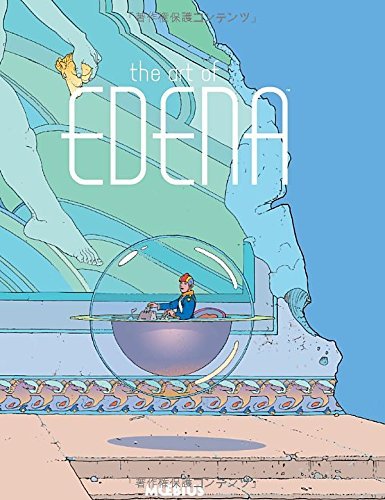
The Art of Edena, Moebius (2018, France). So I ordered this a couple of months ago, but Amazon failed to source it and after a month cancelled my order. And then a week after that, I noticed they had copies in stock. So how does that work? I know: it’s because people are so fucking lax about data that you can no longer uniquely identify something because there might well be hundreds of identical copies under different ids in a system. Anyway, I re-ordered it and it was delivered the next day. Despite the title, it’s not a study of Moebius’s Edena series (see here). It’s more of a companion volume, explaining details that are patently obvious in the series itself, but – and it’s worth buying for this if you’re a Moebius fan – it also includes several short graphical stories featuring Stel and Atan that are not in the Edena volume. And they’re pretty good.

1001 Books You Must Read Before You Die count: 131


1 Comment

Moving pictures 2018, #25

A mixed bag, this time around. When it comes to choosing films to watch of an evening, there are several factors to consider: rentals DVDs that I need to send back if I want to get another three for next weekend, the growing to-be-watched pile, the growing pile of DVDs lent to me by my mother, the 1001 Movies You Must See Before You Die list, the sort of day I’ve had at work, whether there’s anything I need to get done that evening, whether I have a Moving picture post to write and I’ve forgotten the details of one of the films in it…

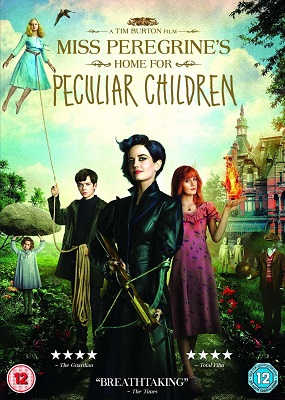
Miss Peregrine’s Home for Peculiar Children, Tim Burton (2016, USA). I’m not a big fan of Tim Burton’s films and have managed to avoid them for the past decade or so, but this one sounded like it might be worth a go and… well, I actually enjoyed it. It wasn’t bad. It wasn’t overdone, it wasn’t massively whimsical, and Burton’s treatment seemed to suit the material. Okay, so Eva Green was as mad as a bucket of spanners in it, but then she is in everything she does – and still she’s eminently watchable. A young man’s grandfather dies in mysterious circumstances – found dead in nearby woods, his eyes missing – and so the young man follows up on stories he was told as a child of a children’s home on  an island off the coast of Wales. He travels there with his father, and discovers that the home was bombed in 1941 and no one knows what became of the children. But then he meets some of them and discovers they still exist, living in an endlessly-repeated day in 1941 (the day, in fact, which ends with the home’s destruction by a German bomb). There are lots of “peculiar children”, although only a dozen or so at the school, and they’re under threat from a group of people led by Samuel L Jackson. He and his group performed an experiment to give themselves immortality early in the twentieth century, but it has slowly been turning them into invisible monsters – unless they eat the eyes of peculiar children, which keeps them human and ageless. And the young man, it turns out he’s peculiar because he can see the monsters… Okay, so it all looked a bit more Cornish than it did Welsh, but the cast were generally good and the villains were pretty effective. A solid effort.

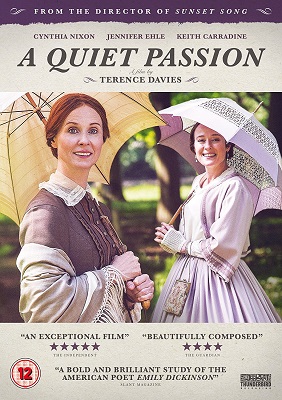
A Quiet Passion, Terence Davies (2016, UK). This is a biopic of American poet Emily Dickinson, who was notoriously odd and who this film shows to be very odd indeed. Reading up on her afterwards, I don’t think the film quite does her justice. American actress Cynthia Nixon, perhaps better-known for Sex and the City, which is no doubt doing her a grave disservice as she can’t obviously chose which of her work becomes best-known, plays the title role, with a supporting cast of Brits who mostly seem to have trouble with a US accent. Which means that despite a great deal of care over costumes and setting, this film doesn’t always convince. It doesn’t help that Emily Dickinson was barking, so she’s a hard character to sympathise with in the first place. But this is a Terence Davies film, so it looks great and the performances are top-notch (accents notwithstanding). It certainly inspired me to look up Dickinson’s poetry, which I discovered left me completely cold. She was a… singular talent, with a poetic sensibility very much not of her time. These days, her poetry reads like a cross between doggerel and greeting card, and while her refusal to follow the poetic tradition of her time, and her sheer prolificity are admirable (although she only saw a handful of poems in print during her lifetime), I can’t really defend lines like:

Success is counted sweetest
By those who ne’er succeed.
To comprehend a nectar
Requires sorest need.

An interesting film about an interesting person, but don’t expect me to start admiring her poetry as a result.

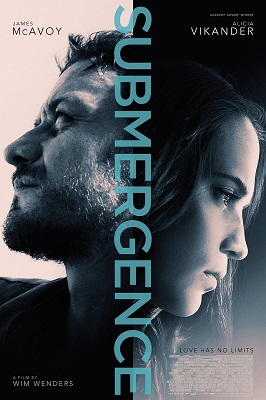
Submergence, Wim Wenders (2017, USA). I had not known this was a Wenders film until I started watching it. It was the link to diving in submersibles that persuaded me to put it on my watch list. And, after all that, it was a bit meh. It didn’t even feel like a Wim Wenders film, and I wouldn’t have known it was if I hadn’t looked it up. Alicia Vikander is a marine biologist specialising in the hadal zone, on holiday in France. Where she meets James McAvoy, who claims to be a water engineer but is actually a MI6 operative en route to Somalia to meet a contact in a jihadist group. A brief romance ensues. Shortly after arrival in Somalia, McAvoy is captured and held captive. Meanwhile, Vikander visits in the ocean floor off Greenland in a submersible. Both flashback to their romance at the French pension. The only interesting thing about the film was its even-handed treatment of the jihadists, whereas in US films they’re immediately painted as totally evil and fully deserving of extraordinary rendition, torture, imprisonment without due process, making up laws after their capture in order to find them guilty of something, and, of course, illegally invading sovereign nations… Funny how that works…

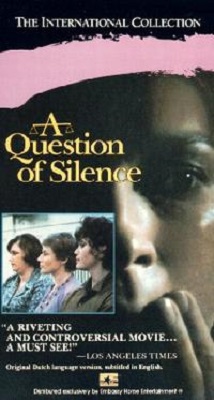
A Question of Silence*, Marleen Gorris (1982, Netherlands). Three women are arrested for the murder of a man, and while being interviewed by the police it transpires they do not know each other… The film starts ordinarily enough, introducing the three women as they go about their daily business. One runs a café, another is a secretary in an office, and the third is a housewife, who does not speak. Each of the women are arrested and then interviewed by a police officer. They are accused of beating a man to death in a clothes shop. Nothing up until that point has suggested the women capable of committing such an act. It is only when the crime is shown in flashback, that the motive becomes apparent. The housewife had shoplifted a garment, and the shop owner had insisted she return the garment. The three women attacked the shop owner. The other women in the shop just stood and watched them. A court-appointed psychiatrist tries to understand why the women committed the murder, but they refuse to discuss it. In court, the prosecutor suggests the crime would still have occurred if the shop owner had been female. Every woman in the court room starts laughing. This film definitely belongs on the 1001 Movies You Must See Before You Die list. It certainly does not deserve to be so difficult to find. There are plenty of Dutch films available on sell-through in the UK – most of Paul Verhoeven’s oeuvre, for example – and, of course, many Dutch films released in the Netherlands have English subtitles available. But A Question of Silence really was a hard film to track down, and it definitely doesn’t deserve to be. That’s a shame.

Queen of the Desert, Werner Herzog (2015, USA). I had not known this was a Herzog film until– well, no, I had known it was a Herzog film but I found it hard to believe it as I watched it. It seemed more like a Kidman star vehicle. She plays Gertrude Bell, one of a number of British female explorers of the Middle East. Another is Frey Stark. Bell graduated from Oxford with a first in History, the first woman to do so, but was not awarded a degree as women were not awarded degrees at the time. Bored with the life planned for her, Bell travelled to Tehran to join her uncle, a diplomat there. She learns Farsi and studies Persian poetry. She falls in love with a member of the embassy staff – played, bafflingly, by an American with a US accent, who’s a made-up character anyway. But her family deem him unsuitable (her real life lover was married), and he commits suicide. So she throws herself into her work, travelling about the region, doing archaeological and philological work. I got the impression from the film that she was involved with Saudis – I distinctly remember mention of the House of Rashid, the original rulers of the Nejd region of the Arabian peninsula – but Bell’s biography on Wikipedia states she mostly travelled and worked in the region now occupied by Syria and Iraq. True, the House of Saud was based in Kuwait at one point, I seem to recall, and that borders Iraq – in fact, the British drew the Iraqi borders, and I think Bell was one of those involved. She also met TE Lawrence several times, and spent WWI working with him in Cairo for British military intelligence. Given I have a long personal connection to the Middle East, it’s no surprise I find the history of the region interesting. But nothing in this film quite rang true. And nothing about seemed very, well, Herzogian. A disappointment on both counts.

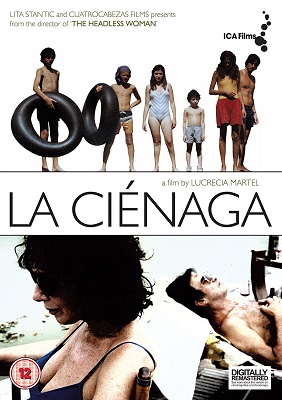
La Ciénaga, Lucrecia Martel (2001, Argentina). I watched Martel’s last but one film, The Headless Woman, last July (see here), and thought it very good. But it wasn’t until I saw a review of her latest, Zama, on Alternate Ending, that I added her other available films to my rental list. This was her first movie. Apparently, the script won a prize at Sundance, but the jury suggested she change it to a more straightforward narrative with clear lead characters. She refused. And so she should have done. Unlike The Headless Woman, which does have a (relatively) straightforward narrative, but – and this is what makes that film so good – it then begins to unravel its own story, until not only the characters but also the viewer begisn to doubt what has actually happened… Unlike that movie, La Ciénaga has no real plot or story. Things happen. And, er, that’s it. There’s no forward momentum. A family have escaped the humid weather in the city by removing themselves to their country house. The mother slips and bashes her head at the side of the pool. She takes to her bed, while her children run riot. The servants take liberties, and she accuses one of theft. Her sister visits with her own children. Martel has made four feature films to date and she really is very good. In fact, Argentina has produced some excellent films by female directors. Lucía Puenzo is another name from the country to watch. It’s not just Argentina – there’s also Claudia Llosa from Peru. And no doubt others from other South or Central American countries I’ve yet to stumble across. The more I see of the cinema of the continent – and it’s not just recent films, but also older ones, such as those by Glauber Rocha of Brazil, of whom I’m a fan – the ‘more I want to explore it. I guess my rental list will be expanding a bit over the next few weeks…

1001 Movies You Must See Before You Die count: 908

1 Comment

Books in May

It’s a shame the York and Sheffield pub meets have packed in as it was a good way for me to get rid of books I didn’t want. After all, I’m not going to dump first editons in excellent condition I no longer want in charity shops. I’d much prefer them to go to a good home. Selling them on eBay is a faff, and no one will buy them on Amazon if you price them what they’re actually worth… Perhaps, instead of a book haul post, I should put up a book sale post here…

These books, however, are ones that have just arrived… although one or two I may be getting rid of once I’ve read them.

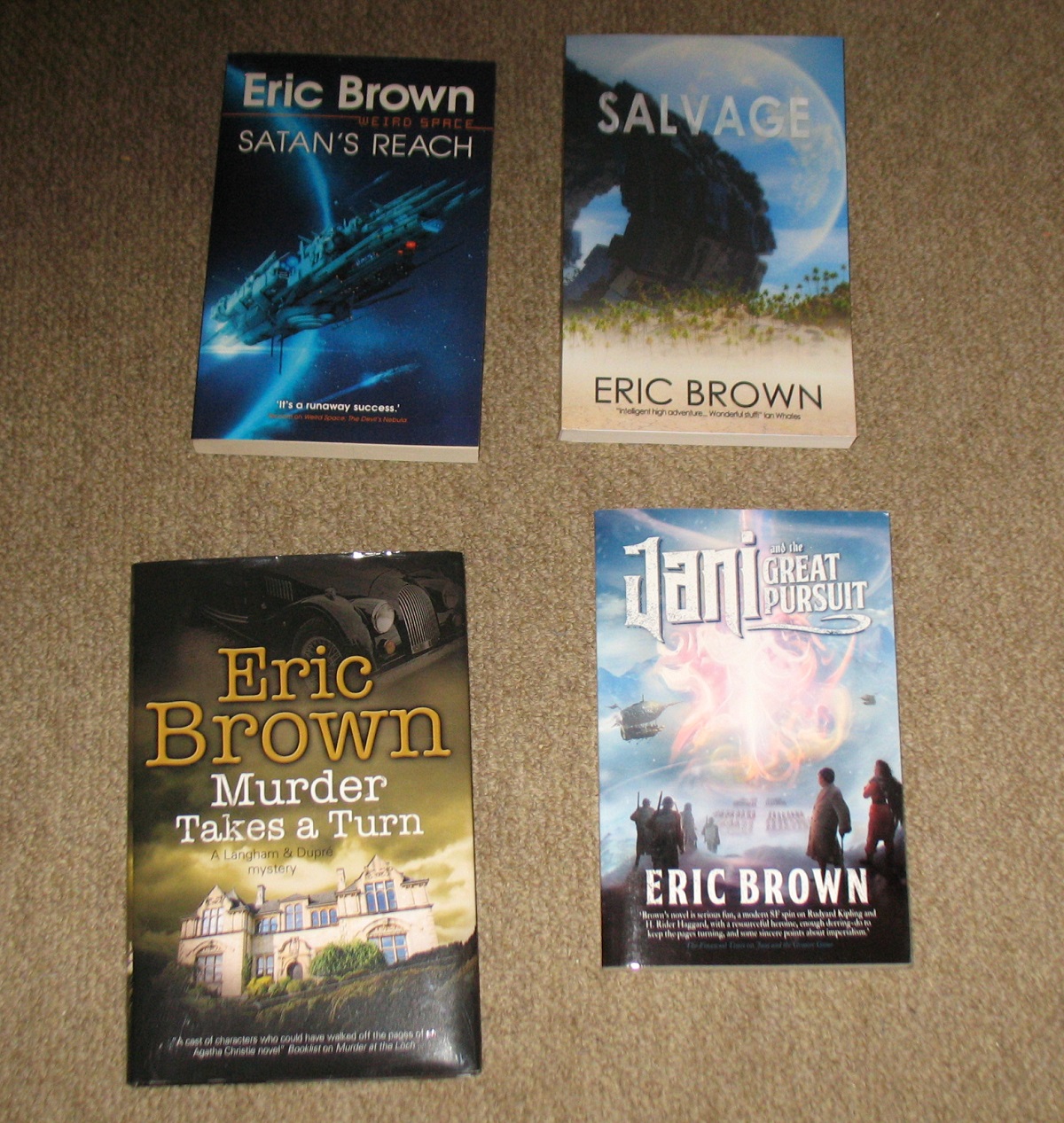
I was a bit behind on my Eric Brown books, so I ordered a bunch of them: Salvage, Jani & the Great Pursuit, Murder Takes a Turn and Satan’s Reach. Two are sequels, and I’ve yet to read the previous books. But I’ve been reading, and enjoying, the Langham and Dupree crime novels as they’re published.

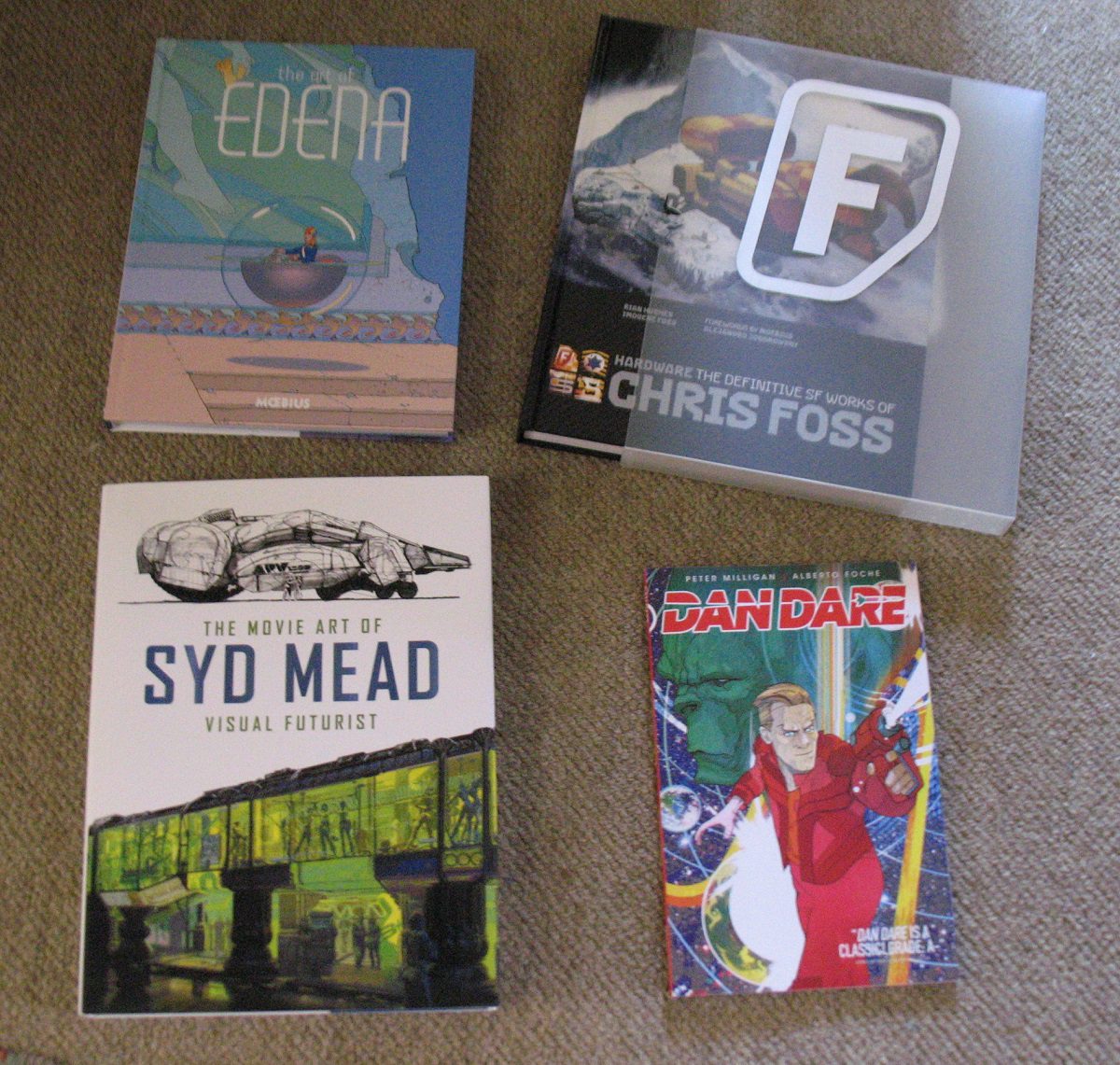
I remember just before Loncon 3 seeing mention of a signed limited edition of a book of art by Chris Foss, Hardware, but had assumed they’d all been sold back then. But recently I discovered the Titan Books’ online shop still has copies. So, of course, I ordered one. I ordered The Art of Edena several weeks ago from a large online retailer, but they told me a month later the book was unavailable. A week later, it was in stock. Go figure. Years ago, I had the Dragons Dream book of Syd Mead art, but I gave it to a friend in payment for some cover art. I’ve always regretted that, but now I have The Movie Art of Syd Mead instead. And I’ve been a fan of Dan Dare since I was kid. I’m not old enough to have read him in the Eagle; my introduction was via a 1974 Hamlyn annual containing two stories. Over the years, various attempts have been made at re-imagining him, mostly unsuccessfully. Dan Dare: He Who Dares is the latest such try.

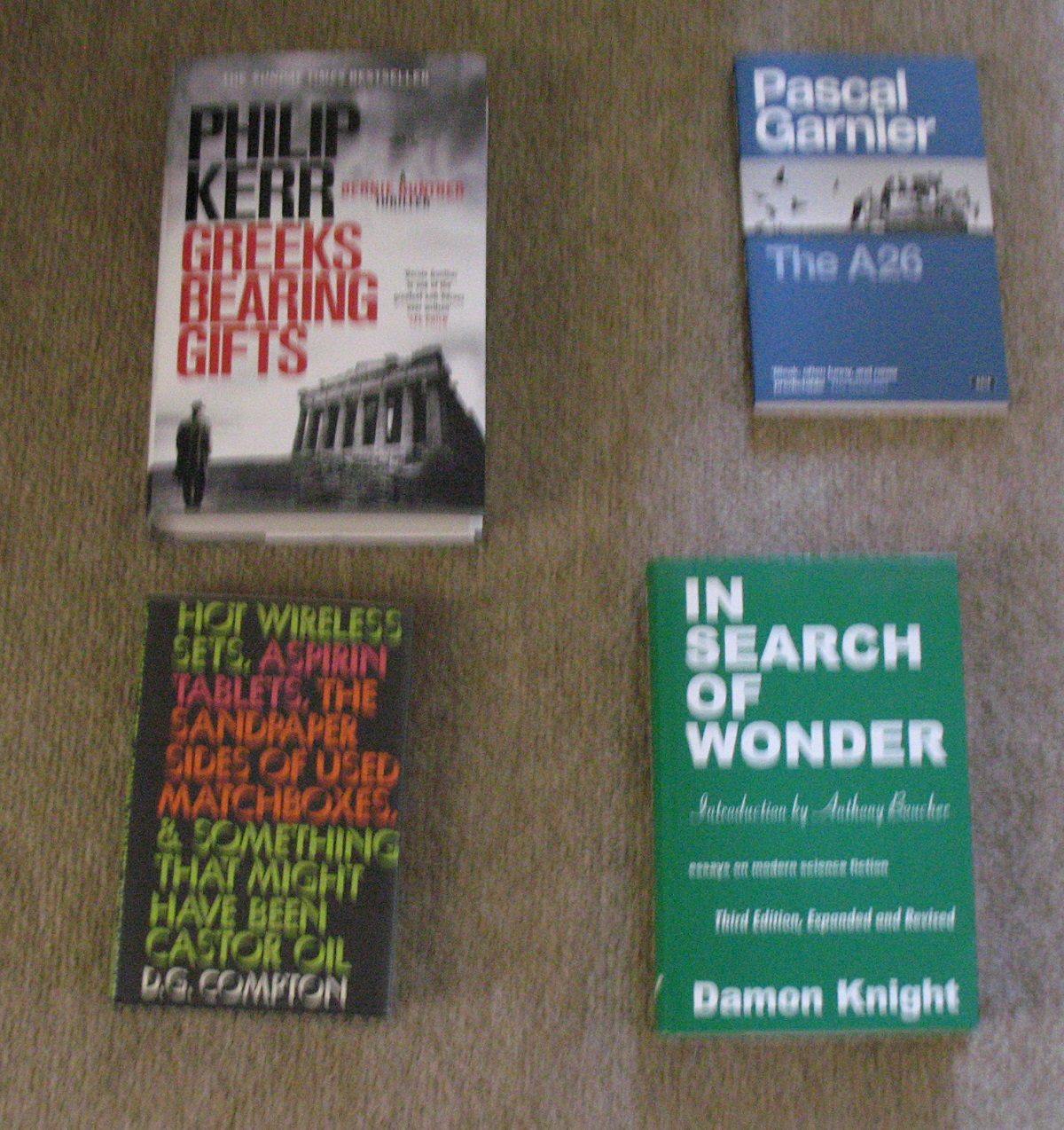
I was very sad to hear of Philip Kerr’s death earlier this year as I’ve been a fan of his books for a long time, especially the Bernie Gunther ones. Greeks Bearing Gifts is the latest, but not, I think, the last. I seem to remember hearing there is one more to come. And then that’s it. A very big shame. Someone tweeted about Pascal Garnier a few weeks ago, and his books sounded interesting so I thought I’d give one a try: The A26. I already have a copy of Hot Wireless Sets, Aspirin Tablets, The Sandpaper Sides of Used Matchboxes & Something That Might Have Been Castor Oil (a sure winner for the most unwieldy title of a sf novel evah), AKA Chronocules, but this one a) is in much much better condition than mine, and b) was really cheap. I’ve been after a hardback copy of In Search of Wonder for several years, most of those for sale on eBay are from US sellers. This copy – the third edition from 1996 – was from a UK seller. And it’s in mint condition. Result.

They announced the shortlist for this year’s Clarke Award a week or so ago, and I must admit it’s a more interesting shortlist than we’ve had for a number of years. I certainly agree that Anne Charnock’s Dreams Before the Start of Time should be there – I’ve been championing it since I read it last year. But the others? Spaceman of Bohemia I’ve heard some good things about. American War, Gather the Daughters and Sea of Rust were completely off my radar, although I vaguely recall hearing mention of the last. Anyway, I’ll give them all a go. And yes, there is a sixth novel, Borne by Jeff Vandermeer. I didn’t take to his Annihilation when I read it so I’m not going to bother with Borne.


Leave a comment

Moving pictures 2018, #24

After the last post’s diversity, it’s swung the opposite way here, with a mostly Anglophone half dozen films…

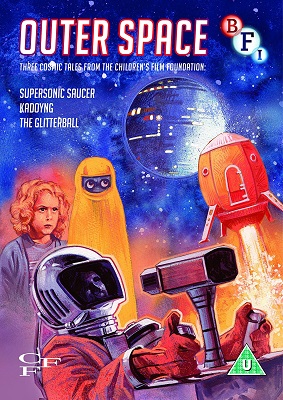
Supersonic Saucer, Kadoyng, The Glitterball, Guy Fergusson, Ian Shand, Harley Cokeliss (1956, 1972, 1977, UK). These three films were packaged as “Outer Space”, which is a  bit of a phiz as they all take place on Earth. In the south of England, in fact. In the first, an inhabitant of Venus, all of whom can transform themselves into flying saucers, is a bit of a late starter, and when he – or perhaps it – finally transforms, he makes his way to Earth, where he is befriended by two girls spending half-term at their school in the care of the headmaster’s know-it-all son. Since said alien has the power to make things vanish and then re-appear, much typical 1950s moralising then ensues, with a raid on the local cake shop reluctantly undone before the pesky kids, and alien/flying saucer, foil a bank robbery by some comedy villains. Very much of its time. Kadoyng, on the other hand, is the name of a comedy alien who lands on Earth and is befriended by a group of kids. He looks like a human, however, except for the stalking growing from the top of his head. So they give him a top hat to hide it. Meanwhile, a bypass is about to be run through the village, and the kids are on the nimby side… and there are a bunch of kids who bully them on the other side. Naturally, the alien helps save the village from the march of progress, through the use of alien, er, advanced science. The Glitterball is is also an alien, which a pair of kids find and, er, befriend. But some others want the alien ball once they realise its powers. And like the other two films on this disc, it’s all about kids standing up for something else, and perhaps some noble cause, as catalysed by the arrival of an alien, human-looking or otherwise. I thought it might be fun watching these CFF films, but I can’t really say that it has been. I doubt I’ll bother with the rest.

Dark Victory, Edmund Goulding (1939, USA). My mother found a box set of four Bette David films in a charity shop and lent it to me after she’d watched them. I’m not a Bette Davis fan – there are other actresses from that period I’d sooner watch. And it turned out I’d seen two of the films in the box set before – Now, Voyager and The Letter (see here) – but I’m happy to rewatch classic Hollywood films, so no bother. Dark Victory is a film adaptation of a well-known play, in which Davis’s role is that of a young socialite with bad habits who learns she has a brain tumour, marries her doctor, who then tells her that her condition is operable, which it is not. Despite being a play before it was a film this still comes across as a Bette Davis star vehicle – although, to be honest, pretty much every Bette Davis film does. Humphrey Bogart plays a minor role as an Irish horse trainer, but the film is all about Davis and her illness-induced deterioration. Meh.

Jubilee, Derek Jarman (1978, UK). A new box set of Derek Jarman films on Blu-ray? I’ll have me a copy of that… No, wait. I’ve seen a few of his films over the years, but I’d hardly call myself a fan. I never quite plugged into his slightly amateurish aesthetic, and his choice of subjects was not one designed to appeal to me… But then I watched his Wittgenstein earlier this year (see here) and was really quite impressed. Clearly, I had misjudged Jarman. And since this new box set included Jubilee, perhaps his most famous film, and one I’d never actually seen, then maybe it was worth a punt…  So I bought it. And a very nice object it is too. The BFI have done him proud. Obvs, the first film I chose to watch from it was Jubilee. And it was not at all like I had imagined. I had thought it was some punk aesthetic celebration of the time, starring some well-known names from the scene and some of its defining music. Except, it wasn’t. It’s set in a post-apocalyptic UK after the death of Queen Elizabeth II (although even back in 1978 that was an unlikely outcome for her death). Queen Elizabeth I is transported forward in time to the 1970s by John Dee (played by Richard O’Brien. With hair! And a beard!), and then it’s sort of her hanging around with a bunch of punk misfits. The music is not at all punk, and surprisingly good. Some of the cast aren’t great, but the whole thing hangs together much more effectively than I’d expected. I thought it pretty good. And I’m glad I bought the box set.
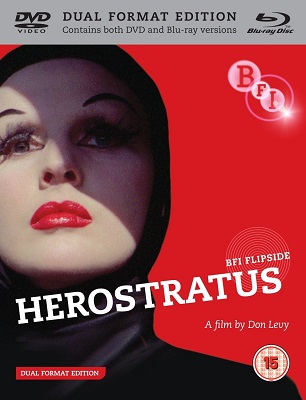
Herostratus, Don Levy (1967, UK). I stumbled across this on the website of a certain online retailer whose owner is so desperate to spend his fortune he’s throwing it at a private space programme but apparently won’t even considered giving his employees a living wage. Anyway, I spotted it in my recommendations, before they went and changed how that works so now it’s next to sodding useless, and I bunged it onto an order. I suppose I was expecting something either like Penda’s Fen (see here) or Privilege (see here). What it is, is like neither. If anything, it reminded me of Nicolas Roeg’s Performance (see here). A young man, sick of the world and its failure to cater to his sensibilities, decides to commit suicide, and tries to turn it into a media event. He approaches an advertising mogul, and they try to make a media event out of it all. Every so often, the film flashes up images of a woman in black, or a woman in a red. There’s also a scene where a young Helen Mirren, in bustier and fishnets, performs an erotic dance. Herostratus is very much a film of its time. I think it’s trying to make a similar point to Watkins’s Privilege, but it’s not as biting, or as entertaining, a satire as that one is. But I did enjoy it more than Performance.

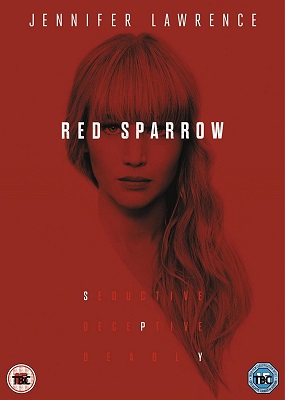
Red Sparrow, Francis Lawrence (2018, USA). It’s 2018, FFS, should we still be making movies in which Russians are played by Anglophones sporting silly accents? (Although not entirely, as one of the Russians is played by a Belgian, and another is Dutch.) And the entire plot relies on copying data on 3.5″ floppy disks. In 2018. Good luck on finding a computer with a floppy disk drive, even in Russia. Jennifer Lawrence, who may be a very good actress but seems to have the usual Hollywood problem of being unable to pick good projects, plays a ballerina who is injured onstage and then blackmailed by her uncle into becoming a sex operative, or “sparrow”, for the KGB, er, FSB. This is a film that wants its Cold War and is determined to ignore the last thirty years of actual history to get it. After demonstrating she is not going to obey the rules at sparrow school, the viewer is repeatedly told she is something special, not that this is especially evident onscreen. She’s sent on a mission to Budapest to seduce a CIA agent. Because he runs a mole in the KGB, er, FSB, and naturally they want to know who it is. She goes about it in her own way, which means blackmailing anyone who thinks she’s behaving like a double agent for the CIA. There really is nothing good to say about this film. It feels like it’s set 30 years ago and not in the present day. Jennifer Lawrence is a complete blank. And the plot doesn’t even make sense as a spy story plot. One to avoid.

Winter of Discontent, Ibrahim El Batout (2012, Egypt). This is a dramatisation of events during Arab Spring, featuring actors playing real people. One of the major characters is the female anchor of a current affairs show, who quits after being bollocked for asking dumb questions on air and decides to investigate the events ongoing in Tahrir Square for herself. The film shows both sides – and not just those fighting the authorities, but also those who are trying to shut down the insurrection. And even those who are caught up in it by accident. One such man was arrested by the secret police simply because he was in the wrong place at the wrong time, and then beaten and tortured as a “rebel” despite his protestations of innocence. Arab regimes have been, traditionally, autocratic, and even democratic Arab nations have often devolved into autocracy. The West is happy to support such regimes, either to protect strategic resources – look up the history of BP, if you don’t believe me – or to keep active a ready market for armaments exports. And dropping bombs on such nations will not “fix” them. And yet, in most cases, these authoritarian regimes are so well-entrenched that not even an Arab Spring can unseat them, especially not when they’re being propped up by the West. Let’s not forget that Gaddafi may have been Public Enemy No. 1 but he was left in power for precisely as long as the West was happy to let him be in power. And now that’s he gone, Libya is a disaster area. And for all that we boast of our freedoms, they’re being eroded daily – only this month, voters were turned away from polling stations because they did not have ID for the first time in British history. Demanding ID to vote is not a solution to electoral fraud because it’s a trivial problem – in 2017, there were 28 allegations from 45 million votes, and only one conviction. It’s a way to disenfranchise people. And if the government is going to tackler electoral fraud, they would do well to address the illegal campaign spending perpetrated by their own party in the last general election… None of which is especially relevant to Winter of Discontent, which provides a good overview of the events of the January 25 Revolution of 2011 but does very little reaffirm a person’s faith in humanity…

1001 Movies You Must See Before You Die count: 907


Leave a comment

Moving pictures 2018, #23

Six films, six countries. It’s been a while since I managed that.

Oliver & Company, George Scribner (1988, USA). I have a vague ambition to work my way through all the Disney films – that’s vague, as in I’m not putting much effort into meeting it. So I added some Disney films I’d not seen to my rental list, and I watch them when they pop through my letter-box. But, to be honest, I’m not much of a fan. Sleeping Beauty I consider one of the most gorgeous animated films ever made, but that doesn’t make me a Disney fan. And Oliver & Company is a good example why. I’ve no idea who the DVD cover art is  meant to represent as the art is a great deal better than that in the film. Which is a rip-off of Dickens’s Oliver Twist, but with a kitten in the title role, and dogs playing most of the other roles. Although Fagin is a human. It’s not a bad spin on Dickens’s tale, to be fair, but Disney animated feature films live or die on the quality of animation and the songs. This one has one good song, sung by a lead character voiced by Billy Joel, but piss-poor animation. I was not impressed.

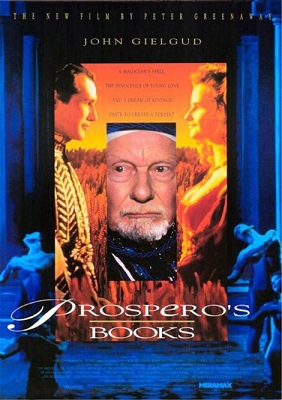
Prospero’s Books, Peter Greenaway (1991, UK). So many willies! I’m familiar with Greenaway’s oeuvre – in fact, I’ve been more or less following his career since first seeing one of his films back in the mid-1980s. I let it slide for a while, but caught up recently via rental DVDs. This particular film has been hard to find, but when I did track down a copy… there was lots and lots of full-frontal male nudity. Now, I hasten to add, I have nothing against male nudity, much as I have nothing against female nudity. I am not remarking on its presences, only its excessive presence. Although, I must admit, against what standard I have no idea. Apart from that, the most striking thing about Prospero’s Books is how much like his later films it is. It’s almost as if he were trying out a new way of telling stories on film, one that he went on to use in Nightwatching and Goltzius and the Pelican Company – but not, I seem to remember, in The Pillow Book or 8½ Women, which were made after Prospero’s Books but precede the other films. Prospero’s Books stars John Gielgud in the title role, the sorcerer from Shakespeare’s The Tempest. The other characters from the play also appear, but the film is very much about Prospero. And his library. As each book of his is introduced, so CGI brings it to life, both the writing and the subject. In between these are tableaux, over which Gielgud narrates, some of which are static, while others illustrate scenes from the books or allude to scenes from the play. It is a very clever film, and the CGI is very effective. I’ve never really been a fan of Greenaway’s most-celebrated film, The Cook, the Thief, His Wife and Her Lover (although perhaps The Draughtsman’s Contract is better known), but I’ve always thought he was a singular talent and I’m glad I returned to his films after a decade or more gap. It’s a shame there’s no handy box set of his works, but I expect that would be difficult to arrange given the multi-national financing of most of his films since The Cook, the Thief, His Wife and Her Lover

Padmaavat, Sanjay Leela Bansali (2018, India). In thirteenth-century India, the nephew of the sultan of Delhi murders his uncle and seizes the throne and determine to be next Alexander the Great. Meanwhile, in Sri Lanka, a local princess accidentally shoots a visiting Rajput prince with an arrow and wounds him. She nurses him back to health, the two fall in love, as you do, and get married. Then the new Delhi sultan’s plans for expansion send him up against Rajput, and the two kingdoms fight to the death. Padmavati, the Sri Lankan princess, leads the defence of Rajput capital Chittor with an army of women after her husband has fallen to the cheating sultan in single combat. And this is Indian history so it’s all hideously complicated and not really open to easy summary. But Padmaavat is, like Baahubali, one of the new breed of epic movies coming out of India that are CGI’d up to the eyeballs. Padmaavat looks fantastic. It is nowhere near as bonkers as Baahubali, and its battle scenes are somewhat more believable. But everything is giant, the castles are huge, the forests are humungous, and the armies number in the millions. It’s all completely OTT, but also hugely entertaining. Having said all that… I recently tried watching Guy Ritchie’s King Arthur: Legend of the Sword, which is another CGI-heavy retelling of, well, not history exactly, but the Matter of Britain, which I do know a little about. And Ritchie’s film is complete fucking nonsense. Giant elephants and dragon skeletons in tenth-century Britain? WTF? I don’t know the history of India – it’s an enormous country, I suspect no one really does it all – so I can’t say if Padmaavat, an allegedly historical film, annoyed Indian viewers as much as King Arthur: Legend of the Sword annoyed me. But perhaps I should have just gone with the flow – it’s a movie, not a history lesson – and accepted it as entertainment, which is likely what it was intended to be. Certainly, Padmaavat was entertaining. And if you have to watch two Bollywood films this year, then I recommend this one and Baahubali.

No Fear, No Die*, Claire Denis (1990, France). I knew this was on the 1001 Movies You Must See Before You Die list but I had not known it was by Claire Denis until I started watching it. And, I suspect, there are other Denis films that deserve a place on the list more. Like Beau Travail. Which is, I think, a better film than this one. It doesn’t help that the story of No Fear, No Die revolves around cock-fighting, which is barbaric – no, it’s not a “sport” – and indeed the title is the name of one of the character’s favourite cockerel. Two guys from the Caribbean travel to France, and persuade a contact there that they can make money running cock fights. He provides the venue, they provide and train the birds. But it does not go as well as planned. The situation is further complicated by the attraction one of the two guys feels toward the French guy’s wife. In most respects, this is a typical French film of tangled relationships. The cock-fighting gives it an unusual edge, and metaphor, but it’s not something you really want to watch. The cast are excellent. But I can’t help thinking Denis’s Beau Travail looked better and was a more effective movie. It deserved to be on the 100 Movies you Must See Before You Die list. Not this one, which is clearly held in such high regard it’s almost impossible to find on DVD…

No compteu amb el dits, Nocturn 29, Lectura Brossa, Pere Portabella (1967, 1968, 2003, Spain). There are 22 films in this box set, and I don’t think I could write intelligent reviews of each one so I’ll lump them together. I had hoped the films would be presented on the discs in the box set in chronological order, but apparently not. Anyway, I watched all three films on the first disc in the box set and… I have no real idea what I watched. Lectura Brossa is the least puzzling of them. An actress stands on a stage in front of a screen. A script is projected on the screen, which she reads. On the right side of the stage, a woman translates the words spoken into sign language (I don’t know which one, sorry). The story involves two characters identified only as “the boy” and the “the girl”, but then introduces “the wife” and “the husband”. It is by Joan Brossa, what also provided the scripts for the previous two films, and who is then interviewed in a short follow-on piece. Both No compteu amb el dits and Nocturn 29 are black and white. The first has a fake documentary/infomercial voiceover, the second uses strange electronic cracklings or discordant piano playing as its soundtrack. Things happen, with no seeming logic – a man takes a shower, a woman removes her make-up, a man visits a post office… these could have come from either film. There is something fascinating in the way a narrative forms out of the connections between the disparate scenes – although “scene” may be too strong a word, as many are simply short sequences in which, for example, a man exits a car, climbs some stairs, enters an apartment, and then sits down. The second of the two is clearly about Franco’s rule, with its film of military parades. The first attempts to mock consumption, and the fact the two films are so similar in presentation and technique, and were made within a year of each other, makes the wide gap between the subjects seem odd. This is good stuff. And I’ve still got another 19 films to go…

Haunting Me, Poj Arnon (2007, Thailand). Four drag queens run a boarding-house for young men. A young woman dies when she falls and bashes her head on a toilet. So she haunts the boarding-house. There’s another ghost too, another young woman, who fell from the roof while running from an attempted gang rape. The drag queens initially cover up the deaths, and employ a number of methods to try and exorcise the ghosts. None of which work. Gradually they realise they need to avenge the ghosts if they’re going to get rid of them. There’s not much to say about this film. It was fun, even funny in places. Annoyingly, the quality of transfer varied throughout the film – some scenes were really high resolution, others were blocky and pixellated. Ah well.

1001 Movies You Must See Before You Die count: 907


4 Comments

Reading diary 2018, #7

My reading has been a bit all over the place of late. On the plus-side, I seem to be better at picking books I enjoy.

The Silent Multitude, DG Compton (1966, UK). After Gwyneth Jones, I would say DG Compton was likely the second-best sf writer the UK has produced. Except… His writing was a cut above what is typical for the genre, and his best work is among the top rank of British sf – and rather than being timeless, it makes a virtue of the fact it is tied to its time of writing – but… Compton’s range was somewhat narrow. He wrote many similar novels. And there are a number of other UK sf writers of the 1970s whose prose was perhaps not as good as Compton’s but who managed to produce more varied work. Which is not to say that Compton was never good, or that mediocre Compton is not a great deal better than some other writers’ best. The Silent Multitude is Compton coming into his voice, after a handful of years of writing crime novels as Guy Compton. A mysterious organism is spreading across the UK which dissolves mortar and reduces buildings to rubble in a handful of days. The “Sickness” has now reached Gloucester, a city completely rebuilt in the 1980s, which has now been evacuated. Except for the local dean, an old man who collects newspapers and lives alone among the tens of thousands he has collected, a twentysomething hoodlum who proves to be the son of the architect who designed the new Gloucester, and a twentysomething young woman reporter who is the daughter of the editor of the newspaper for which she works. (The mentions of a redesigned Gloucester reminded me not only of Portmouth’s Tricorn Centre, which I’ve only seen in photographs, but also the various plans to rebuild the city centre of Coventry and, of course, the precinct which eventually resulted.) The Silent Multitude is essentially these four characters witnessing the death of a city – the death of its buildings and infrastructure, that is; the people have already left – and while Compton is good on the descriptive prose and the characterisation, this novel doesn’t feature any of the narrative tricks he later used. The Silent Multitude is a slim work, ideas-wise, propped up by good prose, but that’s no bad thing as science fiction in general could do with upping its game prose-wise. Compton is good – bloody good, in fact – but this is nowhere near his best work.

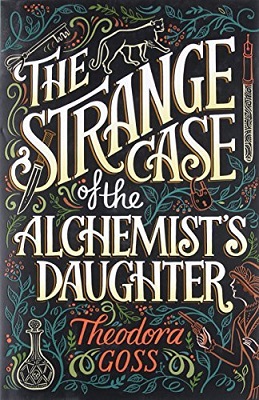
The Strange Case of the Alchemist’s Daughter, Theodora Goss (2017, USA). Most of Goss’s short fiction that I’ve seen has been fantasy or reworked fairy tales, which is not really the type of fiction that interests me. But a year or two ago, she wrote ‘Cimmeria: From the Journal of Imaginary Anthropology’, which was the sort of referential mash-up genre fiction that does appeal to me – and I thought it so good, I nominated it for the BSFA Award, but it did not make the shortlist – and it seems she has written more in a similar vein. Anyway, I saw mention of this, her first novel, and its premise – the daughters of various nineteenth-century fictional scientists team up to help Sherlock Holmes solve Jack the Ripper’s murders – sounded like it might be worth a go. And so it was. It is, in fact, very good. Except. Well, it feels a bit dumbed-down. I’m not sure what it is, but it doesn’t feel as clever a novel as its central conceit would suggest. It doesn’t help that Mary Jekyll – yes, the daughter of that Jekyll – is the main character but spends much of the plot tagging along behind Sherlock Holmes. On the other hand, the novel is explicitly presented as a narrative written by Catherine Moreau, often with interjections by the other women, and that works really well. It’s also quite funny. For a novel set in Victorian Britain, there are a few slips – the ground floor is continually referred to as the first floor; and some of the expletives are US English. Despite those minor quibbles, I enjoyed The Strange Case of the Alchemist’s Daughter, and plan to pick up a copy of the sequel, European Travel for the Monstrous Gentlewoman, when it’s published in July.

Author’s Choice Monthly 10: Tales from a Vanished Country, Elizabeth A Lynn (1990, USA). One day I will have all of these muahahah. Ahem. But for now, I have just over half of the series. Lynn was not an author known to me, so I came to this short collection cold. In the first story, a wizard runs a trading empire, and when his CEO, so to speak, betrays him, he imprisons him as water in the sea. Some time later, he frees him, because a rival wizard has been upsetting the balance of power. The two disguise themselves to visit the other wizard, but he sees through their disguises. Fortunately, after several months of drugged gaslighting, the CEO chap regains his senses, and the world is set right. So far, so consolatory. The second story, however, is anything but. Three sisters are noted for their beauty, intelligence and martial prowess. A mysterious woman appears and challenges them to combat. One accepts and is killed. Some time later, the mysterious challenger reappears, and this time the second sister is killed in combat. So the third sister hunts down the killer, who turns out to be an aspect of the Moon, and she becomes her lover. Years later, the sister decides to return to her family, but it seems decades have passed. But she stays and lives out her life, mourning her dead sisters and lost lover. The final story reads more like mythology than epic fantasy. A goddess entrusts command of the five winds to a reclusive astronomer who lives in a cave in the mountains. The goddess’s son decide to check this out, and becomes the woman’s lover. She has two girls, who grow faster than human girls. He leaves and steals the cloak the woman uses to command the winds. Chaos ensues. Eventually, the goddess returns. But the woman has disappeared and the two daughters are only just managing to survive. I don’t think I’ve read anything by Lynn before, and I have the impression I’ve seen her name chiefly on the covers of sharecropped novels… although checking on isfdb.org, I see that’s completely false and two of her three standalone novels are, in fact, science fiction. (The 1983 UK paperback edition of one has quite striking cover art.) The three stories in Tales from a Vanished Country are really good, which was completely unexpected. They make clever use of fantasy tropes, and are deeply feminist, even the first one which features no female characters. I think I’ll track down copies of those two science fiction novels…

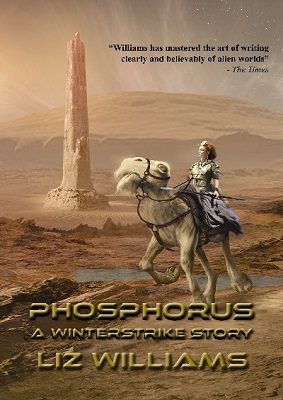
Phosphorus, Liz Williams (2018, UK). This is the third novella of the third quartet of NewCon Press novellas, although the fourth book I read of the set. Not, I hasten to add, for any particular reason. It is subtitled “A Winterstrike Story’, and I have no objection to subtitles but I would like to point out that they are not titles. So when a data entry form has a field called “title”, it means title, not title and subtitle, not title and, as I have seen, “[random award] winner”. People complain about Big Data, but it would be much less of a problem if we didn’t have Shit Data. But that’s a rant for another day. I have read Winterstrike, but not the other books in the series. Neither is necessary to understand the story of Phosphorus, which, to be honest, isn’t much of a story. It’s extremely strong on setting – and Williams’s Mars is a fascinating place – but the story doesn’t really go anywhere or do much. A young woman with some mysterious quality is adopted by her mysterious aunt, who takes her from Winterstrike, which is under attack by another city, to the dead city of Tharsis. Meanwhile, the sole survivor of the Hunt – although she is dead, but animated by one of the Hunt’s starships – an alien race that saw its mission in life as “culling” other races, leaves her homeworld of Phosphorus, and eventually ends up on Mars. An event which, it transpires, happened centuries before the other narrative, and the young woman is in some way connected. And, er, that’s it. Pretty much. An interesting idea that’s not at all explored. It reads like the start of a novel. Nice writing, nice world-building, but disappointing plot.

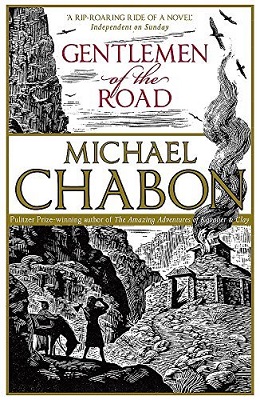
Gentlemen of the Road, Michael Chabon (2007, USA). Back in the day, The Yiddish Policeman’s Union appeared on several genre award shortlists, IIRC, and I read it and thought it quite good. So I stuck The Amazing Adventures of  Kavalier and Clay on my wishlist and some years later was given it as a birthday present. And then I read it, an embarrassing number of years after that, and was much more impressed. And shortly after that I found a copy of Gentlemen of the Road in a charity shop, so of course I bought it. And… Chabon writes in an afterword that to him the novel (a very short novel) was always titled “Jews with Swords”. Because to him Jews had never been associated with swords – at least not since Biblical times. I’ve never attached a religion to a weapon – people with swords are people with swords, and I’ve never really thought about the religious tradition from which they came, perhaps because in most cases in fiction that tradition was invented, and for those where it was not the context more than explained it. But “Jews with Swords” gives us a Frankish Jew estranged from his European family, and an Ethiopian Jew from tribe that no other Jew seems willing to accept, on a mission which involves the Khazars, a Turkic state which converted to Judaism, but vanished after three centuries. The two unwillingly accept a commission to take a young Khazar prince, the last survivor of the family of a deposed bek (martial leader, a sort of government CEO to the kagan’s chairperson). But they lose him to some mercenaries, who are taking him to the new bek. Except the prince persuades the mercenaries to rally his cause, and sort of builds up an army from the Muslim Khazar cities in the south of the region which the new bek had let the Vikings plunder with impunity. And… well, the big secret about the prince is pretty obvious from about a page after he’s been introduced, and the only suspense is in wondering how the two main characters can be so dumb as to not figure it out. Having said that, the history is fascinating, the characters are interesting, and, while I find Chabon’s prose a bit hit and miss, the mannered style he adopts here works well with the story. I should read more Chabon. Fortunately, I have Wonder Boys on the TBR, picked up from a charity shop at the same time as Gentlemen of the Road

Inside Moebius, Part 1, Moebius (2004, France). I came to Moebius’s work from Jodorwosky, as Moebius – Jean Giraud – illustrated Jodorowsky’s Incal series, still one of the greatest sf bandes dessinées of all time. Although, having said that, I seem to remember seeing parts of Moebius’s Airtight Garage many. many years ago. Back in the early 1980s, I used to fly out to the Middle East for holidays via Schiphol Airport, and in the bookshop there I would often pick up a copy of Heavy Metal or Epic, and even an issue of 1984 (which I had to hide once I’d discovered what it contained). I’ve a feeling that’s where I first encountered Moebius’s work. That’s all by the bye. I’ve been a fan of Moebius for many years now, so I keep an eye open for when new stuff by him appears in English (I could, I suppose, buy the original French editions, but I have enough trouble keeping track of new stuff in one language market, never mind doing it in two). Inside Moebius, originally published in in six volumes in France but now as three volumes from Dark Horse, is a sort of autobiographical private project that blossomed. Moebius wanted to give up smoking, so he started writing a bande dessinée about it, and then sort of dragged in the books he had worked on, or was currently working on, and his thoughts on a variety of subjects. Particularly politics. Osama bin Laden makes an appearance in Inside Moebius, Part 1, as do some of Moebius’s characters – Blueberry, Arzak and the Major. The art is not as detailed as in other Moebius works, it’s almost sketches, in fact. But the way the book is designed, it’s clear the words are more important. The dialogue is full of puns, many of which have not translated but a helpful afterword explains them. (For the record, I did get the “Fumetti” one.) It’s all good stuff, although I could have wished for artwork as good as that in the aforementioned works.

1001 Books You Must Read Before You Die count: 131


1 Comment

Moving pictures 2018, #22

Sometimes, I even convince myself these posts must be taking the piss – I mean, there may be two films from the 1001 Movies You Must See Before You Die list here, but both are pretty obscure… and they’re probably the least obscure of the half-dozen. Jancsó films I buy as soon as the come available. Colorful was lent to me, and A Silent Voice was added to my rental list when I wasn’t looking. And Penda’s Fen I stumbled across on Amazon, and it looked interesting enough to give it a go…

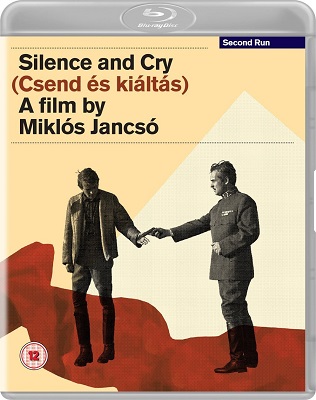
Silence and Cry, Miklós Jancsó (1968, Hungary). I’m a fan of Jancsó’s films, even if I don’t understand them half the time. Watching Silence and Cry, it felt like an early attempt at Red Psalm (see here), a film it precedes by four years. Like the later film it is set at the same farmhouse, and it has the same sort of flowing camera movement, following the cast as they move around. And, also like that film, the cast are never still. Even when in conversation, they continue to stroll around. However, Silence and Cry is set in 1919, not 1890, after a nationalist revolution against the communists in power. A troop of soldiers occupy the farm – it may be a village, as it contains several separate dwellings; I don’t know – unaware that one of the men who lives there was a member of a Communist battalion. For their own amusement, however, they force him to undergo demeaning trials. All of which comers to a head. Like Red Psalm, the characters are more stand-ins for the roles played by people in Hungary’s chequered past than they are actual characters. But given Jancsó’s predilection for filming against flat landscapes in which only sparsely scattered trees appear, or framing such landscapes in the doorways and windows of interior scenes, then their lack of depth seems entirely appropriate. Despite the staged fell to much of the story, Jancsó’s camera-work, almost continually on the move, gives the story a flow and urgency it would not other wise possess. As far as I’m concerned, Jancsó is one of the great directors. I’d definitely put him in my top ten greatest directors – in alphabetical order, at this moment in time, they’d probably be: Antonioni, Dreyer, Ghatak, Godard, Haneke, Hitchcock, Jancsó, Jia, Ozu and Sokurov (sadly, no female directors).

Colorful, Keiichi Hara (2010, Japan). David Tallerman lent me this as he seems to be on a mission to convince me anime is not all completely weird shit like Utena Revolutionary Girl (see here). I know that already, of course, but I’m not going to turn down the lend of a film worth watching. And, okay, I thought Colorful laid it on a bit thick, but it was a good film nonetheless. Some of the animation was really quite lovely. A soul is prevented from reaching heaven, and returned to earth to inhabit the body of a fourteen-year-old boy who has just committed suicide. A guardian angel tells him he has six months to figure what he did wrong in his former life, and to fix whatever led the boy whose body he is currently occupying to take his own life. Unfortunately, it’s not so easy, and after making a complete hash of everything – through a combination of his own self-centredness and his failure to make an effort to tackle the problems of his host body. Eventually, he is befriended by a fellow pupil, whose completely non-judgemental treatment of him, and indeed everyone, leads him to redemption… and the discoveries he needed to fulfil his contract with his guardian angel. Who offers him as a reward, a continued life, with no knowledge of the trial he has just undergone. I do like these sort of anime films – ie, the realistic dramas, not that the central premise of this one, with its A Matter of Life and Death conceit, is especially realistic – but when I worked my way through the Studio Ghibli films, I much preferred the high school drama ones, and that seems to be holding true for anime films in general.

Wanda*, Barbara Loden (1970, USA). I’m not sure why this made the 1001 Movies You Must See Before You Die list. It feels a bit like a John Cassavetes film – improvised, almost guerrilla film-making, about working-class Americans, very strong representation of women (I should like Cassavetes’s films more than I do) – but it’s not an ensemble piece, it’s not telling the story of a group, it’s telling the story of a single woman and it’s very much from her point of view, with entirely female gaze. That’s something you won’t find in Hollywood movies, and forty-seven years ago I suspect it was vanishingly rare in independent US film-making. The title refers to a woman who leaves her husband, does not contest custody of their kids at the divorce hearing, runs away with a one-night stand, only to be abandoned by him, before falling in with a bank robber and being forced by him to act as accomplice. For all that, like Cassavetes’s films, Wanda struck me as more admirable than likeable. Barbara Loden was best-known as an actress, and was married to critically-acclaimed and influential director Elia Kazan. But Wanda was made on a budget of $100,000, with a crew of four, and Loden as writer, director and star. That’s about as good a definition of vanity project as you can get. And, of course, not all vanity projects are ego trips with no redeeming qualities. I suspect Wanda is a more important film than a single viewing might suggest, and, of course, it doesn’t help that it’s a grim and depressing story… Apparently, Loden directed it because she could not interested anyone else – including Kazan – in doing so. It was critically well-received on release, but Loden died ten years later, at age 48, while preparing to direct her second feature film. After seeing Wanda, I must admit I’m now interested in seeing some of her other films roles.

Peking Opera Blues*, Tsui Hark (1986, China). I should have guessed what this film might be like since I knew the name Tsui Hark and had seen his Once Upon a Time in China (see here), but the title fooled me as I thought it might be more like Farewell My Concubine. It wasn’t. The story does feature Peking Opera, from which women were banned from performing, but it’s by no means the central plot. Peking Opera Blues is more of an action/comedy than it is a social drama. It’s set in the 1920s, and depicts the attempts by Sun Yat-Sen supporters to get hold of a document proving the emperor has borrowed money from Western bankers. The paper is held by a general, and his daughter is one of the supporters trying to steal it. Then there’s a young woman who had stolen a box of jewellery during a raid on another general’s house, but she lost it. While trying to hide from the general’s soldiers, the rebels hide out in an inn hosting a Peking Opera show. The impresario’s daughter gets caught up in the whole thing, helping to hide them, then assisting them in their several attempts to purloin the letter (did you see what I did there?). Other than the setting, and the three female leads, this is a typical Hong Kong action/comedy of the time. The fight scenes are good, there’s plenty of broad comedy, and the three leads – Brigitte Lin, Cherie Chung and Sally Yeh – are especially good. But the final scenes set during a performance of the Peking opera troupe, in which the three women, and their male accomplices, have taken over some of the roles, is a lot of fun. I’m not sure if Peking Opera Blues deserves its place on the 1001 Movies You Must See Before You Die list – it’s a lot of fun, but is it there because it’s atypical for its type? Is that enough? Not, I think, when you consider all the films that belong on the list but aren’t there. Still, it’s worth watching.

A Silent Voice, Naoko Yamada (2016, Japan). This anime film I actually rented – only to discover after watching it that David Tallerman had stuck it on my watch list during one of our afternoons out in Shalesmoor. The story is relatively simple: a deaf girl joins a new school, is bullied by the other students, years later the biggest bully bumps into her, having spent years unable to deal with people because of guilt over how he treated her, and tries to kindle a friendship. Her willingness to forgive him, despite the the mockery of other members of the class whom he still runs into, helps him deal with his guilt, and he soon finds he can meet the gaze of other people – and they don’t much care about, or even know, what he did. However, the other members of that high school class are happy for him to carry the blame for their treatment of the deaf girl, and many still deny their own cruelty and hate him for forcing them to confront their own behaviour. There’s a lot about A Silent Voice that reminded me of Makoto Shinkai’s films, especially his latest, Your Name (see here), although A Silent Voice is straight-up drama that uses some elements that feel like genre to emphasise aspects of its story. Whereas Your Name uses a time-slip narrative, which is about as genre as you can get. Recommended.

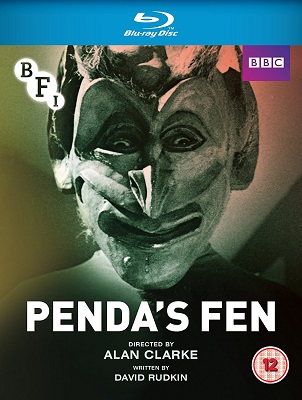
Penda’s Fen, Alan Clarke (1974, UK). The title refers to an area near the Malvern Hills in Worcestershire. A teenager, the son of the local vicar, is not liked by his peers, chiefly because he’s a priggish know-it-all whose ideas on religion appal his liberal low Anglican parents. The government is engaged in some secret project nearby – probably digging a secret nuclear bunker – and the locals have had several meetings on the topic, at which the chief opposition has been a playwright known for writing controversial television plays. The schoolboy, meanwhile, who is very irritating, has various fantastical encounters, including angels, Elgar, whose music features heavily, and eventually King Penda. This is good stuff – unassuming, but with real intelligence and depth. It was broadcast as a Play for Today in 1974, and written by David Rudkin. It’s very English, in the way that Robert Holdstock’s Mythago Wood is very English, but it’s an England that’s as foreign to me as it would be to a non-Brit. My England is the run-down and neglected industrial areas of the Midlands and Yorkshire. Their streets of terraced houses, mills and factories and works fallen into ruin, tap rooms and chip shops. The only mythology is that which attaches to generations of the same family working in the same industry. There are no sleeping kings at the bottom of a pit shaft. So I find films – or, technically, television plays – like Penda’s Fen almost as fascinating as I would a film set in, say, Mali, or China, or Greenland… Recommended.

1001 Movies You Must See Before You Die count: 906


7 Comments

Moving pictures 2018, #21

I promised 2018 wouldn’t be all film posts, but we’re less than four months into the year and I’m on my twenty-first film post. That’s like three a week. And not much else, except posts on the books I’ve bought and the books I’ve read. While I’ve started reviewing again for Interzone, and SF Mistressworks is back up and running, I still need to start writing criticism again. I suspect I’m better at ranting than sustained arguments, and since the “reviews” in these film posts have a tendency to turn into mini-rants, I’m letting it out in dribs and drabs instead of holding it back for one long piece on science fiction… On the other hand, I’ve found it harder to engage with online sf fandom this last year or so, chiefly because I’m usually not interested in the books and authors under discussion.

Speaking of mini-rants… We have an Oscar-winner in this post. And I wouldn’t be surprised if it won the Hugo this year. I hated it.

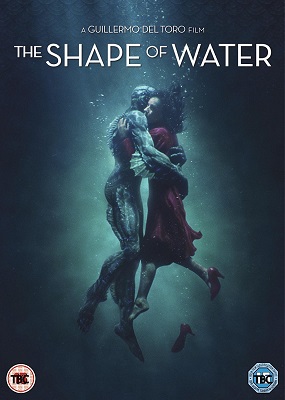
The Shape of Water, Guillermo del Toro (2017, USA). I’m not really sure how to write about this film. Del Toro has been widely praised over many years, and not just in genre circles, and of course The Shape of Water won the Oscar. Now I’m not so foolish as to believe the Oscar is any real indication of quality, and often as not the Academy’s choice of winner is baffling to everyone (as is their choice of shortlist). But that’s awards for you. The Shape of Water, in which a captured amphibian human, an experimental subject in  a secret government research programme, enters into a relationship with a mute woman (mute, but not deaf), has been seen by many as a sensitive treatment of the disability. I can’t speak to that, it’s not my experience to discuss. But I can certainly discuss the film I watched. Which opened with an acknowledgement to Jean-Pierre Jeunet, and then proved to be a complete rip-off in mise en scène and lighting and the whole look of the film to the oeuvre of Jeunet and Caro, so much so it went beyond homage. Then there’s the fact the amphibian human is basically Abe Sapiens from the Hellboy films, and even played by the same actor, Doug Jones, under the prosthetics. Meanwhile, one of the scientists in the lab is a Soviet mole, and he fancies the mute woman, but his KGB handler is after him to kill the creature. The mute woman helps the amphibian human to escape and hides him out in her apartment. The two start having sex. But the chief US scientist is after them, as is the KGB handler, and it all comes to a violent end. The film is set in the 1950s, and I thought it horribly misogynistic. Yes, the times were misogynistic – and I’ve seen a lot of 1950s films; my favourite film was released in 1955 – but del Toro’s depiction of it felt excessive. It made a film, which felt like a rip-off of better films, quite horrible to watch. Why it won the Oscar is a mystery. I thought it was rubbish. Plus, at one point the amphibian bites the head off a cat, which is not going to endear a film to me at all…

Z*, Costa-Gavras (1969, Algeria). I didn’t bother to look this one up before watching – I mean, it’s on the 1001 Movies You Must Watch Before You Die list, so I was going to watch it whatever. Which meant I cam to it completely cold… and, unlike some of the films from the list I’ve come to cold, I was actually pleasantly surprised and, by the end, very much impressed. The title refers indirectly to the military junta which seized power in Greece in the early 1960s. Among the many things the right-wing military dictatorship outlawed was the letter “Z”. The film is thinly-disguised retelling of events surrounding the assassination in 1963 of the Opposition Deputy after he had given a speech on nuclear disarmament to an audience opposed to the right-wing government in power. The government try to cover up the assassination, but put no real effort into making it plausible. And the investigating magistrate put on the case soon develops a case against senior military officers linked to the government. But this is not the result the government want. After various failed attempts to make it go away, they eventually let the investigation and court case run its course. Several senior military officers are charged and found guilty. A few months later, the army seizes power, the sentences from the court case are quietly forgotten, and the military dictatorship bans, among other things, the Opposition, demonstrations and the letter “Z”, zeta, because it was used by the Opposition to mean “he lives”, in reference to the assassinated Deputy. The story is told in an economical style, which feels very French – and it’s a French language film – for all that it’s set in Greece. There’s a refreshing lack of clutter to the story, which moves through its plot like it’s on rails – and even attempts to, er, derail it, such as the alternative theories to the assassination given by the authorities, which are shown in flashback as if they were true, fail to shift the story from its intended ending. So fake news doesn’t always win. A lot of the films on the 1001 Movies You Must See Before You Die list have been new to me. Some of them have proven not very good at all; others have surprised me, and I’ve been greatly impressed, despite them not being ones I’d expected to like or enjoy. This one definitely falls into the latter category.

Same Old Song, Alain Resnais (1997, France). This film opens with an acknowledgement to Dennis Potter, and as well it should as it borrows a conceit from Potter’s Pennies from Heaven: the characters break into song at intervals, but they actually lipsynch to the original versions of tracks. I don’t remember much of the Potter TV series, or the later Hollywood adaptation for that matter, although I do vaguely remember seeing the series back in the 1980s. Same Old Song is an ensemble piece. Camille bumps into Nicolas, a man her sister Odile was once close to but who has been away from Paris for many years. Odile is now married to Claude. She is also looking for a bigger apartment, using estate agent Marc. Camille runs historical walking tours of Paris. A regular on these tours is Simon, who fancies Camille but only irritates her by expanding on her lecturettes to the others in each group. He claims to write radio plays, but he actually works for Marc – and he is useless at is job and only kept on out of loyalty to Marc’s father. Camille meanwhile fancies Marc, and enters into an affair with him. Nicolas is also looking for an apartment, so he can bring his family back to Paris. Later, he admits he is estranged from his wife and child. At points throughout the film, members of the cast begin singing– well, no, they don’t, they lipsynch. To popular songs performed by the original artist. In several cases, they lipsynch to songs performed by artists of a different gender. I didn’t at first think the gimmick added anything to what was essentially a fairly common type of French relationship drama, but it actually started to grow on me. It helped that the cast were uniformly very good. I liked the film. On the other hand, it all felt a bit lightweight for the director of Muriel or Hiroshima Mon Amour

WR: Mysteries of the Organism*, Dušan Makavejev (1971, Serbia). I joked on Twitter while watching this that I had persistently misread “Mysteries of the Organism” as “Mysteries of the Orgasm” only to discover that my misread was closer to the truth. Which is not entirely fair. But, to be honest, I have no idea what this film was about. Well, I know what it was about, but I don’t… It’s about Wilhelm Reich and his theory of orgone energy, and is partly a documentary about Reich and his “Orgonon”, his lab in Maine, USA, but it also includes shots of Jackie Curtis eating an ice cream on Broadway, a story about a woman in Communist Yugoslavia who is forced out of her flat because her room-mate is having sex and so lectures on sex and politics to the rest of her apartment block and later enters into a relationship with a People’s Artist ice skater, an interview with a woman who paints people while they masturbate, a man who dresses like a homeless soldier and stalks well-off New Yorkers with a plastic rifle, and several others bits of found footage, interviews and drama… It’s pretty much impossible to summarise the plot, or the various sections. It’s also completely mad. But in a good way. I loved the bits set in Yugoslavia – it was that sort of declamatory film-making I really like. The documentary bits were less interesting, perhaps because Reich’s theories are so off-the-wall they’re hard to take seriously. It’s an odd choice for the 1001 Movies You Must See Before You Die list. I can see how it might have become a cult favourite, but it does several things that other films do perhaps better – bits and pieces, for example, from the oeuvres of Miklós Jancsó or Sergei Parajanov – although they don’t use the collage (if that’s the right word) technique used here. It’s an interesting film, but I’m not sure if WR: Mysteries of the Organism belongs on the list. If the list includes this, it might as well include Anthony Balch’s Secrets of Sex

Pina, Wim Wenders (2011, Germany). I have watched many films by Wenders, and some of them I have liked a great deal. I have a box set of his works somewhere. Though at one time Wenders may have had the same stature internationally, I suspect Herzog has since outstripped him. Possibly because Herzog has made a couple of movies for Hollywood. It can’t be because Wenders makes documentaries on obscure subjects as well as feature films, because Herzog does that too. Perhaps it’s just me, but I’d classify Pina Bausch and Tanztheater as an obscure subject. The weird thing is, there are several films in which a completely off-the-wall dance routine bumps the movie from very good to borderline genius – and one of them is even by Herzog – and yet I’m not a fan of dancing. (Watching, or doing.) Or Tanztheater. So much of this documentary was wasted on me. It was interesting, inasmuch as it was something I’d not seen before. And the footage shot in  Wuppertal, especially of the city’s unique Schwebebahn, was fascinating. But Tanztheater didn’t strike me as an artform I feel inspired to explore further. Apparently, Bausch died during the filming of Pina, and Wenders planned to abandon the project. But all those who knew Bausch persuaded him to continue, and the film became a memorial to her. In that respect, I think it succeeds extremely well.

The Oath, Laura Poitras (2010, USA). This is the second film this year I’ve watched with this title. The first was a good thriller from Iceland (see here). This one is a documentary about two men who were involved with al-Qa’eda during the 1990s. And, like any documentary about the War on Terror, the US comes out of it looking like the biggest villains. At one point, a military lawyer representing the US in a case against one of the two guys mentions “crimes against humanity” – and this from a state which has imprisoned people without due process, without a trial, has secretly abducted them from sovereign nations and smuggled them to their illegal prison, breaking no end of international law, tortured them (in direct defiance of international law and a treaty to which the USA was a signatory), and, in this case, even manufactured a crime they could find the defendant guilty of because he plainly wasn’t guilty of the one for which he was arrested. Anyway, Abu Jandal was a bodyguard for bin Laden but left al-Qa’eda shortly before 9/11 after a difference of opinion over the organisation’s tactics. When he saw 9/11 on the news, he was so disgusted he gave himself up to the Yemeni authorities. And after a couple of years in prison was rehabilitated via the National Dialogue Conference. He then fed intelligence to the US regarding al-Qa’eda, and now talks regularly to young Yemeni men – and has been interviewed on Arabic television – about his history, about what al-Qa’eda means, and about how best to fight US hegemony in the Arab world. Abu Jandal’s brother-in-law, Salim Ahmed Hamdan, was bin Laden’s driver. He was not a combatant, he was not privy to tactical or strategic information. But the US arrested him, renditioned him to Guantanamo, tortured him, and then put him in front of a military court. But Hamdan’s lawyer challenged the verdict as unconstitutional (now there’s a joke!) and it went to the Supreme Court. So the US government quickly invented a crime – “giving material aid and support to terrorists” – that they knew they could make a case for, and he was duly found innocent of all charges except for two of the five charges of giving material aid. This is a fascinating documentary, and tells you more about how the US has prosecuted the War on Terror – like a bunch of war criminals, basically – than it does on the War on Terror itself. When those who fight terrorists employ even more immoral and illegal tactics than the terrorists, then they need to be brought down too. Once, history may have been written by the winners, as they say; but now, with the internet, so many narratives spring up around every event it’s no wonder the authorities have to resort to accusations of “fake news!” in order to get their version of events accepted…

1001 Movies You Must See Before You Die count: 904


3 Comments

Moving pictures 2018, #20

I know most of the films I watch are blindingly obscure, and only of interest to a limited group of people, but occasionally I watch – or, at least, write about – popular films. Not always, it has to be said, approvingly. And there’s a glaring example in this post: Blade Runner 2049. There’s a tendency among genre fans to love movies because they’re respectful of genre, whether or not they’re good films. Throw in good visuals – or even ersatz art house visuals – and said fans are pretty much wetting themselves. If you judge a film by fan service, you’re doing it wrong. On the other hand, I do have a somewhat idiosyncratic taste in films. As is evidenced by my DVD collection…

Paradox Alice, Erika Dapkewicz (2012, USA) I forget where I saw mention of this, but the premise sounded intriguing. A routine flight to Europa to harvest ice returns to Earth, only to witness the planet being destroyed. The one female member of the four crew is murdered. A remaining member of the crew (now all male) then inexplicably transforms into a female. Which means there are now only two male crew-members left: an old sensible one, and a young nutjob who thinks he’s some sort of Waco messiah. And that last tells you as much as you need to know about this film. In other words, it was fucking awful. The CGI was shit, but never mind, it seemed to be doing its job… but then the three of them were left the only humans alive and the quality nosedived very quickly. The nutjob messiah character was played one-note, and the female character immediately started acting like a victim. And was then tortured and raped. I had thought the film was recent, but after watching it I was surprised it hadn’t been made forty years ago. The sexual politics were offensive and a generation old at least. Do yourself a favour: avoid.

Blade Runner 2049, Denis Villeneuve (2017, USA). This and Arrival, another Villeneuve film I did not like, have received much love from the genre community. The first might be partly due to the fact the film was an adaptation of a story by Ted Chiang; and, okay, Blade Runner 2049 is plainly a sequel to the much-loved Blade Runner from 1982, as the title clearly indicates, so that’s going to get it some love from the genre community straight off. Because when it comes to movies, the genre community – AKA fandom – has pretty poor taste, or rather, its critical faculties completely desert it. “Woo, Hollywood made a film of a book we like… Quick! Give it a Hugo!”. Which is not to say that only fandom has fallen for Villeneuve’s superficial charms. He has been lauded by the film community too. Blade Runner 2049, I will freely admit, looks gorgeous. But it is still a bad film. It is deeply misogynistic: only one female character survives to the end. It is needlessly violent. In the original, the only people killed by Deckard were replicants he had been authorised to “retire”. In this version, the protagonist kills far more people, and often for no good reason. There is one scene, which does not advance the plot, in which the protagonist’s vehicle crashes in an area outside the city and he has to kill a number of people who attack him. Because that’s what people do in the future obvs. They attack people who have car accidents. And, I don’t know, maybe they eat them. Then there’s Jared Leto’s character, Niander Wallace, who is clearly meant to be the new Tyrell, but Tyrell was proud of his accomplishments while Wallace is mostly contemptuous. The more I think about it, the more I think Blade Runner 2049 is a deeply offensive film, and I wonder what that says about twenty-first century science fiction and twenty-first cinema. Villeneuve is like Winding Refn, a director lauded for their visuals by critics who are happy to overlook their misogyny and violence. Sorry, it doesn’t work that way. A good film is more than just pretty pictures.

Hunt for the Wilderpeople, Taika Watiti (2016, New Zealand). I had never heard of Watiti until I watched Thor: Ragnarok. And then, having learnt who he was, I wondered about Disney’s wisdom in putting him in charge of a MCU film. But he pulled it off. More than that, he made probably the most entertaining MCU film so far. And since that film pleasantly surprised me, I decided to give some of his earlier work a go. It has been horribly mis-sold. I hate whimsical shit. I cannot stand the films of Wes Anderson. Someone has tried to sell Watiti as New Zealand’s answer to Anderson. For me, this is a massive turn-off. Fortunately, it is complete bollocks. Hunt for the Wilderpeople is a straightforward drama told with a slightly sideways dead-pan comic point-of-view. It is, thankfully, not at all fucking whimsical. A kid in care is dumped on a well-meaning, but none too bright, couple on a smallholding outside the city. The kid tries to run away several times, but he’s overweight and knows nothing about the bush. Eventually, the wife’s kindness wins him over. The husband is a gruff type who doesn’t want him there. But then the wife dies unexpectedly, and the kid runs away because he doesn’t want to go back into care. The husband tracks him down, but injures himself in the process, so the two end up staying in the bush for weeks while he recovers. Meanwhile, everyone thinks the husband has kidnapped the kid… Sam Neill plays the husband, and he gives it his best, but his career tells against him – he’s played too many scientists and urbane types to convince as a taciturn bushman. The kid, in, I think, his first professional role, is really good. I think what makes the film is that all the characters are well-meaning but really dim. Often, they’re comically stupid. And that played well against the seriousness of the story. I’m told Hunt for the Wilderpeople is a bit of a Marmite film, and I generally find myself on the hating side of such films. But I really liked it. And it wasn’t at all whimsical, thank god.

Dispossession: The Great Social Housing Swindle, Paul Sng (2017, UK). Maggie’s great sell-off of council houses was the most financially successful of all the Tory policies. It brought in more money than any other sell-off. And in itself, it was no bad thing. Except. The social housing that was sold was never replaced. Sheffield is currently doing the same with its trees: cutting them down, but not always planting new ones. (They cut down two on my street… and replaced only one of them.) And that’s what happened to social housing in the UK. The number of council houses plummetted. So now we have people living on the street. And in London, land once occupied by social housing has been developed and turned into luxury apartments which the rich use as investments and never actually occupy. Empty flats should be taxed 90%. More. It is absolutely fucking disgusting that people are left homeless just so some one-percenter can park money in property. One story repeatedly told in this film, which should be watched by everyone, is that of people who had bought their council house/flat, but their estate was now being developed, so they were offered £150k for their home, but the market price of an equivalent property in the area was £600k or more. Much of the impetus for redevelopment comes from the poor condition of the estates, where maintenance has been neglected for decades. In some cases, the neglect is deliberate in order to justify a sell-off to a developer; in other cases, it’s the result of central government cutting back funding to local authorities. Tory central government, of course. They used council houses to pay a ton into the Treasury to offset the tax cuts they’d given their mates, to make up for the shrinking of the economy caused by policies such as Austerity… And yet the claim to be the party that’s good for business! On what planet? Dispossession mostly covers estates in London, but does also film in the Gorbals and at Red Road and other locations in Glasgow. I seem to remember it also covering Sheffield’s Hyde Park. This film should be require viewing in schools – although the scumbags at Eton and the like will probably think it’s a comedy. But that’s doesn’t matter because there are more of us, and we can vote them out of office. and then ensure that they are charged for their crimes.

Underwater Love, Shinji Imaoko (2011, Japan). This was a birthday present from David Tallerman. After mentioning that I’d loved The Lure (see here), he told me I’d probably like this too. And he was right. Although not as much as I loved The Lure. A woman who works in a fish factory and is engaged to the boss. But then she bumps into a kappa, a Japanese water sprite, sort of half-man half-turtle, who proves to be a past boyfriend who drowned when they were both seventeen. She sorts of befriends him – and there is some comedy around her trying to hide him from her fiancé – and through the kappa she meets other water sprites. Oh, and every now and again, they all break into song. It’s sort of eighties music, but not really – and I’m not sure if that’s because it’s Japanese… Comparisons with The Lure are, I’m afraid, inevitable – and not only because I watched the two within a short period of time. The Polish film is the more visual of the two, and, it must be said, the more musical. But Underwater Love is a romance, not horror, and so entirely different in tone. The protagonist in Underwater Love is, of course, a great deal more sympathetic – slightly ditzy, slightly harassed, but generally happy. The protagonists in The Lure are, er, carnivorous mermaids. And the more I think about it, the harder it is to compare the two films. Underwater Love was fun, if lightweight, and I’ve seen enough Japanese cinema to be reasonably familiar with its conventions. The comedy didn’t always works for me, the frank depictions of sex were a surprise but seemed to fit, and I can’t really complain: it was a good present.

The Mother and the Whore*, Jean Eustache (1973, France). This was the first feature film by Eustache, previously known for shorts and documentaries, and it is highly regarded – not just featuring on the 1001 Movies You Must See Before You Die list, but praised by many critics both inside and outside France. It is also 219 minutes long, and shot in black and white. It is about a self-obsessed twenty-something Parisian, his girlfriend, and a woman he meets with whom he has an affair. Much of the film takes place in cafés and bars, and consists of the man talking at women. Sometimes, there is even a conversation. I read the Wikipedia entry, and it sounded interesting. Not Nouvelle Vague, which I find a bit hit and miss, but very French. And it was clearly highly-regarded. But such films… sometimes it’s hard to see what their reputation rests upon. Over three hours of bullshit uttered by a young man trying to carry on affairs with two women? Maybe I missed something, maybe there’s more to this film than appeared on the screen. It felt… glib, and far too common a scenario. Especially in French cinema. And length is not always a sign of deeper exploration. I shall probably give it another go sometime, but I honestly could not understand why it was so praised. I like French cinema, I like a lot of Nouvelle Vague films (which, to be fair, this wasn’t), I even like some long films by French directors (well, mostly by Jacques Rivette…). I feel like I missed something with this film, but perhaps it just wasn’t for me. Ah well.

1001 Movies You Must See Before You Die count: 902