It Doesn't Have To Be Right…

… it just has to sound plausible


Leave a comment

Moving pictures 2018, #66

Another somewhat eclectic bunch of movies, although only one counts as Extruded Hollywood Product. Even worse, it’s Extruded Marvel Hollywood Product. But I actually enjoyed it. It came across mostly as a piss-take, which is a definite improvement over the po-faced bollocks of the Avengers films…
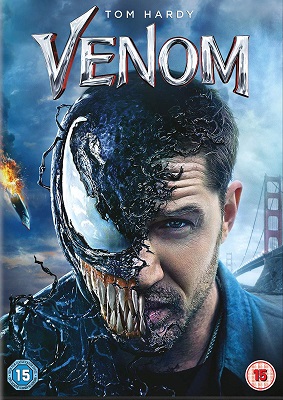
Venom, Ruben Fleischer (2018, USA). As is the case with 90% of the current MCU output these days, I’m coming to this with little or no knowledge of the original comic incarnation. To be honest, I had thought Venom was a Spider-Man villain, although I’ve no idea why, but Spider-Man doesn’t appear here and the story is set entirely in San Francisco and Spider-Man lives in New York city. Tom Hardy plays an internet investigative journalist who pisses off the wrong person once too often – in this case, it’s Musk-like zillionaire Riz Ahmed, who seems to have the secret of interstellar flight which no one on planet Earth in 2018, er, actually has. But, WTF, this is MCU. People with fucking superpowers. So a “space shuttle” that apparently visits an exoplanet, even though no one has apparently colonised Mars, or even spread out into the galaxy, seems completely unremarkable. Unfortunately, said mission to the exoplanet has brought back some sort of weird alien life form. Which escapes and inhabits Tom Hardy’s body. Turning him into Venom, a superhero/supervillain. Sort of. Another alien parasite inhabits Ahmed, turning him into Riot, who is just the same as Venom but, well, bad. It’s all completely risible, but the filmmakers seemed to recognise that and there’s a nice line in piss-take throughout the movie, which is to be honest the only thing that makes it watchable. Thank fuck Joss Whedon didn’t make it. It would be unwatchable. Venom is not a great film. It’s mildly amusing, Hardy puts in a performance judged to a nicety, and the banter is unexpectedly better than is typical for a MCU movie. Unfortunately, the CGI is unexpectedly worse than is typical for a MCU film. Which is the only thing that spoils an otherwise entertaining 112 minutes.
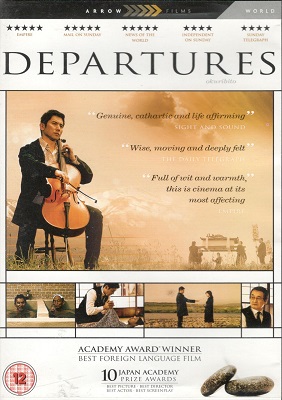
Departures, Yōjirō Takita (2008, Japan). My mother lent me this, and one of these days I’ll persuade her to watch a film by Yasujiro Ozu… But for now, she’s the one lending me Japanese films. and quite odd ones at that. (Take that, David Tallerman.) Departures is a bout a young man who leaves Tokyo when the orchestra in which he was a cellist is disbanded, and in his home town he answers a job ad and becomes someone who prepares bodies for “encoffinment”, usually in front of the family of the deceased. Apparently, this is not an actual Japanese practice – or rather, it is not a separate career, as it’s normally performed by the funeral directors. But in the film, it’s a real job. Takita makes it clear this is not a run-of-the-mill occupation, opening with the dressing of a transgender person, and in which the dressers’ sensitive treatment defuses the obvious tensions in the room. It’s people’s response to the protagonist’s choice of career which drives the film – it’s seen as a slightly shameful job, although as is always the case in such films, attitudes soon change. While not an especially memorable film, Departures struck me as a well-played drama.
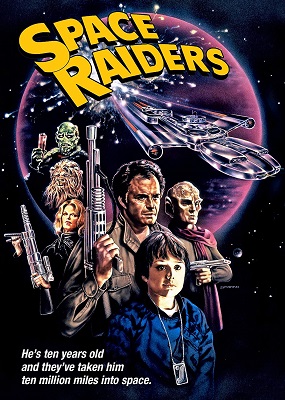
Space Raiders, Howard R Cohen (1983, USA). I don’t normally bother to document crap films, even science fiction ones, but Space Raiders is one of several movies Roger Corman cobbled together out of the special-effects footage from Battle Beyond the Stars. And, to be honest, I’m sort of conflicted about how I view Battle Beyond the Stars. Actually, I’m not. I liked it for many years, but I have to admit it is actually shit. It’s The Magnificent Seven in space – and, shockingly, one of them is a woman – and it’s a cheap piece of crap, albeit with some nice model work. And it’s the latter which resurfaces in Space Raiders. Who, as the title suggest, raid a base, only to discover a stowaway aboard: the son of the base’s commander. But they take a shine to him, and while ostensibly holding him for ransom, they look after him, even saving him from a plot by the alien controller of that space opera perennial the lawless where-pirates-meet-up space station that only seems to exist in brainless space operas. Oh wait, I committed a tautology. But you know what I mean. Having said all that, even for New World Pictures Space Raiders is weak sauce. The studio famously tried to make as many feature films as it could out of its rip-off material. Space Raiders is definitely New Worlds second-tier, although for me the studio will never exceed the greatness that is Queen of Blood.

Schloss Vogelöd, FW Murnau (1921, Germany). I do like Murnau’s films, although a friend thinks them over-rated. And it wasn’t until I watched this film I though he might be right. A hunting party at the eponymous secluded schloß is kept in by constant rain. An uninvited guest turns up, uninvited because it’s believed he shot his older brother and so became sole heir of the family fortune. To make matters worse, his brother’s widow also turns up to the schloß, which sort of makes things a bit icky. Flashbacks show that the widow’s marriage wasn’t as smooth as she claims, but also casts doubt on the brother’s guilt. While the film is well-shot, and some of the close-ups are really quite astonishing in their detail, at 70 minutes the story feels stretched beyond its natural length. Had it been made 20 or 30 years later, with, you know, sound, perhaps the slower scenes – and there are plenty of them – might have been a bit more interesting. But when you have characters sitting around mouthing silently, with only the occasional revelation or plot twist, attention quickly flags. Of course, the cinema experience was entirely different back in 1921, and while I don’t believe attention spans are actually any shorter now than they used to be, film audiences in 2017 have been trained over several decades to watch movies in an entirely different way to audiences in 1921. I do like Murnau’s films, but watching them is definitely an exercise in experiencing an historical document – some more so than others…

Women, Stanley Kwan (1985, China). This is one of many Shaw Brothers films that have been dumped on Amazon Prime. It is also Chow Yun-Fat’s first starring role. And Kwan’s first go at director. Make of that what you will. Which is, er, probably not much. Cora Miao plays a newly-divorced wife who is trying to make a new life for herself and meets up at regular intervals with a group of female friends. Who occasionally bring along male friends. Mostly to treat them in a nicely subversive way, much as men would treat women. But the woman’s husband, play by Yun-Fat, is not so quick to let his wife go. Women is a film that wears its time of making firmly on its sleeve. I’ve watched a number of films that were more 1980s than this one – and it’s strange but I’ve yet to see a film not made in the 1980s, but set then, that has managed to be 1980s – which is a long-winded way of saying that Women is very 1980s. But unless you’re a fan of the 1980s, I can’t really recommend this one.

Cathy Come Home, Ken Loach (1966,UK). In British television history, this is an important work. The fact its message has been entirely ignored – if not at that time, then almost certainly this century – seems almost incidental. As does the fact the heartless government during which its story takes place is Labour. Tories are evil scum. That’s a fact. But Labour have done their best over the decades to match them. Corbyn will in all likelihood make a crap prime minister, but he’ll make a better one than any Tory. But why bother? British politics has fuck-all to do with what either party will actually do, only with some rose-tinted view of what they’re supposed to have done in the past… A young couple end up homeless because the wife becomes pregnant and the husband is injured at work. They’re forced to leave their flat because of the baby and… It all sounds like the heartless consequences of Tory social policies – and in the twenty-first century that would almost certainly be true. But, as mentioned earlier, at the time Cathy Come Home was broadcast, Harold Wilson was prime minister and Labour had been in power for two years. But then, when you compare Cathy Come Home and I, Daniel Blake… The latter film is more immediately affecting because it shows the consequences of evil policies we can see for ourselves pretty much anywhere in the UK. The earlier film might well have been the first people saw of Labour’s policies of the time but, because they couldn’t map the experiences of Cathy and her husband onto what they thought they knew of the country… Of course, some people have been quite vocal in expressing a similar disconnect with I, Daniel Blake – but they’ve all been entitled Tory wankers, like Toby Young. Cathy Come Home is considered a landmark piece of television, but it does feel like its message has been lost over the decades since it was first broadcast. I, Daniel Blake, on the other hand, is an equally important film, but it feels like its message has been lost in only a year or two, or has been wilfully ignored…

1001 Movies You Must See Before You Die count: 933


1 Comment

Best of the year 2018

I usually do these posts in early December, which is not exactly the end of the year. But I’ve been so busy the last few weeks, I’ve not had the chance – which means this best of the year actually represents what I read, watched and listened to in all of 2018. This is likely the best way to do it.

And what a year it was. The Big Project at work finally ended in September. I applied for a job in Sweden, was offered it, and accepted. I made five visits to Nordic countries during the twelve months: twice each to Sweden and Denmark, once to Iceland. I beat my 140 books read Goodreads challenge by ten books. I watched 547 films new to me, from 52 different countries, forty-nine of them by female directors. I didn’t do much listening to music, I have to admit and I only went to two gigs: Therion in February and Wolves in the Throne Room in June.

And then there was Brexit. Yes, we had the referendum two years ago, and 17 million people – around a third of the actual electorate, so not a majority – voted for something very very stupid and self-destructive, in response to a campaign that told outright lies and broke election law. None of which is apparently enough to consider Brexit a travesty of democracy. And just to make things even worse, the last two years have demonstrated just how useless and incompetent the UK’s current government is, and how committed they are to destroying the country’s economy and perhaps even ending the union. Their latest scam is giving a £14 million contract to a ferry company that owns no ferries and has never operated any ferries previously. The whole lot of them should be in prison. Who knows what 2019 will bring? Will the government see sense and revoke Article 50? I think it unlikely given how racist May is and how committed she is to ending freedom of movement. Her deal will likely be the one that goes into effect, and it’ll be voted through because no deal is an unthinkable alternative.

But me, I’ll be out of it. Living in another country, a civilised country. I can’t wait.

This post, however is, as the title cunningly suggests, my pick of the best books, films and albums I consumed during 2018. (Position in my Best of the half-year post is in square brackets for each book, film and album.)

books
1 The Sound and the Fury, William Faulkner (1929, USA). [-] My father had a sizeable collection of Penguin paperbacks he’d bought direct from the publisher in the late 1960s and early 1970s. I’ve no idea why he bought them, but he certainly read them. After he died, I took a couple of dozen of them for myself. Including two by Faulkner. And it’s taken me a while to get round to reading one of them… And I loved it. It tells the story of a family from three viewpoints, and from them you have to piece together exactly what happened. It’s set in the Deep South at the beginning of the twentieth century, so of course it’s very racist. But that feels like something Faulkner wrote because overt racism was endemic in that place and at that time (and still is now, to be fair), and not a sensibility of the author that has leaked through into the text. I now want to read everything Faulkner wrote.

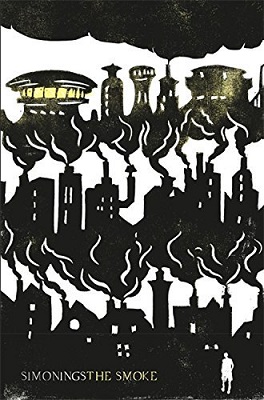
2 The Smoke, Simon Ings (2018, UK) [1]. Being knocked off the top spot, which is where this book was in my best of the half-year, by William Faulkner is no bad thing. The Smoke is genre, and was published by a genre imprint, but it’s not a book that invites easy description. It does some things I don’t think I’ve seen genre novels do before, and it crashes together ideas that really shouldn’t work on their own, never mind side by side. It’s set in alternate mid-twentieth century, where “biophotonic rays” have radically altered the world. Animalistic homunculi created by the rays have spread throughout Europe, and a secular group of Jews turned the ray on themselves and now lead the world in technology by a century or more. The Smoke is a story about a man whose mother has been reborn as an infant in order cure her of her cancer, a treatment pioneered by his ex-girlfriend’s father… The Smoke reads like an unholy mash-up of so many things that it’s a wonder it doesn’t collapse under its own weight. In fact, it rises above them.

3 The Rift, Nina Allan (2018, UK) [3]. This is where the top five sort of gets all Schrödinger, because this novel and the two below might well have, on any other day, been swapped out for one of the honourable mentions. But I’ve kept The Rift here, in the same spot it occupied in my best of the half year, because Allan’s two previous novels never quite gelled for me. They felt like fix-ups, but without a framing narrative or much in the way of a link between the constituent parts. But The Rift is coherent whole, from start to finish. It has an interesting plot, which it not only fails to resolve but presents several possible mutually-exclusive endings all at the same time. A woman’s sister reappears several decades after mysteriously vanishing and claims to have been living on an alien world. Is she telling the truth? Is she indeed the long-lost sister? Or was the sister murdered years before by a spree killer? Everything about the story confounds a One True Reading, which is its strength.

4 Spring Snow, Yukio Mishima (1962, Japan) [-]. I bought this on the strength of Paul Schrader’s film about Mishima, although I was aware of how Mishima had died. The novel is the first of a quartet, and details the illicit affair between the son of a wealthy family with the daughter of much less wealthy aristocratic family. They have been friends since childhood, but he grew irritated with her affections and so convinced her he could never love her. But now she has been affianced to an Imperial prince, and the two conduct an clandestine affair. The writing is crystal clear, and even though set in a culture not my own, and a history of which I know only a few small bits and pieces, Mishima makes everything comprehensible. I’ve seen historical novels set in Britain by British writers that are larded with footnotes and info-dumps. Mishima was writing for a Japanese readership, obviously, but it’s astonishing how he makes his narrative flow like water.

5 1610: A Sundial in a Grave, Mary Gentle (2003, UK) [-]. I’m a huge fan of Gentle’s fiction, and buy each of her books on publication. And it continually astonishes me she seems to go out of print almost immediately. I bought 1610: A Sundial in a Grave back in 2003. But for some reason, it sat on my bookshelves for 15 years before I finally got around to reading it. Possibly because it’s a pretty damn large hardback. And… I loved it. It’s that mix of fantasy and historical Gentle does so well, better in fact than anyone else. There’s a slight framing device, but the bulk of the story is the journal of a seventeenth-century French adventurer who has to flee France when a faked-up plot to kill Henri IV actually does just that. He ends up in a plot in England by Edward Fludd to kill James I, along with the sole survivor of a Japanese mission and a sixteen-year-old crossdressing sword prodigy he believes to be male but with whom he falls in love. It’s brilliant stuff – thick with historical detail, visceral and smelly and real. The novel’s fantasy content is also fascinating, a sort of reworking of ideas from the White Crow books, but thoroughly embedded in the history.

Honourable mentions: Irma Voth, Miriam Toews (2011, Canada), a fascinating study of a Mennonite girl, by a Mennonite writer, in a Mexican colony, inspired by the excellent film Stellet Licht, I will be reading more by Toews; Golden Hill, Francis Spufford (2016, UK), intriguing historical novel set in early New York, paints a portrait of a fascinating, if horrifying, place; If Then, Matthew de Abaitua (2015, UK) [hb], any other year and this might have made the top five, the sort of liminal sf the British do so well, historical and alternate history, not unlike Ings’s novel above; The 7th Function of Language, Laurent Binet (2017, France) [hb], a contrived plot but a fascinating lesson in semiotics and Roland Barthes, cleverly mixed into real history; The Buried Giant, Kazuo Ishiguro (2015, UK) [hb], a book that has grown on me since I read it, an elegy on both the Matter of Britain and genre fantasy, that is a more intelligent commentary than 99% of actual genre fantasies; Pack My Bag, Henry Green (1940, UK) [2] [hb], autobiography by Green, written because he thought he might not survive WWII, but he did, a fascinating and beautifully written look at life among the privileged in 1920s Britain; Four Freedoms, John Crowley (2009, USA) [5] [hb], a semi-utopian community created around an aircraft factory in the late years of WWII and how it fell apart once the war was over, beautifully written.

films
1 The Lure, Agnieszka Smoczyńska 2015, Poland) [1] No change for one of the most bizarre films I watched in 2018, and I watched a lot of bizarre films. Carnivorous mermaids in 1980s Poland. Who join a band. In a nightclub. With music. It is entirely sui generis. It also looks fantastic, the mermaids are scary as shit, and the music is pretty good – if not technically entirely 1980s. I watched a rental of this and love it so much I bought myself the Blu-ray.

2 Dunkirk, Christopher Nolan (2017, UK) [2] No change here either. And the fact I love this film continues to astonish me. I’m not a Nolan fan but something about this – the cinematography, the sound design, the total absence of plot… appealed to me so much, I bought myself a Blu-ray copy after watching a streamed version. Perhaps it’s because the hardware features so heavily in it and I love machines. I’m not sure. It’s one of the most immersive films I’ve ever watched. Perhaps that’s it.

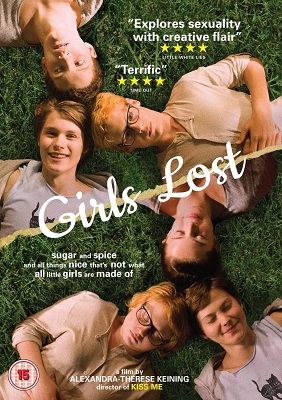
3 Girls Lost, Alexandre-Therese Keining (2015, Sweden) [-] Three girls discover a magic seed that transforms them into boys, and they get to experience life as the other gender – and they’re each in a position to appreciate the advantages of being male. This film just blew me away with its treatment of its premise, and then did more by turning the stereotype – girl becomes boy becomes bad boy – into something meaningful.

4 Shirley: Visions of Reality, Gustav Deutsch (2013, Austria) [-] A film which comprises a series of vignettes in the life of the eponymous woman, all of which are inspired by, and set up to resemble, paintings by Edwin Hopper. It sounds like something that belongs in a modern art museum, and it probably should be there, but it is also a beautiful piece of cinema. There’s something about the look of the film – attributable to Hopper, of course – which makes something special of it. It also made me more appreciative of Hopper’s art.

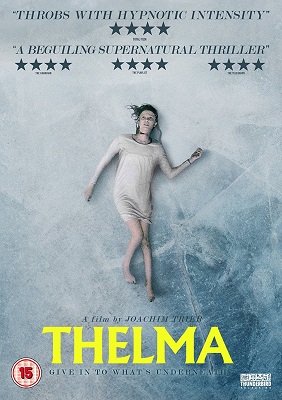
5 Thelma, Joachim Trier (2017, Norway) [3] Comparisons with Carrie are both inevitable and do this Norwegian take on the story an injustice. When something is a thousand times better than something it might resemble, why forever harp on about the resemblance? De Palma’s film is a blunt instrument compared to Trier’s, although to be fair to Trier he does push the religious angle quite heavily. But Thelma looks great, and its lead is very impressive indeed.

Honourable mentions: to be honest, I’m not sure if some of these should not have appeared in the above five – that’s the peril of choosing a top five, especially when you’ve watched so many bloody good films, or just so many bloody films… Here, Then, Mao Mao (2012, China) [-] although not associated with any “generation” of Chinese film-makers, this film exhibits all the hallmarks of the Sixth Generation: a semi-documentary feel, disaffected youth, narrative tricks… and it does it like a master of the form; Vampir Cuadec, Pere Portabella (1970, Spain) [4] I loved this experimental film so much I tracked down a 22-film collection from Spain of Portabella’s works and bought it, this particular film is a heavily-filtered re-edit of Jess Franco’s Count Dracula that turns cheap commercial horror into avant garde cinema; India Song, Marguerite Duras (1975, France) [5] my first Duras and such a remarkably different way to present a film narrative, sadly her movies aren’t available in UK editions but I would dearly love to see more; Mandabi, Ousmane Sembène (1968, Senegal) [-] I love Sembène’s films and this might be his best, the story of the hapless eponymous man who spends money he doesn’t have and chases down the paperwork he needs to cash it in, even though it’s not his, a beautifully pitched comedy; Stellet licht, Carlos Reygadas (2007, Mexico) [-] precisely the sort of film that appeals to me – slow, beautifully shot, and a slow unveiling of the plot; War and Peace, parts 1-3,  Sergei Bondarchuk (1966-1967, USSR) [-] movies as they used to make them, a cast of tens of thousands, more technical innovations than you could shake a large stick at, and the widest screen on the planet, and despite there not being a single decent 70 mm print in existence what remains is more than sufficient to show this was a remarkable piece of film-making… and I’ve not even seen the final part yet; Bambi, David Hand (1942, USA) [-] why not a Disney animated movie? I’ve been working my way through them and this is one of the best, despite the mawkishness and frankly dubious message.

albums
Frighteningly, I only bought ten albums in 2018. Music really seems to have drifted out of my life. Which is a shame as, well, I like it a lot. But I generally have a fast turnover in music and will move onto something new quite quickly. I’m not one of those people who can listen to the same album over and over again for years. But I do have my “classics”, albums I return to again and again. And that list, of course, is always evolving…

On the other hand, my album picks each year tend to be from albums published during the year as I don’t “discover” older music as much as I do books or films.

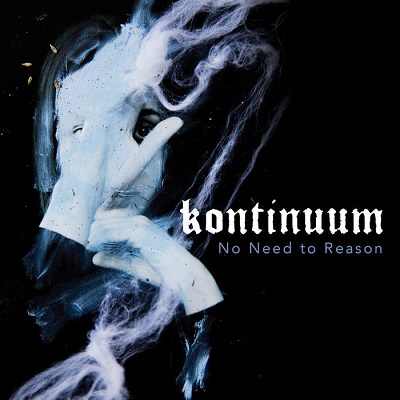
1 No Need to Reason, Kontinuum (2018, Iceland). I liked Kontinuum’s previous album, Kyrr, especially the track ‘Breathe’, but No Need to Reason is much much better. In places, it’s a bit like mid-career Anathema, although deeper and heavier. In other places, it’s a bit post-metal, or a bit rocky, or a bit, well, heavy. It’s probably that melange of styles that appeals to me the most – all filtered, of course, through a metal sensibility.

2 Slow Motion Death Sequence, MANES (2018, Norway). Frank Zappa once wrote that writing about music is like dancing about architecture, and certainly I’ve yet to find a way to explain in print why some music appeals to me and some doesn’t. I don’t, as a rule like EBM, but MANES might well be classified as that – although, to me, they come to it with a black metal sensibility because they were once a black metal band. They changed their sound, quite drastically, yet for me something of their origin remains in the mix. I’ve no idea if that’s true or exists only in my head. I do know that MANES approach to electronica, and their occasional use of heavy guitar, seems very metal to me and I like it a lot.

The Scars of Man on the Once Nameless Wilderness I and II, Panopticon (2018, USA) I’ve been following Panopticon since stumbling across one of their albums which mixed bluegrass/folk and atmospheric black metal, and over the past few years I’ve seen them – well, him, as it’s a one-man band – grow increasingly sophisticated in his use of the two musical genres. And here he’s at his current best – the folk sections are excellent and fade naturally into the black metal and vice versa. I’ve been impressed by all of Panopticon’s albums, but this one was the fastest like of them all. Everyone should be listening to them.

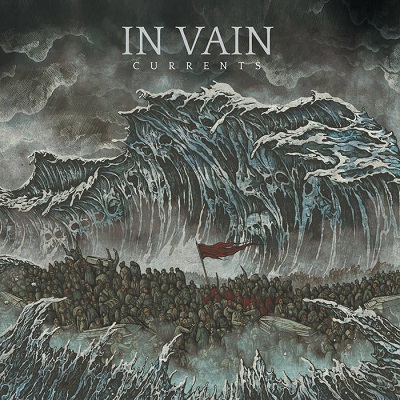
Currents, In Vain (2018, Norway). Ten years ago, I suspect this may not have made my top five. It’s good – because In Vain are good, But their previous albums were better, and this feels less musically adventurous than them, which is perhaps why I think it less successful. It’s solid progressive black metal from someone who has made the genre their own, but nothing in Currents is as playful as tracks on earlier albums. I liked that about them. Good stuff, nonetheless; just not as good as previously.

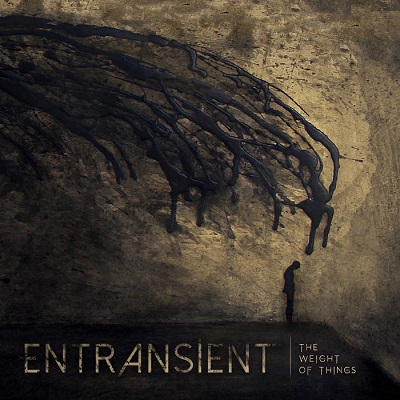
The Weight of Things, Entransient (2018, USA). Some bands are easy to categorise, others require such detailed tagging that they might as well be in a category all their own. Entransient are sort of progressive rock, but they’re a little too heavy to be just rock, and yet their music is not intricate enough to be metal. Some might call that heavy rock. But Entransient feel like they have elements of metal in their music, even if they mostly make use of non-metal forms. One of the tracks on this album has harmonies you would never find on a metal album, and yet works really well. Entransient give the impression they aren’t trying very hard to be anything other than what they want to be. They’re just writing songs down the line they’ve chosen… But they seem to be operating in a much bigger, and more interesting, space than they might have imagined.

Hopefully, my changed circumstances in 2019 will have me watching less films, reading more books, and listening to more music. And buying less books too, of course.


1 Comment

Reading diary 2018, #21

Another eclectic bunch of books read. Only one recent genre novel (and one old one). The rest are mainstream.

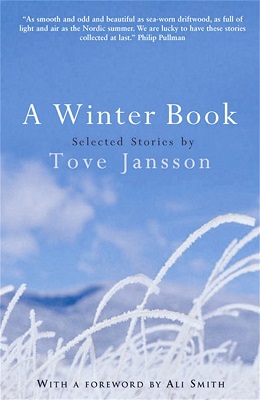
A Winter Book, Tove Jansson (1971, Finland). Jansson apparently came to adult fiction late. She was in her fifties before she wrote her first novel that wasn’t children’s fiction. She also wrote a number of short stories. A Winter Book is cobbled together from a previous collection – not translated into English, IIRC – and a number of uncollected stories. They’re grouped thematically, and many deal with childhood in some way. Except for the ones that are about old age. Those who have read other fiction by Jansson will know what to expect. She’s very good at describing  the world she knew – pretty much every story she wrote drew on her own life. So we have stories set in Finnish winters, and stories that take place among the islands during the summer. It’s all very smooth and effortless storytelling, although some stories are more interesting than others. And yet, the collection itself doesn’t exactly linger. I read it more than a month ago and I’d be hard-pressed to describe any of the stories in it. Perhaps it’s that smoothness. Worth reading, though I suspect fans will get more out of it than I did.

Marune: Alastor 993, Jack Vance (1975, USA). I’m not sure why I picked this one off the shelves for a reread, given that previous Vance rereads haven’t gone so well. But I had fond memories of his Alastor Cluster series, and if the books were going to go back into storage I might as well remind myself of those fond memories. And… Marune: Alastor 993 was a much better book than I’d remembered it. Or rather: I’d remembered it as middling Vance, but it was a better put-together narrative than Star King, which I’d remembered as good Vance. The plot is one Vance has used several times: the amnesiac who has to research his origin and background, and discovers that his amnesia was deliberately induced in order to improve his rivals’, or enemies’, lot. Of course, the book’s real charm lies in the bizarre society the amnesiac belongs to. And, of course, his experiences away from his people have given him a broader outlook, which allows him to think past his family’s customs and traditions, and so he takes his rightful place as head of the family and overcomes his rivals and the family’s enemies. Although his amnesia does get in the way at times… Vance wrote two other Alastor Clusters books: Trullion: Alastor 2262 and Wyst: Alastor 1716. I might give them a reread before they go into storage.

The Waterdancer’s World, L Timmel Duchamp (2016, USA). I’m a big fan of Duchamp’s Marq’ssan Cycle, which is easily one of the best first contact sf series ever written – and certainly contains one of the genre’s best-written villains in Elizabeth Weatherall – not to mention thinking Duchamp’s short story ‘The Forbidden Words of Margaret A.’ is a bona fide genre classic… So any new work by her is a cause for celebration. Except, she’s not always an easy read, and not because her prose is especially hard. There are lots of things in The Waterdancer’s World to like, but I still struggled to read it. It doesn’t help that its narrative is formed from multiple journals, all from different times during the history of the world Frogmore, because some of the narratives were way more engaging than others. There are also excerpts from a “galactic encyclopedia”, which is never a good way to info dump, and in many cases the info wasn’t actually necessary. But I’m a big fan of bending and twisting forms of narrative, so I can’t begrudge Duchamp’s experimentation. Of the various narratives, the journal of Inez Gauthier, the privileged daughter of the head of Frogmore’s occupation forces, is the most interesting; but the eponymous character, who doesn’t actually appear all that often, is the most fascinating person in the novel. There’s a fierce intelligence to Duchamp’s fiction – which is surprisingly rare in science fiction, the only other examples that spring to mind are Gwyneth Jones and Samuel R Delany – but Duchamp’s fiction seems much more, well, researched than those two. In the case of The Waterdancer’s World that has the unfortunate effect of making the sf feel a bit old-fashioned – not in sensibilities, they’re thoroughly twenty-first century; but in the whole look and feel… At times, I was almost visualising sets and costumes from Out of the Unknown, a British sf TV anthology series from the 1960s. Still, it’s all good stuff. I still have Duchamp’s latest to read on the TBR.

Vile Bodies, Evelyn Waugh (1930, UK). My first Waugh. I hadn’t realised when I decided to work my way through Waugh’s books quite how old they were. I’d known he was writing during the 1940s and 1950s, but it seems much of his fame rests on the novels he wrote in earlier decades satirising the “bright young things” of 1930s London. I do enjoy fiction from that period, although I prefer post-war, but I have at least something to which I can compare Waugh… And the obvious candidate is Henry Green, whose fiction I like a great deal. And who Waugh himself takes a few potshots at in his novels (perhaps not in this one but certainly the one below). Waugh is generally considered one of the best novelists the UK has produced but on the strength of Vile Bodies I’d say Green was better. Vile Bodies, which is apparently a sequel to Decline and Fall (which I also have), opens with the characters crossing the Channel from France, and then getting into various upper-crust scrapes in London. One long-running joke involves the dim-witted father of the female lead, whose less-than-illustrious fiancé wants to marry her, doesn’t have enough money, so he approaches the future father-in-law several times for help. There’s also a trip to a motor race to support a race driver friend, in which an air-head aristocrat socialite finds herself taking the race driver’s place and disappearing off into the wild blue yonder out of control. It’s all very obvious and yet all very cleverly done. And well-written, if not up to Green’s standards. I’ve got most of Waugh’s oeuvre to read, thanks to my mother, and I shall work my way through them. But it’s not looking like he’ll ever become a favourite.

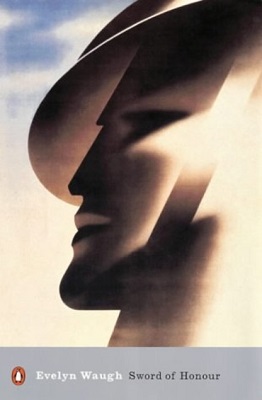
Sword of Honour, Evelyn Waugh (1965, UK). My second (old) Waugh – and it’s also about the Second World War (did you see what I did there?). I’d been hoping to sneak this onto my Goodreads challenge as three books, as Sword of Honour is an omnibus of Men at Arms, Officers and Gentlemen and Unconditional Surrender. Except it isn’t, as Waugh rewrote the trilogy as a single novel shortly before his death. So it goes down on the challenge as a single book. Anyway… The novel charts the war experience of Guy Crouchback, scion of an old Catholic aristocratic family now fallen on hard times. He has spent the between-war years in Italy and speaks the language fluently. But he’s a bit of a wet, and the British are so thoroughly incompetent they’re incapable of taking advantage of his language skills. The nearest he gets is serving in Croatia near the end of the war. In fact, if there’s one thing that comes across in Sword of Honour it’s how useless the British were. We like to pretend we won WWII, but we didn’t. Not really. The Soviets did. And the Americans. Initially, we just fucked up big time. That’s what Dunkirk was. A major fuck-up. And even after all that, we still had a country run by upper-class twits and it took a while for the competent middle-class to get control. Reading Sword of Honour makes Brexit seem a lot more understandable – or rather, the fucking hash our government has made of Brexit. And yet Sword of Honour was meant to be a satire. It’s based partly on Waugh’s own war experiences, although he makes a Crouchback a much more likeable protagonist than Waugh himself apparently was. Because was by all accounts he was a nasty piece of work – a total snob and arrogant and a good candidate for being shot by his own men. Waugh gives Crouchback a better, if more ironic, future in his rewrite of the trilogy, but it’s still an essentially cheerful novel for all that it takes the piss mercilessly out of the British armed forces during wartime. I thought it a great deal better than Vile Bodies, not just because its subject matter I found more interesting but because it didn’t feel so overdone. Recommended.

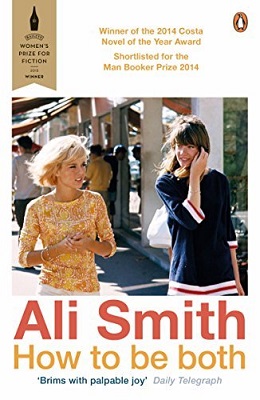
How to be Both, Ali Smith (2014, UK). It’s probably time to accept I just don’t get on with Smith’s novels. Admittedly, I’ve only read two, but I can’t say I enjoyed either. Which is odd, because you would think her style would appeal to me. It’s copiously-researched, often turns on little known history, is written present-tense and without speech marks for dialogue… but it’s also often – at least in those books I’ve read – pretty close to stream-of-consciousness and that’s never a style I could deal with at length. It doesn’t help that the actual plot of How to be Both is wilfully obscure. I mean, yes, I grew up on genre fiction, and it privileges plot, but I like literary fiction, and that privileges, well, any number of things but plot is rarely one of them. I’ve not had the training to be fully appreciative of Smith’s fiction, even though I’ve read any number of literary authors and appreciated what they’ve tried to achieve. I suspect this will be the last novel by Smith I’ll read. She’s just not for me.

1001 Books You Must Read Before You Die count: 133


Leave a comment

Reading diary 2018, #20

I won’t be able to squeeze in one more of these posts before the end of the year, which is, er, today, although I’ve read enough books for one. But that post can wait for 2019. I’ll have enough trouble trying to pick the best five books I read in 2018 – not to mention the best five films I watched…

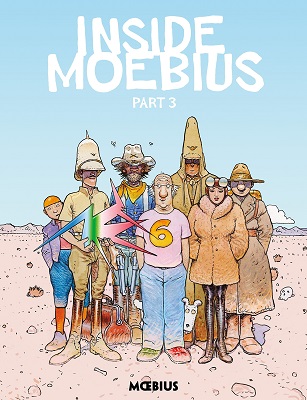
Inside Moebius, Part 3, Moebius (2008 – 2010, France). This is the final two volumes, in a single volume, of Moebius’s exploration of his inability to give up marijuana. I’ve no idea why Dark Horse chose to double up the original French editions, but they’ve done an excellent job in presenting them – with a useful glossary which attempts to explain some of the more obscure reference Moebius makes, not to mention some of his impenetrable-to-non-Francophones puns (although many have been deliberately transliterated to be equally punnish in English). But, in essence, it’s more of the same. As in the first two volumes, Moebius explores Desert B, encountering younger versions of himself and versions of his best-known characters. On balance, I think the first volume was the best as more things seemed to happen in it. Part 3 contains more references to Moebius’s contemporaries, but that’s entirely lost on me as my knowledge of the field is pretty much limited to science fiction bandes dessinées and what’s been translated into English… Worth it if you’re a Moebius fan.

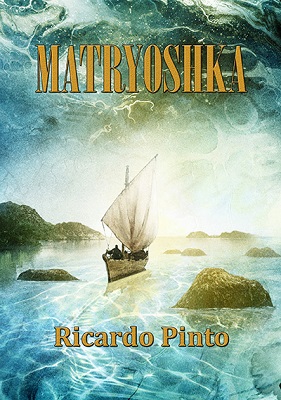
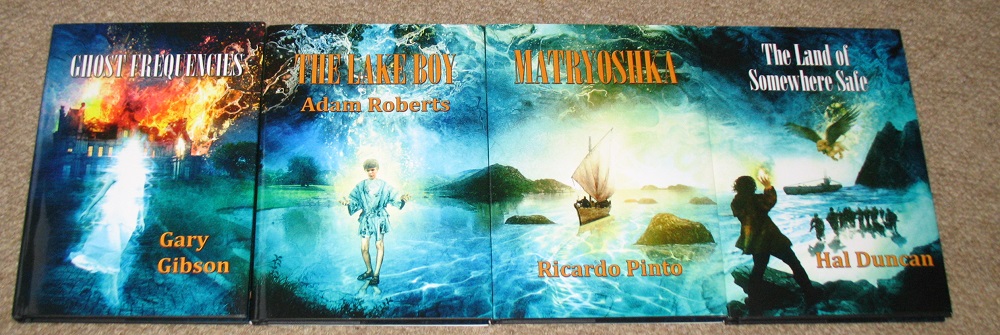
Matryoshka, Ricardo Pinto (2018, UK). This is the third of NewCon Press’s fourth quartet of novellas – and I believe there’s another quartet due out next year, also containing, as this quartet does, a novella by Adam Roberts (is there no end to his productivity?). But this novella is by Ricardo Pinto, who is best known for his Stone Dance of the Chameleon fantasy trilogy. I have all three books, but have only read the first two. They are excellent. The third book, The Third God, I’ve been reluctant to pick up because, well, because it’s too bloody big to pick up. I bought the hardback when it was launched at an Eastercon in Bradford, it is humongous. And yet I loved the first two books. I really ought to get round to reading it. Maybe I’ll get a chance during those dark Scandinavian winter nights… Anyway, Matryoshka is completely unrelated to the Stone Dance of the Chameleon, and is perhaps best described as either science fiction masquerading as fantasy or fantasy masquerading as science fiction. The protagonist, a young man drifting about Europe after WWI, meets an enigmatic young woman in Venice and accepts her invitation to… another dimension. Where time runs faster the further you are from the portal. She persuades him to accompany her on a sailing trip to rescue her brother from a distant island where he was lost years before. When they get there, the brother is no more than a few months older. And when they return to the city, everyone else has aged decades. The concept is handled well, but this is a story which privileges the imagery and, fortunately, Pinto has the writing chops to pull it off. It feels a little like an excerpt from a longer work, or at least the world certainly deserves further exploration. This quartet is shaping up to be quite a good one, it has to be said.

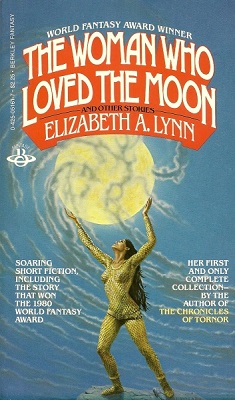
The Woman Who Loved The Moon, Elizabeth A Lynn (1981, USA). I bought this at Fantasticon in Copenhagen. Someone was selling a whole bunch of UK and US sf and fantasy paperbacks. These days, I seem to have more luck finding secondhand books at Nordic cons than I do at UK cons. Good job I’m moving there, then. Or maybe not – given I have a shitload of books to sort out before I flee the country… Lynn is not a well-known name on this side of the Atlantic – she doesn’t appear to have been published in the UK since the late 1970s. Not that she appears to have written much since then – pretty much nothing between 1990 and a new fantasy novel in 2004, and nothing since. Which is a shame, as there are worst writers with much healthier careers. But then fantasy has never been about the writing, which is why so many bad writers have proven so successful in the genre. As fnatasy collections go, this is a perfectly respectable one, with, as is typical, a couple of sf stories, such as ‘The Man Who Was Pregnant’. Each story has a brief introduction, and I admit I like author’s notes in collections. Lynn never made the big time, which seems unfair given how polished the stories in this collection are. But perhaps the fact I can remember little of them a few weeks after reading the book explains why she never made it a big. A good writer, but not, it seems, of especially memorable stories.

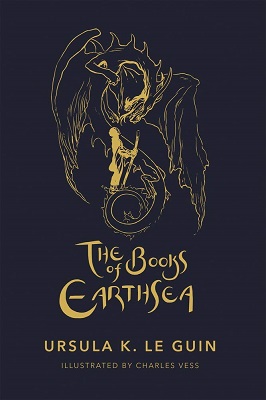
The Books of Earthsea, Ursula K Le Guin (1968 – 2001, USA). I’d been meaning to reread the Earthsea books for years, chiefly because I suspected I would get more out of Tehanu now than I had when I first read it back in the early 1990s. I’d been considering buying a copy of the Earthsea Quartet, as it’s normally sold here in the UK, but when I saw this new omnibus, containing all six Earthsea books – A Wizard of Earthsea, The Tombs of Atuan, The Farthest Shore, Tehanu, Tales From Earthsea and The Other Wind – plus some additional material, and illustrated as well, I decided to get myself a copy. The problem with ominbuses – omnibi? omnibodes? – however, for those of us who track our reading – and this is a vitally important question – is: does it count as a single book, or do you count the individual volumes it contains? So, is The Books of Earthsea one book read, or is it six books read? The Books of Earthsea makes it a little awkward as it contains material not previously collected, but the point is still valid. I chose to record each of the six volumes on my Goodreads reading challenge, if only so I could make my 140 books read target, which I have well overshot, but I’ve marked it as a single book in my own personal record of books read. As for the contents… do I really need to describe them? The first three books were more male-centric than I’d remembered – an issue Le Guin herself was aware of, and addressed in later books and stories, although the world-building required some retconning and twisting out of shape to make it work. The Tombs of Atuan was better than I had remembered and The Farthest Shore a bit duller. Tehanu I really liked this time around. Its plot felt a little uneven, with everything seemingly wrapped up in the last few pages of the book, but that seemed like a fault with all five of the novels in the series. Tales from Earthsea was entirely new to me, and the stories were good. The Other Wind was a little too obvious in places – I mean, who thought the king and princess would not end up together? And again, the plot seemed wrapped up a little too quickly and a little easily. But these are germinal works (not seminal, obvs), and read in sequence form an important dialogue with the fantasy genre. The individual books should certainly never be read in seclusion. Just reading A Wizard of Earthsea would be completely missing the point of Earthsea. On the other hand, this is a book for people with strong arms, as it’s not a comfortable weight to read easily. And the illustrations didn’t work at all for me. I’d sooner they hadn’t been there. But it’s definitely worth getting hold of a copy of this book.

Spring Snow*, Yukio Mishima (1968, Japan). After watching Paul Schrader’s Mishima: A Life in Four Chapters (see here), I decided to give some of Mishima’s fiction a go, and since the Sea of Fertility was his most famous work, I bought the first book of it: Spring Snow. It’s… good. Very good. The story is set in the second decade of the twentieth century, and concerns the relationship between the son of a wealthy family and the daughter of an impoverished aristocratic family. They grew up together and their eventual pairing was considered inevitable. But he, for whatever reasons, pretends he has no feelings for her. And so she ends up affianced to a prince of the Imperial family. As a result, the two conduct an illicit affair in the weeks leading up to her marriage. Also in the story are a Thai prince and his companion, who attend the son’s school and live in his family’s guest-house. I knew nothing about Mishima’s fiction – I was aware of how he had died, however – when I started this book, and I still know little other than what I read in Spring Snow. But it’s an excellent piece of writing, and the period, and lives, it depicts are fascinating. I’m almost certain I’ll read the rest of the quartet. Recommended.

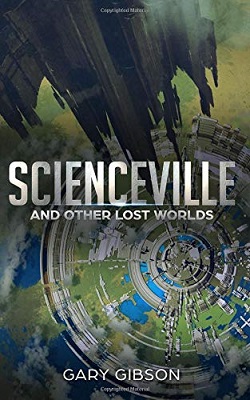
Scienceville & Other Lost Worlds, Gary Gibson (2017, UK). Gary is a friend of many years, although I see him only rarely as he lives on the other side of the planet. But I’ve bought each of his his books in hardback as they were published – except for one, I think, which was a freebie at a Fantasycon; sorry, Gary – and enjoyed those I’ve read (complaints about excessive bodycount notwithstanding). Scienceville & Other Lost Worlds is a short self-published collection, containing six stories, some of which are close to novella length. The title story refers to an invented utopia that seems to exist for many people. The other stories are mostly light science fiction – a story about prisoners in some future dystopian UK who have one of their senses removed, a story about travellers to alternate universes and a mission that nearly comes a cropper, a story about a rock star who agrees to a deal with a steep price in order to revitalise his career… It’s all polished stuff, although none stand out as much as Gary’s recent novella for NewCon Press. Having said that, there are few stories which hang around so much you remember them months later… which does sort of make it difficult to pick the best of the year. Or it would if awards were actually about the stories and not the writers, who helpfully provide “eligible works” posts and so bend everything totally out of shape. True, the field is now so big it’s impossible for a reader to make an informed decision on the “best” story of a particular year. But, FFS, voting for your pals and favourites only makes it more of a mockery. Are there no truly memorable stories during any one year? Gibson does not provide exact publication details for the stories in Scienceville & Other Lost Worlds – which he ought to have done – and not all of the contents are eligible for awards in 2019 and, much as I like Gary, I don’t think they’re especially deserving either. Good solid sf, yes; but when “good solid sf” wins awards then awards are even more broken than they are now…

1001 Books You Must Read Before You Die count: 133


8 Comments

Moving pictures 2018, #65

Cor, look at that: no Extruded Hollywood Product. Two new British films – one that most people will think is American, and another in that long line of recent films celebrating British pluck during WWII, as if that has fucking anything to do with Brexit. Sigh. Plus two very different French films, an excellent Swedish comedy (I think I’m starting to get their sense of humour), and another from the master Sembène.

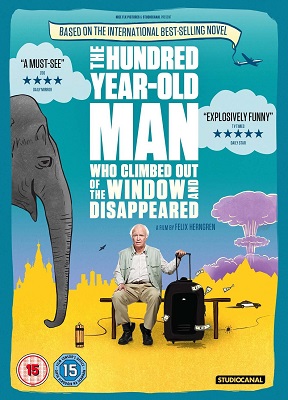
The 100 Year-Old Man Who Climbed Out of the Window and Disappeared, Felix Herngren (2018, Sweden). I’d had this on my Amazon watch list for a while but had put off watching it, perhaps because I expected it to be similar to Roy Andersson’s movies, which are a bit odd. Well, more than a bit. But good nonetheless. However, you do need to be in the right sort of mood to appreciate them. But The 100 Year-Old Man Who Climbed Out of the Window and Disappeared (Amazon can’t seem to decide on the exact wording of the title and varies it between DVD, Prime video, Blu-ray and source novel) proved to be a brilliantly dry comedy about a Swedish man who managed to stumble into a number of historic moments in, er, twentieth-century history, all told as flashbacks after he escapes from his old people’s home on his one-hundredth birthday and ends up on the run from gangsters after a mix-up involving a suitcase containing millions of kroner. The flashback scenes involve, among others, Stalin, Einstein, Roosevelt, Oppenheimer, and I forget the other historical persons who appear. The present day plot thread is just as funny, with the eponymous character surviving through a combination of luck and ineptitude. I really enjoyed this. Recommended.

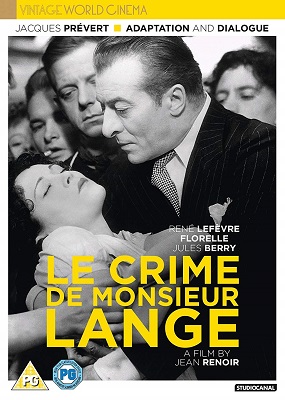
Le Crime de Monsieur Lange, Jean Renoir (1936, France). I’m not sure what to make of Renoir’s films. A couple of his films are extremely highly regarded by cinephiles, and I can see how they’re well-made and espouse politics which roughly align with my own… But his movies don’t seem very interesting, and cinematographically they don’t really stack up well against those by some of his contemporaries, such as Max Ophüls. In other words, he’s a director whose films I want to like much more than I find myself doing so. Le Crime de Monsieur Lange is a case in point. In it, a pulp publisher takes advantage of his misreported death only to discover that his publishing company is doing much better without him. He reappears, and is shot dead by the company’s most successful author. A response many in publishing could probably understand. The story is told in flashback by the fleeing author as he is about to cross into Belgium. Where he is arrested, but as he tells his story so his audience begins to sympathise with him. As, I suppose, the cinematic audience was also intended to. It’s a neat narrative trick, but I can’t say it worked on me. For all that I sympathised with M Lange’s plight, the film never really got me invested in his story. Meh.

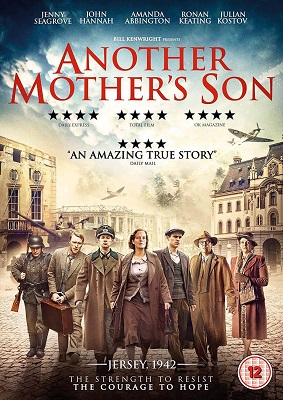
Another Mother’s Son, Christopher Menaul (2017, UK). All this dwelling on plucky British spirit during WWII is definitely unhealthy. In the years immediately following the war, it made sense: it was a way to deal with the trauma and ever-present evidence of destruction created by an event that was within living memory. But those days are long past, and if there’s any lesson to be learned from WWII, it’s that Nazis deserve to die. Oh, and that the British would never have survived without outside help, and were so deeply incompetent in the opening stages of the war it’s a miracle we weren’t immediately wiped out. But, instead, we get stories of British heroes and heroines who stood up to the Nazi menace, as if they need to show the same stiff upper lip and fortitude in order to survive Brexit. But Brexit is not about survival because it’s destructive. Self-destructive. Staying in the EU is survival. And while the true story told in Another Mother’s Son is certainly uplifting, and the principals deserve to have their story told to a wider audience, this new-found fascination for WWII dramas is neither applicable to the present day and deeply misrepresents what actually happened over seventy years ago. Here, we have a principled woman who hides a Russian POW (the Soviets were allies at this point, obvs) from the Nazi occupiers on Jersey. And, er, that’s it. She gets found out, and her and her family are shipped off to the death camps. She does not survive, and is posthumously awarded a medal for her actions. It’s all heart-warming stuff, and actually manages to paint the Nazis as evil scum, which is a bonus in this day and age. Not a badly-made film, but let’s have some films showing what the Europeans did for us for a change.

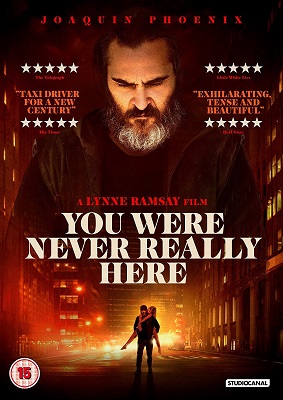
You Were Never Really Here, Lynne Ramsay (2017, UK). I’ve seen a lot of love for this film in the last month or so, from friends and from total strangers. And yet… I prefer Andrea Arnold’s work to Lynne Ramsay’s, although it may well be unfair to compare the two. But You Were Never Really Here is a brutal US thriller with an arthouse touch, and reminded me a bit of Pete Travis while still being very US. Joaquin Phoenix plays a man who rescues kidnapped girls for a fee. He’s approached by a senator whose young daughter has been kidnapped and is being abused in a paedophile brothel. He rescues the girl, but finds himself up against a well-organised opposition, seemingly centred around the man most likely to be elected New York mayor, who is at the heart of it all. To be honest, it felt like an ordinary thriller, with the odd moment that lifted it way above that, but in the end it’s one of those pointless the-powerful-people-always-win stories that makes you wonder why everyone doesn’t just rise up and shoot the fucking lot of them – after all, isn’t that why the right to bear arms is enshrined in the US constitution? Except, of course, these days firearms are only used for spree killing, and that’s no reason to ban them… Pointing out that the US is fucked-up is so banal, I’m surprised people bother to make films about it still. But Lynne Ramsay apparently did. Meh.

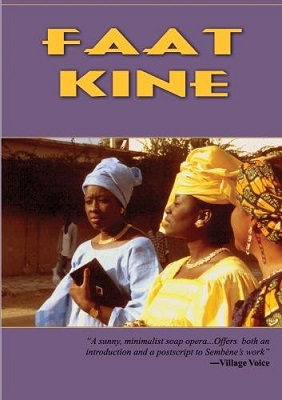
Faat Kiné, Ousmane Sembène (2000, Senegal). The title is the name of an unmarried mother of two children who now runs a successful petrol station in downtown Dakar. Being unmarried and in possession of a profitable business – as Jane Austen famously might have said – she is an obvious target for suitors. Which, had Jane Austen said something like this, would have completely changed her novels. Perhaps for the better. Who knows. I do love Sembène’s films, and while this one doesn’t have a plot as robust as, say, Mandabi or Moolaadé, it still exhibits all his trademark themes – ie, women doing a better job at navigating life than men. Venus Seye is good in the title role, although there’s a cheerful amateurishness to much of the acting – also true of other films by Sembène. The copy I watched wasn’t a very good transfer, and I suspect good transfers of it are pretty much impossible to find. Which is a shame. Someone really needs to put together a remastered box set of Sembène’s films. He didn’t make that many, only eleven (of which I’ve seen seven), and his movies really are very good. He’s an excellent candidate – BFI? Curzon Artificial Eye? Please.

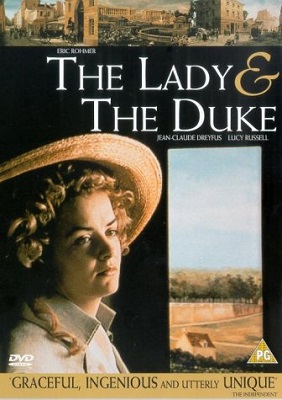
The Lady and the Duke, Éric Rohmer (2001, France). After complaining that the French couldn’t do historical films – and in reference to a Rohmer film too – I’ve only gone and been proven wrong. By Rohmer. Because The Lady and the Duke is set during the Terror, ie, the late eighteenth century, and it’s really very good, perhaps even among my favourites of the films by Rohmer I’ve seen to date. It is, to be honest, all a bit Greenaway, which is no bad thing, in as much as the scenery is CGI and presented to mimic paintings of the time. Everything looks fake – and deliberately so. The interior scenes have walls like theatre flats, where everything is painted to look 3D but isn’t. The exterior scenes have the actors perform in front of what are plainly matted-in during post-production paintings of scenes from eighteenth-century France. I loved it. I’m a big fan of that deliberately artificial presentation of narrative used by some films, where the presentation itself is a tool used by the narrative. The story is about an English woman who has settled in France and is a friend of certain high-placed aristocrats. Which subsequently lands her in trouble post-Revolution. She is arrested and interrogated, but proves to have well-respected pro-Revolution friends. Even so, she seems more concerned with her friend the Duke of Orléans than is healthy. The film is based on the memoirs of Grace Elliott, a Scottish courtesan who was the mistress of the Duke of Orléans and, later, King George IV of Britain. She’s played by Lucy Russell, who demonstrates an impressive facility with both English and French. I’d been going off Rohmer a bit, I must admit, but this film has rekindled my interest in his oeuvre.

1001 Movies You Must See Before You Die count: 933

5 Comments

Moving pictures 2018, #64

I’m working my way through the backlog of these. And it’s time to start thinking about what films to pick for my best of the year – and o god, I’ve watched so many films this year…

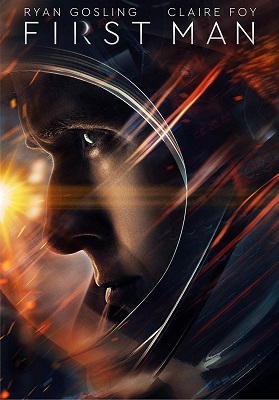
First Man, Damien Chazelle (2018, USA). Well, I couldn’t not see this, could I? Back in 2009, for the fortieth anniversary of the Apollo 11 Moon landing, I read the (auto-)biographies of the three crew: Neil Armstrong, Buzz Aldrin and Michael Collins. Collins’s Carrying the Fire is probably the best of astronaut auto-biographies. Aldrin has written a number of books but his first, Return to Earth, is remarkably frank. Armstrong, however, never wrote about himself, and it is the (official) biography of him by James R Hansen from which Chazelle’s movie was adapted. (For that fortieth anniversary, I also wrote a flash fiction piece, ‘The Old Man of the Sea of Dreams’, about an invented Apollo mission… and from which the Apollo Quartet grew.) Armstrong was the first human being to set foot on an alien world, but he was only the point man in a remarkable achievement which employed tens of thousands of people, cost billions of dollars and took several decades. In all other respects, he was a pretty dull chap. Which presents a problem for a commercial Hollywood movie. It’s one thing reading about a boring man who achieved something remarkable in a dry biography – the book is going to appeal to a particular audience. But a Hollywood film has to appeal much more widely. Chazelle tries hard to make Armstrong interesting, but he is only as interesting as things he does. Which means opening First Man with one of Armstrong’s flights in the X-15, and making the whole thing come across as something that was forever seconds away from disaster. Yes, it was dangerous, and several pilots died. But Armstrong was notoriously cool. To increase the sense of the jeopardy, Chazelle takes a leaf out of Christopher Nolan’s book and ups the ambient sounds to ear-splitting levels. It worked superbly in Dunkirk, and it does work quite well here. But the characterisation of Armstrong doesn’t tally with the source material, and the tacked-on human drama feels like it diminishes the achievements of the Apollo programme. The Moon landings are an excellent subject for a blockbuster movie; Neil Armstrong as a person is not. First Man does some things really well – it’s very… visceral in places, but lacks the sheer presence of Dunkirk – but ultimately I was disappointed.

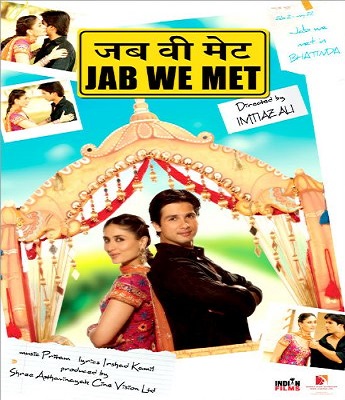
Jab We Met, Imtiaz Ali (2007, India). A young man walks away from his ex-girlfriend’s wedding to another man, leaves all his worldly possessions behind and wanders off… eventually finding himself at the railway station, where he jumps on the first train to… wherever. He ends up sharing a sleeper with a garrulous young woman from the Punjab, on her way home to see family. She prevents him from throwing himself from the train to his death. At the next stop, he disembarks, but she is worried about him and follows. And misses the train. So they catch a taxi to the next stop. But they miss it a second time. And so it goes. The scenes showing the taxi hurtling along the roads, or the train hurtling along the tracks, are sort of stylised model shots, like something out of Gerry Anderson by way of Michael Bentine’s Potty Time. Which is odd – but works well. The female lead, Kareena Kapoor, is good, but male lead Shahid Kapoor is a bit bland. The scenes with the woman’s family are a definite highlight, especially the musical number. Of course, the two are mistaken for lovers, and so eventually become lovers. It’s a fairly standard Bollywood plot. But Jab We Met has bags of charm, and if it’s a bit of a downer to start – and that’s a Bollywood staple too – then it quickly warms up and proves lots of fun.

Manji, Yasuzô Masumura (1964, Japan). Apparently this film also had an international release under the name Swastika. I suspect it would do much better now with that title than it did back in the mid-1960s, what with press barons in the English-speaking world happily promoting Nazi ideology. Burn the press to the ground, it’s no longer fit for purpose and, if anything, is the enemy of society. None of which, sadly has anything to do with this film, and its story in no way explains its title. Because manji is apparently Japanese for ‘swastika’. The story is about the wife of a lawyer who falls in love with a model at her life-drawing class. The two women reject their men, then re-introduce one… and it all ends in a bizarre suicide pact. Except… the story is told entirely as flashback, with an opening scene in which the wife tells her husband’s boss (I think) how she came to be obsessed with the model. So clearly she survives the suicide pact – although she doesn’t know why the other two switched her dose of poison with something harmless. Manji has apparently been remade several times since, and while the tragic romantic triangle is a popular plot – sort of like Rome and Juliet but with a, er, third person – I couldn’t honestly see why this story has proven so appealing it had been remade. Meh.

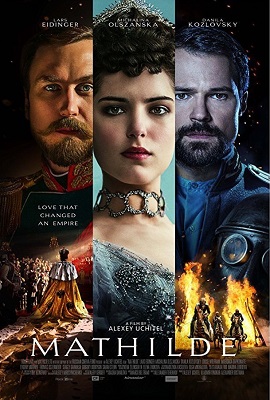
Matilda, Alexey Uchitel (2017, Russia). The Russians have been churning out expensive commercial movies for a couple of decades now, but few of them make it out of the Russo-speaking world. Of course, they have a film tradition going back as long as the US’s, and have had their fair share of world-class directors, even under the Soviets… But go into HMV and all you’ll find are a handful of twenty-first century Russian movies, as curated by labels such as Artificial Eye. For example, Pavel Lungin’s The Island (AKA Ostrov) is readily available, but not his later Tsar (see here), which is arguably better. But now we have streaming, and curated streaming services such as Mubi and Curzon, for those of us who dislike Extruded Hollywood Product. But I found Matilda (AKA Mathilde AKA Матильда) on Amazon Prime, which has some pretty good stuff hidden away. But you have to look for it. Matilda was the mistress of Prince Nicholas Romanov, who became Tsar Nicholas II. The film opens with her about to disrupt Prince Nicholas’s wedding to Princess Alix of Hesse-Darmstadt, with whom he probably shared most of his chromosomes anyway, as European royalty at that time was all as inbred as fuck. The film then flashes back to Nicholas spotting Matilda in the ballet, stealing her from her ducal boyfriend, and basically behaving like Prince Super-Entitled, so sort of like a nineteenth-century One-Percenter but without the arms-dealing and money-laundering and secret bank accounts in the Cayman Islands. The film is all very glossy, with visibly high production values, and some quite lovely visuals – a nicely-done commercial cinema treatment in other words. It’s not the most fascinating piece of history – who gives a fuck about inbred royals? – but it was good drama and presented well.

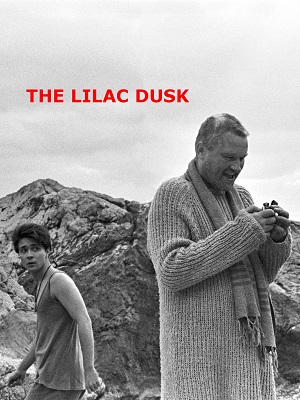
The Lilac Dusk, Yuri Konopkin (2000, Russia). I also found The Lilac Dusk (AKA Lilac Twilight AKA Сиреневые сумерки) on Amazon Prime, although I will admit I had no idea what it was when I started watching it. The black and white poster led me to think it was an older film, perhaps mid-twentieth century, but actually the film is in colour and less than two decades old – certainly well after glasnost. Having said that, I’ve no idea what the film is about. I think I can work out what it thinks it’s about, but for much of its length it felt like a poor Russian attempt at a Peter Greenaway film. A young man is sent to a strange sanatorium on an island. There don’t seem to be many patients, and the staff are as odd as the patients – if they are patients, it wasn’t entirely clear. The male lead isn’t always the lead in scenes, or indeed always on screen, although when he does appear he’s clearly the viewpoint character. It made for a confusing story, that wasn’t helped by its resemblance to a Greenaway film without actually feeling like it was deliberately trying to be a Greenaway film. More a similarity in approach than a deliberate homage. Parts of the film also reminded me of the work of Wojciech Has, but, well, cheaper. I know nothing about Konopkin’s career or oeuvre, but on the strength of this film I suspect his influences were not altogether homegrown…

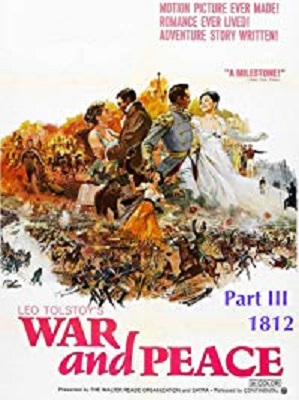
War and Peace, Part 3: 1812, Sergei Bondarchuk (1967, Russia). War and Peace 2, Natasha Rostova (see here) ends with a cut to the Imperial Russian forces gathering outside a village called Borodino. This is where they meet Napoleon’s armies in the, er, Battle of Borodino. And the entire 84 minutes of this third film in the series is taken up wholly with the battle. From the thick of it. It’s brilliant. Oh, it’s not visceral and gruesome like we do it these days, in Atonement or Saving Private Ryan, to name two recent films famous for their depictions of WWII. It’s very much old school, with physical effects and clever camera work. And for that reason it looks a little dated, if the viewer has the imagination to picture how it might be staged today… But for its time, it’s an amazing achievement, sort of like complaining that 2001: A Space Odyssey doesn’t have the twenty-first special effects, when what it does have are effects that still work today given a suspension of their limitations (to coin a phrase). These Bondarchuk War and Peace movies are bona fide classics of cinema and it’s a fucking tragedy there are no decent copies of the original print left. If there were any justice, some would be found in some ex-CSSR state, and the four films can take their rightful position in the history of cinema.

1001 Movies You Must See Before You Die count: 933


2 Comments

Moving pictures 2018, #63

I’m a bit behind on these, chiefly because I’ve been busy with other things during the last couple of weeks. Such as getting a new job. In Sweden. So those few nights when I’ve been at home, and not celebrating, I’ve been mostly watching TV series, such as season two of The Marvelous Mrs Maisel, season three of Lost, and the first season of Dollhouse. I’ve got three or four of these posts to get out before the end of the year. Not to mention picking the best five movies – I’m dropping the documentary split I used in my best of the half-year post (see here) – out of the 600+ films I watched in 2018…

Anyway, aside from the last two films here, and they’re hardly twenty-first century commercial Hollywood extruded movie product, this post goes on a bit of a global tour, with a film from Europe, two from Asia and one from Africa.

Winter Sleep, Nuri Bilge Ceylan (2014, Turkey). It took me a couple of goes to get into this, but once I was twenty or so minutes into it, something clicked and I found myself engrossed – for all of its 196 minutes. True, I’ve seen films by Ceylan before, and I know he’s an excellent director. His cinematography distinguishes him, but I’ve found the tone of each of his films very different. Once Upon a Time in Anatolia, for example, is almost Tarantino-esque. And Winter Sleep very definitely isn’t. Aydın, once a famous actor, now owns a cave hotel in Cappadoccia and several properties in the town. The film opens with Aydın accompanying his agent to collect rent from a tenant… who has no job and no money, and reacts angrily to threats of more of his possessions being taken by bailiffs. But not as angrily as his young son, who throws a rock through the window Aydın’s Land Rover. That starts off an ongoing feud, in which Aydın cannot understand why the tenant is so angry and so uncooperative. Meanwhile, his relationship with his wife is deteriorating, to the extent that he muscles in and rubbishes her charity campaign to fund local schools. So he decides to head to Istanbul, to work on his pet project, a history of Turkish theatre. But he gets sidetracked because one of his friends has been badmouthing him… And this is one of those films where things follow on naturally from one to the other but there’s no real story as such, except perhaps some form of realisation by Aydın over how badly he’s treated his friends and family. And tenants. A slow-mover, but definitely worth watching.

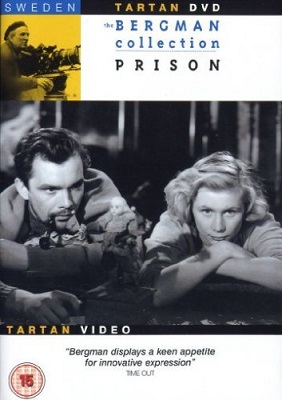
Prison, Ingmar Bergman (1949, Sweden). Bergman made a shitload of films – some for the cinema, some for television, some released on both media. Prison is Bergman’s first film both directed and solely written by him, and it’s notable because of its film-within-a-film narrative structure. Bergman apparently later disowned Prison, although there’s no good reason I could see while watching it why he should have done. It’s an early work, sure, and he used similar techniques, and covered similar topics, much better in later films. But Prison is still a good piece of drama, and if its story feels a bit belaboured at times that’s likely a consequence of Bergman’s lack of experience, although he had directed five films before this one. A film director is approached by an old teacher who tries to sell him a very obvious and very belaboured story of good and evil. The director has his co-workers discuss the story, but they pass on it… only to find real life sort of illustrating the old teacher’s story. But there’s another level of film-within-a-film, and that’s an explicit take on an early silent comedy, with people jumping in and out of windows and closets, all at faster-than-normal speed. Though its subject matter is as weighty as anything Bergman made, Prison didn’t feel especially grim or humourless. Perhaps that was why Bergman disowned it…

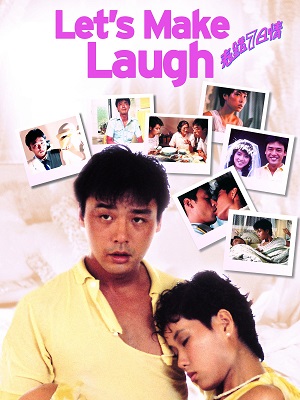
Let’s Make Laugh, Alfred Cheung (1983, China). This was apparently the most successful film in Hong Kong in 1983, and one of the most successful comedies in China for that decade. Shame then that it’s not at all funny. And I don’t think it’s an 1980s thing, or a Hong Kong thing. I mean, I’ve seen enough Hong Kong films to get the gurning thing, and the physical comedy, but while there’s plenty of the former there’s very little of the latter and much of the movie seems more focused on its romantic subplot. Idiot security guard is asked to guard a house because its owner has substantial debts, not knowing that owner has abandoned his wife and she’s still living in the property. But then the woman’s parents turn up, and she asks the guard to pretend to be her husband… The problem is the guard is such an idiot, and so useless, that he ever seems to achieve anything. And the wife is completely self-centred. Which means the romantic sub-plot, er, isn’t. I’ve seen some successful and very funny Hong Kong comedies – anything by Jackie Chan, for example – so the success of this one as a comedy is baffling.

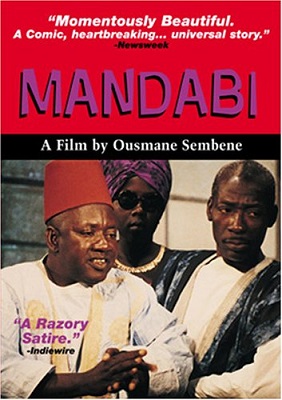
Mandabi, Ousmane Sembène (1968, Senegal). I’ve now seen six films by Sembène, and have a seventh yet to watch, and I really do think his films are bloody brilliant. I’m astonished they’re so hard to find. He made eleven films, and only three are available in the UK, two on a single dual release. And if there’s one thing I’ve noticed from the films I’ve watched, a theme that unites them, it’s that, in Sembène’s world, when men run things it’s absolute chaos, and it’s only when the women take over that things run smoothly. I can go for that. In Mandabi, a postman approaches the two wives of Ibrahima Dieng, who has been unemployed for several years, and tells them there is a money order for 250 Francs waiting for him at the post office. So he heads off to collect it. But the post office won’t give it to him without ID. And when he goes to the police station to get himself an ID, he needs another piece of paper… Meanwhile, his friends and family all want a piece of the money, and have started spending it. None of them realising, because none of them have read the letter accompanying the money order, that 30 Francs of the Fr 250 is for the nephew’s mother, Fr 200 to kept for the nephew, and only Fr 20 for Ibrahima… So on the one hand you have everyone spending money that isn’t theirs, while on the other Ibrahima gets himself further into debt in his efforts to persuade the post office to hand over the money order. The sight of Ibrahima, in his shining boubou, strutting down the street, convinced his fortunes have finally turned is one of the great comedy visuals.

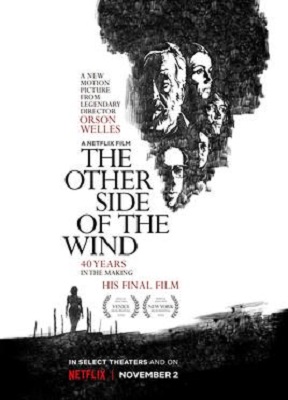
The Other Side of the Wind, Orson Welles (2018, USA). This is one of those movies which has a more interesting production history than it does a plot. Welles, of course, was a true Hollywood maverick, and would finance his films himself, shooting them in parts over an extended period as he worked to raise the money to continue filming. And yet, in most cases, the films that resulted are pretty damn seamless. I came to Welles late, but I became a fan after seeing his later films rather than because of his more famous earlier ones. The Other Side of the Wind was not Welles’s last film, but it was locked in legal limbo for so long it’s only just finally been re-edited and released, thirty-three years after Welles died. And, in fact, pretty much the entire cast of The Other Side of the Wind are also now dead. It’s a mockumentary about a great director, played by John Huston, and the film he is working on, which appears to be the worst sort of New Hollywood soft porn director-as-auteur excess. It doesn’t help that the supporting cast – which comprises a number of familiar faces – all play pretty horrible Hollywood stereotypes. Movie industry stereotypes, that is, rather than the usual simplistic Hollywood characterisation. The end result is… an interesting historical document. But not a good film. Thee are good bits, of course – Welles was one of the best directors the US has produced – but this doesn’t feel like Welles at his best, and this version here – edited by Peter Bogdanovich, who plays Huston assistant – does its best but it’s not Welles’s vision and you can’t help but wonder how Welles would have put together the footage, especially when you remember other of his films, such as Mr Arkadin

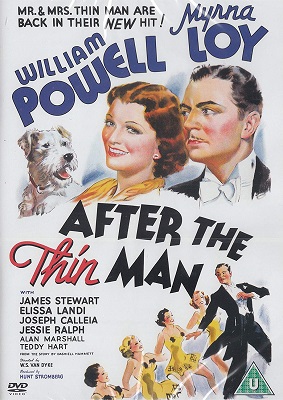
After the Thin Man, WS Van Dyke (1936, USA). The thin man of The Thin Man was actually the villain of that original movie, but it proved so successful a film, and the characters played by Myrna Loy and William Powell so popular, that a sequel was made, with the perfectly understandable title of After the Thin Man (as in “following the previous film” or “following on from the villain of the previous film”), but which served only to confuse audiences into thinking Powell’s character, a semi-retired PI, was the Thin Man. And so the moniker sort of became his as the film series progressed. Otherwise, there’s no link between the story of After the Thin Man and The Thin Man. Loy and Powell are returning to their San Francisco home after a holiday away when they’re contacted by Loy’s tearful sister, whose playboy husband has vanished. He proves remarkably easy to find. Unfortunately, he’s involved in an extortion scam, and gets murdered for his pains. And the chief suspect is Loy’s tearful sister… Watching this film, you have to wonder how much of the boozing was acted, because while the dialogue between the two leads was certainly witty and snappy, and occasionally sounded ad-libbed although it may not have been, Powell did seem to have a shit-eating grin on his face for much of the film. The Thin Man was popular enough to spawn a series, but this follow-up felt weak, perhaps because it spent more time exploring Powell’s and Loy’s relationship than it did its mystery plot. Still, worth seeing if you like 1930s Hollywood movies…

1001 Movies You Must See Before You Die count: 933


4 Comments

Moving pictures 2018, #62

At least two of the films in this half-dozen I thought were on the 1001 Movies You Must See Before You Die list, but aren’t. And I’m not sure why Bondarchuk’s War and Peace – at least one, if not all four, of the films – never made the grade.

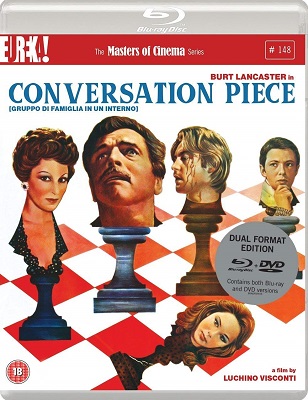
Conversation Piece, Luchino Visconti (1974, Italy). Visconti seems to have a thing about veils, as at least one woman in his films appears wearing one. In this film it’s a flashback to the mother of the character played by Burt Lancaster, as the movie itself is set in the 1970s. You can tell from the fashions. Boy, can you tell. Lancaster plays a wealthy professor who lives in a Roman palazzo with large collection of books and “conversation pieces” (a type of informal group portrait, typically British and typically eighteenth-century). He is pressured into renting the top floor of is palazzo to an overbearing jet-setting marchesa, ostensibly for her daughter and her daughter’s fiancé, but actually for her own lover. Things go wrong from the start. The lover, under the impression the apartment has been purchased for him, starts knocking down walls… But despite getting off to a bad start, he and the professor become unlikely friends. The professor tries to hide the shady things going on in the lover’s life – at one point even hiding him from the marchesa, at another providing him with an alibi for the police. As he does, so he becomes less of a recluse and, surprisingly, less attached to his books and conversation pieces. I’m not entirely sure what to make of the film, given it didn’t have much in the way of a plot, or indeed a cast, which was small but high-powered. Lancaster was especially good, better I think than in The Leopard, and Helmut Berger managed a remarkable transition from dislikable to sympathetic. But the film suffered somewhat from having too small a story – evident in the fact it was shot entirely indoors.

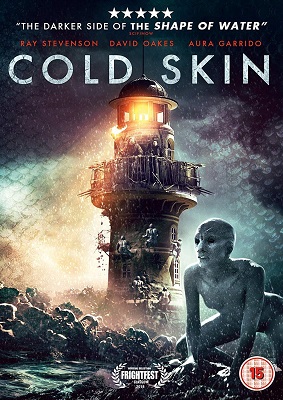
Cold Skin, Xavier Gens (2017, France). Not sure what prompted me to add this to my rental list. Perhaps it was something in the description. Certainly neither the director nor any member of the cast was known to me. And while I’ve identified the film as French – although these days few films are the product of a single nation – Cold Skin is actually a French-Spanish production, adapted from a 2002 Spanish novel, but filmed as English language. An Irishman during WWI hitches a ride to a remote South Atlantic island to work as its meteorologist. There is only one other person on the island: a lighthouse keeper. And he doesn’t seem all there. The reason for that the Irishman discovers during his first night on the island when his hut is attacked by a horde of fish-people. He manages to survive and moves into the fortified lighthouse. Where he discovers the keeper has a fish-people woman as a sex slave. And, er, that’s about it. The Irishman learns the fish-people are not monsters (but the keeper is), even though the lighthouse is attacked nightly by swarms of them. It felt a bit like a less-commercial del Toro film, to be honest, and I’m not a del Toro fan. The fish-people were done well, and the two actors were of the type where you know their faces but you can’t think of their names and you can’t remember what you’ve seen them in before. Meh.

The Scarlet Empress, Josef von Sternberg (1934, USA). The empress in question is Princess Sophie Friederike Auguste von Anhalt-Zerbst-Dornburg (a principality in Prussia), but she is better known as Catherine the Great. She’s played by Marlene Dietrich in what is pretty much a straight-up Hollywood biopic. She’s taken to Russia to marry the Imperial heir, Peter, but he turns out to be a half-wit, so she finds her pleasures elsewhere, all the while trying not to offend the actual Empress of Russia, and eventually seizes power six months after Peter is crowned. And goes on to rule Russia for thirty-four years. Despite not being Russian. Neither was Peter. He was born in Kiel, in Schleswig-Holstein, was at one point declared the King of Finland and at another the heir presumptive to the Swedish throne. His mother, however, was Russian, as was his aunt, the Empress of Russia was his aunt. However, despite the manglings and mischaracterisations, The Scarlet Empress proved surprisingly entertaining because of the production design. I don’t know who was responsible – von Sternberg obviously, in some part – but the sets were completely bonkers. Giant doors with Lovecraftian marquetry on them. All the walls designed to resemble the logs of a wooden fort. And the chairs! All designed to look like gargoyles from some deranged hell. It’s a shame it was in black and white. It must have looked like Hope Hodgson on acid in colour. Perhaps one day someone will colourise it. I hope so: it would certainly rival Mughal-E-Azam (see here) for eye-curdling visuals.

Rififi, Jules Dassin (1955, France). There’s a famous scene in Rififi, where the thieves have taken over the flat above a jewellery shop and cut a hole in the floor and lower themselves into the shop. While this was playing, I was convinced I’d seen it before. But in colour. I’m thinking maybe it was pastiche of the scene in something by Buñuel but I’m not sure. Rififi is a well-known film, and highly-regarded in French cinema, so it’s likely it inspired a similar scene in another movie. Dassin, despite the name, was American, and after being outed as a Communist and blacklisted in the USA (Land of the Free kof kof), fled to France, where he continued to direct movies. Rififi was apparently a rush-job, based on a novel that no one thought any good – Truffaut said of it, “Out of the worst crime novel I ever read, Jules Dassin has made the best crime film I’ve ever seen”. The plot is pretty basic. A jewel thief finishes a five-year sentence, recruits a gang, and robs a jewellery store under cover of night. Then it all falls apart. Because one of the gang gives a stolen diamond ring to his girlfriend, a singer at a gangster’s club, and the gangster subsequently figures out who was responsible for the robbery. Cue shoot outs. Rififi is straight-up American noir, but set in France and with a French cast. But then the French were quick to adopt film noir – the Cahiers du Cinéma were big fans of the genre, and Godard, for one, pastiched it several times during his career. And that, I think, is one of the problems with Rififi. It’s film noir, and the French made better film noir when they were making knowing take-offs of it. The fact the only thing that stands out about Rififi is its inventive robbery probably tells you all you need to know. Worth seeing, but fans of film noir will appreciate it more than others.

Kin, Jonathan & Josh Baker (2018, USA). A young adopted black boy with a white father is helping a gang he was fallen in with steal old wiring from a derelict factory when he gets caught in the middle of a firefight between two groups of armoured aliens who appear through some sort of portal. As you do. He manages to escape, but returns later and discovers one of the high-tech blasters carried by one of  the aliens. Meanwhile, his stepbrother has returned home having finished his sentence. But his dad doesn’t want him around. And with good reason. It turns out he owes money to a gangster who protected him in prison, and the only way he can arrange to pay it off is to help the gangster rob his father’s construction office. But they’re caught in the act, the father is shot and killed, as is the gangster’s brother. So the step-brothers go on the run. Along with the alien blaster. Kin suffers because it doesn’t know if it’s a science fiction film or a gangster film. The latter are ten a penny, and need to be really special to stand out. Kin isn’t. The former, well… there isn’t enough there for the film to get a good grip on its science-fictional ideas, not even given the film’s final twist. For all that, it’s a reasonably accomplished piece of movie-making. The cast are generally good, although James Franco’s gangster joins a long line of clichéd psycho movie gangsters, Dennis Quaid’s blue-collar honest Joe dad is no less a stereotype, and and as for Zoë Kravitz’s kind-hearted lapdancer… Meh.

War and Peace, Part 2: Natasha Rostova, Sergei Bondarchuk (1966, Russia). Two films in and I think these are actually quite brilliant. They were massive technical achievements for Soviet cinema at the time, and every rouble spent, every technical ambition realised, is up there plain to see on the screen. Not to mention the cast of thousands. I believe Ilya Muromets holds the records for the most number of extras – I’ve heard figures ranging from 100,000 to 250,000 – although a lot of sources claim Gandhi had 300,000 extras. But the Ilya Muromets extras were costumed, which makes it a more impressive achievement. Some of these War and Peace movies must have casts numbering tens of thousands, again all in period costume (well, uniform). Anyway, this second film focuses on the eponymous heroine, and her burgeoning relationship with Prince Bolkonski. There are lavish balls – and they are lavish. But we see much of its from Rostova’s point of view, although the POV does jump about a bit, with swathes of cloth sweeping across the screen, which is odd. Also odd is the inclusion of occasional scenes where the dialogue is in Russian, since the rest of the film has  been dubbed into English (well, except for the French and German dialogue, which isn’t dubbed at all. This is apparently because the original 70mm masters have degraded beyond restoration, so an edited version was used for the DVD release, but with some scenes – the ones that aren’t dubbed – added from other surviving copies. It’s plain the full film, all 431 minutes, in 70mm – albeit on apparently awful Soviet film stock – must have been amazing. And there isn’t a single copy in good enough condition remaining to capture that – although some DVD editions are apparently better than others. That’s a shame. Perhaps we’ll be lucky and someone will find a well-preserved copy in some fleapit in a former SSR. Something similar happened to Metropolis. And to Limite. Although both are still incomplete. But they’re also much older films. Anyway, War and Peace, Part 2: Natasha Rostova finishes with the opening shots in the Battle of Borodino, and it lokos fantastic. I can’t wait to watch War and Peace, Part 3: 1812.

1001 Movies You Must See Before You Die count: 933


Leave a comment

Must. Stop. Buying. Books…

Maybe I should make it a New Year’s Resolution or something. I did recently go chasing down my teen years by buying role-playing magazines and supplements from the 1980s that I remembered fondly, which at least are not books… But that’s no solution. And actually a little bit depressing, when you think about it. Anyway, the following book-shaped objects containing many thousands of words landed chez moi during the past month or so.

I’m so shallow I’ll buy anything if you make it look like a set. And get unreasonably enraged when you stop making it a set – like publishers who completely change the cover design of a trilogy when they publish the last book. Argh. I shall be forever grateful to Gollancz for not numbering their relaunched SF Masterworks series. Because if they were numbered, I would have to buy them, even the ones I already have in the old series. OTOH, Gollancz: Alastair Reynolds’s Poseidon’s Children trilogy. Argh. This is perfectly normal behaviour, of course. Anyway, NewCon Press, an excellent small press, have over the last couple of years been publishing quartets of novellas which share a single piece of cover art split across the four books. This is the fourth such quartet, subtitled “Strange Tales” – The Land of Somewhere Safe, Matryoshka, The Lake Boy and Ghost Frequencies – and I’ve enjoyed those I’ve read so far.

Some recent, and not so recent, genre fiction. Europe at Dawn is the fourth book of the excellent Fractured Europe series. I don’t know if this is the last book. I hope not. Kim Stanley Robinson is an author whose books I buy in hardback; hence, Red Moon. A desire to reread Le Guin’s Earthsea books came over me when I saw The Books of Earthsea advertised, so I got myself a copy. It’s a humongous book, and not a comfortable size to read, but the contents are definitely worth it. Yaszek’s name I already know from Galactic Suburbia, which I read as research for All That Outer Space Allows. Recently, she’s been involved in a couple of projects to signal-boost early sf by women writers, much as SF Mistressworks has done, and Sisters of Tomorrow, an anthology, is one of them. Ignore the copy of Without A Summer, which sneaked its way into the photo. I thought I’d bought it recently, but I actually purchased it about three months ago. The Quantum Magician I have to review for Interzone.

Here we have a couple of bandes dessinées. Distant Worlds Episode 1 is another, er, episode in Léo’s long-running science fiction story which began with Aldebaran (see here). I admit I’m not entirely sure on the chronology of Léo’s series, given there are half a dozen or so separate stories, and no real indication of which follows which. But this one appears to have been written by someone else, Icar, although I still think it’s set in the same universe. Inside Moebius, Part 3 is, er, the third volume of Inside Moebius, containing books 5 and 6 of the original French edition. It’s one for fans of Moebius – and who isn’t one? – and not much use without the two earlier volumes.
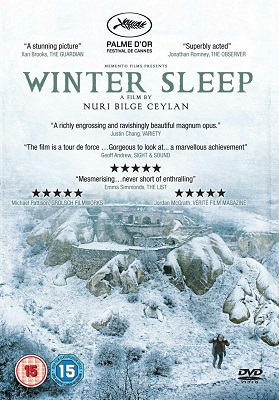
I’ve been a fan of Shariann Lewitt’s fiction since finding a copy of her debut novel, Angel at Apogee, in a remainder book shop in Abu Dhabi. I subsequently hunted down copies of her other novels. Initially, she was SN Lewitt (see what I did there?), but with Memento Mori, her fifth novel, she became Shariann Lewitt. I bought a paperback copy back when it was published in 1995, but always fancied upgrading it to a hardback. Sadly, her seventh novel, Rebel Sutra, published in 2000, appears to have been her last. Cherryh is another author I’ve upgraded to hardback– Actually, no, that’s not strictly true. I read a lot of Cherryh during the 1980s, back when she was pretty much ubiquitous on the sf shelves of UK high street book shops. And then in the 1990s, when I was living in the UAE, I started buying her books in hardback as soon as they appeared. But when I returned to the UK, I stopped doing that… And then I discovered eBay, and started picked up hardback copies of her back-catalogue. Some of which were published in signed limited editions by Phantasia Press, like this one: Forty Thousand in Gehenna.

A copy of The History of American Deep Submersible Operations popped up on eBay for kof kof £95. And even though I fancied it, that was too much. But then I discovered that all the other copies I could find were £400+ and, well, then it suddenly turned into a bargain. So I, er, bought it. Owner’s Workshop Manual: NASA Mercury is one of a range of excellent books on spacecraft by Haynes, who have branched out from cars to covering everything from the Death Star to Pies. Yes, honestly. I admire Delany a great deal. He’s probably one of the cleverest writers and critics the genre has produced, and while I probably like the idea of his fiction more than I actually like his fiction – although Dhalgren remains a favourite novel – I suspect I also like the idea of Delany more than I do reading his non-fiction. But I’m determined to give it a go. Hence, In Search of Silence: The Journals of Samuel R. Delany Volume 1 1957 – 1969. Which had sat on my wishlist for over a year before finally shaming me into putting it into my basket. I’ve no idea when volume 2 will appear, or if indeed it ever will (Delany is not very good at producing sequels). And yes, I’ve read The Motion of Light in Water. And I have a copy Times Square Red, Times Square Blue on its way to me…

Some secondhand books. The Lung is not an easy book to find – or, at least, those few copies that can be found are not cheap, especially not for a 1970s paperback. But this one was more reasonably-priced than other copies I’ve seen. And in really good condition. A Trick of the Light, which is Faulks’s first novel, on the other hand… I’ve seen copies on eBay priced between £300 and £400, which is way more than I’d pay for a book I’m not desperate to own. So I was pretty chuffed when I found this copy for £35 from a US-based seller on abebooks.co.uk. Bargain. How to be Both and A Handful of Dust were charity shop finds. (The part of the city where I live, by the way, has around a dozen charity shops. In fact, my local high street is charity shops, discount food shops and cash converters. Welcome to Tory Britain.)

I asked my mother, who is a regular browser in charity shops, to keep an eye open for books by William Golding or Evelyn Waugh. The only Golding she could find was Lord of the Flies, which I already have. But she did find a bunch of Waugh: The Loved One, Vile Bodies, Scoop, Put Out More Flags, Work Suspended and Black Mischief. I should ask her to look for some female writers for me, like Manning, Taylor, Lehman, West, Bowen, Ertz, Frankau and so on.

On my way back from Leeds last week, I caught a black cab home from the station. The route goes along Shalesmoor, a road I’ve travelled along hundreds of times – and walked it many times too on my way from the tram stop to the Shakespeare pub. This time I noticed a new shop, the Kelham Island Bookshop. So the next day I went and checked it out. And found Decline and Fall and When the Going was Good, and The Pyramid and Pincher Martin. The shop has an excellent selection of secondhand books. And they sell vinyl too. I asked how long they’d been open. Since last July I was told. I’ve been along that road I don’t know how many times in the past five months, and never spotted the shop. Shows how observant I am. Sigh.

I nearly forgot. Three more of the Heinmann Phoenix Edition DH Lawrence Books: The Complete Short Stories Volume 1, Volume 2 and Volume 3. I already had two of them, but these came as a set and the two I already owned aren’t in as good condition as these. That means I now have twenty-one of, I think, twenty-six books. Why collect these when I have a full set of the white Penguin paperbacks? Well, aside from the fact it’s a set, the Phoenix Edition does include some books not in the white Penguiun editions, and vice versa.


2 Comments

Reading diary 2018, #19

After last month’s all-female roster, only one woman writer this time. I’m currently also 12 books ahead of my Goodreads reading challenge of 140 books in 2018, and will probably meet the target before the end of November.

Ghost Frequencies, Gary Gibson (2018, UK). This is the first of the fourth set of NewCon Press novellas, and the second quartet to have an overall title, which is “Strange Tales”. It’s as apt a description as any. The story of Ghost Frequencies is hardly new – I’m pretty sure even Dr Who has covered it – although Gibson has given it a nice twist. But, I think, mostly, the good thing about Ghost Frequencies is that it all adds up. The story neatly folds back onto itself and it all makes sense. Which is not something you can normally say of ghost stories. A project to use quantum entanglement to send messages instantly between a lab in the UK, sited in an old haunted manor house, and California, has yet to show meaningful results and is about to be closed down. Then a team of parapsychologists turn up to investigate the manor’s alleged ghost. And weird things start to happen, witnessed by the quantum project’s lead researcher. And it’s all linked to the ghost and the murder of a young woman decades before and the owner of the manor house and backer of the quantum project, a billionaire who grew up there… And it all slots together, in a way that is actually rational. It’s a neat take on the ghost story and satisfies my science fiction brain. Gibson doesn’t usually write short fiction, but this is a well-plotted and nicely-written novella, so perhaps he should try it more often.

The Lake Boy, Adam Roberts (2018, UK). The NewCon Press novellas are not numbered but I think this was the second one published from this quartet. In one respect, this novella was a first for me. About halfway in, I was very surprised to discover myself as a character. A Mr Sales makes an appearance, and then a disappearance. But I hadn’t been killed off, as I initially thought, just abducted by aliens and then returned. However, Roberts introduces the character as “Mr Sales from Leeds”, which is close but I’m actually from the Socialist Republic of South Yorkshire (or, as Dr Who recently named it, the Peoples’ Republic of South Yorkshire). That aside, The Lake Boy is an accomplished pastiche of nineteenth-century fiction which reminds me, more than anything else, of John Fowles’s A Maggot, which is, yes, I know, set in the eighteenth-century. But it’s that whole thing about telling a science fiction story from the POV of people who don’t understand that it’s science. It’s livened up a bit with the protagonist’s Sinful Past and her Unnatural Desires. I normally find Roberts’s fiction somewhat hit-and-miss – some I bounce off, some I really like – and this one definitely fell into the latter category. Worth reading.

Ancestral Machines, Michael Cobley (2016, UK). Mike is a friend of many years – I believe we first met at the first convention I ever attended, Mexicon 3 in Nottingham in 1989. So, on the one hand, that’s a long enough friendship to survive a negative review; but on the other, it feels somewhat off to tell a mate he’s written a bad book. In fact, most people I know won’t review books by friends – but, seriously, your friendship must be pretty fragile if it can’t survive someone’s opinion over a piece of fiction, FFS. Which is by no means a cunning lead-in to saying that Ancestral Machines is a bad book. Mike can write – he’s especially good at writing descriptive prose, which is unusual in genre writers – but Ancestral Machines definitely suffers from too much Banks and not enough Cobley. I mean, it was obvious from the first book of the Humanity’s Fire trilogy, Seeds of Earth, that Mike was ploughing a Banks furrow, but he made it enough of his own it didn’t matter. Unfortunately, Ancestral Machines reads like he tried a bit too hard. The book opens with two AIs, very much like Minds, discussing what will become the plot. Then you have the crew of a tramp spaceship, who are either the most inept or the unluckiest ever, because everything they do fails. They get dragged into the story when their ship is stolen. There’s a BDO in the form of an artificial planetary system of two hundred worlds, which can travel between galaxies and whose inhabitants are in thrall to a handful of evil alien overlords called Gun-Lords, who are actually sentient alien weapons who have taken over host bodies. The whole BDO is set up as the arena for brutal wargames, often with death tolls in the millions, and a league table of the victors. The AIs and the freighter crew end up involved with an attempted rebellion against the Gun-Lords, who are set to steal lots of worlds to put in their BDO. It’s all a bit of madcap dash from one set-piece to the next, and the plot seems to teeter on the edge of falling over for much of the book’s length. The banter didn’t always work for me, and the characters seemed a tad generic, but there’s some good space opera invention, and if the ending is a bit pat, it’s not an easy one. I’d sooner space operas didn’t feel the need for mega-bodycounts, but at least in Ancestral Machines the evil bastards get their just desserts.

The Quantum Magician, Derek Künsken (2018, Canada). I read this for review in Interzone (I wasn’t quick enough to get the new Anthony Burgess book, sadly). Given the title and plot, comparisons with Rajaniemi are inevitable – and The Quantum Magician, even though I didn’t really take to The Quantum Thief, doesn’t come off quite so well. The protagonist, Belisarius Arjona, is a homo quanta, a member of a genetically-engineered race who can disable their subjective consciousness in order to not collapse wave functions. And other superhuman stuff. Sigh. Arjona, however, grew disillusioned with the scientific research station where his people live, and became a con man. And now he’s been approached by members of the Sub-Saharan Union, who have invented a fantastic new stardrive and want to get their fleet through the stable wormhole controlled by the Puppet Federation to their home planetary systems. The puppets, like Arjona, were genetically-engineered, but as a slave race neurochemically fixed to worship a race of “Numen”. But they overthrew their masters and now keep those few who survive as captive gods. Arjona comes up with a complex plan which involves a member from each of the genetically-engineered human races but basically ends up as full-on frontal assault on the fortress guarding the wormhole entrance. As far as I know, I’ve never read anything by Künsken previously, but something about the puppets definitely tickled my sense of déjà vu – although I can’t work out where from. There’s some good stuff in The Quantum Magician, particularly in the worldbuilding, but the con which forms the plot isn’t really a con as such – this is no science fiction Ocean’s 11, for all that it wants to be – and the resolution is a bit of a letdown. Anyway, full review to appear in Interzone soon.

Moonwalker, Charlie & Dotty Duke (1990, USA). I went through a phase about ten years ago of buying signed autobiographies by astronauts. I’d read them, and other books about space exploration, and review them on a blog, A Space About Books About Space, where I last posted a review in May 2013. That’s more or less where the Apollo Quartet came from. I’m still interested in the subject, although I’m no longer so zealous about buying the books. And I still have a number of them to read. Like this one, Moonwalker, by the LMP for Apollo 16. You expect certain things from astronaut autobiographies, such as how something they invented proved vital to the programme, or iconic to the US Space Race. But not from Duke. He loved every minute of it, and says so repeatedly. He also admits it pretty much destroyed his marriage. That is until some years after he left NASA when his wife joined some weird Christian sect and the two discovered God. Moonwalker is at least cheerfully honest. You have the opening section where Duke describes his early career, and admits he was a bit of a screw-up. Then there are the NASA years, when he was clearly having a ball, culminating in Apollo 16’s time on the Moon. And then you have his post-NASA career as, first, an unsuccessful mall developer and then as a Coors distributor… before finding God. When people claim to pray to God and he responds, I call bullshit. If you think you are hearing from God, then you are delusional. Both Dotty and Charlie Duke claim to do so in Moonwalker. They leave their decision-making to God – well, Jesus, as apparently their particular brand of Christian weirdness means accepting Jesus as the Son of God (and why the fuck do I keep on using init caps on this nonsense?) – anyway, they basically leave things to fate and when it pans out the way they’d hoped, OMG, IT’S JESUS! HE’S REAL! OMG! Gordo Cooper’s autobiography Leap of Faith was spoiled by his insistence that UFOs were real, and the same is true here: Moonwalker would be a more interesting book if the Dukes had not chosen to document their religious conversion. But on Apollo 16 alone, it’s a quite good read.

Such Good Friends, Lois Gould (1970, USA). This was the result of some drunk eBaying after watching the adaption of the novel by Otto Preminger, which isn’t, to be honest, a very good film. But reading up about the story on Wikipedia persuaded me it might be worth a punt, and I found a copy for a couple of quid – a tatty hardback – on eBay from one of those big secondhand clearance sellers and, well, bought it. And it is indeed much better than the film. The Wikipedia entry describes it as “stream-of-consciousness” but it really isn’t. It’s very much fixed in the POV of its protagonist, Julie Messinger, whose husband – NY magazine art director and illustrator of a best-selling children’s book – is in a coma after an adverse reaction to the anaesthetic used in his operation to remove a mole. As friends and colleagues gather to donate blood and comfort Julie, so she slowly learns of her husband’s constant philandering. And each medical intervention in the comatose man’s condition only makes his situation worse. The film plays the story as a black comedy, stressing the incompetence of the doctors and hospital – in fact, in the movie, the coma is caused by a surgeon nicking an artery during surgery. But in the book, the doctors do their best – if only because it will reflect well on them. For all the book wasn’t exactly an intentional purchase, so to speak, it was a pretty good read. There’s not much information on Gould on Wikipedia, but if I stumble across one of her other novels I might well give it a go.

1001 Books You Must Read Before You Die count: 131