It’s been a month since the last one, so here goes:
Books
Interstellar Empire , John Brunner (1976), is a fix-up of three novellas from 1953, 1958 and 1965. They’re juvenilia and it shows. For a start, it’s “enslaved”, not “slavered”. Gah. And despite being set in a post-collapse galactic empire, everyone talks like comedy barbarians. Brunner admits in an included essay that the novellas were partly inspired by a desire to invent a workable swords & spaceships universe – ie, interstellar travel but each world possessing no more than Dark Ages tech (although a helicopter does make an appearance). The mention of mutants and telepathic powers, however, in no way explains the magic powers which feature in one of the novellas. Aldiss did it much better in Starswarm
 and Galaxies Like Grains of Sand
 .
.
Ascendancies , DG Compton (1980), I wrote about here.
Planet of the Apes , Pierre Boulle (1963), was terrible. The film is a great deal better. Although originally published in France in 1963, this book reads like it was written forty years earlier. And, annoyingly, the author (or perhaps the translator of the Penguin edition I read) refers to chimpanzees, gorillas and orangutans throughout as “monkeys”. That’s in spite the book’s title. Gah. The story opens with a couple in a spaceship finding a message in a bottle floating in space – which is too dumb a concept to be taken seriously, as paper simply wouldn’t survive in space. The message is the story of Ulysse Mérou, who lands on an inhabitable planet in the Betelgeuse system and is captured by intelligent apes. He’s an unpleasant narrator, the swapping of humans for apes and vice versa is painfully obvious a conceit, and the details of the apes’ world don’t really add up. Avoid.
Alanya to Alanya (2005), Renegade (2006) and Tsunami (2007), L Timmel Duchamp, are the first three books of the Marq’ssan Cycle. I’m currently reading the fourth book, and I plan to write about all five once I’m done. Just like I planned to write about the five books of Gwyneth Jones’s Bold as Love Cycle – the piece on those is almost done, and should be going up here soon-ish. So far, however, the Marq’ssan Cycle is proving an excellent thought-provoking read, and I’d certainly recommend it.
The Collector , John Fowles (1963). Perhaps when reading an author’s oeuvre, you should start with their debut novel. I didn’t. The first novel I read by Fowles was A Maggot
 , and I thought it was excellent. When I later read The French Lieutenant’s Woman
 , I was even more impressed. The Collector can’t match either of those. Fowles’ maintenance of his two characters’ voices is good throughout The Collector, and the novel is cleverly-structured. But it all seems a bit, well, tame. The eponymous entomologist kidnaps Miranda, locks her in his cellar, and then treats her like an imprisoned princess. When you compare that to similar situations from television shows such as CSI, or even from the real world, it all seems a bit too comfortable and home counties. Disappointing.
The Girl At The Lion d’Or , Sebastian Faulks (1989), is Faulks’ second novel. The eponymous character is a young woman of mysterious background who takes a waitress job at the titular hotel in France during the early 1930s. She immediately falls in love with wealthy lawyer Charles Hartmann. The two have an affair, and she tells him her secret. This changes his view of her, and so he breaks off the relationship… The Girl At The Lion d’Or has a good sense of time and place – and the heroine’s secret is very much a product of the time – but the writing is a little too flowery in places. But then it is only Faulks’ second novel…
The Secret History Omnibus Volume 1 , Jean-Pierre Pécau (2010), is a graphic novel. Back in the Stone Age, four youths were each gifted with a powerful magic rune – the shield, sword, chalice and lance. These four Archons were immortal, and have battled throughout human history for supremacy. When one’s plan backfired during the early years of the Holy Roman Empire, it created William of Lecce, an evil immortal, who has subsequently been responsible for all the wars and tribulations since. There’s a good idea at the heart of this graphic novel, and the historical periods are handled well. But a lot seems unexplained, and it’s easy to get confused. This first volume covers from the Stone Age to the First World War, with episodes set in Ancient Egypt, the reign of Frederick I, the Great Fire of London, and Napoleonic France. I’ll be picking up Volume 2 when that becomes available.
The Flying Saucer , Bernard Newman (1950), I read to review for Interzone.
Films
Déjà Vu , dir. Tony Scott (2006), is one of those high-concept thrillers Hollywood likes to rip bleeding from the oeuvre of Philip K Dick. Except this one isn’t based on anything by PKD. A bomb explodes on a ferry in New Orleans, killing everyone aboard. Denzel Washington investigates, and is seconded to a super-secret taskforce which has access to… a time portal. They can see back in time, to the very moment of the explosion. There’s some guff about wormholes and Einstein-Rosen Bridges, but this is Hollywood so it’s not very plausible. It all ends up with Washington getting sent back in time to rescue a woman who might hold a clue to the bomber’s identity. Entertaining, but it’s best not to think about it too hard.
The Men Who Stare At Goats , dir. Grant Heslov (2009), surprised me. I was expecting some stupid gung-ho thriller related to the title, but it turned out to be a funny and slightly offbeat comedy. The book on which it was based is actually non-fiction. Yes, the US military really did train soldiers in telepathy and telekinesis. Not to mention lots of other weird hippy-type crap. Not that they were successful. At least, not in the real world. In this movie, it’s left open. George Clooney is good, Spacey plays a nasty piece of work convincingly, but Ewan McGregor seems a bit out of place. A fun film.
Lured , dir. Douglas Sirk (1947), is an early thriller by the master of melodrama. It’s set in London, but made in the US with a US cast. Which makes for an odd viewing experience as the accents are variable. Lucille Ball plays an American, however. She gets embroiled in the hunt for a serial killer when Scotland Yard ask her to act as bait. There are several Sirk touches in the film, but it’s not a patch on his later stuff. It’s too light-hearted to really pass as noir, and a bit too bizarre in places as well; and some of the faux Hitchcockian staging sits at odds with the more conventionally-filmed interior scenes. One for fans.
Fanboys , dir. Kyle Newman (2008), I reviewed for VideoVista here.
The Time Traveler’s Wife , dir. Robert Schwentke (2009), I watched because I’ll probably never get around to reading the book. And, to be honest, I couldn’t see what all the fuss was about. Man stalks woman through time, right from when she was really young. It struck me as a bit unhealthy. Meh.
Black Lightning , dir. Dimitriy Kiselev & Aleksandr Voytinskiy (2009), I reviewed for VideoVista here.
Sherlock Holmes , dir. Guy Ritchie (2009), entertained me more than I expected. I don’t have much time for Ritchie’s films, but a few people had told me Sherlock Holmes was actually quite good. And so it proved. Nothing to do with Conan Doyle’s Sherlock Holmes, though. Well, it was about a detective and his sidekick; and they happened to be named Sherlock Holmes and Dr Watson. But that’s about as far as it went. Entertaining, if supremely silly. It’s been a couple of weeks since I watched the film, and I find I can’t remember any of the plot. Which pretty much sums it up.
The Woman In Question , dir. Anthony Asquith (1950), I reviewed for VideoVista here.
La Reine Margot , dir. Patrice Chéreau (1994). They were a nasty lot those French royals in the 16th century. We might piss and moan about our current government dumping on the population from a great height, but at least they haven’t manufactured a massacre just to keep themselves in power. That’s what the mother of King Charles IX did in France in 1572. Since he was Catholic, and she didn’t want the Protestants to gain the throne, she had a bunch of them killed, which in turn sparked off a wave of mob violence. As many as 30,000 might have died (estimates vary). The title character is the sister of King Charles IX, who is married off to Henri, King of Navarre (a separate kingdom in the Pyrenees), who is Protestant. This is allegedly to placate the French Protestants, but it doesn’t go very well. Henri is imprisoned, and forced to convert to Catholicism. He eventually escapes, with the help of his wife. But not before King Charles IX’s mother tries to poison him, but inadvertently poisons her son, the king. When he dies, his brother takes the throne. But then he dies too, and Henri ends up as King of France. So he got the last laugh, after all. You couldn’t make this sort of stuff up. If you put it in a fantasy novel, readers would say it was too implausible. This film adaptation is noted for its excellence, and it’s easy to see why. Although sixteenth century France seems a bit minimalist and flat, and there are lots of meaningful glances between members of the cast. And it’s a long film. But it’s definitely worth seeing.
Edge of Darkness (1985), is the original BBC television series, not the inferior Hollywood remake. I thought I’d seen this before, perhaps when it was originally broadcast. But apparently not. Bob Peck plays a Yorkshire policeman, whose activist daughter is shot by an assassin on his doorstep. It turns out it’s all to do with Northmoor, a nearby nuclear waste facility based in an old mine. Peck’s character was a bit odd, even kissing one suspect in order to get him to confess, and later trying a similar trick on the assassin. Also bonkers was Joe Don Baker’s CIA agent, who helps Peck to crack the case because it’s in the interest of the US to blow the lid on the secret British plutonium project and the sale of Northmoor to a US billionaire. I can see why the series has become a cult favourite – it’s not the straightforward thriller a summary of its plot might suggest. It’s a little odd, but compelling viewing nonetheless. And the ending is completely mad.
The Last Mimzy , dir. Robert Shaye (2007), is a genre film which seems to have slipped beneath a lot of people’s radars. It’s based on a short story by Lewis Padgett (AKA husband and wife Henry Kuttner and CL Moore). Basically, the future is in trouble, so they send kids’ toys back into the distant past in the hope of educating a child to send them what they need. A brother and sister, aged six and twelve, who live in Seattle in the present day find the toys. And they make the kids smarter. And also provide some good sfx. While this is a family film, I think it’s concept is a little too high for its target audience. It’s done well, but it tries too hard to get its central conceit across and comes close to losing its viewers in parts. Entertaining, but, well, perhaps the filmmakers shouldn’t have thought about it too hard.
Death Watch , dir. Bertrand Tavernier (1980), I wrote about here.

 , or
, or  . And I watched it last night.
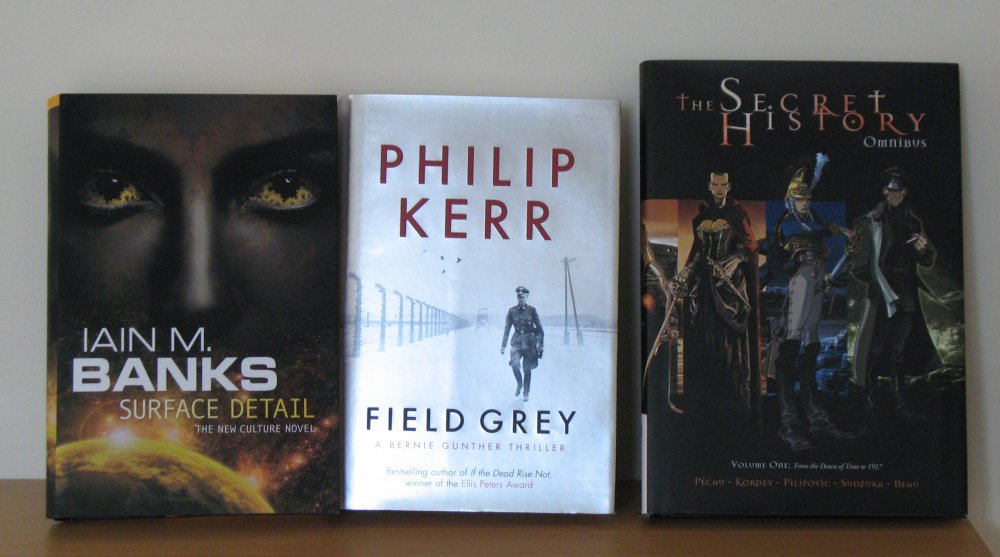
 , which I plan to read soon-ish; the latest in Philip Kerr’s Bernie Gunther series,
  ; and an omnibus edition of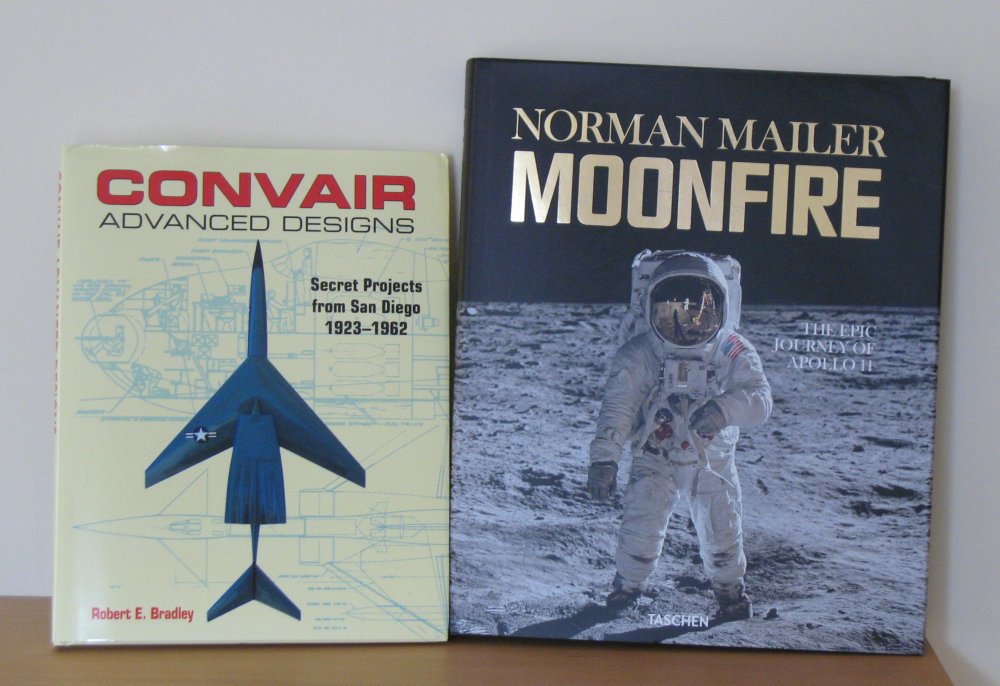
 . It’s about planes. The second,
  , is a re-issue of Norman Mailer’s 1971 book about the Moon landings,
  , but as a coffee-table tome by Taschen, with many, many excellent photographs. There’s a signed limited edition which costs around £600, and a “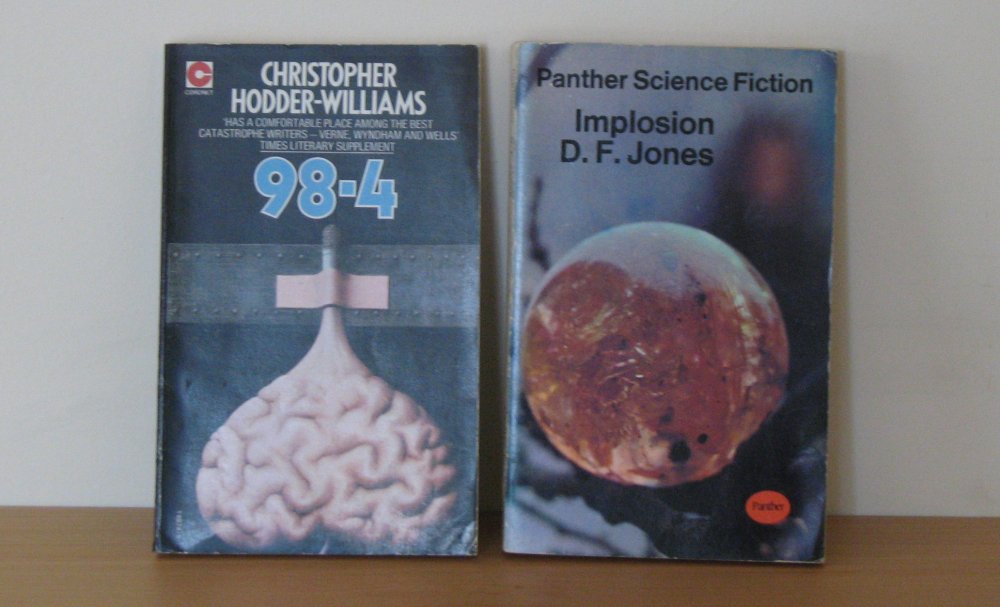
 by DF Jones, and
  by Christopher Hodder-Williams. Look at the awful cover art. They don’t do cover-art like that anymore. I’ll be posting reviews of them here, just as I did for
  (
( (
(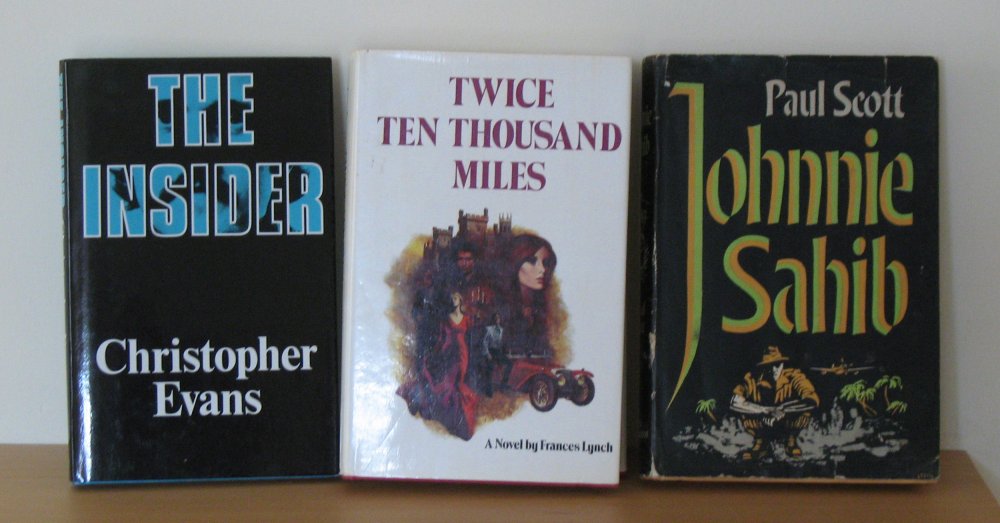
 by Christopher Evans;
  , Paul Scott’s debut novel; and
  by Frances Lynch. Yes, that last one is a
  , dir. William Cameron Menzies (1936) – there’s not much you can say about this. It’s an astonishing piece of cinema, especially given when it was made.
 , dir. Val Guest (1955) – Quatermass had a powerful impact on British sf, so one of the three films featuring him deserves to make this list.
 , dir. Val Guest (1961) – not only a disaster film, caused by testing nuclear weapons, but also a post-apocalypse film. The shots of empty cities remain creepy even today.
 , dir. Nathan H Juran (1964) – the recent Gatiss adaptation on BBC4 was entertaining, but there’s a bonkers charm to Lionel Jeffries’ portrayal of Professor Cavor.
 , dir. Gordon Flemyng (1966) – back when Daleks were cool, they drilled a hole to the centre of the Earth so they could replace it with an engine and turn the whole planet into a spaceship. And they did it in Britain. Until Bernard Cribbins stopped them. With a bit of help from Dr Who.
 , dir. François Truffaut (1966). The book is rubbish, but the film is excellent. Casting Julie Christie in two roles was inspired. And the monorail is really cool too.
 , dir. Bernard Knowles (1966) – an Anglo-German production, set in Germany, in which a scientist, well, he freezes himself. But his wife is murdered while he is frozen, and he’s the chief suspect. It sounds daft, but it works.
 , dir. Freddie Francis (1967) – and the plot of this one seems even dafter: meteorites land throughout the UK and take over people, who subsequently build an armed camp in southern England. This is so they can send rockets to the Moon, launched from underneath a lake, to help repair the alien spaceship marooned there.
 , dir. Stanley Kubrick (1968) – Kubrick may have been an American but this film was as British as you can get – from Anthony Burgess’s source novel through to the cast and crew.
 , dir. Robert Parrish (1969) – Gerry Anderson’s only live-action feature film, although some of the cast were as wooden as his puppets. The central conceit – a copy of the Earth on the other side of the Sun, where everything is reversed – is complete nonsense, but all those Meddings model shots make up for it.
 , dir. Stanley Kubrick (1971) – Kubrick gets two films on this list because
  , dir. Nicolas Roeg (1976) – Bowie was perfectly cast. Any film that can say that deserves to be on this list.
 , dir. Mike Hodges (1980) – it’s like a panto. In space. With Brian Blessed. Three reasons why it belongs on this list.
 , dir. Peter Hyams (1981) – there’s not much that’s British about
  set on a moon of Jupiter (although without Grace Kelly). This was actually a British production, however.
 , dir. Michael Radford (1984) – qualifies in the same way
  , dir. Terry Gilliam (1985) – could be
  , dir. Peter Hewitt (1997) – it’s about the Many Worlds Hypothesis… Well, sort of. It’s a romance, a fluffy version of Kieslowski’s
  , in which catching a train or not causes the story to split into two separate narratives.
 , dir. Danny Boyle (2002) – zombies that can run. Enough said.
 , dir. Michael Winterbottom (2003) – is one of those films which seems to inhabit a near-future which already exists. It also asks some difficult questions about biotechnology.
 , dir. Duncan Jones (2009) – I wrote about this
  It Doesn't Have To Be Right...