It Doesn't Have To Be Right…

… it just has to sound plausible


29 Comments

Looking for a challenge

For the past four years, I’ve had a reading challenge – i.e,. each month I read a book and then write about it on this blog. Each one was themed. Sort of. In 2007, I read ten (plus two extra) of my favourite science fiction novels. In 2008, I read twelve novels by literary authors I’d not read before. In 2009, I read twelve sf novels I remembered enjoying as a teenager and had not reread since. This year, I tried reading the first books of twelve fat fantasy series, but had to give up halfway through.

But I can’t think what to do as a reading challenge in 2011, so I’m looking for suggestions. Either a theme, into which twelve books fit. Or simply a list of a dozen books. Or perhaps twelve books from a single author’s oeuvre. I don’t mind. Except, no fantasy. I tried that this year and couldn’t do it. Also, no westerns. I’ll read Cormac McCarthy, but I’m not at all a fan of the genre. But, otherwise, pretty much anything else goes – science fiction, literary, classics, crime, horror, historical… No rereads, though. I’d like to read something I’ve not read before.

So, suggestions please.


7 Comments

Summing up: reading challenge fail

This year for my reading challenge, I chose to read the first books of twelve fat fantasy series I’d not read before. It sounded easy enough. Fantasy novels, after all, are not known as difficult reading. It should, in fact, have been a doddle. I’ve read and enjoyed fat fantasy novels in the past, so I foresaw no difficulty in reading twelve of them in one year. And it’d be interesting to see whether or not each book persuaded me to read the rest of the series. I had a bit of help putting together a list of a dozen –  people suggested titles, both here on my blog and on LibraryThing, and I picked twelve which appealed. Then I started reading…

I failed.

I lasted six months and then gave up. This is how it went:

January: Pawn of Prophecy, David Eddings. The first book of the Belgariad. These books are now marketted as YA, and it’s easy to see why. The novel also felt like a cynical attempt to jump on the fantasy bandwagon by someone who hadn’t quite mastered the spirit of the thing. I’m told the series improves as it progresses. I shall never know. Full review here.

February: Assassin’s Apprentice, Robin Hobb. The first book of the Farseer Trilogy. An engaging narrator, readable prose… but what a dull world. And a prince called Verity. Too little happened in this book’s 480 pages, the story took far too long to kick into gear. Full review here.

March: The Blade Itself, Joe Abercrombie. The first book of the First Law Trilogy. Everyone raved about this book. It was, apparently, a superb new fantasy novel, different to everything that had gone before. Well, yes. The characters were despicable prats, the narrative circled about the plot without actually engaging with it, and the combat scenes were quite gory. I was not impressed. Full review here.

April: Colours in the Steel, KJ Parker. The first book of the Fencer trilogy. This one was a surprise: I actually enjoyed it and thought it quite good. It’s in serious need of editing – whole passages should have been cut as they add nothing to the narrative – but otherwise the writing flows along, the world is well-built, and the characters are engaging. I’ve since picked up the second book of the trilogy, The Belly of the Bow. Full review here.

May: The One Kingdom, Sean Russell. The first book of the Swan’s War trilogy. This had an interesting world, but the story was so incredibly slow that reading the book proved a chore. I’d like to know what happened, but I’m not prepared to read through 1000+ pages of lethargic prose in order to find out. Full review here.

June: King’s Dragon, Kate Elliott. The first book of the Crown of Stars series. I couldn’t finish this. I got about 100 pages into this 700-page brick and gave up. One narrative thread had a sixteen-year-old girl in slavery and raped nightly by her owner, the other was about a young man who mucks out the stables. I didn’t have the patience to work my way through these to find out what happened.

Unfortunately, King’s Dragon was not only unfinishable, it also put me off reading the remaining six books of the challenge. For the record, they were:

Yes, maybe I made some bad choices – although all the books were recommended to me by others. And, to be honest, there’s still a couple on the list above I’d like to try: the Wells, for example; and the Ruckley. One day, I might indeed read them. But the rest I’ve no interest in tackling. Still, I suppose in one respect the challenge was not a complete failure as it introduced me to a writer whose books I will continue to read: KJ Parker. It also introduced me to some writers whose books I will now assiduously avoid.

Now I just have to think of a reading challenge for 2011.


5 Comments

Long live rock n roll, side A

I first read Bold As Love back in June 2002, a year after its publication. While it was very different from Jones’ previous novel, Phoenix Café (the third book of the Aleutian trilogy), I enjoyed it and thought it very good. I wasn’t the only one – it was shortlisted for both the BSFA Award and the Arthur C Clarke Award, and won the latter. I started the sequel, Castles Made of Sand, shortly after finishing Bold As Love, but ground to a halt about halfway through it. Another three books in the series were published over the following years: Midnight Lamp (2003), Band of Gypsys (2005) and Rainbow Bridge (2006). I bought each one as they came out and put them on the bookshelves… but, after my experience with Castles Made of Sand, I never actually got around to reading them.

It had always been my intention to read the five books, preferably one after the other. But like many people who suffer from my condition – procrastination – I’m more likely to do something if it becomes part of my routine, or I make a project of it. This summer I did the latter. Jones’ Bold as Love quintet became a Summer Reading Project (along with L Timmel Duchamp’s Marq’ssan Cycle and Doris Lessing’s Canopus in Argos quintet; see here). The start of the project was delayed somewhat, for a number of reasons, but in late August I started rereading Bold As Love… and by 15 September had finished all five books.

It was well worth doing. And this is how it went…

Shape is important to a story. It is even more important to a story which stretches over several novels. Gene Wolfe’s The Book Of The New Sun is one novel split into four books (see here); Paul J McAuley’s Confluence trilogy is one novel split into three books; EC Tubb’s Dumarest series has no shape, merely a direction (ie, Dumarest is seeking the location of his home world, Earth). Gwyneth Jones’ Bold as Love series is neither one novel split into five, nor is it a quintet possessing direction only. It has a five-book shape, which is itself comprised of five one-book shapes. The novels can be read individually, but are richer if read in order as a quintet.

The overall story of the quintet is the near-future of the world. It begins in the UK, but over the course of the five books encompasses Europe, the US and China. It begins during the dissolution of the union of England, Scotland, Wales and Northern Ireland. For reasons not completely explained, the English government puts together a think tank, comprising members of the “Counter Cultural Movement” (CCM) – rock and pop stars, in other words. This goes horribly wrong when one such rock star, Pigsty Liver, machine-guns members of the government and seizes power. This is not, it has to be said, especially convincing. But Jones is busy setting up her “Rock n Roll Reich”, and the authorial hand-waving is forgivable. I mean, counter-cultural types are generally anti-authoritarian, government types are generally all about authoritarianism – there’s an obvious conflict of philosophies. But that’s neither here nor there, because the world as Jones wants it – and gets – is an England effectively ruled by the Triumvirate.

The Triumvirate is the three protagonists of the five books: Ax Preston, guitar hero; Sage Prender, AKA Aoxomoxoa, frontman and driving-force for a techno group; and Fiorinda, daughter of rock god Rufus O’Niall, and his incestuous victim in her early teens. That incestuous incident is important – both for what it does to Fiorinda, and for what it nearly did to Gwyneth Jones.

The opening chapter of Bold As Love was published in Interzone’s July 2001 issue, under the title ‘The Saltbox’. Apparently, someone bought that issue of Interzone in a shop, decided ‘The Saltbox’ was obscene (paedophilia and incest), and reported the magazine to the police. Who promptly descended on the editorial address and carted away several copies of the issue. Happily, nothing came of it. Gollancz published Bold As Love as planned, and Interzone is still going strong today.

But Ax, Sage and Fiorinda: the Bold as Love cycle is the story of these three, the world they create, the world in which they find themselves after they lose control of it, their accommodations with the future which results, and a final game-changing event which rewrites geopolitics for the future.
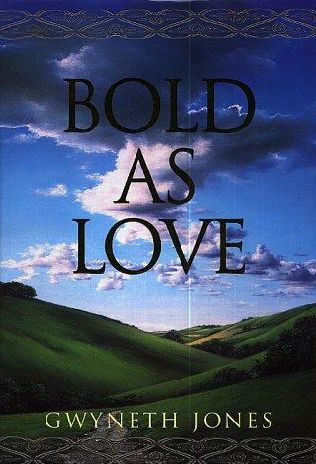
Bold As Love
Several things about Bold As Love struck me on this reread. I’d noticed the first time I’d read the book that it was structured more as a series of vignettes than it was a linear connected narrative. This is not necessarily a bad thing, but I was surprised that I’d remembered the story as less episodic than it actually was, almost as if I’d confabulated something into the gaps in the chronology. I said in a review of Jones’ Flowerdust in Vector back in 1994 that the worlds she created felt so complete it felt as though they continued to live on after you’d finished the book. The same is true of Bold As Love.

Ax and Sage often came across as very similar, which was occasionally confusing in dialogue. The same cannot be said of Fiorinda, who is in many respects a typical Jones heroine – i.e., broken. The story-arc, and especially the plots of Bold As Love and Castles Made of Sand – seem driven as much by the need to “fix” her as it is by the unfolding of the future-history of the series’ world.

The musical dimension to the series I never found wholly convincing, perhaps because my own taste in music is defiantly niche (ie, extreme metal). While I could map Aoxomoxoa and the Heads onto Prodigy and their like, and there are plenty of female singer-songwriter analogues for Fiorinda, I could never quite figure out how Ax’s band, the Chosen Few, might sound, what position they might occupy in the rock universe. They felt out of time – too modern for the 1960s or 1970s, too old-fashioned for the 1980s and 1990s. The fact that three such acts might appear at the same festivals, sufficiently often for them to know each other, also seemed to me to depict the UK music scene as a curiously small world. The music is important, of course – Jones even provides a soundtrack to the novel (see here) – and plays its part during a national tour in which the country tears up the old to usher in the new.

As an introduction to the five chief elements of the Bold as Love series – the three members of the Triumvirate, the world of the novel, and the music – the novel Bold As Love works extremely well. And the prose, as is usual from Jones, is very, very good indeed.
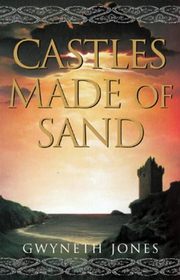
Castles Made of Sand
This I expected to be a less satisfying read – I’d bounced out of it once before, after all. And the somewhat inelegant précis of Bold As Love which opens the novel didn’t bode too well. The first third of the story focuses on the Triumvirate’s relationship, depicted in a strange Delanyesque-Heinleinian fashion – character dynamics by Delany, dialogue by Heinlein. This may be why I bounced out of the book the first time I tried reading it. I’m not a big Heinlein fan. However, once Ax steps out of the relationship, things start to improve. In fact, the sub-plot concerning human sacrifice is very good indeed, and the way it slowly introduces magic to what has chiefly been a near-future sf story is cleverly done.

It is this last which eventually lifts Castles Made of Sand above what those early chapters had promised. The near-future of Bold As Love is slowly contaminated by magic – and yet, all the clues were there in the first book (not least the aforementioned saltbox). Castles Made of Sand is a darker book than its predecessor, and it’s the introduction of magic which is the cause.

This is especially obvious in the book’s finale, the magic duel with Rufus O’Niall. It recasts the story arc of the five books completely – the story-arc which starts to take shape in the second half of Castles Made of Sand is not the story-arc of which the first book offered misty glimpses.

To be honest, I found Castles Made of Sand a less satisfying read than Bold As Love. And yet, thinking about the books to write this post, I find that I remember more of Castles Made of Sand than I do Bold As Love. It’s a more impactful novel, I think, partly because it builds on the promise of the first book and partly because it warps and twists that promise into something very different. Which may be why I feel I want to reread the books more so after finishing this one than I did Bold As Love.

The remaining three books I’ll cover in another post, side B (of course). There may even be a third post of bonus tracks.


1 Comment

The craft of space

I can’t decide if the success of USAF’s X-37B mission a couple of days ago is the most exciting thing to have happened recently regarding space, or simply further evidence that the US’s space programme is moribund. The Boeing X-37B is an unmanned orbiter which, like the soon-to-be-retired Space Shuttle, is thrown into orbit atop a launch vehicle (an Atlas V) but lands like an aircraft on a runway. The X-37B landed at Vandenberg AFB on 3 December after 220 days in orbit – photos here and video of the landing here.

The X-37B could be exciting because it’s a new orbiter. Admittedly, it’s the Space Shuttle’s Mini-me, and it’s robotic. But it’s new tech, and it’s likely to be kept up to date. So it might well be the first in a whole new, and evolving, generation of spacecraft. Which is important since, after all, launch vehicles haven’t substantially changed in more than fifty years. Rocket engines still work the same way; the same fuels are still used. But a cutting-edge orbiter? That’s a different matter.

Of course, there are a number of crewed spacecraft already in use, or at various stages of development. Soyuz, which is, ahem, as old as I am. Shenzhou. Also a handful of uncrewed spacecraft, such as Progress, ATC, H-II. SpaceX’s Dragon has had one test flight, but it was a stripped-down version and it’ll be a while yet before it’s capable of lofting people into orbit. Then there’s all those currently on the drawing-boards of numerous companies: Excalibur Almaz, Skylon, Lynx, CST-100, Dream Chaser… And, of course, NASA’s own Orion spacecraft.

I’m still not convinced that COTS, the reliance on the commercial sector to open up space, is going to work. It needs long-term, capital-intensive investment to really exploit space, and private companies won’t, and often can’t, do that. They may help populate LEO, but anything further, and more interesting, is out of their budget and timeframe. Perhaps it’s time the ESA’s member-states upped their contributions and set about doing something exciting involving people.

Some of you are no doubt wondering why this post isn’t on my other blog, A Space About Books About Space, as that would seem better suited to the topic. But I wanted to drag the news about the X-37B into the ongoing series of whinges I’ve posted here about realism in space-based science fiction. If it feels like I’m going on and on and on about this, it’s because a) I find the nuts and bolts of it all fascinating, and b) I think there’s plenty of opportunity in it for science fiction to do something interesting.

Which is not to say that I completely repudiate space opera and all that fanciful magic tech you find in most space-based science fiction. Yes, yes, I know: they’re literary devices. But the problem with literary devices is that they quickly become set-dressing. And then before you know it, they’re being used all over the place without any real thought for how they ought to be deployed. And, you know, sf has been doing that sort of thing for eighty years, so perhaps it’s time to try something a little different. Not that realistic space-based sf – or, as I call it, “spacecore” – has never been done before. You have everything from Jeff Sutton’s First On The Moon to Ben Bova’s Grand Tour series of novels. And plenty in between. For me, however, the two touchstones are Jed Mercurio’s Ascent and the BBC television series Space Odyssey.

More by accident than by design, I’ve been quite faithful in my own short fiction. My Euripidean Space stories (see here) may feature a mysterious alien sentinel loose in the Solar system, but otherwise treat space and space travel realistically. And my story in Postscripts 20/21, ‘Killing the Dead’ (see here), was set aboard a generation starship – so no fancy bending of the laws of physics there. I did say a couple of months ago that I was going to try writing a genre heartland sf story, with FTL and aliens and all the space opera trappings. But I couldn’t do it. One turned into a slower-than-light story, and the other ended up as a UK-based anti-capitalist tale.

Of course, not every sf story idea is suitable for either space opera or spacecore. But at the very least focusing on the mechanics and physics of space travel should prevent writers from writing skiffy – ie, sf stories that don’t really need to be sf. You know the sort I mean: the space destroyer and her noble captain, re-fighting WWII in outer space. I think they call it “military sf”… Recognising that space is not just the blank stuff between plot points can only help concretize the sfnal elements of a story, can only lead to a story which will only work in the setting invented for it.

These days, no sf writer has an excuse for not making an effort – all the information you need is at your fingertips. Everything you could possibly want to know, about everything from the interstellar medium to star maps to the Pioneer Anomaly, can be found somewhere on the Internet. And all those spacecraft I mentioned earlier? There’s plenty of info on those to be found online too. You can get a very real idea of exactly what is required for travelling or living in space.

There are too many monsters in science fiction these days. It sort of takes the science out of it. Shine a spotlight on the hardware, on the physics required for all to work, and we might get back to the sort of sf that inspired generations of scientists and engineers. It’ll be optimistic too. It’s the nature of the material.

And, it goes without saying, there’s more than enough wonder for everyone.


Leave a comment

New moon

There’s a review here of issues 28 and 29 of Jupiter magazine on this month’s sfsite.com by Rich Horton. Jupiter XXVIII Autonoe has the second of my Euripidean Space stories in it (note to self: write more). Horton describes it as “a fun pure SF piece, a story of old wars and revenge in the moons of Saturn, with alien artefacts thrown in”. Not a bad response to a story I, er, “borrowed”  from an Ancient Greek tragedy…


3 Comments

Do as Romanians do

I’ve been quiet the last week because I’ve not been at home. I went to Romania with some friends. We flew to Cluj, spent the weekend there, and then travelled onto Cugir, a small town in the mountains south of Cluj. Most of the nights were spent drinking Romanian beer and wine, and eating Romanian food. On one day, we walked up a mountain – about fifteen kilometres in total – and the weather chose that day to chuck it down. Otherwise, it was sunny and cool. The food was good, the people really nice, everything extremely cheap, and the language very easy to get by in. I’ll do a longer post on the week in a day or two, but thanks to everyone we met. I had a brilliant time.


8 Comments

Calling occupants of interplanetary craft

I may have just destroyed my credibility by borrowing the title for this post from The Carpenters, but it does seem to fit the topic perfectly. To be fair, the song was written and originally recorded by Klaatu… and you can’t get more science-fictional a band-name than that. But, onwards…

There’s an excellent article on the New Scientist website Why space is the impossible frontier, which makes clear quite how hostile an environment outer space is. Space travellers can expect to suffer from atrophy of the heart (one week in space is quivalent to six weeks bed-ridden), loss of muscle volumne (six months in space leads to a loss of 32 percent of leg muscle power), and bone loss (about 1 to 2 percent per month). About one in ten space travellers can expect to develop cancer.

There are other hazards: micrometeroid strikes, solar flares, the fact that humans can only survive in a manufactured environment… And, to make matters worse, getting out of a gravity well is expensive, which means those environments must be as light as possible. The walls of the Apollo LM were famously thin – an engineer dropped a pencil in one while it was still at the Grumman factory; the pencil went straight through the wall. The entire craft weighed only 30,000 lb. That’s about as much as three African elephants. And two of those elephants were left behind on the Moon.

Charlie Stross has written in the past (see here; as have I here) how this shows the inappropriatness of the pioneer mentality when applied to outer space. Space is a new frontier; but it bears no resemblance to the old New Frontier of the Wild West. At present, the only means we have of colonising it is with our imaginations.

And sometimes those imaginations run a little too free. A lot of science fiction is set in outer space, or on worlds which orbit other stars. Or, indeed, other types of celestial objects, both natural and artificial. In these stories, much of the difficulties associated with space travel are blithely ignored. Spaceships magically travel out of gravity wells. Spaceships magically provide interior gravity. Spaceship hulls magically protect occupants from all manner of spaceborne hazards. And, of course, spaceships magically travel unimaginable distances within days or weeks.

Yet look here. It seems Panspermia as a theory has a serious hole in it. While life in some form, such as hardy microbes,  may be able to survive months or years in space, they’re not going to get very far in such timeframes. To travel between star systems could take millions of years. Not even a kevlar-coated microbe with an atomic pile for a nucleus is going to survive that journey. But its corpse might. And, providing radiation, etc, has not garbled too much of the information embedded in it, the microbe could be used as a template for life. So… zombie microbes. Zombie space travellers.

Some sf novels have suggested that only information – carefully safeguarded, of course – may be the only way to colonise the stars. The Orphans of Earth trilogy by Sean Williams and Shane Dix springs to mind. In it, AI constructs based on real people are sent to various stars with exoplanets, and they then use robot bodies on arrival. Then there’s William Barton’s Dark Sky Legion, in which the protagonist travels dead from star to star, and is resurrected at each destination.

These are ways of dealing with the distances. Because the distances are vast. Sf writers and readers often lose sight of that. Take, for example, the heliopause, the point where the solar wind is too weak to push against the stellar winds of others stars. It’s approximately 100 AU from the Sun. That’s nearly fifteen billion kilometres. Voyager 1 is not expected to reach the heliopause until 2015, and it’s been travelling at around 67,000 km/h since 1977. Interstellar distances are orders of magnitude greater. Intergalactic distances are simply mind-boggling. There is a wall-shaped structure of galaxies some 400 million light-years from Earth called the Sculptor Wall. It is 370 million light years long, 230 million light years wide and 45 million light years deep. Try and picture that. It can’t be done. It’s impossible to imagine how long it would take just to travel its length. Yes, space is big, as Douglas Adams famously wrote. Human beings cannot travel to other planetary systems – space is too big. It’s also lethal. Human beings cannot survive in it unaided. At least, living human beings cannot survive. Perhaps the only well-travelled human is a dead human.

But, however humanity makes it to the stars, imagination will lead the way, and I think there’s plenty of room in the noosphere for stories which explore such futures with a more-realistic bent. Not Mundane science fiction; just “less magical” science fiction. I can’t think of a single sf novel which does not trivialise that first difficult step out of a gravity well. Perhaps the rocket, the brute force approach, is the most effective means of throwing something into orbit. Perhaps weight will be the most important limiting factor in interplanetary or interstellar travel – assuming all journeys start and end at the bottoms of gravity wells, of course… Well, living in space is untenable over the long term.

Instead of fighting aliens, or other interstellar empires of humans, it’s a battle for survival. The only enemy is the universe. And it’s a common enemy. If there are aliens out there, then they too will be fighting the same war. Why can’t we have more science fiction that reflects this? As Sir Arthur Eddington, an astronomer, said, “Not only is the universe stranger than we imagine, it is stranger than we can imagine”. And yet sf writers seem content to refight historical wars in some sanitised and romanticised and safe imaginery place which is supposed to resemble the universe around us. They’re ignoring the unimaginable strangeness and the mind-boggling vastness of it all. They turned the Orion Arm into a shopping mall, and the Milky Way into Smallville. They’ve taken the wonder out of the real universe.

It’s time to put it back. Please.


Leave a comment

Another Catastrophia review

Library Journal have posted a review here of Catastrophia, edited by Allen Ashley. My story, ‘In the Face of Disaster’, is one of four from the anthology mentioned in the review. Although the review only gives a short précis of each of the four stories, it says the anthology is “inventive though somewhat uneven in literary quality”.

There’s also a review of LE Modesitt Jr’s new novel, Empress of Eternity, on that page. Library Journal apparently liked it a great deal more than I did – see my review in this month’s Interzone.