As promised, here is a list of science fiction novels by women sf writers whose careers have been active chiefly during the past decade. The sharper-eyed among you will spot two authors who were also on the previous sf mistressworks list. I felt both books deserved to be on this list, and so they are. While researching this list, I discovered that many of the more recent women sf writers whose names I knew hadn’t actually had novels published so far – such as Rachel Swirsky, Kij Johnson, Jennifer Pelland, Theodora Goss, Vandana Singh… Or they had written only fantasy novels to date – eg, Aliette de Bodard, Mary Robinette Kowal, Vera Nazarian…
Same as before: science fiction only, no YA. Trilogies and series named in [square brackets]. I could have snuck in a collection or two (see above), but decided that might have been pushing it a bit. Bold for those you’ve read, italics for those you own but haven’t read. My own showing is a bit embarrassing on this list.
1 Solitaire, Kelley Eskridge (2002)
2 Warchild [Warchild], Karin Lowachee (2002)
3 Natural History, Justina Robson (2003)
4 Maul, Tricia Sullivan (2003)
5 The Time Traveller’s Wife, Audrey Niffenegger (2003)
6 Spin State, Chris Moriarty (2003)
7 Dante’s Equation, Jane Jensen (2003)
8 Steel Helix [Typhon], Ann Tonsor Zeddies (2003)
9 Life, Gwyneth Jones (2004)
10 Nylon Angel [Parrish Plessis], Marianne de Pierres (2004)
11 The Courtesan Prince [Oka-Rel Universe], Lynda Williams (2004)
12 Survival [Species Imperative], Julie E Czernada (2004)
13 Banner of Souls, Liz Williams (2004)
14 City of Pearl [Wess’har Wars], Karen Traviss (2004)
15 The Year of Our War, Steph Swainston (2004)
16 Bio Rescue, SL Viehl (2004)
17 Apocalypse Array [Archangel Protocol], Lyda Morehouse (2004)
18 The Child Goddess, Louise Marley (2004)
19 Alanya to Alanya [Marq’ssan Cycle], L Timmel Duchamp (2005)
20 Carnival, Elizabeth Bear (2006)
21 Mindscape, Andrea Hairston (2006)
22 Farthing [Small Change], Jo Walton (2006)
23 Half Life, Shelley Jackson (2006)
24 The Carhullan Army, Sarah Hall (2007)
25 Bright of the Sky [The Entire and the Rose], Kay Kenyon (2007)
26 Principles of Angels [Hidden Empire], Jainne Fenn (2008)
27 Watermind, MM Buckner (2008)
28 The Rapture, Liz Jensen (2009)
29 Zoo City, Lauren Beukes (2010)
30 Walking the Tree, Kaaron Warren (2010)
31 Birdbrain, Johanna Sinisalo (2010)
32 Who Fears Death, Nnedi Okorafor (2010)
33 Song of Scarabaeus, Sara Creasy (2010)
(Incidentally, I did start Bright of the Sky, but gave up halfway through.)
EDIT:
It has been pointed out to me that Steph Swainston’s The Year of Our War is more fantasy than it is sf. I’ll leave it on the list for the time-being – for one thing, it’s one of the books I picked for my 2011 reading challenge.
I’d also intended to include Kage Baker, but I’ve never read any of her books. The first of the Company series, In the Garden of Iden, was published in 1997 and so not eligible for this list. Which novel should I include?
And I’ve also added Louise Marley, a writer I’d missed, at #18.
Yet more culture – or its complete opposite – devoured by Yours Truly in the past four weeks or so. Someone, incidentally, needs to invent a way to upload books directly to the brain. Reading them is too low-bandwidth. I’m never going to be able to get the TBR down to manageable levels if it takes me two to three days to take in a book by scanning and parsing each page serially.
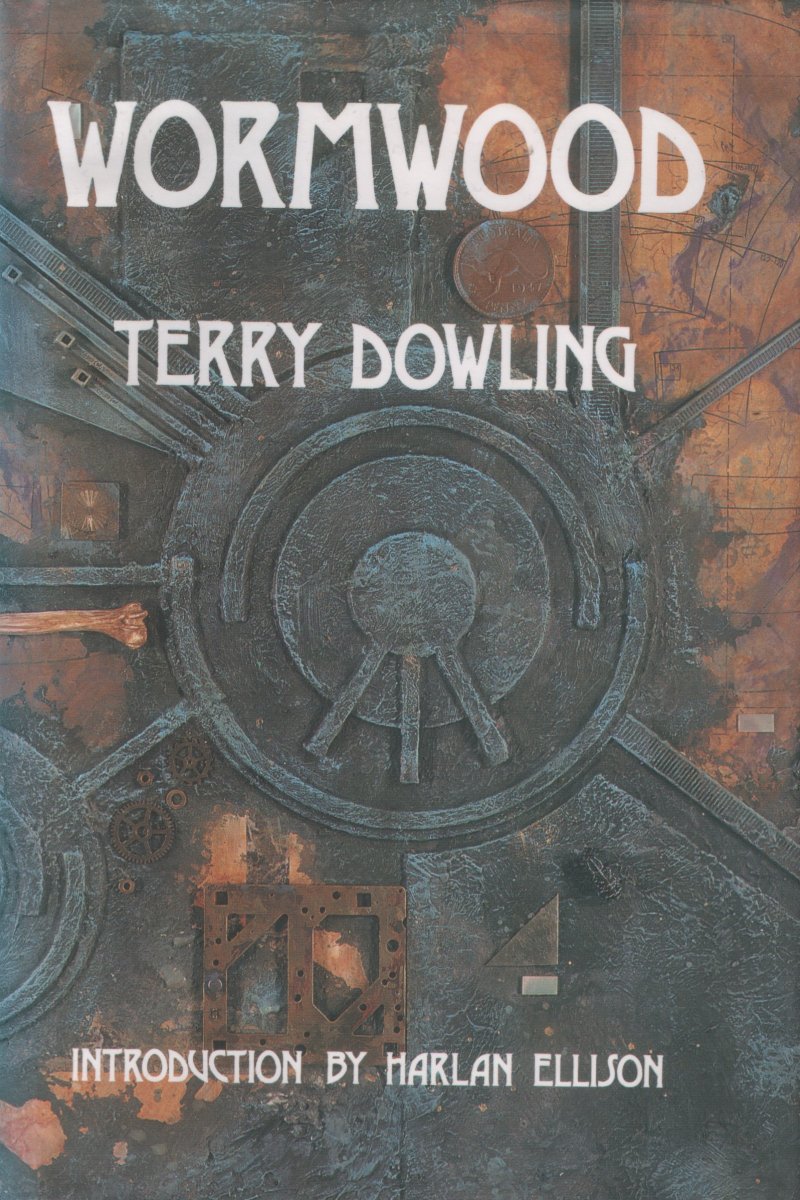
Books Wormwood, Terry Dowling (1992). I was intrigued by the story Dowling contributed to The New Space Opera 2. While I found it a little too dependent on familiarity with the setting, I did think that setting worthy of further reading. But all I could find reference to was a single collection, Wormwood, published by Australian small press Aphelion, in 1992. It contained seven stories set in the same universe, most of which appeared in Australian sf magazines. After some searching, I tracked down a copy of the book – the signed hardback, as I couldn’t find any copies of the paperback – bought it, and read it. And… The future Earth Dowling has created is indeed fascinating. A mysterious alien race, the Nobodoi, has remade the planet, chopping it up into regions with different environments (some of which are lethal to humans). Several other alien races have also settled Earth, and humanity has found itself no longer ruler of its planet. The stories set in this world are not entirely successful. ‘Housecall’ is quite good, a haunted house story, in which two thieves must break into an alien’s booby-trapped house. ‘A Deadly Edge Their Red Beaks Pass Along’ is similar, and quite effective. Not a bad collection, and I’d certainly read more if Dowling revisited the setting.
Easy Meat, John Harvey (1996). I used to rattle through Harvey’s novels when I was living in the UAE. I’d get them out of the subscription library to which I belonged, and read them the same day. Their chief attraction was that they were set in Nottingham, a city I used to know well. The main character, Charlie Resnick, is a police detective, a lover of jazz and exotic sandwiches, and has ties to the local Polish community. He’s a bit of a glum sort too. In this one, a young offender dies in custody. Resnick is worried the investigation will result in a whitewash, but is taken off the case to investigate a fatal mugging. Then the near-retirement officer who replaces Resnick on the first case is murdered – and it looks like it was by the same people who committed the mugging… They sort of keep you entertained books like this, but only while you’re reading them. As soon as you finish them, they’re gone, forgotten. Resnick doesn’t especially stand out as a character, and the crimes are usually the sort of every day stuff you can read about in the Daily Fail. I think I’ll call it a day on this particular series.
Midnight Fugue, Reginald Hill (2009), is by another crime author whose books I used to read for light relief when I was in the Gulf. I also enjoyed the Dalziel & Pascoe television adaptations when I was back in the UK on leave. But the quality of the books has sadly declined over the years – this one reads as though Hill knocked it out between cappuccinos – so I’d not bothered keeping up with the series. But then my mother lent me Midnight Fugue, so I decided to give it a go. I read it in a single day. It all feels a bit perfunctory. Dalziel, who was always more of a caricature than a character, is a shadow of his former self. The invented town of Wetherton (allegedly based on Wetherby, although I know Wetherby well and have never been able to spot the similarities) could be anywhere in the UK, and the crime which drives the plot comes across more like an intellectual exercise than something involving human beings and death. So, another series I’m going to have give up on. Again.
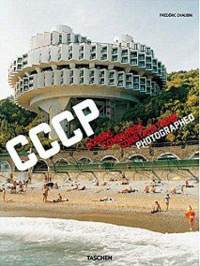
CCCP: Cosmic Communist Constructions Photographed, Frédéric Chaubin (2011), may have a somewhat forced title, and is a pretty huge coffee-table book – 26 x 34 cm – but it’s also full of amazing and wonderful photographs. Over the course of more than a decade, Chaubin travelled around East Europe, and photographed modernist buildings. Not all of them still stand today. Many of them are very strange, but also quite beautiful. You can page through it here. I’m pretty sure CCCP: Cosmic Communist Constructions Photographed is going to make my Best of the Year list.
Dark Space, Marianne de Pierres (2007), the first book of the Sentients of Orion tetraology, was March’s book for my 2011 reading challenge. I wrote about it here.
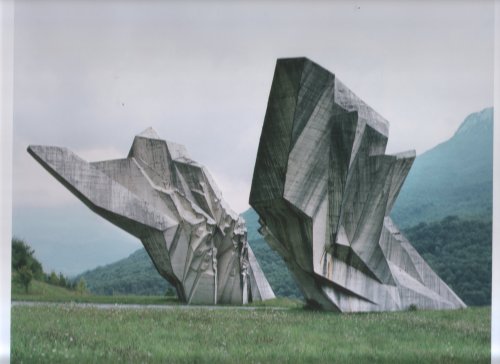
Spomenik, Jan Kempenaers (2010), is the book of Kempenaers’ photography exhibit about the eponymous objects. Spomenik is Serbo-Croat for “monument”, and that’s what the exhibit was about. Monuments to those lost in World War II built built during the 1960s and 1970s throughout the former Yugoslavia. Many were destroyed when Yugoslavia collapsed, many have been allowed to fall into disrepair, but some still remain in good condition. Spomenik contains photographs of twenty-two of them. They are weird, modernist sculptures, many on a huge scale, baffling and weirdly beautiful.
Pig Tales, Marie Darrieussecq (1996), I scored from bookmooch.com because it was on that list of 1001 books you should read published by the Guardian a couple of years ago. I’ve no idea why, because it’s complete rubbish. The narrator of the story is a dim-witted young woman in Paris who slowly turns into a pig, and back again, several times. The whole thing read like it was made up by a kid. None of the details convinced – I don’t mean the narrator’s transformation, obviously that wasn’t intended to be “convincing” – but the details of her life, first as a shop assistant, then as a prostitute. None of it was even remotely realistic. Then about halfway through the novel some plutocrat seizes control of the French government and ushers in a collapse of French civilisation. The language throughout Pig Tales was no better, and I’m not sure it can be entirely blamed on the translator. The narrator is clearly meant to be unsophisticated, but that doesn’t explain all the horrible clichés Darrieussecq uses. Complete and utter, well, tripe. Avoid.
Engineering Infinity, edited by Jonathan Strahan (2011), I’m working on a review of this SFF Chronicles.
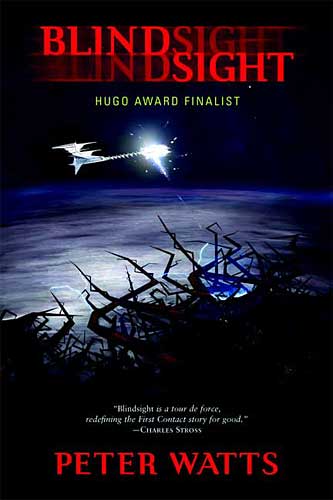
Blindsight, Peter Watts (2003). I’d been told many times by many people that this was a novel I would like. Earlier this year, I finally got round to picking up a copy. And now that I’ve read it… Good, but it may have been oversold to me. Sometime toward the end of this century, the Earth learns it is not alone – but quite what the “Fireflies” were, or what they were for, is anybody’s guess. When an artificial signal is detected from near the edge of the Solar system, a ship is sent to investigate. It finds a Jovian planet, and in close orbit about it, an alien ship. But Blindsight is not your typical first contact novel. The aliens are really very alien. Blindsight is filled with interesting ideas, but as I read it something about it kept on bothering me. It was a while before I figured it out. It read like a sf novel from the mid-1990s. It was the little things – a character who smokes like a chimney, the use of the word “spam” as a euphemism for human beings plugged into machinery, the tone of the story… It also reminded me a little of Williams & Dix’s Heirs of Earth.
Gilead, Marilynne Robinson (2004), is only Robinson’s second novel, twenty-four years after her first, Housekeeping. It also won the Pulitzer Prize. Gilead is framed as an extended letter from a dying reverend in 1950s Iowa to his young son (although he is not intended to be given it until he’s much older). There are some lovely anecdotes, and some interesting – and very personal – history. But. I was never really convinced by the narrator. He’s meant to be a pastor in his sixties or seventies, and yet he seemed a bit too, well, maternal in places. He seemed too sensitive, too considerate, to actually be a man, especially a religious man of the 1950s. Having said that, the writing throughout is beautiful. I might try Robinson’s other two novels.
Ghostwritten, David Mitchell (1999), is Mitchell’s debut and, like his other novels I’ve read, isn’t quite the sum of its parts. It opens in Okinawa, with the first-person narrative of a terrorist hiding out after a gas attack on the Tokyo subway. The terrorist is quite bonkers – completely in the thrall of a cult leader. The next section is set in Tokyo, and the narrator is a young slacker who works in a jazz record shop, and falls in love with a half-Chinese half-Japanese young women visiting relatives. She lives in Hong Hong. Which is where the following section is set. The narrator this time is a bent broker, like Nick Leeson, who comes a cropper when he loses the money he’s laundering for a Russian mobster. And so on… The book is structured as these short, mostly independent sections. There are links between some – and occasional events and characters do cross over. About halfway through, we’re suddenly introduced to an “incorporal”, a bodiless person who inhabits the mind of one of the characters, and can transfer from person to person. The final section features what is obviously an AI, tasked with preventing wars from ever recurring, but having trouble meeting this objective. Those two genre elements are just too odd and disconnected to sit comfortably in what had initially seemed a series of linked stories with an implied story-arc. There is, it has to be said, some really nice writing in Ghostwritten, and it’s a very readable novel. But it just feels like it doesn’t quite add up.
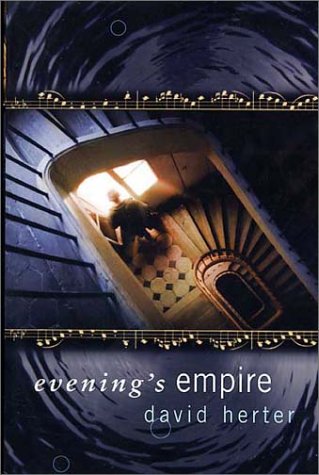
Evening’s Empire, David Herter (2002), was Herter’s second novel, and I bought it when it was published. Why it’s sat on my book-shelves unread since then, I’ve no idea. I thought Herter’s debut, Ceres Storm, excellent. Perhaps it was because it was fantasy, rather than the sf of his debut. Whatever the reason, I shouldn’t have left it so long. Because Evening’s Empire really is very good indeed. Russell Kent is a composer, working on an opera inspired by Jules Verne’s 20,000 Leagues Under The Sea. Needing somewhere quiet and inspiring to work, he returns to the small out-of-the-way Oregon town of Evening. During his last visit there several years before, his wife slipped and fell to her death from a bluff overlooking the sea. Evening’s Empire begins in a very Crowley-esque vein, but somewhere in the middle it takes a strange left-hand turn – strange in a good way. It is not the novel I expected it to be when I started it. It is also beautifully written. A definite contender for my top five best of the year.
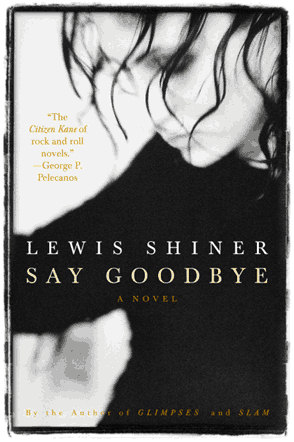
Say Goodbye, Lewis Shiner (1999). I’m a big fan of Shiner’s writing, and own all his books. Say Goodbye, subtitled The Laurie Moss Story, is not genre. It is, like Glimpses, a mainstream novel about music. In this case, Laurie Moss, a young hopeful who moves to LA to make it big. Opening in the form of reminiscences by a journalist about his writing the Laurie Moss story, it soon moves into a more traditional narrative. Moss hooks up with some important people, and her career gets an impressive kick-start. But she doesn’t, as the first half of the book implies, make it big. Her band suffers while on tour, and then the record company shafts her. Say Goodbye is a good novel, but it does feel a bit lightweight.
The Quantum Thief, Hannu Rajaniemi (2010). I hadn’t intended to do a full-on review of this, but after thinking about it decided it was worth one. You can find my review on SFF Chronicles here. It’s a book which can probably be studied in more depth than I did, but never mind.
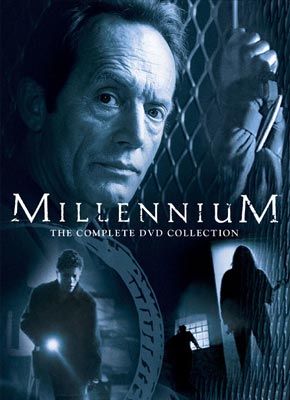
Films Millennium season 2 (1998). Frank Black is an ex-FBI profiler with a psychic gift: when in the presence of a victim, he can see in his mind what the killer saw. In season one of Millennium, he had returned to Seattle with his wife and young daughter, and begun working for the Millennium Group, consultants who help the police solve crimes. The seasons was basically crime-of-the-week, with a slow-burning story-arc based on the Millennium Group. In season two, the Millennium Group’s history – and the series mythology – begins to dominate. The Millennium are not just a bunch of ex-law enforcement professionals with weird apocalyptic ideas, they’re actually a bizarre cult, descended from the knights templar or something, and charged with protecting an important holy relic (which they had actually lost). I still like Millennium, and Lance Hendrickson successfully carries the series as Frank Black, but all the historical conspiracy stuff, and the schism within the Millennium Group, did start feel a bit silly and over-the-top. We’ll see if the third and final season can rescue it.
Sans Soleil, dir. Chris Marker (1983), is a very strange film. Which is not unexpected. Marker, after all, directed Le Jetée, a film entirely comprised of black-and-white stills with a voice-over (but likely best known these days as the inspiration for Terry Gilliam’s Twelve Monkeys). Sans Soleil also stretches the definition of a “film” inasmuch as it is presented as a series of short linked filmed vignettes from around the world, over which a woman reads a series of letters to the cameraman. Some of the footage is very good, but the lack of narrative, or even drama, makes it a difficult movie to watch to remain focussed on. It’s probably going to need a second sitting before I have it entirely clear in my head. Unfortunately, it was a rental.
Much Ado About Nothing, dir. Stuart Burge (1984), was a surprise. I knew of the play, of course, but nothing of the story. It turned out to be typical Shakespearean fare: star-crossed lovers, mistaken identities, Elizabethan banter, sword-fights… But it was so much better than some of the other Shakespearean plays I’ve seen. The wit was, as usual, a bit heavy-handed in some scenes. But in others, it was very nicely done. Benedick (Robert Lindsay) doesn’t believe in love; neither does the shrewish Beatrice (Cherie Lunghi). So their friends tell each one that the other is madly in love with them, and so trick them into actually being so. Meanwhile, Claudio and Hero are madly in love, but evil Don John (he even has a goatee) plots to scupper it. Wandering around the play are the watch, led by Dogberry (Michael Elphick), who talks in really obvious and heavy-handed malapropisms. Elphick was not especially good in the role either, and seemed perpetually covered in sweat. Happily, Lindsay and Lunghi were excellent, and the banter between the two was done well. I was surprised at how much I enjoyed Much Ado About Nothing. I’ve found the other Shakespearean comedies I’ve seen to be a bit obvious and blunt-witted, but this one was a real charmer.
Trafficked, dir. Ciarán O’Connor (2004), I reviewed for VideoVista here.
The Runaways, dir. Floria Sigismondi (2010), is based on a real-life group of the same name, the first successful all-female rock group. It’s where Joan Jett’s career began. As did Lita Ford’s. I saw Lita Ford live back in the late 1980s at Coventry Polytechnic. I don’t remember the gig being especially good. But The Runaways… The cast played their parts well, bit it never really felt like it was based on a true story. Perhaps that was because the story Sigismondi wanted to tell wasn’t the actual story of the band. It was an entertaining film, and the music was quite good. I was actually surprised at how good the Runaways had been as musicians – you usually expect garage bands of that sort to be pretty bad to begin with. The film did wander off on some weird dream-like sequences on occasion, which added very little to the story. But a film worth seeing.
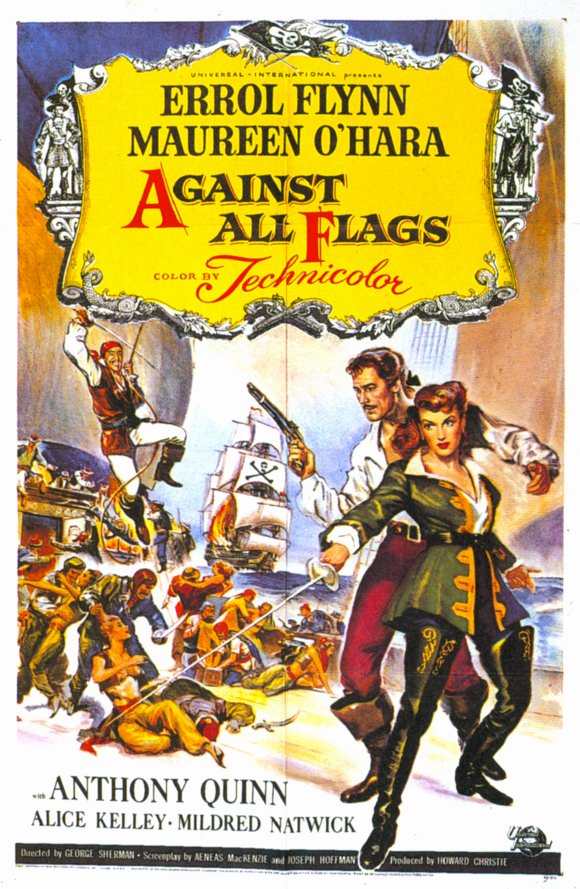
Against All Flags, dir. George Sherman (1952). They don’t make films like this anymore. Which is probably just as well. It’s about as historically accurate as the Pirates of the Caribbean films, but, well, silly. Hollywood heartthrob Errol Flynn plays an officer aboard a British merchant ship en route to India, who goes undercover on pirate haven Madagascar. His task is to spike the island’s guns, as these have prevented the Royal Navy’s previous attempts to clean out the hive of scum and villainy found there. When Flynn and a pair of fellow seamen turn up at the pirate base of Diego-Suarez, not everyone welcomes him with open arms. Anthony Quinn, for one, believes him to be a spy. But Maureen O’Hara, who is a Captain of the Coast, but not a pirate per se – she owns a ship, but mainly looks after her gun and sword shop – believes Flynn to be on the level. And he fancies her. And from there it’s all Hollywood pirate shenanigans, with everywhere proving remarkably clean and the violence unsurprisingly sanitised. Flynn’s Australian accent is quite noticeable, but he acted better than I’d expected. Quinn just chews the scenery, and the rigging, and the everything else in sight. O’Hara’s character is called “Spitfire”, which tells you all you need to know about her characterisation. Even for a Sunday afternoon movie, this is risible stuff.
Ink, dir. Jamin Winans (2009), I reviewed for VideoVista here.
Our Man in Havana, dir. Carol Reed (1959), is based on the Graham Greene novel of the same name, and was adapted by him for the screen. Alec Guinness plays the title character, Wormold, a vacuum salesman in the Cuban capital. Desperate for money to keep his nubile teenage daughter (who looks suspiciously adult) in the style to which he is accustomed, Wormold agrees to act as a paid spy for HMG. Not actually having access to any useful intelligence, he makes stuff up. And one such “coup”, drawings of a secret project hidden in the hills outside Cuba, which he actually made up by sketching vacuum cleaner parts, gets the British secret services in a tizzy. It all comes to a head, of course, and Wormold has to come clean. But not before a few friends and acquaintances have died. As a comedy, it’s a bit grim. Guinness is great as Wormold, a proper thesp, with a lightness of touch that steals the film. Maureen O’Hara plays his no-nonsense assistant, sent out from London to help him manage his (non-existent) ring of agents. A sharp script, some excellent acting, and directed by Carol Reed: a film certainly worth watching.
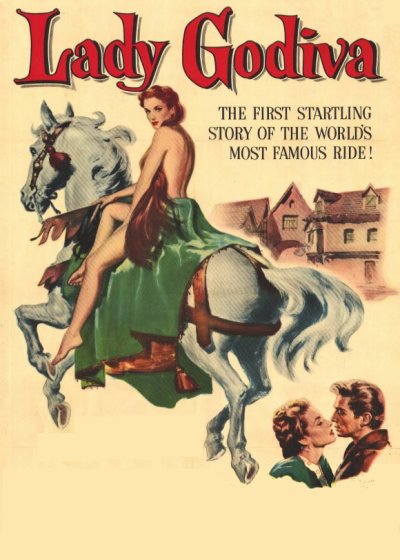
Lady Godiva, dir. Arthur Lubin (1955), is yet more proof they made crap films as well as good ones fifty years ago. Hollywood has always had a creative approach to history, especially other countries’. Well, they don’t have any of their own to garble, I suppose. In Lady Godiva, Maureen O’Hara plays the title character, a Saxon noble lady who marries Lord Leofric of Coventry (George Nader, who seems to have plasticised hair). He has been imprisoned in her father’s jail – he’s a sheriff somewhere in Lincolnshire – after refusing to marry a Norman woman when told to by King Edward the Confessor. Happily, the king soon comes to appreciate Lady Godiva’s good qualities. Unhappily, neither Leofric, nor his rival Lord Godwin, are especially big fans of the king, who they can plainly see is overly influenced by his Norman advisors. Eventually, a cunning plot is hatched which sees Edward reconciled to his Saxon barons, the Normans out of favour, and Godwin’s son, Harold (played by Rex Reason of This Island Earth fame), as the heir to the throne. Harold, of course, gets in the eye a few years later, and the Normans end up in charge anyway, but never mind. Historically, Godiva’s famous ride was in protest against punitive levels of taxation (I can’t quite imagine Kate Middleton doing the same today in response to Tory policies), but in the film she rides naked through the streets to show Saxon support for King Edward. Or perhaps the opposite. I went to uni in Coventry, incidentally. Not much of the city from the eleventh century has survived, but even so there wasn’t much that looked mediaeval about the Coventry of the film. These days, Lady Godiva is chiefly notable for an uncredited early appearance by Clint Eastwood as “First Saxon”.
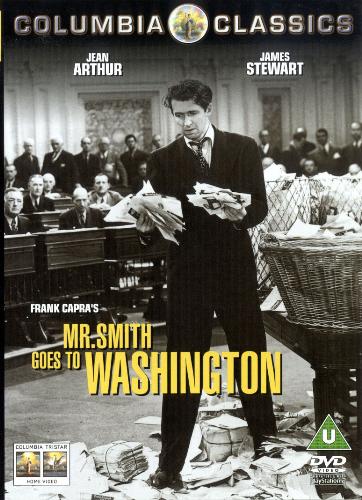
Mr Smith Goes to Washington, dir. Frank Capra (1939). I’ve yet to get a handle on Capra’s politics. He seems at times like the archetypal Hollywood liberal, and yet an occasional streak of Randism often seems to surface in his films. Perhaps that’s simply US politics, which is, naturally, foreign to me. Mr Smith Goes to Washington is a case in point. It’s clearly a paean to the venerable tradition of democracy as practiced in the USA, yet it goes about praising the institution in a peculiar way. A senator dies in office, and the state governor must appoint one for the interim. A local plutocrat, who controls the governor, doesn’t mind who providing the candidate rubber-stamps a scheme he has cooked up for a hydro-electric dam (which will profit him, and the state’s other senator, Claude Rains, greatly). They chose James Stewart (the Smith of the title), a popular and woefully naive scout master, as their new senator. Unfortunately, once in Washington Smith stumbles across their scheme and tries to prevent it. But Rains and the plutocrat drum up support against him, and fabricate evidence showing he is corrupt, in an attempt to have him removed from office. Smith responds by “filibustering” – keeping the floor of the Senate as long as he can talk, while his friends hunt for evidence to exonerate him. Which, of course, they do. Smith is clearly an everyman – committed to the ideals which founded the US, firmly against corruption, and yet willing to bend the system to ensure justice prevails – and in this case, justice aligns precisely with his own wishes. Stewart comes across as a little too desperate to right wrongs, but it’s hard to imagine anyone else in the role. Rains is good as the urbane, experienced senator who is both party to the scam and yet reluctantly involved. I’m not entirely sure why Mr Smith Goes to Washington is considered a classic, and these days it’s more of an historical curiosity than a meaningful melodrama. Nevertheless, my soft spot for Capra’s films remains untarnished.
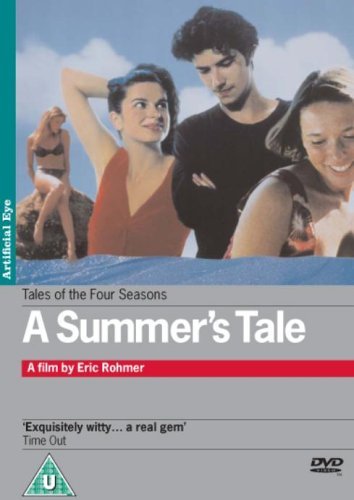
A Summer’s Tale, dir. Éric Rohmer (1996), is the third of Rohmer’s quartet of films named for the seasons. It is also the best of the ones I’ve seen so far. Gaspard arrives in Breton seaside resort Dinard expecting his girlfriend Lena to arrive a few days later. Unfortunately, she’s not very reliable – or indeed entirely his girlfriend as she doesn’t want to commit fully. Shortly after arriving in Dinard, Gaspard meets Margot, a doctoral student who is working as a waitress in her family’s restaurant over the holiday. The two spend their days together, but merely as friends. As Lena’s arrival is further and further delayed, Gaspard and Margot discuss relationships. Margot introduces Gaspard to Solene, a friend of hers. Solene wants to go out with Gaspard, and, since Lena doesn’t seem to be coming any time soon, Gaspard agrees. And then Lena does appear – and she’s decided she wants to commit to a relationship with Gaspard. Unfortunately, he’s made plans with Solene to visit a nearby island, assuming Lena would not arrive on time. And he’s promised to take Margot if Solene doesn’t want to go… A Summer’s Tale is one of those stories the French do so well, a beautifully judged romantic triangle, played with an astonishingly light touch.
The Space Race (2007) is a compilation of newsreel footage from the 1940s to the 1960s covering assorted events related to space exploration. There’s the two failed Vanguard launches, of course; Telstar; Yuri Gagarin; Alan Shepard meeting JFK; and John Glenn being recovered after splashdown. Some of the footage about the Soviets uses a V-2 launch instead as they, unsurprisingly, had no footage of a Vostok rocket. Also included, to give the flavour of the times, I suppose, are some unrelated news items, such as a bad railway accident in London, which I think was the Lewisham rail crash of 1957.
The Rare Breed, dir. Andrew V McLaglen (1966), is an odd film. I’m not a big fan of Westerns (with the notable exception of Howard Hawk’s Rio Bravo), but I do find James Stewart and Maureen O’Hara very watchable actors. But I had to wonder why either was cast in this film. Notto mention Brian Keith’s presence. Stewart plays ‘Bulldog’ Burnett, so called for his talent at ‘bulldogging’ or bringing down a steer by wrestling its horns. O’Hara is Mrs Price, a recently widowed English lady, who has brought her daughter and a prize Hereford bull to the US. She is convinced the US Longhorn cattle would benefit greatly from being crossbred with her Hereford. She sells the bull to a broker who is more interested in forming an attachment with her. To escape his advances, she agrees to accompany the bull to its new owner in Texas, Brian Keith. Meanwhile, the broker has hired Stewart to take the bull to Texas, but Stewart also agrees to rustle it for another rancher. There are some impressive landscapes on display in The Rare Breed, but little else that can be said about it. Stewart is plainly too old for his role. O’Hara plays an English lady with a marked Irish accent (not implausible, but it does undermine the character a little). And Brian Keith, who plays a rancher who looks like Yosemite Sam, puts on one of the worst Scottish accents I’ve ever heard. The two romantic subplots are also about as convincing as Keith’s accent, as are those scenes filmed on a soundstage. Watch it for the Texan countryside, ignore everything else.
Today is the 50th anniversary of Yuri Gagarin’s flight. Half a century ago, Gagarin was the first human being to leave this planet – albeit for only one hour and forty-eight minutes. Thirty years ago today was also the launch of the first Space Shuttle to reach orbit, Columbia. Which was sadly lost eight years ago on mission STS-107 when it broke up on re-entry, killing its crew of seven. I am choosing to honour Gagarin’s achievement – and Columbia’s crew; and all those who have been in space, however briefly – in my own way:
I’m going to edit a hard science fiction anthology.
It will be titled Rocket Science, and it will be published in 2012 by Mutation Press.
This announcement is advance warning. I’m looking for submissions, but I won’t be open to receive them until 1st August 2011. I want stories and non-fiction of up to 6,000 words, which meet the following description:
Science fiction does take place in a vacuum. Travel more than 100 kilometres vertically from where you’re standing, and you’ll be in space. Where there’s no life-sustaining air; where the cold, and direct sunlight, can kill. There’s no gravity, and background radiation will cause cancer in one in ten people. Yet the future of our species quite possibly lies up there, or somewhere that will require us to cross space to reach.
Too often, science fiction glosses over the difficulties associated with leaving a planetary surface, traveling billions of kilometres through space, or even living in a radiation-soaked vacuum. The laws of physics are side-stepped in the interests of drama. Yet there’s plenty of drama, plenty of science fiction drama, in overcoming the challenges space presents. Whether it is, for example, an alternate history take on the Apollo Lunar landings; the discovery of an alien artefact on a moon of Jupiter; or the story of a mission to the nearest star.
ROCKET SCIENCE is looking for stories which realistically depict space travel and its hazards. The reader needs to know what it would be like to be there. This doesn’t mean stories must be set in interplanetary or interstellar space; but the technology and science involved must be present somewhere. It could be a story set in a spacecraft, on an asteroid or space station; or about a mission soon to leave Earth’s surface. It could be a first contact, a rescue against the odds, or a study of some unusual space phenomenon. Whatever suits. Don’t be afraid to be literary.
But no space opera, definitely no space opera.
Payment will be £10.00 per 1,000 words. Again, don’t send in any submissions until 1st August 2011. So you’ve got plenty of time to come up with something suitable.
You can find more details on the website here. I’ve also put together four flyers (PDF), which you can print out, hand to friends, stick on the wall of your den / study, etc., etc. You can find them here: one, two, three and four. If you have any questions, feel free to email the editorial address given on the flyers and website.
There is a branch of science fiction – some would say it’s the branch which actually defines the genre – known as “hard science fiction”. Like all the terms associated with sf, its meaning is confused, confusing, disputed and not always useful. Wikipedia, for instance, defines hard sf as science fiction which is “characterized by an emphasis on scientific or technical detail, or on scientific accuracy, or on both”. Yet this is not what I’ve always understood by the term.
To me, hard sf has always been that mode of science fiction which features, or emphasises, the “hard” sciences – physics, cosmology, chemistry, etc. This is in contrast to soft sf, which focuses on the “soft” sciences – anthropology, psychology, archaeology, etc. The fact that two such intersecting definitions for the same thing exist is not unusual in science fiction. Indeed, the genre itself has never been satisfactorily defined.
Yet I also believe that hard sf needs to be rigorous. And Wikipedia’s definition (taken from The Encyclopaedia of Science Fiction) does indeed focus on that. But some fictions which would be excluded from the label using Wikipedia’s definition I would still describe as hard sf. Indeed, the classic example given for the sub-genre is often Hal Clement’s Mission of Gravity. Which features aliens and, by implication, faster-than-light travel. Neither concept is “scientifically accurate” in the most rigorous sense of the phrase. Clearly, the definition is problematical.
Categorising a fiction by the sciences which feature in it, hard or soft, is no better. Both types may be present. And if they exist in equal measure, is the fiction hard or soft? And which science is hard and which soft? In order to define hard sf, you must first define the hard sciences. So that’s not going to work either.
And then I came across this…
There’s an interesting article here on the Cosmos Magazine website about humanity’s future in space – or rather, lack of a future. Much of the author’s discussion revolves around the limitations placed on rocketry by chemistry. Rocket engines have not substantially changed for almost a century, and that’s because there’s very little that can be done to improve what is, at its most basic, a chemical reaction. The laws of chemistry dictate how much energy that reaction can generate, and those laws are not something that can be changed. This seems counter-intuitive because in so many other areas of science and technology progress is rapid and effective – computing, for example. But, as the author of the piece writes, “In the case of electronics and information systems, we are dealing with soft rules, related to the limits of human ingenuity. In the case of space flight, we are dealing with hard rules, related to the limits of physics and chemistry.”
Science fiction often has to sidestep such “hard rules” in order to tell a story. The aforementioned faster-than-light travel is a good example. The laws of physics are quite clear that the speed of light cannot be exceeded. There are theoretical ways around this, but most are either impossible or unlikely – Alcubierre’s drive, for example, would require more energy than is available in the entire universe.
So perhaps we should consider sf which stays within the boundaries of these hard limits as hard science fiction. Any fiction which requires authorial invention to circumvent these limits would thus be “soft” sf – or whatever other sub-genre its characteristics identify it as, such as space opera.
Admittedly, it’s not as if a new, or more accurate, definition of hard sf is demanded. Most genre readers and commentators are quite happy with shifting, amorphous and evolving genre categories. Others insist that science fiction is resistant to taxonomy; or even that taxonomy itself is not useful in genre conversations. But taxonomy does indeed have its uses – it allows people to compare like with like, it sets the terms of reference for discussions, it allows for commentary on thematic similarities. And my new definition at least has the benefit of being “hard” itself: we know the hard limits imposed on us by the laws of the universe, and we can recognise those concepts and conceits invented by the author to circumvent those limits.
And it does seem fitting that hard sf should be definable, that it should operate within clearly-drawn boundaries, that its definition should be as rigorous as those fictions which comprise it.
The author tells us that he’d had the title in his head for years, but no real plot to go with it. “Later the idea of setting the story on a generation starship occurred to me,” he says. “And then I decided it should be about terrorism, which fit perfectly with the setting – the sealed environment of a generation starship is especially vulnerable to terrorists. The rest of the story came out of a conversation with Eric Brown as we travelled north from a convention on a much-delayed train.”
So reads part of the introduction to my story ‘Killing the Dead’ by the editors of the Postscripts magazine/anthology . It appeared in ‘Edison’s Frankenstein’, issue 20/21, dated December 2009. According to my records, I finished ‘Killing the Dead’ in June of 2008, tried it at two magazines, before it was bought by Pete Crowther and Nick Gevers of Postscripts at the end of July. It was another 18 months before it eventually saw print.
I had indeed had the title knocking around for years – the earliest version of the story I can find was written on an Amstrad PCW, and I owned that I when I was at university in the early 1990s. In the 500 or so words which are all I completed of that draft, the story is set on an alien world and in a city which, like in ancient Egypt, sits on one side of a river with a necropolis on the other. But that’s as far as I got with it. Some fifteen years later, I decided to have another go. I kept the necropolis, but moved it onto a generation starship – which then gave me a reason for preserving the bodies of the dead. And indeed for their destruction to be a major felony, with ramifications for all those aboard. It also gave me the opening image of the dark spreading across the sky.
‘Killing the Dead’ is one of the few stories I’ve written where I actually did make it up as I went along. I had a fairly clear idea of the cast and plot: members of the starship’s crew are preserved after death in necropolises with the intention of resurrecting them, and their valuable skill-sets, once the starship reaches its destination. But someone is destroying the tombs, and so jeopardising the crew’s ability to build a functioning colony when they arrive. These crimes would be under investigation by a detective, who previously has had little beyond the occasional theft or assault to look into.
The logic behind all this was hashed out in the conversation with Eric Brown mentioned above. We were on our way to our respective homes from Novacon in Wallsall in November 2007. He told me I should write the story, so I did. I finished it in less than a week. But it wasn’t very good, and needed more work. So I fiddled with it over the next six months.
I did some research, of course: I picked a suitable destination and worked out how long the journey would reasonably take. At some point I decided that I wanted the story to reference Dante’s Divine Comedy. I’d already described the necropolises as low hills of seven levels in reference to Purgatorio, but I wanted to include more. So I split the story into seven sections – including a dream sequence – and buried in each section an image derived from one of the seven terraces of Purgatory. These are:
1 The Proud, who carry huge stones on their back 2 The Envious have their eyes sewn shut 3 The Wrathful walk around in acrid smoke 4 The Slothful are engaged in a ceaseless activity of some sort 5 The Covetous lay face down on the ground 6 The Gluttonous are forever tempted by fruit out of reach (although I think the source I used mentioning running water, so I went with that instead) 7 The Lustful must pass through a wall of flame
I leave it to the reader to find the relevant sentences in the story.
Despite all this, I don’t think I’d actually figured out the end when I started the story. I didn’t know who the terrorists were. So when I did work it out, it came as a surprise – but one of those good ones, one of those ones where you realise the answer has already been set up in the story right from the start.
The same was true of the final few sentences. I’d been hiding references to purgatory throughout the story, so it seemed only natural that the journey aboard the generation starship should be cast as a form of limbo. It also occurred to me that a fear the journey’s end might leave them in hell rather than heaven could be a valid motivation for the terrorism.
Incidentally, all the named characters in the story are named for various mythologies’ gods of the dead: Arawn (Welsh), Supay (Inca), Flins (Wendish), and Jabru (Elamite).
Those few venues which did review the issue of Postscripts were positive about ‘Killing the Dead’. It didn’t set the genre on fire, although I’d have been surprised if it did. Tangent Online described the story as “Highly recommended”, and Gav at NextRead was also nice about it. And, er, that’s about it.
For those of you who want to make up your own mind, here it is (PDF).
Over on Pornokitsch they’re doing V Days of Rome, and some excellent content has been posted so far. I was invited to contribute and wrote one of my customary rants on the over-use, and mis-use, of the Roman Empire as inspiration in space operas. It’s all Isaac Asimov’s fault, of course. See my piece here.
April’s VideoVista is now up, containing my reviews of turgid fantasy reworking of Moby Dick, Age of the Dragons (review here), clumsy dream-world thriller Ink (review here), and Irish people smuggling drama Trafficked (review here).
I have always been a science fiction writer. I remember filling an exercise book with deck-plans for a starship when I was twelve years old. I wish I could find that book, but it has long since vanished. During my teens I played RPGs, and wrote up the sessions as fiction. After joining the British Science Fiction Association in the late 1980s, I turned my hand to writing your actual original science fiction. Not entirely successfully, it has to be admitted. And this despite the fact there seemed to be new sf small press magazines appearing every five minutes in the UK. Some of the titles I remember, and still have copies of, are: BBR, Dream Magazine, New Moon Quarterly, Works, REM, Exuberance, Critical Wave, Territories, The Lyre, Nova SF, Auguries, Strange Attractor, Opus Quarterly, Sweet Dreams Baby!, New Visions, The Edge, The Scanner, Sierra Heaven…
I submitted fiction to several of the above, but my first ever published short story was a space opera parody which appeared in The Scanner #8 in 1990. It wasn’t very good. Shortly after graduating from university, I left the UK. And spent ten years working in the United Arab Emirates. While there, I started submitting fiction to the pro magazines, with even less success. Occasionally, I tried stories at small press mags… Which is how Sierra Heaven ended up with my second piece of published fiction in their Summer 1997 issue.
Here, for your delight and delectation, your edification and edumacation, is that story. It’s a space opera metafictional story, titled ‘Pulp!’, that probably owes far too much to certain film by Quentin Tarantino. Apologies for the poor quality of the scan.
While reading Marianne de Pierries’ Dark Space last week (see here), it struck me that sf writers are all too keen to extrapolate or invent science and technology in their fictions – FTL, AI, anti-gravity, etc. – but they then insist on imagining socially regressive societies. The world of Araldis in Dark Space is markedly sexist – the women are either wives or mistresses, and have no say in Araldisian society. Why would a writer do that? After the decades of struggle for gender equality, to then write about a society in which women are once again second-class citizens just seems stupid. It’s not even a failure of the imagination because it was plainly a deliberate artistic choice.
But this is not unusual in space opera. Writers invent galaxy-spanning empires with magical technology… and then populate them with tyrants, slave traders, mass-murderers, pirates and all manner of scum and villainy, design them with systemic inequality, inequity, injustice and unfairness. True, scum and villainy exists in modern-day society, and even the twenty-first century has its share of inequality and inequity. But they don’t define it.
Space opera is an inherently right-wing subgenre. As is military science fiction. There are exceptions but, as a general trend, both subgenres tend to the right of centre. It is, I suspect, a consequence of the form, since not all writers of space opera or military sf cleave to the political right. But the vast majority of those writers – Anglophone ones, as that’s the bulk of my reading, and the area about which I know most – live in developed nations, where slavery is illegal, where everyone has the vote, where fairness in many areas of life is either legally or constitutionally protected. And yet these same authors can happily invent a future universe in which sentient beings are treated worse than animals, the first solution to any problem is unregulated violence, and inequality is institutionalised… And that inequality is all too often ignored by the protagonists, because typically they’re among the privileged. (This latter is especially true of secondary-world fantasy, with its penchant for adventuring princes; but that’s an argument for another day.)
There are, I noted above, exceptions. Iain M Banks, Alastair Reynolds, Ken MacLeod, for example. These exceptions are usually British. Having said that, while Banks’s Culture is famously a post-scarcity utopia, he still populates his novels with plutocratic shits (possibly a tautology) and the like – if only to give Special Circumstances something to do…
I’ve been wondering why space opera / mil sf needs to be so socially regressive / right wing. Is it a consequence of science fiction’s history? Military science fiction often appears to be little more than fancied-up Horatio Hornblower in Space, and so copies 17th Century British society – in all respects but the technology. It could be that Asimov’s Foundation trilogy, famously based on Gibbon’s The Decline and Fall of the Roman Empire, led to the Roman Empire as a model for galactic empires in space operas. Personally, I suspect US science fiction owes an unconscious debt to Rudyard Kipling’s Kim. The similarities are striking.
And why are the exceptions mostly from the UK? Is it just a consequence of domestic politics? I’d like to think British sf owes an equal debt to HG Wells, but it was plainly dominated by the US mode – at least until the advent of the New Wave. Admittedly, the last couple of decades has seen more Wellsian sf creeping into British sf, though his influence continues to be ignored by US science fiction. Which is odd, historically, as HG Wells – and Jules Verne – were both extensively reprinted in magazines during the early days of the genre in the USA.
Some have argued that space opera and military sf require conflict, that without it there’d be no story. But conflict is not the only delivery mechanism for drama. There are others – exploration and puzzle-solving are two alternatives, for example. Literary fiction does not require rapes, murders, slavery, genocide or global wars to provide drama. Further, science fiction is, above all else, about the present. And present-day society – for the majority of those who read and write Anglophone sf – is mostly fair, and has become increasingly so over the centuries. (Bar current Tory policies designed to profit the few at the expense of the many.) That fairness is not universal, true; but even those who do not currently experience it are generally better off than they would have been in earlier decades and centuries.
Perhaps it’s simply that space opera / mil sf are predominantly escapist subgenres. Perhaps they can’t aspire to anything higher. If they were to comment on unfairness, if they were to justify their regressive societies as story qua story, you’d expect to see some discussion of those it effects most in the real world. But the Other is also noticeably absent from both subgenres. Both are still characterised by the privileged expressing their privilege – mostly using awesome weaponry.
The history of space opera and military science fiction, from EE ‘Doc’ Smith through Poul Anderson and John Brunner to CJ Cherryh and now Peter F Hamilton, is almost entirely populated with examples which demonstrate the above. It has become axiomatic. That needs to be questioned. A regressive society is not, in and of itself, implicit in space opera, and should not be treated as such. Space opera need not primarily be escapist; and escapist fiction need not be defined by unfairness in its invented universe.
It’s time to think a little more intelligently about the universes we create for our fictions. It’s time our fictions reflected our ambitions and didn’t simply parrot the assumptions of past decades.
It’s time we dragged space opera, and military science fiction, into the twenty-first century.
It has just been pointed out to me that one of the writers on my sf mistressworks meme list isn’t actually, er, female. I forget where I got the name from, but I should have realised straight away – because if Francis Leslie Ashton was female, “her” name would be Frances Lesley Ashton. There aren’t many names in English which differ in spelling by gender, but Ashton has two of them… and I still failed to spot it. Oops. So thanks to Dave Post of Worlds without End for pointing it out.
Because the meme list has already spread, I won’t bother posting a corrected list, merely updating the original one. At some point, I hope a consensus meme list might be generated and, if so, the makers might take note of Ashton’s gender.
Meanwhile, I’m still working on putting together a list of 21st century women sf writers… and I’ll make sure they are all actually women.



 It Doesn't Have To Be Right...