It Doesn't Have To Be Right…

… it just has to sound plausible


6 Comments

2012 challenge

It’s time I started thinking about what my reading challenge will be for next year. Put simply, each month I read a book from a list of a dozen and then blog about it. In the past, I’ve done my favourite sf novels, classic literary writers I’ve not read before, the first books of epic fantasy series, sf novels I loved as teenager, and sf by women writers. The point is to introduce me to writers new to me  and/or read books I wouldn’t normally read.

I asked for suggestions on Twitter, and recevied a couple of sensible ones. I like the idea of reading books by Asian writers, but perhaps I might instead expand that to reading books by writers from countries whose literature I’ve never before tried. I’m not an avid reader of world fiction, though I’ve read a number of European and Arabic writers, so it would certainly be a challenge.

Another person suggestion modern crime/noir fiction, but I was less keen on that idea. Having been impressed by the movie Winter’s Bone, I’d like to try one of Daniel Woodrell’s novels, but I don’t usually get on that well with modern crime fiction. I like Sara Paretsky, Sue Grafton and Philip Kerr, but I’ve gone off a lot of the crime writers I used to read, such as Reginald Hill, John Harvey or Patricia Cornwell. Having said that, there are many published crime writers I’ve not read that I might enjoy and, I have to admit, they would at least be pretty quick reads…

Alternatively, I’ve thought about sticking to a single author’s oeuvre, perhaps DH Lawrence. To date, I’ve only read Lady Chatterley’s Lover and some novellas. Or Charles Dickens. Joseph Conrad. Graham Greene. I could reread some literary favourites: The Alexandria Quartet, The Master Mariner, Earthly Powers, The Right Stuff… But they’re quite hefty books.

Alternatively, I could make it a watching challenge, and do films. Or even do book then film: read a book, watch the film adaptation, write about it…

Anyone else have any suggestions?


2 Comments

Too many words, too little time

I promised yesterday I’d put up a post showing the books I bought at Novacon, and so here it is. Also included are those books purchased since the last book haul post. Embarrassingly, it’s more than I thought it was. Oh well. Time to learn to speed-read…


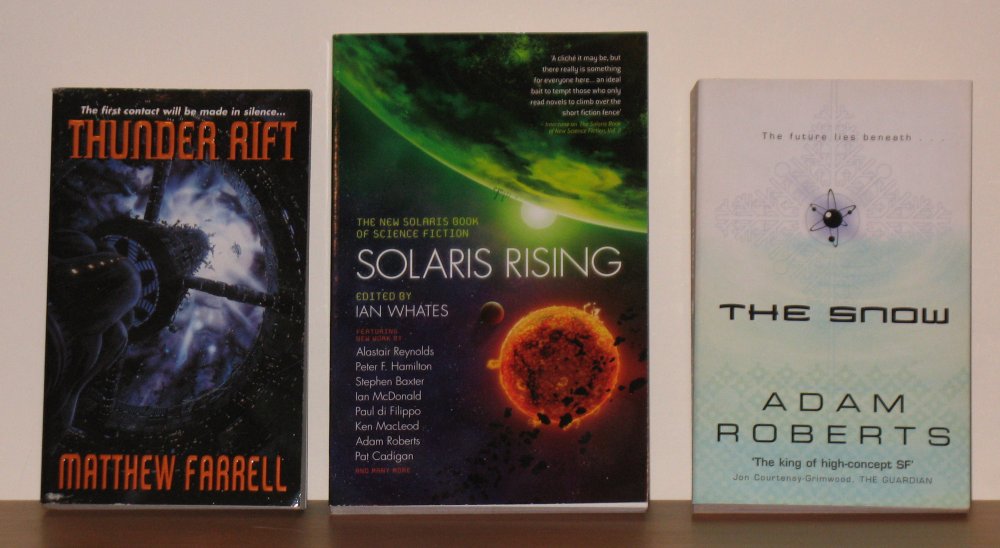
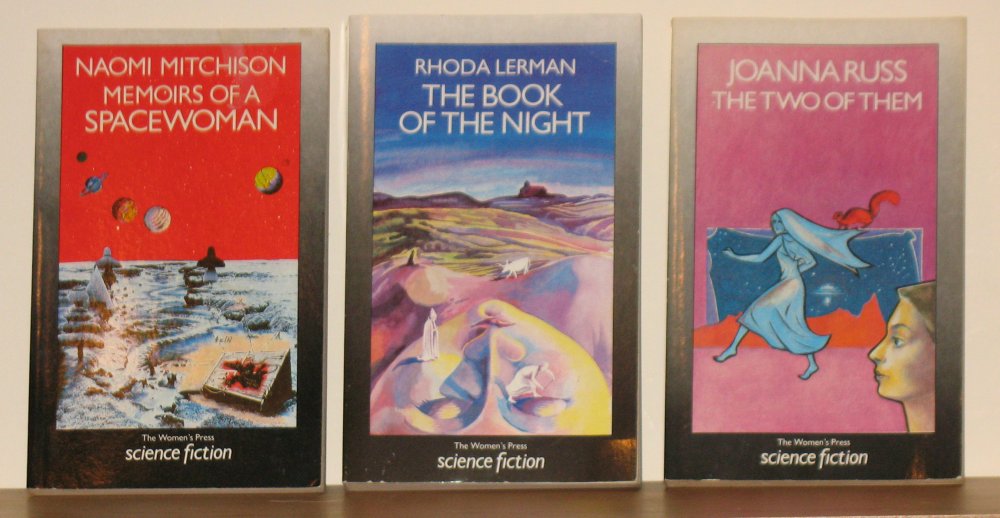
Three Women’s Press sf titles from Novacon – as mentioned in my previous post: Memoirs of a Spacewoman, Naomi Mitchison; The Book of the Night, Rhoda Lerman; and The Two of Them, Joanna Russ. Expect reviews to appear at some point on SF Mistressworks.


More from Novacon – and, er, a Moore from Novacon: Judgment Night by CL Moore. Also for SF Mistressworks. Critical Threshold and The City of the Sun are the second and fourth books of Brian Stableford’s Daedalus Mission sextet. Now I need to find copies of the other four…


More recent books from Novacon. And you can’t get more recenter than the brand new Solaris Rising collection. The Matthew Farrell of Thunder Rift is actually sf author Stephen Leigh, and the Adam Roberts of The Snow is actually top parodist A.R.R.R Roberts.


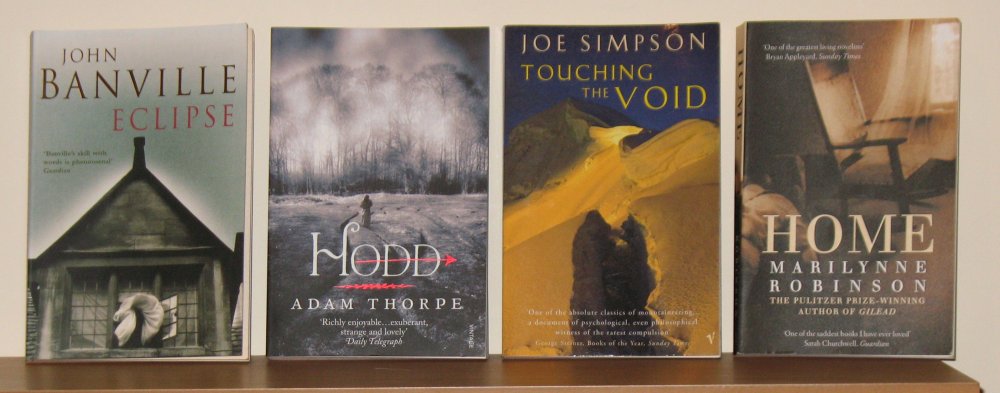
Some charity shop finds. Marilynne Robinson’s Home I’ve been keen to read after being impressed by her Gilead. Not sure why I picked up Touching The Void – possibly because it’s on the World Book Night list. Adam Thorpe is an excellent writer and his Hodd is a retelling of the Robin Hood legend. John Banville I’m not especially keen on, but I thought I’d give his Eclipse a go.


Some sf (-ish) novels from Harewood House’s second-hand book shop. Jayge Carr’s Leviathan’s Deep I’ve been after ever since I read her story in Women of Wonder: the Contemporary Years (see here). It will be reviewed for SF Mistressworks. The Raw Shark Texts was a Clarke Award finalist in 2008, but lost out to Richard Morgan’s Black Man. The Manual of Detection by Jebediah Berry I’ve been on the look-out for ever since seeing an approving review of it by Michael Moorcock.


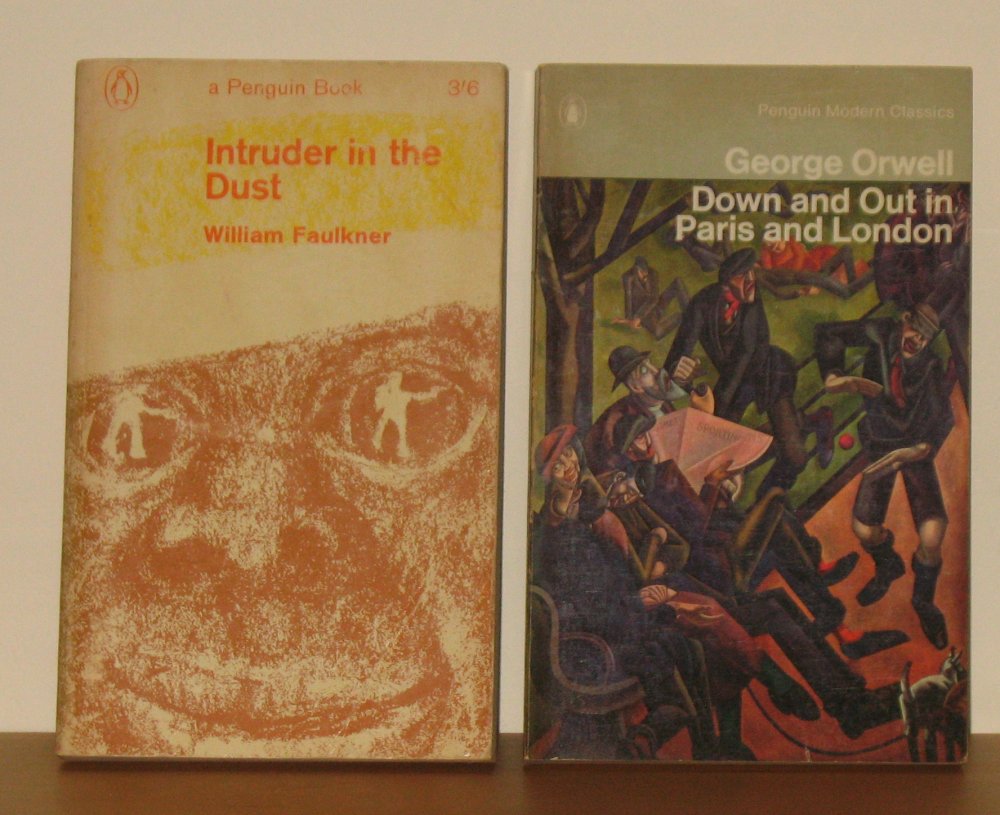
A pair of paperbacks from my father’s Penguin collection. Never read any Faulkner, so Intruder In The Dust should be interesting. And the only Orwells I’ve read are Animal Farm and Nineteen Eighty-four, so Down and Out in Paris and London should also be interesting.


Some new books. Songs of the Dying Earth I have to review for Interzone. I’m about a third of the way through it. The Ascendant Stars is the third and final part of Mike Cobley’s jam-packed space opera trilogy. Prague Fatale is the eight novel featuring German detective Bernie Gunther. I’m guessing it’s set in the Czech Republic…


The Electric Crocodile first edition is for the collection. Anthony Burgess: A Bibliography is to assist with the collection.


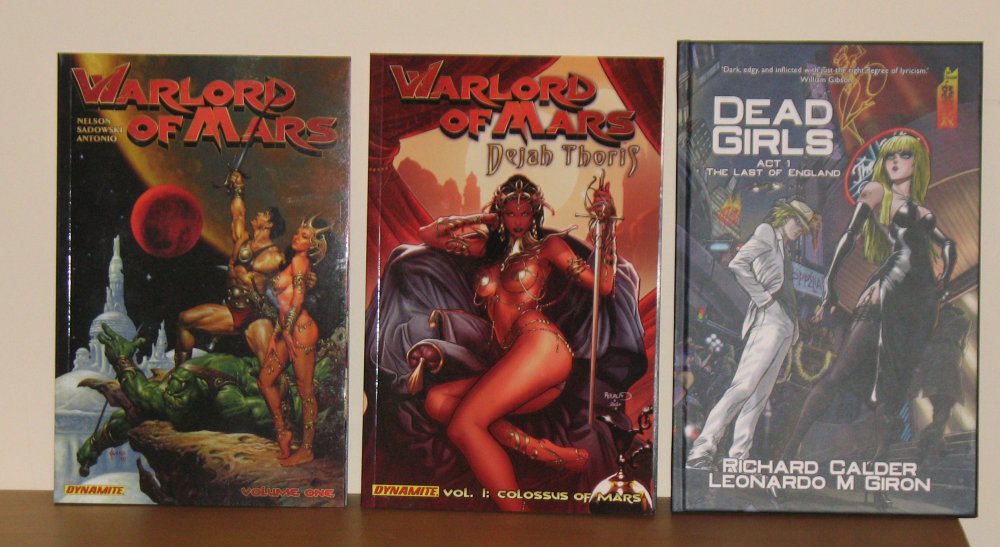
Some sf graphic novels. I finally got round to buying a copy of Dead Girls, the first part of the graphic novel adaptation of the novel of the same title. It’s very good. Dejah Thoris: Colossus of Mars is an original story set in Edgar Rice Burrough’s Barsoom, featuring John Carter’s improbably bosomed wife and set long before he appeared stark naked on the Red Planet. It’s actually quite good – keeps to the spirit of the books, gives Dejah Thoris very much a starring role with agency, and has some lovely artwork. Warlord of Mars, an adaptation of ERB’s A Princess of Mars, is less successful. The art is a little variable, and ERB’s prose was never very good. But then the idea of ERB’s Barsoom novels was always better than their implementations.


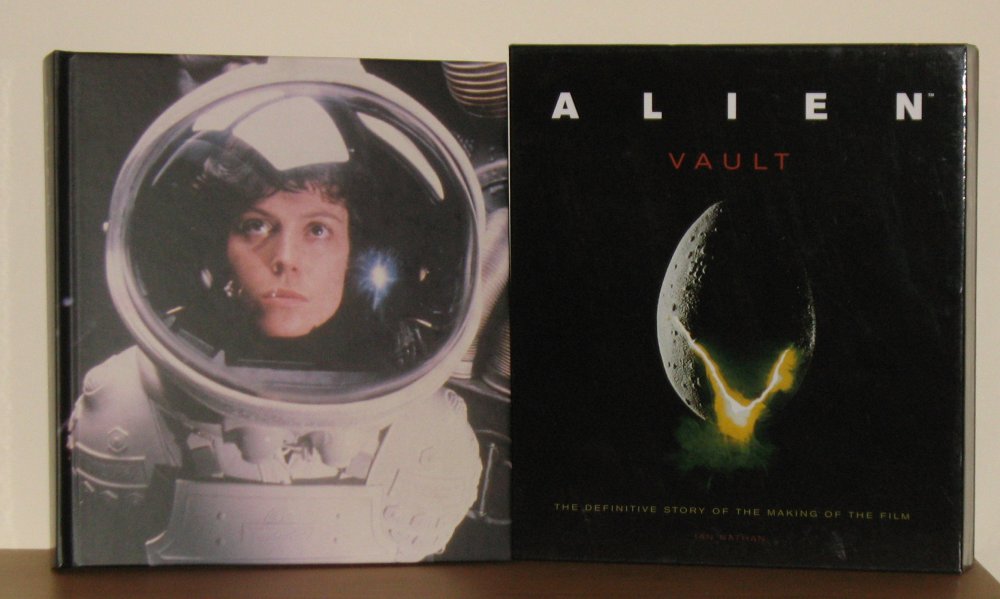
Finally, a book about Ridley Scott’s Alien. It’s full of lots of fanboi goodies, like behind-the-scenes photographs, production design sketches, fold-out plans of the Nostromo, and all that sort of stuff. Cool.


Leave a comment

In the Zone

The Zone SF has recently posted up some of my reviews of genre films. There’s cult classic Damnation Alley, based on the Roger Zelazny novel – review here. And Black Heaven (AKA L’autre monde), a French thriller about MMORPGs – review here. And finally, 51, a really crap film set at Area 51 – review here. I can’t in all honesty recommend any of the three films, though Black Heaven wasn’t too bad.


3 Comments

A tale of two cities

Well, that was a busy weekend. Two cities in two days, each in the opposite direction from home.

On Friday night, I was in Manchester, at the Academy to see Opeth perform live. The support act were Pain of Salvation. While I like bits of Pain of Salvation’s two Road Salt albums, I’m not really a fan of their music. Live, they put on a good show, but they struck me as bit posey and frontman Daniel Gildenlöw seemed to think he was Lenny Kravitz.

Rumour had it the Opeth set would be taken entirely from the new album, Heritage. Which is entirely progressive rock. Given that I still think that Blackwater Park is the band’s best album, and that Heritage is an album that is only slowly growing on me, I wasn’t entirely sure what to expect, even though this was the fourth time I’d seen them perform. And the set did indeed open with some tracks from Heritage. But then Mikael Åkerfeldt started bantering with the crowd – that night it was a lightly sarcastic paean to Kiss – and I knew that despite the new “direction” Opeth hadn’t really changed. The band then performed some older songs, although the entire set featured only clean vocals. In the case of ‘A Fair Judgment’ from Deliverance (a favourite track of mine), this wasn’t an issue as the album version features clean vocals. But ‘The Face of Melinda’ from Still Life is certainly different when it has all the growl vocals taken out. Still, Opeth are superlative musicians, and I suspect I’ll find myself liking Heritage a bit more after being reminded live just how good they really are.

The gig was my first in Academy 1. Last year, I’d seen Ghost Brigade, Orphaned Land and Amorphis in Academy 3, which is the smallest of the four venues. Academy 1 is like a small aircraft hangar. We were up near the front for Pain of Salvation’s set, and that wasn’t a problem – you could still get out to visit the bar or the toilets. But about five songs into Opeth’s set I felt the call of nature, and it was a real battle to get out of the crowd in front of the stage. And once I was done, there was no way I was going to be able to get back to where I’d been standing. That was annoying. (Also, I was wearing my Mithras Forever Advancing Legions T-shirt that night, and someone said, “Nice T-shirt” to me.)

So, Manchester meant getting home after midnight. And the next morning I was up and off to Nottingham for Novacon. I’d checked train times, both there and back – I was intending to only spend the Saturday at the convention, but I did take toiletries and a change of clothes in case I decided to stay the night. The last train home was at 23:15 but it didn’t get in until… 10:16 the next morning. Essentially, it dumped you in Derby, and you then had to wait for the first train the next morning. That’s not a viable journey, and you’d think railway timetable websites would recognise that. However, there were some direct trains between 20:00 and 21:30, so I had until then to make a decision.

I arrived in Nottingham at 11:00. Back in the late 1980s, I lived in Mansfield, my home town, and spent many weekend nights pubbing and clubbing in Nottingham. I’ve only been back a handful of times, but even so I know the geography of the city pretty well. I noticed a few changes in the city centre, but Mansfield Road, which is where Novacon’s hotel was sited, looked exactly as I remembered.

I bought a day membership on arrving at the hotel, and then headed straight into the bar. The first familiar face I spotted was Chris Amies, who I’d not seen for many years. After a chat, I left my bags with him and hit the dealers’ room. The usual suspects were all present: Porcupine Books, Cold Tonnage, Replay Books, Murky Depths, NewCon Press… I was at the Porcupine Books stall, when I spotted a couple of Women’s Press sf titles I didn’t own, and reached out for them. The stranger standing next to me turned to me and said, “You must be Ian Sales.” Which was a pretty good trick: my day membership badge didn’t have my name on it. The stranger proved to be Colum Paget, who has a story in Rocket Science. After a few more chats with various people, I returned to the bar… Which is where, as usual, I spent much of the con.

I had conversations with Al Reynolds, Ian Whates, Terry Martin, Kim and Del Lakin-Smith, Caroline Mullan, Fran and John Dowd, John Meaney, Leigh Kennedy, Janet Edwards… There was quite an intense discussion on utopias with Charles Stross, Justina Robson, Kev McVeigh and myself. I also remember a long talk about Uriah Heep (the band, not the Dickens character) with Swedish fan Bellis. The only programme items I attended were a 15 to 1 quiz and the second book auction (but I didn’t bid on anything). By about six o’clock, it was clear I’d be better off staying the night, so I checked into the hotel. I was quite impressed with the room – it was small but very modern. The shower – there was no bath – had a huge showerhead set flat again the ceiling, which was quite odd.

I was up at my usual time the next day, wolfed down breakfast, and then just hung around – in and out of the dealers’ room – throughout the morning. I was planning to leave later in the day, but was offered a lift home by Kev leaving at noon-ish, so I decided to accept it.

So that was the weekend. I caught up with a band I’ve liked for many years and caught up with some friends I don’t get to see very often. I didn’t feel up to much when I got home on the Sunday, so I’m now horribly behind on nanowrimo. But never mind. I bought almost a dozen books at Novacon, but I’ll put up photos of them in a separate post.

2 Comments

British sf masterwork: The Uncensored Man, Arthur Sellings

When I put together my list of British SF Masterworks last year (see here), a number of eligible authors were suggested to me that I’d never heard of before. One such was Arthur Sellings who, I discovered, had written six novels and numerous short stories (many of which were collected in two collections) between 1953 and 1970. He died suddenly in 1968 of a heart attack, “just as he was gaining more and more notice” according to his entry in the SF Encyclopedia here.

Although I actually put Sellings’ 1970 novel, Junk Day, on my British SF Masterworks list, I have so far only managed to acquire The Silent Speakers (1962), his debut novel, and The Uncensored Man (1964), his second novel. It was the latter I read.

Dr Mark Anders is a physicist at Jarwood, a secret British weapons laboratory. He is married to Ruth, who also works there, but their marriage is faltering. Ruth is too perfect, and too much a perfectionist, and whatever spark their relationship had possessed has long since dissipated. In an effort to cheer himself up, Anders goes visits an old friend who is a doctor in a distant town. While there, he witnesses a teenage patient of the doctor’s have an epileptic fit, wake up and talk for a minute in German, and then fall into a light coma. But the boy has learning difficulties and has never been taught a foreign language. Intrigued, Anders investigates further, but draws a blank. Then his brand-new computer spits out a page of Greek writing instead of the expected experimental results. He gets this translated, and it proves to be a quote from the Book of Revelations.

Mystified, and suspecting he may be suffering from some psychological condition, Anders visits Dr Nowatski, A Polish psychiatrist he met briefly at a party years before. Nowatski gives Anders a shot of LSD – it was legal, in those days. Under the influence of the drug, Anders… visits a parallel world and meets its human inhabitants. The remainder of the novel describes Anders attempts to learn the truth of this alternate Earth, his run-ins with Jarwood’s security stemming from his association with Nowatski, and his subsequent development of mental powers.

The Uncensored Man is tosh, but it’s quite well-written tosh. The central premise – the origin and reason for existence of the alternate Earth – is neither plausible nor convincing. While Anders is a nuclear physicist working on neutron bombs, Sellings gives no information on his actual work. And though the reason why his computer spouts Greek is explained, how it actually does so is ignored. The book lacks authenticity.

However, Anders is a well-drawn character. Likewise Nowatski. The two women – Ruth, and Nowatski’s wife, Anna – are less rounded, though their treatment is sympathetic. In fact, they are repeatedly shown to be better persons than their menfolk. The prose is also good – in other words, it is typical of British sf of the 1960s, and so much better than US sf of the same period. US authors of the time may have had the ideas, but British sf authors had the writing chops.

The Uncensored Man is a very British novel, and very much a novel of its time. These days, it’s little more than a curiosity. It’s no masterwork, and it remains to be seen which of Sellings’ novels belongs on my list. It’s an interesting read, but not one, I think, that would have set the genre alight.

As mentioned earlier, I also have a copy of Selling’s debut, The Silent Speakers (published as Telepath in the US), and if I see other novels by him I’ll no doubt pick them up. But he was neither as good as Compton, nor as prolific as other British sf authors of the time, such as Tubb, Brunner or Cooper. Like Rex Gordon and Leonard Daventry, the fact he’s now forgotten does not seem entirely surprising. But it would not have done the genre a disservice to have had the likes of Sellings and his peers representing it rather than some of the sf novels we now consider to be classics.


1 Comment

Getting there

On 8 November, Phobos-Grunt, a Roscosmos mission to a moon of Mars, launched. Unfortunately, soon after achieving orbit the rocket engine designed to boost the space probe out of Earth orbit and on its journey to the Red Planet failed to fire. Engineers are working hard to fix the problem. They have until 12 November. After that, the space probe will not have enough fuel to make the trip.

Phobos-Grunt is an interesting mission. Yes, it’s a robot, and a crewed mission would have been much more exciting. But. It is a sample-return mission. Phobos-Grunt will land on Phobos, scoop up some of the regolith, and then a small section of the space probe will return the sample to Earth. The trip to Mars will take almost a year. And the same back again. In order to return some 200 gm of soil from a moon only 26.8 by 22.4 by 18.4 kilometres in size. It will be the first space probe to return an extraterrestial sample to Earth since Luna 24 in 1976.

Phobos

Mars at its closest approach to Earth is 56 million km, when Earth is at aphelion and Mars at perihelion. John Carter might be able to travel there in the blink of an eye – and lose all his clothes in the process – but Phobos-Grunt is having to make the journey the non-magical way using a Hohmann Transfer orbit. That puts the distance it needs to travel closer to 200 million kilometres. Phobos-Grunt will leave most of itself behind on Phobos and only a small capsule will return to the surface of the Earth.

Perhaps a detail or two there need to be stressed. 200 million kilometres. That’s roughly the same as travelling from London to New York about 36,000 times. If you did that continuously, refueling in the air, you’d be flying constantly for around 30 years. And then, once you’d completed your journey, you’d present scientists with a handful of dust. This is not to stress the inefficiency of the Phobos-Grunt mission, but its difficulty. Or rather, the near-impossibility of space travel to other planets. Which is something science fiction has traditionally ignored. Unless, of course, you count arriving stark naked at your destination a “difficulty”…

Looking closer to home, there are places which present real challenges to explorers. Such as, er, Challenger Deep. It’s considerably closer than Phobos, but it’s still 10,900 metres beneath the surface of the Pacific Ocean. That’s more than the height of Everest (which is 8,848 m). Challenger Deep has only been visited three times, and only once by human beings (see here). Two subsequent visits by robotic vehicles, in 1995 and 2009, took samples from the ocean floor. But Challenger Deep presents its own difficulties. The trip there might be relatively trivial. You just sink. But the pressure down there is something else. It’s over 1000 atmospheres, or 1250 kilograms per square centimetre. For Phobos-Grunt, the reverse is true: though extreme heat and cold, and radiation may cause problems, the vacuum of space is almost benign by comparison. On the other hand, whatever you send to Phobos has to survive a year-long trip…

It sometimes seems to me that the point of science fiction is to show how science and/or technology could overcome such problems. Not render them trivial, or even completely ignore them. But overcome them. Solve them. When Hugo Gernsback started Amazing Stories in 1926, he saw the genre as chiefly didactic. I don’t think it needs to be that – or rather, it doesn’t need to be overtly didactic. When Anthony Burgess wrote A Clockwork Orange, he intended for the novel to “brainwash” its reader into understanding Nadsat. That’s what sf should do. And while I don’t subscribe to Kim Stanley Robinson’s “the infodump is just another narrative technique”, I do think a reader should put down a sf text knowing more about something than they did when they picked it up. But as long as the genre continues to ignore the issues which science and technology can address, as long as it turns a blind eye to the obstacles which actually prevent its plots from occurring, then readers will not learn anything new from a sf text.

Does that mean science fiction should comprise only “improving” texts? Yes, why not? It’s not as if learning is a bad thing, after all.


Leave a comment

Going with the flow

So that’s the first week of Nanowrimo over. Seven days of trying to write 1,667 words – at least – a day. Of a novel about which I had nothing but the title and a vague idea on which to base it. By the end of Day 7, I had managed 11,666 words, which is pretty much on target.

But are they 11,666 good words? Well, no; not really. So far, Into the Dark, as it’s titled, is not very coherent. It’s not quite automatic writing, but it’s not far from it. But then it’s not as if I decided to do Nanowrimo expecting there to be a complete polished novel at the end. I’m doing it more to discipline myself into writing on a daily basis more than anything else. Though I do hope there will be something salvageable come the end of November.

The idea for the novel was simple. It would recount the first stage in humanity’s first mission to another star. Initially, this was going to be the preparations for the launch of the rocket which would take the crew of six up to their spacecraft waiting in orbit. The style would be very literary, but also hard sf.

Then I decided to move it back a bit. To before the launch. Instead, the crew would be coming to the end of a simulated mission in a copy of the spacecraft on the ocean bed. A bit like NASA’s NEEMO, but much deeper. The protagonist is a project director sent down to tell the crew that for reasons of politics they need to get them up into orbit as quickly, and covertly, as possible. But what this project director finds in the underwater habitat is not at all what he expected…

It’s nothing Deep Star Six or anything like that. No monsters, or psychopaths. Instead, all of the crew have converted to Fedorovism. And the project director, Beeney (yes, I named him after my cat), is convinced this is not good for the years-long mission. He finds it troubling and possibly dangerous.

At which point, Into the Dark has sort of gone all Heart of Darkness on me. Which may be a good thing.

Some things about the novel have proven happy accidents. I only have a cast of seven, and the story is told from only one point of view. It’s set entirely in the underwater habitat, which is small and limited. The plot has allowed me to throw in research I did for other stories – yes, the descent of the Trieste (see here) is in there; also stuff about the Mercury, Gemini and Apollo programmes. Nothing about Spitfires yet (see here), but give me time…

But mostly I’ve been completely winging it, and I suspect the chapters written so far are riddled with repetitions, inconsistencies, complete nonsense, and wild improbable swings in story-logic. But perhaps there are also one or two gems buried in the midden heap.

As for what I plan to do with manuscript once it’s finished… well, that remains to be seen. For now, it’s teetering on the edge of rescue.


Leave a comment

Prolificity

Well, not really. However, Alt Hist #3 was published yesterday and is currently available on Kindle here and from Smashwords here. I mention this because it is a good magazine, and because it contains my story ‘A Light in the Darkness’ about Wilfred Owen and Nikola Tesla. It’s alternate history, of course. One of these days I’ll have to have a go at a straight historical story. But for now, go out and buy Alt Hist #3. It’s a good thing.


23 Comments

Bookjoy: more Compton

Synthajoy was DG Compton’s fourth science fiction novel. Previously, he had written half a dozen crime novels under the name Guy Compton. So it should come as no surprise that Synthajoy is as much a crime novel as it is a science fiction novel.

Thea Cadence has been incarcerated in the Kingston, a clinic designed to rehabilitate criminals using the Sensitape process. Thea’s husband, Dr Teddy Cadence invented Sensitape – or rather, he invented the concept. The device itself was invented by Tony Stech, his business partner. Sensitape is, as the name suggests, recorded emotional states which can be played into a person’s mind, and thus directly affect it. At the Kingston, Thea is undergoing Sensitape treatment in contrition as her sentence for a crime.

Cadence had been inspired to invent Sensitape while attempting to cure Stech’s father of an increasingly common condition called UDW, Uncompensated Death Wish. He failed to prevent the man’s death, but Sensitape did subsequently make UDW extremely rare. In fact, Sensitape was a great success. But the recording made of a couple making love, Sexitape, was an even bigger success. Cadence, however, always dreamed of artificially creating the emotions on a Sensitape, i.e., deliberately programming the effect required. He called this process Synthajoy.

Thea drifts in and out of her memories as she is being treated. Though she did not defend herself during her trial, she does not consider herself guilty of the crime. She resists her rehabilitation treatment. And in between periods of introspection and rebellion, she relives – or explains to her nurse – the history of Sensitape and her involvement with it. In this way, facts pertinent to the crime of which she has been charged are revealed.

Thea murdered her husband.

An early Sensitape session in which she was the guinea pig gave her a revulsion for her husband’s body. He found sexual companionship in the arms of another woman – the one from the Sexitape, in fact. Thea meanwhile had an affair with Tony. Who later committed suicide under suspicious circumstances. During her trial, the prosecution claimed it was jealousy that had led to the murder. They did not know of Thea’s relationship with Tony, nor did she tell anyone of it.

Synthajoy is a carefully-plotted ramble through Thea’s consciousness and history. She is hiding the truth from herself as much as she is from her prosecutors and rehabilitators. And it is only as she reveals her past that the truth about Tony’s suicide and the murder of Dr Cadence are uncovered. Unlike later novels, Synthajoy is a single-hander, and told entirely from Thea’s point of view. She is intelligent, educated, middle-class, and beautifully real. Unsurprisingly, the writing is a joy to read:

It is extraordinary to watch my hands. They smooth and fold, now so neat and expert, so accomplished now that they act without mind, without my volition … Hope is like a fever, a heat engendered by battle, and it leaves a deadly chill behind it. My arms ache. My hands tingle and creak. (p 50)

Also, unsurprisingly, the book is very firmly British, and very firmly a novel of the late 1960s / early 1970s. (It was first published in 1968). Those characteristics, as much as the writing, are the essence of Compton’s appeal. His novels are fiercely intelligent and beautifully crafted, but it is their finely-tuned sense of time and place, the way the central ideas are so well integrated into the real world, that makes them stand out.

There are ideas that Compton returns to again and again. The abuse of technology is an obvious marker – and one that demands a story set in as close an analogue of the real world as is possible. And yet… It seems odd that Compton should begin his writing career in crime, writing novels in which the purpose of the story is to explain a death. Yet his science fiction novels typically feature epidemics of unexplainable deaths – UDW in Synthajoy, Gordon’s Syndrome in The Continuous Katherine Mortenhoe (see here), and the Disappearances in Ascendancies (see here).

In his three decades of writing science fiction, Compton never won an award, despite being published regularly in both the UK and the US. The Steel Crocodile was shortlisted for the Nebula in 1971, but lost out to Ringworld (an extremely popular book, but nowhere near as well-written). He appeared on the Locus Award shortlist three times, and in 2007 the SFWA made him an Author Emeritus. Yet he was possibly the best British sf writer of the 1970s. At a time when US authors of the 1950s dominated the field on both sides of the Atlantic – Asimov, Smith, Herbert, Heinlein – Compton was one of a handful of British sf writers writing sf novels so much more intelligent and well-crafted than those of their contemporaries. It’s a shame they appear to be mostly forgotten, and it’s the likes of Foundation and Stranger in a Strange Land which dominate lists of so-called genre classics. Perhaps the re-issue of Compton’s back-catalogue as ebooks through the SF Gateway (Compton’s entry is here), and The Continuous Katherine Mortenhoe‘s appearance in the SF Masterwork series in October 2012, will see Compton receive the recognition he deserves.

The following novels by Compton are currently available on Kindle via the SF Gateway. If you own such a device, you should buy them immediately: Farewell, Earth’s Bliss (1966), The Silent Multitude (1966), The Quality of Mercy (1967), Synthajoy (1968), The Steel Crocodile (1968), Chronocules (1970), A Usual Lunacy (1978), Windows (1979), Ascendancies (1980), Scudder’s Game (1988), Nomansland (1993), Justice City (1995) and Back of Town Blues (1997).