It Doesn't Have To Be Right…

… it just has to sound plausible


Leave a comment

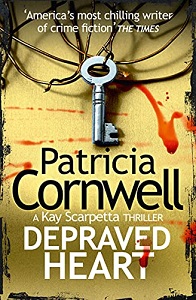
Scarpetta 22: Flesh and Blood, Patricia Cornwell

One of the problems with formulas, particularly when it comes to book series, and especially series that have been going for longer than the author likely originally expected… I mean, I don’t know how many Scarpetta novels Cornwell set out to write, but twenty-two must be more than she ever envisaged – and the series is currently up to twenty-nine books. She’s maintained an impressive inventiveness in the murders, and the solving of them, over the books I’ve read so far…

But because of the formula, the books demand a villain against whom Scarpetta can pit her expertise and wits, and they’re usually genius-level psychopaths who enjoy planning and executing complicated murders. And good villains are hard to give up, so they have a tendency to come back from the dead. Cornwell has already done this once. And she does it here again.

It’s Scarpetta’s birthday and she’s due to go on vacation in Florida with her husband, FBI profiler Benton Wesley. But then, a college music teacher is shot in his driveway by a sniper. Scarpetta has history with the victim. Whose death has similarities to two other murders. Then more deaths – accidental, homicide mistaken for accidental, and actual homicide – seem to be connected… and somewhere in the centre of all this is Scarpetta. So once again, the death and mayhem is all intended to destroy her or her reputation.

Lucy is also involved, and she seems to have a good idea who the killer is. As does Benton. Scarpetta does not figure it out until near the end (long-time readers of the series will probably work it out before Scarpetta). The killer has been hired as a fixer by a corrupt congressman with a sociopathic son, but the fixer seems to have jumped the rails. Americans like their corrupt public officials – they even put one in the White House. Twice.

The ending hews close to the formula – Scarpetta becomes the killer’s target, although not this time because she sets things up so that’s the case: the killer wants her dead for reasons of their own. Of course, the killer fails – there are another seven books in the series to go, after all. But Flesh and Blood (2014, USA) does end with one of the most ambiguous cliff-hangers I have ever read.

On the whole, one of the better of the recent Scarpetta novels, so it seems the series is improving. And I’m really looking forward to the television adaptation, starring Nicole Kidman, I believe, in the title role.


Leave a comment

The Underpeople, Cordwainer Smith

The Underpeople (1968, USA) follows directly on from The Planet Buyer (1964, USA), although four years separates their publication. In fact, both were published in magazines in 1964, but the second wasn’t published as a paperback until 1968, two years after Smith’s death. The two books were later merged and published as a single novel, Norstrilia (1975, USA) – and it is that version which has been reprinted a number of times since, including in the SF Masterworks series in 2016.

The Planet Buyer left Rod McBan, of Norstrilia, the wealthiest man in the universe, and the new owner of Earth, newly arrived on Earth, where he is met by C’Mell, a catwoman and girlygirl and one of the underpeople. McBan, incidentally, is disguised as a catman.

There’s no real plot to The Underpeople, just a series of incidents which sort of lead to a conclusion and an implied resolution. The latter is the freeing of the underpeople, who are little more than slaves (the callousness with which they are disposed of is quite disturbing). The former sees McBan back home on Norstrilia, happily married, and Earth no longer in his ownership.

There are things to like about Cordwainer Smith’s oeuvre. He certainly built a unique universe, and had a distinctive voice. And it worked well in his short fiction. But both The Planet Buyer and The Underpeople read like badly-welded together collections of short stories, and in that format they’re not so impressive. Also, I really hate poetry and songs in narrative unless they’re part of the plot.

I am… undecided about Smith’s fiction. Some of his short stories are very good, even if the language is a little cringeworthy at times. Norstrilia, ie, The Planet Buyer and The Underpeople, has some good ideas. But it’s all too haphazard and never really quite links together. I wanted to like The Underpeople more than I did. There is a book out there somewhere, possibly even The Instrumentality of Mankind (1979, USA), which is in the SF Masterworks series, which presents the best of Smith’s fiction in a way that displays what’s good about it. The Planet Buyer and The Underpeople do not. 

Which may well be why they’re no longer in print (although perhaps the corridor of naked bottoms played a part).


Leave a comment

2025 in books

I posted my list of the best books I read in 2025 on my Medium blog – you can find it here. This post is just a few stats about the books I read during 2025.

I read a total of 170 books in 2025, of which 15% were rereads of books read in earlier years – well, decades, and many of which I’d read before I began recording the dates on which I completed books.

Obviously, since the bulk of my book collection is still in storage, I had to buy replacements for these rereads. From Fantastikbokhandeln, my local secondhand sf bookshop, and other bookshops in town, or at the conventions I attended during the year: Fantasticon in Copenhagen, Norcon in Oslo, Archipelacon 2 in Mariehamn and Swecon in Lund. In total, I bought 166 books in 2025, 22% of which were for rereading, and 9% were copies of books that went into storage before I had the chance to read them. (I also sold four books back to Fantastikbokhandeln once I’d read them.)

Returning to the books read, the bulk were science fiction at just over 50%. Then mainstream (17%), fantasy (13%) and crime (10%), plus a handful of other genres. Gender-wise, 48% were by male writers and 43% by female writers. The remaining were multi-author books, non-fiction, graphic novels and the single anthology I read in 2025.

Geographically, the preponderance of science fiction means it’s no real surprise most of the books I read were from the US (44%), closely followed by the UK (38%). The next highest were France and Sweden, with around a half a dozen books each. I also read books from Australia, Canada, Denmark, Finland, Germany, India, Iraq, Ireland, New Zealand, South Korea and Spain.

Given I reread a number of books in 2025, the decades in which the books I read were originally published are a bit all over the place, although the 2020s came top with 29% (although only five were published in 2025), followed by 17% in the 2010s, and 12% in both the 1990s and 1980s. But I did read books published in every decade of last century except the first two, and in the last decade of the century preceding that (HG Wells, natch).

The 170 books were by 127 different authors. Top of that list is Patricia Cornwell, with nine books; followed by L Timmel Duchamp and Cynthia Ward, with four each; and then three books each by Terry Pratchett, Anne McCaffrey, Aliette de Bodard, Samuel R Delany, Clive Cussler, Doris Lessing and TH White. Some of those, of course, were rereads.

And the high numbers are because some of the books I read were in series: Scarpetta (9), the Adventures of the Blood-thirsty Agent (4), Discworld (3), Millennium (3), the Adventures of Dirk Pitt (3), the Dragonriders of Pern (3), and Canopus in Argos: Archives (3). The Blood-thirsty Agents were a quartet, so they’re done (I recommend them). I have two books left in Canopus in Argos: Archives. I’ll not bother reading any further Pern books. But I still have a way to go for the other series (except Millennium, with one more promised, but perhaps more after that).

Here’s to 2026. I’ve not set any reading resolutions yet, and may not even bother. But I definitely have some quite weighty novels on my bookshelf, real and electronic, and I’d like to tackle a few of them some time over the next twelve months. On the other hand, I want to start writing seriously again, so perhaps that will impact my reading. We shall see…


Leave a comment

The Ringworld Engineers, Larry Niven

This was a reread, although I don’t recall when I previously read the book. Some time in the 1980s, I suspect. Everyone knows Ringworld (1970, USA), it was even No. 60 in the SF Masterworks series. Niven admits he had never intended to write a sequel, but he’d received so much correspondence about the novel – a lot of it pointing out where he’d got things wrong. Earth famously rotates the wrong way in the opening chapter of the novel (updated in later editions), but the chief complaint was that the ringworld was unstable. It needed attitude jets to keep it in orbit. So Niven decided to write The Ringworld Engineers (1979, USA), which is all about the attitude jets. Mostly.

Twenty-three years after the events of Ringworld, Louis Wu is a wirehead. He and his kzinti companion on that trip, Speaker-to-Animals, now called Chmeee, are kidnapped by a Pierson’s Puppeteer. Who is actually the mate of the Pierson’s Puppeteer from Ringworld, and was the leader of the race, the Hindmost. He was ousted and now plans to win back his position by fetching a “treasure” from the ringworld, a transmutation device.

Which doesn’t exist and never existed. But that proves irrelevant because the ringworld has been knocked from its orbit and will impact the sun in a year or so. The City Builders, the most powerful race on the ringworld, had removed the attitude jets from the ringworld’s rim, the jets that kept it in orbit, in order to power their spaceships. Hence the current situation.

Wu decides there must be a Repair Centre, a sort of central control complex for the ringworld. If he can find it, then he can prevent the ringworld from being destroyed. But first he has to find it.

The humanoid races on the ringworld have created, and maintained, treaties and coalitions through “rishathra”, which is sex between people of different hominid races. Niven obviously likes writing about sex, or rather the easy availability of it to males, but this is commercial science fiction so it’s either alluded to or entirely off the page. Nevertheless, it leaves a bad taste.

The other problem is the distances – the ringworld is huge. Absolutely fucking enormous. With a surface area equivalent to three million Earths. Most of the action in The Ringworld Engineers takes place around the Great Ocean, an ocean so large it features archipelagos which are full-size maps of various planets in Known Space (including Earth, Mars and Kzin), and which are hundreds of thousands of miles apart. After a while, the distance gets wearying, it’s almost like some sort of scale fatigue sets in. It becomes meaningless, just words. Niven uses the right words, but there’s no sense of wonder attached to the vast scale of it all.

The Ringworld Engineers fixes the issue with the ringworld’s unstable orbit, and even identifies its builders – linking back to an earlier novel by Niven. He returned to the ringworld seventeen years later with The Ringworld Throne (1996, USA), and then again eight years after that with Ringworld’s Children (2004, USA). Five prequel novels, the Fleet of Worlds series, then followed.

The ringworld is a great creation, one of science fiction’s most memorable. The plot of the novel which introduced it doesn’t really matter. Same for its sequels. Dune (1965, USA) had great world-building, but its plot helped bring it to life. The plot of Ringworld is irrelevant, the Big Dumb Object exists in spite of it. And so it is for The Ringworld Engineers. Which presents a disappointing, and unconvincing, explanation as the answer to the question of who built it, and never really manages to really evoke the scale of it all.


Leave a comment

A Choice of Destinies, Melissa Scott

Scott has written a number of excellent science fiction novels, although career-wise I suppose she’s a fairly common example of a US female mid-list genre author. Which happens to be a space where a lot of my favourite genre writers live. Mostly, however, I find her books variable. Shadow Man (1995, USA) is pretty good, as is The Kindly Ones (1987, USA). The Silence Leigh trilogy (1985 – 1987, USA) is fun. Mighty Good Road (1990, USA) is enjoyable if a little forgettable. I’ve not read all of her oeuvre, so there’s plenty left to explore.

A Choice of Destinies (1986, USA) is straight-up alternate history. What if Alexander the Great had turned west instead east? In our world, he conquered land as far as the Indus, and his empire fell apart after his death at the age of 32. In Scott’s novel, the rebellion of the Greek League cities brought him back west, and then down to Naples, before eventually onto Rome, with whom he signed a treaty. He then fights Carthage, and defeats it.

The thing about alternate history is that its story rests on its difference to real history, and if the reader doesn’t know that real history then the difference is meaningless. There was a sf story, I forget who wrote it, in which Fidel Castro was a baseball player and not the president of Cuba. Apparently, he did at one time play for a baseball team in the US, but the writer had to explain this in an afternote for the story to make sense. Scott does something similar, interspersing her main narrative of Alexander’s life with sections set 1800 years later in a world in which Europe, north Africa and west Asia are part of an Alexandrian empire. The novel ends in a section set on Alexandria-in-orbit, a space station, in 1591 CE. I very much doubt Alexander’s empire would last nearly 2000 years – no other did, after all – nor that it would lead to space flight some 350 years earlier than real history.

A Choice of Destinies starts off well enough, but soon becomes little more than blow-by-blow accounts of Alexander’s battles, both actual and political. Those interested in Alexander the Great’s life will find more to enjoy here than the average reader of science fiction or alternative history. It’s a smoothly-written piece, and I’m going to trust Scott on her presentation of history, but it definitely begins to flag around halfway in. Despite which, the final scene, the siege of Carthage, seems rushed and incomplete. It’s as if Scott wanted to write a much longer novel, or perhaps even a series, but was contractually constrained to a single novel. One for fans.


Leave a comment

Gráinne, Keith Roberts

Winner of the BSFA Award in 1988. There doesn’t appear to have been any shortlist that year, so I’ve no idea how it was chosen. The Eastercon in 1988 took place in Liverpool and was three years before my first Eastercon.

Gráinne (1988, UK) is the name of a princess from Irish mythology, who at their betrothal party dumped the man she had been promised to and ran off with Diarmuid instead. In Roberts’s novel, it’s the name of a young woman the narrator, Alistair Bevan, meets, has a mostly platonic relationship with, and who then leaves him… and several years later appears on television as the presenter of a documentary series on the brand new Channel 5. By this point, Bevan works for an advertising agency, which Gráinne hires to promote a series of “clinics” to empower women.

This narrative is framed by, and interspersed with, short scenes of an old man in a hospital bed, explicitly telling the story of his life to a doctor and nurse. I’ve no idea if the resemblance was intentional, but there’s a lot in these sections that reminded me of John Fowles’s Mantissa (1982, UK)

Most descriptions of the novel classify it as semi-autobiographical, and while I’ve read a lot of Roberts’s fiction, I know little of his life – but perhaps enough to for the classification to ring true. (His careers in illustration and advertising, for example.) Other aspects, especially the gender politics and attitude to women evidenced in the novel, are definitely the same as in Roberts’s other writings (cf ‘The Natural History of the P.H.’).

Roberts’s main thesis seems to be feminism and women’s lib are a waste of time because women should not be trying to fight for equality with men but simply fighting for their own variety of rights. Which sort of ignores the fact of the patriarchy, a concept Robert never appears to have taken onboard. And it does render the central element of Gráinne’s plot, the empowerment centres, somewhat moot. On the other hand, they do make Gráinne something of a messianic, or a Valentine Michael Smith-type, figure.

Of course, it all ends badly. It always does for such figures. The narrative hints at unsavoury backers who helped Gráinne financially, perhaps hoping for the social and economic disruption she eventually causes in the UK, but it doesn’t go any further. The final section also implies a post-apocalyptic Earth, perhaps after a nuclear war, but it’s only a single sentence and ambiguous.

The reviews of Gráinne I’ve read online seem mostly to have missed the point of the story. It’s not a fantasy about a Celtic goddess who has a love affair with a human man. Gráinne may be more than human, but that’s from Bevan’s point of view. Her later influence is a mixture of clever television (much cleverer than Channel 5 ever proved to be, or indeed the bulk of British tv in the mid-1980s), deep pockets and a mishmash of Eastern religions. Even then, her empowerment centres proved more disruptive than intended.

Robert Heinlein’s Stranger in a Strange Land (1961, USA) follows a similar story although, given it’s American, it reads like a carnival novel, and its central protagonist, Valentine Michael Smith, is a thinly-disguised carnival freak. Roberts’s novel, however, uses Irish mythology rather than US carnival folklore, and focuses on female empowerment and not free love. Heinlein wrote prose that was extremely readable and smooth, but Roberts’s style is more literary. British sf produced a number of excellent prose stylists in the 1970s, not part of the New Wave but almost certainly adjacent to it, such as Coney, Cowper, Compton, Lee, Saxton, Watson…

I’ve no idea why Gráinne, published by small press Kerosina Books, was given the BSFA Award. Other notable sf novels published in the UK in 1987 include Banks’s Consider Phlebas (1987, UK), Mann’s The Fall of the Families (1987, UK), Wolfe’s The Urth of the New Sun (1987, USA), and even Haldeman’s Tool of the Trade (1987, USA). Certainly, a shortlist could have been drawn up. Perhaps it was.


Leave a comment

Oka Rel 1: The Courtesan Prince, Lynda Williams

I bought a copy of this book back in 2009 but never got around to reading it. I don’t even remember why I bought it. I’ve a vague memory of corresponding with the author, but that may be confabulation. I was interested in writing space opera, and had been for a number of years, and The Courtesan Prince (2005, Canada) is the first in a ten-book space opera series, so it may have been no more than that.

It could be argued that space opera, more so than any other branch of science fiction, succeeds or fails more on its world-building than its story. They all pretty much use the same story, anyway. Oka Rel starts from a future history and a, mostly, hard-ish sf universe, but by the time this first novel opens, Earth is lost and there are two mostly antagonistic human polities, which lost touch 200 years earlier. The Oka Rel universe plays off on the difference between the two polities – the Reetions are technological and progressive, the Gelacks are a semi-feudal empire ruled by the descendants of genetically-engineered humans.

After two centuries of separation, and all the two groups know of each other is legend and rumour, they finally meet up at a neutral space station. Von is a courtesan and dancer ordered to impersonate a member of the aristocracy during the first Gelack meeting with the Reetions. Ann is a hot-headed Reetion pilot who falls for Von, and then becomes involved in Gelack politics. Because Von is really a long-lost son of the emperor, although he doesn’t know it.

The Courtesan Prince tries hard with its world-building, but doesn’t quite make the grade. Possibly because the two groups are too much the opposite of each other. It’s all a bit too binary. It doesn’t help that Von is simply far too good a character to be entirely credible, despite the violence inflicted on him. Some of the sensibilities haven’t aged particularly well in the last twenty years but, to be fair, there is worse being published even now. It all feels, in many respects, a bit like Cherryh, but the details seem harder to visualise. In fact, now I think about it, there’s a lot of Cherryh in there. Which is no bad thing, of course. I’m a big fan of Cherryh’s fiction.

I’m not sure if I’ll continue with the series, although I’m a sucker for a series. I’ll read anything if it comes in three or more books with a single over-arching story. But, as I said earlier, space operas succeed or fail on their world-building more than their story, and I’m not all that taken with the Oka Rel universe, to be honest.


1 Comment

The Corporation Wars 1: Dissidence, Ken MacLeod

This was a reread – I read it back in 2017 – but never got the chance to read the two sequels before I put the books in storage when I moved. Earlier this year I bought an omnibus edition of the trilogy, intending to finally finish all three. 

I actually wrote a review of Dissidence (2016, UK) on my blog back then. For some reason, I wrote that it took place on a moon of Jupiter, which was complete rubbish – the author even called me out on my mistake. I’ve no idea why I wrote that. The terms exoplanet and exomoon are used throughout the novel, and it states several times that it takes place in a planetary system 25 light years from Earth. So sorry, Ken: I’ve no idea why I wrote that and I’d like to make it clear the novel is set in another planetary system.

Anyway. Two companies are exploring the mineral wealth of an exomoon using robots. One of the robots, through a sequence of events, becomes self-aware. And so causes other robots, in both mining companies, to become self-aware. They rebel. So the AIs which run the mining companies unöeash their legal AIs on the “freebots”. Everything in the planetary system is run by AIs, based on a mission profile originally sent from Earth at sublight speeds.

Carlos the Terrorist was responsible for killing thousands in London during the undeclared war between the Acceleration (left-wing, basically) and the Reaction (right-wing, basically). He finds himself reincarnated in a simulation running on an AI in the same system as the aforementioned freebots. He, and several other resurrected and uploaded war criminals from the Acceleration, is there to fight those freebots on behalf of the legal AI that represents the mining company to which the robots belonged.

Except, it’s slightly more complicated than that. Is the simulation Carlos and his team experience really a simulation? Why does the legal AI representing one of the mining companies break off relations and start a war?

The story is surprisingly fast-paced, given all the ontological discussions, but MacLeod keeps the focus tight on Seba, the first robot to gain self-awareness, and Carlos. There’s a few bait-and-switches before the novel finally reveals its plot, but it’s the first of a trilogy. There are few authors I’d trust with political science fiction, but MacLeod is definitely one of them. True, I have more in common with him politically than most sf authors (especially US ones, past and present), but also because he writes sf to his politics, not despite them.

I’d happily recommend any novel by Ken MacLeod. Some are better than others. If you read them all, there may be a few disappointments, but on the whole you’ll be impressed. The Corporation Wars trilogy, based on just this first novel, seems to be somewhere near the middle, so definitely worth reading.


Leave a comment

The Lie Tree, Frances Hardinge

I’d heard good things about Hardinge’s fiction for several years, but I’d never bothered checking them out because, well… fantasy… YA… Not my usual, or preferred, choice of reading. But The Lie Tree (2015, UK) popped up for 99p on Kindle, and I thought it worth seeing what all the fuss was about.

And I’m glad I did.

Faith’s father, a reverend, is a celebrated palaeontologist in the 1860s, but he’s been accused of faking the fossils he discovered, so he and his family flee to the invented Channel Island of Vane to join a dig there. But all is not as it seems. The invitation was a ruse because the reverend is in possession of something that others want.

On the one hand, the title of the novel is a hint to the central element of its plot, which is not revealed until at least halfway in; on the other, it’s hard to describe the plot without spoilers. The spoiler-free version would go: Faith defends her father, uncovers a conspiracy against him, then tries to solve his murder and so learns his secret, the reason why he was invited to Vane, and uses it to take revenge on his killers.

However, a major part of the novel – although it doesn’t really kick in until around a third of the way in – is that Faith is clever, but because she is a girl it means nothing. She wants to be a scientist but her gender bars her from it. This is a novel about women as property, about chattel slavery of half of the human race, and about the means and methods open to women of the time to arrange a future for themselves and then safeguard it. Faith is a teen, and knows her much younger, and not very bright, brother, whom she loves nonetheless, is accounted more valuable than her. Even though she has the intelligence, the aptitude and the interest to follow in her father’s interests.

And it’s this element of the novel which lifts it above others of its ilk. Faith thought her father valued her because of her intelligence, but he was just using her – much as he used others to further his aims. Faith meets a woman – two, in fact, but one more so than the other – who have found a way to be intellectual without offending Victorian (male) society – I am for some reason reminded of JG Farrell’s The Siege of Krishnapur (1973, UK), an excellent novel – but it doesn’t end well. And also I’m reminded of Jeanette Ng’s Under the Pendulum Sun (2017, UK), which presents as a fantasy set in Victorian times but is actually a brilliant commentary on Victorian fiction by women, missionary colonialism and women’s rights.

The Lie Tree is really good, and I should definitely read more by Hardinge.