It Doesn't Have To Be Right…

… it just has to sound plausible


Leave a comment

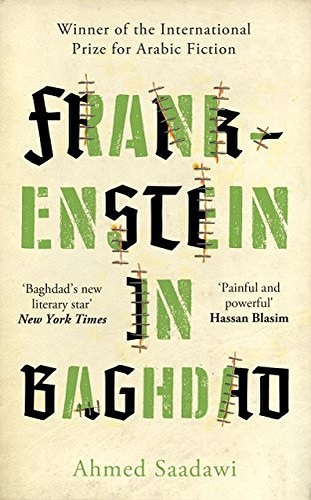
Frankenstein in Baghdad, Ahmed Saadawi

Very little science fiction has been translated from Arabic into English – in fact, I knew of only one other author, Emirati Noura Al Noman, and she hasn’t been published since 2014. Ahmed Khaled Tawfik wrote several sf novels, most notably Utopia (2008, Egypt), and a little hunting revealed it had been translated into English – but with his name spelt Towfik. There’s been plenty of fantasy translated from Arabic, however, from Alf Laylat wa Layla to Naguib Mahfouz, and a number of contemporary writers. Having said that, Frankenstein in Baghdad (2013, Iraq) was not published as category sf, and likely only deserves the label because its central conceit references Mary Shelley’s novel, a proto-sf novel. (The English title, incidentally, is a direct translation of the original Arabic title.) It was nominated for both the Arthur C Clarke Award and the International Booker Prize.

The central conceit of Frankenstein in Baghdad is actually not at all rigorous as science fiction. It’s a neat twist on the original – the monster (because of course Frankenstein is the doctor) in Saadawi’s novel is made from the body parts of victims of IEDs in post-invasion Iraq, and the monster’s mission is to avenge those deaths. But Saadawi seems more interested in telling a more general story about life in present-day Baghdad, as seen through the eyes of a handful of characters. Chief among these are the junk dealer Hadi, who originally creates the monster in some sort of fever dream; Mahmud, a young journalist, who takes Hadi’s tales of a monster semi-seriously, but is more interested in becoming like his rich and powerful editor; Elishva, an old Armenian woman who mistakes the monster for her long-dead son; and General Majid, who runs a secret police bureau of astrologers and magicians who predict bomb attacks in the city.

The novel bounces around between these characters, and a handful of others, mostly centred around the area of Bataween, and occasionally focusing on the monster. Who has discovered that once it avenges the death of one of the people whose parts make up its body, that body part rots and falls off. So the monster needs new parts – and it reaches the point where, with its own small army of followers, it too begins murdering people to keep itself together (so to speak).

The monster is a great invention, and there’s so much commentary that could be attached to the concept, but Frankenstein in Baghdad doesn’t seem all that interested in it. It’s more like an introduction, or a framing narrative, to the personal stories of the book’s cast. Which is a shame. It’s a good novel, don’t get me wrong, and its descriptions of life in post-invasion Baghdad are both heart-breaking and enraging.

A good novel, but one that feels like it failed to capitalise on its central idea.


Leave a comment

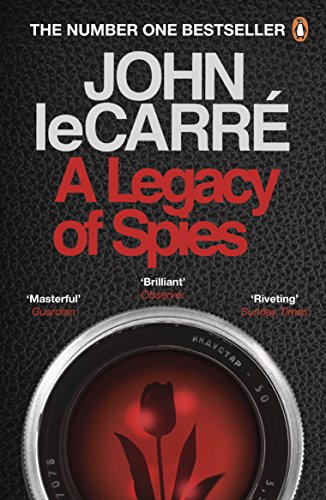
A Legacy of Spies, John le Carré

After a gap of 17 years, le Carré returns to George Smiley, although A Legacy of Spies (2017, UK) is actually a retrospective look at the events it describes, most of which centre around the stories of The Spy Who Came in from the Cold (1963, UK) and Tinker Tailor Soldier Spy (1974, UK).

Peter Guillam has retired to Brittany, to the farm which has belonged to his family for generations. He is visited by an officer from the Circus. At the end of The Spy Who Came in from the Cold, agent Leamas and his girlfriend, Liz Gold, attempted to escape over the Berlin Wall, but were both shot and killed. Now Leamas’s son and Gold’s daughter are suing the British government for compensation. And the Circus paperwork detailing the affair is not as complete as it should be.

Which, of course, is as was intended. Because Smiley kept the details of the operation from everyone, given it was a double bluff, and he hadn’t wanted the mole in the Circus, Haydon, to warn the Soviets and the East Germans.

Guillam wasn’t aware of all the operational details involving Leamas, but as he tries to prevent the current Service leadership from learning about the operation, so he discovers more about it himself. There was, for example, the East German woman Guillam helped defect, and with whom he fell in love – only for her to apparently commit suicide a handful of days after arriving in the UK. Not to mention numerous other details about the operation – all carefully concealed so Haydon would not know of them.

Guillam manages to deflect suspicion from himself, although not until after several threats by those involved, and tracks Smiley down in Germany. Who promises to clear Guillam’s name. I was, I admit, surprised Smiley was still alive – he seemed middle-aged in the first novel, Call for the Dead (1961, UK), so by the late 2000s or early 2010s, he would be in his eighties or nineties. But still active. As an indication, Alec Guinness was 60 when he played George Smiley in the 1974 TV adaptation of Tinker Tailor Soldier Spy, so even in 2000, years before Guillam recounts the events of A Legacy of Spies – an assumption, but not unlikely – Smiley would be 86. All perfectly believable – and Guillam’s disinclination to name the actual year makes it plausible.

Le Carré apparently wanted to write a novel about the stupidity that was the Brexit Referendum, and indeed Brexit itself. We all know it has failed, and has cost the UK more than the UK actually paid the EU in all the decades it was a member state. The only people still championing it are moronic racists and those grifters who profited from it – which is most of the Conservative Party, and the leadership of Reform UK. I’m not sure A Legacy of Spies makes this message clear, or that it actually adds anything worthwhile to the literary conversation around Brexit – but then neither does Ali Smith’s Autumn (2016, UK), which was written in direct response to Brexit, and may have been shortlisted for the Booker Prize, but had little impact on public discourse about the referendum. Preaching to the choir, no doubt.

Despite all that I’m not wholly convinced A Legacy of Spies adds anything to the plots of The Spy Who Came in from the Cold or Tinker Tailor Soldier Spy. I mean, don’t get me wrong, A Legacy of Spies is a good book – le Carré was an excellent writer and all of his books are worth reading. But it’s not even a pendant; it fills out a few details but offers no substantial changes.

A Legacy of Spies may have been written for the right reasons, but it doesn’t feel like it adds anything worthwhile to the Smiley series. Read it because it’s a le Carré novel rather than because it’s a capstone to the Smiley series.


Leave a comment

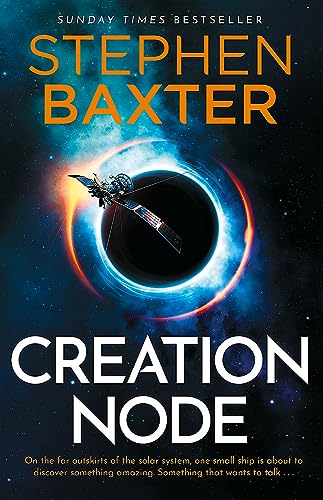
Creation Node, Stephen Baxter

Back in the late 1990s, a friend complained that deciding to collect books by Stephen Baxter was proving more expensive than expected because he was so prolific. Baxter is still going. I’m not sure my friend’s collection is. But never mind. I later made the same mistake – and I’m still going: I buy Baxter’s books in hardback on publication. I have rather a lot of them. But I have also read rather a lot of them.

Creation Node (2023, UK) is, if I’ve counted correctly, Baxter’s forty-eighth novel (including three YA novels, one co-written with Alastair Reynolds, four with Arthur C Clarke, and five with Terry Pratchett). And then there are the collections and novellas. Creation Node is much like his other more recent novels – an exploration of some cosmological puzzle by people not far removed from ourselves, and a tendency to feel a little juvenile in places.

After a climate crash, Earth has partially colonised the solar system. There are three political blocs – Earth, the most powerful and mostly conservationist; the Lunar Consortium, which believes in exploiting whatever natural resources are available in the solar system; and the Conservers, who are hardline conservationists and refuse to use any resource that is not immediately renewable, such as sunlight. The Conservers sent a spacecraft, propelled by a solar sail, to the ninth planet, a journey which took 35 years. And they discovered the planet was actually a black hole. And it was emitting Hawking radiation that was… structured.

So they sent a message into the black hole. Which promptly expanded. Until its outer shell had a surface gravity of 1G and a 15C surface temperature. And a weird sarcophagus containing a living teenage birdlike alien…

Earth sends a ship out to Planet Nine – with a brief stopover, and much excitement, at a station orbiting Saturn, where the ship converts from a slow fission drive to a fast fusion drive. Over a decade has passed by the time representatives from Earth – and one from the Lunar Consortium, plus the Conserver’s chief legal counsel – reach Planet Nine. Which prompts the discoverers to attempt sending another message…

This triggers the appearance of an enigmatic black globe, which calls itself Terminus. It proves to be a Boltzmann Brain from the quantum substrate in which all universes are created. It gives the human ambassadors a brief lesson in speculative cosmology, and then offers the human race eternity, ie, continued existence after the heat death of our universe. For a price. It’s how Baxter’s novels tend to work – a story based around a big idea, a plot with a payload, if you will. Which often prompts a momentous decision on the part of the cast.

Baxter does his homework, and the ideas he bases his novels on are fascinating. If Creation Node’s extended timescale results in a number of longeurs, there’s still plenty to like here. Creation Node may suffer from Baxter’s typical weaknesses – that tendency to use teenage protagonists, which often drops the narrative into YA territory – but it also displays his strengths: making huge mind-expanding ideas easily palatable. Lots of sense of wonder, but the human dimension may be a little flat. On the other hand, Baxter is nothing if not consistent – which is why I probably keep on buying his books…

Incidentally, I should point out my takes on the books I review on this blog (and my other blog) are not always typical. My views may be individual, but that doesn’t mean they’re not open to question. So I welcome conversation about what I write. Feel free to leave a comment, or start a discussion.


Leave a comment

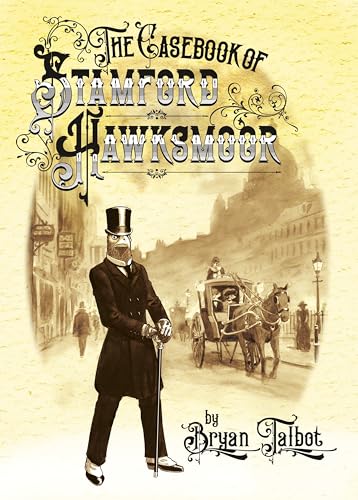
The Casebook of Stamford Hawksmoor, Bryan Talbot

I’ve been a fan of Talbot’s The Adventures of Luther Arkwright (1989, UK) for years. When I was at college in Nottingham in 1985, I often visited a comics shop on Mansfield Road before catching the bus home. I forget the name of the shop – and I can’t find it on Google. (I also visited a games shop, a grubby place in a courtyard, around the same time, and bought copies of the Laserburn RPG rules – Tabletop Games, possibly?) Anyway, I recall buying an issue or two of The Adventures of Luther Arkwright from that comics shop on Mansfield Road, although I didn’t read the completed series until buying the omnibus trade paperback many years later.

Not long after I read Talbot’s Alice in Sunderland (2007, UK), and thought it very good. I also kept up with the sequels to Luther Arkwright. So yes, I’d say I’m a fan of Talbot’s independent work, even if I’ve not been obsessive about keeping up with his oeuvre (it’s difficult with comics anyway; I much prefer to wait for the omnibus edition). Which is all slightly irrelevant as I’d missed Talbot’s Grandville series, five graphic novels set in the late 1800s in a UK that has been ruled from France since the Napoleonic Wars and in which all the characters are anthropomorphic animals.

The Casebook of Stamford Hawksmoor (2025, UK) is set in the same universe. It’s a clear homage to Sherlock Holmes – his deerstalker is something of a joke in the book. Hawksmoor, named for the architect – and the novel by Peter Ackroyd is also name-checked – is a detective at Scotland Yard. He recognises that not all of his colleagues are honest. But even he is shocked when he discovers links between some of them and the terrorists responsible for some of the most heinous crimes of recent years.

When Hawksmoor’s brother, a man he hasn’t spoken to in years, commits suicide in an open field near his house, Hawksmoor reluctantly investigates his brother’s life in an effort to understand why he killed himself. Hawksmoor is also investigating a series of murders linked to the Angry Brigade, the terrorist wing of the Resistance Movement, and which seems to have gone rogue now the French are pulling out of Britain and allowing home rule.

It’s all linked, of course, and the result of corruption in high places in the British establishment – plus ça change, and all that. Although framed as a Victorian whodunnit, much like its inspiration, Talbot has a put a lot of effort into working out his world. Not just the politics within a Britain that has been ruled by the French for over a century, but also the way the characters’ animal species impacts their behaviour, and the relations between the various species.

It’s excellent stuff. Recommended. But now I have to go and buy all the Grandville graphic novels. Oh look, there’s an omnibus edition available…


Leave a comment

Scarpetta 22: Flesh and Blood, Patricia Cornwell

One of the problems with formulas, particularly when it comes to book series, and especially series that have been going for longer than the author likely originally expected… I mean, I don’t know how many Scarpetta novels Cornwell set out to write, but twenty-two must be more than she ever envisaged – and the series is currently up to twenty-nine books. She’s maintained an impressive inventiveness in the murders, and the solving of them, over the books I’ve read so far…

But because of the formula, the books demand a villain against whom Scarpetta can pit her expertise and wits, and they’re usually genius-level psychopaths who enjoy planning and executing complicated murders. And good villains are hard to give up, so they have a tendency to come back from the dead. Cornwell has already done this once. And she does it here again.

It’s Scarpetta’s birthday and she’s due to go on vacation in Florida with her husband, FBI profiler Benton Wesley. But then, a college music teacher is shot in his driveway by a sniper. Scarpetta has history with the victim. Whose death has similarities to two other murders. Then more deaths – accidental, homicide mistaken for accidental, and actual homicide – seem to be connected… and somewhere in the centre of all this is Scarpetta. So once again, the death and mayhem is all intended to destroy her or her reputation.

Lucy is also involved, and she seems to have a good idea who the killer is. As does Benton. Scarpetta does not figure it out until near the end (long-time readers of the series will probably work it out before Scarpetta). The killer has been hired as a fixer by a corrupt congressman with a sociopathic son, but the fixer seems to have jumped the rails. Americans like their corrupt public officials – they even put one in the White House. Twice.

The ending hews close to the formula – Scarpetta becomes the killer’s target, although not this time because she sets things up so that’s the case: the killer wants her dead for reasons of their own. Of course, the killer fails – there are another seven books in the series to go, after all. But Flesh and Blood (2014, USA) does end with one of the most ambiguous cliff-hangers I have ever read.

On the whole, one of the better of the recent Scarpetta novels, so it seems the series is improving. And I’m really looking forward to the television adaptation, starring Nicole Kidman, I believe, in the title role.


Leave a comment

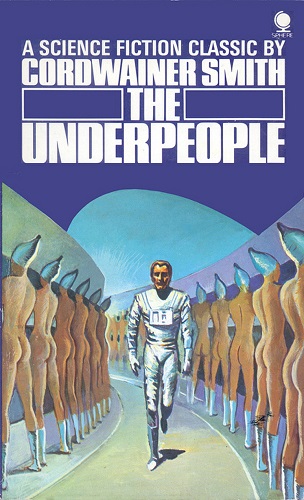
The Underpeople, Cordwainer Smith

The Underpeople (1968, USA) follows directly on from The Planet Buyer (1964, USA), although four years separates their publication. In fact, both were published in magazines in 1964, but the second wasn’t published as a paperback until 1968, two years after Smith’s death. The two books were later merged and published as a single novel, Norstrilia (1975, USA) – and it is that version which has been reprinted a number of times since, including in the SF Masterworks series in 2016.

The Planet Buyer left Rod McBan, of Norstrilia, the wealthiest man in the universe, and the new owner of Earth, newly arrived on Earth, where he is met by C’Mell, a catwoman and girlygirl and one of the underpeople. McBan, incidentally, is disguised as a catman.

There’s no real plot to The Underpeople, just a series of incidents which sort of lead to a conclusion and an implied resolution. The latter is the freeing of the underpeople, who are little more than slaves (the callousness with which they are disposed of is quite disturbing). The former sees McBan back home on Norstrilia, happily married, and Earth no longer in his ownership.

There are things to like about Cordwainer Smith’s oeuvre. He certainly built a unique universe, and had a distinctive voice. And it worked well in his short fiction. But both The Planet Buyer and The Underpeople read like badly-welded together collections of short stories, and in that format they’re not so impressive. Also, I really hate poetry and songs in narrative unless they’re part of the plot.

I am… undecided about Smith’s fiction. Some of his short stories are very good, even if the language is a little cringeworthy at times. Norstrilia, ie, The Planet Buyer and The Underpeople, has some good ideas. But it’s all too haphazard and never really quite links together. I wanted to like The Underpeople more than I did. There is a book out there somewhere, possibly even The Instrumentality of Mankind (1979, USA), which is in the SF Masterworks series, which presents the best of Smith’s fiction in a way that displays what’s good about it. The Planet Buyer and The Underpeople do not. 

Which may well be why they’re no longer in print (although perhaps the corridor of naked bottoms played a part).


Leave a comment

2025 in books

I posted my list of the best books I read in 2025 on my Medium blog – you can find it here. This post is just a few stats about the books I read during 2025.

I read a total of 170 books in 2025, of which 15% were rereads of books read in earlier years – well, decades, and many of which I’d read before I began recording the dates on which I completed books.

Obviously, since the bulk of my book collection is still in storage, I had to buy replacements for these rereads. From Fantastikbokhandeln, my local secondhand sf bookshop, and other bookshops in town, or at the conventions I attended during the year: Fantasticon in Copenhagen, Norcon in Oslo, Archipelacon 2 in Mariehamn and Swecon in Lund. In total, I bought 166 books in 2025, 22% of which were for rereading, and 9% were copies of books that went into storage before I had the chance to read them. (I also sold four books back to Fantastikbokhandeln once I’d read them.)

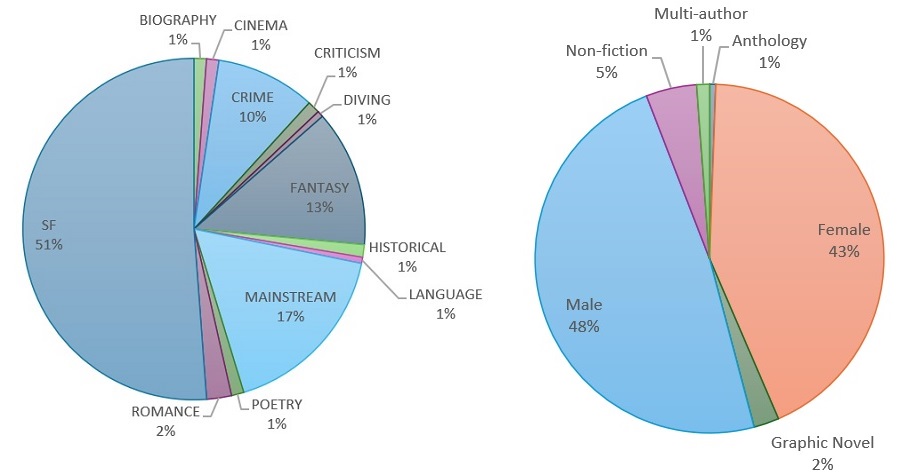
Returning to the books read, the bulk were science fiction at just over 50%. Then mainstream (17%), fantasy (13%) and crime (10%), plus a handful of other genres. Gender-wise, 48% were by male writers and 43% by female writers. The remaining were multi-author books, non-fiction, graphic novels and the single anthology I read in 2025.

Geographically, the preponderance of science fiction means it’s no real surprise most of the books I read were from the US (44%), closely followed by the UK (38%). The next highest were France and Sweden, with around a half a dozen books each. I also read books from Australia, Canada, Denmark, Finland, Germany, India, Iraq, Ireland, New Zealand, South Korea and Spain.

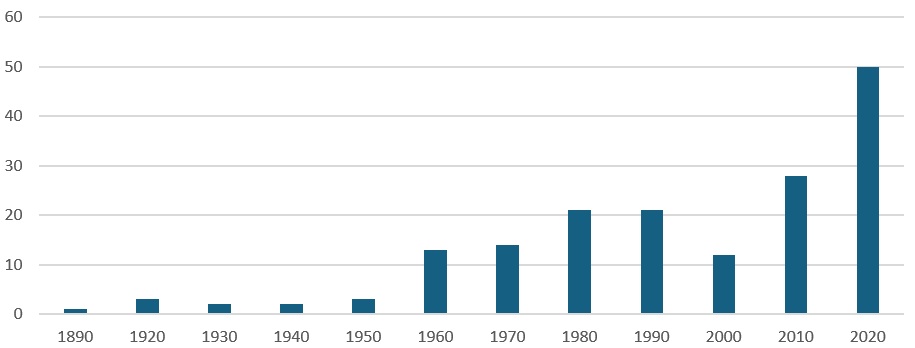
Given I reread a number of books in 2025, the decades in which the books I read were originally published are a bit all over the place, although the 2020s came top with 29% (although only five were published in 2025), followed by 17% in the 2010s, and 12% in both the 1990s and 1980s. But I did read books published in every decade of last century except the first two, and in the last decade of the century preceding that (HG Wells, natch).

The 170 books were by 127 different authors. Top of that list is Patricia Cornwell, with nine books; followed by L Timmel Duchamp and Cynthia Ward, with four each; and then three books each by Terry Pratchett, Anne McCaffrey, Aliette de Bodard, Samuel R Delany, Clive Cussler, Doris Lessing and TH White. Some of those, of course, were rereads.

And the high numbers are because some of the books I read were in series: Scarpetta (9), the Adventures of the Blood-thirsty Agent (4), Discworld (3), Millennium (3), the Adventures of Dirk Pitt (3), the Dragonriders of Pern (3), and Canopus in Argos: Archives (3). The Blood-thirsty Agents were a quartet, so they’re done (I recommend them). I have two books left in Canopus in Argos: Archives. I’ll not bother reading any further Pern books. But I still have a way to go for the other series (except Millennium, with one more promised, but perhaps more after that).

Here’s to 2026. I’ve not set any reading resolutions yet, and may not even bother. But I definitely have some quite weighty novels on my bookshelf, real and electronic, and I’d like to tackle a few of them some time over the next twelve months. On the other hand, I want to start writing seriously again, so perhaps that will impact my reading. We shall see…