It Doesn't Have To Be Right…

… it just has to sound plausible


Leave a comment

Not This August, Cyril M Kornbluth

Nominated for the Hugo in 1956, which was won that year by Robert Heinlein’s Double Star (1955, USA). Not This August (1955, USA) takes place in 1965 in a US that has been fighting USSR and Chinese forces for three years. The war has not been going well, and life in the US is grim, deprived and increasingly restrictive.
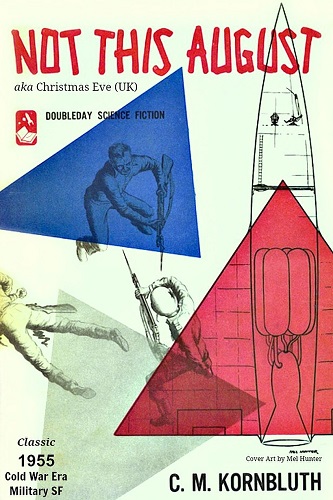
Billy Justin is a veteran and a small milk farmer barely scraping by. He hires a local itinerant who doesn’t appear to have all his marbles, only for the man to reveal he headed a secret project to build a crewed orbital bomb platform to end the war. The project was in danger of being discovered so he sealed the secret bunker and fatally gassed everyone inside.

The Soviets conquer the US and a political troop take over the county where Justin lives. He hooks up with a US resistance, and they restart the orbital bomb platform project, which was nearly finished anyway. Then the Soviet occupying troops are replaced with more hardline troops, but the Americans manage to stage an uprising, which serves as a successful ploy to prevent the Soviets from stopping the launch of the bomb platform.

Not This August reminded me a little of MJ Engh’s Arslan (1976, USA), a novel I didn’t like. One of the problems I had with that novel was the US at the time of writing, 1976, threw off fifty years of progress seemingly overnight, going from cars to carts and horses in a matter of days. In Not This August, the US has at least been at war for three years, and while it has taken most of the nation’s resources, it has not at the start of the novel managed to take US territory. Except the life lived by Justin is not the 1965 we remember, but closer to 1935. True, there were still farms and rural communities in the US without electricity until the mid-1960s in the real world, but even so… 

There’s a lot of American sf written and set in the early latter half of last century that feels like it’s set between the wars. Because that’s when the writers were teenagers, or young men (they’re almost always men; except for, well, Engh), and their imagination doesn’t stretch much further than that. Either that, or the US was a lot more backward, and perhaps still is, than it liked, or likes, to insist. Not This August is an entertaining if dated and not especially plausible sf novel. I remember living under the threat of Mutually Assured Destruction, and Kornbluth obviously was when he wrote this novel, but there’s nothing here to evoke that – or, I suspect, to remind those who lived during rationing what it was like (the US had rationing during WWII, but it was nowhere near as severe as in the UK). Nice try, but no Blue Peter badge, I’m afraid.
Leave a comment

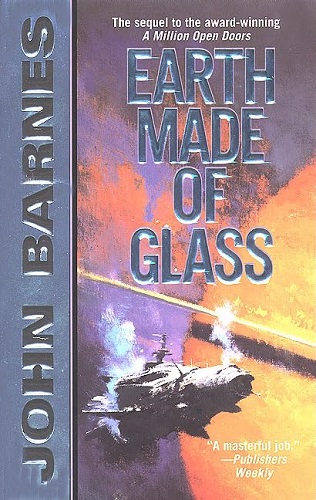
Earth Made of Glass, John Barnes

A sequel to A Million Open Doors (1992, USA), which I did not like much, also set in Barnes’s Thousand Cultures universe and featuring the same characters, Girault and Margaret Leones. Earth Made of Glass (1998, USA) was shortlisted for the Clarke Award in 1999.

This second Thousand Cultures novel is, I think, a better book – at least, I liked it slightly more – but not for the right reasons. Like the novel preceding it, the story could easily take place in the present-day. It doesn’t need to be science fiction. In A Million Open Doors it was toxic masculine society versus repressed puritanical society. Here, it’s racist society versus enclosed society. In the first novel, the two cultures were invented, openly so, but invented based on a set of principles. In Earth Made of Glass, the two cultures, which share the limited habitable area of the world of Briand, are appropriated. The Tamil Mandalam are an attempt to create the culture of southern India in the first few centuries CE, specifically that which generated the Cankam, a huge body of epic poetry often considered to be the historical highlight of Tamil literary culture. The Maya of Kintulum, on the other hand, are a best-guess at how the Maya actually lived. None of those involved in setting up the two cultures had any connection, cultural, racial or geographic, to them.

By the time the springer arrives at Briand, the Tamil and the Maya hate each other, and consider each other to be less than human. A past disaster has resulted in a Maya shanty town outside the Tamil capital of Tanjavur. Ethnic violence is commonplace. The main Maya city of Yaxkintulum is completely off-limits to the Tamil. Girault and Margaret are sent in undercover to find some way to stop the ethnic violence and bring both cultures peacefully into the Council of Humanity fold.

Barnes does a good job of describing Tanjavur and its culture, but the endless racism towards the Maya gets tiresome very quickly. (As does the joke about people trying to pronounce Girault correctly.) And when the action shifts to Yaxkintulum, it proves just as fascinating a place (and, ironically, the Maya relied heavily on AI to invent the stories and myths which are carved into every available surface in the city). The Maya want to improve relations, and embark on a risky plan. They send a Mayan prophet to Tanjavur, with a message to not let their lives be defined by their literary corpus or mythology. Things began to look up, but then rapidly go downhill.

The two cultures are fascinating, but it feels like a guilty pleasure. Occitan and Caledony in A Million Open Doors were entirely invented; Tamil Mandalam and the Maya are not. They’re very deliberately skewed takes on real cultures. It feels like misuse, or perhaps even abuse, even though they make for a more interesting read than the dull Occitan and Caledon cultures. There is also a major female player in the plot – she’s not a character because Barnes’s characterisation of her is basically “slut”, but she has more impact on the story than anyone else. Every mention of her leaves a bad taste in the mouth. Even more so, when the narrative seems to expect the reader to admire the most racist of the Tamils.

There were two more novels after Earth Made of Glass, The Merchants of Souls (2001, USA) and The Armies of Memory (2006, USA). There’s mention in both A Million Open Doors and Earth Made of Glass of an alien race whose artefacts have been discovered in numerous places, and that sort of makes me want to read the rest of the quartet, even though I may find lots in them I don’t like…


2 Comments

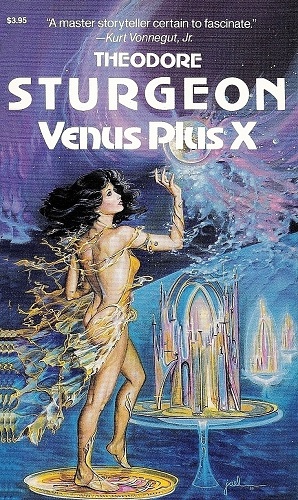
Venus Plus X, Theodore Sturgeon

This was a reread, although I couldn’t tell you when I last read the book. The late seventies or early eighties, at a guess. I’d remembered the novel’s basic set-up, but nothing else. Venus Plus X (1960, USA) is set in the distant future, in a utopian community of hermaphroditic humans (not really an acceptable term these days, but these have the organs of both sexes and can procreate). 

A man from the mid-twentieth-century is pulled forward in time to the community of Ledom. Yes, it’s “model” backwards, but Sturgeon admits in a postscript he reversed the name of a can of his favourite tobacco. The time-traveller, Charlie Johns, is asked to give his opinion on Ledom and its society. Various guides show him around and explain things. Everything in Ledom is a consequence of the “A-field”, a sort of force-field, and the “cerebrostyle”, which can write knowledge directly onto people’s brains. There is also a chapter on biology – the Ledoms have both sex organs, and two uteruses, and always give birth to twins.

Alternating with this guidebook-style narrative is some sort of sitcom featuring two families who live next door to each other. These sections are almost entirely dialogue.

(The cover shown above, which I think is the edition I have in storage, badly misrepresents the actual story)

There are long sections on gender, which I suspect only gammons and terfs will disagree with, and religions, which manages to erase almost all of them except Christianity and misrepresents those it does mention. Sturgeon’s thesis is that both of these – the elimination of gender through the creation of hermaphroditic humans, and a charitic religion – were necessary to create the utopian Ledom. Except, while Sturgeon rightly points out gender roles are social constructs, he still defines them using biological sex; and, as others have pointed out, the gender politics Sturgeon presents were not universal even back in 1960 – and his model society only exists more because of its two magical inventions than anything else.

Charlie learns Ledom exists inside an A-field bubble on an Earth devastated by nuclear war. He also discovers – against the wishes of the Ledom senior members – that the Ledoms give birth to normal humans, which are then (surgically?) altered to be Ledoms. For some reason, this sends Charlie completely off the rails and he tells them he, and all humans, would kill them if they could. When Charlie tries to escape to the past, he discovers the truth about the time-travel machine. Meanwhile, nuclear bombs explode outside Ledom’s A-field – is this implying humans still live? Or that Ledom is actually in the present? It’s unclear.

Sturgeon writes that he wanted to write a novel about sex. The novel credited with introducing the topic of sex into science fiction is Philip José Farmer’s novella, ‘The Lovers’ (1952, USA). The earliest sf novel I can find centred around a hermaphroditic character is Katherine Burdekin’s Proud Man (1934, UK), but in that novel the hermaphrodite travels back in time from the future to 1930. Burdekin’s novel, according to Wikipedia, criticises gender roles. Venus Plus X doesn’t do that – it posits a near-utopia, which despite its arguments only survives because it hides a horrible secret, which, to be fair, is a common science fiction trope, sort of like soylent green. I wasn’t convinced.

The title, incidentally, comes from the phrase “men are from Mars, women are from Venus”, and Charlie speculates the hermaphroditic Ledoms are women with a bit extra, “x”. Ugh.


Leave a comment

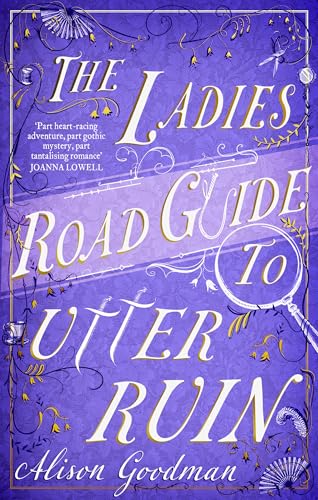
The Ladies Road Guide to Utter Ruin, Alison Goodman

The Ladies Road Guide to Utter Ruin (2025, Australia) is a direct sequel to The Benevolent Society of Ill-Mannered Ladies (2023, Australia), a Regency crime/romance novel, from a writer whose previous work was a Regency dark fantasy trilogy (plus a straight-up fantasy and a straight-up crime novel). I really enjoyed The Benevolent Society of Ill-Mannered Ladies, so picking up what looks to be the second book in a series was a no-brainer.

Lady Augusta, Gus, and Lady Julia are in their early forties and independently wealthy. Lady Gus has never wed, Lady Julia is a widow. In The Benevolent Society of Ill-Mannered Ladies, they were held up by a highwayman, who proved to be a lord transported twenty years earlier for killing someone in a duel. He was back to rescue his sister, who had been put in an insane asylum by their brother, the current title holder, for being a lesbian. Lady Gus and Lady Julia get involved in Lord Evan’s plan to free Lady Hester, and Lady Gus gets involved with Lord Evan.

The Ladies Road Guide to Utter Ruin carries pretty much straight on from the end of the first book. Lady Gus and Lady Julia freed Lady Hester and are now keeping her, and her partner, hidden. Lady Julia is enjoying the company of Mr Kent, the Bow Street Runner who helped them. Lord Evan is still in hiding, but it seems he might not have killed his opponent in that duel, so he and Lady Gus are hunting for evidence to exonerate him. However, there’s a vicious thieftaker on his trail, and it’s someone in the Exalted Brethren of Rack and Ruin, a gentleman’s club not unlike the Hellfire Club, who’s pulling the strings. Lord Evan’s involvement is a mystery, but they’re a bad lot – women have been known to enter their club house and not come out. Meanwhile, Lady Hester’s brother is trying to track her down, and the brother of Lady Gus and Lady Julia has things to say about their behaviour…

People have been churning out these sorts of novels since Georgette Heyer first invented the genre back in the 1920s. There were even imprints dedicated solely to Regency romances. I called The Ladies Road Guide to Utter Ruin a Regency romance/crime novel, but really it’s not much different to Heyer’s “adventure” novels. What has changed since the days of Harlequin and Signet and Zebra, with their garish covers, is the presence of social commentary – although I seem to remember Fiona Hill’s Regency romances from the late 1970s and early 1980s included it. But Goodman’s series not only features social commentary, but also social justice – and it’s from a present-day perspective. Which only makes the books more likeable. I mean, I do like me some Heyer, but some of the baked-in sensibilities in her books are hard-to-take: the unexamined privilege, old men marrying teenage girls, the blindness to social inequality, the demonisation of the poor… 

Heyer did have the wit, of course, and the charm, and there she reigns supreme. Goodman’s first-person narrative is not so light, but it does cover weightier topics, and in her favour she makes excellent use of a number of real historical figures. These are fun, but also a little more meaningful than most novels of their type. Recommended.


Leave a comment

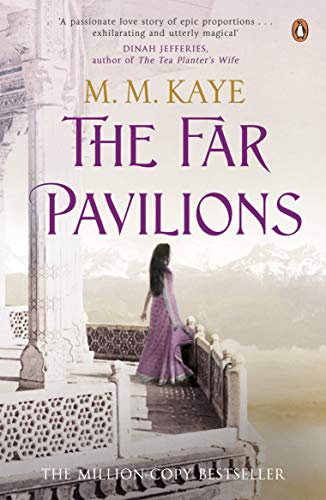
The Far Pavilions, MM Kaye

I read The Far Pavilions (1978, UK) back in the 1980s while visiting my parents in Oman. It was hardly my usual reading fare, but the book choice was limited. (I also read Shirley Conran and Judith Krantz that holiday.) I enjoyed it so much I went on to read all of Kaye’s novels, and even tracked down copies of her Death in… series, which were hard to find at the time. Since then, I’ve watched the TV adaptation of The Far Pavilions, starring Ben Cross and Amy Irving, a couple of times, but it’s a poor adaptation.

The Far Pavilions is set during the 1860s and 1870s, when the Raj ruled much of India. The plot follows Ashton Pelham-Martyn, whose parents died when he was young, and he was brought up, believing himself to be Indian, by his nanny in the invented Himalayan kingdom of Gulkote. He learns he is British at age eleven and is shipped off to Britain, returning a decade later as an officer of the Corps of Guides. After going AWOL for a year to recover stolen rifles from Afghan tribesmen, he is suspended and charged with escorting a royal wedding party across India. One of the princesses proves to be his childhood playmate, Anjuli, and the two fall in love. She is married to the rana of Bhithor, and Ash is sent to various places in India until the Guides are ready to have him back. Then he learns the rana has died and the widows will commit suttee. So he rescues her and spirits her away. Meanwhile, there’s been trouble in Afghanistan – once labelled the “graveyard of empires” – thanks to the Great Game, with the Russians sending a mission. Ash goes undercover among the tribes. The Second Anglo-Afghan War takes place. Afterwards, the British send a mission to Kabul, which Ash tells them is ill-advised. And so it proves…

I’d forgotten how good this book was. The TV adaptation overrode some of my memories of the novel, and not for the better (it didn’t help they had a white actress in brown make-up play Anjuli). The Far Pavilions is also a thick novel, and does occasionally get bogged down.

Much of it is historically accurate – the two main characters are invented, as are the two princely states involved in the wedding party; but many of the supporting cast are real historical figures. Kaye is critical of the treatment of India by the Raj, and before it the East India Company, and of the English’s behaviour towards the Indian people. It’s clear where her sympathies lay (Kaye was born in India, and lived there a number of times throughout her life). There’s some lovely descriptive writing of the landscape, but Ash in an almost constant state of anguish gets a little wearying. The final section of the book, about the British mission in Kabul, is also drawn out somewhat. But it’s good stuff, and I’m glad I reread it. Recommended.

Incidentally, it was Kaye’s agent who persuaded her to write about India. She had previously published a series of murder-mysteries. He was Paul Scott… who later went on to write the Raj Quartet (1966-1975, UK), which I very much recommend. 


Leave a comment

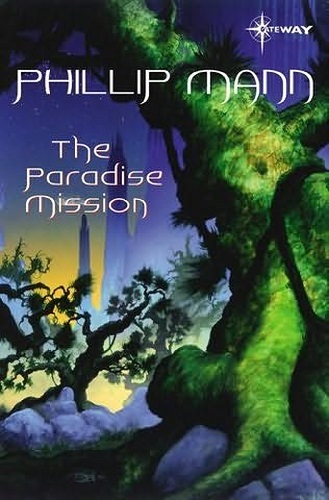
The Paradise Mission, Phillip Man

I’ve been a fan of Mann’s science fiction for many years, but I was disappointed by his last sf novel (he died in 2022), The Disestablishment of Paradise (2013, New Zealand), which was shortlisted for the Clarke Award. He had one more novel published, Chevalier & Gawayn (2022, New Zealand), only in New Zealand. I have a copy, bought online a couple of years ago.

The Paradise Mission (2014, New Zealand) is a novella aimed at teenagers and set on the same planet as The Disestablishment of Paradise, called, er, Paradise. One of the areas where The Disestablishment of Paradise scored highly was in its world-building. And that’s what The Paradise Mission sort of is. It’s a quick run-through of the more notable lifeforms on Paradise, as encountered and experienced by a somewhat breathless narrator.

Hetty is an Explorer, an interstellar scout sent on solo missions to survey planets. Previously, she had been on two-person missions with Crispin, but now Crispin is missing. He landed on Paradise, and no one has heard from him since. Except for a puzzling message saying he has found gold.

Hetty makes her own way to Paradise to hunt for Crispin. She finds his ship and lands beside it, but there’s no sign of him. Notes in his cabin point to three locations around the planet, which she then visits in her air-sled, finding him at the third. The bulk of the story is Hetty making sense of the flora on Paradise, which includes: the Dendron, 220 metre tall three-legged ambulatory tree-like creatures; Monkey Jokers, which are a sort of plant spider; the Michelangelo, a pitcher plant with psychic abilities; and a plant that creates vast tubes in the mountains, which act like organ-pipes and leads to Crisping labelling the range the Windsong Mountains.

Hetty has adventures. She finds Crispin, who is trying to help a Dendron which is ready to reproduce but can’t without help from another Dendron. Hetty uses her earlier encounter with a Michelangelo to call for a Dendron. Afterwards, Hetty and Crispin decide Paradise should remain untouched, and so falsify their reports to the Space Council.

Given The Disestablishment of Paradise is about the closing down of a colony on Paradise, it seems Hetty and Crispin were unsuccessful in protecting the planet. Having said that, there’s no indication how much earlier to the novel The Paradise Mission takes place. As for the novella being aimed at teenagers… other than Hetty being quite, well, excitable, as a narrator, and the frequent mentions of the young age of Explorers – and their capacity for risk-taking, and curiosity, etc, which justifies this… Well, there’s not much that makes it a YA novella – although the two characters are not explicitly described as teenagers, they’re at minimum not far from it.

Mann’s oeuvre, while small, packed a punch. The Story of the Gardner – Master of Paxwax (1986, New Zealand) and The Fall of the Families (1987, New Zealand) – is a superior space opera, and very much unlike most space operas. The A Land Fit for Heroes quartet (1993-1996, New Zealand), an alternative history in which Rome did not fall, presents a fascinating portrait of an alternate Britain. His other sf novels were high-quality literary sf of a type you rarely see these days. But The Paradise Mission is one for completists, I suspect. It’s hardly a good introduction to his work… 

Although it is a good introduction to the setting of The Disestablishment of Paradise.


Leave a comment

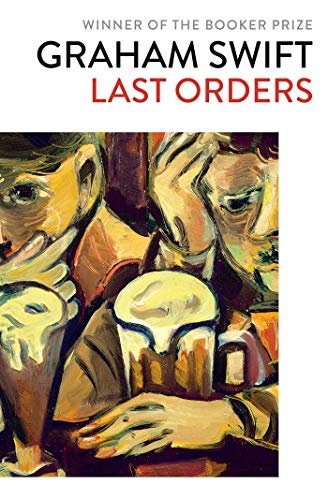
Last Orders, Graham Swift

Winner of the Booker Prize in 1996, beating out, among others, Margaret Atwood’s Alias Grace (1996, Canada), which is an outstandingly good novel, probably her best. But Last Orders (1996, UK) is very good, and one that grows on you as you read it.

Jack Dodds has died and his adopted son and three old friends agree to take his ashes to Margate to throw them into the sea. The novel is about the journey, but it’s also about the past of the five men, their wives and daughters (although they don’t appear much in the story), and their relationships. Jack and Ray fought together in North Africa during WWII. Jack’s butcher shop was on the other side of the street to Vic’s funeral parlour. Lenny was a childhood friend, whose daughter had a relationship with Jack’s son. Who isn’t really his son, but the sole survivor of a neighbouring family whose house was hit by a bomb during the Blitz. Vic is the closest to middle-class as he’s a funeral director, he might even be lower middle class. Vince, the adopted son, is upwardly mobile (a very definite thing in the 1980s), a butcher’s son turned mechanic, but now running a car showroom specialising in top-end second-hand motors. The odd one out is Ray, who works in an office as an insurance clerk, but makes a tidy living betting on the horses.

Last Orders is set mostly in Bermondsey, south east London, during the years following World War II. Jack dies in the 1980s – the film is explicitly set in 1989. The story is told through the voices of its cast, which is East End English – not Cockney, not Estuary Speak, but the English of the London working class of the first half of last century. Swift’s control of voice is really impressive. The prose is a joy to read.

It occurred to me while reading the novel the setting had been spoiled by Guy Ritchie and all those “Mockney” movies. Last Orders is about working class culture in central London. Little of which exists anymore. For example, the novel mentions hop-picking, which was a thing up until the 1960s. Working class people from London would spend the summer in Kent, living in tents and shacks, and picking hops. It was the only holiday they had. The practice ended when farmers began using machines to pick hops.

Which suggests Last Orders is in part a paean to a lost way of life – signified, for example, by Vince’s refusal to be the son in “Dodds & Son, family butchers”. It’s in the nature of progress for ways of life to disappear. Tradition is a social brake, usually imposed for the wrong reasons. Ruing change is healthy, rolling it back is not. Last Orders makes that explicit, because disposing of Jack’s ashes also disposes of the world he knew.

Last Orders: lovely writing, with an excellent command of voice. And if it’s overly nostalgic, that’s the point. Recommended (the book more so than the film).


Leave a comment

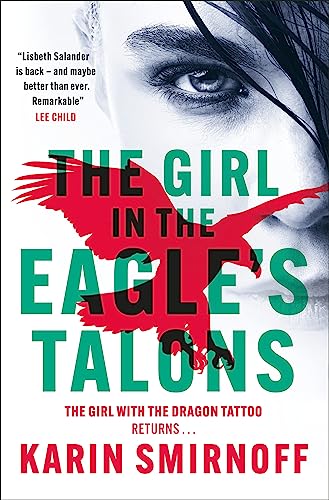
The Girl in the Eagle’s Talons, Karin Smirnoff

The start of the third trilogy featuring Lisbeth Salander and Mikael Blomkvist, and a new author. As indicated by the title, I read it in English – and… a new translator too. This time it’s a professional translator from Swedish to English. The English version keeps up The Girl… book titles, which are not of course direct translations of the original Swedish titles. In this case, it’s Havsörnens skrik, The Sea Eagle’s Cry – but weirdly, it’s a boy who finds himself in the titular, er, appendages.

Blomkvist is in the invented town of Gasskas in Norrbotten, a county in the most northerly part of Sweden. He’s there for his daughter’s wedding. To the head of the Gasskas kommune (district council/municipality). Who Blomkvist doesn’t like from the moment he meets him as he seems to be a bit of a chancer. Honest – but not the most transparent of politicians. Especially when it comes to a deal to build Europe’s biggest windfarm on land in the district. There are three companies in line to take a third each of the contract, but one wants 100% of it, a shadowy Swedish company run by a disabled psychopath who lives in a refurbished military bunker near Gasskas.

Lisbet Salander is in Gasskas because her half-brother’s daughter – previously unmentioned in the series, unsurprisingly – is about to go into care, and Salander is the only surviving relative. The daughter, Svala, is a genius like Salander, and also has the same genetic condition as her father which means she doesn’t feel pain.

The two narratives are connected. Svala’s mother is missing because she’s been kidnapped by the psycho millionaire. Blomkvist’s soon-to-be son-in-law is being threatened by the same psycho to give him the entire contract. The two stories intersect when Blomkvist’s grandson is kidnapped at the wedding.

There’s little that’s new here, except perhaps the setting: the Swedish north. Blomkvist is a bit more of a fogey than in earlier novels, and Svala fills more of Salander’s typical role than Salander does. The villains are almost caricatures – they even have a secret underground lair!

The writing is better than the Lagercrantz trilogy, although that’s hardly a high bar to clear. Everything is in present tense, which gives it more urgency, and often drops into choppy sentence fragments. It works, to an extent – although I don’t think the material is really strong enough for it, given everything is so clichéd. 

This is the English prose, of course, so it seems the translator is much better. There were a couple of questionable choices: Systembolaget is referred to throughout as “the off-licence”, which may well be a UK term for a shop that sells booze, but Systemet is the state liquor monopoly chain, which is not quite the same thing. The word “Lapp” is used interchangeably with “Sámi”, even though it’s considered offensive, and it’s not always in dialogue or in the POV of characters who are prejudiced. And someone orders “a pizza salad”, but “pizza salad” is the name of a side-dish in pizza restaurants here (the indefinite article looks odd – like, you order a pizza and say “and garlic bread”, not “and a garlic bread”).

So, slightly better than the preceding three books, and makes good use of the series mythology. They are at least better than Dan Brown’s “weapons-grade bollocks” – and English is his first language! – but even for a commercial thriller this is near the bottom of the barrel.

And yes, I really should try reading the books in Swedish.