
Another allegedly classic sf novel, which was nominated for the Hugo in 1963. Dick’s The Man in the High Castle (1962, USA) won that year, and was easily the best of the shortlisted novels. Little Fuzzy (1962, USA), on the other hand, is slight, not in the least bit plausible, and opens from a position of such comprehensive US hegemony its story is pretty much unrecoverable.
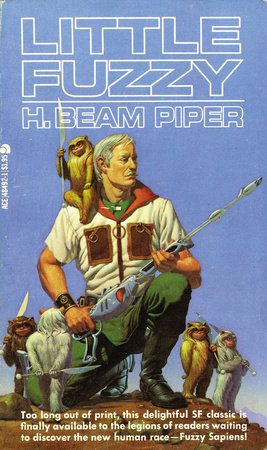
The title refers to the indigenous race on Zarathustra, waist-high cute-looking furry creatures with an average intelligence comparable to that of small children. Humans have been on the world for several decades before the first “Fuzzy” appears, and the corporation which owns the planet quickly realises that a native race invalidates their ownership of the world and all its resources. So they play dirty in an effort to prove the Fuzzies either non-existent or not intelligent. A situation which comes to a head when a company bigwig stamps on a Fuzzy, killing it, and a company bodyguard is shot and killed in self-defence.
Like a lot of American sf of the period, this is resolved by people coming together, homespun legal wizardry, a general distrust of the government (and governing corporation), and a handful of native backwoods cunning from several of the cast. While the local governor is corrupt, the local Navy base is packed to the gills with upright honest officers and personnel. The corrupt mayor is a cliché, but so too is the valorisation of military probity – at least in 1962, before the Vietnam War. There are entire Hollywood movies from the 1930s through to the 1950s which use any one of those tropes on which to hang a plot. And each one is as hokey as the next.
If anything, Little Fuzzy multiplies the hokiness. It’s a novel with far more mouthpiece characters than it needs or the reader deserves. The Fuzzies may be intelligent enough to determine their own destiny, but the humans on their side seem to treat them chiefly as precocious pets. There are many arguments to be made about the European invasion of continental North America, but this novel doesn’t even come within spitting distance of them. It’s the colonisers defending the colonised against the colonisers’ own kind, for reasons that are best not examined too deeply.
 It Doesn't Have To Be Right...