I have only a small number of literary heroes, but in all cases my admiration of them – and my decision to collect their oeuvre – was sparked by a single book. With Lawrence Durrell, for example, it was The Alexandria Quartet, his most famous work. Likewise for Paul Scott, after I read The Jewel In The Crown, the first part of the Raj Quartet, also his most famous work. But for the latest author to join this august company, it was not their best-known work I read. It was in fact a posthumous collection. And, to be honest, the first story in it did not bode well at all. But I persevered, and the second story, a novella, proved to be very very good indeed. And pretty soon I was hooked.
The book was Hear Us O Lord from Heaven Thy Dwelling Place, and the author was Malcolm Lowry. I knew of Lowry, of course; though previously I had never read anything by him. But I’d picked out the aforementioned collection, Ultramarine and Under the Volcano from my father’s Penguin paperbacks collection to read. I have subsequently ordered more Lowry books. Lowry only saw two novels published during his lifetime – which will at least make collecting signed editions easier… When he died, he left behind a number of manuscripts which were edited by his wife and subsequently published. He also left behind several hundred poems. Here’s one of them. It’s from Selected Poems of Malcolm Lowry, published in 1962 and number seventeen in City Lights Books’ The Pocket Poets Series.
Venus
And, when you go – much as a meteor,
Or as this swaying, incandescent car,
Which, like lost love, leaves lightnings in its wake,
(And me, an aspen with its Christ in mind,
Whose wood remembers once it made a cross,
So trembles ever since in wind, or no wind)
But most like Venus, with our black desire
Which blinds me now, your light a horned curve
First; then, circling, a whitely flaming disc,
Not distance, but your phase, removes the mask –
Until you burn the brightest of all stars –
Pray then in your most brilliant lonely hour
That, reunited, we may learn forever
To keep the sun between ourselves and love.
Back in December last year, Anarchy Books published an ebook-only anthology, Vivisepulture. It contains twenty-two “weird tales of twisted imagination”, including one by me titled ‘Wunderwaffe’. When editor (and author) Andy Remic had asked me for a story for an anthology of “bizarro” fiction, I’d known straight away what I wanted to write about: Nazi flying saucers. I was aware of Iron Sky – I had in fact seen an advance trailer for it – but I’d been fascinated by the whole Nazi secret science mythology for a number of years. (This had led me to attempt reading WA Harbinson’s Projekt Saucer series, but I gave up after the second book as they really are quite appallingly written.)
In the event, the story I sent Andy Remic only mentioned Nazi flying saucers in passing and focused more on the Bell, a strange Nazi secret science device I was also using in Adrift on the Sea of Rains. A few reviews of Vivisepulture appeared online, one or two of which praised my story.
Recently, a twitter conversation prompted me to send Lavie Tidhar a PDF of ‘Wunderwaffe’ for him to read. But he is – and he freely admits it – somewhat dilatory at reading ebooks. So I cobbled together a little chapbook of the story, printed it off and sent to him.
I’ve produced twelve copies of the Wunderwaffe chapbook, so there are eleven remaining. I’m tempted to put them up on the Whippleshield Books website for sale. I’m also tempted to make chapbooks of one or two other stories I’ve written – perhaps ‘Dancing the Skies’ from The Monster Book for Girls; or ‘In the Face of Disaster’ from Catastrophia. A good idea? I quite like the concept of “cottage industry” short fiction chapbooks, though I recognise it’s by no means a new idea. I’m even considering doing something similar under the Whippleshield Books imprint for short stories which meet the guidelines.
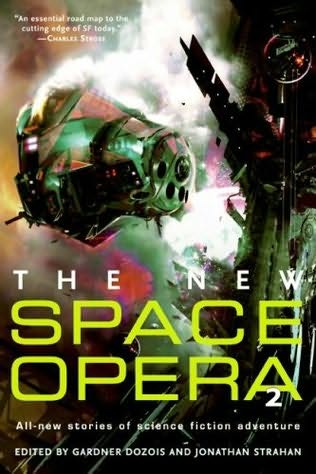
The New Space Opera 2, Gardner Dozois and Jonathan Strahan, eds.
(2009 Eos, $15.99, 544pp)
When Wilson Tucker coined the term “space opera” in 1941 to refer to “the hacky, grinding, stinking, outworn space-ship yarn”, he can’t have imagined the sub-genre would still be going strong sixty-nine years later. Or indeed that it would be considered one of the more successful forms of science fiction. That’s not to say that the “outworn space-ship yarn” no longer exists. There are plenty of examples of it being published in the twenty-first century. Some of them are even space opera.
According David G Hartwell and Kathryn Cramer in The Space Opera Renaissance (2006), space opera never went away and merely evolved over the decades into the form we now call New Space Opera. Which is, of course, to completely ignore the British re-invigoration of the sub-genre in the 1980s and 1990s. Before there was New Space Opera, there was New British Space Opera. Of the nineteen authors in The New Space Opera 2, only three are British. Since this anthology is a successor volume and its publisher is American, this is not unexpected. Likewise the fact that eleven of the authors are from the US, with only three Canadians and two Australians. Science fiction is a US-dominated genre.
But is space opera?
It is, if you extend its definition to include some of the stories in The New Space Opera 2. Because from this anthology, the only possible conclusion is that the new space opera has not only morphed back into the old space opera, but it has also expanded to include a great deal more of science fiction. How else to explain the stories by Kristine Kathryn Rusch or Elizabeth Moon in The New Space Opera 2? Both are the sort of sf CJ Cherryh was churning out by the yard in the 1980s. Or Mike Resnick’s spoof tale, which may riff off Tucker’s original definition, but seems to miss the point of new space opera. While John Scalzi’s ‘The Tale of the Wicked’ may be space opera, inasmuch as it features spaceships, AIs and humanity at war with an alien race, it has neither the vigour, scale, nor inventiveness of new space opera. And Bill Willingham’s ‘Fearless Space Pirates of the Outer Rings’ is pure pulp sf, although its ending does drag it into the twenty-first century.
Perhaps this is the way of things. A new movement injects vigour into a moribund genre, and is then subsumed by it. Which is not to say that science fiction was entirely moribund, nor that it has been wholly re-invigorated. There is still a whiff of corruption from some areas of sf.
Happily, The New Space Opera 2 is mostly a good read. With contents provided by, as the back-cover blurb has it, “some of the most beloved names in science fiction”, the stories are readable and mostly entertaining. But naming any anthology after a movement – however arguable its definition – is a hostage to fortune. There are some good stories in The New Space Opera 2. There is some new space opera in The New Space Opera 2. There is even a small overlap between those two groups. But there are a number of pages which do not belong in either group.
The New Space Opera 2 scores best at presenting a snapshot of science fiction in 2009. It is not an all-inclusive snapshot – for that, one of the many “best of the year” anthologies is needed. The New Space Opera 2‘s contents lean in a specific direction. But the good stories in it show what’s been good in sf during the past couple of years – those stories, for example, by Robert Charles Wilson, John Barnes, John Kessel, John Meaney, Justina Robson, Sean Williams and Bruce Sterling. No anthology will ever be perfect, no matter how “beloved” its contributors. The New Space Opera 2 improves its chances with its titular theme. For most readers it will have a higher than average hit-rate. But as part two of a manifesto for new space opera, its title does it few favours.
This review originally appeared in Interzone #226, January-February 2010.
It’s been a while since I last noted here what books I’d read. Yes, I’ve given up on the readings & watchings posts, but I’d still like to record what literature I’ve consumed throughout the year. Here I shall attempt to do it in a single line per book (occasionally through the creative use of punctuation, I must admit).
A Torrent of Faces, James Blish (1967) Pleasingly detailed, somewhat dated, but a much more interesting sf novel than I’d expected.
The Girl with the Dragon Tattoo, Stieg Larsson (2005) Oof – worse than I’d expected (though I’ve heard the translation was rushed), but Blomqvist is a Gary Stu and the attempts to drag in references to the original title (Män som hatar kvinnor, Men Who Hate Women) are hamfisted to say the least.
The Immersion Book of SF, Carmelo Rafala, ed. (2010) Small press anthology of, er, science fiction; some contents better than others, though nothing stands out especially.
The Ghost, Robert Harris (2007) Blair’s biographer is murdered so pro ghost writer is drafted in and discovers something rotten in the ex-PM’s career– oh wait, it’s not Blair, it’s a made-up politician…
Devil May Care, Sebastian Faulks (2008) Faulks does Fleming and makes a pretty good fist of it – also: a Caspian Sea Monster!
Islands, Marta Randall (1976) Reviewed on SF Mistressworks here.
If the Dead Rise Not, Philip Kerr (2009) Bernie Gunther in Berlin after leaving the Kripo; and decades later in Cuba – and it’s all about corruption by US mobsters over building work for the 1936 Olympics in Berlin.
Eastmodern, Herta Hurnaus (2007) Bratislava, home to some surprisingly interesting-looking Modernist buildings; as this book amply demonstrates.
Dulcima, HE Bates (1953) I read it but I’m not sure why it was written; apparently they made a film of it too…
The Maginot Line, Rob Redman, ed., (2012) Literary paperback anthology, contains some good stories, including one by a bloke called Sales.
Goldfinger, Ian Fleming (1959). A bit like the film, but with added homophobia and sexism! – Bond turns ice-cold lesbian Pussy Galore into a warm and loving heterosexual with a good rogering; plus a half-page homophobic rant by 007.
So Long a Letter, Mariama Bâ (1980) April’s book for my reading challenge; I wrote about it here.
Girl, David Thomas (1995) Man goes into hospital but through implausible mix-up gets vaginoplasty; played for laughs, manages some sensitivity, but definitely from the male gaze so nothing learned.
The Maquisarde, Louise Marley (2002) Reviewed on Daughters of Prometheus here.
Machine, Jennifer Pelland (2012) Read for review in Vector; interesting approach to the central conceit, though a little muddled in execution.
Disguise for a Dead Gentleman, Guy Compton (1964) Actually DG Compton: murder most foul at a public school; some nice-ish writing but a bit all over the place structurally.
Two Sides of the Moon, David Scott & Alexei Leonov (2004) Reviewed on A Space About Books About Space here.
The Summer Book, Tove Jansson (1972) Not a Moomin in sight, just grandma and granddaughter having fun and games among Finland’s islands; simple, elegiac.
Impact Parameter & Other Quantum Realities, Geoffrey A Landis (2001) Variable collection by Analog/Asimov’s stalwart; contains a couple of good ones, but a few are surprisingly poor given their initial publication venues.
Time Future, Maxine McArthur (1999) Reviewed on SF Mistressworks here.
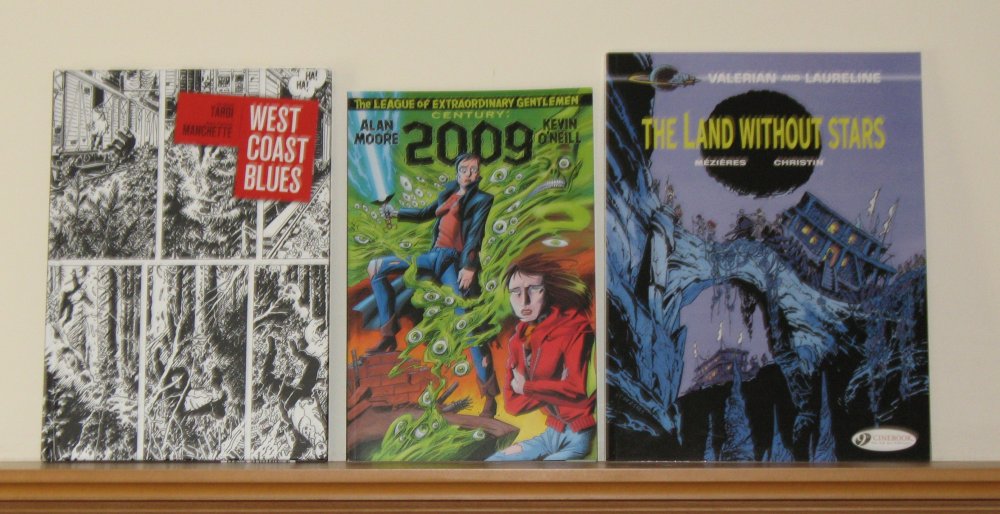
Valerian 3: The Land Without Stars, Mézière & Christin (1972) English slowly catches up with famous French lightweight space opera bande dessinée series.
The Jagged Orbit, John Brunner (1969) Even in 1969, Brunner should have thought twice about this – a near-anarchic over-armed US with voluntary racial segregration; painfully, embarrassingly and datedly hip.
West Coast Blues, Jacques Tardi (2009) Bande dessinée about a man who goes on the run after being mistakenly targetted by hitman; astonishingly nihilistic.
In Great Waters, Kit Whitfield (2009) European history re-imagined with mermen, sort of; a slow start, drags even slower for the first third, then gets moving… and proved actually rather good.
The White Peacock, DH Lawrence (1911) His first novel: structurally weird and the viewpoint lacks rigour, but some lovely prose and it all feels very local to me; will definitely be reading more.
Ison of the Isles, Carolyn Ives Gilman (2012) Read for review in Vector – sequel to Isles of the Forsaken (see here), and not quite the expected story; some excellent bits nonetheless, though the plot feels a little problematical.
Starship Winter, Eric Brown (2012) Third in a quartet of seasonal novellas set on the world of Chalcedony; shenanigans at an art exhibition; the weakest of the three so far.
The Sea, The Sea, Iris Murdoch (1978) Published in 1978, from the characters’ ages would appear to be set in 1968, feels like it was set in 1958; Booker Prize winner, though felt far too long and flabby to me.
Starshadows, Pamela Sargent (1977) Collection of early short fiction with a patronising introduction by Terry Carr; will be reviewed on SF Mistressworks soon.
‘À Propos of Lady Chatterley’s Lover’ & Other Essays, DH Lawrence (1961) English literature’s one true Puritan wibbles on about masturbation (bad), the right sex (good), marriage (sacrosanct!) and obscenity (“moi?”) – he really was a dirty old reactionary…
Griffin’s Egg, Michael Swanwick (1990) Novella about, er, a group of astronauts stranded on the Moon after a nuclear war on Earth – not an inspiration, honest; nor anywhere as good as I’d vaguely remembered it.
For every book you see in these book haul posts, I get rid of two books. So the collection is steadily being reduced to manageable proportions… That is, of course, a complete lie. It’s getting bigger every month. It’s not quite up to hoarder levels yet, but there are piles on the floor. And they reach knee-height.
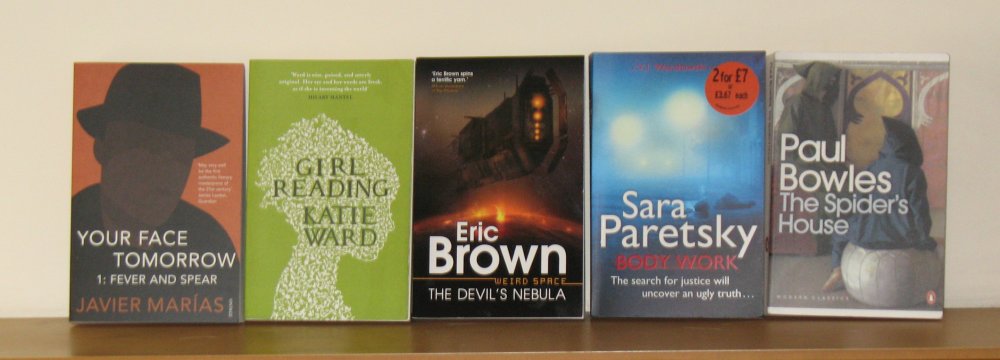
Some paperbacks, new and second-hand. Fever and Spear is, er, May’s book for this year’s reading challenge. I really must get caught up on that. Girl Reading I borrowed from my mother after seeing a positive comment on it on someone’s blog. Eric sent me The Devil’s Nebula; one day I hope to be able to return the favour. I’ve been a fan of Sara Paretsky’s books for many years and Body Work is her latest. I found it in a charity shop. As I did The Spider’s House, though I really must get around to reading The Sheltering Sky first.
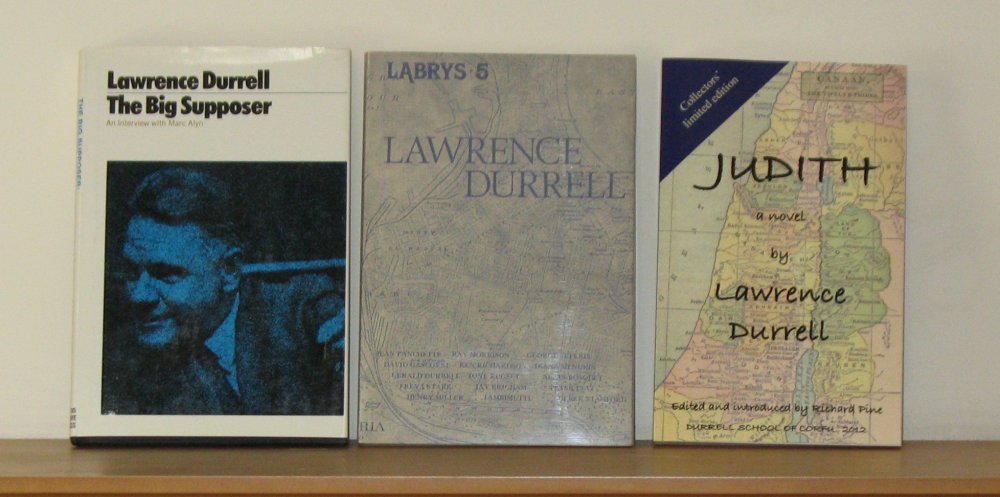
Some more Durrelliana. The Big Supposer is the English translation of a long interview which originally appeared in French. Labrys #5 is a special issue on Durrell. It’s also signed by him. And Judith is a previously-unpublished novel published only this year for the Durrell centenary.
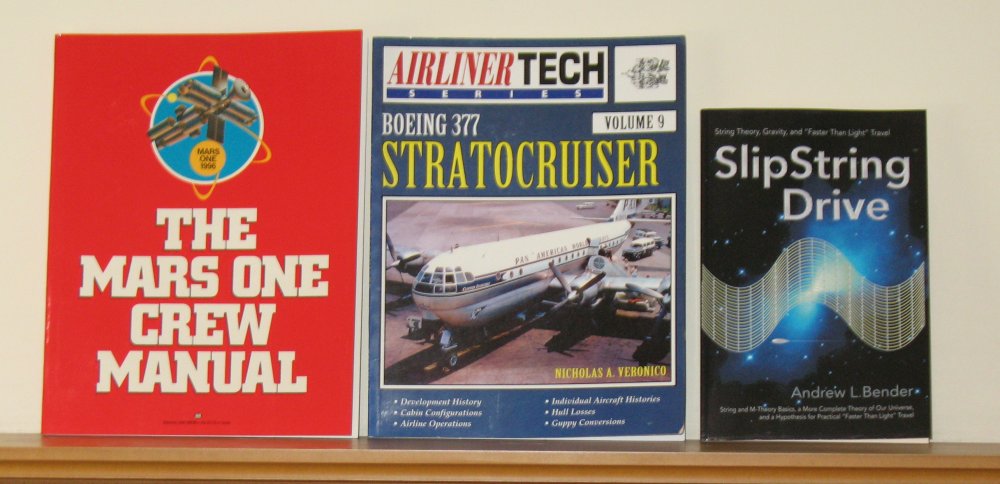
Here’s some research material. Both The Mars One Crew Manual and SlipString Drive are for Apollo Quartet 2: The Eye With Which The Universe Beholds Itself. The Boeing 377 Stratocruiser book is because I’m fascinated by the aircraft of the early days of air travel (it was also cheap on eBay).
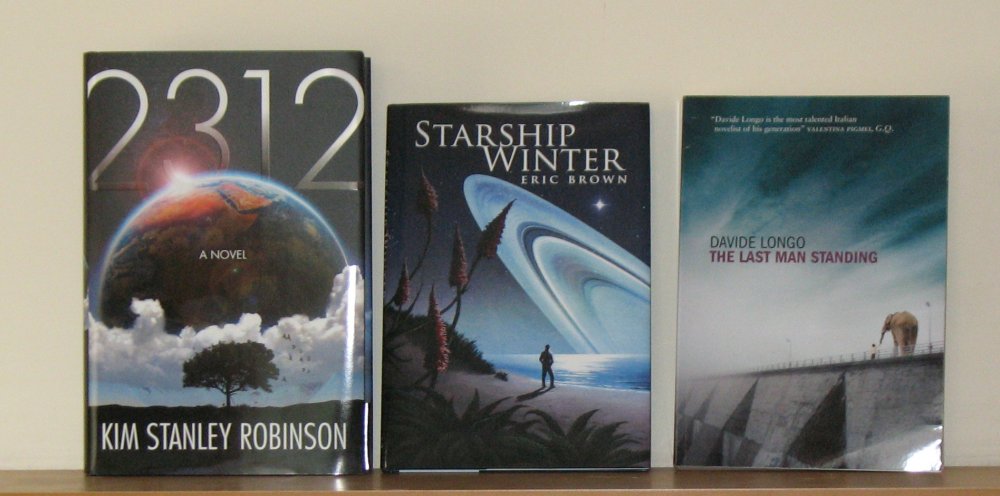
Kim Stanley Robinson is a genre writer whose fiction I admire, so I’m looking forward to reading 2312. Starship Winter is the third of Eric Brown’s seasonal novellas set on the world of Chalcedony. The Last Man Standing is an Italian novel in its first English translation, and I have to review it for Interzone.
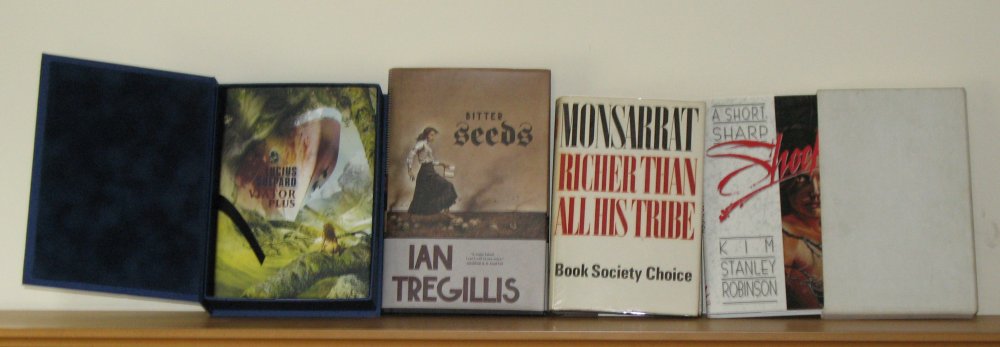
For the collection, here’s the traycased signed edition of Lucius Shepard’s Viator Plus, bought for half-price in their recent sale; Bitter Seeds I won on Twitter for a silly joke (many thanks, Andrew); Richer Than All His Tribe is signed and for the Monsarrat collection; and I found a cheap copy of the slipcased signed edition of Kim Stanley Robinson’s A Short, Sharp Shock.
I took this meme from David Hebblethwaite’s Follow the Thread blog, and he says he found it Story in a Teacup. It’s fifty-five questions about your reading. I think some of my answers are pretty much the same as David’s…
1 Favourite childhood book? I started out in sf reading Dr Who novelisations, but I can remember virtually nothing about them now. I don’t recall any specific books that I loved prior to that. I just read voraciously.
3 What books do you have on request at the library? I don’t use the library.
4 Bad book habit? Buying more books than I can read, and starting books when I haven’t finished the current read.
5 What do you currently have checked out at the library? I don’t use the library.
6 Do you have an e-reader? Nope.
7 Do you prefer to read one book at a time, or several at once? I prefer to read serially, but sometimes – often – I end up reading several books in parallel.
8 Have your reading habits changed since starting a blog? Yes. Since starting SF Mistressworks, and contributing to Daughters of Prometheus, I read far more fiction by women writers. I’ve also used this blog to challenge myself to read books I wouldn’t normally read – see this year’s world fiction reading challenge here.
11 How often do you read out of your comfort zone? Regularly.
12 What is your reading comfort zone? Science fiction and/or literary fiction. Also non-fiction about space exploration.
13 Can you read on the bus? Yes. I commute to work on a tram and read on it every day.
14 Favourite place to read? I usually read for 30 minutes to an hour in bed every night.
15 What is your policy on book lending? For my collectible books, never. Others, I’m happy to give away – and visitors have occasionally left with piles of paperbacks.
16 Do you ever dog-ear books? Never.
17 Do you ever write in the margins of your books? Never. But I will probably buy an ereader of some description soon because it’ll allow me to annotate what I’m reading.
18 Not even with text books? Nope.
19 What is your favourite language to read in? English.
20 What makes you love a book? Beautiful prose, it says something important, engaging characters, interesting structure… rigour, beauty, insight and depth.
21 What will inspire you to recommend a book? I’m happy to recommend books I both enjoy and admire; and often do.
22 Favourite genre? Science fiction.
23 Genre you rarely read (but wish you did)? I’ve read just about every genre there is, but… The genres I don’t read I generally have no intention of reading. Like urban fantasy.
25 Have you ever read a self-help book? No. I’ve no intention of ever doing so.
26 Favourite cookbook? I don’t have one. I prefer eating to cooking.
27 Most inspirational book you’ve read this year (fiction or non-fiction)? I don’t think of books as “inspirational”, or read ones that describe themselves as such.
28 Favorite reading snack? I don’t usually eat while I’m reading.
29 Name a case in which hype ruined your reading experience. Probably The Quantum Thief by Hannu Rajaniemi. It was good, but not as good as I’d expected it to be.
30 How often do you agree with critics about a book? Depends on the critic, obviously. But quite often. Award shortlists, on the other hand…
31 How do you feel about giving bad/negative reviews? Not giving a negative review to a bad book is dishonest. And dishonest reviews are next to useless.
32 If you could read in a foreign language, which language would you choose? I’ve tried reading in French, German and Arabic, and I’d like to improve my facility in those languages. But I also quite like the idea of being able to read Russian classic literature in Russian.
33 Most intimidating book you’ve ever read? In terms of sheer size, probably Ash: A Secret History by Mary Gentle. It proved to be excellent.
34 Most intimidating book you’re too nervous to begin? Possibly House Of Leaves by Mark Z Danielewski. Ian McNiven’s biography of Lawrence Durrell is also intimidatingly big, especially in hardback.
35 Favourite poet? Bernard Spencer or John Jarmain.
36 How many books do you usually have checked out of the library at any given time? I don’t use the library. When I lived in the UAE, I was a member of a subscription library and would generally take out four books every fortnight.
37 How often have you returned books to the library unread? In the UAE, I did it a couple of times. One such book was… The Alexandria Quartet by Lawrence Durrell. I later bought a copy and read it, and subsequently became a huge fan of his writing.
38 Favourite fictional character? I don’t know. There are characters I admire as writerly creations; there are characters who are little more than placeholders for the reader. I prefer the former.
39 Favourite fictional villain? See above.
40 Books I’m most likely to bring on vacation? Big fat ones that require sustained bouts of reading, such as I’ll enjoy on a plane flight or long train journey.
41 The longest I’ve gone without reading. A week, maybe slightly longer.
42 Name a book that you could/would not finish. Most recently, The Windup Girl by Paolo Bacigalupi.
43 What distracts you easily when you’re reading? The television, the internet, the cat…
44 Favourite film adaptation of a novel? It used to be The Right Stuff, but after a recent rewatch I found myself disappointed by the film. Now it would be Fahrenheit 451 – though I love the film but hate the book. Irony in action…
45 Most disappointing film adaptation? The Sylvia Kristal adaptation of DH Lawrence’s Lady Chatterley’s Lover? It’s a bad film and it’s an adaptation. But the same could be said for a lot of sf adaptations… I don’t really know. I rate David Lynch’s Dune as a flawed masterpiece (and I’d have paid good money to see Alejandro Jodorowski’s film of the book had it been made). And Paul Verhoeven’s Starship Troopers is vastly superior to the book…
46 The most money I’ve ever spent in the bookstore at one time? No idea. I’ve spent around £100 on a single order at Amazon a number of times. The most money I’ve spent on a single book is $500, for a first edition of Pied Piper of Lovers, Lawrence Durrell’s first novel. See here.
47 How often do you skim a book before reading it? Very rarely.
48 What would cause you to stop reading a book halfway through? Blatant racism and/or sexism. Offensive sensibilities. Eye-stabbingly bad prose. An inability to plot. Despicable characters.
49. Do you like to keep your books organized? Yes, though the collection is getting a little bit out of hand…
50 Do you prefer to keep books or give them away once you’ve read them? Depends. Collectibles I keep. Likewise books that were hard to find. Others I get rid of as soon as I’ve read them. I’ve also purged my book shelves several times – for example, I saw no good reason to keep the Stainless Steel Rat novels I originally bought back in the early 1980s…
51 Are there any books you’ve been avoiding? Urban fantasy novels. Anything with zombies in it. Many of the books that have appeared on recent Hugo Award shortlists…
52 Name a book that made you angry.Leviathan Wakes by James SA Corey. See my review here.
53 A book you didn’t expect to like but did?Lady Chatterley’s Lover, DH Lawrence. My father was a big fan of Lawrence’s writing, but I never bothered trying any of his books. And this despite Lawrence Durrell being a big admirer of Lawrence. But after watching Pascale Ferran’s excellent adaptation, Lady Chatterley, in 2009, I decided to have a go at the book. And loved it. After my father died, I promised myself I would read all of Lawrence’s fiction, and recently finished The White Peacock. Structurally it’s a bit odd, but there’s some lovely prose in it. And it is sort of “local” fiction for me as I was born in Nottinghamshire. I am now becoming a bit of a Lawrence fan.
54 A book that you expected to like but didn’t?Bodies by Jed Mercurio. I loved his Ascent, and thought American Adulterer very good indeed. But Bodies was just too gruesome for me.
 It Doesn't Have To Be Right...