
I first saw mention of Eric Ambler on Paul Kincaid’s blog. He praised him as a superior writer of thrillers. For some reason, I had the impression he was a 1960s and 1970s writer like, say, Hammond Innes. In fact, Ambler is from an earlier generation, published chiefly in the 1930s and 1940s. And the plots of his novels reflect that period. At least, Uncommon Danger (1937, UK), his second novel, certainly does so.
Kenton is a freelance journalist in Europe, based mainly in Germany. After losing money in a game of poker-dice, he catches the train to Vienna to borrow money from a friend. Enroute, he’s asked to carry suspicious documents across the Austrian border, which he does for money. But then the owner of the documents is murdered and Kenton is the chief suspect.
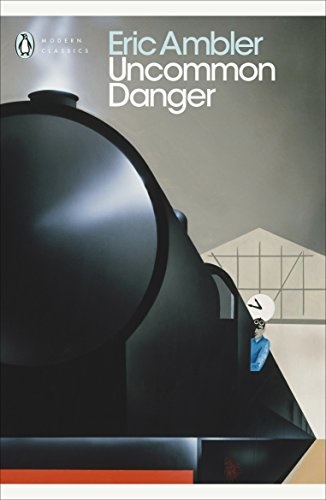
The documents are copies of a Soviet plan to invade Bessarabia (now part of Moldova) and take over its oil fields. (History fans will already know Stalin led the Soviet annexation of Azerbaijan, which was famous at the time for its oil fields.) The Soviet plan is actually speculative, rather than intended, but a UK oil company plans to use it to hoist a right-wing government into power in Romania, which will then give them majority rights to Romanian oil.
None of which helps Kenton, who is wanted for murder in Austria. He’s helped by Zamenhoff, a Soviet agent, and Zamenhoff’s sister, and the three team up to retrieve the stolen documents and scupper the oil company’s plan, as managed by “political saboteur” Colonel Robinson and his sadistic sidekick Captain Mailler.
The end result is a solid thriller, like early Graham Greene, and very much of its time. There are telephones, but they’re not ubiquitous (no mobiles, of course). Long distance travel is chiefly by train. Kenton eludes capture by the police simply by eluding individual police officers. There’s no way the plot could be transposed to the present day – Kenton wouldn’t last a minute.
Which is not a complaint. The book was published in 1937 and that’s what the 1930s were like. The politics may not have changed much, but technology and infrastructure certainly have. Ambler’s prose is good, with an interesting tendency to delve into detail. The story is surprisingly violent for its time – more so than Greene, from what I remember of his books. Perhaps the characters are a little broad brush-stroke, and the story a little predictable – although explaining the underlying plot in a prologue is unusual.
Nonetheless, a good read. And for what it is, a between-the-wars political thriller, a good example of its type. I’ve another Ambler on the TBR, which I’ll read – but I’m not sure I’d describe him as a must-read author.
 It Doesn't Have To Be Right...