
It Doesn't Have To Be Right…

… it just has to sound plausible


Leave a comment

Earth Made of Glass, John Barnes

A sequel to A Million Open Doors (1992, USA), which I did not like much, also set in Barnes’s Thousand Cultures universe and featuring the same characters, Girault and Margaret Leones. Earth Made of Glass (1998, USA) was shortlisted for the Clarke Award in 1999.
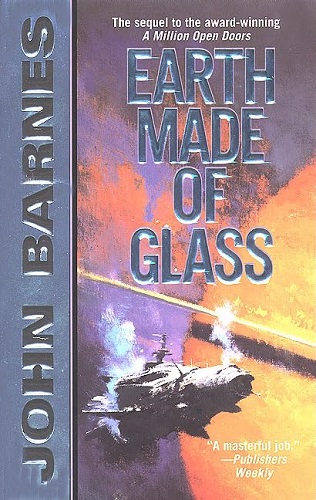
This second Thousand Cultures novel is, I think, a better book – at least, I liked it slightly more – but not for the right reasons. Like the novel preceding it, the story could easily take place in the present-day. It doesn’t need to be science fiction. In A Million Open Doors it was toxic masculine society versus repressed puritanical society. Here, it’s racist society versus enclosed society. In the first novel, the two cultures were invented, openly so, but invented based on a set of principles. In Earth Made of Glass, the two cultures, which share the limited habitable area of the world of Briand, are appropriated. The Tamil Mandalam are an attempt to create the culture of southern India in the first few centuries CE, specifically that which generated the Cankam, a huge body of epic poetry often considered to be the historical highlight of Tamil literary culture. The Maya of Kintulum, on the other hand, are a best-guess at how the Maya actually lived. None of those involved in setting up the two cultures had any connection, cultural, racial or geographic, to them.

By the time the springer arrives at Briand, the Tamil and the Maya hate each other, and consider each other to be less than human. A past disaster has resulted in a Maya shanty town outside the Tamil capital of Tanjavur. Ethnic violence is commonplace. The main Maya city of Yaxkintulum is completely off-limits to the Tamil. Girault and Margaret are sent in undercover to find some way to stop the ethnic violence and bring both cultures peacefully into the Council of Humanity fold.

Barnes does a good job of describing Tanjavur and its culture, but the endless racism towards the Maya gets tiresome very quickly. (As does the joke about people trying to pronounce Girault correctly.) And when the action shifts to Yaxkintulum, it proves just as fascinating a place (and, ironically, the Maya relied heavily on AI to invent the stories and myths which are carved into every available surface in the city). The Maya want to improve relations, and embark on a risky plan. They send a Mayan prophet to Tanjavur, with a message to not let their lives be defined by their literary corpus or mythology. Things began to look up, but then rapidly go downhill.

The two cultures are fascinating, but it feels like a guilty pleasure. Occitan and Caledony in A Million Open Doors were entirely invented; Tamil Mandalam and the Maya are not. They’re very deliberately skewed takes on real cultures. It feels like misuse, or perhaps even abuse, even though they make for a more interesting read than the dull Occitan and Caledon cultures. There is also a major female player in the plot – she’s not a character because Barnes’s characterisation of her is basically “slut”, but she has more impact on the story than anyone else. Every mention of her leaves a bad taste in the mouth. Even more so, when the narrative seems to expect the reader to admire the most racist of the Tamils.

There were two more novels after Earth Made of Glass, The Merchants of Souls (2001, USA) and The Armies of Memory (2006, USA). There’s mention in both A Million Open Doors and Earth Made of Glass of an alien race whose artefacts have been discovered in numerous places, and that sort of makes me want to read the rest of the quartet, even though I may find lots in them I don’t like…

Leave a comment

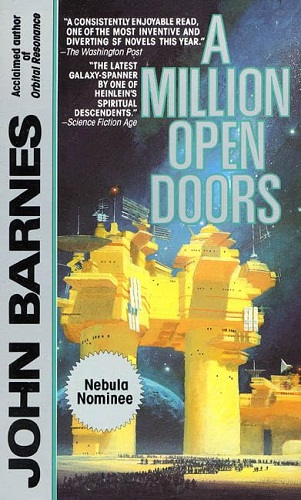
A Million Open Doors, John Barnes

Nominated for both the Nebula and the Clarke Awards. Barnes seemed to have a moment in the mid-to late-1990s, with a Hugo nomination, three Nebula nominations and three Clarke nominations. But no wins. And nothing since then except appearances on the Locus Award/readers’ poll pretty much every year until a decade ago (for his last published novel, in fact). A Million Open Doors (1992, USA) is only the second book by Barnes I’ve read – I read Mother of Storms (1994, USA) back in 1999.

A Million Open Doors is the first of four novels set in the Thousand Cultures. Taking place several centuries from now, Earth has colonised a number of worlds, each of which is home to one or more “cultures”, groups of people – ethnic, national, religious, some even completely invented. Like Nou Occitan, which is supposed to be some sort of Iberian Romantic culture of troubadours and duellists, but is really just massively sexist. The worlds were colonised by slower than light ships, but now “springers”, instantaneous transport, even across interstellar distances, connect them together.

When Giraut catches his paramour in flagrante delicto with a gang of “Interstellars” (youths aping what they think is an Earth culture by “beating up and degrading young girls”), he accompanies a friend to Caledony, which has just received its first springer. Caledony is a religious culture, which uses Christianity to justify some garbled economic philosophy. Giraut opens a school to teach Occitan culture – music, duelling, poetry, dancing, painting, etc – to the joyless Caledons. Unfortunately, the success of the Centre for Occitan Arts prompts a coup by hardliners, house arrest for the previous government, martial law and armed mobs on the streets.

To build support, Giraut and his liberal Caledon friends stage a camping trip across the continent, but there’s an accident in the mountains, resulting in several fatalities. While dashing back to get into communications range, Giraut discovers the ruin of an alien city. Meanwhile, while he was away, Council of Humanity troops have overthrown the hardliners…

Reading A Million Open Doors, I had trouble working out why it was science fiction. Yes, other planets, springers, spaceships, etc, but you could set the story on Earth. Some community full of rapists, another full of nutball religious types – I’m pretty sure you could find two towns that qualify in the US. Even the alien ruins could be the ruins of some prehistoric American culture. All the rest is just bells and whistles.

And when a science fiction novel is not science fiction, then what’s the point of it? And you also have to wonder why the novel appeared on two science fiction award shortlists. In other respects, it’s all just a little too textbook. Giraut is a male chauvinist, but he comes to value and respect women – and even falls in love with one who isn’t even attractive and whose physical flaws he mentions repeatedly. Two characters are killed irretrievably – the technology exists to bring people back using personality recordings, and there’s even an example to illustrate it, the victim of a brutal sexual assault, torture and murder. (This is not just everyday sexism, this is everyday sexual assault.) The bad guys get their just desserts – except, well, not really, a friend who insulted Giraut is humiliated (with a spanking), and the villainous pastor who seized power on Caledony is imprisoned off-world.

A Million Open Doors lost the Clarke to Jeff Noon’s Vurt (1993, UK), and the Nebula to Doomsday Book (1992, USA) by Connie Willis (Sarah Canary (1991, USA), Karen Joy Fowler, or China Mountain Zhang (1992, USA), Maureen McHugh, would have been better winners). Even so, it didn’t belong on those shortlists. It’s mediocre, its one idea is in service to a story that doesn’t even need to be science fiction, and it’s offensive in parts.