
We make foolish decisions all the time, probably even several times a day. Mostly, they cause no harm, perhaps a little mild embarrassment, and often no one witnesses the embarrassment but we know about it ourselves all the same. I have no idea why I decided to complete my exploration of Larry Niven’s oeuvre. I last read books by him back in the early 1980s, and while I had fond, if incomplete, memories of some of them, I also knew they weren’t very good. But, for some reason, I decided to read the rest of his books. I don’t know; perhaps I saw a couple, with their pretty damn cool Peter Andrew Jones cover art, in my local secondhand sf bookshop, and thought, yeah, let’s give them a go, I liked them back when I was, er, fourteen or fifteen, what could possibly go wrong?
Everything, of course.
I’d remembered the ideas in Niven’s books over the decades, and I knew he was a proponent of “transparent prose”, which is what writers say when their prose is so bad it’s almost an anti-style, and yes, I’d remembered Niven’s politics were considerably to the right of mine (and not just because I’m British but because he’s a conservative loon)… but what I’d forgotten was how effortlessly offensive his fiction was. My sensibilities were still in flux back in my mid-teens, so perhaps I just skated over the worst bits and only took the good, if rare, bits on board.
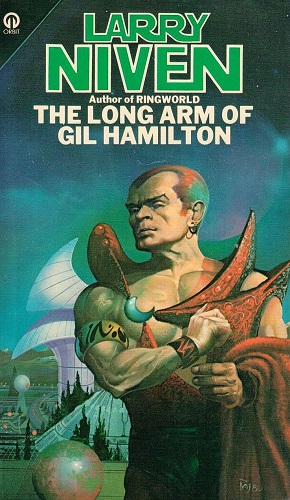
The Long Arm of Gil Hamilton (1976, USA) was not a Niven book I’d read back in the day. It’s a collection of three novellas set in Niven’s Known Space universe and featuring a single protagonist, Gil Hamilton. Who is an officer in the UN police, which is called ARM, Amalgamated Regional Militias (an unconvincing backronym, which Niven himself admits). Hamilton lost an arm in an accident in the Asteroid Belt, and developed a telekinetic arm as replacement – he has ESP, it works like an arm, only not as strong, but it can reach through solid objects. Even though he had the lost arm replaced with a transplant, he still has his psionic arm. See, the “long arm” in the title, it’s a pun: Hamilton works for ARM and he has a psionic arm too. Hoho.
Hamilton chiefly investigates organleggers… and this is where I have to wonder how I didn’t immediately recoil at Niven’s politics back in the day. Earth in the Known Space series has a population of eighteen billion, which, according to Niven, means it’s massively overpopulated and covered almost entirely by cities. (Earth currently has a population of over 8 billion but there are still vast swathes of unpopulated wilderness. I can bore you with population density by country, but you can look it up on Wikipedia yourself.) For some reason, these 18 billion people have an insatiable demand for new organs. So insatiable, in fact, that pretty much breaking any law results in a death sentence so the criminal’s organs can be harvested. Having one more kid than licensed, for example. Or drunk driving. Which first supposes the death penalty is normal – it’s not, the US is an aberration (one of around 15% of nations). And second, that all medical conditions are solved by transplanting a new organ. It’s complete nonsense, complete right-wing nonsense.
The plots of the three novellas are almost incidental. Hamilton is, to be fair, a mostly engaging narrator. In the first story, Hamilton is confronted with the seeming suicide of a Belter friend by direct simulation of the pleasure centres of the brain. Except it goes against everything Hamilton knows about his friend. It’s murder, of course. And Hamilton tracks down the killer. In the second, an attempt on Hamilton’s life leads him to suspect an organlegger who retired when the world government made it legal to use cryogenically frozen bodies for organs harvesting. The third story is one Niven freely admits he had the most trouble completing – it’s a locked-room murder mystery, of a sort, but also a sf story, which, according to the essay which ends the collection, took Niven several goes to get right… and even then it’s confusing, muddled and neither a good murder-mystery nor a good sf story.
Everything in The Long Arm of Gil Hamilton, although it mentions other nations, is Americocentric. Everything operates according to US laws and sensibilities. This is hardly surprising – it’s a US sf collection written by a US sf author for the US sf market. And that was not only common, it was the actual state of the genre for much of the twentieth century. So it seems churlish to point this out, except to say it makes these books – not just Niven’s, but other sf authors of his generation – irrelevant to a twenty-first century sf audience.
 It Doesn't Have To Be Right...