
I’d heard good things about Hardinge’s fiction for several years, but I’d never bothered checking them out because, well… fantasy… YA… Not my usual, or preferred, choice of reading. But The Lie Tree (2015, UK) popped up for 99p on Kindle, and I thought it worth seeing what all the fuss was about.
And I’m glad I did.
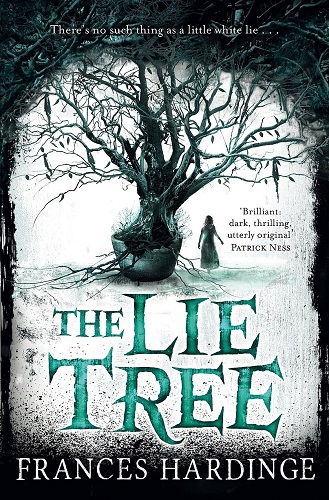
Faith’s father, a reverend, is a celebrated palaeontologist in the 1860s, but he’s been accused of faking the fossils he discovered, so he and his family flee to the invented Channel Island of Vane to join a dig there. But all is not as it seems. The invitation was a ruse because the reverend is in possession of something that others want.
On the one hand, the title of the novel is a hint to the central element of its plot, which is not revealed until at least halfway in; on the other, it’s hard to describe the plot without spoilers. The spoiler-free version would go: Faith defends her father, uncovers a conspiracy against him, then tries to solve his murder and so learns his secret, the reason why he was invited to Vane, and uses it to take revenge on his killers.
However, a major part of the novel – although it doesn’t really kick in until around a third of the way in – is that Faith is clever, but because she is a girl it means nothing. She wants to be a scientist but her gender bars her from it. This is a novel about women as property, about chattel slavery of half of the human race, and about the means and methods open to women of the time to arrange a future for themselves and then safeguard it. Faith is a teen, and knows her much younger, and not very bright, brother, whom she loves nonetheless, is accounted more valuable than her. Even though she has the intelligence, the aptitude and the interest to follow in her father’s interests.
And it’s this element of the novel which lifts it above others of its ilk. Faith thought her father valued her because of her intelligence, but he was just using her – much as he used others to further his aims. Faith meets a woman – two, in fact, but one more so than the other – who have found a way to be intellectual without offending Victorian (male) society – I am for some reason reminded of JG Farrell’s The Siege of Krishnapur (1973, UK), an excellent novel – but it doesn’t end well. And also I’m reminded of Jeanette Ng’s Under the Pendulum Sun (2017, UK), which presents as a fantasy set in Victorian times but is actually a brilliant commentary on Victorian fiction by women, missionary colonialism and women’s rights.
The Lie Tree is really good, and I should definitely read more by Hardinge.
 It Doesn't Have To Be Right...