
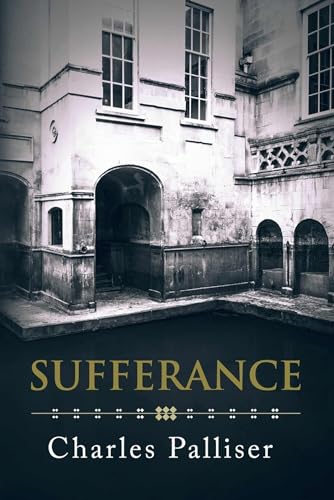
I’ve been a fan of Palliser’s novels since reading his debut, The Quincunx (1989, UK), a complex Dickensian novel about an orphan and the mysteries surrounding his birth back in the 1990s. Betrayals (1993, UK) features a pitch-perfect pastiche of the TV series McTaggart and a borderline litigious spoof of author Jeffrey Archer (allegedly based on fact). Sufferance (2024, UK) is the first book from Palliser since Rustication (2013, UK), and it’s perhaps the most obvious book he’s written to date.
In terms of length, it’s probably closer to a novelette, or perhaps a sf novel from the 1960s. It’s set in an unnamed country after it has been occupied by unnamed enemy forces – or rather, the western half of the country has been annexed, but the eastern half, where the story takes place, has chosen to collaborate. While Palliser names no names, we’re clearly in some analogue of World War 2 France.
A well-meaning man has taken in a schoolfriend of his youngest daughter, whose rich parents were trapped in the western half of the country when it was overrun. His motives are not entirely altruistic – he hopes for a better-paying job from the daughter’s father – but the girl’s family are members of a “community” whose rights and privileges are slowly taken away as the novel progresses. To the extent, in fact, their property and wealth is confiscated, they’re forced to live in a ghetto, and later are “relocated” to camps outside the city…
All of which makes looking after the girl ever more difficult. Initially, lies to neighbours are enough, but when rationing is introduced the lack of papers becomes a problem. Eventually, they have to hide the girl in the attic. Throughout all this, the girl is arrogant, ungrateful and manipulative. The title is clearly intended to refer to both the city under the collaborationist regime and the danger to the family brought on by the girl’s presence in their apartment (and, also, the behaviour of the girl to the family).
It’s hardly subtle. Pallier’s prose distances the reader from events – there are no names, the countries and period are not mentioned – but the narrative remains sympathetic to the narrator, even though his motives are chiefly self-serving. He hopes to be rewarded, but he’s also sensitive to the evolving situation regarding the community. And he’s powerless to prevent his family from suffering as the regime slowly collapses from corruption, greed and fear.
It’s all very inexorable, as no doubt it felt in the 1940s. Palliser manages to evoke sympathy in a narrator who does bad things out of greed, but soon finds himself doing worse simply in order to survive. Of course, he’s implicitly questioning the reader: what would you do to survive in the same situation? How long would you hold onto your principles? Should the laws still be obeyed, even when they’re plainly immoral?
After all, the family hiding Anne Frank was breaking the law; anyone who told the Gestapo about her would have been considered law-abiding.
 It Doesn't Have To Be Right...