Okay, so SF Signal posted this last Sunday, but I was in Berlin then, with no access to a computer. And yes, I had an excellent time, despite the weekend’s inauspicious start: getting up at 2:30 am, wandering down to the kitchen to make breakfast and stepping on a slug; and then getting to the airport and realising I’d left my credit and debit cards at home (fortunately, I had plenty of cash). Anyway, the meme…
My favorite alien invasion book or series is…?
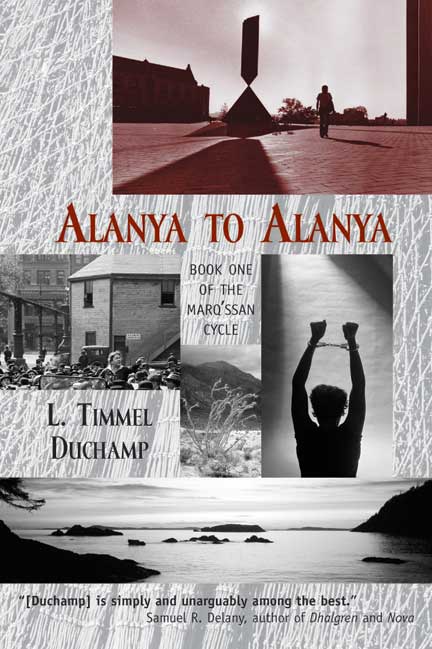
Probably the Marq’ssan Cycle by L Timmel Duchamp, although Gwyneth Jones’ Aleutian trilogy runs a close second. Duchamp’s five novels – Alanya to Alanya, Renegade, Tsunami, Blood in the Fruit and Stretto – document the arrival on a near-future Earth of an alien mission which will only talk to women. Supporting character turned chief villain Elizabeth Weatherall is one of the genre’s best creations. Jones’ White Queen, North Wind and Phoenix Café cover similar ground, but from a more global perspective. It also features, like Duchamp’s quintet, an extremely well-drawn antagonist in Braemar Wilson. Both series are intensely political and among the smartest books in science fiction.
My favorite alternate history book or series is…?
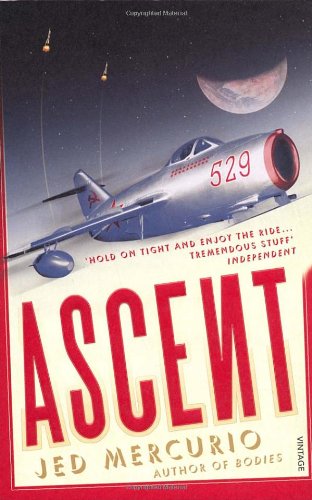
The Apollo Quartet, of course. But seriously: I’d say Ascent by Jed Mercurio, but naming it as alternate history might constitute a spoiler. It could also be argued that the superb Ash: A Secret History by Mary Gentle is alternate history. I think I’ve read my fair share of Hitler-victorious alternate histories, and I suspect there are very few changes remaining to be rung on that particular trope. Not being American, I’ve little interest in their civil war and how it might have ended differently. Stephen Baxter’s alternate take on the US space programme, Voyage, appeals for obvious reasons. And many sf novels of the past written about exploring Mars and the Moon may not have been written as alternate history, but they pretty much qualify as it now. Unfortunately, most twentieth-century sf novels about twenty-first space travel, such as those by Steele or Bova, suffer from being, well, not very good. Sadly, early and alternate space travel doesn’t seem to be an area of the genre that has attracted writers with much in the way of writing chops. Which is a shame.
My favorite cyberpunk book or series is…? Metrophage by Richard Kadrey, the book which folded cyberpunk back into science fiction. Everything that came after is just the twitchings of a dead subgenre.
My favorite Dystopian book or series is…?
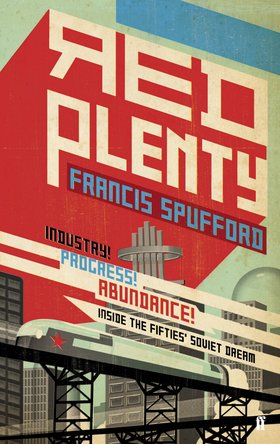
Dystopia is in the eye of the beholder. If you read Francis Spufford’s excellent Red Plenty, you’ll see that not everyone thought the USSR was a dystopia. And for all the UK’s fabled streets of gold, it’s starting to look more and more like a dystopia each day to those of us living here. As for reading about dystopias… I don’t think it’s been done especially well in science fiction – but then Nineteen Eighty-Four casts a long shadow. Some of DG Compton’s works from the 1970s might be considered dystopian, such as The Continuous Katherine Mortenhoe; and in Ascendancies, he manages to find a dystopian story in a near-utopian society. JG Ballard wrote plenty of novels and short stories which might qualify, but no specific title springs to mind – it’s probably best to consider his entire oeuvre as dystopian fiction. And you can’t really go wrong by reading them all.
My favorite Golden-Age sf book or series is…?
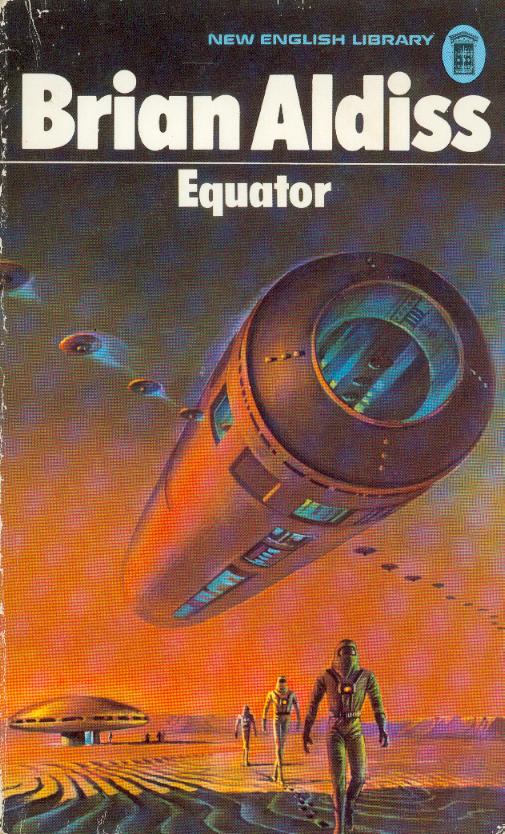
AE van Vogt’s The House That Stood Still (AKA The Undercover Aliens), which mixes California noir and pulp sf and just about manages to get away with it, is one of my favourite sf novels. It’s completely bonkers, of course; but it’s one of van Vogt’s more coherent works. Which isn’t saying much. Recently, I’ve read some early sf by women writers and found it much better than the so-called classics I read as a kid – these days, I find EE ‘Doc’ Smith, Robert A Heinlein and Isaac Asimov near-unreadable. There’s also an early Brian Aldiss novel, Equator, which I really like, though it’s more like spy fiction with added aliens than science fiction per se. Which may be one reason why I find it so appealing.
My favorite hard sf book or series is…?
The Apollo Quartet, of course. But seriously: it’s probably Kim Stanley Robinson’s Mars trilogy. I don’t read that much hard sf as such. When I need my real science kicks, I read books about space or deep sea exploration. There are very, very few hard sf novels which come even remotely close to emulating the authenticity those books possess.
My favorite military sf book or series is…?
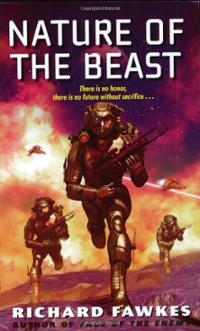
I don’t have much time for military science fiction, though in the past I’ve read my fair share – including David Weber, Tanya Huff, Elizabeth Moon, Jack Campbell, David Feintuch, John Steakley, and probably a few others. The only such books left on my book-shelves, and which may well get purged should I ever get around to rereading them, are Richard Fawkes’ Face of the Enemy and Nature of the Beast, which I remember as quite interesting. Also worth a go is Shariann Lewitt’s debut novel, Angel at Apogee, and her two Collegium novels, Cyberstealth and Dancing Vac. And if any of CJ Cherryh’s books qualify, then they’re certainly worth reading.
My favorite near-future book or series is…?
I don’t think I have one. I’ve always been a fan of John Varley’s Eight Worlds novels and short stories, but do they count as near-future? Gwyneth Jones’ Kairos, a favourite novel, was near-future when it was published, but that was back in 1988 – and these days it reads more like alternate history. The same might well prove true of Ken MacLeod’s excellent Intrusion a decade from now. Another excellent near-future novel is Maureen F McHugh’s China Mountain Zhang, though despite being two decades old it has yet to become alternate history – perhaps because it doesn’t feel like it’s set in a near-future which might well happen.
My favorite post-apocalyptic book or series is…?
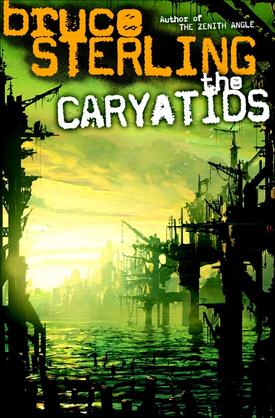
To be honest, I’m not interested in how Americans would react should their society collapse, nor do I believe that every single person on the planet would react in that way. Which pretty much discounts ninety-nine percent of post-apocalyptic novels. The only one that springs to mind as different is Bruce Sterling’s The Caryatids, which shows the world – all of it – coping with the aftermath of climate crash and nation-state failures. Perhaps the best of the more traditional post-apocalyptic novels is Joan Slonczewski’s The Wall Around Eden, in which mysterious aliens save isolated pockets of humanity. It reads like a masterclass in sf and deserves to be back in print.
My favorite robot/android book or series is…?
Science fiction’s treatment of robots has always been silly. They’re either human in all but name and yet treated like slaves, or blatant signifiers for slaves. In remarkably few sf stories do they actually resemble real robots.
My favorite space opera book or series is…?
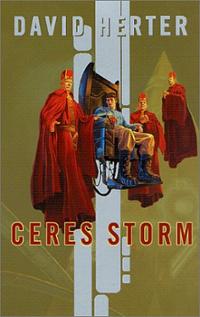
I’ve always enjoyed Iain M Banks’ Culture novels, though I think the individual parts are not as impressive as the sum of them. Colin Greenland’s Take Back Plenty has always been a favourite space opera too, and I remember being impressed by Scott Westerfeld’s The Risen Empire when I read it many years ago. Likewise David Herter’s Ceres Storm, which I read back when it was published in 2000. I really must reread it one of these days…
My favorite steampunk book or series is…?
I don’t read steampunk. There’s nothing in it that appeals to me. Airships? Pfft. Give me supersonic jets every time. Brass? Useless metal. And anyway, steel is more emblematic of the British Empire than brass. Difference engines? NASA didn’t put twelve men on the Moon using clockwork computers, did they?
My favorite superhero book or series is…?
I used to read superhero comics by the likes of Warren Ellis and Alan Moore, but went off the whole genre several years ago. I can no longer think of anything nice to say about the genre.
My favorite time travel book or series is…?
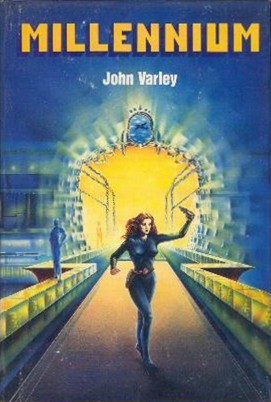
I’m more likely to read and enjoy an historical novel than I am a time travel one. I can’t off the top of my head think of any time travel novels that I hold in especially high regard. I remember enjoying Peter Delacorte’s Time on My Hands, which is set in 1940s Hollywood. And Stephen Baxter’s The Time Ships takes Wells’ The Time Machine and runs with it… and runs… and runs… I’m a big fan of John Varley’s short story ‘Air Raid’, and I still have a soft spot for the film adaptation Millennium, despite its godawful production design… which does mean I really like the novel written by Varley of the film adapted by Varley of the short story written by Varley…
My favorite young adult sf book or series is…?
I don’t read YA books. I am no longer sixteen, and haven’t been for a few decades.
My favorite zombie book or series is…?
I don’t read zombie books. I don’t even like zombie films. Maybe one day somebody will do something interesting with the trope, but I’m not holding my breath.
The 3 books at the top of my sf/f/h to-be-read pile are…?
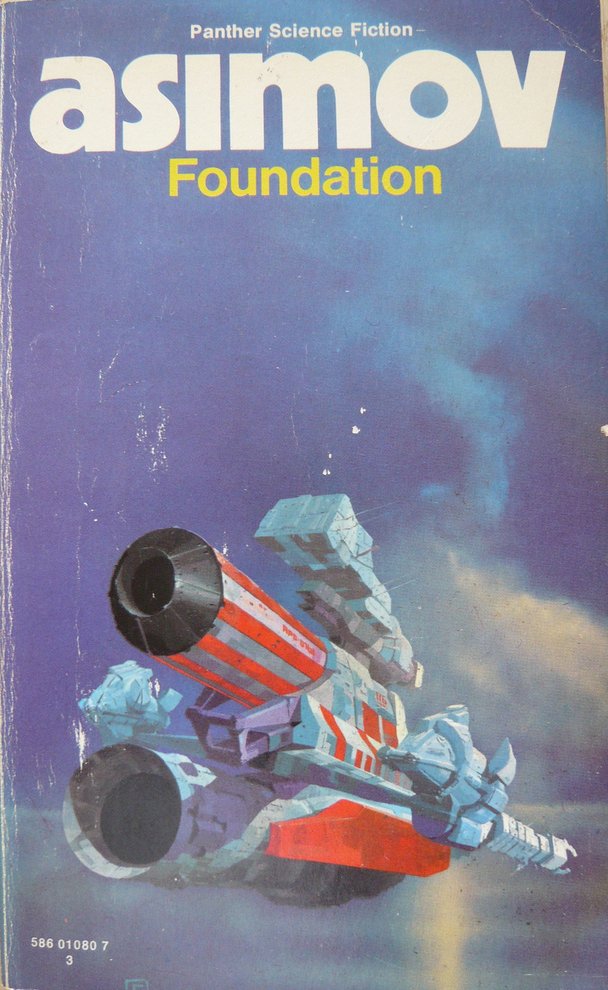
Last month, I foolishly agreed to read and blog about half a dozen classic sf novels, so I have The Moon is a Harsh Mistress and Foundation to look forward to over the next couple of weeks. Other than that, I have some reading for SF Mistressworks, and I hope to sneak in a few more recent genre novels as well, but I’ve yet to decide which ones. In fact, when you have a TBR of around 700 books, it’s often difficult to pick what to read next and I can sometimes spend ten or twenty minutes feeling really indecisive as I wander from one bookcase to the next…
And now I’ve finished this I’ll no doubt think of books I should have mentioned. Oh well. The more observant among you might also have noticed that all the links on this post go to Foyles using their affiliate scheme (except for the one link to a DVD). I found it relatively easy to use – a little fiddlier than Amazon’s, but not unworkably so. We’ll see how it works out.
Day two and here are my essential sf novels, from 26 through to 50. See here for Jared’s on Pornokitsch and here for James Smythe’s.
To me, what constitutes science fiction has always been quite clear, and my numerous attempts at defining the genre have merely been a way of communicating that certainty. But what does “essential” mean? I found that much harder to define. Yes, I relied a lot on my favourite novels when compiling this list – I thought they were brilliant, therefore they must be essential. Except several of them I could not quite squeeze in. My favourite DG Compton novel, for example, is Synthajoy, but in yesterday’s list I instead included The Continuous Katherine Mortenhoe – because I think it covers a theme more essential to a true exploration of the science fiction genre. Likewise, I wanted to include Jed Mercurio’s Ascent, a novel that has been a touchstone work for my own writing for several years. But it only hints at being alternate history in its final pages, and it barely qualifies as space fiction. Oh well.
We readily agreed that graphic novels, or bandes dessinées, were allowed. I picked the most obvious choice – see number 26 below. I’d like to have chosen Dan Dare or the Trigan Empire, but I don’t think either really characterises a tradition in British sf comics – certainly not one that continues to this day. So, much as I love them, I found their inclusion hard to justify.
Certainly, there were movements during the last few decades in sf which I needed to represent in my list: cyberpunk, steampunk, New Space Opera… As long as I picked one work from each, and could justify its presence, then job done. The works I chose for those subgenres are not the most obvious ones, but I think they’re the most important – or I certainly believe they deserve to be. Others may disagree.
Anyway, the list…
26The Incal, Alejandro Jodorowsky & Moebius (1981)
In France, there is a strong sf tradition associated with comics, or bandes dessinée. Not all of these have been translated into English – sadly. The Incal is one of the most popular bandes dessinée, and rightly so. It is completely bonkers, beautifully drawn, and an excellent example of what the medium can do.
27Downbelow Station, CJ Cherryh (1981)
Cherryh has been churning out muscular hard sf since 1976, and she’s still going. Somehow she has managed to stitch all these novels in to a single future history. It’s an astonishing achievement. This book is perhaps her best-known, and is very much characteristic of her oeuvre.
28Native Tongue, Suzette Elgin Haden (1984)
Women-only utopias do not happen overnight – though from some of the novels which feature them you might think so. Native Tongue charts one route, starting from a near-future in which women are reduced once again to the status of chattel. The development of a women-only language, Láadan, is instrumental in overturning this situation. This novel is both linguistic sf and feminist sf.
29The Handmaid’s Tale, Margaret Atwood (1985)
The scary thing about this book is that it’s completely made-up but it feels like it could really happen – might be happening now, in fact. You see it in the news every day, and sometimes you have to wonder what is going through people’s heads – the Young Earthers and Creationists, the congresswoman who publicly declares women should not have the vote, New Mexico recently passing a law which requires rape victims to carry pregnancies to term… I’d consider making such people read this book, but I have a horrible feeling they’d consider it utopian fiction…
30Last Letters from Hav, Jan Morris (1985)
Hav is not a real place, though you might be fooled into thinking so as you read this novel. Very early proto-sf often couched its tall tales in the form of travel journals, but once Gernsback bootstrapped the genre into existence, as a form of sf it seemed to go into decline. A pity, if Last Letters from Hav is any indication of what it can do.
31Metrophage, Richard Kadrey (1988)
Say “cyberpunk” and everyone immediately thinks of Neuromancer. But I’m not convinced that’s an especially essential book – cyberpunk has become a lifestyle, and does it really matter which novel – arguably – booted it up into existence? What is essential, however, is the book which folded cyberpunk back into science fiction. This one. It marked the end of cyberpunk as a sf literary movement. All the cyberpunk novels and stories that followed were just twitchings of the subgenre’s rotting corpse.
32‘Great Work of Time’, John Crowley (1989)
This is one of my two slightly sneaky inclusions. We did agree to allow novellas, and many novellas are indeed published as independent books. But this one never was – it first appeared in the collection Novelty. It is possibly the best time paradox story ever written, with the possible exception of Ted Chiang’s The Merchant and the Alchemist’s Gate.
33Take Back Plenty†, Colin Greenland (1990)
New Space Opera has been good for science fiction. But if this book had been its model rather than Banks’ Culture novels, it could all have turned out very differently. Take Back Plenty celebrates the pulp side of sf, and does so with intelligence, wit and verve. It is one of the genre’s best books.
34The Difference Engine†, William Gibson & Bruce Sterling (1990)
Another slightly sneaky choice, as Sterling appears alone at the end of this list. The term “steampunk” was coined by KW Jeter, and his Morlock Night and Infernal Devices are emblematic of the subgenre. But they’re not actually that good. The Difference Engine is good. It is the one steampunk novel that stands head and shoulders above the rest of the subgenre (which is now, sadly, a lifestyle).
35Stations of the Tide, Michael Swanwick (1991)
This sf novel is the only one I can think of which mixes science fiction and Southern Gothic. It’s a mashup that shouldn’t by rights succeed. But it does. It is a rich and strange book – and sf needs to be rich and strange more often.
36Sarah Canary†, Karen Joy Fowler (1991)
Not all first contact novels involve hardy explorers beaming down onto an alien planet and trying to communicate with mysterious aliens. Sometimes the mysterious aliens are here on Earth; and sometimes we will never know if they were alien or even if we have made contact. This book is proof that sf does not need to be about the future, spaceships, robots, time travel, or giant computer brains.
37Red Mars*, Kim Stanley Robinson (1992)
This is the definitive novel on the near-future colonisation of another planet – in this case, our neighbour, Mars. Enough said. (Don’t forget to read the sequels too.)
38China Mountain Zhang, Maureen F McHugh (1992)
Near-future sf is difficult to do well, if only because the author is expected to have some sort of magical crystal ball. But sf has never been predictive, and when it has got something right it’s been a happy accident. China Mountain Zhang is a near-future novel, but that’s incidental. It is beautifully written. That’s all that matters. McHugh is one of the genre’s very best writers.
39Dark Sky Legion, William Barton (1992)
We may never find a way to circumvent the speed of light. Which means 90% of science fiction is just so much magical hogwash. But some writers have tried to envisage a distant future in which the speed of light restriction still holds true. This is the best of the bunch. It also does something interesting philosophically – and sf is traditionally not very good at that.
40A Fire Upon the Deep, Vernor Vinge (1992)
Some space operas aren’t New, though they appeared while New Space Opera was doing its thing. The central premise of A Fire Upon the Deep, the Zones of Thought, is one of those ideas that shows why sf is such an important and vibrant mode of fiction. The somewhat ordinary plot attached is almost incidental.
41Fatherland, Richard Harris (1992)
One form of alternate history is vastly more popular than any other: Hitler winning WWII. It’s impossible to write a story based on it that is neither derivative nor clichéd. This is probably the best of the lot – because it is set decades after the War, and is only peripherally concerned with the fact of the Nazi victory.
42Coelestis, Paul Park (1993)
There are many themes which science fiction rarely tackles. Postcolonialism is one. It smacks too much of the real world – and too much of the real world that is not the First World – for most sf writers and readers. Coelestis treats the subject with intelligence, and then goes on to deconstruct the colonial identity of one of its protagonists. A masterwork.
43Shadow Man, Melissa Scott (1995)
Among the many themes covered by sf over the decades has been sexuality and gender. The most famous such novel is LeGuin’s The Left Hand Of Darkness, but given the one-book-per-author rule I couldn’t pick that. (And besides, its treatment of its hermaphroditic humans is somewhat problematical.) Scott complicates matters here by throwing in five genders and nine sexual preferences and, while the gender politics are still a little iffy, this is an essential exploration of the theme.
44Voyage, Stephen Baxter (1996)
This is not only alternate history, it is also space fiction: it is an alternate history of a NASA mission to Mars. The research is impeccable, and it makes a highly plausible fist of its premise. Space fiction has been chiefly dominated by writers who are not very good, which is unfortunate. Happily, Baxter can write well, and he does so in this book.
45Ash: A Secret History, Mary Gentle (2000)
Is it science fiction, or is it fantasy? The world of the title character does seem more fantastical than sfnal, but it’s wrapped in a near-future narrative which is resolutely sf. And the way the two narratives interact, and change each other, is definitely straight from science fiction’s toolbox.
46Light, M John Harrison (2002)
This is perhaps the most literary science fiction novel ever written (not counting, of course, the two sequels). Or perhaps it’s the most science-fictional literary novel ever written. On balance, I suspect the former – it is too steeped in genre to be wholly accessible to readers of literary fiction. That still makes it essential for sf readers, however.
47Life, Gwyneth Jones (2004)
Surprisingly, working scientists are not especially popular as protagonists in science fiction. This novel is about one. And science. It is also brilliant.
48Alanya to Alanya, L Timmel Duchamp (2005)
First contact is a genre staple. This novel – the first of the Marq’ssan Cycle quintet – is not the first in which the visiting aliens choose to speak only to women, and which subsequently prompts a global crisis. It is, however, notable for a near-future world in which the ultra-rich rule openly and cruelly. Elizabeth Weatherall, PA to the chief villain of this book, goes on in later volumes to become one of the genre’s great villains in her own right. Go read all five books.
49The Road, Cormac McCarthy (2006)
Post-apocalypse is such a well-established subgenre that recently most such novels have been by writers of literary fiction. And this is the best of those. It’s also much better than any genre post-apocalypse novel. Sadly, the trope has now been so over-used it’s become banal. Someone needs to do something different with it.
50The Caryatids, Bruce Sterling (2009)
We look at the world today and see impending climate crash and the collapse of national economies… but no sf novel except this one has dealt with such a scenario. It’s for good reason that Sterling was one employed as”Visionary in Residence” at a Californian university. Essential reading for the near-future.
And that’s it. I think I’ve covered all the major bases. Not every book in my list of fifty is a blinding piece of literary genius – this is science fiction, after all… But I think my choices show a good spread of themes and subgenres, and every book is certainly worth reading. I couldn’t get everything in, however. Some choices were just too hard to justify. For example, one subgenre of sf I was keen to have on my list was early space travel. Unfortunately, I’ve not read Garitt P Serviss or Willy Ley, and there’s a reason why High Vacuum (1956), First on the Moon (1958) and The Pilgrim Project (1966) are forgotten. So, no early space travel. Instead, I have Voyage as my entry for realistic space fiction (as if I’d really pick Bova, or Steele, or their like).
Finally, it has been a little dismaying putting together this list to discover how many of my selections are out of print. Some have recently been made available after many years OOP, either in the SF Masterworks series, or as ebooks through the SF Gateway. Respect to both for that. But others on my list have languished in obscurity since their original publication. This, I feel, doesn’t invalidate their, er, essentialness. After all, books don’t stay in print because they are essential, they stay in print because they’re popular, because people keep on buying them.
We have no real agreed academic canon in genre fiction, no fixed list of sf novels which teachers and lecturers turn to when designing courses on the subject. Yes, there are several books that people point to when the word “classic” is mentioned, but most of those are artefacts of the genre’s history. They were not chosen because experts in the subject have over the decades deemed them the best science fiction has produced in its eighty-seven years. Perhaps it’s good that sf is democratic in that regard… but when it elevates Foundation, Starship Troopers, the Lensman series and the like to greatness, I have to wonder…
There have been a few posts on anticipated genre 2013 releases around and about the internet, but most have either been uncritically exclusive, or squeeing fannishly over volume umpteen in various piss-poor epic fantasy series. Which is not to say the outlook for 2013 is entirely glum. Yes, there will be the usual badly-written tomes of badly-mangled mediaevalish adventure, all of which are interchangeable: swords! rape! magic! feisty princesses! rape! war! rape! But there are one or two books upon which I have my beady eye…
January Adam Robots, Adam Roberts
A collection of Mr Robot’s stories. Who could not want this? I’ve appeared in a couple of anthologies alongside Adam, which has sort of forced me to read his stories. But what I’ve read I have liked and thought very good, so I’d like to read more of them. I seem to react better to his short fiction than his novels. And, it has to be said, that is a pretty damn cool cover.
February The Best of All Possible Worlds, Karen Lord
This has been getting lots of good press and looks like one of the year’s more interesting sf releases. I’m not sure the précis on Amazon makes it sound wholly appealing – remnants of the galaxy’s once ruling elite is short on women, and a civil servant must accompany one such male on his search for a mate – but it all depends who’s writing it…
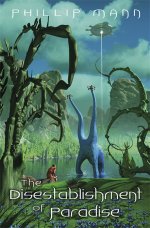
The Disestablishment of Paradise, Phillip Mann
I’ve been a big fan of Mann’s fiction for decades (oof, that makes me feel old) – see here – so I’ll buying this one in hardback the moment it is released. It will be Mann’s first book since 1996’s The Burning Forest, the final book in his A Land Fit for Heroes alternate history quartet. That’s quite a long silence – seventeen years. Alexander Jablokov spent a decade not writing before Brain Thief was published. I thought it very good, but it didn’t seem to do very well. Let’s hope Mann’s The Disestablishment of Paradise does better…
March Life After Life, Kate Atkinson
I’ve not read any Atkinson, though I understand she’s quite good. I did watch the television series with Jason Isaacs, however (though, to be honest, it clashed with Scott & Bailey, which I thought much the better series). This book, about a person who serially reincarnates, sounds like it might be worth a go. I’ll wait for the paperback, though.
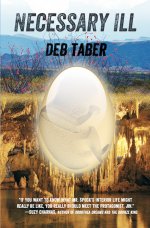
Necessary Ill, Deb Taber
According to Suzy McKee Charnas, this novel “offers hopeful glimpses of alternatives to the current cultural barrage of post-Apocalyptic savagery and regression to warlordism”. Am sick to bloody death of post-apocalypse novels in which people turn into animals and only some warped version of right-wing US society offers hope or a way forward. So, want.
April The Serene Invasion, Eric Brown
Eric has been churning out quality sf for more than two decades, and his novels and short fiction are always worth reading. It’s a shame his books seem to cause few, if any, ripples. Except, of course, he’s been shortlisted this year for the Philip K Dick – albeit bafflingly for Helix Wars, rather than the year before for The Kings of Eternity, which is by far the better book.
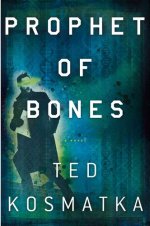
Prophet of Bones, Ted Kosmatka
To be honest, I’d sooner see a collection from Kosmatka. I’ve only read a handful of his short fiction, but what I’ve read I’ve thought very good – I even picked his ‘Divining Light’ for the Locus All-Centuries Short Fiction Poll. I’ve been meaning to pick up Kosmatka’s first novel, last year’s The Games, in paperback, and whether or not I get Prophet of Bones will depend on my reaction to that book.
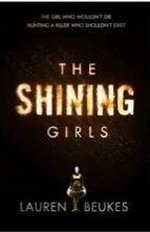
June The Shining Girls, Lauren Beukes
I really liked Zoo City (see here), so I’m keen to read this one, even if the plot has been described as “The Time Traveler’s Wife meets The Girl with the Dragon Tattoo“. Ugh. But I trust Lauren to produce something good despite that. (Incidentally, it really annoys me they never bothered correcting the spelling mistake in the title of The Time Traveler’s Wife (yes, I know, it’s the american spelling; but I don’t live in the US, and we use British English here).)
The Adjacent, Christopher Priest
I’m always late reading Priest’s novels, though I usually get there in the end. It’s useless speculating what it might be about, because Priest’s novels generally defy summary. This one is allegedly his “most complex yet”, although if anyone knows of a simple Priest novel I’ve yet to hear it. Santa brought me The Islanders for Christmas, so I’ll be reading that soon… two years after everyone else and a year after it won the BSFA Award…
August On the Steel Breeze, Alastair Reynolds
The second book of Poseidon’s Children and the sequel to Blue Remembered Earth. I liked the first book, I liked its optimism and its avoidance of sf’s usual panoply of magic bullshit technology. This one I will certainly be buying in hardback on its release.
September Proxima, Stephen Baxter
There’d be something wrong if there wasn’t at least one Stephen Baxter novel out each year. It’s deep future sf, with humans living on a dead world orbiting Proxima Centauri, and all sounds very Baxterian.
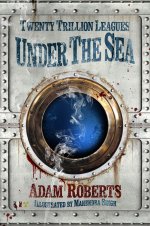
Twenty Trillion Leagues Under the Sea, Adam Roberts
A sequel to The Asylum’s “mockbuster” of Verne’s Twenty Thousand Leagues Under Sea by Adam Roberts has to be worth a go. Though, to be fair, I did think the ending to the film was pretty unequivocal – the Nautilus was destroyed by the nuclear warheads Nemo had planned to launch against the US, and everyone aboard, including Nemo, was killed. But I’m sure Adam will come up with some cunning trick to show how Nemo escaped death in a nuclear explosion at the very last second.
December Equilateral, Ken Kalfus
I saw mention of this on io9, and its description sounded interesting: British scientists at the turn of the century have come to believe there’s life on Mars, so they propose to build a massive triangle in the Egyptian desert. Yup, I’d read that. (io9 gives the publication date as April, but according to Amazon it’s December in the UK. I guess I’ll have to wait a bit longer than them, then.)
No doubt there will be more titles I want to read appearing throughout the year, but these are the only ones that have been announced so far that appeal to me. I’ll also probably end up reading other new books recommended to me but which, at first glance, I hadn’t thought worth trying, or hadn’t known about. So it goes.
It has been a good month for the book collection and a bad month for the TBR: both have grown larger. As follows…
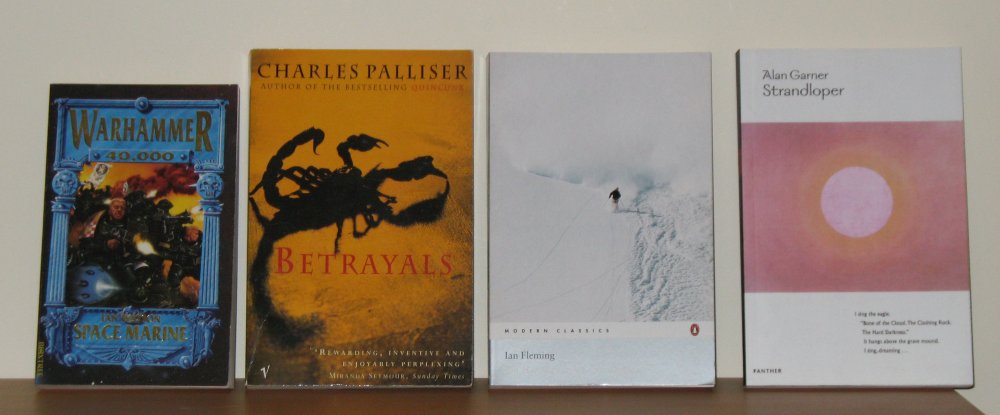
Some charity shop finds to start: Maureen Kincaid Speller has been singing the praises of Alan Garner for decades, though my only exposure to him has been the children’s classic fantasies The Weirdstone of Brisingamen, The Moon of Gomrath, Elidor and The Owl Service. Time to remedy that with Strandloper, methinks. Despite thinking they’re really bad, I’m determined to work my way through Fleming’s Bond novels – hence, On Her Majesty’s Secret Service. I remember being impressed by Palliser’s The Quincunx when I read it back in the early 1990s, and also enjoyed his The Unburied some ten years ago. But he’s not an author who appears often in charity shops, so I was pleased to pick up Betrayals. The infamous, and expensive, Warhammer 40, 000: Space Marine by Ian Watson I didn’t find in a charity shop but bought off a seller in Canada on eBay. I got it for less than the going rate – especially considering its condition – so I’m happy. And now I get to read it, too.
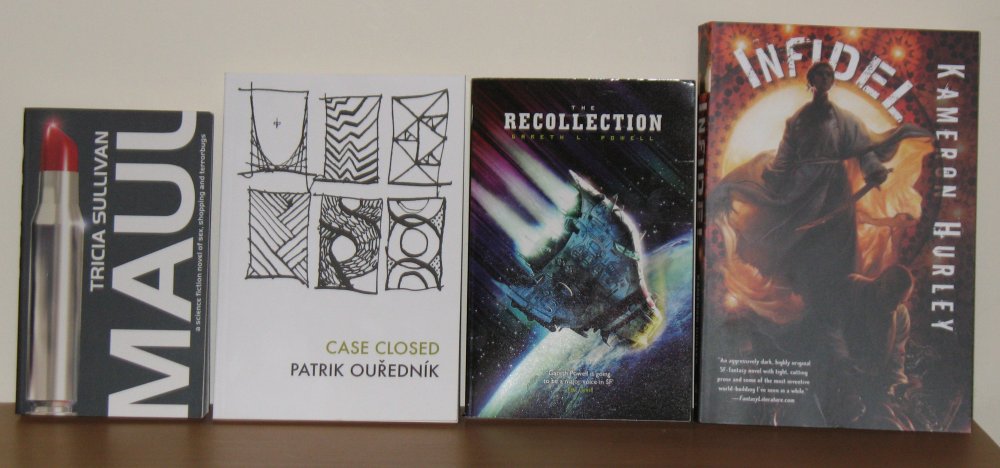
New paperbacks: Infidel is the sequel to the excellent God’s War (see here). A third book, Rapture, is I believe due next year. The Recollection is Gareth Powell’s debut novel from a big publisher. Patrik Ouředník’s Europeana made my best of the year list back in 2006 (see here), so I felt it was time to try his next book, Case Closed. And Maul is this month’s book for my 2011 reading challenge (see here).
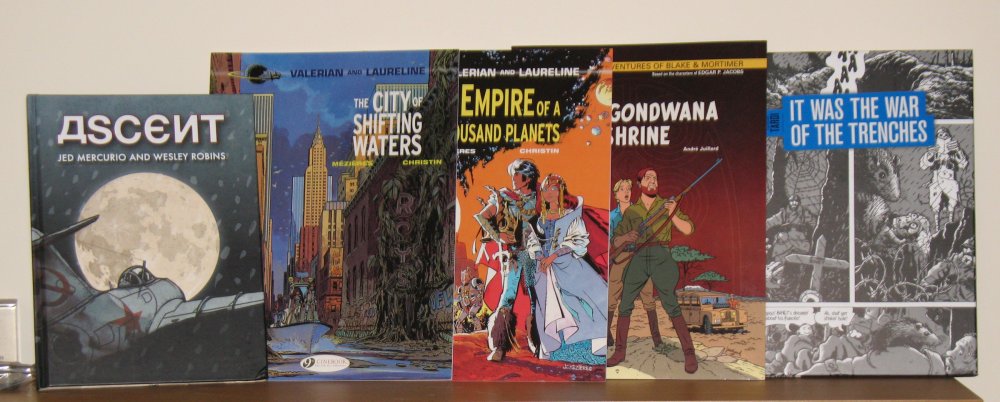
Graphic novels: I like Jacques Tardi’s bandes dessinée, and these Fanatagraphics editions are handsome volumes, so I’ve been buying them. It Was the War of the Trenches is about, well, World War I. The Gondwana Shrine is the eleventh volume of the adventures of Blake and Mortimer, and is another one by the team of Yves Sente and André Juillard (series creator Edgar P Jacobs died in 1987). The books have all the intense seriousness of Tintin, but where Hergé tempers his stories with slapstick humour, Jacobs (and now Sente) marry them with bonkers pulp scientific romance. It makes for an entertaining combination. Then there’s the first two books of Jean-Claude Mézière and Pierre Christin’s Valérian et Laureline, Agents Spatio-Temporel, now in English translation – and published by Cinebook, who are doing excellent work. The series currently stands at 21 volumes, although previously only seven have been translated into English (I have them all). Both The City of Shifting Waters and The Empire of a Thousand Planets are a bit clumsily written, but they’re fun – and the series does improve a great deal. There are, incidentally, some interesting similarities between elements of the latter and the Star Wars films, though The Empire of a Thousand Planets was originally published in 1971. Coincidence? Ascent is a graphic novel adaptation of Jed Mercurio’s excellent novel of the same title (see here).
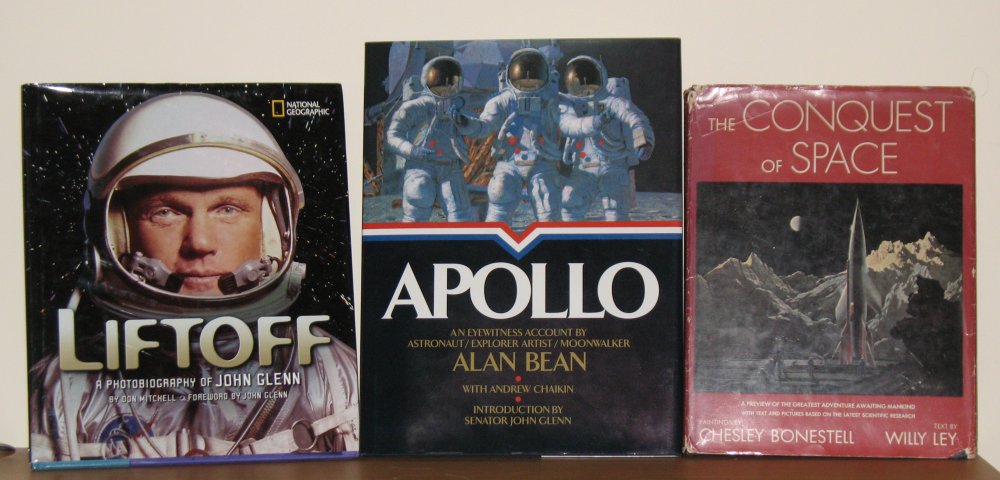
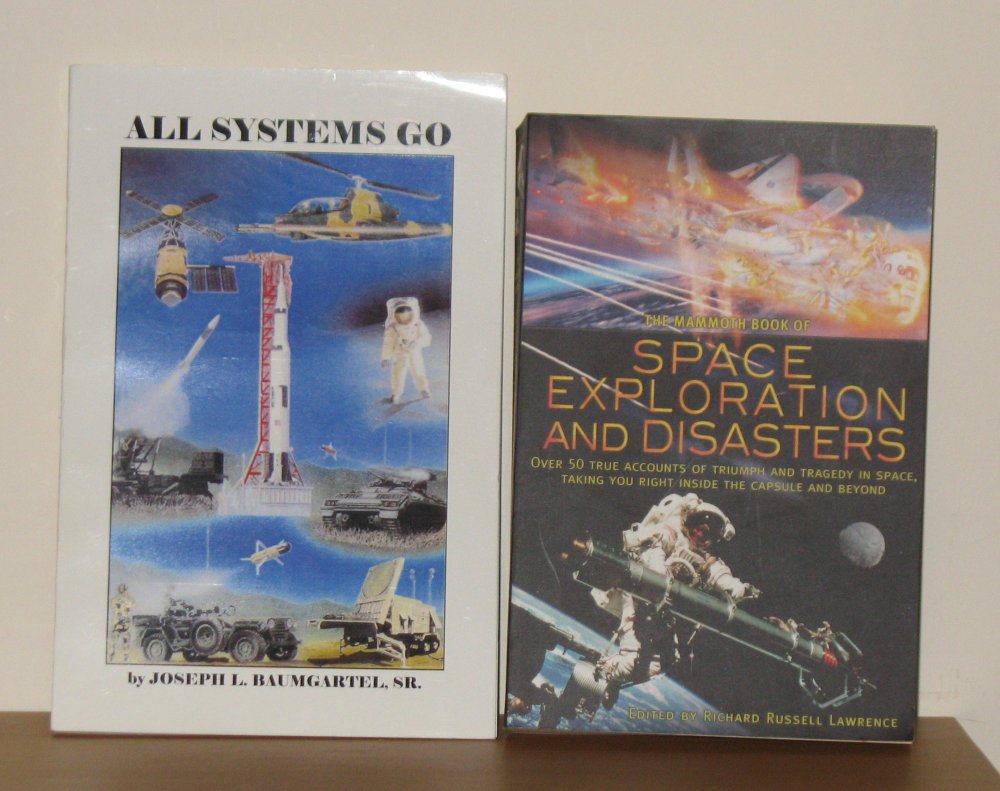
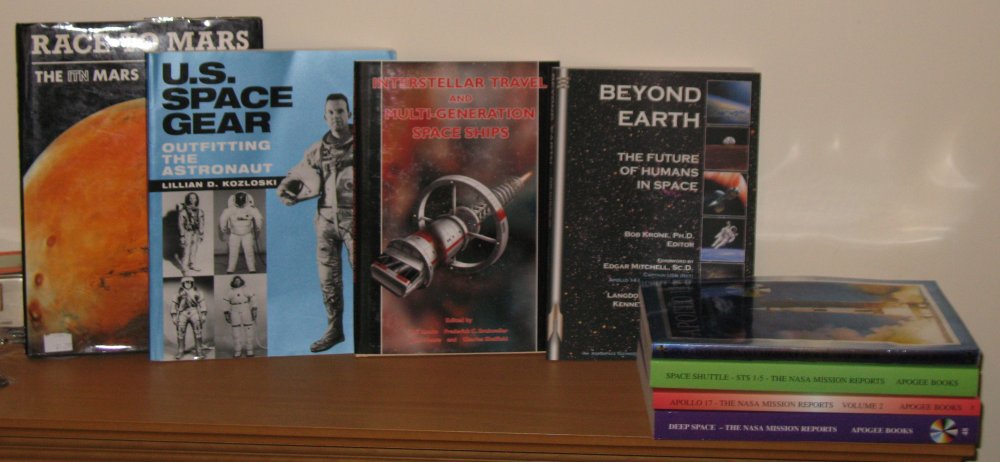
And more space books: All Systems Go is a self-published memoir by an engineer involved in a number of NASA and US military projects, including SAGE, Apollo, Skylab, and the TOW missile. The Mammoth Book of Space Exploration and Disasters was a charity shop find. I suppose the publishers thought exploration on its own wasn’t exciting enough – people would only buy the book if it included shit blowing up.
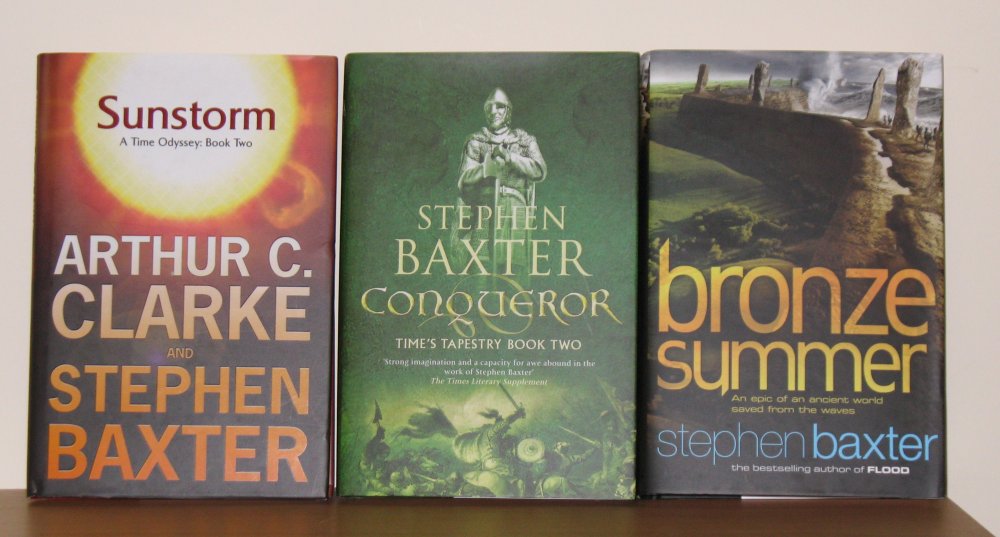
A trio for the Baxter collection: Sunstorm, book two of the A Time Odyssey trilogy, completes it for me; Conqueror is the second of the Time Tapestry quartet and I still need to get books 3 and 4; and Bronze Summer is the sequel to Stone Spring, which I have yet to pick up a copy of.
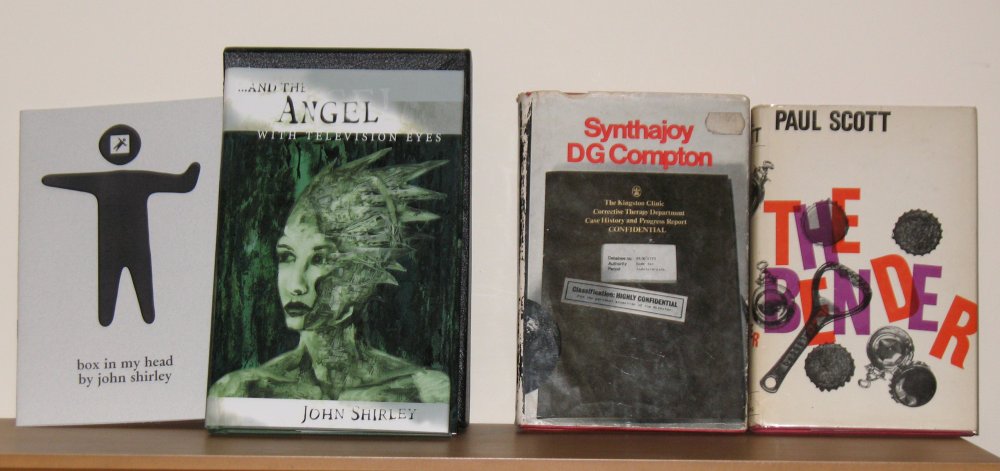
More first editions: Paul Scott’s The Bender was lucky find on eBay. As was Compton’s Synthajoy, though it’s a tatty copy. …And the Angel with Television Eyes is the signed slipcased edition from Night Shade Books, which includes a chapbook, the box in my head, of lyrics and poems.
It’s been just under a month since the last one of these, and that one proved to be a somewhat humungous post. So I thought I’d try for a more bite-sized installment this month. Sort of. Anyway, you know the drill: the books wot I have read, the films wot I have watched. Comments thereon.
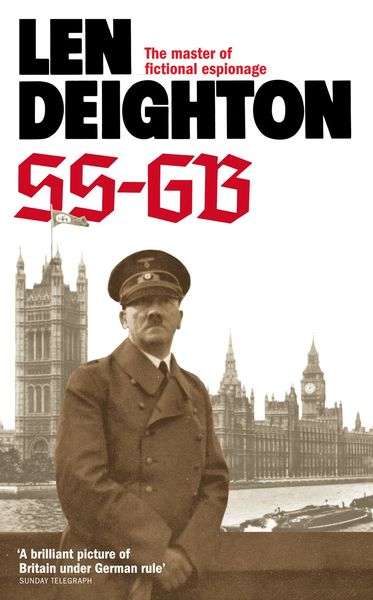
Books SS-GB, Len Deighton (1978), is perhaps the classic “Hitler won” alternate history, although it’s by no means the first. A Scotland Yard detective, now working under the aegis of the SS in an occupied Britain, is dragged into several intersecting plots when he investigates the murder of an unknown man in a small flat in London. It’s all tied in with the British resistance’s plan to smuggle the imprisoned King George VI out of the country, the fierce – and often violent – rivalry between the SS and the Wehrmacht, and the Wehrmacht’s secret atom bomb being built by British scientists. Archer, the detective, is a bit of a cipher, and, in fact, much of the cast are blanks. That Deighton has done his research is obvious from the first page, and he paints a convincing portrait of a UK under the Nazis. The writing, sadly, is pretty poor. I’ve read Deighton’s Harry Palmer novels, and his Game, Set and Match and Faith, Hope and Charity trilogies, and I don’t remember his writing being this inept and clumsy. Still, I’m glad I read it, and it can go back to the charity shop now. Incidentally, I wonder if choosing a photo of Hitler in such a camp pose for the cover was a wise decision: his depredations are not something we should make light of, or forget.
The League of Extraordinary Gentlemen: Century 1969, Alan Moore & Kevin O’Neill (2011), is the latest installment in Moore’s slow progress back up his own bumhole. Actually, this one is slightly better than the previous two. The League are now in England Swings territory, and an acolyte of Aleister Crowley, but with very real powers, is trying to bring about the creation of an Antichrist. This will take place during a free concert in Hyde Park. There’s some nice touches, and plenty of in-jokes, but I’m starting to wonder where this series is heading and whether it’s going to be worth it when it gets there.
The Extraordinary Adventures of Adèle Blanc-Sec 1, Jacques Tardi (2010), I picked up after enjoying Tardi’s The Arctic Marauder. It has apparently been made into a film by Jean-Pierre Jeunet, master of Gallic surgary whimsy, and starring Audrey Tatou. And yet there’s little that’s whimsical about the two stories in The Extraordinary Adventures of Adèle Blanc-Sec 1. In the first, a pterodactyl is terrorising Paris, and Adèle uses it as cover to help solve an entirely different crime. Which is sort of linked. The final scene, in which a villain turns up and explains the plot, only to be gazumped by another villain who explains another more-encompassing plot, who is then gazumped by another, is completely bonkers. The second story is more traditional: a demon is terrorising Paris, and Adèle tracks it down to a group of cultists associated with a local theatre. If it hadn’t been for that pesky Adele… Fun. And I’ve already ordered another one of Tardi’s graphic novels.
Daily Voices (Author’s Choice Monthly #3), Lisa Goldstein (1989). Back in the late 1980s, Kristine Kathryn Rusch and Dean Wesley Smith published twenty-nine collections, each contain no more than half a dozen short stories, by twenty-nine different genre authors. Each book was published in three editions: a trade paperback, a signed and numbered jacketed hardback, and a signed and lettered leather hardback. The stories were mostly reprints. This volume, the third in the series, contains five stories, all originally published in Asimov’s. One, ‘Tourists’, inspired a novel of the same title. These are literary stories, deceptively fantastical, and unsettling. ‘Tourists’ is a case in point: part Hav, part The City & The City (though contemporary with one and predating the other). Nothing especially jumped out at me in this collection, though they are stories it is easy to admire.
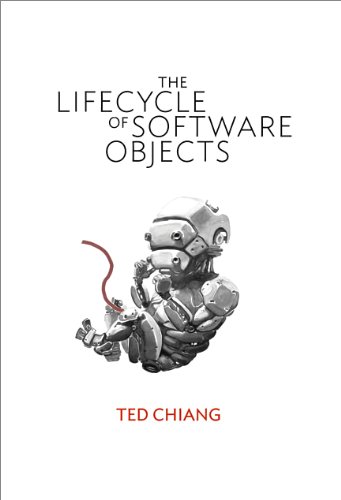
The Lifecycle of Software Objects, Ted Chiang (2010), won this year’s Hugo for Best Novella. Which is hardly a surprise. The only time Chiang doesn’t win is when he withdraws his work. And certainly he’s produced an enviably high-quality body of work over the years. Unfortunately, while The Lifecycle of Software Objects is as well-written as you’d expect from Chiang, it’s also a little dull and doesn’t go anywhere very interesting. A startup produces a new range of heuristic software lifeforms, “digients”, but the amount of work required by customers to parent them proves the company’s undoing. But a handful of people, emotionally attached to their digients as if they were real children, continue to nurture this new form of life. It’s a neat idea, but it does feel in places a little like Chiang wasn’t entirely sure where to take his idea. It’s like someone had invented the cat and had no idea what it was good for. Except the concept of a “better mousetrap” doesn’t appear to have occurred to Chiang. Disappointing, though only because Chiang sets his own bar so high.
Gravity Dreams, Stephen Baxter (2011), is another brick in the great wall that is Baxter’s Xeelee Sequence. In fact, Gravity Dreams brings the sequence full circle as it’s tied into Baxter’s first novel Raft (and the PS novella includes the short story on which Raft was based). Gravity Dreams is a very… expositionary type of story. A man in the unimaginably distant future experiences strange lucid dreams, which prove to be contact with a device in the universe of Raft (where the universal gravitic constant is considerably higher). The people of that universe, and the tech which the dreamer embodies, could prove of use in the ongoing war against the Xeelee. As a whole, the Xeelee Sequence is quite an achievement, certainly greater than the sum of its parts. Which, unfortunately, has the logical consequence that individual parts may not be as exciting, or as interesting, as the whole suggests. I enjoy reading hand-wavey magical cosmological-type hard sf, but not as much as I like reading nuts & bolts engineering-type hard sf.
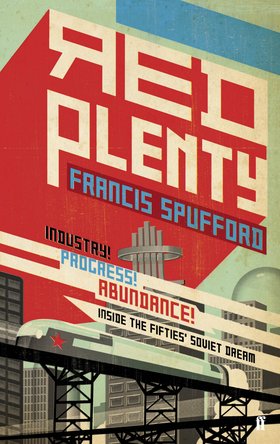
Red Plenty, Francis Spufford (2010), appeared on the non-fiction short list for the BSFA Award this year, though it lost out to a series of blog posts on the Hugo novel shortlist by Paul Kincaid. I’ll admit I had somewhere picked up an entirely erroneous impression of Red Plenty. I knew that it was non-fiction told as if it were fiction – dramatisations, if you will, of the life of ordinary Russians during the years of the USSR. But I’d also got the impression from somewhere – perhaps by the use of the word “science fiction” to describe it some place – that it also extrapolated the great Soviet experiment into later decades, as if perestroika and glasnost had never happened. That isn’t the case. Red Plenty ends in 1968. Nor did it affect my enjoyment: I thought the book excellent. Red Plenty follows the lives of a handful of peoples – some real, some invented – through the first half-century of the USSR. There’s a very real sense of utopia in the book, and it is sad to see how it is slowly corrupted. The USSR was one of history’s two great attempts to create a utopian society and, like the other one, Islam, its ideals didn’t last much beyond the first generation. All too often people forget what the USSR was trying to achieve. That it failed doesn’t invalidate the experiment, or its objectives.
Debris, Jo Anderton (2011), I read for review for Interzone. “File under science fiction” it says on the back cover, but I’m not convinced…
Leap of Faith, Gordon Cooper (2000), I reviewed on my Space Books blog here.
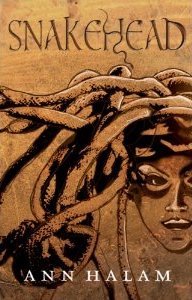
Snakehead, Ann Halam (2007), is Gwyneth Jones’ last novel as Halam, although apparently a new one – a sequel to Dr Franklin’s Island – will be published next year in the US. Snakehead is a retelling of the Perseus and Andromeda story from Ancient Greece. But slightly different. In the myth, Perseus first meets Andromeda when he returns from slaying Medusa, but in Snakehead Andromeda has run away from home and is taken in by Perseus and his mother Danaë. Much of the novel concerns Perseus’ life, and Andromeda’s introduction to it, on the island of Seriphos. The killing of the Gorgon occupies only a chapter or two towards the end of the book. There is a lovely matter-of-factness about the way the story is presented, the way its strangenesses are streamlined into the narrative. Also good is Perseus’ meeting with his father, Zeus, which reads like pure science fiction. Halam’s novels have always been extremely strong – I’d argue her Inland trilogy is better than Le Guin’s Earthsea books – but may have suffered from their variety. YA book series sell by the boatload, but Halam’s novels have been (mostly) singletons. As an adult reader, that variety is part of their appeal – when else am I going to read a novel treatment of the Perseus myth, for example? – but it may have hampered their success.
The Old Funny Stuff (Author’s Choice Monthly 1), George Alec Effinger (1989), is a collection of short stories from the early 1980s. The collection takes its title from a complaint by a fan of Effinger, who preferred the writer’s comic tales to the ersatz cyberpunk of When Gravity Fails. I vaguely recall enjoying the latter, but I didn’t enjoy any of the stories in The Old Funny Stuff. One story is set in the editorial offices of a genre magazine and reads like it was written in the 1930s. Another story has a mugged couple “assisted” by a variety of fictional detectives and vigilantes… yet all those characters are from the 1940s and earlier, though the story does mention an ATM. ‘Mars Needs Beatniks’ at least successfully pastiches Beat prose, but is unfortunately quite dull. An eminently forgettable collection, but mercifully short.
A Quiet Flame, Philip Kerr (2008), is the fifth Bernie Gunther, featuring the Berlin-based private investigator from Nazi Germany. The One from the Other, the first post-war novel, ended with Gunther on a boat to South America in the company of an ex-Panzer captain and Adolph Eichmann. Though not a Nazi himself, a case of stolen identity had resulted in Europe being a bit too hot for Gunther and so now he’s pretending to be someone else. The trio arrive in Argentina, and Gunther is taken to meet Juan Perón. At which point he confesses his true identity. But that’s fine, because the head of the secret police remembers, and admired, him back when Gunther was a detective for the Berlin police force, and there just happens to have been a recent murder in Buenos Aires which resembles a pair of unsolved murders Gunther had investigated just before Hitler seized power and Gunther left the police. The inference, of course, is that the murderer is a Nazi war criminal who is hiding out in Argentine with all the other Nazis. A Quiet Flame follows Gunther’s investigation into this murder, which soon spirals into an entirely different case, but is eventually resolved, and Gunther’s time in Berlin in the 1930s when the Weimar Republic was booted out of power by the Nazis. An afterword makes it clear that the plot of the novel, while invented, is based on either true events, or plausibly extrapolated ones. It’s one of those books that both makes you angry such things were ever permitted to happen and scared that there are people who would not think twice about doing such things. I thought it so good I moved the next book in the series, If the Dead Rise Not, up the TBR pile.
The Coming of the Terrans, Leigh Brackett (1967), is a pretty clumsy fix-up. Half a dozen of Brackett’s Mars stories have had dates stuck on them, and then placed in order as if they were part of a coherent future history. But ignore all that, because the stories in this collection are excellent stuff. Brackett’s sf doesn’t seem to fit in anywhere – it uses the tropes of early sf but is written with the sophistication of much later genre fiction. So we have Mars, populated with ancient civilisations and dying races, but stories that are considerably more than just swashes being buckled, uppity natives being quelled, or righteous pioneers carving out homesteads. The upstart Earthlings who come to exploit the Martian races rarely end up on top. This is not the gung-ho adventurism of Edgar Rice Burroughs, but its antithesis.
Charlotte Gray, Sebastian Faulks (1998). I’m pretty sure I tried reading this shortly after it was published. I’d have borrowed it from the Daly Community Library in Abu Dhabi. I think I gave up on it because I found the pacing so glacial. Later, I saw the film. Now that I’ve read it I’m sorry I didn’t persevere all those years ago. Yes, it’s a slow book. The title character volunteers for a department of the Special Operations Executive because she speaks French like a native. She is parachuted into Vichy France to courier some radio crystals to a member of a British network, but stays on because her lover, a RAF pilot, is missing in action somewhere in the country. For much of Charlotte Gray, she does little except pine for her lover and help out the local resistance. But the final third of the book more than makes up for that. Before returning to the UK, she tries to track down two Jewish children taken by the Germans, and discovers something of the truth behind their fates.
Oryx and Crake, Margaret Atwood (2003), is not science fiction, of course it’s not. It’s speculative fiction. Yes, well. Atwood’s idiosyncratic categorisations aside, I think most people would classify Oryx and Crake as science fiction. I’m not entirely sure what to make of it. There’s some sharp prose in it; there are also some embarrassingly bad neologisms. Some time in the future, rogue genius Crake unleashes a plague on the world, killing off everyone except his friend Jimmy and the Crakers, a handful of genetically-engineered humans he has bred. Now calling himself Snowman, Jimmy acts as a beneficial god/shaman to the Crakers, while trying to survive in a world in which he no longer fits. His life is interspersed with flashbacks detailing his friendship with Crake, how we went to work for him, and how the world became as it is. Most of the satire is so blunt as to be ineffective. And the “trendy” names Atwood uses for all the corporations, like RejoovEsense, annoy mightily. I preferred The Blind Assassin.
Films 51, Jason Connery (2011), I watched for The Zone, but I’ve yet to finish my review.
Time to Leave, François Ozon (2005). I like Ozon’s films, but only when he’s being playful not when he’s being serious. Except, perhaps, for Under The Sand, which I did like. But, Time to Leave (AKA Le temps qui reste): a gay fashion photographer learns he has three months left to live. He keeps this secret, telling only his grandmother (played by French screen legend Jeanne Moreau). The protagonist is, frankly (no pun intended), selfish and unlikeable, and his eventual change of heart feels overly sentimental and clichéd. Not one of Ozon’s best.
Leviathan, George P Cosmatos (1989), is another film set in a mining installation at the bottom of the ocean. This one, however, does not rip off Outland. It rips off Alien, instead. A reasonably good cast for the time – Peter Weller, Richard Crenna, Amanda Pays, Ernie Hudson, Hector Elizondo, Daniel Stern – unwittingly release some old Soviet bio-experiment aboard their habitat, and it tries to turn everyone into some sort of Cronenberg-esque monster. But Weller and Pays manage to escape. Leviathan makes a decent fist of imagining its environment, but the plot is by-the-numbers from start to finish and the characters are not allowed to develop much beyond clichés.
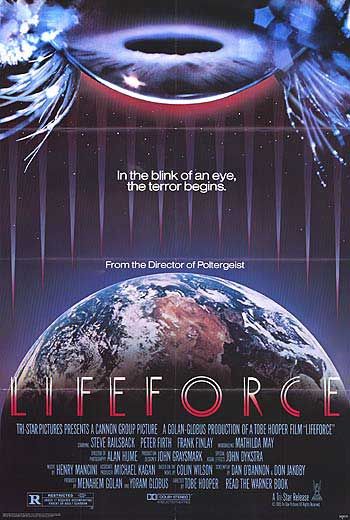
Lifeforce, Tobe Hooper (1985). I remember going to see this at the cinema when it was released. I didn’t take it seriously then, and I couldn’t take it seriously this time. A space mission to Halley’s comet finds a giant spaceship in its coma. Aboard are a pair of naked humans: a beautiful young woman and a handsome young man, both in hibernation. The astronauts take both aboard their Shuttle and head back to Earth. On arrival, mission control can’t reach anyone aboard the spacecraft, so they send up a mission. The crew is dead, and the Shuttle has been gutted by fire. The only survivor is the naked young woman. so they take her back to Earth, to London. But she’s a space vampire – the film is based on Colin Wilson’s novel, The Space Vampires – and she brings about a plague of zombies to the UK. All those people who claimed 28 Days Later such an astonishing film because it showed zombies running rather than shuffling along should watch Lifeforce. Zombies run in it too. It’s about all the film does have in its favour, however.
The Taming of the Shrew, Jonathan Miller (1980). I’ve been enjoying these Shakespeare plays, but every now and again you have to wonder what was going through the Bard’s head when he wrote them. Like this one. Everyone wants to marry Bianca, but her father has decided that she will not entertain suitors until her older sister, Katherina, is wed. But Kate is a “shrew” – i.e., an independent woman, not afraid to voice her own opinion, and far from the demure mistress apparently valued in Padua. Along comes Petruchio (played by John Cleese), who decides to woo Kate, for reasons never satisfactorily explained – the challenge? her fortune? There are several instances of witty banter, though Kate is played disconcertingly as a shrill termagant which often seems at odds with her dialogue. So there I was thinking that the part was just misplayed and The Taming of the Shrew couldn’t be as sexist as it seemed. Only for the final wedding banquet scene to feature speeches by each of the male cast explaining what a good wife should be, and it’s the worst sort of sexist claptrap and I’m surprised Elizabeth I didn’t have their heads off for it. Not one of the Bard’s best.
Predators, Antal Nimród (2010), is yet another sf franchise getting the reboot. Which is a creative process I find hard to understand. The Predator and Alien franchises were munged together into a series of increasingly rubbish films, and that should have killed them stone dead. Instead, we got Predators, and Ridley Scott reported working on a prequel to Alien. To be honest, of the two, I always much preferred the latter, though none of the films were as good as the first. Predator, on the other hand, was just an uglier Rambo. And Predators is just I’m a Celebrity Get Me Out of Here with guns. A group of scumbags are parachuted into a jungle. They’ve no idea where they are, how they got there, or even why they are there. It doesn’t take long before they discover they’re being hunted by aliens, the Predators, for sport. But never mind, they’re Men, the horneriest critters in the universe, and of course they can beat someone who is both phyisically and technologically superior because they’re Men. It’s Neanderthal tosh like this that gives Hollywood a bad name– No, wait, Hollywood already has a bad name. It would be nice to see the occasional sf film of real intelligence from Hollywood, but I’m not holding my breath. It would also be nice to see sf films which didn’t celebrate violence, psychopaths or sociopaths, and which didn’t paint all aliens (that’s everybody outside the US, you understand) as fit targets for invasion, repression, dismemberment, or genocide. Avoid.
The Green Hornet, Michel Gondry (2011), I’d heard mixed reports on, but I rented it anyway. I’m not a big fan of the Seth Rogen / Judd Apatow style of humour, though I do like superhero films. Sadly, the humour outweighed the appeal of the superhero aspect, and I hated this. I hated Rogen’s character, I hated the stupid jokes, and I hated the concept, which was even more implausible than your average superhero movie. Rubbish film. Avoid.
Underground, Emir Kusturica (1995), I wasn’t initially sure what to make if. It opens during World War II, with the Germans bombing, and then invading, Belgrade. A pair of local wideboys become heroes of the resistance, more by accident than by design. They’re out for themselves, but somehow or other that helps the resistance. And then one of them, Blacky, is injured, so the other, Marko hides him, and the rest of the resistance cell, in his cellar. But he never tells them when the war ends. As Marko rises in Tito’s government in post-war Yugoslavia, so those in the cellar continue to believe WWII is ongoing. They make weapons, which Marko sells. Eventually Blacky manages to escape, but he stumbles on the set of a film re-enacting the climactic raid in which he was injured. He kills the actor playing the part of the German officer, and runs way. Later, after Tito’s death, he is the leader of a militia in the former-Yugoslavia. Marko, meanwhile, disappeared when Tito fell, and is now an international arms dealer. Underground opens with the Germans bombing Belgrade Zoo, and initially seems like a somewhat clumsy comedy. But as movie progress, so does the comedy turner blacker… and blacker… and more surreal. And the end result is superb. Recommended.
… I have too many books. But then, I ask, what is wrong with that? Aside from the issue of space. And the occasional difficulties actually finding the book I am looking for. Not to mention the fact that I can’t read them as fast as I buy them – though some of them are references works and not intended to be read per se.
Anyway, a few parcels have arrived at It Doesn’t Have To Be Right Manor over the past weeks, and here is what they contained:
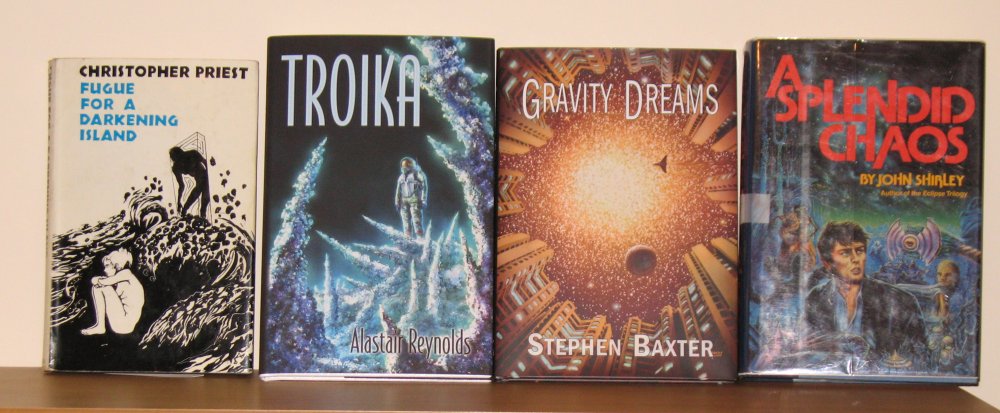
Some first editions to start with: I’ve been after a copy of Fugue for a Darkening Island for a couple of years, but the paperbacks I’ve seen have all been expensive; and then I found this first edition for a fiver… only to be told that Gollancz are soon to publish a revised edition. Gah. Troika is the Subterranean Press edition of the SFBC Alastair Reynolds novella which is on the Hugo Award shortlist. Gravity Dreams is a new Stephen Baxter novella from PS Publishing. And A Splendid Chaos is a signed John Shirley sf novel from 1988.
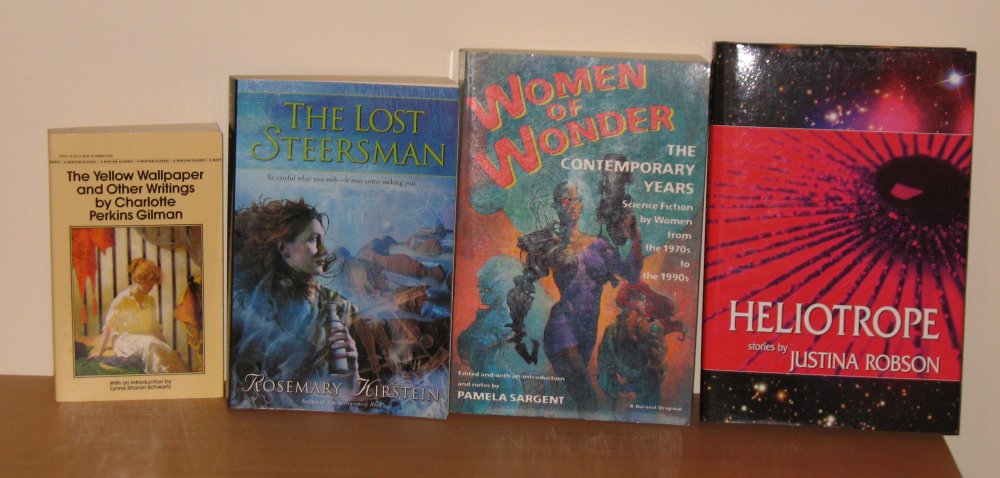
Four books by women sf writers: “The Yellow Wallpaper is a collection of Charlotte Perkins Gilman’s writings, both fiction and non-fiction. The Lost Steersman is the third book in Rosemary Kirstein’s Steerswoman series. I very much enjoyed the first book (see here), but I’m going to have to buy the omnibus of books one and two, The Steerswoman’s Road, before I can read this one. Women of Wonder: the Contemporary Years is an anthology of science fiction by women writers from 1995. And Heliotrope is Justina Robson’s first short story collection, published by Ticonderoga in Australia.
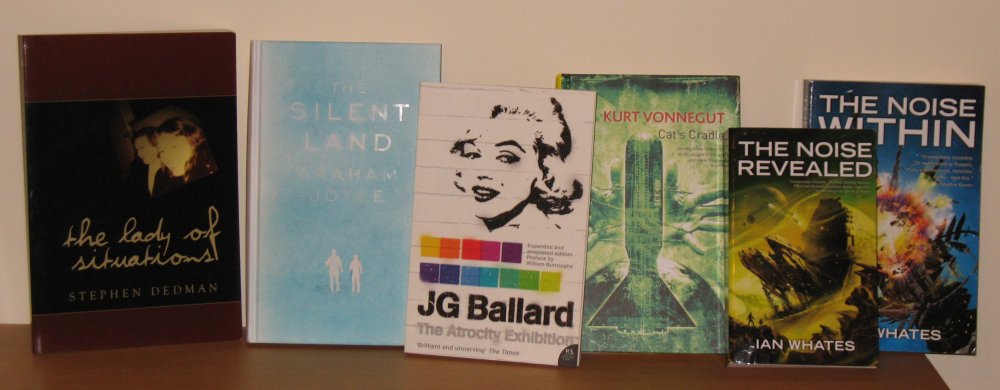
The Lady of Situations is a short story collection by Stephen Dedman, bought from Ticonderoga in the same order as Heliotrope above. The Silent Land I found in Oxfam. I’m expanding my Ballard collection, hence The Atrocity Exhibition. I’ve also been collecting the SF Masterworks series since they first appeared over ten years ago – thus Cat’s Cradle – though I’m not a fan of Vonnegut’s books. The two Ian Whates space operas, The Noise Within and The Noise Revealed, are for review for Vector. A bit annoying, isn’t it, when they release books in a series in different formats…
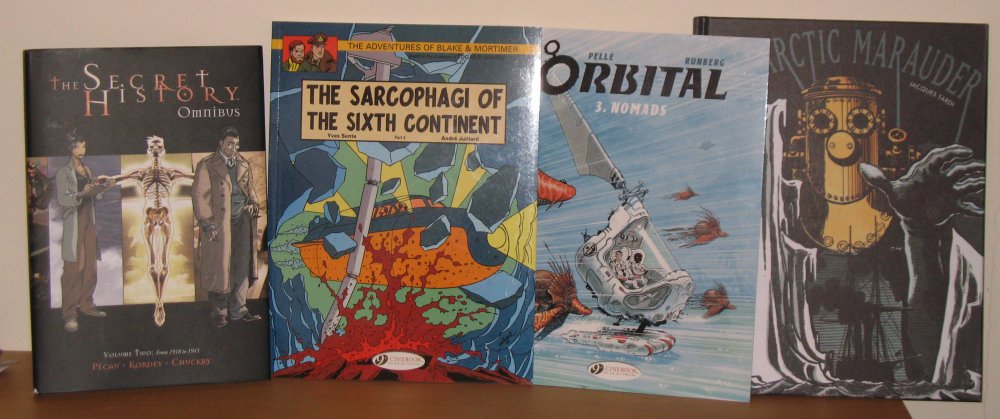
Graphic novels: The Secret History Omnibus Volume 2, written by Jean-Pierre Pécau, covers from 1918 to 1945, and cleverly weaves in real historical events and persons. Good stuff. The Sarcophagi of the Sixth Continent, Part 2, is another episode in the continuing adventures of Captain Francis Blake and Professor Philip Mortimer, this one opening with Mortimer’s childhood in India and finishing up in the late 1950s as a megalomaniac Indian prince attempts to destroy the West from his Antarctica base. Orbital 3: Nomads is the, er, third in a space opera bande desinée series – it looks good but doesn’t actually feel like a whole story. Finally, Jacques Tardi’s The Arctic Marauder is one of Fantagraphics’ new English-language editions of Tardi’s bandes desinée, and is a bonkers Vernesque tale set in the, um, Arctic.
Here we go again – we know a song about that – it’s time for more scrapings from the petri-dish of popular and unpopular culture, as studied under the microscope by Your Scientifically-Minded Correspondent.
Books Satan Wants Me, Robert Irwin (1999). Irwin’s The Arabian Nightmare is one of the best fantasies of the 1980s, and his Night and Horses and the Desert (re-issued as The Penguin Anthology of Classical Arabic Literature) is a highly-entertaining and informative study of, well, classical Arabic literature. Satan Wants Me – god knows what people thought when they saw me reading this on the tram during my commute to work – is presented as the journal of a hippie sociology doctoral student in early 1970s London. He has recently joined an occult group spun off from Aleister Crowley’s Order of the Golden Dawn. He’s also taking a lot of drugs. And he has some very weird friends. There are some very funny laugh-out-loud bits in this novel – which probably got me even stranger looks on the tram – and it’s sharply-observed throughout. Then it goes completely batshit weird towards the end. While not the classic The Arabian Nightmare is, it certainly confirms my belief that Irwin is a writer very much worth reading.
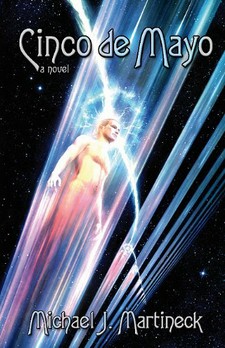
Cinco de Mayo, Michael Martineck (2010), I reviewed for SFF Chronicles here. I’ve known Michael for a long time, though we’ve never actually met in person. We’re both members of an informal critting group, with a couple of other people – i.e., we email each other stories, novel extracts, etc., for comments. So I saw bits of Cinco de Mayo several years ago. But I’d never seen the finished product. I have now, and I enjoyed it very much. And thought it a happily diverse and intelligently put-together story. Definitely worth a read.
Twenty Thousand Leagues Under the Sea, Jules Verne (1870). This 1973 edition of Verne’s classic has my name and old school number written on the ffep, which means I’ve owned this book for just over thirty years. So I must have read it at some point. I know the story – everyone does – but is that from actually reading the book, or just from some form of cultural osmosis? This (re)read did demonstrate that there’s much about the story I’d forgotten / not known. It’s very dull, for one thing. There are endless pages listing ocean flora and fauna. Very little actually happens. Aronnax et al go hunting a mysterious sea monster which has been sinking ships. In an encounter with it, they are swept overboard and then rescued by the monster… which proves to be a submarine: Captain Nemo’s Nautilus. The Nautilus sails around the world, and they do things every now and again. Eventually, Aronnax and his two companions manage to escape, and witness the Nautilus being sucked into a giant maelstrom. That’s pretty much it. Some of the science is impressively detailed; in other places it is impressively wrong – the quoted ocean depths, for instance, are out by quite a margin, claiming the deepest part of the Pacific is something like 15,000 fathoms deep – that’s 90,000 feet! Challenger Deep is actually almost 36,000 feet deep – I know this because of this. Still, despite Twenty Thousand Leagues Under the Sea being a bit of a slog to read, I actually fancy trying a bit more Verne. Perhaps I’ve been unduly influenced by David Herter’s Evening’s Empire…
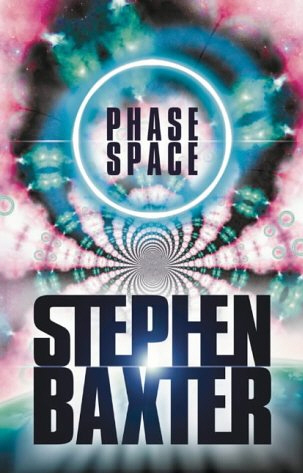
Phase Space, Stephen Baxter (2002), is a collection of short stories, many of which are off-cuts from Baxter’s Manifold trilogy. I read those three books back in 1999, 2000 and 2001 – when they were published, in other words. But not Phase Space. I have a lot of time for Baxter’s fiction, both short and long; but this collection was a bit of a disappointment. There’s some good stuff in it – ‘War Birds’, for example, which won the BSFA Award for Best Short Story in 1998 (and unfortunately resembles something I’ve been working on myself; damn); ‘Tracks’, based on an interview Baxter conducted with Apollo 16 astronaut Charlie Duke; ‘Moon-Calf’, about a retired astronaut on holiday in south-west England; ‘Barrier’, which is the sort of sf I’d be happy to have in Rocket Science. Unfortunately, many of the other stories follow a similar pattern – the narrative is interspersed with italicised first-person infodumps – and so they tend to blur together. And one or two, well, I was surprised to see they’d originally been published by Asimov’s and Interzone… Phase Space is not Baxter’s strongest collection by any means, but there’s some good stuff in it.
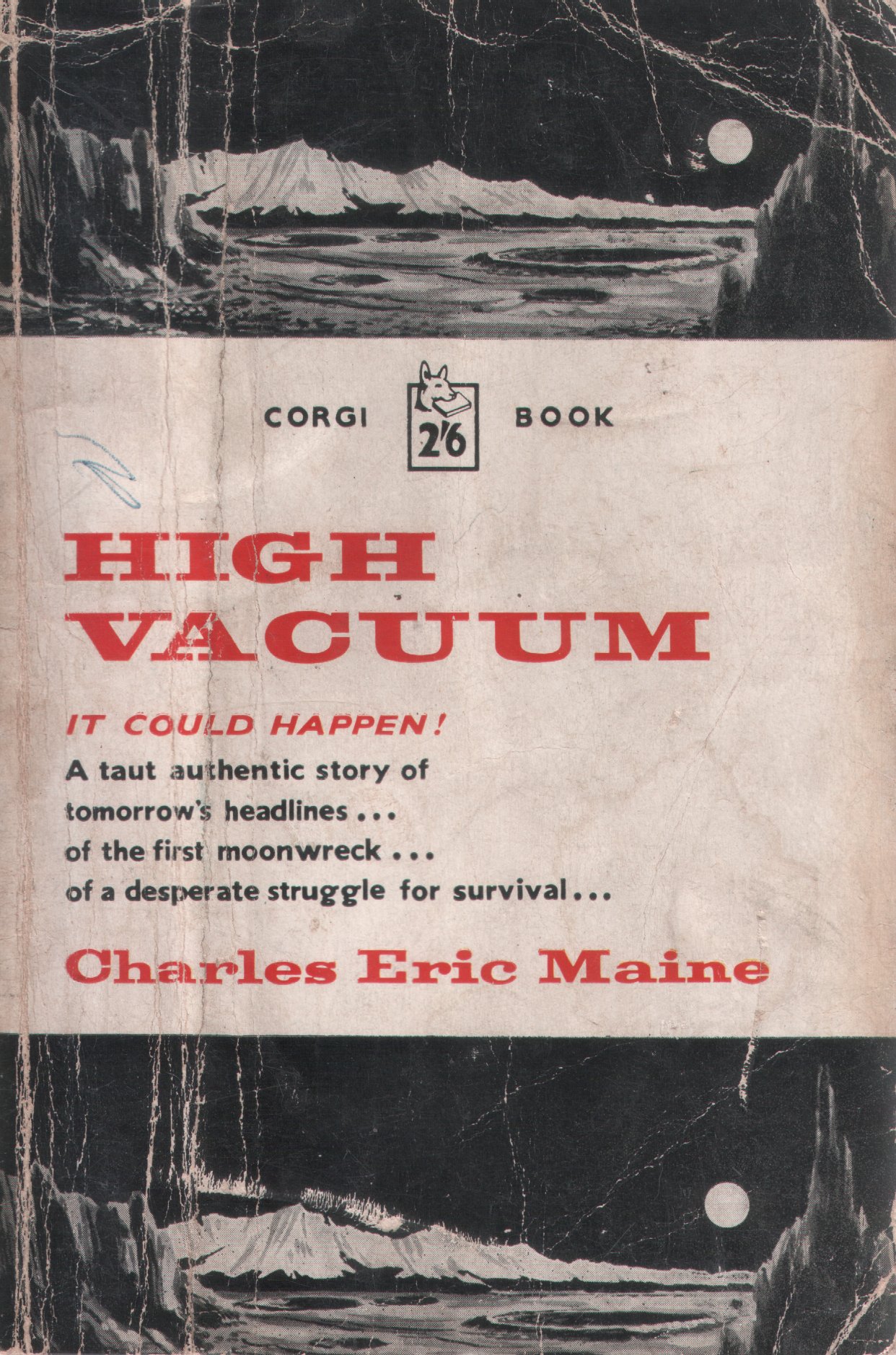
High Vacuum, Charles Eric Maine (1957). I’m currently working on a two-hander review of this and Jeff Sutton’s First on the Moon for my Space Books blog. I thought it might be an interesting exercise to contrast two novels about Moon landings written before the Apollo programme with the real world lunar landings. While I would have said there was plenty of drama in actually trying to get to the Moon, both Sutton and Maine clearly felt what was need for real drama was… a crash-landing.
Icehenge, Kim Stanley Robinson (1984). I have planned a “cage-fight” – which I will write up on this blog – between this book and Robert Heinlein’s The Moon is a Harsh Mistress (which I will have to read first; sigh). Because Icehenge is a much better candidate for the SF Masterwork series. Some of the world-building is a little quaint now – USA vs USSR – but I’ll be completely unsurprised if I find that Icehenge shits all over the Heinlein.
Winterlong, Elizabeth Hand (1990), was April’s book for my reading challenge and I wrote about it here.
The Silver Chair, CS Lewis (1953), is the fourth book of the Chronicles of Narnia by publication date, but the sixth book by internal chronology. Useless Eustace and new-found friend Jill Pole escape from bullies at “modern” school Experiment House (dear god, but Lewis shows his reactionary side with his description of the school), because Aslan wants them to find Prince Rilian of Narnia, who was abducted ten years before. Aslan gives Jill four clues, which she manages to screw up, but it all works out in the end. And everyone gets lashings of buttered scones and hot chocolate at the end, or something. These books are a bit like your old Daily Mail-reading grandad telling a bedtime story – the only bits missing are rants against immigration and falling house prices…
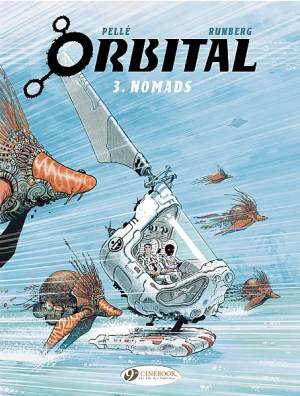
Orbital Vol 3: Nomads, Sylvain Runberg & Serge Pellé (2011), is the third book of a bande desinée series published in English by Cinebook. It’s heartland sf, but far more adult than you’d expect of a science fiction “comic.” Earth is a reluctant new member of a galactic federation, after a war with the alien Sandjarr. A pair of special agents, one human and one Sandjarr, must ensure the celebrations in Kuala Lumpur to mark the end of the war, to which a Sandjarr delegation has been invited, goes without a hitch. But a nomadic alien race has settled nearby, and something is killing all the fish and the fisherman are not happy about it… Good stuff.
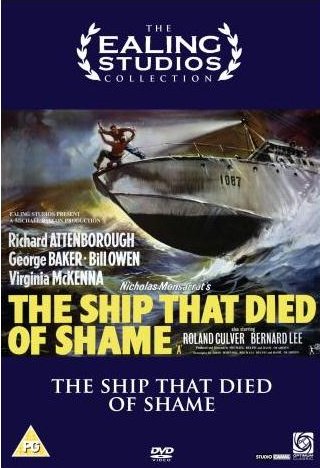
The Ship That Died of Shame, Basil Deardon (1955), is an adaptation of a Nicholas Monsarrat short story of the same title. The crew of a wartime MGB are re-united when they find their old boat – stripped of her weapons, of course – for sale. So they buy her, make her seaworthy, and use her to run contraband across the Channel into post-war austerity Britain. But it all goes horribly wrong when they accept a job to smuggle a murderer to France. Good solid British film-making from the Fifties.
Tin Man (2007), is a mini-series “re-imagining” of The Wizard of Oz, in which Oz becomes the Outer Zone or “Oh Zee”. DG, not Dorothy Gale, finds herself embroiled in a plot by her evil sister to bring endless darkness to the OZ. DG hadn’t known she had a sister, or that the OZ even existed. But when the Midwest farmhouse where she lives with her parents is attacked by strange men in black uniforms, she escapes through a tornado – discovering as she does so that her parents are actually robots. Because she’s really a princess from the OZ. With the help of a heartless ex-law officer (i.e., a “tin man”), the queen’s old advisor who has had his brain removed, and a cowardly lion-like humanoid – oh, and her old tutor, who can transform into a small terrier – DG must find the Emerald of the Eclipse in order to defeat her sister. An interesting spin on a children’s classic which, to be honest, has never appealed to me; but it all felt a bit meh in places. Though it reminded me a lot of the Sci Fi Channel Flash Gordon telly series – which was cheap and a bit silly, but which I quite liked – it didn’t have that programme’s charm.
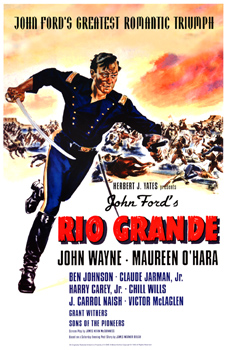
Rio Grande, John Ford (1950). I am not, I admit, a big fan of Westerns. In fact, the only one in my DVD collection is Howard Hawk’s Rio Bravo – which is actually an alternative name for the Rio Grande, the river forming part of the border between the US and Mexico. Rio Grande the film is the third in Ford’s cavalry trilogy, following on from Fort Apache and She Wore a Yellow Ribbon, neither of which I’ve seen. It’s John Wayne doing manly men stuff in the Wild West as injuns run rampant and hide out in Mexico where Wayne’s cavalry can’t follow them. Except he does, even though it might provoke a diplomatic incident. Then he learns that the injuns have captured a wagonload of white kids, which only makes the mission more righteous. The US Cavalry must have been the biggest bunch of war criminals in uniform until the formation of the SS, and their portrayal in films such as Rio Grande has only romanticised their crimes. It’s unlikely a John Wayne film would be “warts and all”, given that there’s always been a strong element of fantasy to the depiction of the Wild West in Hollywood cinema. Wayne’s character may be a racist, but he’s still the hero…
The Spy Who Came In From The Cold, Martin Ritt (1965), is a curiously flat adaptation of Le Carré’s novel of the same name. Richard Burton, who always sounds as though he’s declaiming rather than acting, plays the head of the Berlin office who comes under a cloud when a defection from East Berlin is bungled. He is demoted to a lowly position in London, eventually leaves the “Circus”, and turns to drink and a succession of low-paid jobs. At which point he is approached by East German agents, and reluctantly defects to them. But, of course, it’s all a cunning plot. They’re a bit bloody convoluted these Le Carré films. I have the novel on the TBR; I shall have to read it.
An Autumn Tale, Éric Rohmer (1998). That’s it, all four of Rohmer’s Contes des quatre saisons now watched. In this one, a forty-something woman attempts to matchmake for a winemaker friend of the same age. As does the winemaker’s son’s ex-girlfriend, who has just split up with her university professor lover and who she thinks is an ideal candidate. Unfortunately, most of the characters in An Autumn Tale aren’t especially likable. They prattle and pontificate too much. The ex-girlfriend is particularly annoying – she spouts off lots of arrogant drivel about love and people, but doesn’t actually display much insight. Some poor bloke who gets dragged in as a prospective suitor is horribly mistreated but still hangs in there, though he and the winemaker don’t appear all that well-suited to each other… I first came to Rohmer’s films after watching Triple Agent, and enjoyed its slow-burning drama very much. These Four Seasons films have been… mixed. A Summer’s Tale was easily the best one, with A Winter’s Tale a middling second. A Tale Of Springtime and An Autumn Tale both suffered from unlikable casts. All the same, I’ll be bunging Rohmer’s six Comédies et Proverbes films on the Lovefilm rental list.
Frau im Mond, Fritz Lang (1929), I will be reviewing in more depth on my Space Books blog. For the time-being, I’ll just say that it’s badly-paced, with far too much silliness up-front and not enough screen-time devoted to the mission to the Moon.
The Objective, Daniel Myrick (2008), is advertised as being by the director of The Blair Witch Project, which I’ve never actually seen. A Special Forces team of walking clichés, led by a tight-lipped CIA agent, infiltrate the mountains of Afghanistan where satellites have spotted something very strange indeed. If you like films in which US military stereotypes spout manly men bullshit, and then shoot at things, you might find The Objective interesting inasmuch as it’s not wholly a war film: the eponymous, er, objective, is – keep this to yourselves – not of this world. The film felt a bit amateur in places, and probably would have benefitted from a couple of beers inside the viewer.
The Small Back Room, The Archers (1949). Those back room boys… Without them, we’d never have won the war, you know. Though they don’t actually appear to do much in this film. Sammy Rice is one such back room boy. He has an artificial foot, which pains him; and a dependency on pills and alcohol. He’s also in a strange relationship with his boss’s secretary. When a new type of booby-trapped explosive device, dropped by Jerry planes, starts killing children, Rice is brought in to puzzle out how it works. Meanwhile, he’s crawling further into a bottle, politics at the office is causing major problems, and his increasing bitterness is jeopardising his relationship with his girlfriend. Despite some clever photography, the tension and drama in The Small Back Room never quite works, but as a study of a man succumbing to despair during wartime – including a bizarre drunken dream sequence – the film is very effective. The Archers – Powell and Pressburger – were bloody clever filmmakers, and it certainly shows in this. In lesser hands, The Small Back Room could have been just another anodyne WWII home-front melodrama. We need directors like the Archers in the twenty-first century.
Le Refuge, François Ozon (2009), was surprisingly ordinary and a bit dull for an Ozon film. Could it really have been directed by the same person who made 8 Women, Angel or Water Drops On Burning Rocks? Two junkies score some smack, but one dies of an overdose. The other, the dead man’s girlfriend, only just survives. And then discovers that she’s pregnant. The dead junkie’s family, who are wealthy, don’t want her to keep the baby. But she chooses to have it, so runs away to a friend’s house on the coast. A few months later, the dead junkie’s gay brother comes to visit, and ends up staying a week or so. And, er, that’s about it. There are a number of scenes filmed on a beach, in which the woman’s pregnant belly is plainly visible. I was quite impressed by the prostheses and make-up used for this effect, only to learn in a featurette on the DVD that the actress, Isabelle Carré, really was pregnant during the making of the film. You have to wonder if she was cast because she was pregnant; or did Ozon completely rewrite the script on learning she was pregnant? Le Refuge is a likable drama, but Ozon has made much more interesting films.
Norwegian Ninja, Thomas Cappelan Malling (2010), I will be reviewing for VideoVista, but I decided to give it an early mention because it’s a pitch-perfect spoof of low-budget action/spy movies, and might well end up on my Best of the Year top five films.

 My favorite alien invasion book or series is…?
 My favorite alternate history book or series is…?
 My favorite Dystopian book or series is…?
 My favorite Golden-Age sf book or series is…?
 My favorite military sf book or series is…?
 My favorite near-future book or series is…?
 My favorite post-apocalyptic book or series is…?
 My favorite space opera book or series is…?
 My favorite time travel book or series is…?
 The 3 books at the top of my sf/f/h to-be-read pile are…?









 It Doesn't Have To Be Right...