
This is the third novel in a loose trilogy, and I have to wonder if it was originally intended to be a trilogy, even though the three books were published one after the other. The first book, Grass (1989, USA), is considered a genre classic, and was No 48 in the original SF Masterworks series. Tepper, who came to her career late, appeared frequently on the Clarke, Tiptree and Campbell Awards during the late 1990s and early 2000s, and with good reason – she wrote a number of excellent sf novels. Her feminism grated with some genre commentators of the time (men, of course), although these days it mostly seems notable for being not very intersectional.
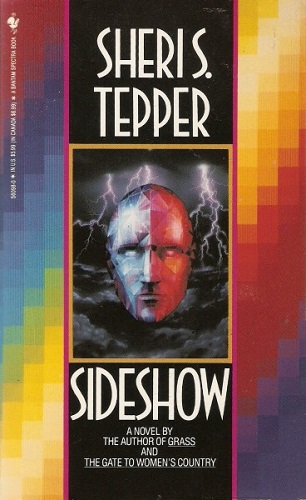
Grass was followed by Raising the Stones (1990, USA), and then Sideshow (1992, USA), and all three are linked by the Arbai, an ancient race of dragon-like aliens who created a galaxy-wide network of Doors, which provided instantaneous travel between worlds. In Sideshow, an alien visits Earth in the late twentieth century and persuades a pair of joined twins to destroy an Arbai Door moments after it arrives on Earth. While doing so, they accidentally fall into the Door.
The story then jumps ahead several thousand years to the world of Elsewhere, which is the only planet left in the galaxy inhabited by humans not “enslaved” by the Hobbs Land Gods (an alien fungus which has created a hive mind out of all the infected humans, as described in Raising the Stones). But the founding philosophy of Elsewhere is a perversion of the term “diversity”, where a thousand or so cultures are protected despite their depredations on their members, such as sacrificing babies, treating women as property, abusing children, and generally allowing the privileged to treat the poor as less than human…
Elsewhere is administered from Tolerance, which uses Enforcers to, well, enforce Elsewhere’s distortion of diversity, by ensuring people do not move between cultures, the cultures do not change, or do not use technology of a higher level than is mandated for their culture. The Provost in Tolerance once a year consults a hidden computer holding the minds of the thousand academics from the galaxy’s greatest university (before the Hobbs Land Gods), but those uploaded minds, especially the four most powerful, are now quite insane and have been masquerading as “gods” and interfering in many cultures.
A team of three Enforcers, the joined twins from the twentieth century (they ended up in Elsewhere when they fell through the Door), and a mysterious old woman and her equally aged male companion (and an even more mysterious not wholly physical companion called Great Dragon), travel to the uninhabited centre of one of the continents, on the run from the mad uploaded “gods”, and eventually discover the secret of Elsewhere and the Arbai.
It makes for an odd novel. The cultures are perversions, but then Tepper has been deliberately perverse before – in Raising the Stones, for one – and it’s clear she’s arguing against the philosophy which governs Elsewhere. Even so, “diversity” was a bad choice of word to use. It makes something reprehensible of something that should be admirable. And it sometimes seems Tepper delighted in doing just that. There are also weird tonal shifts between the various sections – the opening chapters with the conjoined twins reads like some sort of US carnival novel (sadly all too common in twentieth-century US science fiction) flavoured with a little Ray Bradbury. But then Sideshow turns into a Jack Vance novel, although the wit is considerably more heavy-handed than Vance’s. The final section is pretty much explanations, but relies a little too much on close knowledge of the preceding novels, which, to be fair, I read in 2020 and 2018.
And yet, this is Tepper. You expect certain things, a certain angle of attack, so to speak, and in Sideshow she delivers it. A bit too much in places, I think. The main characters are mostly sympathetic, but the rest are grotesque, often more like caricatures than characters, especially the villains. It’s a book that’s slow to start, picks up pace in the middle, before slowing down once again for the grand finale. Which is, to be honest, a little disappointing.
Tepper is always worth reading, and in Sideshow she’s as inventive as ever, as extreme as ever, and as readable as ever. I’m not convinced you need to read Grass or Raising the Stones first, but it would probably help.
 It Doesn't Have To Be Right...