It Doesn't Have To Be Right…

… it just has to sound plausible


8 Comments

A British sf masterwork? Implosion, DF Jones

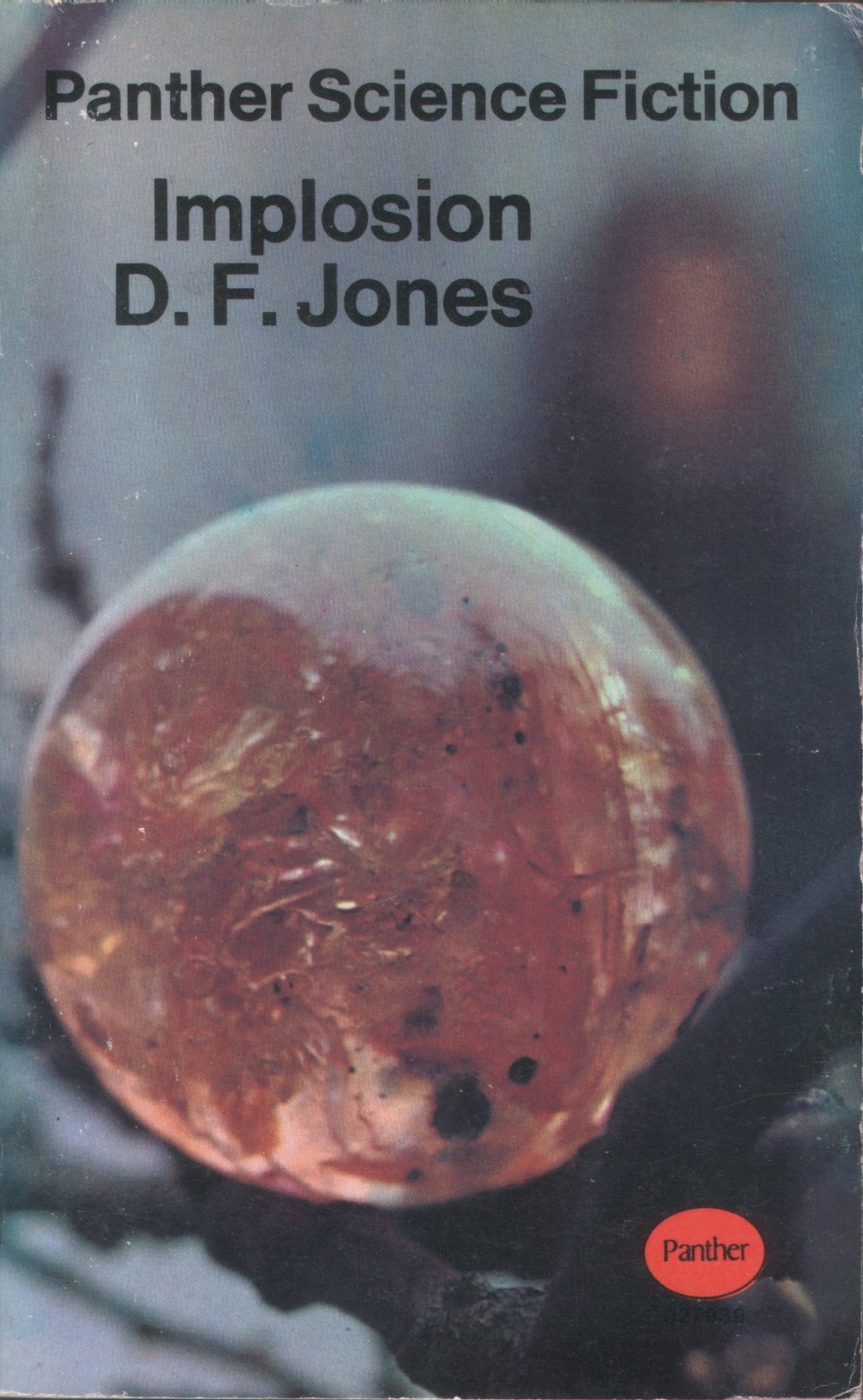
The SF Encyclopedia makes no real comment on the works of Dennis Feltham Jones, preferring instead to précis his novels. He is perhaps best known for his first novel, Colossus, which was filmed as Colossus – The Forbin Project. Implosion, from 1967, is his second novel.
An unnamed Eastern Bloc country develops a substance which renders women sterile. Because the nation’s premier is the illegitimate son of a British diplomat, he chooses to use this powder on the UK. Two years later, fully eighty percent of British females can no longer ovulate. The country’s population begins to fall, and is calculated to hit around five million by the mid-1980s. A government with far-reaching powers and a mandate to fix the problem is voted into power. All the fertile women are put into camps to become baby machines. Children are put in National Schools, where they are kept safe from harm and educated to as high a level as possible. Villages are demolished, and towns abandoned, when their populations fall below sustainable levels.

In charge of all this is John Bart, the Minister for Health and Regeneration. His wife Julia proves to be one of the rare fertile women, and is packed off to a camp. Meanwhile, the government tightens its grip on the country. After a raid on the lab which developed the powder, the Brits reverse-engineer it but can find no cure. They publish the formula, so that now everyone has it. Naturally, other countries soon find themselves in the same situation.

Meanwhile, Julia has come to realise that the regime in the fertile women’s camps has turned nasty. Women are whipped for the slightest infraction, such as smoking (even when not pregnant). She escapes… and discovers that the world outside is very different to what she had been told. She finds her husband, who is still the number two man in the government, and likely soon to be the number one, and learns that he is now shacked up with her twin sister. The twins turn on one another, Julia gets sent back to the camp, and that’s that. Except Nature has one final trick up her sleeve…

There’s a very 1960s British po-faced earnestness to Implosion. The characters are exemplary – Bart himself is young and noble and brilliant at organisation and making decisions. His wife is beautiful and loving and a true soulmate. Or at least, she starts out like that. Even their lady who does is a treasure. The prime minister is a hearty man of the people, straight-talking and more than willing to do the necessary. The Britain of the story appears pretty much the same as the Britain of 1967. Even though it begins in the early 1970s, the currency is still pounds, shilling and pence.

Implosion reads like a novel in which the author had a good idea and then set out to show clever he was in solving it. Its politics are simplistic, as is its view of the British people. The Barts are very much the “right sort”, and what few working class people do make an appearance are viewed with all the patronising indulgence of the privileged. Implosion is not a cosy catastrophe – there’s more brandy drunk than tea, for one thing – but it is peculiarly English. Perhaps it could be called a “Mayfair catastrophe”. That’s what it feels like, a black and white 1960s television Play for Today with a cast speaking in cut-glass accents, while around them the world they don’t much care for slowly falls apart…

So, not a British sf masterwork, then.

(And no, I’ve no idea what that blobby thing on the cover of the book is supposed to represent.)


9 Comments

How science fiction works

Let’s be reductive and say science fiction refers only to those subgenres which occupy what is generally considered the genre’s heartland – hard sf, space opera, soft sf, first landing, first contact, military sf, etc. Let’s call all the rest “speculative fiction”, a term I dislike, but since they seem not to bother with the science aspect it is perhaps more appropriate.

Let’s say there are two types of science fiction as defined above. There is the type of science fiction that appeals to people who would happily read supplements for a role-playing game. And there is the type for people who would prefer to read a physics text, or a book about the engineering involved in building the Saturn V. Both types, at heart, operate by adjusting a reader’s sense of scale and turning that which cannot be conceived into something which can. Or vice versa. For example…

Credit: ESA/NASA/JPL/University of Arizona

Look at the photograph above. That’s the surface of Titan, a moon of Saturn. The photo was taken by Cassini-Huygens, a space probe which launched in 1997, and the Huygens part of which descended to Titan’s surface in 2005. Saturn orbits between 1.3 billion and 1.5 billion kilometres from the Sun. Earth orbits between 147 million and 152 million kilometres from the Sun. If you could travel to Titan in a straight line (which you can’t), it’d be a journey of around 1.2 billion kilometres… That’s equivalent to flying from London to New York and back over 108,000  times, or 6.5 million circuits of the M25 (at an average speed of 120 kph, that would take you about 1,150 years).

Numbers. They define our world – what we can directly see and experience, and what we can’t see or experience. As those numbers increase in size, so our sense of place in our world is increasingly diminished. Using science we can investigate, and gain an intellectual understanding of, this feeling of diminution. Science fiction, however, postulates situations in which we can experience it directly. It also gifts us with agency in this new world being explored. It is a visceral, albeit vicarious, manifestation of what science can show us.

Science fiction is scale, its uses and abuses. It can take something huge and beyond direct human experience, and by giving it the purpose of something within the reader’s real-world frame of reference, render it unfamiliar:

Planets. Seven of them. Armed and powered as only a planet can be armed and powered; with fixed-mount weapons impossible of mounting upon a lesser mobile base, with fixed-mount intakes and generators which only planetary resources could excite or feed. (p 40, Second Stage Lensman, EE ‘Doc’ Smith (1953))

It can directly manipulate the human frame of reference, and make of it something which would otherwise be strange and impossible to fathom:

It was not clear what had happened to the man for the next million years or so. One line of argument held that he had expanded himself to encompass a massive swathe of galactic space – swallowing hundreds of thousands of systems, across thousands of lights. (p 239, House of Suns, Alastair Reynolds (2008))

Or, it can simply map parts of the real world we cannot experience, and allow us to compare the scale of our frame of reference with that being described:

It took an effort to remember that the distance to the horizon was more than ten times that on Earth. That the storm was two thousand kilometres across. That the sky was hydrogen and helium a thousand kilometres deep, with cloud layers of ammonium ice above and decks of ammonium hydrosulphide and ammonium-rich water-ice and water-droplet clouds below, endlessly blowing around this vast world. (p 215, The Quiet War, Paul McAuley (2008))

There are a number of rhetorical tools and literary devices science fiction uses to manipulate scale and the reader’s perception of it. Analogy is a particularly common one – by directly referencing something known, and of a size encompassable by the reader’s mind, the sf text can make manageable the scale of something normally beyond comprehension. This is not always a good thing, as it can have a trivialising effect.

There is a great deal of implication in the findings of science. The photograph earlier in this post does not in and of itself present a particularly impressive-looking picture. It’s a stretch of orange ground littered with pebbles. But it’s on Titan. Which means… the launch of the space probe, the journey there, the distance the probe travelled, the mechanisms which comprise the probe and the science behind them, the descent into Titan’s atmosphere, Titan’s surface conditions… the real and true fact that it is an alien world.

Science fiction not only gives us the orange photograph, but it also shows us how it was achieved. It makes explicit the wonder. And since wonder is central to science fiction, then to define wonder is to define science fiction:

…where:
W = wonder
lg = greatest distance mentioned in the text
tg = greatest length of time mentioned in the text
Nn = number of ideas/nova in the text
Nf = number of ideas/nova reader has encountered previously
ir = closeness of the viewpoint character to the reader as a function of background, worldview, attitudes, etc – ie, an indicator of their ability to identify with the character
jn = number of situations of jeopardy for point-of-view character(s)
ja = amplitude of situations of jeopardy for point-of-view character(s), where 1 is fatal
Cn = size of cast in the text
Br = bandwidth of the reader (calculated from educational level, number of books read, age)
Dr = willingness of the reader to suspend disbelief


1 Comment

Fragment

So a year or two ago I had this idea for a postmodern planetary romance, a Leigh Brackett-style story as much about story as it was about the events in its strange and implausible world. But like most such projects – and I have an embarrassingly large number of them – it never got beyond some vague ideas and a couple of hundred words. I had a great title, ‘Gods of Saturn’, and what I thought was a pretty cool opening, but then other new shiny ideas captured my attention and my postmodern planetary romance got filed away in a forgotten folder. Until now. Maybe one day I’ll do something with it, actually finish it off perhaps, but for now it qualifies as one of those “stories that never were”, of which I have far more than I care to enumerate. But rather than let it go totally to waste and, in part, to perhaps prompt me into actually working on it and maybe finishing it, here’s the opening of ‘Gods of Saturn’ for you to enjoy…

Of all the winds which blow across the sand seas, an easterly is the most disagreeable. From that quarter, the town of Kumpara boasts no defence against the scouring grains of sand. The western wall of Pu Chou rises behind Kumpara’s tumbled blocks, and curves enfolding arms to north and south. But to the east: nothing.

There was, however, much which could be said about the couple who strolled along Kumpara’s long stone jetty one day in the Age of Helium, as small wisps of easterly wind whipped up dancing devils of sand.

Kumpara had seen better years, but had yet to reach the nadir of its decline; or its subsequent rise to quiet gentility. See it now, and perhaps you would find it hard to picture the narrow streets thick with blinding red dust, the sand whipped into fountains fifty feet high, and every house shuttered and doors firmly bolted. Those who lived there knew better than to risk the wind’s wrath.

A local spy – and there was one – who watched the young couple will have deduced they were strangers to Kumpara. The wind was not yet dangerous, but only the foolhardy or ignorant remained out once it began to blow. So too did their garments advertise their origins. The young lady was dressed in a fashion yet to be seen in the town. The eye in the telescope might have glimpsed the split skirt which was common at that time in the capital city, Xu; the high-collar, with its arcane symbols of rank and allegiance; the long gloved sleeves. Her companion was equally well-dressed.

As they turned to stroll back along the jetty, some feeling or whim caused the young woman to look back. She halted, head turned and, as if conjured into being by her gaze, features formed on the face of Saturn. The lemon and orange and tan stripes swirled like the ingredients of some decadent cocktail. It was a vast face, a face which filled the planetary canvas on which it appeared, and it caused the spy to drop his telescope and scramble from his vantage point.

As a result, he did not see the reactions of the Xuan lady and her companion. He did not see her turn her back on the face in disdain.

If such an occurrence sounds remarkable but the couple’s reaction does not, it is because at that time the gods of Saturn would often manifest on the face of the gas giant. From their celestial vantage point, they would gaze on each of the moons and on each of its civilisations. Their impact depended very much on the moon’s distance from Saturn. Here on Janus, where Saturn occupies a significant portion of the horizon, the gods held sway more than on, say, distant Iapetus.

When a god appears, all see him or her. When a god speaks, only those to whom they direct their instructions hear.

Lady Eresu turned to Captain Quradu and took his arm. She gently pulled him about. “Ignore him, Quradu,” she said softly. “He cannot harm us.”

The captain dropped his hand from the butt of his tantalum-pistol. That looming face – its presence alone in the sky suggested great power. Quradu looked up at Lady Eresu – as befitted her rank, she was a head taller than he – and noted her lack of concern.