
For a novel explicitly constructed as an old Analog-style puzzle story, there are four puzzles in Project Hail Mary (2021, USA) which the novel does not attempt to solve: why did I buy it, why did I read it, why was it published, and why has it been successful? I can possibly answer the first two – it was cheap, 99p in fact; and, I am an idiot. But the last two will forever remain a mystery.
Weir, of course, is best-known for The Martian (2014, USA), a surprise best-seller, originally self-published, which was then turned into a movie by Ridley Scott. The Martian is not a good book – a first-person narrative written by an unlikeable narrator, and written in the first-person for all the wrong reasons. It sold itself on its science, which is, unfortunately, not as accurate as it claimed.
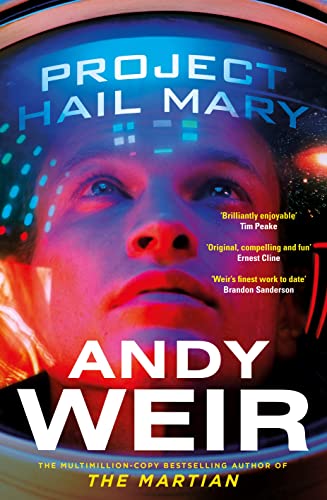
Project Hail Mary is Weir’s third novel, following Artemis (2017, USA), which I have not read. In Project Hail Mary, a man wakes up aboard a spacecraft in another planetary system, with no memory of who he is or why he is there, or indeed where he is. Through chronological flashbacks, he learns he is one of three astronauts – the other two did not survive hibernation during the trip – sent to Tau Ceti. A microscopic creature has begun feeding on the Sun, and this threatens life on Earth. Tau Ceti is also infested with the microbes, called “astrophages”, but it is not losing luminance. An international project is put together to send a ship to Tau Ceti to discover why, and possibly send back a means to kill the microbes.
The microbes’ biology means they can convert mass to energy and back with no loss, making them a perfect fuel, allowing the ship to reach near light-speed. Soon after awakening, the narrator is hailed by an alien ship. It too has a single surviving crew. The alien is a rock-skinned spider-like creature which lives in a hyperbaric ammonia atmosphere. So, of course, the narrator names it Rocky. The two learn to communicate, and together discover why Tau Ceit’s astrophages have not destroyed the star.
The narrator is a high school science teacher. He was a physicist, but he published a paper on extraterrestrial life which saw him drummed out of the scientific community. Somehow or other, he ends up as an expert on the astrophage. Which is why he’s sent to Tau Ceti. He mentions repeatedly that he’s a good and well-loved teacher, which seems completely plausible as he thinks like a teenager.
Because he’s a high school science teacher, everything he encounters is solvable using high school maths. Which Weir explains in detail. All the technology, the sophisticated computers, aboard the spaceship, and yet every problem he encounters can be solved using schoolboy mathematics. It gets old very very quickly.
The astrophage is, I admit, quite ingenious, but it seems extremely unlikely to have evolved – in fact, I kept on expecting to read it was engineered. But no. Every other idea in the novel springs from the astrophage’s biology. The characters are drawn with the broadest of strokes; and while the cast is international, it’s only the handful of Russians and Chinese who don’t come across as Americans.
Many years ago, there was an international best-selling novel which taught its reader about the history of philosophy. Sophie’s World (1991, Norway) by Jostein Gaarder. I seem to remember reading it. Project Hail Mary reads like an attempt to do the same for high school maths, by showing how useful it is when, for example, trying to rendezvous with an alien spaceship, work out how not to poison yourself in an ammonia atmosphere, or even accidentally blow up the entire Earth while experimenting on microbes which are capable of total mass-energy conversion. Handy to know.
A novel that sets a low bar and all too often barks its shins on that bar. Avoid, unless you’re a masochist, or, like me, an idiot.
 It Doesn't Have To Be Right...