
One question I frequently ask myself when reading a book is, why the fuck did I read (or reread) this book? If it’s a book by an author unknown to me, then perhaps I have an excuse. But a reread of a novel I know to be not very good, or even actively bad? The only possible answer is: I am an idiot. When it comes to books, and books only, I hasten to add. (Well, maybe not just books.)
Anyway. Polaris (2004, USA) is the second book in McDevitt’s series about far-future treasure hunter Alex Benedict, published fifteen years after the first book, and which is set in a human federation 9,600 years from now which somehow culturally resembles late twentieth-century USA. There’s a few sf tropes and macguffins in there, but everything else is more than familiar to a US sf reader of the 1990s and early 2000s.
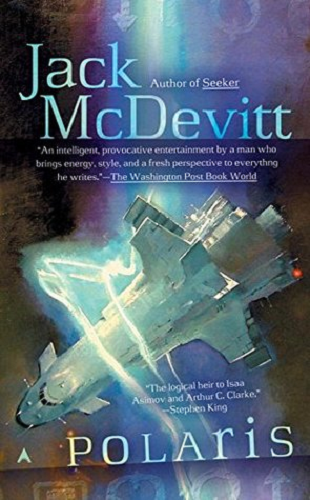
The title refers to a ship which did a Marie Celeste some sixty years earlier. It carried seven famous passengers to the death of a star, and was found empty shortly after transmitting it was returning home. No one has ever solved the mystery.
Unlike the first book in the series, A Talent for War (1989, USA), Polaris is narrated by Benedict’s pilot and employee, Chase Kolpath. Benedict develops an interest in the Polaris mystery, and then shortly afterwards an exhibition of Polaris artefacts is bombed. The bombing is ostensibly a political assassination attempt, but Benedict suspects otherwise and begins digging deeper…
The solution to the mystery is, sadly, somewhat ordinary, and the real strangeness in the plot – the Polaris passengers faked their own deaths because they’d taken an immortality treatment, and have been conspiring behind the scenes ever since – is handled more or less in passing. Most of the plot covers the conspirators’ attempts to prevent Benedict from discovering the truth, and some of the events are, I think, a great deal like events in A Talent for War (wasn’t there a forced landing of a flying car into the sea in A Talent for War, as well?)
The world-building is just as sketchy as in the preceding novel, with a whole catalogue of sf tropes badly welded onto an essentially West Coast US society / monoculture. Cars fly, but remote towns can still be cut off by storm damage. The only real change from A Talent for War is that, thanks to a new starship drive discovered in that novel, interstellar travel in Polaris is more like twentieth-century air travel than sea travel.
These books are easy reads, and I suspect I’ll continue with them, but I can’t recommend them. Even the mysteries which drive their plots are feeble. Perhaps that will improve; I have no expectation the world-building will improve. In truth, the only interesting thing about these novels is that McDevitt managed to logroll his way onto the Nebula Award shortlist with them for a decade or more.
 It Doesn't Have To Be Right...