
Back in 2014, Paul Park published the novel All Those Vanished Engines (2014, USA), which comprised three linked novellas. One of these, which shared the book’s title, was originally commissioned to accompany a sound installation by Stephen Vitiello at the Massachusetts Museum of Contemporary Art in 2011. The Employees (2020, Denmark) by Olga Ravn was inspired by the art of Lea Gulditte Hestelund, a Danish visual artist, after Ravn was asked to provide accompanying text for her exhibition, Consumed Future Spewed Up as Present. Knowing this in no way affects reading The Employees, although it does in part explain some parts of a novel which takes pains to obscure its story.
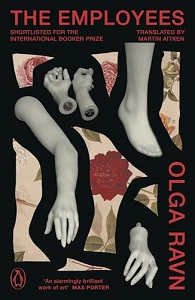
The novel is told in one- or two-page chapters, each of which is the testimony of a member of the crew of the Six-Thousand Ship, so called because that’s the number of people aboard it. Just like the Three Ship that went to the Moon, and indeed the One Ship that put the first human being in space. Not all of the six thousand are human, some of them are androids – the novel is vague to their exact status, only that they are human in all ways except actually being considered human. Science fiction is normally quite happy to feature chattel slavery without commentary, so why it bothered to invent a metaphor for it will forever be a mystery.
The opening testimonies describe members of the crew, or “employees”, visiting rooms containing “objects” from Hestelund’s installation. There are also visits outside the ship to a valley, although its unclear if the ship has landed on a planet or is in space. At some point, the non-human humans object to not being treated as humans, and mutiny. This is supposed to comment meaningfully on the human, or indeed non-human, condition.
The problem is, there is nothing new here. And couching everything in terms so vague, despite the manifold viewpoints, does not render the story profound or deep. I am in general in favour of science fiction written by non-genre writers. Their unfamiliarity with the tropes and conventions of science fiction can result in something interesting to say about common sf concerns – although that “common” often means their treatment is old-fashioned or adds little to the genre conversation.
And so it is here: The Employees, while poetically written, contains no new insights into the human condition, or even human resources. Some nice prose, an interesting structure, and a link to an art installation of a real-life artist are married to a story that tries hard to hide the fact it is thuddingly obvious from start to finish.
 It Doesn't Have To Be Right...