After a number of unsatisfying, and occasionally offensive, old science fiction novels, it’s time for something new. Navigational Entanglements (2024, France) is a short novel, probably closer to a novella (and has been nominated as such in this year’s Hugo Awards), set in de Bodard’s Xuya universe.
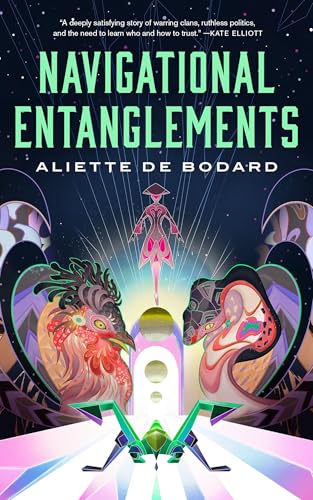
At least, I think it’s set in that universe. It’s certainly set in a space opera universe which is culturally Vietnamese, much like in The Red Scholar’s Wake (2022, France; recommended). Việt Nhi is a navigator in the Rooster Clan, one of a handful of clans responsible for guiding ships through the Hollows (some sort of hyperspace, I think), and protecting them during their journeys from tanglers (some sort of squid-like space creatures which live in hyperspace and can kill people by touching them, I think). A navigator from a rival clan crashes a ship and a tangler is let loose in the real universe. A team of four junior navigators, each of them to some extent considered a loser, is put together to catch the tangler. They’re expected to fail.
It’s all a political plot to destroy the influence of one of the clans, the Dog clan, which acts as the liaison between the other clans and the Imperial authorities. But the plot, so to speak, is more or less immaterial. The four juniors are very different characters, each one flawed; and it’s their dynamics, mediated by the protagonist, Nhi, which drives the story. Plus her attraction to one of the other juniors, Hạc Cúc of the Snake clan.
It’s all good stuff – although I do find myself a little puzzled by some of the background. I’m sure I’ve seen the Hollows mentioned in other stories set in the Xuya universe, but the concept of navigator, navigator clans and tanglers was new to me. Perhaps I missed something somewhere, but it felt like a retcon.
Having said that… on the one hand, no universe is set in stone and authors are of course free to chop and change as they wish – cf John Varley’s Steel Beach (1992, USA) for a good example. On the other, there’s something slightly less immersive about a universe that changes underneath you – and one thing the Xuya stories are very good at is immersion.
I do like these stories. The world-building is excellent, the mix of politics and (ironically) heightened emotions is effective, the level of detail in the prose is impressive, and they hit that space opera spot without being the usual hateful hyper-capitalist slave-owning oligarchic space opera universe so beloved of US science fiction writers.
Worth a read; even better, vote for it at the Hugos.
 It Doesn't Have To Be Right...