It Doesn't Have To Be Right…

… it just has to sound plausible


Leave a comment

Millennium 8: The Girl with Ice in her Veins, Karin Smirnoff

The second book of the third trilogy featuring Lisbeth Salander, genius sociopath hacker. The problem with novels which centre sociopaths as the hero is the villains have to be complete psychopaths in order to present some spectrum of good to bad. So, here, for example, a bad guy who infiltrates a group of eco-activists turns out to be a paedophile, because being on the bad guy’s side is not enough on its own. And when every villain is grotesque beyond plausibility, suspension of disbelief even, then you have to wonder what point the story is trying to make.

On the other hand, this is a deckare, a thriller, so I guess making a point is not, well, the point of the book. The Girl with Ice in her Veins (2025, Sweden) is not a translation of the book’s original Swedish title, Lokattens klor, which means “the lynx’s claws”, but neither of the titles is especially relevant to the plot – although there is a a newly-introduced character nicknamed Lo, lynx. She’s a baddy, of course.

Like the preceding novel, The Girl in the Eagle’s Talons (2022, Sweden), The Girl with Ice in her Veins is set mostly in the invented north Swedish town of Gasskas. It also features the same cast – not just Salander and Blomkvist from the original trilogy, but also Blomkist’s daughter and family, Salander’s niece, and the trilogy’s main villain, disabled white supremacist millionaire Branco. The ecological theme also continues, although this time it’s opencast mining rather than windfarms.

Salander’s niece, Svala, is interning at the local newspaper and has joined a local group of eco-activists. After discovering a local abandoned sanatorium is secretly in use, Svala’s mentor at the newspaper is murdered. A bomb explodes near a disused mine, which appears to be in the process of being re-opened. There is also a consortium interested in opening a new mine in the area.

It’s all connected, of course, although the novel seems more interested in the depredations of the secondary cast, especially the villains. The Cleaner is hired to murder someone in Copenhagen, who turns out to have connections to the new mine in Gasskas, but instead he decides to help Svala. A visiting Greek/Chinese millionaire, who is interested in investing in re-opening the old mine (which is actually owned by Gaskass kommune), turns out to be the father of Blomkvist’s grandson. But because he’s a baddy, he’s also a domestic abuser and made his fortune through people trafficking. Branco pops up every now and again. He’s after the harddisk containing billions in cryptocurrency which Svala was given by her mother and which she has hidden. He’s also less interested in business and more in his white supremacist political organisation.

The Girl with Ice in her Veins resolves its main plot-threads, but Branco once again escapes. So that’s the plot of book three – as yet untitled – sorted. The prose is present-tense again, and often choppy. It mostly works, but occasionally gets perilously close to the fourth wall. I did spot a couple of weird choices in translating Swedish words/culture, but fewer than in the previous book. The Girl with Ice in her Veins is not a great book, but then the series could hardly be called a great series. The first book, The Girl with the Dragon Tattoo/Män som hatar kvinnor (2005, Sweden), was a solid serial killer hunt thriller, but it’s been downhill since then. I must admit, I do wonder how far they plan to take the series. Blomkvist is now in his sixties, Salander is slowing down too… The Girl in the Eagle’s Talons and The Girl with Ice in her Veins do feel a little like they’re moving Svala to centre-stage, so who knows…

Leave a comment

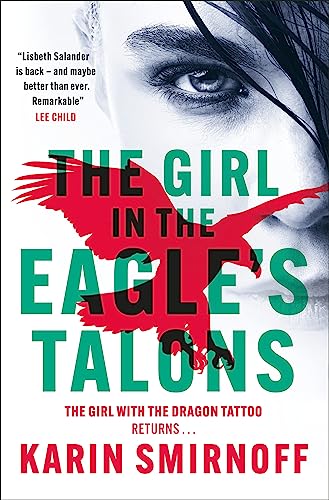
The Girl in the Eagle’s Talons, Karin Smirnoff

The start of the third trilogy featuring Lisbeth Salander and Mikael Blomkvist, and a new author. As indicated by the title, I read it in English – and… a new translator too. This time it’s a professional translator from Swedish to English. The English version keeps up The Girl… book titles, which are not of course direct translations of the original Swedish titles. In this case, it’s Havsörnens skrik, The Sea Eagle’s Cry – but weirdly, it’s a boy who finds himself in the titular, er, appendages.

Blomkvist is in the invented town of Gasskas in Norrbotten, a county in the most northerly part of Sweden. He’s there for his daughter’s wedding. To the head of the Gasskas kommune (district council/municipality). Who Blomkvist doesn’t like from the moment he meets him as he seems to be a bit of a chancer. Honest – but not the most transparent of politicians. Especially when it comes to a deal to build Europe’s biggest windfarm on land in the district. There are three companies in line to take a third each of the contract, but one wants 100% of it, a shadowy Swedish company run by a disabled psychopath who lives in a refurbished military bunker near Gasskas.

Lisbet Salander is in Gasskas because her half-brother’s daughter – previously unmentioned in the series, unsurprisingly – is about to go into care, and Salander is the only surviving relative. The daughter, Svala, is a genius like Salander, and also has the same genetic condition as her father which means she doesn’t feel pain.

The two narratives are connected. Svala’s mother is missing because she’s been kidnapped by the psycho millionaire. Blomkvist’s soon-to-be son-in-law is being threatened by the same psycho to give him the entire contract. The two stories intersect when Blomkvist’s grandson is kidnapped at the wedding.

There’s little that’s new here, except perhaps the setting: the Swedish north. Blomkvist is a bit more of a fogey than in earlier novels, and Svala fills more of Salander’s typical role than Salander does. The villains are almost caricatures – they even have a secret underground lair!

The writing is better than the Lagercrantz trilogy, although that’s hardly a high bar to clear. Everything is in present tense, which gives it more urgency, and often drops into choppy sentence fragments. It works, to an extent – although I don’t think the material is really strong enough for it, given everything is so clichéd. 

This is the English prose, of course, so it seems the translator is much better. There were a couple of questionable choices: Systembolaget is referred to throughout as “the off-licence”, which may well be a UK term for a shop that sells booze, but Systemet is the state liquor monopoly chain, which is not quite the same thing. The word “Lapp” is used interchangeably with “Sámi”, even though it’s considered offensive, and it’s not always in dialogue or in the POV of characters who are prejudiced. And someone orders “a pizza salad”, but “pizza salad” is the name of a side-dish in pizza restaurants here (the indefinite article looks odd – like, you order a pizza and say “and garlic bread”, not “and a garlic bread”).

So, slightly better than the preceding three books, and makes good use of the series mythology. They are at least better than Dan Brown’s “weapons-grade bollocks” – and English is his first language! – but even for a commercial thriller this is near the bottom of the barrel.

And yes, I really should try reading the books in Swedish.


Leave a comment

The Girl Who Lived Twice, David Lagercrantz

This is the third sequel to Stieg Larsson’s Millennium trilogy featuring super-hacker loner Lisbet Salander written by Lagercrantz. Two books of a new sequel trilogy, by Karin Smirnoff, have so far been published. I still find it amusing the English translations of these novels use The Girl Who… as titles, unlike the Swedish novels (this one is actually titled, Hon som måste dö, She who must die), especially given Sweden cobbled together a series of unrelated Goldie Hawn movies in the 1970s and 1980s by retitling them as The Girl Who…, Tjejen som…, such as Tjejen som föll överbord (Overboard) and Tjejen som gjorde lumpen (Private Benjamin). It’s either a bizarre coincidence (possible, as the first book was The Girl with the Dragon Tattoo, after all), or someone somewhere is displaying a wicked sense of humour…

The story so far: Salander’s father was a senior GRU officer who defected to Sweden and, while there, protected by a secret department of Säpo, set up a Russian criminal syndicate, Zvesda Bratva. Salander also has a sister, who is stunningly beautiful and now the head of the syndicate. The two hate each other.

A homeless man in Stockholm dies in suspicious circumstances, and the forensic pathologist attached to the case contacts Mikael Blomkvist. Who then contacts Salander. Between them, they identify the homeless man as a sherpa, who saved the life of the current Swedish minister of defence during an ill-fated expedition to climb Everest years before. A woman died on the expedition – her husband was a US billionaire with links to Zvesda Bratva, and rumour has it she was going to reveal all. So what really happened on the mountain?

Salander is busy trying to destroy her sister; Blomkvist is hunting for a story to re-invigorate his career… and the murdered homeless man might be it… but he’s side-tracked by the apparent breakdown of the Swedish minister of defence. Of course, everything is linked. Blomkvist’s investigations result in him being kidnapped by Zvesda Bratva, and tortured. Salander rides to the rescue.

The previous two Lagerctantz novels were not very well-written – certainly, the English translations were badly-written. This one is even worse. I mean, you don’t expect shining prose from a thriller (known as deckare, here in Sweden), but even prose anti-stylists, and there are a lot of them in science fiction, would say prose which is painful to read is doing it wrong. The Swedish cultural elements are handled well enough – although Lagercrantz does like name-checking streets in Stockholm – but it’s hard to see much past Salander’s genius hacking, genius everything in fact, or Blomkvist’s amazing journalism and interstellar journalistic reputation. Neither of which are remotely credible.

The first book in the series was a solid thriller – which is why I maintain the US adaptation is better than the Swedish one – but the sequels are like… those gymkhana event things, except each jump is made up of sharks stacked one on top of the other… One day I’ll definitely read the books in Swedish… but I suspect my opinion of them will not change.