
It Doesn't Have To Be Right…

… it just has to sound plausible


Leave a comment

The Ringworld Engineers, Larry Niven

This was a reread, although I don’t recall when I previously read the book. Some time in the 1980s, I suspect. Everyone knows Ringworld (1970, USA), it was even No. 60 in the SF Masterworks series. Niven admits he had never intended to write a sequel, but he’d received so much correspondence about the novel – a lot of it pointing out where he’d got things wrong. Earth famously rotates the wrong way in the opening chapter of the novel (updated in later editions), but the chief complaint was that the ringworld was unstable. It needed attitude jets to keep it in orbit. So Niven decided to write The Ringworld Engineers (1979, USA), which is all about the attitude jets. Mostly.
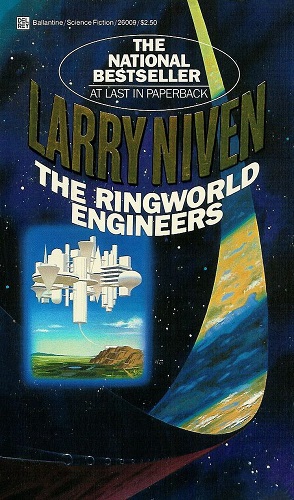
Twenty-three years after the events of Ringworld, Louis Wu is a wirehead. He and his kzinti companion on that trip, Speaker-to-Animals, now called Chmeee, are kidnapped by a Pierson’s Puppeteer. Who is actually the mate of the Pierson’s Puppeteer from Ringworld, and was the leader of the race, the Hindmost. He was ousted and now plans to win back his position by fetching a “treasure” from the ringworld, a transmutation device.

Which doesn’t exist and never existed. But that proves irrelevant because the ringworld has been knocked from its orbit and will impact the sun in a year or so. The City Builders, the most powerful race on the ringworld, had removed the attitude jets from the ringworld’s rim, the jets that kept it in orbit, in order to power their spaceships. Hence the current situation.

Wu decides there must be a Repair Centre, a sort of central control complex for the ringworld. If he can find it, then he can prevent the ringworld from being destroyed. But first he has to find it.

The humanoid races on the ringworld have created, and maintained, treaties and coalitions through “rishathra”, which is sex between people of different hominid races. Niven obviously likes writing about sex, or rather the easy availability of it to males, but this is commercial science fiction so it’s either alluded to or entirely off the page. Nevertheless, it leaves a bad taste.

The other problem is the distances – the ringworld is huge. Absolutely fucking enormous. With a surface area equivalent to three million Earths. Most of the action in The Ringworld Engineers takes place around the Great Ocean, an ocean so large it features archipelagos which are full-size maps of various planets in Known Space (including Earth, Mars and Kzin), and which are hundreds of thousands of miles apart. After a while, the distance gets wearying, it’s almost like some sort of scale fatigue sets in. It becomes meaningless, just words. Niven uses the right words, but there’s no sense of wonder attached to the vast scale of it all.

The Ringworld Engineers fixes the issue with the ringworld’s unstable orbit, and even identifies its builders – linking back to an earlier novel by Niven. He returned to the ringworld seventeen years later with The Ringworld Throne (1996, USA), and then again eight years after that with Ringworld’s Children (2004, USA). Five prequel novels, the Fleet of Worlds series, then followed.

The ringworld is a great creation, one of science fiction’s most memorable. The plot of the novel which introduced it doesn’t really matter. Same for its sequels. Dune (1965, USA) had great world-building, but its plot helped bring it to life. The plot of Ringworld is irrelevant, the Big Dumb Object exists in spite of it. And so it is for The Ringworld Engineers. Which presents a disappointing, and unconvincing, explanation as the answer to the question of who built it, and never really manages to really evoke the scale of it all.

Leave a comment

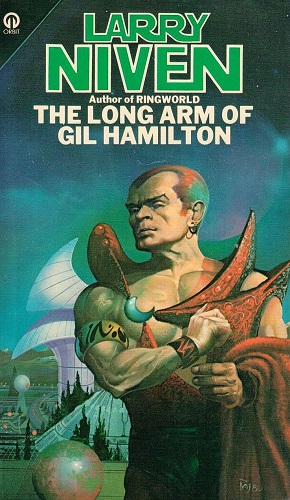
The Long Arm of Gil Hamilton, Larry Niven

We make foolish decisions all the time, probably even several times a day. Mostly, they cause no harm, perhaps a little mild embarrassment, and often no one witnesses the embarrassment but we know about it ourselves all the same. I have no idea why I decided to complete my exploration of Larry Niven’s oeuvre. I last read books by him back in the early 1980s, and while I had fond, if incomplete, memories of some of them, I also knew they weren’t very good. But, for some reason, I decided to read the rest of his books. I don’t know; perhaps I saw a couple, with their pretty damn cool Peter Andrew Jones cover art, in my local secondhand sf bookshop, and thought, yeah, let’s give them a go, I liked them back when I was, er, fourteen or fifteen, what could possibly go wrong?

Everything, of course.

I’d remembered the ideas in Niven’s books over the decades, and I knew he was a proponent of “transparent prose”, which is what writers say when their prose is so bad it’s almost an anti-style, and yes, I’d remembered Niven’s politics were considerably to the right of mine (and not just because I’m British but because he’s a conservative loon)… but what I’d forgotten was how effortlessly offensive his fiction was. My sensibilities were still in flux back in my mid-teens, so perhaps I just skated over the worst bits and only took the good, if rare, bits on board.

The Long Arm of Gil Hamilton (1976, USA) was not a Niven book I’d read back in the day. It’s a collection of three novellas set in Niven’s Known Space universe and featuring a single protagonist, Gil Hamilton. Who is an officer in the UN police, which is called ARM, Amalgamated Regional Militias (an unconvincing backronym, which Niven himself admits). Hamilton lost an arm in an accident in the Asteroid Belt, and developed a telekinetic arm as replacement – he has ESP, it works like an arm, only not as strong, but it can reach through solid objects. Even though he had the lost arm replaced with a transplant, he still has his psionic arm. See, the “long arm” in the title, it’s a pun: Hamilton works for ARM and he has a psionic arm too. Hoho.

Hamilton chiefly investigates organleggers… and this is where I have to wonder how I didn’t immediately recoil at Niven’s politics back in the day. Earth in the Known Space series has a population of eighteen billion, which, according to Niven, means it’s massively overpopulated and covered almost entirely by cities. (Earth currently has a population of over 8 billion but there are still vast swathes of unpopulated wilderness. I can bore you with population density by country, but you can look it up on Wikipedia yourself.) For some reason, these 18 billion people have an insatiable demand for new organs. So insatiable, in fact, that pretty much breaking any law results in a death sentence so the criminal’s organs can be harvested. Having one more kid than licensed, for example. Or drunk driving. Which first supposes the death penalty is normal – it’s not, the US is an aberration (one of around 15% of nations). And second, that all medical conditions are solved by transplanting a new organ. It’s complete nonsense, complete right-wing nonsense.

The plots of the three novellas are almost incidental. Hamilton is, to be fair, a mostly engaging narrator. In the first story, Hamilton is confronted with the seeming suicide of a Belter friend by direct simulation of the pleasure centres of the brain. Except it goes against everything Hamilton knows about his friend. It’s murder, of course. And Hamilton tracks down the killer. In the second, an attempt on Hamilton’s life leads him to suspect an organlegger who retired when the world government made it legal to use cryogenically frozen bodies for organs harvesting. The third story is one Niven freely admits he had the most trouble completing – it’s a locked-room murder mystery, of a sort, but also a sf story, which, according to the essay which ends the collection, took Niven several goes to get right… and even then it’s confusing, muddled and neither a good murder-mystery nor a good sf story. 

Everything in The Long Arm of Gil Hamilton, although it mentions other nations, is Americocentric. Everything operates according to US laws and sensibilities. This is hardly surprising – it’s a US sf collection written by a US sf author for the US sf market. And that was not only common, it was the actual state of the genre for much of the twentieth century. So it seems churlish to point this out, except to say it makes these books – not just Niven’s, but other sf authors of his generation – irrelevant to a twenty-first century sf audience.