The second book of the third trilogy featuring Lisbeth Salander, genius sociopath hacker. The problem with novels which centre sociopaths as the hero is the villains have to be complete psychopaths in order to present some spectrum of good to bad. So, here, for example, a bad guy who infiltrates a group of eco-activists turns out to be a paedophile, because being on the bad guy’s side is not enough on its own. And when every villain is grotesque beyond plausibility, suspension of disbelief even, then you have to wonder what point the story is trying to make.

On the other hand, this is a deckare, a thriller, so I guess making a point is not, well, the point of the book. The Girl with Ice in her Veins (2025, Sweden) is not a translation of the book’s original Swedish title, Lokattens klor, which means “the lynx’s claws”, but neither of the titles is especially relevant to the plot – although there is a a newly-introduced character nicknamed Lo, lynx. She’s a baddy, of course.
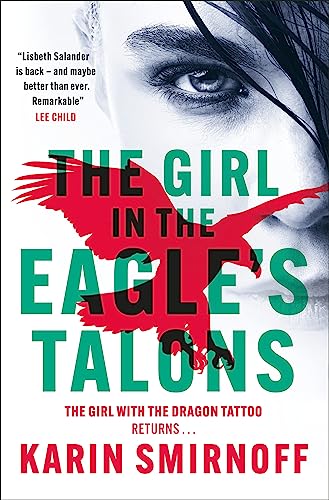
Like the preceding novel, The Girl in the Eagle’s Talons (2022, Sweden), The Girl with Ice in her Veins is set mostly in the invented north Swedish town of Gasskas. It also features the same cast – not just Salander and Blomkvist from the original trilogy, but also Blomkist’s daughter and family, Salander’s niece, and the trilogy’s main villain, disabled white supremacist millionaire Branco. The ecological theme also continues, although this time it’s opencast mining rather than windfarms.
Salander’s niece, Svala, is interning at the local newspaper and has joined a local group of eco-activists. After discovering a local abandoned sanatorium is secretly in use, Svala’s mentor at the newspaper is murdered. A bomb explodes near a disused mine, which appears to be in the process of being re-opened. There is also a consortium interested in opening a new mine in the area.
It’s all connected, of course, although the novel seems more interested in the depredations of the secondary cast, especially the villains. The Cleaner is hired to murder someone in Copenhagen, who turns out to have connections to the new mine in Gasskas, but instead he decides to help Svala. A visiting Greek/Chinese millionaire, who is interested in investing in re-opening the old mine (which is actually owned by Gaskass kommune), turns out to be the father of Blomkvist’s grandson. But because he’s a baddy, he’s also a domestic abuser and made his fortune through people trafficking. Branco pops up every now and again. He’s after the harddisk containing billions in cryptocurrency which Svala was given by her mother and which she has hidden. He’s also less interested in business and more in his white supremacist political organisation.
The Girl with Ice in her Veins resolves its main plot-threads, but Branco once again escapes. So that’s the plot of book three – as yet untitled – sorted. The prose is present-tense again, and often choppy. It mostly works, but occasionally gets perilously close to the fourth wall. I did spot a couple of weird choices in translating Swedish words/culture, but fewer than in the previous book. The Girl with Ice in her Veins is not a great book, but then the series could hardly be called a great series. The first book, The Girl with the Dragon Tattoo/Män som hatar kvinnor (2005, Sweden), was a solid serial killer hunt thriller, but it’s been downhill since then. I must admit, I do wonder how far they plan to take the series. Blomkvist is now in his sixties, Salander is slowing down too… The Girl in the Eagle’s Talons and The Girl with Ice in her Veins do feel a little like they’re moving Svala to centre-stage, so who knows…
 It Doesn't Have To Be Right...