
I’m not a big fan of dystopian fiction, mostly because it all seems so obvious. Oh noes, things are bad, this is what they will look like if they carry on in the same vein… Which , of course, they rarely do. And there’s no real evidence dystopian fiction helps prevent what it describes – if anything, it’s the reverse, as pointed out by the oft-repeated meme about a Torment Nexus…
Of course, dystopia is in the eye of the beholder – or rather, the politics of one era define that era’s dystopia but may not hold true a decade or a generation later. (On a side-note, I find fascinating dystopias where the citizens have been programmed – chemically, technologically, or neuro-surgically – to be happy with their lot; Alastair Reynolds describes one such in one of his Glitter Band novels, John Varley has written something similar.)
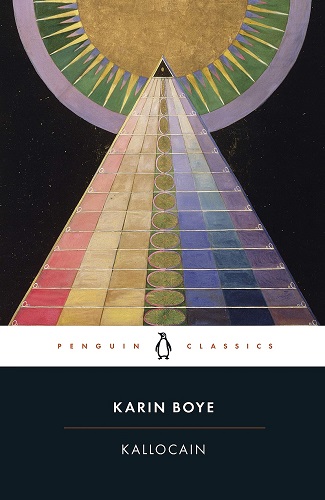
Boye, a Swede who lived in Nazi Germany, wrote Kallocain (1940, Sweden) very much as a response to her experiences living there. In the world of Kallocain, there is a World State. But it has enemies. And a border. Which means it’s not a world state. But that’s just a name. Leo Kall is a chemist in a Chemistry City (which sounds very Soviet). He discovers a new truth serum, which he names after himself and for which the book is named. It allows the authorities to interrogate people while they are only thinking about crimes – pre-crime, as Philip K Dick has it.
Kall uses his discovery to better his situation, and to destroy his superior, who he believes (wrongly) is having an affair with his wife. What follows is pretty much inevitable. There are hints the leaders live lives of luxury and freedom, which reads as a direct dig at the Nazi leadership. The general air of paranoia and deprivation echo both the USSR and the final years of the Nazi regime.
If you’ve read Orwell’s Nineteen Eighty-four (1948, UK) or Zamyatin’s We (1924, Russia), there’s little here that’s different, although Kallocain is less brutal than the former and less science-fictional than the latter. It should by rights be held in as high regard as those two novels, but it wasn’t translated into English until 1966 and, of course, its author is female. A good historical dystopian novel that stands alongside better-known examples.
 It Doesn't Have To Be Right...