
Wodehouse’s first novel was published in 1902, and I had always thought his Jeeves and Wooster stories and novels were published in the decade in which they were set, the 1920s. In fact, he continued writing Jeeves and Wooster novels right up until his death in 1975, although all were set during Edwardian times. As Wodehouse himself explains, Edwardian England was one of the few periods when a character like Bertie Wooster could exist, or indeed an entire community or subculture like him, second sons living on the largesse of their families. In later decades, they would have been forced to find work to fund their lifestyles, but in the 1920s their families were still unencumbered enough to fund them.
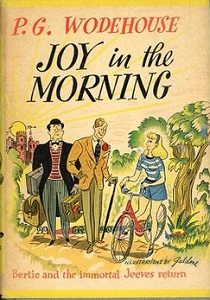
Joy in the Morning (1946, UK) was written two decades later, just after the Second World War, while Wodehouse was in Germany after being released from internment by the Nazis. He then moved to the US and never returned to the UK. Its story, however, follows pretty much the same plot as other Jeeves and Wooster novels. Jeeves, or occasionally Wooster, is asked to help a friend in a matter, romantic or business, and somewhere involved in this is either one or two romantic couples. Who promptly split up. And Wooster ends up, against his wishes, affianced to one of the women involved.
In Joy in the Morning, Wooster is asked to help his uncle arrange a secret meeting with an American shipping magnate called J Chichester Clam (the names in these books are excellent). Meanwhile, Wooster also has to help his friend Boko Fittleworth persuade the same uncle he is a fit husband, despite being a successful writer, for Nobby Hopwood, the ward of the uncle, and against whom the uncle is set after several botched meetings. Wooster further manages to break up the engagement of Florence Craye, the uncle’s daughter, and Stilton Cheeseworth, an old schoolfriend of Wooster’s, who is both large and somewhat dim, and has chosen to join the police rather than become a MP (although, to be fair, both qualities are useful in either career). Florence, who was once affianced to Wooster, promptly re-institutes their old engagement.
The usual hijinks ensue. There’s also a young boy, the uncle’s son, whose efforts to perform good deeds generally result in hurt and chaos – such as accidentally burning down the cottage where Wooster was intending to stay.
Given Wodehouse had by this point been writing these stories and novels for three decades, it comes as no surprise the plot ticks along like well-engineered clockwork, every remark and incident falling inexorably into place to keep plot momentum at a steady pace. Unlike other Jeeves and Wooster novels I’ve read, it’s the two of them who resolve the various situations, rather than Wooster worsening matters and Jeeves resolving it all. In fact, at several points Jeeves declares himself unable to think of a solution (although on one occasion this is a deliberate ploy). Good stuff.
 It Doesn't Have To Be Right...