
Well, slightly less than half of this post are US films, although I’d prefer it to be no more than one or two per post. But we’re getting there, as our national railway famously once said only to be privatised and then completely fail to get anywhere…
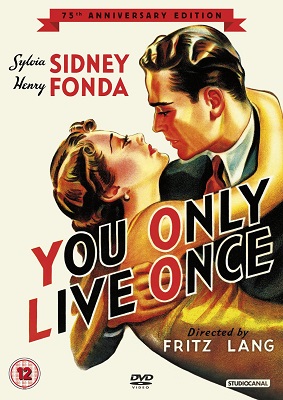 You Only Live Once, Fritz Lang (1937, USA). This was a cheerful movie. Henry Fonda plays a habitual criminal who decides to go straight – mostly thanks to the love of a good woman, in this case Sylvia Sidney, the secretary of the local public defender. But not everyone is so forgiving. Although the public defender (who is secretly in love with his secretary) gets Fonda a job at a delivery company, he’s fired when he takes time out to look over a new house with his new wife. And no one else will employ him because he’s an ex-con. Absolutely no one. And then someone robs an armoured car, and a hat is left at the scene which points to Fonda as the culprit. He’s found guilty (the trial is off-screen, probably because it sounds so much a travesty of justice Lang was too embarrassed to show it), and Fonda ends up on Death Row. But an opportunity for escape presents itself, he takes it, but accidentally kills the prison priest… seconds after the warden has received news that Fonda is innocent and has been pardoned. Too late! Fonda collects his wife, and the two go on the lam. To be honest, I’d expected more from Lang. I’ve seen a fair number of his noir movies, and I expected this to be as good as they were. And certainly the scene where Fonda escapes from prison is very atmospherically staged and shot. But everyone is so horrible to Fonda, and the odds are stacked against him so strongly, the set-up to justify Fonda’s abrupt shift from optimism to desperation feels forced and completely implausible. So, not one of Lang’s better films.
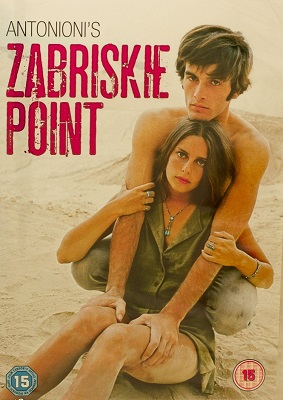 Zabriskie Point*, Michelangelo Antonioni (1970, USA). I’m a big fan of Antonioni’s films, and his Red Desert is one of my all-time favourite movies; but I also like late 1960s/early 1970s hippy films – or, at least, ones that comment on the hippy condition. It’s not just the direct rebellion, nor the questioning of society, but also that so many of these types of films throw in an additional dimension – which might well be typical hippy occult bullshit, but at least adds something a little more interesting to the story. And so to Zabriskie Point, which opens with semi-documentary footage of a protest at a California university. But when the police turn up, the protest takes a violent approach and several people are killed. Including a policeman. The film then abruptly switches to two characters: a young woman who is looking for a man in the Mojave Desert who works with emotionally disturbed children. Meanwhile, a young male student from the university protest, and a prime suspect in the death of the cop, steals a plane and flies off to Arizona… where he meets the young woman. And they go to Zabriskie Point, a real place just east of Death Valley, Nevada, where they have sex – well, actually, a full-blown orgy kicks off… and this isn’t really a film where you can describe the plot, or where such a précis would do the film any favours. But it is by Antonioni so it looks absolute fantastic and, to be fair, he makes just as good a fist of depicting the culture he’s filming as Demy does in Model Shop – they’re neither part of the culture, but their outsider status allows them see more than might be visible from inside. Antonioni made several excellent movies – I’d put Zabriskie Point in the top five of those; in fact I think I’d call it my third favourite after Red Desert and Blow-Up.
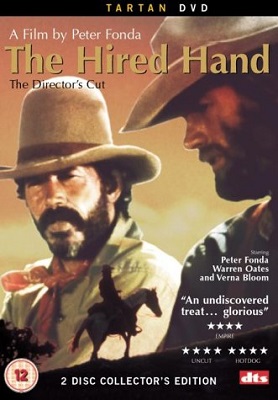 The Hired Hand*, Peter Fonda (1971, USA). Sigh. Another 1970s Western on the 1001 Movies You Must See Before You Die list. But… well, this is a surprise. I’m not a fan of the Western, and have only three in my DVD collection – and I’ve probably seen more than I ever really wanted to because they’re on the 1001 Movies list… Certainly I’d never have considered watching this one: an early seventies Western, directed by Peter Fonda… (Even though I liked Easy Rider a lot.) But in fact it turned out to be pretty damn good. For exactly the same reasons why it flopped on release back in 1970. It’s slow, its cinematography is poetic, and it has a great soundtrack. Its story, to be fair, is not very interesting, and its characters are not very strong… but the whole works because the pictures and story go together exceedingly well. Fonda plays a drifter who decides to return to the wife who kicked him out years before, and asks only that he be taken on as a “hired hand” in order to prove he has changed. But a stop-off en route had made enemies of some nasty sorts and they track him down, and your typical Wild West showdown ensues. Where The Hired Hand really scores, however, is in its opening third: the cinematograhpy goes mad for dissolves and montages, and it works wonderfully well. The bluegrass score by Bruce Langhorne is also really well done – and I’m not a person who really notices incidental music (I have, like, three original soundtracks in my music collection… er, except for all those ones by Andrzej Korzyñski). Altogether, this is good stuff, and I’m tempted to pick up a copy for myself.
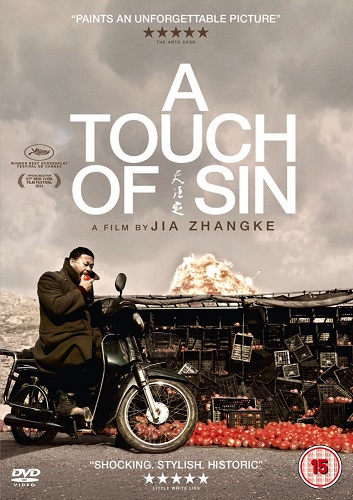
 24 City, Jia Zhangke (2008, China). I had been seriously impressed by Zhangke’s A Touch of Sin, so of course I added the rest of Zhangke’s oeuvre to my rental list… and this was the first sent to me. And, I’m happy to report, I did not choose wrong. Zhangke is a name to watch and a new director to join my favourites. The title refers to a new suburb built on the site of an aircraft factory. The film covers several decades in a semi-documentary style, first interviewing workers in the aircraft factory (whose location and purpose is a state secret because the aircraft are military). The film is divided into three sections: one during the days of the plant’s operations, another after it has closed and the plant has been mothballed, and one after the site has been redeveloped and a dormitory suburb now occupies the location. The mix of staged interviews, informal interviews (one scene consists entirely of a man at a bar reminiscing about his career at the factory), and small family dramas which illustrate the personal histories affected by the history of the factory and the town which springs up in its place, is extremely effective; and I especially like the factualness of it. 24 City is, apparently, a real place, and the story of the film is no doubt based upon, or inspired by, real events; but the mix of fact and fiction I find quite compelling – much as I did in A Touch of Sin. Excellent stuff.
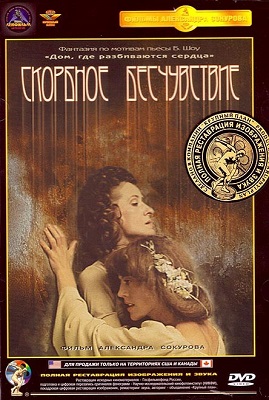 Mournful Unconcern, Aleksandr Sokurov (1983, Russia). This was another work by Sokurov that remained underground for many years – it was banned by the Soviet authorities – before finally being publicly screened after glasnost… and was promptly nominated for a Golden Bear. It’s based on George Bernard Shaw’s Heartbreak House, but is intercut with documentary footage. The cinematography is, surprisingly, straightforward, but the whole thing feels ike an unholy mix of David Lynch and Peter Greenaway, albeit put together in an entirely Sokurovian way. That documentary footage, for example – it’s contemporary with the setting, the 1920s, and features Shaw himself, a zeppelin, World War I, an Antarctic expedition, the River Ganges, and various places in Africa. The choices of incidental music is also typically Sokurovian, and often anachronistic. Heartbreak House, subtitled “A Fantasia in the Russian Manner on English Themes”, which is apparently a reference to Chekhov, whose plays inspired Shaw’s, is set in the home of Captain Shotover – played by Ramaz Chkhikvadze as half Falstaff and half Lear – and is partly a drawing-room farce and partly an Edwardian sex comedy. Gunfire and explosions can be heard on the soundtrack throughout the entire film, which ends with a zeppelin dropping a bomb and blowing up the house. It’s… an odd beast. The story seems well-suited to Sokurov’s feelings about the Soviet Union. The use of documentary stock footage is perhaps more intrusive than in the other films in which Sokurov uses it, but it works really well (some of the inserts provide clever and amusing commentary on the main story). I’m not so sure about the story itself, however – I don’t know what changes Sokurov made to Shaw’s play, though the setting seems to be as described. Still, like all of Sokurov’s films, it’s one that will require repeated viewings.
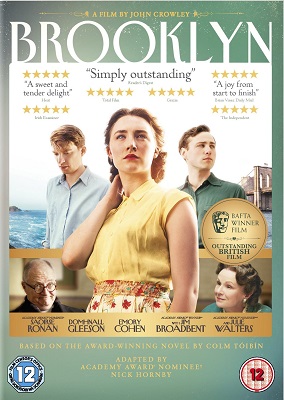 Brooklyn, John Crowley (2015, Ireland). This was one of those films of the last year or so which received lots of positive buzz and reviews, and didn’t involve superheroes, so I thought might be worth watching. It’s also an adaptation of a novel (winner of the Costa Novel Award, but only longlisted for the Man Booker) by Colm Tóibin, who, I admit, I’ve never read. The story is relatively simple – a fact stressed by several of the reviews: young Irish woman in the 1950s travels to New York in order to build a new life. She lives in a boarding-house and works in a department store, but she is shy and unassuming and very homesick. Then she meets a young man, of American-Italian extraction, and the two enter into a relationship. She is is now much happier and more settled. But then her sister in Ireland dies unexpectedly, so she returns to succour her mother. And now life back in Ireland seems much more attractive than it did when she left for New York. That is until the town gossip reveals something the young woman had been sort of trying to forget… and so she returns to New York. It’s a very pretty film, the cinematography is quite lovely, and the cast are uniformly good. Julie Walters as the landlady of the Brooklyn boarding-house, however, is a scream. But the story all feels a bit drab and low-key and devoid of any real insight, which makes the movie feel more like well-shot wallpaper than actual drama. I enjoyed it, but I think it was over-praised.
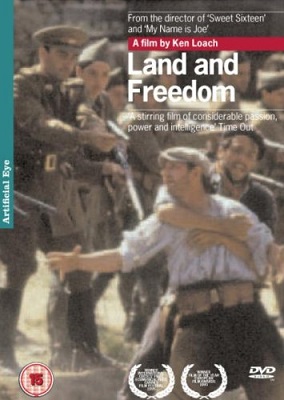 Land and Freedom, Ken Loach (1995, UK). I thought this was on the 1001 Movies You Must See Before You Die list, but not apparently the edition of it I’m using. Still it’s by Ken Loach and the subject matter – the Spanish Civil War – made it seem worth renting. And so it proved. An old working-class man in Liverpool collapses in his council flat, the ambulance comes, but he dies en route. Later, going through his things, his granddaughter discovers he had sailed to Spain in the 1930s to fight for the Republicans against the fascists. She reads his letters… and these are dramatised, with Ian Hart playing the young Scouser. On arrival on Spain, it all seems a bit haphazard, but Hart joins POUM’s milita and is soon out fighting (which basically seems to involve taking potshots from the POUM trenches at fascist soldiers in their trenches). At one point, the militia oust a troop of fascist troops from a village, and the villagers then conduct a fierce discussion on private ownership and collectivisation. After Hart is injured training new recruits – a rifle explodes when he fires it – things take a turn for the worse as the various left factions begin fighting amongst themselves, and even start killing those whose idealogies are not approved. It hardly comes as a surprise the fascists win (even for those who don’t know their history). The right always will… because the left seems happier fighting among itself than showing a united front to the enemy – just look what’s happing in the UK now. You look at Trump, and it’s 1930s Germany all over again; you look at the UK, and it’s 1930s Spain. Neither, of course, bode well… I’ve watched the occasional Ken Loach film over the years and enjoyed them, but have never really made an effort to seek them out. However, I find myself appreciating social realism in movies much more these days than I used to (and consequently despising fascistic sfx-heavy tentpole movies). I see there are three box sets of Loach’s films available – Volume 1, Volume 2 and At the BBC. I might well avail myself of them…
1001 Movies you Must See Before You Die count: 792


 It Doesn't Have To Be Right...