
The second of only two novels published by Tiptree, and opinions on it are somewhat divided, chiefly I suspect because of one element of the book that has aged very badly – and was questionable to begin with.
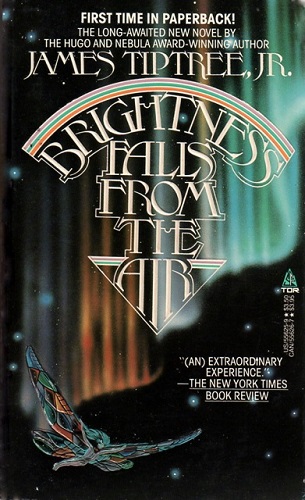
The world of Dameim is home to an alien race who were illegally tortured and maimed in order to harvest a chemical they exude, which was then distilled into an extremely expensive drink called Star Tears. (The drink is mentioned in an earlier story by Tiptree, and the later collection The Starry Rift (1986, USA) takes place in the same universe.) Dameim is now overseen by three guardians, who live in a sort of safari lodge (which Tiptree admitted was inspired by her childhood safaris with her parents). They’re visited by a group of ten tourists, there to witness the wave-front of the Murdered Star pass over the planet. But two other men also disembark, apparently through some error, as does the supercargo who looked after the passengers while they were in cold sleep.
There are two plots – the last survivor of an alien race has tracked down the person who fired the shot which destroyed their sun, ie the Murdered Star; and three of the visitors are planning to make themselves some Star Tears – by torturing and maiming Dameii, of course. The latter plays out pretty much as you’d expect – the villains reveal themselves, and seize control. The first plot presents more of a surprise. It wasn’t the genocide everyone believed, and the alien’s “vengeance” is… complicated.
So far, so not especially a science-fictional story. There are real-world analogues to the two plots. However, the novel’s resolution depends in part on “time flurries” caused by the Murdered Star’s wave-front, and that’s pretty much sf. Tiptree also hints the cause of the genocide has, through the wave-front, altered everyone’s perceptions of Damiem and the Dameii.
Unfortunately, there’s one misstep the novel can’t recover from – among the tourists are four actors ranging in age from thirteen to sixteen, and they’re porn actors. Even in 1985, readers struggled to accept this, and it’s even less acceptable now than ever before, post-Yew Tree, post Trump and Epstein and the Andrew formerly known as prince… The actors are engaging characters, but the teen pornography leaves a bad taste.
I’ve seen Brightness Falls from the Air (1985, USA) described as Tiptree best-known but least-liked novel. She only wrote two and is much better known for her short fiction, so it seems a dumb way to refer to the book. And yet, except for the under-age sex, there’s a lot to like about Brightness Fall from the Air. The main plot is perhaps not intrinsically sf, although Tiptree makes the setting entirely genre, and the many plots and subplots she handles with admirable deftness. It’s perhaps the most colourful and yet bleak novel I’ve read.
The Starmont Reader’s Guide to James Tiptree, Jr (1986, USA) by Mark Siegel, one of only two critical works on Tiptree’s fiction I’ve managed to find, suggests a common theme to much of her fiction: she believed mortality, or the acceptance of mortality, was necessary to create art; it is the shadow of death, oblivion, hanging over us that drives creativity. Brightness Falls from the Air certainly illustrates this theory.
I’ve read a lot of Tiptree this year, and the more I read the more I like it. I’ve always regarded a handful of her stories as stone cold classics of the genre. It’s also true many of her stories have not aged particularly well. I’ll happily recommend her works to people, but with the caveat they should probably stick to her short fiction.
 It Doesn't Have To Be Right...