
Only one US film in this lot? I must be slipping. Lots of British films though – more, in fact, than it appears, since the two Jennings collections contain 14 and 8 films respectively. They were a damn sight more interesting than the one US movie, too.
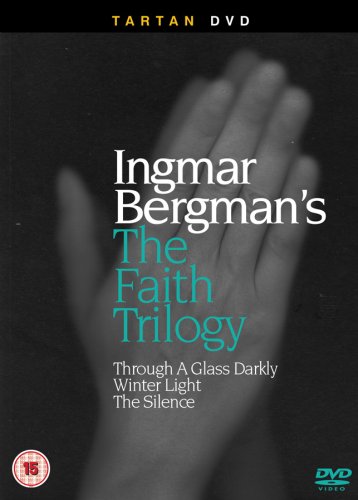 The Silence, Ingmar Bergman (1963, Sweden). This is the third film in Tartan DVD’s The Faith Trilogy by Bergman (the other two in the set are Through A Glass Darkly and Winter Light), but I’ve not been watching them in order. The Silence is set in an invented Central European country. Two sisters, one with her young son, are travelling by train through the country, and stop to spend some time in one of the towns. The older of the two sisters is a translator; she is also ill. They take an apartment in a run-down, but grandiose, hotel. While the son wanders around the hotel – at one point acting about with a troupe of dwarfs from a Spanish travelling show – his mother wanders about the town, visiting a theatre, sitting in a bar, before returning to the hotel with a man. In an introduction, Bergman explains that he’s always liked The Silence, but was convinced it would be a flop. In fact, it proved one of his more successful films internationally. It’s filmed in stark black and white, with very little dialogue (only 38 lines, claims Bergman), and the faded grandeur of hotel and town is evident in every film. I’ve said before that watching a Bergman film is like reading a literary fiction short story… and that’s especially true of this one – but one of those slightly-fabulist European stories where a deep reading is needed to figure out what’s going on. I liked this film much more than Through A Glass Darkly, although only the latter is on the 1001 Movies You Must See Before You Die list.
 The Humphrey Jennings Collection Volume 1: The First Days (2011, UK). After renting The Humphrey Jennings Collection Volume 2: Fires Were Started because the title film was on the 1001 Movies You Must See Before you Die list, I decided to buy all three of the BFI collections of Jennings’s short documentaries. There are fourteen films in this set, from 1934 to 1940. The early ones cover subjects such as the history of the post office, steam locomotives, chalk barges in Cornwall, fashion, a postcard’s journey and the GPO’s telephone link with the US via shortwave (the films were made by the GPO Film Unit). Later films show Britain during WWII – not just of the Blitz, but also showing how the government and farmers worked together to raise crops on land left fallow. Given that the later films are actual propaganda, it’s hardly surprising they’re all patriotic and jolly-old-Britain-look-how-wonderful-we-are, although as historical documents they’re quite fascinating. But even the pre-war ones hav ea certain terribly English quality about them, not just because of the BBC accents, but also thanks to their slightly patronising listen-with-mother air. Some were mucy more interesting than others – while the post office ones were a bit dull, and 1934 documentary on locomotives had its moments, I did find ‘Speaking from America’ (1938), with its description of shortwave translantic communications, fascinating. Worth seeing.
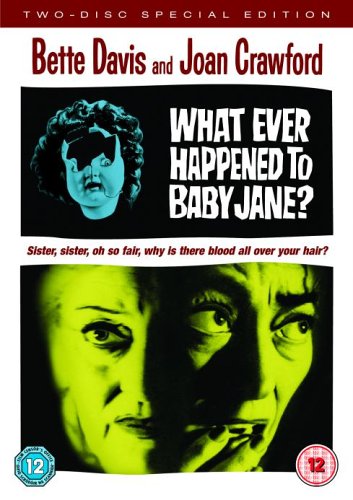 What Ever Happened to Baby Jane?*, Robert Aldrich (1962, USA). It would seem the most notable thing about this movie is that its two stars – Joan Crawford and Bette Davis – loathed each other, and that hatred fed into their portrayals of washed-up acting sisters. Because there’s nothing else in the film to warrant its appearance on the 1001 Movies You Must See Before You Die list. Davis plays a successful child star (well, not her, obvs, a child plays her) who didn’t make the grade as an adult actress; while her sister, Crawford, proved a star as an adult. Until, that is, an attempt by one sister to run over the other – they didn’t get on, even back then – resulted in Crawford being paralysed from the waist down and so killed her career. Who actually ran over who is not revealed, and left to provide a twist at the end… and it’s a pretty feeble twist. The film quickly sets up the sisters’ back-history, and cleverly uses clips from early films by Crawford and Davis, before leaping ahead to the early 1960s. Crawford is bed-ridden, and cared for by Davis, who resents her sister’s fame and the fact she now has to care for her. And then, afraid Crawford is going to sell the house, Davis begins to mistreat her – and impersonates her over the phone to hide her mistreatment… It’s a hard film to take seriously. The plot telegraphs every twist and turn with all the subtlety of a brick in the face, Davis plays her role like a wild-eyed loon, and Crawford couldn’t play a convincing doe-eyed victim to save her life. The final twist in the tale is, as mentioned earlier, neither a surprise nor dramatic. Meh.
 Jeux interdits*, René Cléments (1952, France). During WWII, a young girl’s parents are killed in an attack by a German Stuka, and she seeks refuge at a nearby farm. The family take her in, especially since she is of an age with their youngest son. When one of the older sons dies of his illness, the two kids begin a “game” of their own – they create a cemetery for the dead animals they find, and steal crosses from, first, the older son’s hearse and later the graveyard, for the graves of their creatures. When the boy’s father finds out, he is furious… eventually leading to the young girl being taken away to a refugee camp by the Red Cross. I like the films of Jean Renoir – some more than others, it has to be said – and Jean Cocteau; but I can’t say I’ve ever really got on with other French films made before, say, the mid-1950s. Actually, I did like À nous la liberté (1931), and Dreyer’s The Passion of Joan of Arc (1928) doesn’t count as the film may be French but he’s Danish… I’ve no idea what it is, I just find them a little dull, and often longer than they need to be. And so it was with this one. Meh.
 The Humphrey Jennings Collection Volume 3: A Diary for Timothy (2013, UK). There are only eight films in this final set, but they’re mostly longer than those in the first volume. They’re from 1944 to 1950 (Jennings died in a fall from a cliff in Greece in 1950, while scouting locations), and are mostly work done by the Crown Film Unit (originally the GPO Film Unit) during WWII. The opener, for example, explains how British troops took the German song ‘Lili Marlene’ as their own after finding copies of it in over-run German positions. ‘A Defeated People’ (1946), on the other hand, shows the Germans trying to rebuild their shattered cities – and no film of London during the Blitz can ever compare with what Hamburg looked like by the end of the war. I don’t think you could accuse Jennings’s war films of being jingoistic, despite the fact they were propaganda. Most seem designed to bolster the spirits of the Brits – yes, there’s a note of “they deserved it” in ‘A Defeated People’, but the film is bluntly honest about the state the allies left the country in (and it does rightly point a finger at some of the plutocrats, the Krupp family in this case, whose industrial empire is still going… and you’d be surprised at the number of global brands still in existence which actively supported the Nazi regime…). Anyway, like the first and second volumes, this is worth seeing.
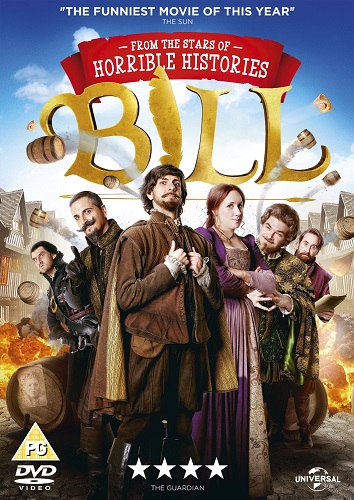 Bill, Richard Bracewell (2015, UK). I stumbled across this on Amazon Prime, and initial indications were not especially good… Bill Shakespeare is thrown out of his lute band after doing a blinding solo in a song during a gig. So he writes a play and decides to head to London to seek fame and fortune… Where he gets embroiled in a plot by the Earl of Croydon and King Philip II of Spain to kill Queen Elizabeth at a peace summit between the two. The story fits in Shakespeare’s “lost years”, between his departure from Stratford and appearance on the London stage. But I’m pretty sure it don’t go as this film claimed. I wasn’t that impressed initially – the humour was mostly based on anachronisms, and that’s a hard trick to pull off. But as it progressed, the jokes got funnier, the humour sharper, and the plot, er, thicker. The film was put together by the central cast from the Horrible Histories series, and is the second project they’ve worked together on (the first was Yonderland). They each play multiple roles, and they’re good in them (some, in fact, it took me a while to notice they were the same actors). There are some good lines and running gags, and it’s all a good deal funnier than Ben Elton’s lacklustre Upstart Crow.
 Trent’s Last Case, Herbert Wilcox (1952, UK). I found this in a local charity shop and thought it worth a go. It wasn’t. It’s apparently the third film version of a 1913 novel by EC Bentley, which is considered by many to be the first send-up novel of the crime genre. Bentley also invented the clerihew (it is, in fact, his middle name). Despite the title, Trent’s Last Case was actually the first novel by Bentley featuring journalist/detective Philip Trent – and was intended as a standalone, but proved so popular Bentley wrote a sequel in 1936, Trent’s Own Case (and a short story collection, Trent Intervenes, in 1938). Wealthy businessman Sigsbee Manderson is found dead in the garden of his home, apparently a suicide. Trent, covering the death for his newspaper, investigates and decides it was murder. Initially, he believes the widow to be the guilty party, but then fastens on the tycoon’s personal assistant. But when he accuses the PA, and explains how the crime went down, he’s told he has some parts right – moving the body, impersonating the dead man, falsifying an alibi – but the tycoon did apparently kill himself. At which point, the widow’s uncle reveals that he actually killed the tycoon, accidentally, in a wrestle over a gun. Trent also falls in love with the widow, and asks her to marry him. Michael Wilding was awful as Trent, Orson Welles wore bizarre prosthetic eyebrows and a prosthetic nose which made him look like Parker from Thunderbirds, and Margaret Lockwood only reminded me of better actresses from the period. The film may have been a piss-take of crime novel conventions, but it came across as just a badly-plotted film. Oh well.
1001 Movies You Must See Before You Die count: 776
 – it’s probably the one novel I’ve reread more than any other, but I don’t think it’s an especially well-written book.
 ,
,  ,
,  ,
,  ,
,  …
… is one of the great films of the 1950s. His films were melodramatic, but also deeply subversive. And very, very cleverly made.
 remains a classic piece of cinema.
 ,
,  , and
, and  . And there are plenty more in their oeuvre.
 It Doesn't Have To Be Right...