
It Doesn't Have To Be Right…

… it just has to sound plausible


Leave a comment

The Far Pavilions, MM Kaye

I read The Far Pavilions (1978, UK) back in the 1980s while visiting my parents in Oman. It was hardly my usual reading fare, but the book choice was limited. (I also read Shirley Conran and Judith Krantz that holiday.) I enjoyed it so much I went on to read all of Kaye’s novels, and even tracked down copies of her Death in… series, which were hard to find at the time. Since then, I’ve watched the TV adaptation of The Far Pavilions, starring Ben Cross and Amy Irving, a couple of times, but it’s a poor adaptation.
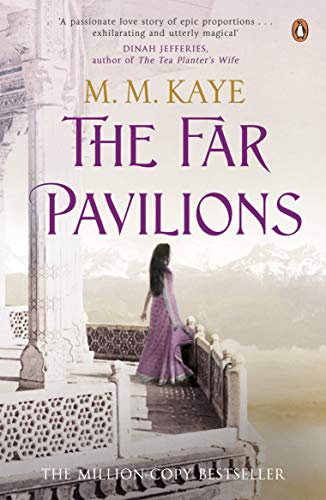
The Far Pavilions is set during the 1860s and 1870s, when the Raj ruled much of India. The plot follows Ashton Pelham-Martyn, whose parents died when he was young, and he was brought up, believing himself to be Indian, by his nanny in the invented Himalayan kingdom of Gulkote. He learns he is British at age eleven and is shipped off to Britain, returning a decade later as an officer of the Corps of Guides. After going AWOL for a year to recover stolen rifles from Afghan tribesmen, he is suspended and charged with escorting a royal wedding party across India. One of the princesses proves to be his childhood playmate, Anjuli, and the two fall in love. She is married to the rana of Bhithor, and Ash is sent to various places in India until the Guides are ready to have him back. Then he learns the rana has died and the widows will commit suttee. So he rescues her and spirits her away. Meanwhile, there’s been trouble in Afghanistan – once labelled the “graveyard of empires” – thanks to the Great Game, with the Russians sending a mission. Ash goes undercover among the tribes. The Second Anglo-Afghan War takes place. Afterwards, the British send a mission to Kabul, which Ash tells them is ill-advised. And so it proves…

I’d forgotten how good this book was. The TV adaptation overrode some of my memories of the novel, and not for the better (it didn’t help they had a white actress in brown make-up play Anjuli). The Far Pavilions is also a thick novel, and does occasionally get bogged down.

Much of it is historically accurate – the two main characters are invented, as are the two princely states involved in the wedding party; but many of the supporting cast are real historical figures. Kaye is critical of the treatment of India by the Raj, and before it the East India Company, and of the English’s behaviour towards the Indian people. It’s clear where her sympathies lay (Kaye was born in India, and lived there a number of times throughout her life). There’s some lovely descriptive writing of the landscape, but Ash in an almost constant state of anguish gets a little wearying. The final section of the book, about the British mission in Kabul, is also drawn out somewhat. But it’s good stuff, and I’m glad I reread it. Recommended.

Incidentally, it was Kaye’s agent who persuaded her to write about India. She had previously published a series of murder-mysteries. He was Paul Scott… who later went on to write the Raj Quartet (1966-1975, UK), which I very much recommend. 

Leave a comment

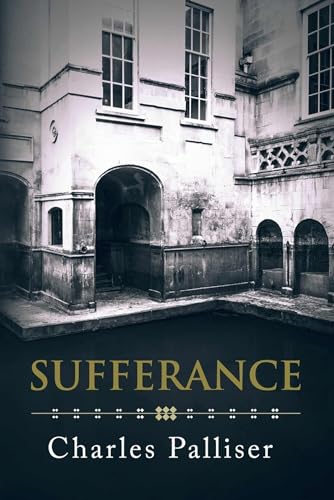
Sufferance, Charles Palliser

I’ve been a fan of Palliser’s novels since reading his debut, The Quincunx (1989, UK), a complex Dickensian novel about an orphan and the mysteries surrounding his birth back in the 1990s. Betrayals (1993, UK) features a pitch-perfect pastiche of the TV series McTaggart and a borderline litigious spoof of author Jeffrey Archer (allegedly based on fact). Sufferance (2024, UK) is the first book from Palliser since Rustication (2013, UK), and it’s perhaps the most obvious book he’s written to date.

In terms of length, it’s probably closer to a novelette, or perhaps a sf novel from the 1960s. It’s set in an unnamed country after it has been occupied by unnamed enemy forces – or rather, the western half of the country has been annexed, but the eastern half, where the story takes place, has chosen to collaborate. While Palliser names no names, we’re clearly in some analogue of World War 2 France.

A well-meaning man has taken in a schoolfriend of his youngest daughter, whose rich parents were trapped in the western half of the country when it was overrun. His motives are not entirely altruistic – he hopes for a better-paying job from the daughter’s father – but the girl’s family are members of a “community” whose rights and privileges are slowly taken away as the novel progresses. To the extent, in fact, their property and wealth is confiscated, they’re forced to live in a ghetto, and later are “relocated” to camps outside the city…

All of which makes looking after the girl ever more difficult. Initially, lies to neighbours are enough, but when rationing is introduced the lack of papers becomes a problem. Eventually, they have to hide the girl in the attic. Throughout all this, the girl is arrogant, ungrateful and manipulative. The title is clearly intended to refer to both the city under the collaborationist regime and the danger to the family brought on by the girl’s presence in their apartment (and, also, the behaviour of the girl to the family).

It’s hardly subtle. Pallier’s prose distances the reader from events – there are no names, the countries and period are not mentioned – but the narrative remains sympathetic to the narrator, even though his motives are chiefly self-serving. He hopes to be rewarded, but he’s also sensitive to the evolving situation regarding the community. And he’s powerless to prevent his family from suffering as the regime slowly collapses from corruption, greed and fear.

It’s all very inexorable, as no doubt it felt in the 1940s. Palliser manages to evoke sympathy in a narrator who does bad things out of greed, but soon finds himself doing worse simply in order to survive. Of course, he’s implicitly questioning the reader: what would you do to survive in the same situation? How long would you hold onto your principles? Should the laws still be obeyed, even when they’re plainly immoral?

After all, the family hiding Anne Frank was breaking the law; anyone who told the Gestapo about her would have been considered law-abiding.