It Doesn't Have To Be Right…

… it just has to sound plausible


1 Comment

Reading diary, #36

My reading seems to have slowed a little, perhaps because I’m choosing books which aren’t quite such easy reads. On the other hand, it could just be that I’ve been quite busy. Anyway, an odd mix this time: two category genre books, one borderline and two classic twentieth century literature; three women, two men; two novels, three collections; three Americans, one Brit and a Dane. I really need to address that latter category a little more – I have a number of translated works on my bookshelves that I plan to tackle, such as Bolaño, Munif, Høeg, Myckle, Vargas Llosa, Gogol, Mallo… All I have to do is schedule them in. It’s easy to read diversely if you plan your reading, after all. Anyway, the five books in this post were all bloody good ones, so perhaps avoiding “easy reads” was worth it. Duchamp and Park are probably two of the best US writers currently working in genre and very much under-appreciated; Green and Dinesen may be from the first half of last century, but they wrote some bloody good stuff; and while LeGui many not always click with me, there’s no denying her importance or the fact she has writing chops we lesser mortals can only dream to possess. In all, a highly recommended handful of books.
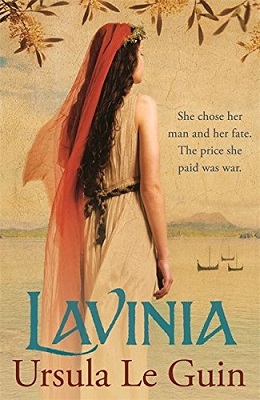
laviniaLavinia, Ursula K LeGuin (2008). Who doesn’t love LeGuin’s fiction? It’s almost impossible not to, because it’s so wide-ranging, so clever and so beautifully written. Personally, I prefer her science fiction, and while I’ve enjoyed her high fantasies I’m not so enamoured of her literary fantasies like Orsinian Tales or Searoad. Lavinia, however, is more of an historical fantasy, and falls somewhere between the two stools of genre fantasy and literary fantasy. I have no especial interest in the period it covers, pre-Roman Italy, although a good book would, you’d hope, make me interested (after reading George Mackay Brown’s Beside the Ocean of Time, for example, I spent several hours looking up brochs online, and nearly even bought a book on the topic). Nor am I trained classicist and so familiar with the sources texts uses in Lavinia – chiefly Virgil’s Aeneid. In fact, to be honest, I know very little about Bronze Age Europe – it’s not an era I’ve read much about. The title character is mentioned in passing in the Aeneid as the wife of Aeneas, a Trojan hero who survived the fall of Troy. LeGuin takes Lavinia’s brief mention and runs with it, opening with Lavinia’s childhood, then there’s arrival of Aeneas and his Trojans, their marriage, the founding of Lavinium, war… Throughout, Lavinia visits a sacred grove, where she talks to the ghost of “the poet”, who is clearly Virgil (who lived over a thousand years later – some of the references by him to “the future” do initially suggest something a little more science-fictional, but no). I know some people were very taken with the novel, but it never quite clicked with, although there was no denying its quality.
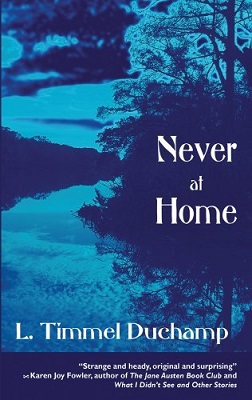
never_at_homeNever at Home, L Timmel Duchamp (2011). I bought this a couple of years ago after being much impressed by Duchamp’s Marq’ssan Cycle – which, incidentally, is one of the best sf series about first contact ever written – but had never got around to reading it for some reason. Which I have now rectified. Partly, I admit, prompted by the superb story by Duchamp which opens the VanderMeers’ feminist sf anthology, Sisters of the Revolution. That story is not in Never at Home, but those that are range from the merely good to the bloody excellent. It’s been a while since I’ve come across a genre collection as strong as this one, and yet looking at the stories I’m not entirely sure why. They’re not bursting with ideas or “eyeball kicks” – that’s not what Duchamp does – but they’re certainly fascinating, and extremely well-written, explorations of very carefully explored ideas. In ‘A Question of Grammar’, for example, a woman taken from her family (who, it is implied, are considered unpersons by the galactic authorities) is bonded chemically to an alien to act as interpreter. I’m tempted to describe the story as “very”Gwyneth Jones”, high praise indeed from me, but I think that’s probably unfair to Duchamp. Either way, this was the best story in the collection and deserves to be much more widely known. ‘The Nones of Quintilis, Somewhere on the Southwest Slope of Monte Albano’ manages that very difficult balancing trick of being genre but not reading like genre. ‘Sadness Ineffable, Desire Ineluctable’ (Duchamp’s strong point clearly doesn’t lie in titling her short fiction) manages to evoke something like Area X half a decade before VanderMeer’s novels, and do so with more mystery and less fungi (both, it must be said, pluses in my book). This is a superior collection, probably the best genre collection I’m likely to read this year (yes, I think it just edges out Other Stories below). Not only do I recommend it, but I think everyone should also read Duchamp’s Marq’ssan Cycle; and, of course, Duchamp’s Aqueduct Press does sterling work and has published some blinding works of fiction since its founding in 2004.
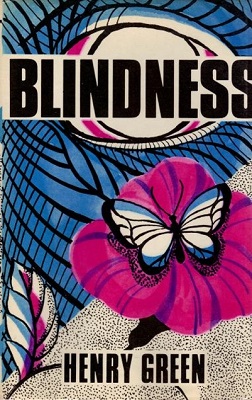
blindnessBlindness, Henry Green (1926). The authors you love, I’ve found, do not come about due to wide or deep reading of their oeuvre, but from a single piece of work, usually in the first half dozen or so by that author you’ve read. It blows you away… and it colours all your other encounters with that author’s works. With Lowry, it was his novella ‘Through the Panama’, with Durrell it was The Alexandria Quartet, with Blixen it was her story ‘Tempest’… and with Green it was the first novel by him I read, Loving. A pitch-perfect control of voice, a refusal to tell the story using normal narrative techniques, and an excellent eye for detail… what’s not to love? Blindness is Green’s first novel, and concerns a public schoolboy whose bright future is snatched from him in an accident which blinds him (a kid throws a stone at a passing train, smashing a window through which the protagonist is looking). The story is told firstly through letters, then through semi-stream-of-consciousness narratives by the young man and his mother and the young woman (of an unsuitable family) whose company he enjoys… It’s very much a story of privilege and deprivation – the main character is the scion of a wealthy family, with a country seat boasting a large staff (members of which which the mother complains about repeatedly); but the young woman is the daughter of an alcoholic vicar fallen on hard times and, if anything, reads more like a DH Lawrence character (on his good days, that is) than a fit companion for the blind boy. Green had a reputation as “a writer’s writer”, which is generally taken to mean he was much admired but sold few copies. It’s true that there’s a dazzling level of technique on display in Blindness, a facility with prose no writer can fail to admire. And it’s Green’s writing prowess I certainly admire, rather than his choice of subjects or the stories he chooses to tell. But there’s a profound pleasure to be found in reading prose that is just put together so well, and that’s why I treasure Green’s writing.
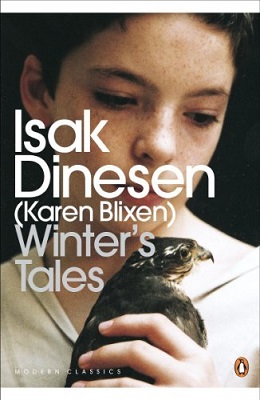
winters_talesWinter’s Tales, Isak Dinesen (1942). As mentioned earlier, Blixen impressed me with her story ‘Tempests’ in Anecdotes of Destiny (AKA Babette’s Feast and Other Stories), and so resolved to read more by her. (I’d also enjoyed the three films made of her works: Out of Africa, Babette’s Feast and The Immortal Story.) Winter’s Tales contains 11 stories, some of which are better than others, but all of which are good and all of which have an almost mythical feel to them. In some it’s quite overt – ‘The Fish’, for example, reads like mannered high fantasy but is about an actual king of Denmark. Most of the stories are historical, typically set in the eighteenth or nineteenth centuries. Some are twist-in-the-tale type stories, such as ‘The Young Man with the Carnation’, in which a young husband reconsiders the future of his marriage after the eponymous person appears in the middle of the night at the door of the hotel room he is sharing with his wife. Only later, does the young husband realise he had been in the wrong room (whoops, spoiler). ‘The Heroine’ is a cautionary tale in which a French woman saves a group of travellers from being shot by Prussian soldiers (during the Franco-Prussian War) by refusing the Prussian commander’s offer. There was something quite DH Lawrence about the story. ‘The Pearls’ reminded me of Blixen’s own ‘The Immortal Story’, although its plot was very different. A woman marries a fearless man and her own sense of adventure is abruptly threatened when she realises the two of them skirt much too closely to danger – a realisation embodied in a  string of pearls he gives her and which she inadvertently breaks… There is, as I’ve said, a near-mythical to these stories, almost as if they’re parables. It’s a type of story that seems to have mostly fallen out of favour; and while that does make the contents seem of their time, there’s also a timelessness to them because they’re set in earlier decades and centuries. I’ll be reading more Dinesen/Blixen.
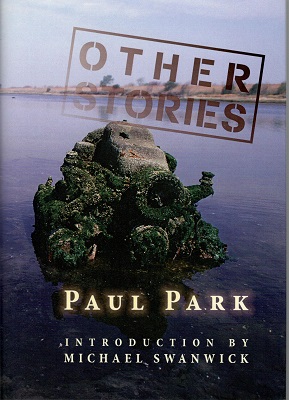
other_storiesOther Stories, Paul Park (2015). I’ve been a fan of Park’s fiction since reading Coelestis back in the mid-1990s, and I still think it’s one of the best sf novels ever written. Like LeGuin, Park’s career has been somewhat varied, albeit considerably less prolific, and his last novel, a metafictional piece that straddles science fiction, fantasy, alternate history and autobiography, All Those Vanished Engines, was for me one of the best novels of 2014. (It didn’t win any awards, of course.) So when PS Publishing announced they were publishing a collection of Parks stories, I was keen to get my hands on it… and it took a while to appear. But it was totally worth it. Some of the stories I’d read before – ‘No Traveller Returns’ was originally published as a signed limited novella by PS Publishing and, yes, I own a copy; ‘Three Visits to a Nursing Home’ forms part of Park’s excellent novel, All Those Vanished Engines. Two stories appeared in Postscripts anthologies in which I also had stories – one of which, I – kof kof – provided the title story (#20/21 Edison’s Frankenstein and #32/33 Far Voyager). As for the rest… they’re slippery things, sliding between fantasy, alternate history and mimetic fiction, and even, in some cases, autobiography. ‘A Family History’ posits an alternate history in which the French Revolution fails and parts of North America remain in French control in the late nineteenth centiry… and the deconstructs the concept of alternate history. ‘Watchers at the Living Gate’ is straight-up fantasy, and while it owes more to Hope Hodgson than Tolkein, it still presents a singular vision. ‘Ragnarok’ is posta-apocalyspe fiction presented as epic poetry (not, to my mind, an experiment that works especially well). ‘Abduction’ is a frankly baffling story about what might, or might not be, alien abductions. But everything in the book is beautifully-written. Park and Duchamp are both massively under-rated US genre writers, and should be much more widely-read.

1001 Books You Must Read Before You Die count: 126

3 Comments

Great wall o’ books

June was a negative month inasmuch as I ended up buying more books than I read, so the TBR increased in size. Oh well. Mostly this was due to Fantastika 2016, which had an excellent book room… but a few books I wanted also popped up during the month on eBay and so I bought them. Having recently discovered there are books I’d like to read but didn’t bother buying when they were published a few years ago, and copies are now £150+… Well, it makes sense to buy a book the moment a copy comes available at a decent price. That’s my excuse and I’m sticking to it.

IMG_4160

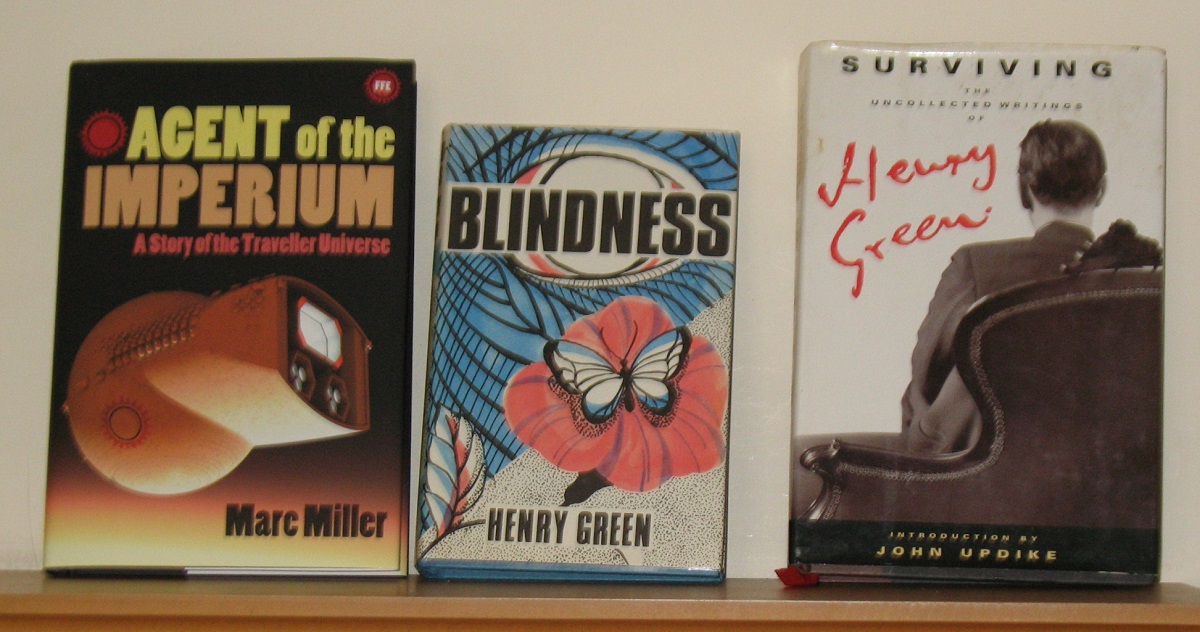
Both Surviving and Blindness are first editions by Henry Green I found on eBay. Unfortunately, Surviving is a bit too tatty (well, it was very cheap) and Blindness was misrepresented as a first edition, but it’s a first edition of the 1977 reprint. Agent of the Imperium, on the other hand, is the first Traveller novel written by the game’s inventor, Marc Miller. I backed it on kickstarter and they’ve done a really nice job of it.

IMG_4161

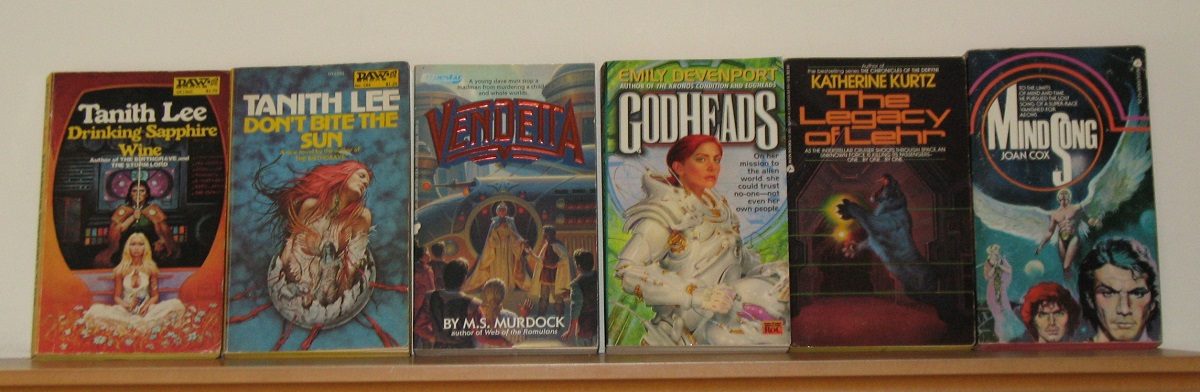
Mindsong, The Legacy of Lehr, GodheadsVendetta, Don’t Bite the Sun and Drinking Sapphire Wine I bought from the Alvarfonden at Fantastika 2016 to review on SF Mistressworks.

IMG_4162

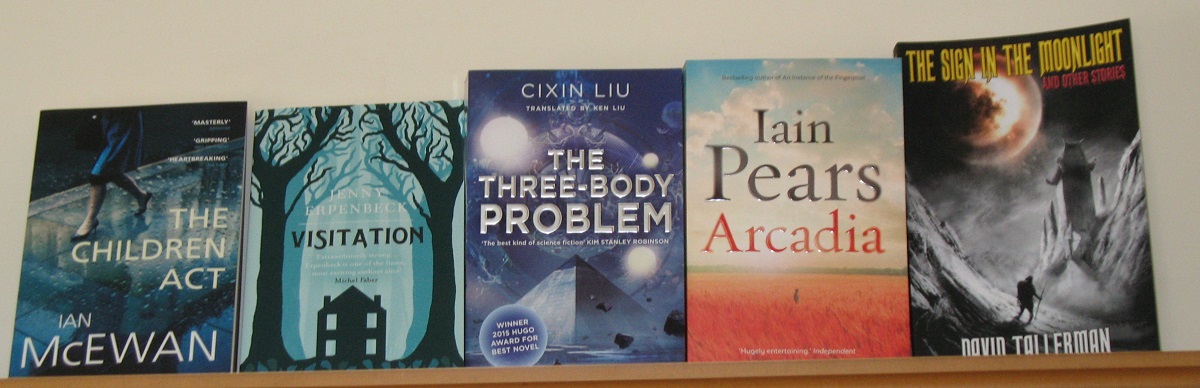
David Tallerman gave me a copy of his new collection The Sign in the Moonlight in a swap for a copy of my Dreams of the Space Age. Arcadia is the only novel on the Clarke Award shortlist I’ve not read – I was waiting for the paperback. The Three-Body Problem won the Hugo last year against all odds and I’ve wanted to read it since first hearing of it. I loved Jenny Erpenbeck’s The End of Days so I’m keen to explore of her fiction, hence Visitation. I’ve no idea why I still read McEwan, but after finding The Children Act in a charity shop I now have his last three on the TBR.

IMG_4163

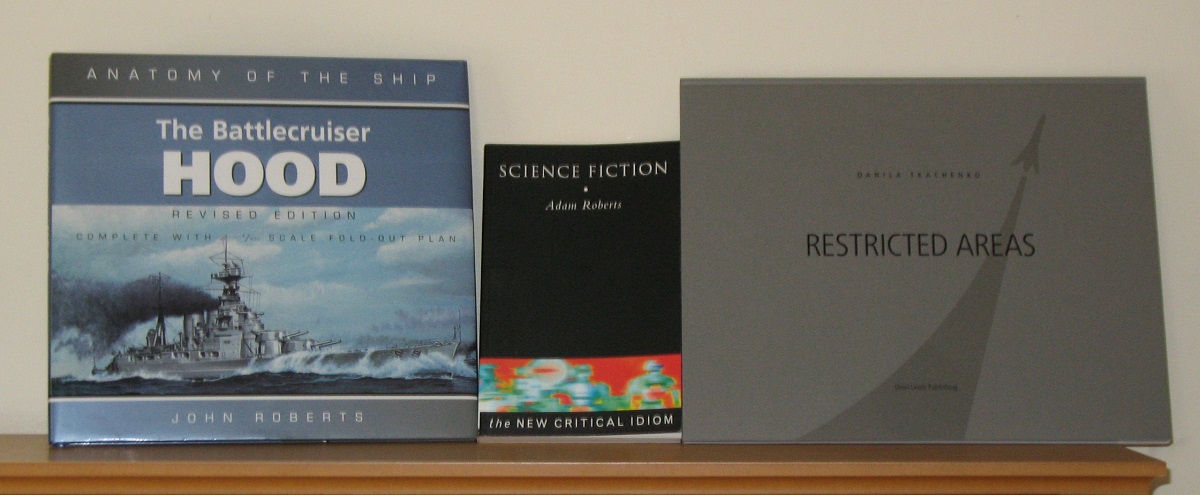
I do like me some books of photos of abandoned Cold War equipment and places, hence Restricted Areas. And Adam Roberts’s Science Fiction I found cheap at the abovementioned Alvarfonden. The Battlecruiser Hood is one of the Anatomy of the Ship books I didn’t have – found this copy going for a good price on eBay.


2 Comments

The north face of Mount TBR

Looks like I’m going to need another clear-out soon. Normally, I dump the books I no longer want at local charity shops, but the more recent genre ones I save for the York and Sheffield pub meet raffles. However, I might stick a list up here of books for sale – I have a lot of 1980s sf paperbacks in very good condition (they were in storage for pretty much the entire 1990s). We’ll see. Meanwhile…

IMG_4155

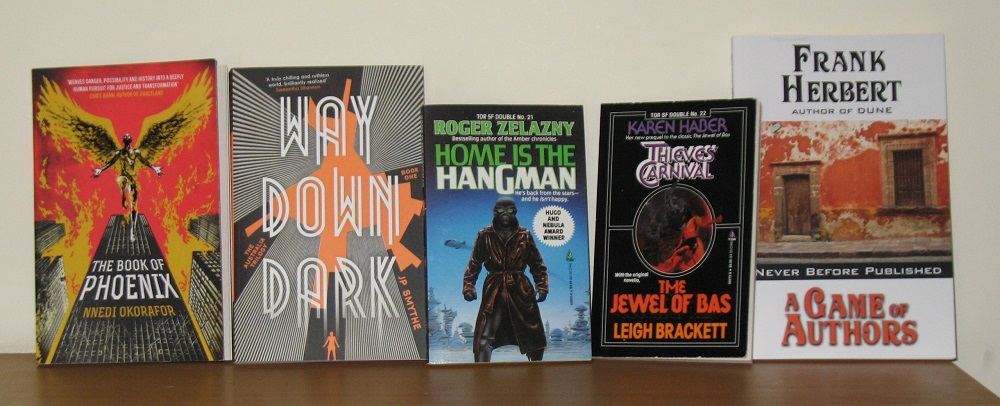
Some sf, recent and not so recent. I bought The Book of Phoenix and Way Down Dark because they were shortlisted for the Clarke Award. I read them. I was not impressed with either – see here. I’ve been picking up copies of the Tor doubles from the 1980s when I find them, although not all are worth reading; hence #21: Home is the Hangman / We, in Some Strange Power’s Employ, Move on a Rigorous Line… and #22: Thieves Carnival / The Jewel of Bas. A Game of Authors is actually not sf, but a thriller. WordFire Press (ie, Kevin J Anderson’s own imprint) has been publishing old manuscripts by Frank Herbert that never saw print, and I’ve been buying them. They’re interesting from an historical point of view, although, to be fair, I can see no good reason why they weren’t published back in the day.

IMG_4157

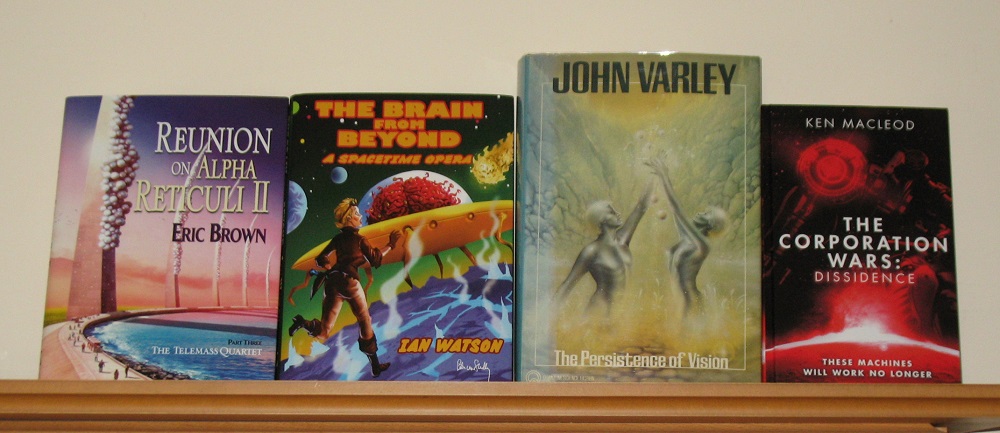
Some first editions for the collection. First up, the third book of Eric Brown’s Telemass quartet, Reunion on Alpha Reticuli II. Also from PS Publishing is The Brain From Beyond. Both were launched at Mancunicon, but the signed editions weren’t available at the con. The Persistence of Vision was a lucky find on eBay. I still rate Varley’s short fiction. And Dissidence is the latest from an author whose books I buy on publication.

IMG_4158

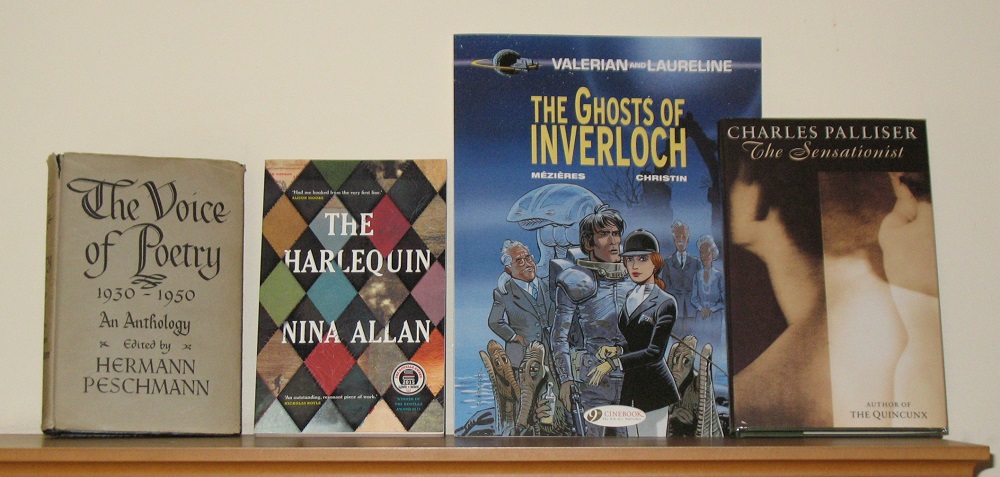
A mixed bag of fiction: The Sensationist is another Palliser for the collection. The Ghosts of Inverloch is the latest English translation of the bande dessinée series. The Harlequin is an award-winning novella, and The Voice of Poetry 1930 – 1950 I stumbled across on eBay and since I like the poetry of that period…

IMG_4159

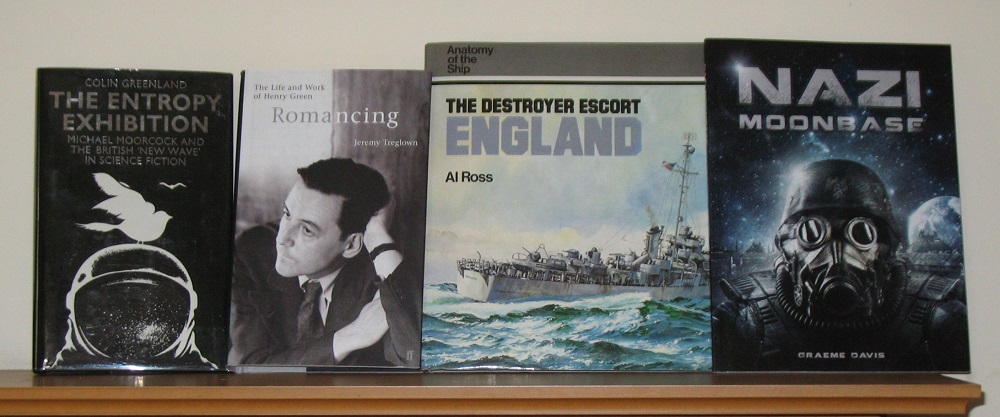
And a mixed bag of non-fiction. The Entropy Exhibition, signed, was a lucky find on eBay. I’ve been collecting the Anatomy of the Ship series when I find them going for a fair price – originally I bought them for research for my space opera trilogy, but now it’s just because they’re cool books: hence The Destroyer Escort England. When I saw spotted Nazi Moonbase on Amazon, I couldn’t resist it. Romancing is a biographical/critical work about Henry Green, an author I’m keen to read more of.


Leave a comment

The year in reading

I managed to read 152 books in 2015, beating my Goodreads Reading Challenge target of 150 by two. So, not bad going. Admittedly, there were a couple of “cheats” in there – for example, I bought a pair of graphic novels from Faraos Cigarer in Copenhagen on 28 December so I could be sure of making 150 by the end of the year. I likely wouldn’t have bought them otherwise. But never mind. However, I did manage to read ten books from the 1001 Books You Must Read Before You Die list, which is pretty good (for the record, they were: The Quest for Christa T., The Leopard, The Island of Dr Moreau, The Rainbow, Loving, The Sense of an Ending, Pale Fire, Frankenstein, The Old Man and the Sea and One Day in the Life of Ivan Denisovich).

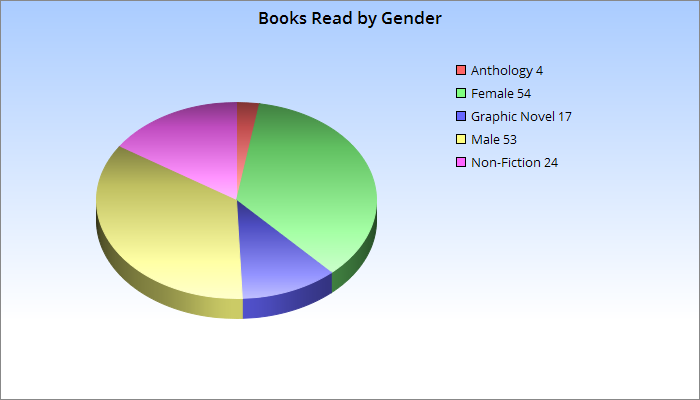
I also managed to read more women writers than men in 2015, although it was close, with only a single title in it. See below.

2015_books_by_gender

I plan to continue alternating genders in my fiction reading for the foreseeable future. Although many of the women writers I read were for review on SF Mistressworks, and my project to read some post-war British women writers didn’t really get into gear, I did discover a couple of non-genre female writers I’d like to read more by, such as Karen Blixen, Sarah Hall and Pamela Frankau.

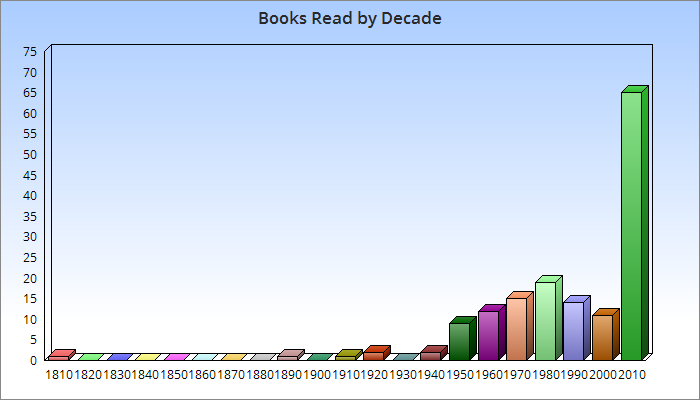
I was surprised to discover how much of my reading is of books from the last five years. I’d have thought it more evenly spread across the decades – although more in the last three or four decades than earlier. But apparently not. See below.

2015_books_by_decade

The one title in the 1810s was, of course, Mary Shelley; and the one in the 1890s was, naturally, HG Wells. The title from the 1910s and the two from the 1920s were by DH Lawrence. The 1970s and 1980s books, I suspect, mostly came from reading for SF Mistressworks.

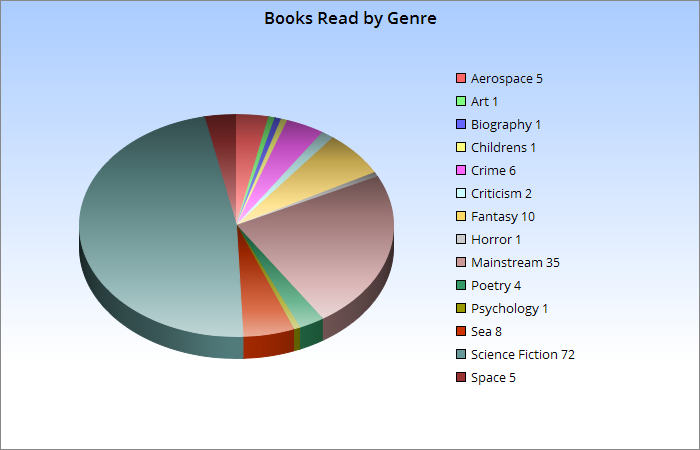
Which also probably explains why science fiction continues to dominate my reading – nearly half at 47%. Mainstream is next at 23%, then fantasy at 7% and crime at 4%. See below.

2015_books_read_by_genre

In 2016, I’d like to read more mainstream fiction and less science fiction. I’d also like to read more non-fiction – on, of course, my favourite topics: space and deep sea exploration. But also criticism. I have, after all, a couple of bookshelves full of critical works on science fiction and my favourite authors. (The one children’s novel, incidentally, was by Nathan Elliott, a pseudonym of Christopher Evans, and was read for completeness’s sake; it wasn’t worth it.)

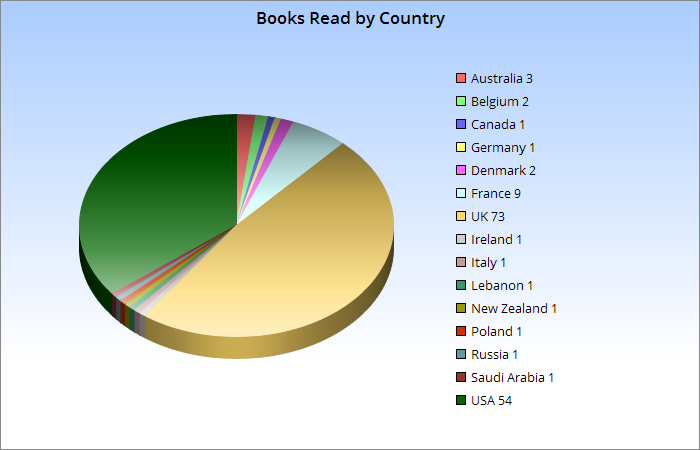
By country (of origin of the writer), the books I read stayed mostly close to home – pretty much half of my reading was by British authors. Followed by the US. France makes a good showing because I read a number of bandes dessinée during the year – they also account for Belgium’s presence. See below.

2015_books_by_country

Not counting the bandes dessinée, I read only half a dozen translated works, and I really should do better. There are certainly authors from other countries I’ve read in previous years I’d like to read more by – like Elfriede Jelinek or Magda Szabó or Abdelrahman Munif. Perhaps I should resurrect my World fiction reading challenge from 2012? It stumbled to a halt that year when I got bogged down in Orhan Pamuk’s My Name is Red and Javier Marías’s Fever and Spear. But I’ve read both of those now, and should be able to find twelve books by writers from nations whose literature I’ve never tried. I probably have a few candidates on the TBR already…

In fact, on the subject of reading resolutions for 2016, I stumbled across (via Eve’s Alexandria) a thing called Read Harder. It’s from Book Riot and is a list of 24 criteria for choosing books to read in 2016. There are a couple of categories I’m not at all interested in (reading aloud, audio books, food memoirs, middle grade fiction), so I’ll replace them with a few of my own…

Read Harder (the Ian Sales version) 2016

  1. Read a horror book
  2. Read a non-fiction book about science
  3. Read a collection of essays
  4. Read a novel by a writer from a country whose literature you’ve never read before*
  5. Read a novel by a woman writer published before 1900*
  6. Read a biography (not a memoir or autobiography)
  7. Read a dystopian or post-apocalyptic novel
  8. Read a book originally published in the decade you were born
  9. Read a book that has won the Orange/Baileys Prize*
  10. Read a book over 500 pages long
  11. Read a book under 100 pages
  12. Read a book by a person that identifies as transgender
  13. Read a book that is set in the Middle East
  14. Read a book that is by an author from Southeast Asia
  15. Read a book of historical fiction set before 1900
  16. Read the first book in a series by a person of colour
  17. Read a non-superhero comic that debuted in the past three years
  18. Read a book that was adapted into a movie, then watch the movie
  19. Read a non-fiction book about feminism or dealing with feminist themes
  20. Read a book about religion (fiction or non-fiction)
  21. Read a book about politics, in your country or another (fiction or non-fiction)
  22. Read a book related to cinema or film-making*
  23. Read a play
  24. Read a book with a main character that has a mental illness

The asterisked challenges are my replacements. The rules state it’s okay to use the same book for multiple categories. And I’m pretty sure I can do about half straightaway just from the TBR. Even so, 24 books in a year is an easy target. One or two are going to be easy – I gave up on reading superhero comics several years ago, so the only graphic novels I read now do not feature men in tights or improbably pneumatic women. I mentioned Abdelrahman Munif earlier, and I have his The Trench on the TBR, so that’s the Middle East book. And I have Karen Armstrong’s The Bible: The Biography on the TBR too (it’s, er, been there a few years, tbh). I have a number of critical works on feminist science fiction, and I went and drunkenly bought that book of plays by Anton Chekhov earlier in the year. Anyway, we shall see how it goes…

I also plan to continue working my way through the oeuvres of DH Lawrence and Malcolm Lowry, as well as reading more books by Henry Green and Karen Blixen, and more from the 1001 Books You Must Read Before You Die list.

I’ll be posting a year in films piece some time over the next few days as a companion to this post.


2 Comments

2015, the best of the year

On balance, 2015 wasn’t a bad year for me. Things improved in $dayjob, goodish things happened in my little corner of genre, and I read a number of excellent books and watched lots of excellent films. Music-wise, it was both successful and not so successful: I discovered some more new bands on Bandcamp, and this year we went VIP for Bloodstock and it really was worth the extra money; but I saw fewer bands live than in previous years, and none of my favourite ones toured the UK – and if they did, it was only in the big cities, like London, Birmingham or Glasgow. But, like I said, some excellent books and films – so much so, I had trouble picking my top five in each. But I did finally manage it.

Oh, and I got a new cat. Oscar. He’s two years old, and I’d forgotten how much of a pain young cats can be.

books
A strange year of reading, on reflection, and I’m not entirely sure why. I read some books as research for All That Outer Space Allows (which was published this year), I read some other non-fiction books (on space and aircraft and submersibles, mostly), I read some sf novels for SF Mistressworks and some more recent genre works… And I decided to widen my reading to include more classic literature. While I like to think of myself primarily as a science fiction fan, of late I’ve found it hard to generate much enthusiasm for recent sf. In part, that’s due to the way fandom is changing as a result of social media and online promotion, but also because a lot of current sf seems to me more interested in style rather than content. I like sf ideas and sense of wonder, but I also like good writing, sophisticated themes and a willingness to experiment with form and structure. While some works which meet those criteria were indeed published in 2015, those I came across didn’t feel especially progressive. Which is why you’ll notice a few notable titles missing from my top five below (and I have only one, in fact, that was actually published in 2015).

loving1 Loving, Henry Green (1945).
An author new to me in 2015, and despite being about a subject – life belowstairs in the Irish country house of an English nob during WWII – that doesn’t interest me in the slightest, Green’s writing was wonderful and his narrative technique amazing. I will be reading more by him – hell, I plan to read everything he ever wrote.

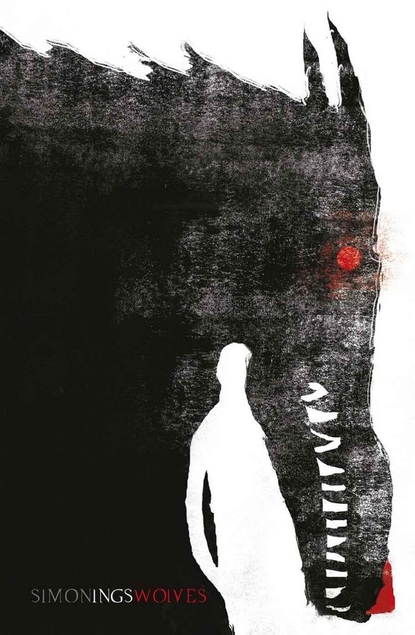
wolves2 Wolves, Simon Ings (2014).
There was some small fuss when this appeared in early 2014, but by the time awards came around it had been forgotten. Which was a shame. And I wished I’d read it in time to nominate it last year – because this is plainly one of the best sf novels of 2014. The focus of his novel tends to drift a little as the story progresses, but Ings has still managed to produce one of the smartest works of sf – if not the smartest work of sf – of the last few years.

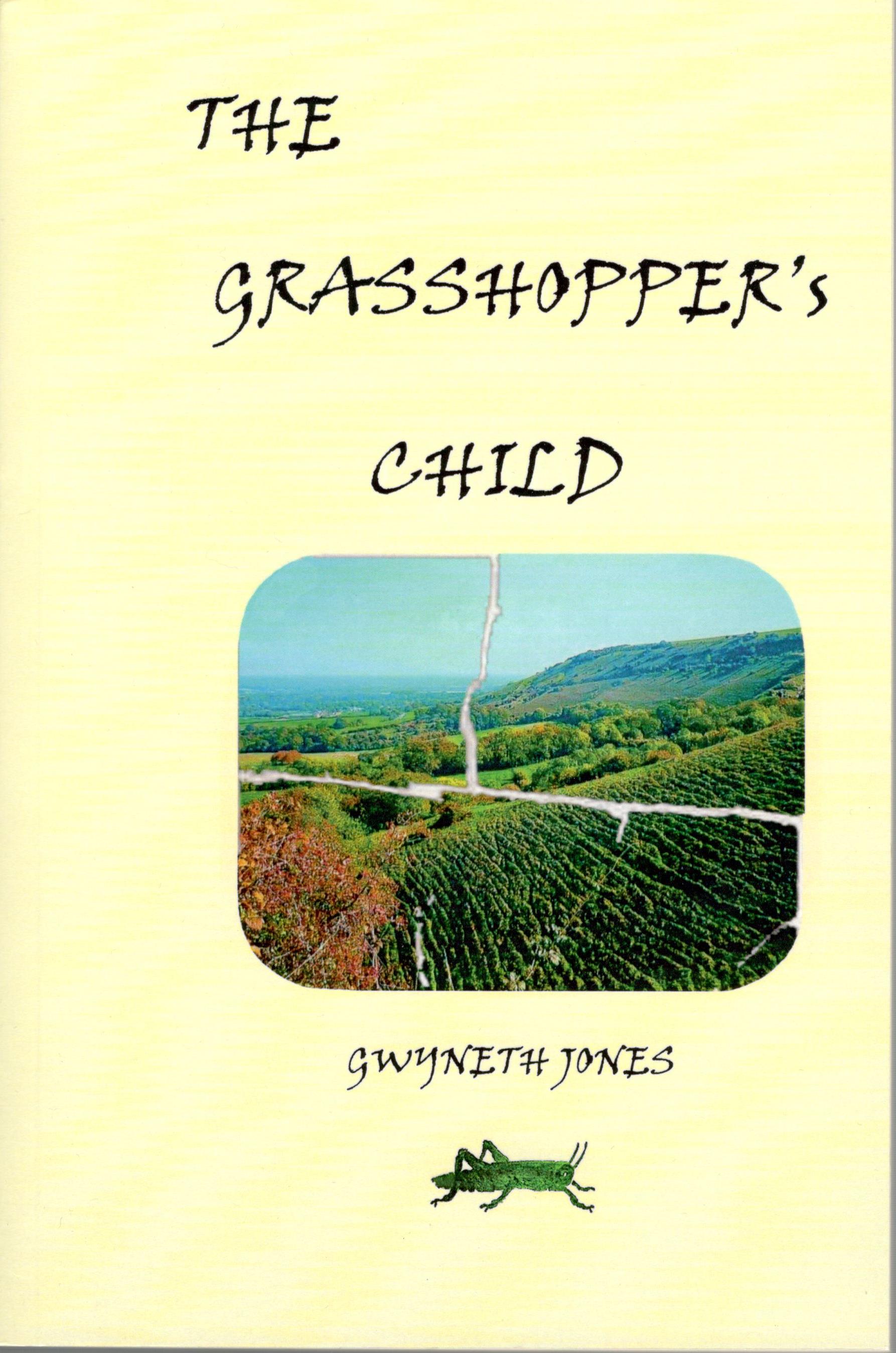
grasshopperschild3 The Grasshopper’s Child, Gwyneth Jones (2014).
A new Gwyneth Jones novel is cause for celebration, even if it’s a YA addendum to the non-YA Bold as Love quintet. But there’s a reason Jones is my favourite science fiction writer, and they’re all evident in this short novel. On the one hand, this is a smart YA novel and I’m no fan of YA fiction; on the other, it’s Gwyneth Jones and her Bold as Love world. But it’s also self-published, so it needs to be on as many best-of lists as possible so that Jones keeps on writing. (And why was it self-published? Do the major UK genre imprints not want to publish new work by the country’s best sf writer?)

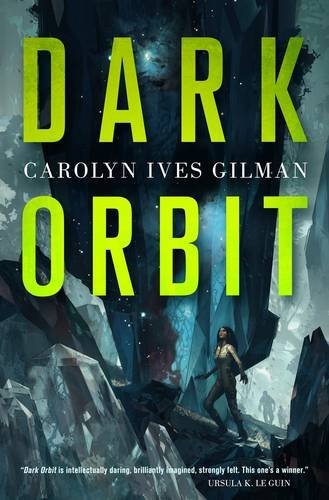
darkoribt4 Dark Orbit, Carolyn Ives Gilman (2015).
I’ve been saying for years that Gilman is a name to watch, and she has at last been given the opportunity to demonstrate it to a wider audience. (She amply demonstrated it with her fantasy diptych from ChiZine Publications back in 2011/2012, but genre commentators can only apparently see what appears from major imprints – which is, if you’ll forgive me, fucking short-sighted). Anyway, Dark Orbit deservedly received a lot of positive reviews, and though to me it didn’t quite feel like Gilman firing on all cylinders, it showed great promise. More from her, please.

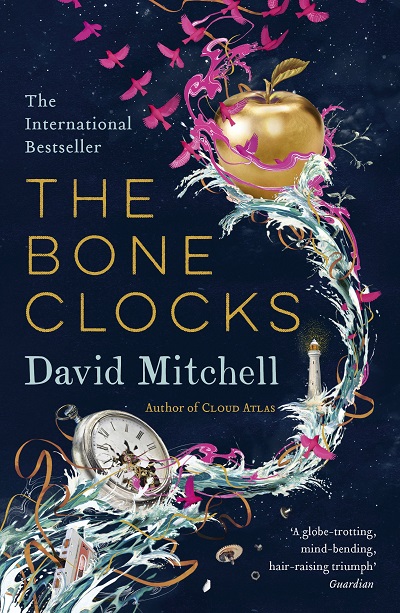
bone_clocks5 The Bone Clocks, David Mitchell (2014).
Friends have been singing the praises of Mitchell for years, but I’ve never really understood why. I mean, I enjoyed Cloud Atlas, and I thought it was clever… but it did seem a little over-praised. But The Bone Clocks is the novel that all the praise had led me to believe Cloud Atlas was. It’s his most insightful yet – and also his most genre.

Honourable mentions: a few titles got bumped from best of the half-year top five, although they were excellent books and probably didn’t deserve to be demoted – namely, The Leopard, Giuseppe Tomasi di Lampedusa (1958), a classic of Italian twentieth-century literature (a bloody good film too); A Division Of The Spoils, Paul Scott (1975), the final book of the Raj Quartet and as beautifully written as the other three; and What the Doctor Ordered, Michael Blumlein (2013), wich showcases why he remains one of my favourite genre short story writers. Also read and noteworthy were: Strange Bodies, Marcel Theroux (2013), a literate mystery based on an interestingly odd premise; Pale Fire, Vladimir Nabokov (1962), my first by him and, though perhaps overly prissy, excellent; One Thousand and One Nights, Hanan Al-Shaykh (2011), a bawdy, and multiply-nested retelling of some of its title’s stories; Housekeeping, Marilynne Robinson (1981), her beautifully-written debut novel; and Galactic Suburbia, Lisa Yaszek (2008), used for research and a fascinating read.

films
I went all-out on the 1001 Movies you Must See Before You Die list in 2015. So much so, in fact, that I signed up with a second DVD rental service, Cinema Paradiso, because they had some films from the list that weren’t available on Amazon’s Lovefilm by Post. And I bought an Amazon Fire TV Stick too, which gave me access to even more movies. Meanwhile, I purged my DVD collection of all the superhero films (why did I buy them in the first place?) and the shit sf movies (why did I buy them in the first place?), not to mention lots of other films I’d bought over the years. My collection is now looking very different, much more of cineaste’s collection (even though I say so myself), with lots of works by Sokurov, Dreyer, Murnau and Benning – and from earlier years, Bergman, Tarkovsky, Kieslowski and Haneke, among many others.

The 1001 Movies You Must See Before You Die challenge has been… interesting. It introduced me to the works of James Benning. I’ve also seen a lot of not very good films that really didn’t belong on the list (mostly from Hollywood, it has to be said). And I’ve seen a lot of early cinema, most of which proved quite interesting. Only one of the five films in my top five was not a “discovery” from the 1001 Movies You Must See Before You Die list.

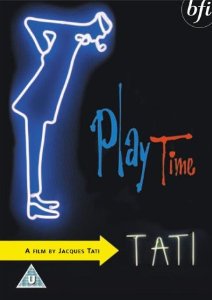
playtime1 Playtime, Jacques Tati (1967)
How could this not be my number one choice? It certainly was halfway back in June, and it remains so now at the end of the year. I loved its Brutalist production design, its situational humour, its wit… it is a work of cinematic genius. I’d watched a rental DVD but I loved it so much I bought a Blu-ray copy for myself… and then bought a boxed set of Blu-rays of Tati’s entire oeuvre. A film that went straight into my personal top ten best films of all time.

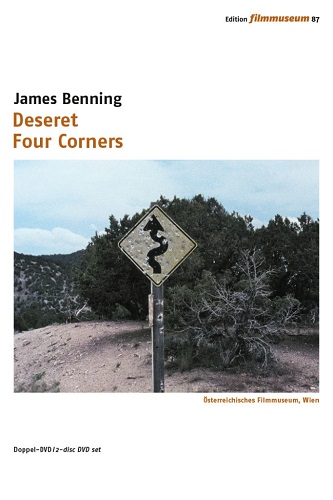
deseret2 Deseret, James Benning (1995)
Ever loved a film so much you went out and bought every DVD you could find by that director? Oh wait, I did that for Tati. But I also did it for Benning. Fortunately, Östereichesichen Filmmuseum have been releasing Benning’s films on DVDs the last couple of years, so there were a few for me to get. And yet… Deseret is static shots of Utah landscape, and later cityscape, while a voice reads out stories from the New York Times from 1895 to the present day. It is cinema as art installation. And I loved it. I am now a huge Benning fan. And I have all of the DVDs that Östereichesichen Filmmuseum have released. And am eagerly awaiting more.

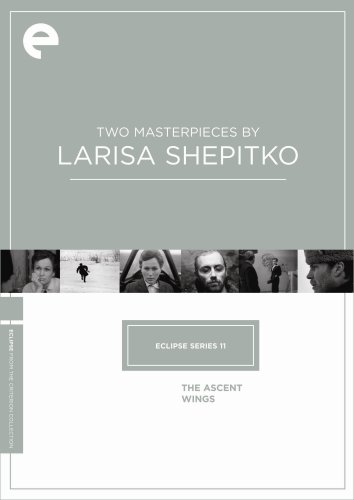
shepitko3 Wings, Larisa Shepitko (1966)
Shepitko’s Ascent is on 1001 Movies You Must See Before You Die list, but the only copy of it I could find was a Criterion double with Wings. I bought it. I watched Ascent. It was good. But then I watched Wings. And it was so much better. A female fighter pilot of the Great Patriotic War, and Hero of the Soviet Union, is now the principal of a school. It’s an artful juxtaposition, more so because the protagonist is female. And it was Shepitko’s debut film. War films, like Ascent, strike me as too easy as choices for assorted lists, but the social drama versus war of Wings is much more interesting. This film should have been on the 1001 Movies You Must See Before You Die list. I’d also like to see more by Shepitko.

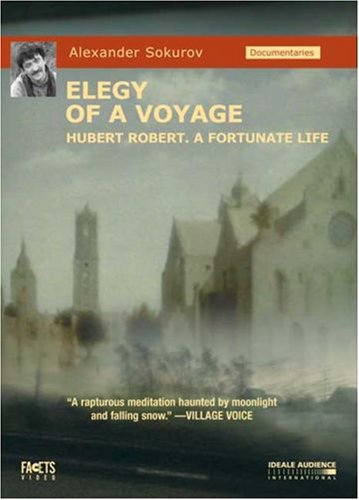
elegy_voyage4 Elegy of a Voyage, Aleksandr Sokurov (2001)
Come on, you didn’t expect me not to have a Sokurov film on this list, did you? I’m being nice by not putting five on it. Well, okay, five maybe could have made it, but one was a rewatch from previous years and so didn’t count. But four could have done. (Yes, the other three are in my honourable mentions below.) Elegy of a Voyage is one of Sokurov’s documentaries, but it’s more of a meditation than an informational film, in which Sokurov muses on journeys and art, particularly ‘The Tower of Babel’ by Bruegel.

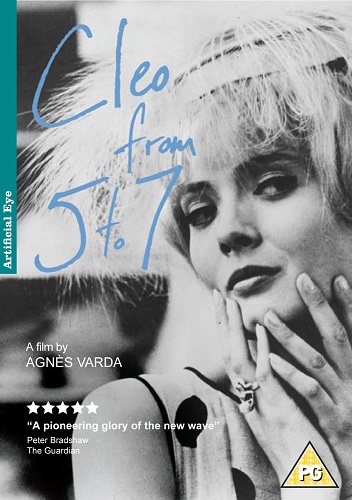
cleo5 Cleo from 5 to 7, Agnès Varda (1962). I have found the Nouvelle Vague to be something of a mixed bag – in fact, I’ve found the oeuvres of Nouvelle Vague directors to be something of a mixed bag. But the only Varda I’d seen prior to Cleo from 5 to 7 was a documentary from 2000. Cleo from 5 to 7 may have covered similar ground to some of Godard’s 1960s films, but it does it so much better. Loved it.

Honourable mentions: two films were dropped from my best of the half year list, one a Sokurov, one a documentary: Jodorowskys Dune (2013) is a fascinating look at a major sf film that never happened, but still left its fingerprints all over sf cinema; Stone (1992) is a typically enigmatic drama from Sokurov… but I could just as easily mention Whispering Pages (1994; which he knocked together after his financing fell apart, but it still manages to hit all those Sokurovian notes), or Spiritual Voices (1995; a documentary about Russian soldiers on the Afghanistan border whose first 40 minutes are a static shot of a Siberian wood). But there’s also Tati’s Mon oncle (1958), nearly as good as Playtime; James Cameron’s Deepsea Challenge (2014), an excellent documentary on his visit to Challenger Deep, only the third person to do so; American Dreams (lost and found) (1984), another Benning piece with an unconventional narrative; Salt of the Earth, Herbert J Biberman (1954), an astonishing piece of social realism drama that deserves to be better known; Sleeping Beauty, Clyde Geronimi (1959), easily the best of the Disney feature films. Day Of Wrath (1943) was another excellent film from Dreyer, Effi Briest (1974) was I thought the best of the Rainer Werner Fassbinder box set I watched, and 2 or 3 Things I Know About Her (1967) was a Jean-Luc Godard that I was surprised to find I liked very much.

albums
I spent much of the year further exploring Bandcamp, and so stumbled across yet more excellent music. I did not, however, see much music live this year – Sólstafir were excellent back in February, Voices and Winterfylleth were very good in September, and highlights of this year’s Bloodstock included Ne Obliviscaris, Sumer, Opeth and Agalloch.

1 Sidereus Nuncius, Apocynthion (2013)
Spanish progressive death metal, not unlike NahemaH (also Spanish, and a favourite band… although they disbanded last year). It seems a little unfair to describe a group’s sound by how much like another band’s it is, but metal these days is such a wide and diverse genre labels are often next to useless. Apocynthion play prgressive metal with clean and growl vocals, some death metal song structures, sound effects and samples, a heavy post-metal influence and a great deal of technical ability.

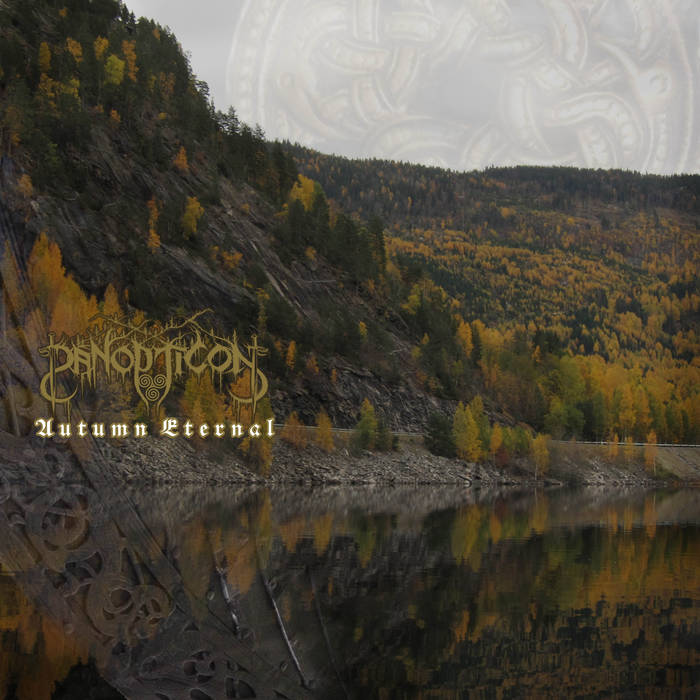
panopticon2 Autumn Eternal, Panopticon (2015)
Panopticon’s Kentucky from 2013, with its mix of black metal and bluegrass, is an astonishing album… but I picked it for my best of last year. Their new album (I say “their” but it’s a one-man show) mixes folky acoustic parts with intense black metal, and it works really well.

3 Ghostwood, Navigator (2013)
This is polished progressive rock with a little bit of djent thrown into the mix, with solid riffs and some catchy hooks. They described themselves as “for fans of Porcupine Tree”, although I think this album is better than most of that band’s albums.

grorr4 Anthill, Grorr (2012)
A relatively recent discovery this one, Grorr play progressive death metal, but more like Gojira than, say, Opeth. There’s all sorts in here – bagpipes, sitar, various types of drums. It’s a wonderfully varied album, but still coherent.

5 An Act of Name Giving, Butterfly Trajectory (2015)
Anothe rrecent discovery. Butterfly Trajectory also play progressive death metal – there seems to be a common theme to this top five… They’re from Poland, and while their sound is quite Opeth-ish, they’re a good deal better than fellow countrymen Gwynbleidd who play similar material. Butterfly Trajectory seem to like their progressive bits a tad more than their death metal bits, which works really well.

Honourable mentions: Worst Case Scenario, Synesthesia (2015), French progessive death metal with plenty of other musical styles thrown in, excellent stuff; Kyrr, Kontinuum (2015), Icelandic post-metal, a little more commercial than fellow countrymen Sólstafir… whose Ótta (2015) and Svartir Sandar (2011) are excellent heavy post-metal albums; Cold and the Silence, Martriden (2015), yet more shredding from excellent medlodic death metal group, who seem to have gone a bit funkily progressive with this new album, and it works really well; and finally, RAMA, RAMA (2015), which is a weird mix of doom, stoner, psychedelic and desert rock all in a three-song EP.


4 Comments

Reading diary, #11

There are a couple of books in this post which likely deserve full-on reviews, but I don’t do that any more (not unless they’re associated with a “reading project” or something, or for a venue such as Interzone or SF Mistressworks), so you’ll have to make do with this. I’ve also decided to institute a new feature and, as I do in my Moving pictures posts, asterisk those books which can be found on the 1001 Books You Must Read Before You Die list (I’m using the 2013 list, as that was the first one I found). To date, I’ve read 115 books on the list, including the one asterisked below, and to be honest there are a number I don’t think I’ll ever bother reading… But others look they might be worth a go – as indeed was Henry Green…

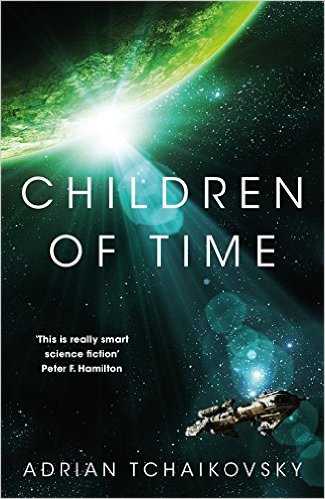
children_of_timeChildren of Time, Adrian Tchaikovsky (2015). I sort of read this by accident. I bought it at Edge-Lit 4, and on the train ride home I finished the book I’d taken to read during the journey there and back, so I started Children of Time. And since I’d started it, I decided to continue reading it. Which I think makes it one of the very few books I’ve actually bought and then started on the same day. The elevator pitch for this novel didn’t sound all that appealing, and the author is better known for a ten-book fantasy series, so I wasn’t sure what to expect. What I found was a polished sf novel with several neat twists on the generation starship story (it seems to be the generation starship’s year, with this and Kim Stanley Robinson’s Aurora). The world the ship plans to colonise, and the only possible candidate its crew have found, unfortunately turns out to have been terraformed and colonised millennia earlier. By spiders (the result of a human seeding programme that went wrong). The novel alternates between events on the ship and the development of the spider civilisation – and the latter narrative is absolutely fascinating. Tchaikovsky puts a few spins on his generation ship tropes, although it soon devolves into a well-visited territory. Which was a little disappointing – but on balance the spiders more than make up for it. I wouldn’t be surprised to see this on the BSFA Awards shortlist next year.

Skin, Ilka Tampke (2015). I reviewed this for Interzone. I picked the book as one of my choices based on the one-line description in the email sent out to reviewers. It turned out to completely different to what I had expected. It’s a Celtic historical fantasy that sort of hovers on the border of YA and adult fantasy. Bits of it worked really well, but the narrator was such a special snowflake it sort of spoiled things for me.

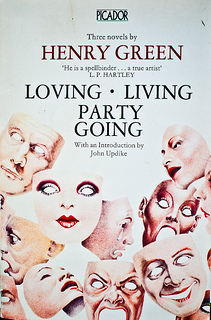
lovingLoving*, Henry Green (1945). According to the back cover of the Picador omnibus paperback I own which contains Loving, Green is “the most neglected writer of our century”. The book was first published in 1978, and that may well have been true then, but he has apparently seen something of a revival in recent years – there’s a 2005 edition of the same book, but with an introduction by Sebastian Faulks rather than John Updike; and Green has a number of other novels in print. Which is all, I suppose, beside the point; suffice it to say I knew only Green’s name and nothing about his oeuvre when I started Loving. Perhaps I’d expected something not unlike Olivia Manning’s novels, she was after all a contemporary, and I do like Manning’s fiction. Loving, however, proved to be entirely different; and excellent for reasons that make it nothing like Manning’s books. It’s set belowstairs in a large house in rural Ireland during World War II. Not only are the staff worried about the war, but also about their own situation in an neutral country should the Germans invade. And, of course, there’s the house to manage, and their employers to wait upon. The novel opens with the death of the butler, and chiefly follows Raunce’s efforts to get himself promoted into the vacant position. Green makes no concessions to his readers, the characters and their relationships have to be inferred from the narrative, much of which is dialogue. Science fiction may over-rely on dialogue to carry its stories, but it never does it with the skill and control of voice Green manages. I’ll definitely be reading more of his novels.

Godsfire, Cynthia Felice (1978). This is one of several paperbacks I bought from Alvarfonden at Archipelacon, with the intention of reviewing them on SF Mistressworks. Which is what I did – see here. I liked it.

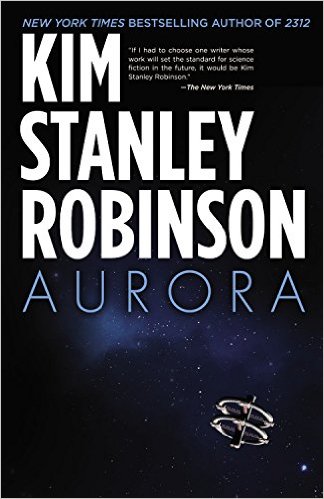
auroraAurora, Kim Stanley Robinson (2015). I’ve been a fan of Robinson’s work for many years, and, so I was told, this was one of his best, even better than 2312. So, of course, being completely contrary, I enjoyed it, thought it quite good, but… not as successful as 2312. The story follows the arrival of a generation starship at Tau Ceti after 170 years in flight, and is told by the vessel’s AI as a study in narratology and a sort of experiment in making the AI more human. The narrative focuses on Freya and first follows her as she goes on a wanderjahr through the twelve biomes which make up the ship. Then there’s the attempt to colonise a moon of one of Tau Ceti’s exoplanets. But that goes horribly wrong, and leads to a civil war on board between those who want to terraform another moon and those who think they should return to Earth. Freya is the de facto leader of the latter faction, and the final section of the book details the ship’s return to Earth and Freya’s experiences once there (those who flew back hibernated for the trip, using a technique in the feed beamed to them from Earth). As a thought experiment on how some elements of a generation starship might operate, Aurora makes for a fascinating read. There’s some handwavey stuff – not least the narrating AI – and many of the mechanical issues are glossed over. However, where the book fails for me is in its human side. Although a number of different cultures are present on the ship, everyone acts like twenty-first century Californians, displaying the sort of liberal individualistic sensibilities more likely to be found on the western seaboard of the US than in the seventh generation of a generation starship’s passengers. For example, there are complaints people are not free to have children as and when they want, but you’d think something like that would have long been accepted. And then there’s the violence between the “stayers” and the “backers”, which for a group of 1200 people who have known only the biomes, didn’t ring true. I was, however, amused that Freya and the others clearly returned to the Earth of 2015 – there were a few backhanded digs at social media and an indirect mention of hipsters. I’m still in two minds about Aurora. The setting is very clever, but the characters are thin and unconvincing; and like 2312, it’s all about making the Earth a fit place to live – because there’s nowhere else in the universe we can do so.

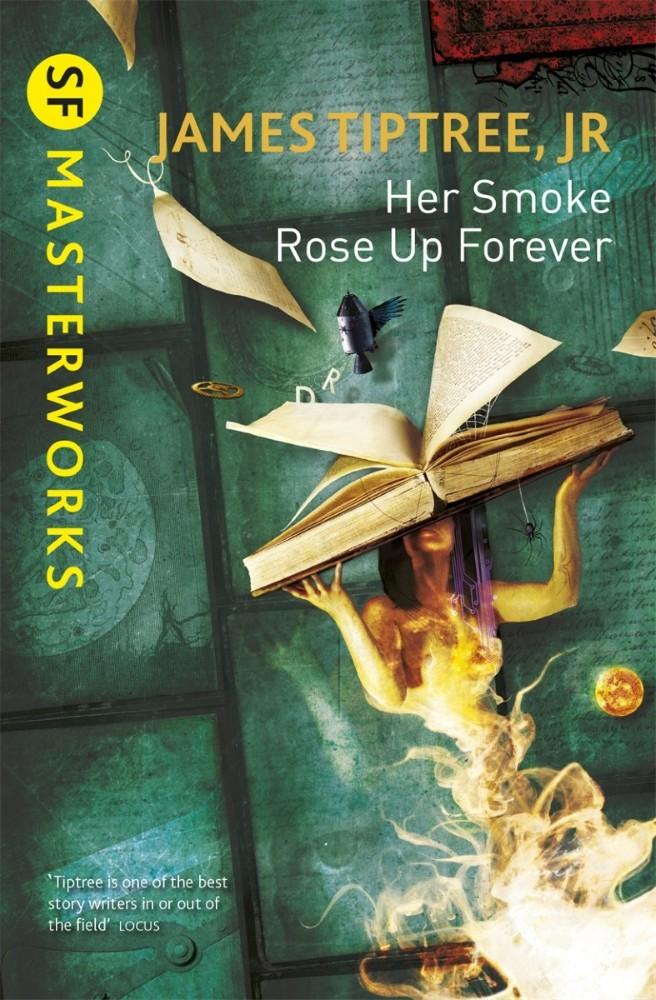
her-smoke-rose-up-foreverHer Smoke Rose Up Forever, James Tiptree Jr (1990). When I first started reading Tiptree back in the late 1970s – it was Ten Thousand Light-Years from Home, originally published in 1973 but my edition was the 1978 paperback – I knew “he” was a woman, but from what I’d read somewhere I thought the pseudonym was in order to protect the author’s career with the CIA. It never occurred to me Ali Sheldon used it because she was a woman. Now I know better, of course. In the early 1980s I bounced out of Tiptree’s Brightness Falls From the Air, and never quite got back into reading her. Well, at least not with the same fervour as before. I’ve reread Ten Thousand Light-Years from Home over the years several times, not to mention the odd story in various anthologies, but it wasn’t until Her Smoke Rose Up Forever appeared in the SF Masterworks series – deservedly so, I might add – that I really decided to give her a reread in earnest. I would normally review this book for SF Mistressworks, but I’ve already got a review lined up by someone else; and besides, I’ve probably reviewed half of the contents in reviews of other anthologies anyway. For the record, not every story in here shines, but a number of them so do very brightly – ‘The Screwfly Solution’, personal favourite ‘And I Awoke And Found Me Here on the Cold Hill’s Side’, ‘The Women Men Don’t See’, even ‘The Man Who Walked Home’ (a story which has haunted me since I first read it decades ago). There are stronger collections in science fiction out there, but not many.

the_danger_gameThe Danger Game, DHF Webster (1978). The author joined the Royal Navy in the nineteen-fifties as a diver, then ran a salvage operation for a while, but that eventually folded due to a lack of contracts. He was employed as a manager for a booze merchant in his home town of Bradford, when an old Navy buddy contacted him and asked him if he’d be interested in working in the North Sea, as the industry was desperate for qualified divers. The Danger Game is about Webster’s years as a commercial diver, and given some of the things he describes the title seems apt. During the early sixties, things were very different, and a lot of deep dives were done on air – 200 feet deep, that’s about seven atmospheres, on air. Nitrogen narcosis, “rapture of the deep”, was not only common, it was expected, and divers frequently surfaced with little or no memory of the final tasks they’d performed. The same was true of the bends, pretty much everyone suffered from it several times, usually because of mistakes with the air supply requiring a quick trip to the surface, or because the wrong tables were used. But they had decompression chambers on deck, so a few hours sealed in one of them and they were right as rain. Although lots of divers perished, it seems a miracle the entire industry wasn’t shut down it was so dangerous. But, of course, because oil. Anyway, a short and reasonably informative read, although likely of worth only to those interested in the subject.

1001 Books You Must Read Before You Die count: 115