I’ve been a fan of Talbot’s The Adventures of Luther Arkwright (1989, UK) for years. When I was at college in Nottingham in 1985, I often visited a comics shop on Mansfield Road before catching the bus home. I forget the name of the shop – and I can’t find it on Google. (I also visited a games shop, a grubby place in a courtyard, around the same time, and bought copies of the Laserburn RPG rules – Tabletop Games, possibly?) Anyway, I recall buying an issue or two of The Adventures of Luther Arkwright from that comics shop on Mansfield Road, although I didn’t read the completed series until buying the omnibus trade paperback many years later.
Not long after I read Talbot’s Alice in Sunderland (2007, UK), and thought it very good. I also kept up with the sequels to Luther Arkwright. So yes, I’d say I’m a fan of Talbot’s independent work, even if I’ve not been obsessive about keeping up with his oeuvre (it’s difficult with comics anyway; I much prefer to wait for the omnibus edition). Which is all slightly irrelevant as I’d missed Talbot’s Grandville series, five graphic novels set in the late 1800s in a UK that has been ruled from France since the Napoleonic Wars and in which all the characters are anthropomorphic animals.
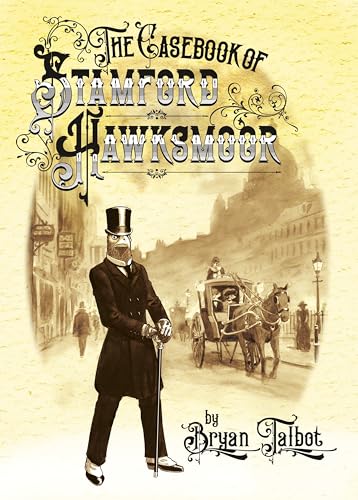
The Casebook of Stamford Hawksmoor (2025, UK) is set in the same universe. It’s a clear homage to Sherlock Holmes – his deerstalker is something of a joke in the book. Hawksmoor, named for the architect – and the novel by Peter Ackroyd is also name-checked – is a detective at Scotland Yard. He recognises that not all of his colleagues are honest. But even he is shocked when he discovers links between some of them and the terrorists responsible for some of the most heinous crimes of recent years.
When Hawksmoor’s brother, a man he hasn’t spoken to in years, commits suicide in an open field near his house, Hawksmoor reluctantly investigates his brother’s life in an effort to understand why he killed himself. Hawksmoor is also investigating a series of murders linked to the Angry Brigade, the terrorist wing of the Resistance Movement, and which seems to have gone rogue now the French are pulling out of Britain and allowing home rule.
It’s all linked, of course, and the result of corruption in high places in the British establishment – plus ça change, and all that. Although framed as a Victorian whodunnit, much like its inspiration, Talbot has a put a lot of effort into working out his world. Not just the politics within a Britain that has been ruled by the French for over a century, but also the way the characters’ animal species impacts their behaviour, and the relations between the various species.
It’s excellent stuff. Recommended. But now I have to go and buy all the Grandville graphic novels. Oh look, there’s an omnibus edition available…
 It Doesn't Have To Be Right...