
Winner of the BSFA Award in 1988. There doesn’t appear to have been any shortlist that year, so I’ve no idea how it was chosen. The Eastercon in 1988 took place in Liverpool and was three years before my first Eastercon.
Gráinne (1988, UK) is the name of a princess from Irish mythology, who at their betrothal party dumped the man she had been promised to and ran off with Diarmuid instead. In Roberts’s novel, it’s the name of a young woman the narrator, Alistair Bevan, meets, has a mostly platonic relationship with, and who then leaves him… and several years later appears on television as the presenter of a documentary series on the brand new Channel 5. By this point, Bevan works for an advertising agency, which Gráinne hires to promote a series of “clinics” to empower women.
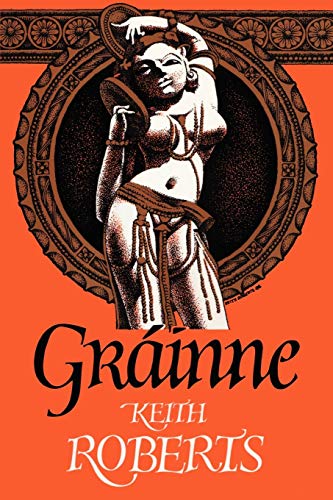
This narrative is framed by, and interspersed with, short scenes of an old man in a hospital bed, explicitly telling the story of his life to a doctor and nurse. I’ve no idea if the resemblance was intentional, but there’s a lot in these sections that reminded me of John Fowles’s Mantissa (1982, UK)
Most descriptions of the novel classify it as semi-autobiographical, and while I’ve read a lot of Roberts’s fiction, I know little of his life – but perhaps enough to for the classification to ring true. (His careers in illustration and advertising, for example.) Other aspects, especially the gender politics and attitude to women evidenced in the novel, are definitely the same as in Roberts’s other writings (cf ‘The Natural History of the P.H.’).
Roberts’s main thesis seems to be feminism and women’s lib are a waste of time because women should not be trying to fight for equality with men but simply fighting for their own variety of rights. Which sort of ignores the fact of the patriarchy, a concept Robert never appears to have taken onboard. And it does render the central element of Gráinne’s plot, the empowerment centres, somewhat moot. On the other hand, they do make Gráinne something of a messianic, or a Valentine Michael Smith-type, figure.
Of course, it all ends badly. It always does for such figures. The narrative hints at unsavoury backers who helped Gráinne financially, perhaps hoping for the social and economic disruption she eventually causes in the UK, but it doesn’t go any further. The final section also implies a post-apocalyptic Earth, perhaps after a nuclear war, but it’s only a single sentence and ambiguous.
The reviews of Gráinne I’ve read online seem mostly to have missed the point of the story. It’s not a fantasy about a Celtic goddess who has a love affair with a human man. Gráinne may be more than human, but that’s from Bevan’s point of view. Her later influence is a mixture of clever television (much cleverer than Channel 5 ever proved to be, or indeed the bulk of British tv in the mid-1980s), deep pockets and a mishmash of Eastern religions. Even then, her empowerment centres proved more disruptive than intended.
Robert Heinlein’s Stranger in a Strange Land (1961, USA) follows a similar story although, given it’s American, it reads like a carnival novel, and its central protagonist, Valentine Michael Smith, is a thinly-disguised carnival freak. Roberts’s novel, however, uses Irish mythology rather than US carnival folklore, and focuses on female empowerment and not free love. Heinlein wrote prose that was extremely readable and smooth, but Roberts’s style is more literary. British sf produced a number of excellent prose stylists in the 1970s, not part of the New Wave but almost certainly adjacent to it, such as Coney, Cowper, Compton, Lee, Saxton, Watson…
I’ve no idea why Gráinne, published by small press Kerosina Books, was given the BSFA Award. Other notable sf novels published in the UK in 1987 include Banks’s Consider Phlebas (1987, UK), Mann’s The Fall of the Families (1987, UK), Wolfe’s The Urth of the New Sun (1987, USA), and even Haldeman’s Tool of the Trade (1987, USA). Certainly, a shortlist could have been drawn up. Perhaps it was.
 It Doesn't Have To Be Right...