It Doesn't Have To Be Right…

… it just has to sound plausible


1 Comment

Unwrapped

Christmas is now over and, as he does every year, Santa brought me some books. But I’d also bought some for myself in the weeks leading up to the festivities and since my last book haul post…

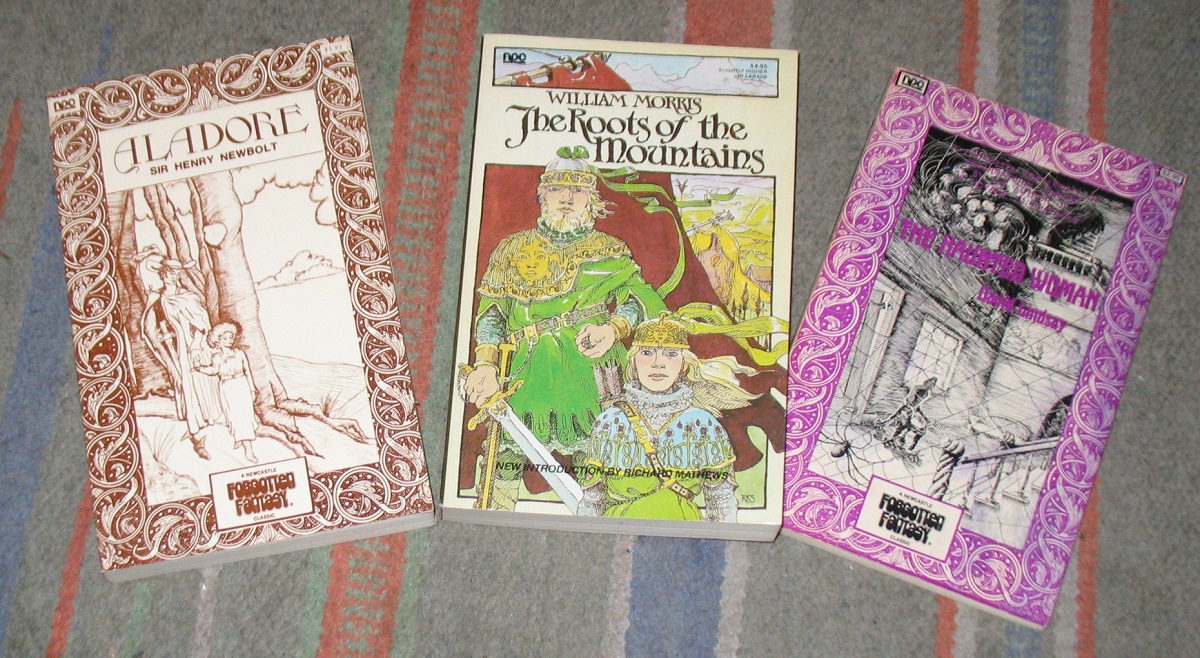
2016-12-29-10-35-22

I managed to find a couple more of the Newcastle Forgotten Fantasy books on eBay – The Haunted Woman, Aladore and The Roots of the Mountain – which are numbers 4, 5 and 19 respectively. Still got a way to go yet, however…

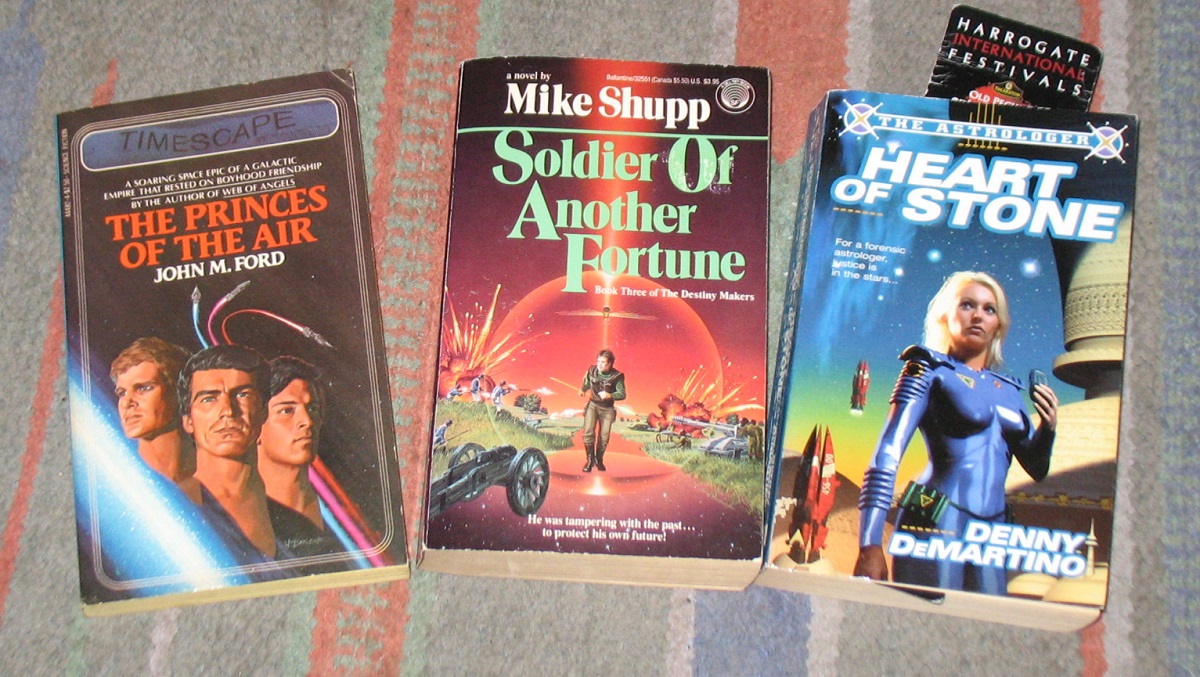
2016-12-29-10-36-31

A trio of secondhand sf novels. I’m currently reading Heart of Stone for SF Mistressworks. I have the sequel, Wayward Moon, somewhere as well. Soldier of Another Fortune finally completes my Destiny Makers quintet. I used to correspond with Shupp back in the 1990s, but we lost touch. And The Princes of the Air is a book I’ve often heard spoken of approvingly, but it’s been hard to find.

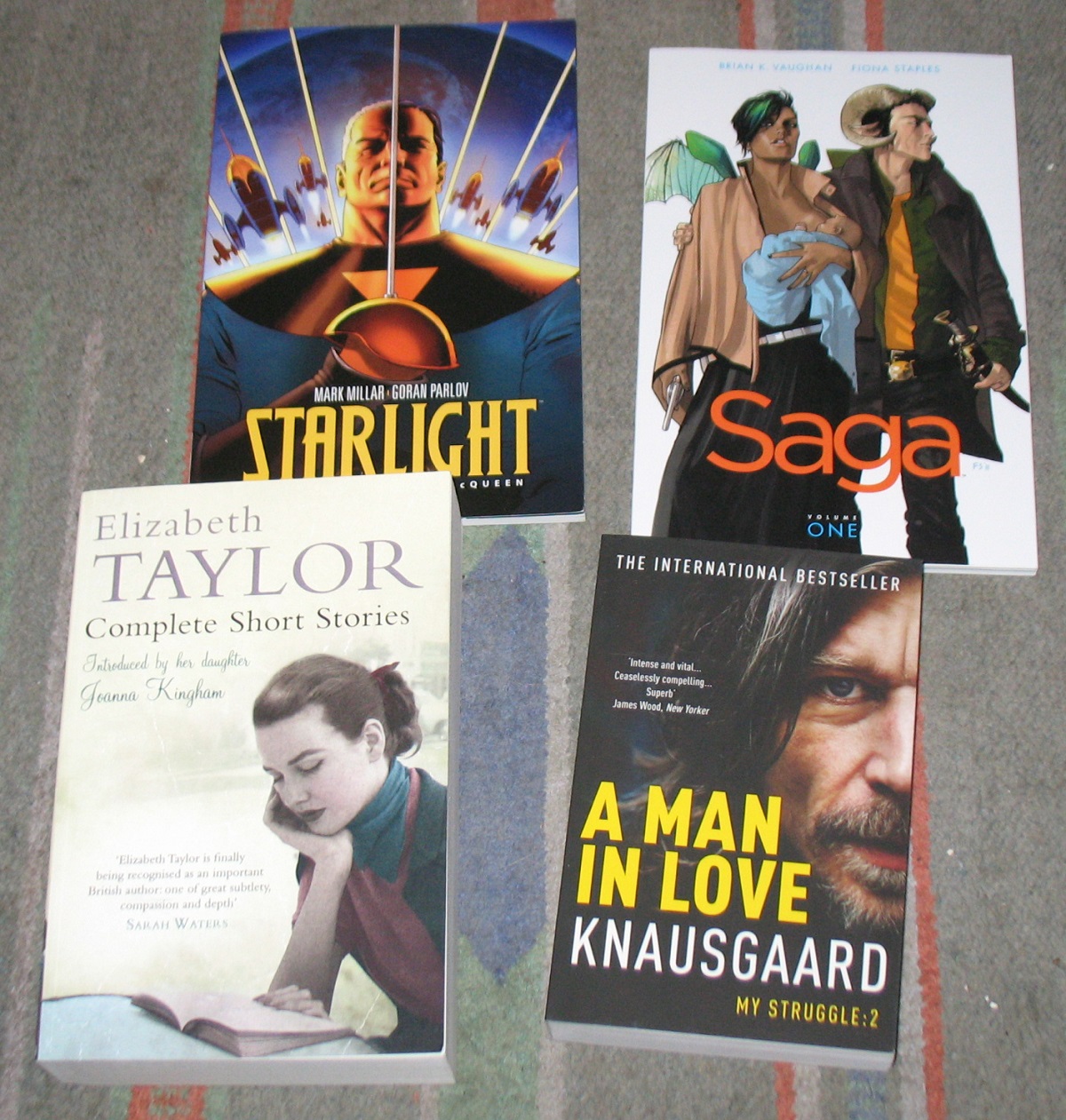
2016-12-29-10-37-58

From the Christmas holiday: Santa brought me Elizabeth Taylor’s Complete Short Stories (no, not that Elizabeth Taylor; the writer, not the actress) and the second book of My Struggle, A Man in Love. I bought Starlight and Saga Volume 1 in Faraos Cigarer, the former because it looked interesting and the latter because lots of people have praised it.

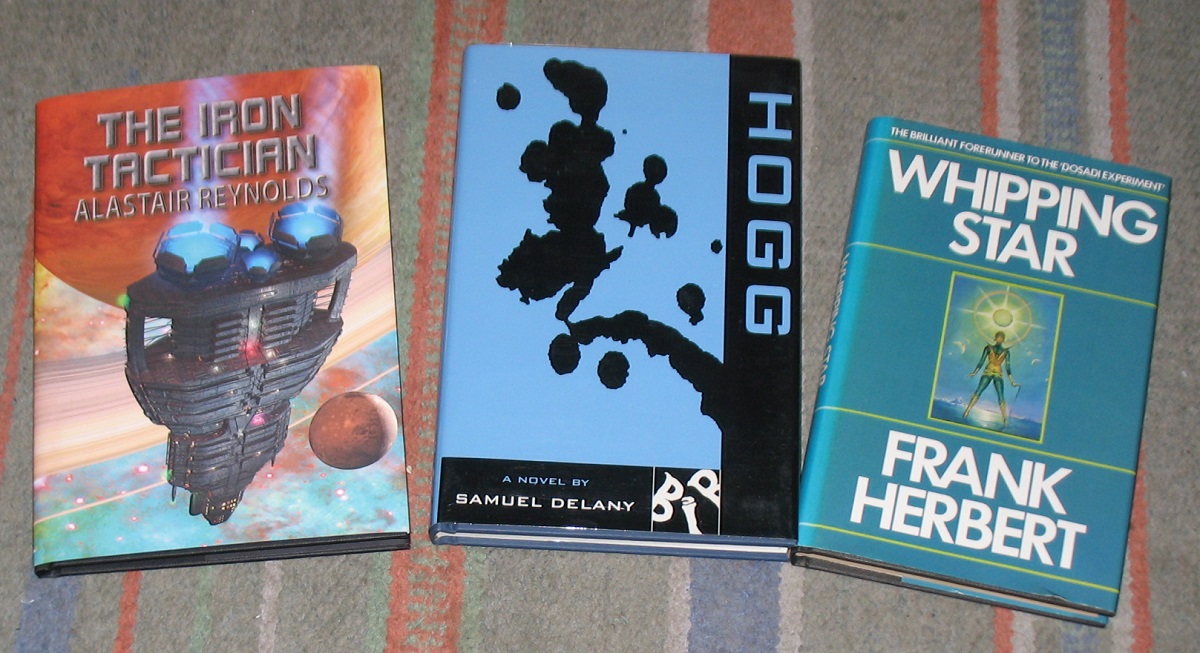
2016-12-29-10-41-07

Three collectibles… The copy of Whipping Star is the first UK hardback edition, but it wasn’t published until 1979, nine years after the US first edition (the first UK edition was a paperback in 1972). Hogg I’d wanted for a while but first editions are hard to find. One eventually popped up on eBay. The Iron Tactician is a new signed and numbered novella from NewCon Press.

2016-12-29-10-42-07

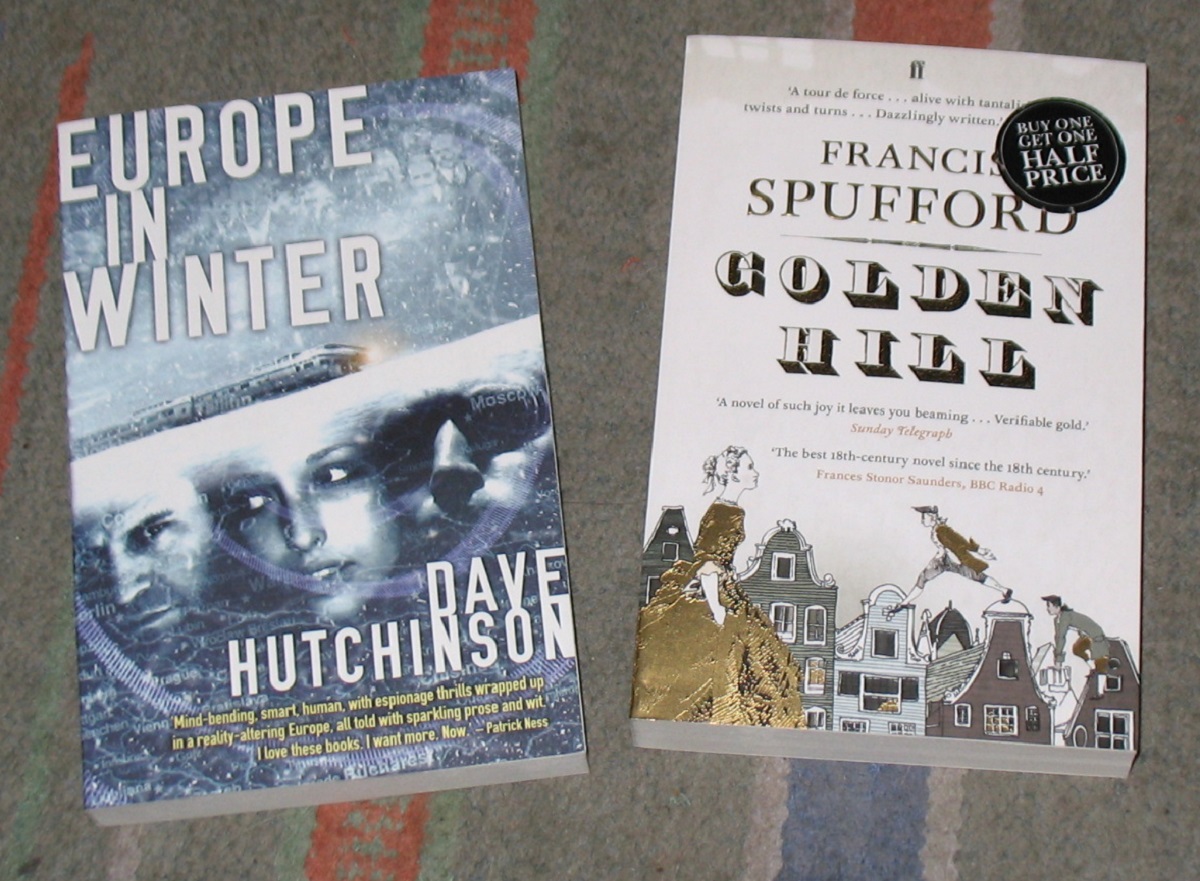
Some new books, just to prove I do read them. Having been impressed by Europe in Autumn and Europe at Midnight, I was certainly going to get a copy of Europe in Winter. Golden Hill I stumbled across in Waterstone’s while purchasing Sebastian Faulks’s latest, Where My Heart Used to Beat (not pictured, because I read it over Christmas and left it with my sister for her to read).


1 Comment

Reading diary, #40

I’m not sure what’s been going on with my reading recently. I usually alternate genders in my fiction reading, but I seem to have had a run of male authors. I’ll probably make up for it before the end of the year.

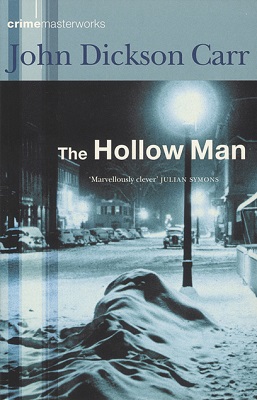
hollow_manThe Hollow Man, John Dickson Carr (1935). Whenever I spot one of these Crime Masterworks in a charity shop, I pick it up. I’m not a big fan of crime fiction, although it does seem many sf fans are, and when I do read crime I tend to stick to a handful of favourite authors, like Sara Paretsky or Sue Grafton. But some of the classic stuff makes for an easy light read, along with the sf, amongst all the literary fiction I seem to mostly read these days… I’ve read Dickson Carr before – I seem to remember buying one of his books at a remainder book shop in Abu Dhabi during the 1990s – but I couldn’t tell you anything about him or his oeuvre. The Hollow Man was apparently voted the “best locked room mystery of all time”, so it comes as no surprise to discover its one of those completely contrived murder mysteries which are set up in order to make the protagonist – eccentric detective Gideon Fell, who is based on London – appear enormously clever. The Hollow Man is split into three sections. In the first, an emigré professor is threatened in a pub, and then is later murdered in his room after admitting a stranger – but when the locked door is forced, the stranger has vanished and there’s no other exit. In the second section, the chief suspect is then shot in the middle of an empty street, with no visible assassin, by witnesses. The final section reveals the back-history of the two dead men (they were brothers) and Fell explains, with diagrams, how both murders were committed. The first was deliberately contrived to be a locked room mystery, the second only became a mystery through a sequence of unlikely events. Although set in London, Dickson Carr completely fails to evoke time or place, and most of the characters are painted very broadly. It’s a mildly entertaining, but slight, intellectual exercise, and requires about as much suspension of disbelief as your average space opera.

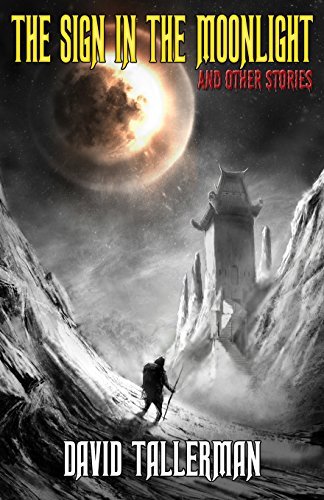
sign_in_the_moonlightThe Sign in the Moonlight, David Tallerman (2016). I was given a copy of this by the author, and I’ll freely admit horror, or dark fantasy, is not really my thing. Even so, if there was one thing which jumped out at me about the stories in this collection, it’s that they pastiched their inspirations a little too effectively. In fact, for much of the collection, it felt like the author had no voice of their own. Granted, it takes good craft to pastiche so effectively, and in an individual story read in, say, a magazine or anthology, it wouldn’t present a problem… but in a collection of such stories, you start to wonder who has actually written them… I wasn’t as taken with the Lovecraft-kiddie story, ‘My Friend Fish Finger By Daisy, Aged 7’, which I first heard at a York pub meet, as much as I know others have been; and I thought the title story, an Aleister Crowley story, suffered from a lack of, well, Aleister Crowley… although I thought it quite effective otherwise. The stories are, on the whole, well-crafted and polished, and wouldn’t look out of place in any random Weird Tales sort of anthology or magazine. The collection is also very nicely illustrated, with a page of art introducing each story. But for me, that lack of a voice felt like a deal-breaker, and it all seemed somewhat too polished, so your attention tended to slide from the prose. It has occurred to me that short stories succeed when they contain a high concept conceit that resonates with readers or a strong voice – and the best stories have both. In terms of strong conceits, some of the stories in The Sign in the Moonlight get close, and in isolation those conceits might have seemed stronger. I’ve always liked collections, I much prefer them, in fact, to anthologies… but reading this one made me think about why I prefer them, and why some are more successful than others.

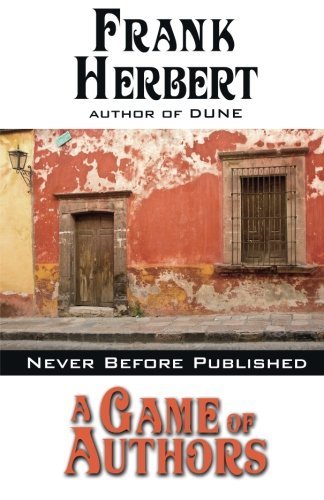
game_of_authorsA Game of Authors, Frank Herbert (2013). Of course, Frank Herbert didn’t write this novel in 2013. WordFire Press – better known as Kevin J Anderson – has been publishing Herbert’s previously unpublished work, and this mainstream thriller is one of those. And I can see why it never saw print back in the day. A journalist is sent a letter in broken English which reveals that a long-missing Pulitzer Prize-winning author is hiding out in Mexico. The journalist persuades his paper to let him check it out… but it’s all a plot by the missing author, who has been imprisoned in a hacienda, with his nubile daughter, by the head of the local communist cell, because the author has been writing propaganda stories for them and selling them under pseudonyms to US slicks. The writing in A Game of Authors is definitely Herbert’s, but it’s much cruder than his later work and some of the dialogue is embarrassingly bad. The Mexican characters are all stereotypes, and the communist conspiracy plot is too weak to justify the violent showdown which results. If you’re interested in Herbert’s career, A Game of Authors might be worth a read; but letting it see the light of day will not do his reputation all that much good.

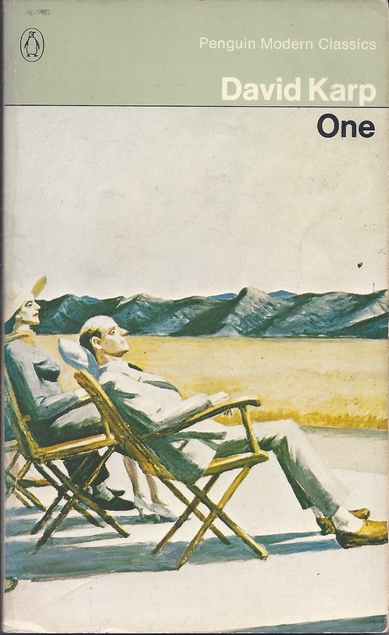
oneOne, David Karp (1953). This was from my father’s collection of Penguin paperbacks and, despite being a literary dystopia, it wasn’t a novel I’d heard of until I came across his copy. I mean, I’ve read Nineteen Eighty-four and Brave New World and I’m aware of We and ‘When the Machine Stops’… but I don’t recall ever seeing mention of One in discussions of dystopian fiction. Has it dropped out of favour? Is it considered not sfnal enough to mention in discussions of dystopias? Because it’s a damn sight more science-fictional than Nineteen Eighty-four. (And is no longer in print, I see.) A couple of centuries from now, the “benevolent State” rules the entire planet. A college professor is a secret informer for the State and writes regular reports on his colleagues and students. But then he is called in for a random check, mistakes his interview with the Department of Internal Examination as an indication the department is about to reward him for his diligence, and so reveals himself to be a “heretic”. But a senior member of the department believes heretics such as the professor are curable, and tries to do so. (Normally, they’re  simply executed.) The professor is brainwashed and rejoins society under a different name and with an entirely different personality. But his subsequent behaviour, although he appears to be a model citizen, reveals that his heresy has not been completely eradicated… Clearly, the 1950s US fear of communism is the driving force behind the world and plot of One, but such novels reveal more about the flaws of the writer’s society than they do those of their invented dystopia (hello there, Fahrenheit 451). The benevolent State is crime-free and the vast majority of its citizens are happy. Why is this a bad thing? A handful of malcontents who believe their dissatisfaction is a result of their “individualism” being curtailed is no reason to write off the entire society. But, of course, that’s how dystopian fiction works. It reinforces present-day values by valourising one single aspect of the writer’s society that a “dystopia” might diminish, while ignoring all the social problems said dystopia might actually fix. Obviously, the USSR was far from a utopia, but at least it tried to become one – which is more than can be said for the US (or indeed most nations). One has its flaws – it’s simplistic, it’s all a bit men-in-hats sf, and its prose is functional rather than evocative (although better than most sf novels of the time). It also makes a meal of the whole “individualism” thing, when it actually does a better job of disproving the need for it. It’s still worth reading.

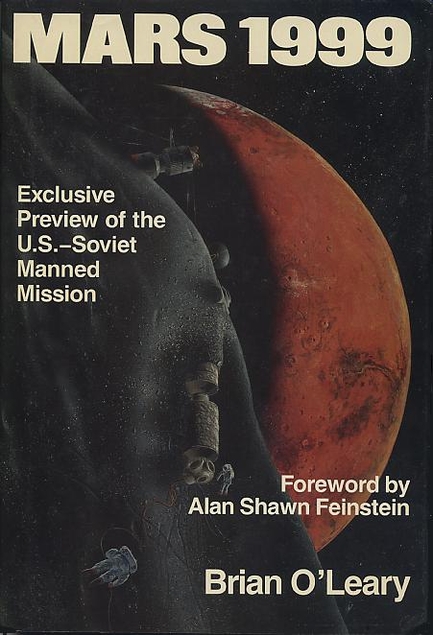
mars_1999Mars 1999, Brian O’Leary (1987). I bought this a few years ago when I was collecting books on missions to Mars, and while its title alone indicated it was now alternate history, I hadn’t expected it to posit such a, well, utopian vision of the early twenty-first century. It’s all very well imagining NASA will expand their space programme and put together a mission to Mars. It’s even plausible such a mission might be a joint mission with the USSR (because, of course, in 1987, everyone thought the Soviet Union was still in rude health). But it’s a frankly bizarre stretch to think that a US-USSR mission to Mars might lead to a world government two decades later… O’Leary covers some of the necessary science in basic fashion, then documents the design of spacecraft which would be used in his preferred mission plan (including some not very good illustrations of the spacecraft), and even intersperses his discussion of his topic with short chapters of a fictionalised mission featuring an international crew. Well, not precisely international – there’s a Soviet spacecraft and a US spacecraft travelling in formation, but the US crew is not entirely American. The commander is, however. And another American in the crew gets to be the first human being to step onto the Martian surface. I didn’t read Mars 1999 looking for a fictional treatment of the first mission to Mars, but I was expecting something a little heavier on the science and engineering that what I found. I suspect the book was among the first on its topic to be published, so all due credit to the author, but thirty years later it reads like, er, science fiction, or alternate history. And not particulary good science fiction or alternate history.  One for those interested in the topic, I suspect.

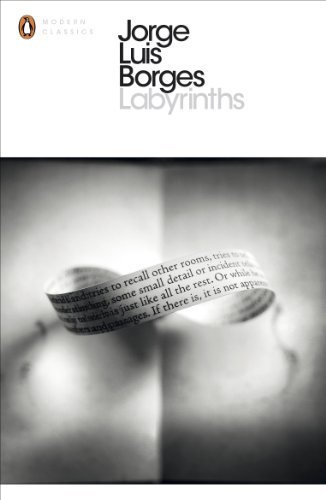
labyrinthsLabyrinths*, Jorge Luis Borges (1962). I had a copy of this years ago but it seems to have gone missing at some point, and I’d never got around to reading it. So I bought a replacement copy, and ended up reading it a couple of weeks after it had arrived. There’s not much you can say about Borges or this collection – either you know what he writes, or you don’t, because explaining it is pretty difficult. Labyrinths contains some of Borges’s best-known stories, such as ‘The Library of Babel’, which describes an infinite library and those who live in it; or ‘Funes the Memorious’, about a boy who falls from a horse, injures his head, and develops a perfectly eidetic memory; or ‘Tlön, Uqbar, Orbius Tertius’, about an encylopaedia which includes an article on a country which does not exist and triggers an obsessive search for more information by the narrator; or ‘Pierre Menard, author of the Quixote‘, which discusses an author who plans to become Cervantes in order to write a word-for-word copy of Don Quixote… The stories have a sort of dry, academic tone, almost reportage in places, but certainly a demonstration, much like I found Blixen’s Anecdotes of Destiny to be, that “show, don’t tell” is a relatively recent writing fad. I particularly liked ‘The Immortal’, but ‘Three Versions of Judas’ read like uninteresting biblical scholarship. Labyrinths also includes ten essays and eight “Parables”. This is erudite, intelligent stuff, and while Borges is fully deserving of his reputation, I can’t see anyone writing anything like it today – at least, writing it and being published… Every self-respecting literature fan should have a copy of Labyrinths on their book shelves, real or virtual.

1001 Books You Must Read Before You Die count: 129


2 Comments

Made from books

Nerds of a feather have been running a series of posts by its members on “books that shaped me”, and I wondered what books I’d choose myself for such a post. And I started out doing just that but then it stopped being a listicle and more of a narrative, so I just went with it…

These will not be recent books – or, at least, the bulk of them won’t be. Because while people’s attitudes, sensibilities and tastes evolve over the years, some of the books I read back when I was a young teen obviously had more of an impact on me than a book I read, say, last week. Some of the following have in part shaped my taste in fiction, while some have inspired and shaped my writing. Some I read because they seemed a natural progression in my reading, some were books I read because they covered a subject that interest me, some I read because they were out of my comfort zone and I felt I needed to broaden my horizons…

Early explorations in sf
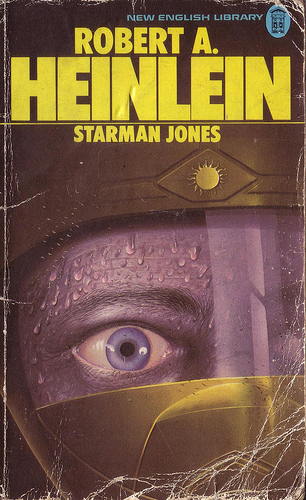
I read my first actual science fiction novel around 1976. Prior to that I’d been reading Dr Who novelisations, but a lad in my class at school lent me a copy of Robert Heinlein’s Starman Jones. After that, another boy lent me some EE ‘Doc’ Smith, the Lensman books, I seem to recall (and probably some Asimov, although I don’t actually remember which ones). But during my early years exploring the genre I cottoned onto three particular authors: AE Van Vogt, James Blish and Clifford Simak. And the first books by those authors I recall reading were The Universe Maker, Jack of Eagles and Why Call Them Back From Heaven?. Actually, I may have read The Voyage of the Space Beagle before The Universe Maker, but something about the latter appealed to me more. Sadly, no women writers. A few years later I started reading Cherryh and Tiptree (and yes, I’ve always known Tiptree was a woman), but I suspect my choices were more a matter of availability – Cherryh was pretty much ubiquitous in UK book shops during the early 1980s.

starmanjones

Growing up the sf way
I remember a lad in the year below me at school reading Dune – that would be in 1978, I think – and it looked interesting, but it wasn’t until a few years later that I read it for myself. And immediately loved it. These days, my thoughts on Dune are somewhat different – it’s not Frank Herbert’s best novel, it’s not even the best novel in the Dune series (and we won’t mention the execrable sequels by his son and Kevin J Anderson)… but what Dune is, is probably the best piece of world-building the science fiction genre has ever produced. And then there’s Dhalgren, which I still love and is probably the sf novel I’ve reread the most times. It wasn’t my first Delany, but it remains my favourite. I still see it as a beacon of literary sensibilities in science fiction. Another discovery of this period was John Varley, whose stories pushed a lot of my buttons. His The Barbie Murders remains a favourite collection, and the title story is still a favourite story. Around this time one of the most important books to come into my hands was The Complete Book of Science Fiction and Fantasy Lists by Malcolm Edwards and Maxim Jakubowski. It’s exactly what the title says – lists of sf and fantasy books and stories. But it was also a map to exploring the genre and, in an effort to find books and stories it mentioned, I started actively hunting down specific things I wanted to read. I was no longer browsing in WH Smith (back in the day when it was a major book seller) and grabbing something off the shelf that looked appealing. This was directed reading, and it’s pretty much how I’ve approached my reading ever since.

Explorations outside science fiction
The school I went to had a book shop that opened every Wednesday afternoon, and I bought loads of sf novels there (well, my parents bought them, as they were the ones paying the bills). But when I was on holiday, especially out in the Middle East, I was limited to reading what was available – which included the likes of Nelson De Mille, Eric Van Lustbader, Judith Krantz and Shirley Conran. I think it was my mother who’d been reading Sara Paretsky and it was from her I borrowed Guardian Angel, and so became a lifelong fan of Paretsky’s books. And after graduating from university and going to work in Abu Dhabi, the Daly Community Library, the subscription library I joined within a month or two of arriving, had I poor sf selection so I had to widen my reading. One of the books I borrowed was Anthony Burgess’s A Dead Man in Deptford, and that turned me into a fan of his writing (although, to be honest, while my admiration of his writing remains undimmed, I’m no longer so keen on his novels… although I still have most of them in first edition). I also borrowed Lawrence Durrell’s The Alexandria Quartet from the Daly Community Library, but had it take back before I’d even started it. So I bought paperbacks copies of the four books during a trip to Dubai, and subsequently fell in love with Durrell’s writing. So much so that I began collecting his works – and now I have pretty much everything he wrote. Perversely, his lush prose has stopped me from trying it for myself – possibly because I know I couldn’t pull it off. Much as I treasure Durrell’s prose, it’s not what I write… but his occasional simple turns of phrase I find inspiring. Finally, two non-fiction works which have helped define my taste in non-fiction. While I was in Abu Dhabi, I borrowed Milton O Thompson’s At the Edge of Space from the Abu Dhabi Men’s College library. It’s a dry recitation of the various flights flown by the North American X-15 – and yes, I now own my own copy – but I found it fascinating. It wasn’t, however, until I read Andrew Smith’s Moondust, in which he tracks down and interviews the surviving nine people who walked on the Moon, that I really started collecting books about the Space Race. And then I decided it would be interesting to write fiction about it…

Ingredients for a writing life
When I originally started writing sf short stories, they were pretty well, er, generic. I’d read plenty of short fiction, and so I turned what I thought were neat ideas into neat little stories. None of them sold. So I spent several years having a bash at novels – A Prospect of War and A Conflict of Orders are products of those years, as well as a couple of trunk novels – and didn’t return to writing short fiction until 2008. It took a few goes before I found the kind of short fiction that worked for me, but it wasn’t until I wrote ‘The Old Man of the Sea of Dreams’ (see here) that I realised I’d found a, er, space I wanted to explore further in ficiton. I’d been partly inspired by Jed Mercurio’s Ascent, because its obsessive attention to detail really appealed to me – and when I started working on Adrift on the Sea of Rains, I wanted it to be like that. But I’d also read some Cormac McCarthy – The Road and All The Pretty Horses – and that gave me a handle for the prose style. I’ve jokingly referred to Adrift on the Sea of Rains as “Cormac McCarthy on the Moon” but that was always in my mind while I was writing it. And for the flashback sequences, I wanted a more discursive and roundabout style, so I turned to a book I’d recently read, Austerlitz by WG Sebald, and used that as my inspiration. And finally, there’s a point in astronaut Thomas Stafford’s autobiography, We Have Capture, in which he discusses the deaths of the three cosmonauts in the Soyuz 11 mission – Georgy Dobrovolsky, Vladislav Volkov and Viktor Patsayev – and he mentions the 19 turns needed to manually close the valve which evacuated the air from their spacecraft, and that figure became sort of emblematic of my approach to writing Adrift on the Sea of Rains. It’s odd DNA for a science fiction novella – Stafford, Mercurio, McCarthy and Sebald – but there you go…

capture

The next two books of the Apollo Quartet were driven by the their plots, inasmuch as their inspirations were plot-related, and the only books which fed into them were the books I read for research. But I should definitely mention Malcolm Lowry, who I’d started reading around the time I launched Adrift on the Sea of Rains, and the titles of some of his books – Hear Us O Lord from Heaven Thy Dwelling Place, Dark as the Grave Wherein My Friend is Laid – inspired the titles of books two and three of the Apollo Quartet. But when it comes to book four, All That Outer Space Allows, well, obviously, Sirk’s movie All That Heaven Allows was a major influence, but so too was Laurent Binet’s HHhH, which showed me that breaking the fourth wall was a really interesting narrative technique to explore. But there’s also Michael Haneke’s film Funny Games, which inspired the whole breaking the fourth wall thing in the first place, and which led to me using art house films as inspiration for short stories, so that ‘Red Desert’ in Dreams of the Space Age and Space – Houston We Have A Problem was inspired by François Ozon’s Under the Sand, and I’m currently working on a story inspired by Lars von Trier’s Melancholia titled, er, ‘Melancholia’, and in which I take great pleasure in destroying the Earth.

Reading for pleasure
Despite all that above, there are authors whose works I read purely because I enjoy doing so. It’s true there might be a bit of DH Lawrence in All That Outer Space Allows, but if I had to pick a favourite Lawrence novel out of those I’ve read I’d be hard pressed to do so. I’ve mentioned Lowry already – for him, the one work I treasure is his novella ‘Through the Panama’ which appears in his collection Hear Us O Lord from Heaven Thy Dwelling Place. And with Karen Blixen, AKA Isak Dinesen, a new discovery for me and becoming a favourite, it’s her novella ‘Tempest’. But I don’t think she’s going to influence my writing much. Neither do I think the writings of Helen Simpson or Marilynne Robinson will do so either, although Simpson has paddled in genre. And much as I admire the writings of Gwyneth Jones, Paul Park and DG Compton, their writing is so unlike my own, their books are just a pure reading pleasure. Jenny Erpenbeck, on the other hand, I think might influence my writing, as I love her distant tone. And while I love the deep personal focus of Hanan al-Shaykh’s novels, she’s reading for pleasure.

hear_us

To some extent, I think, I treat books like movies. There are the disposable ones – commercial sf, in other words; and you can find many examples on the SF Masterwork list, which is more a reflection on the genre as a whole than it is on the SF Masterwork list. But I much prefer movies from other cultures, and while science fiction scratched that itch to some extent, even though its cultures were invented… the level of such invention wasn’t especially deep – and if I get more of a sense of estrangment out of a novel by Erpenbeck, a German woman, than I do from any random US sf writer, I see that as more a flaw of the genre than of its practitioners. Happily, things are changing, and a wider spectrum of voices are being heard in genre fiction. Not all of them will appeal to me, not all of them will earn my admiration. But I wholeheartedly support the fact of their existence. I do enjoy reading books like that but in the past I’ve had to read mainstream fiction – Mariama Bâ, Abdelrahman Munif, Magda Szabó, Elfriede Jelineck, Leila Aboulela, Chyngyz Aitmatov… as well as those mentioned previously. These are the books and movies which join my collection, and for which I am forever struggling to find shelf space.


2 Comments

The north face of Mount TBR

Looks like I’m going to need another clear-out soon. Normally, I dump the books I no longer want at local charity shops, but the more recent genre ones I save for the York and Sheffield pub meet raffles. However, I might stick a list up here of books for sale – I have a lot of 1980s sf paperbacks in very good condition (they were in storage for pretty much the entire 1990s). We’ll see. Meanwhile…

IMG_4155

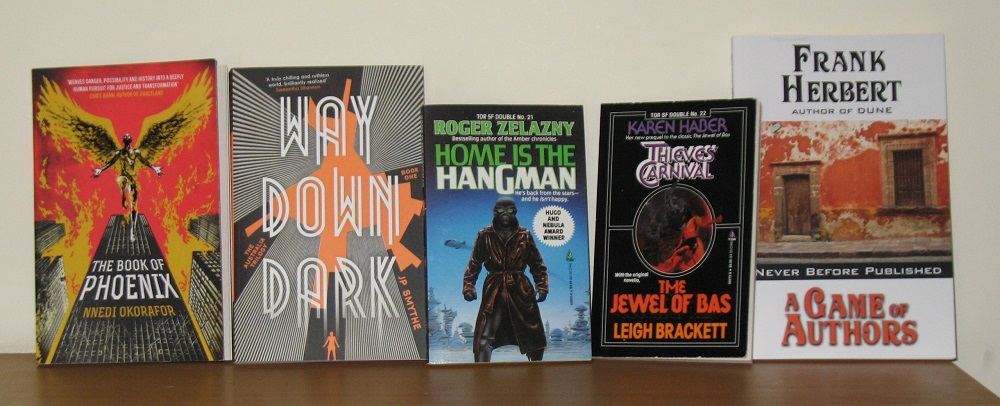
Some sf, recent and not so recent. I bought The Book of Phoenix and Way Down Dark because they were shortlisted for the Clarke Award. I read them. I was not impressed with either – see here. I’ve been picking up copies of the Tor doubles from the 1980s when I find them, although not all are worth reading; hence #21: Home is the Hangman / We, in Some Strange Power’s Employ, Move on a Rigorous Line… and #22: Thieves Carnival / The Jewel of Bas. A Game of Authors is actually not sf, but a thriller. WordFire Press (ie, Kevin J Anderson’s own imprint) has been publishing old manuscripts by Frank Herbert that never saw print, and I’ve been buying them. They’re interesting from an historical point of view, although, to be fair, I can see no good reason why they weren’t published back in the day.

IMG_4157

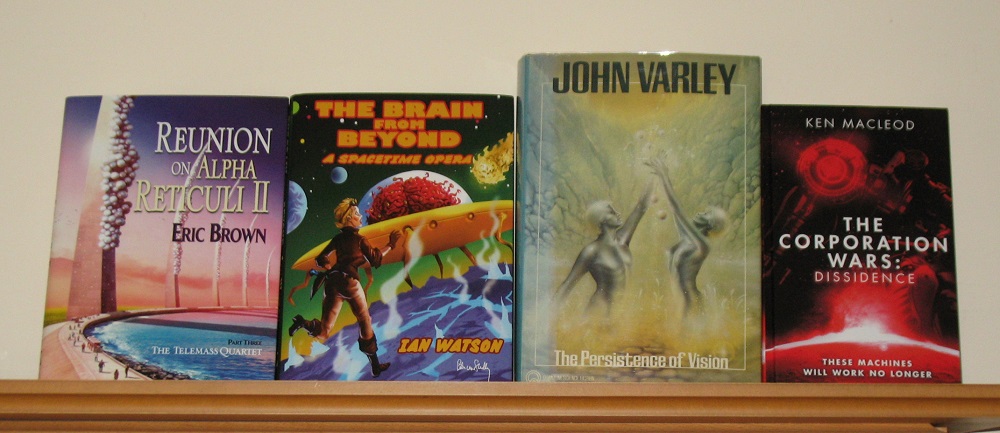
Some first editions for the collection. First up, the third book of Eric Brown’s Telemass quartet, Reunion on Alpha Reticuli II. Also from PS Publishing is The Brain From Beyond. Both were launched at Mancunicon, but the signed editions weren’t available at the con. The Persistence of Vision was a lucky find on eBay. I still rate Varley’s short fiction. And Dissidence is the latest from an author whose books I buy on publication.

IMG_4158

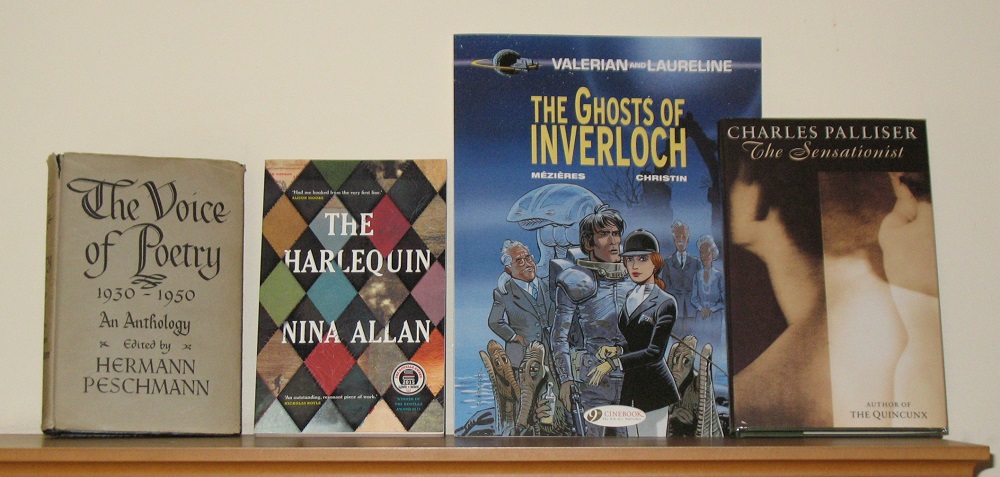
A mixed bag of fiction: The Sensationist is another Palliser for the collection. The Ghosts of Inverloch is the latest English translation of the bande dessinée series. The Harlequin is an award-winning novella, and The Voice of Poetry 1930 – 1950 I stumbled across on eBay and since I like the poetry of that period…

IMG_4159

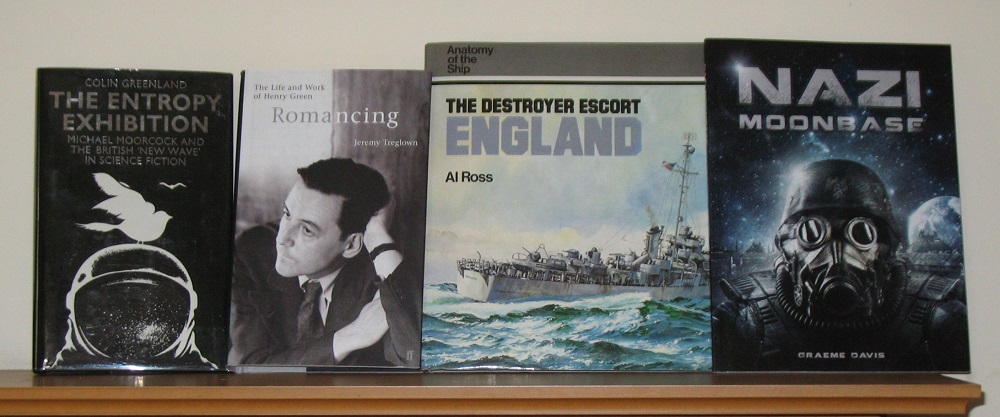
And a mixed bag of non-fiction. The Entropy Exhibition, signed, was a lucky find on eBay. I’ve been collecting the Anatomy of the Ship series when I find them going for a fair price – originally I bought them for research for my space opera trilogy, but now it’s just because they’re cool books: hence The Destroyer Escort England. When I saw spotted Nazi Moonbase on Amazon, I couldn’t resist it. Romancing is a biographical/critical work about Henry Green, an author I’m keen to read more of.


2 Comments

A weight of words

Yes, I know ebooks are a thing, and if I bought them my bookshelves – or indeed the floors of my flat – would not be groaning beneath the weight of so many hardbacks and paperbacks. But there’s something much more satisfying in owning a physical book, just as there is in the actual physical act of reading one. Plus, of course, I wouldn’t be able to do posts such as this one if I bought only ebooks…

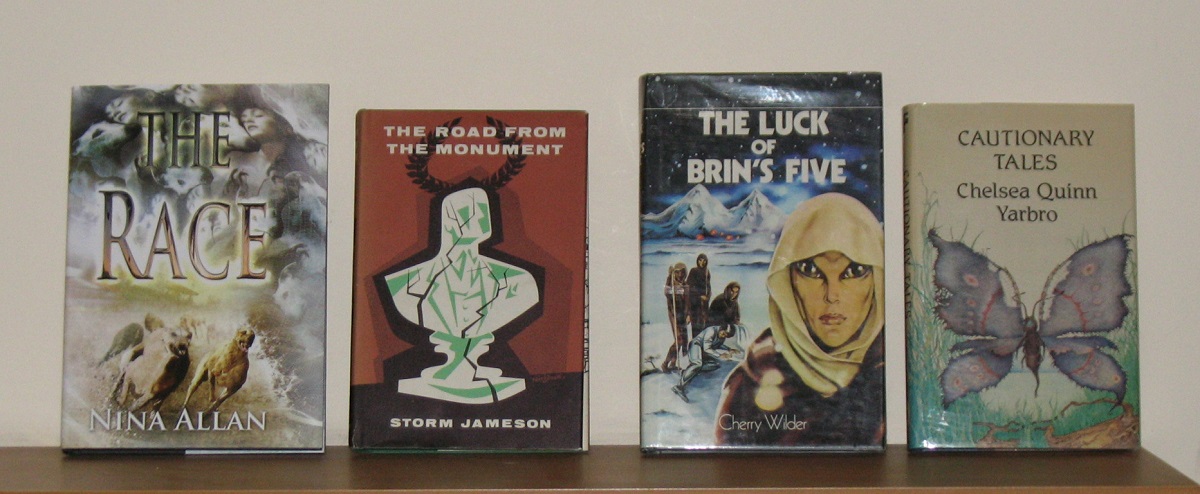
2014-11-29 10.02.30

Another book for my postwar British women writers challenge – I’d enjoyed Jameson’s A Month Soon Goes, so I picked up a copy of The Road from the Monument. The Race is Allan’s first novel, and quite a few people are talking about it. The Luck of Brin’s Five and Cautionary Tales are both for SF Mistressworks and were bought from Porcupine Books.

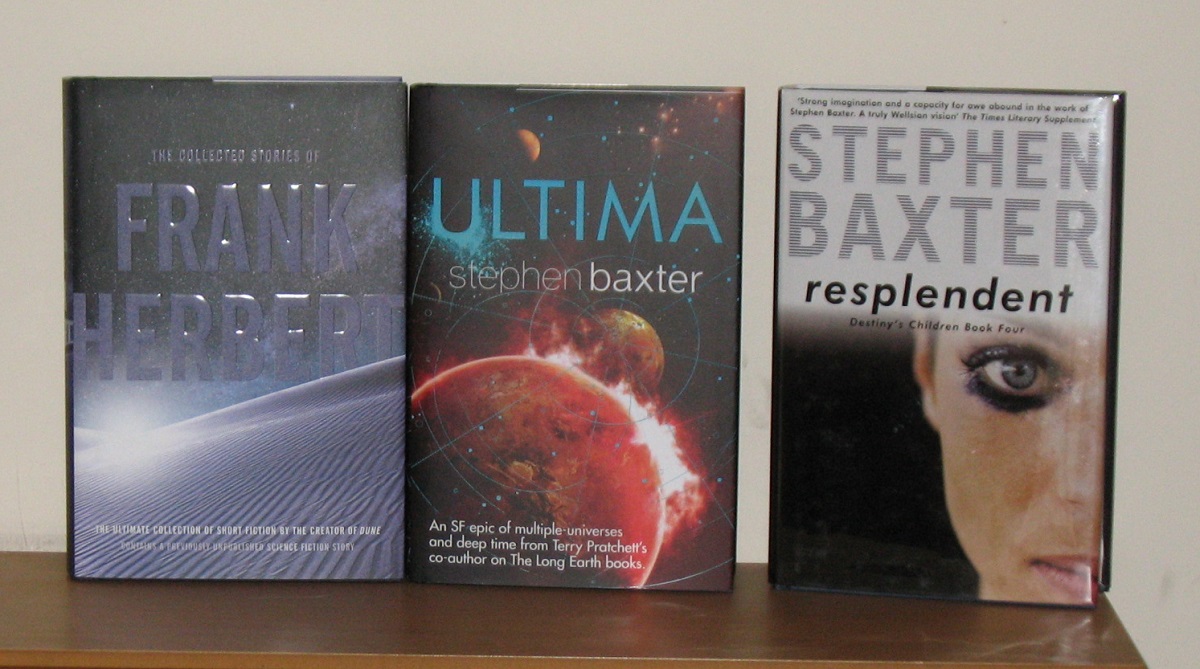
2014-11-29 10.03.44

I finally managed to track down a hardback copy of Resplendent, so now I have the set. I’ve read the first two – I quite liked Coalescent, but was disappointed by Exultant. I was disappointed by Proxima too, but nonetheless I bought the sequel, Ultima. And I’ve long been a fan of Frank Herbert’s fiction, and while I probably have most of the contents of The Collected Stories of Frank Herbert in other collections, I fancied a copy of it.

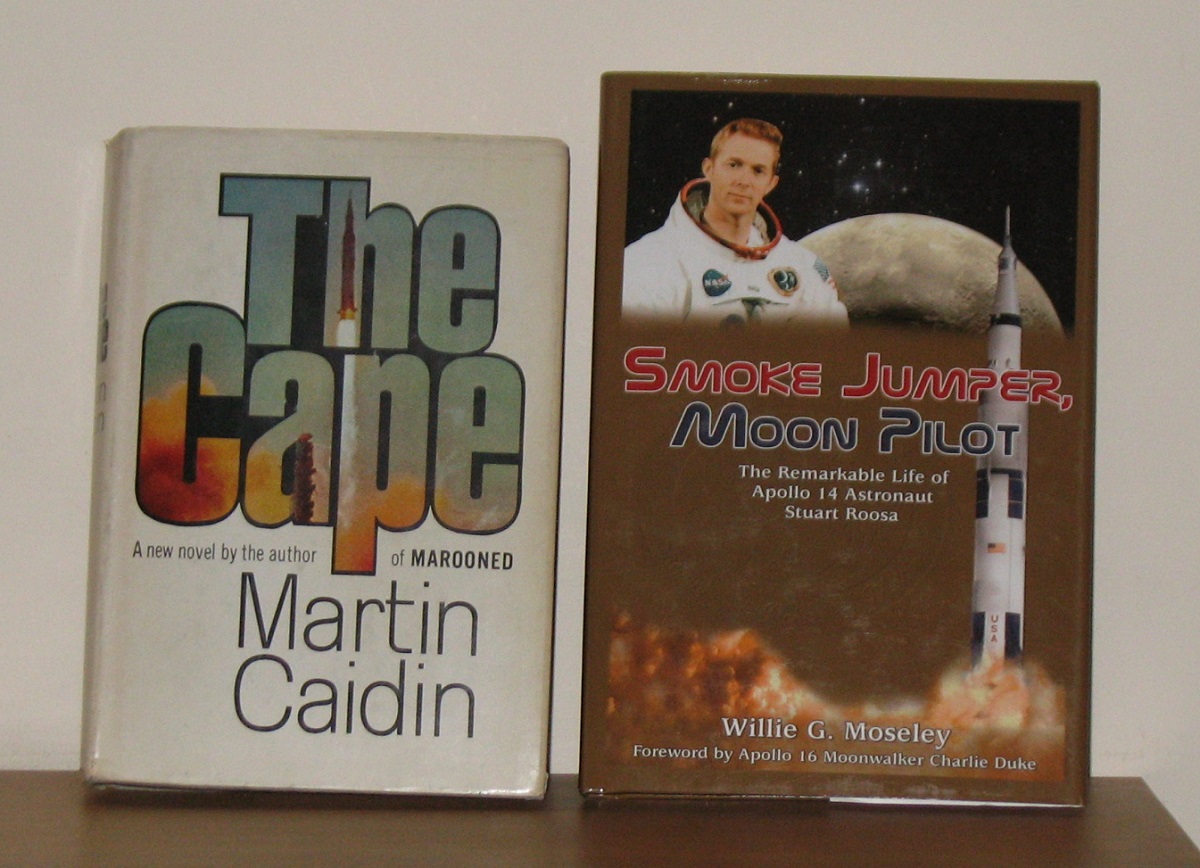
2014-11-29 10.04.18

Both of these were bought for research for Apollo Quartet 4, although they’ll also join the Space Books collection. The Cape is a trashy novel about astronauts, by possibly the worst writer ever to have been published, Martin Caidin. And Stu Roosa, the subject of Smoke Jumper, Moon Pilot, was the CMP on Apollo 14, and also a member of the Group 5 astronauts selected in 1966.

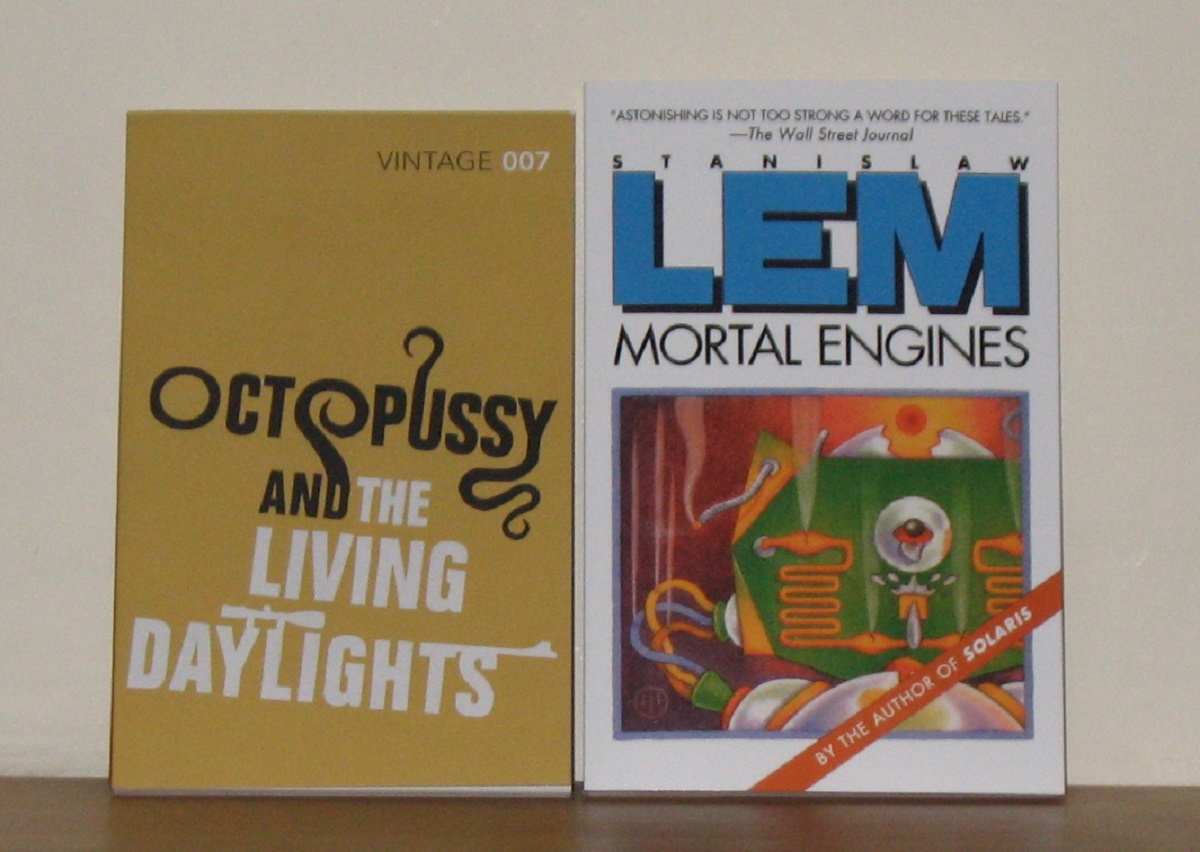
2014-11-29 10.04.40

A pair of paperbacks – Octopussy & The Living Daylights because I’ve been working my way through the 007 books because I’ve no idea; and Mortal Engines because I’ve decided Lem is an author I should read more by.

2014-11-29 10.05.11

Some non-fiction. Sibilant Fricative I won in the Strange Horizons fund drive draw. Galactic Suburbia I’m using for research for Apollo Quartet 4. And I already have a first edition of A Mouthful of Air, but this new copy is signed (and it was surprisingly cheap too).

2014-11-29 10.05.53

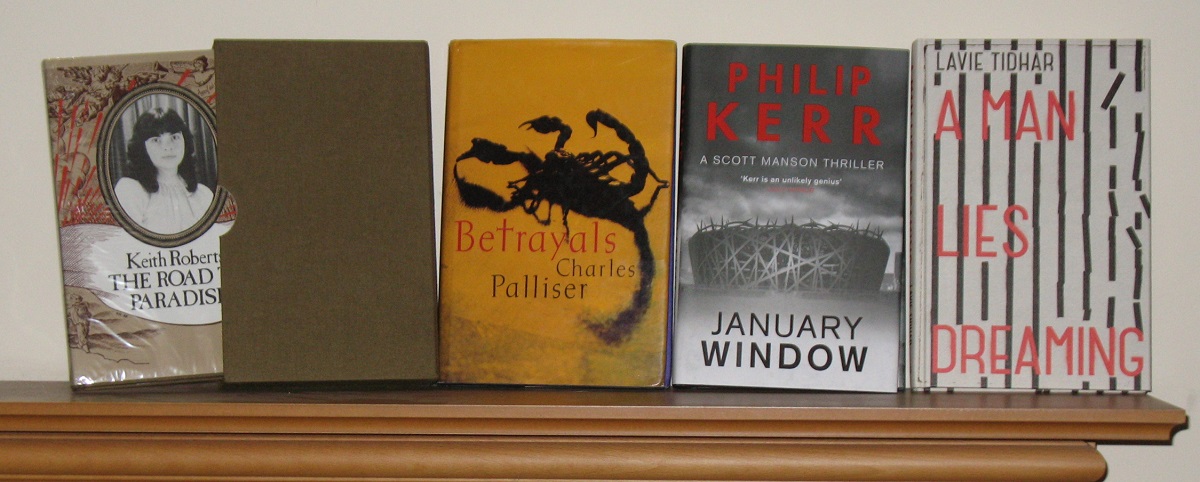
Finally, a selection of first editions. A Man Lies Dreaming, which I think I might have seen mentioned on Twitter recently once or twice; January Window, the first in the Scott Manson series by the author of the Bernie Gunther novels; Betrayals, which features a superb pastiche of both Taggart and Jeffrey Archer, and I really want all of Palliser’s books in hardback; and a lovely slipcased Kerosina book, The Road to Paradise, a mainstream novel, which comes packaged with a short travel book, Irish Encounters.


1 Comment

2014 reading diary, #6

Despite the number of books I read, I don’t think I’m putting much of a dent in the TBR. I must stop buying books for a month or two. Of course, that means publishers must instantly stop publishing books I want, and booksellers must remove all the books I might desire from their shelves… Then I should be able to do it.

ride-with-the-devilRide with the Devil, Daniel Woodrell (1987) Originally published as Woe to Live on but retitled when a film adaptation was made, this is Woodrell doing McCarthy. The narrator is a German immigrant (referred to, of course, as ‘Dutch’ or ‘Dutchy’) and a member of Confederate band of irregulars. They’re bandits in all but name, displaying little or no military discipline, wearing patchwork uniforms (and often masquerading as Union soldiers in stolen uniforms). They are brutal, not particularly smart, callous, and appear to be motivated chiefly by revenge against the depredations of the Jayhawkers. One of their number is black, but he’s not a slave – he and the narrator, Roeder, become good friends, in fact – which does sort of confuse the whole issue of the war. After an attack by Union cavalry, the troop scatter and Roeder, the black guy, and two others hide out on the land of a sympathetic Southern gentleman landowner. One of the other two, Roeder’s best friend, enters into a relationship with the landowner’s widowed daughter-in-law. Soon after, the troop reconvenes and stages a raid on the home town of the Jayhawkers. By this point, Roeder has lost his taste for violence, and has belatedly recognised that his fellows are far from noble freedom fighters but violent psychopaths. I really liked Woodrell’s Winter’s Bone, but this felt too much like McCarthy-lite. I’ll keep an eye open for more books by Woodrell, but if I’d read this one first I probably wouldn’t have bothered.

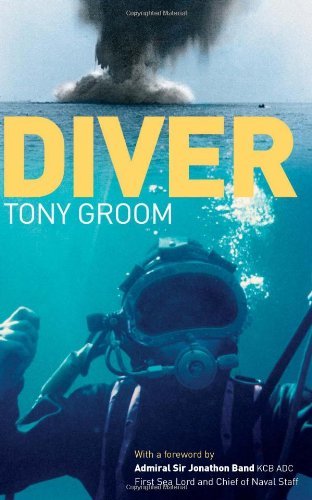
diverDiver, Tony Groom (2007) I think I was a little hungover – or rather, I was feeling insufficiently motivated to do much of anything – when I picked this book off the shelf for a bit of light reading. It proved a good choice, at least initially. The first few chapters, describing Groom’s training and early years with the Royal Navy, are very funny. He signed up determined to become a diver, made it through all the courses, got into a bit of trouble on his first posting to a minesweeper, was then sent to Tuvalu to help clear WWII mines from the waters around the atoll… before flying out to the Falklands as part of the UK task-force. The chapters on the Falklands War are quite harrowing. The Fleet Clearance Diving Team was in the thick of it, defusing bombs that had fallen on British ships but not exploded (pretty much all of the bombs were British-made, incidentally). After leaving the Royal Navy, Groom became a commercial diver in the oil industry, saturation diving in the North Sea. He makes it clear quite how dangerous an occupation it is – not just because of explosive decompression, but also because the divers are dependent on so many other people. They’re trapped inside their decompression chambers, and should the ship or barge suffer some sort of calamity there’s no escape for them. And on the sea floor, they’re totally dependent on their umbilical – though they carry ten minutes of emergency “bail-out” heliox, the umbilical also pumps hot water into their suit and should that fail they’d soon develop hypothermia. Groom has a readable chatty style, and cheerfully admits at times he may have got some of the details wrong – especially when discussing the Falklands War, as he bases his narrative on his diaries. Interesting stuff.

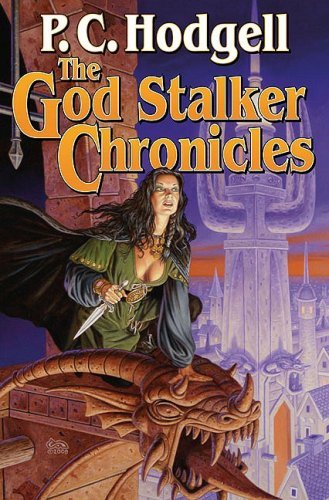
godstalkerGod Stalk, PC Hodgell (1982) I picked up a copy of the Baen reprint omnibus edition, The God Stalker Chronicles, containing both God Stalk and its sequel Dark of the Moon, at the World Fantasy Con last October. I’d sooner have bought them as individual paperbacks, rather than one humungous hardback, but it was all I could find. God Stalk is in almost all respects an ordinary epic fantasy, set in an epic fantasy world with a complex history and pantheon, and featuring a special snowflake protagonist. It’s a very likeable book, as indeed are a number of books of this type; and there are some nice touches in Hodgell’s world-building. I’d been expecting it to be a tad literary, but it’s not – it’s written in precisely the sort of prose common among books of its ilk, although it is somewhat smoother to read than most. However, where I think it fails – and this may account for its apparent obscurity – is that the learning-curve is among the steepest I’ve come across in fantasy. It doesn’t help that protagonist Jame is apparently unaware of her own history – it’s never stated that she’s amnesiac, but she was banished from her home keep by her family, spent several decades wandering, and has no memory of that time. There’s an extensive back-story to God Stalk, but Hodgell is parsimonious with the details – until they’re needed… which often results in a wodge of exposition thick with the names of gods and lords and races. The plot takes a good third of the book to get going, so it’s a bit of a slog for the first few chapters. Eventually, things start to come together – some of the foreshadowing is a little too obvious, however – and you need to refer less and less to the dramatis personae at the front of the novel. I’ve still got the second half of this omnibus to read, and I’ll decide after that whether I can be bothered to continue with the series (the seventh book is published next month). Incidentally, Jame is mistaken for a boy on several occasions – with that cleavage she has on the cover? Baen. Sigh.

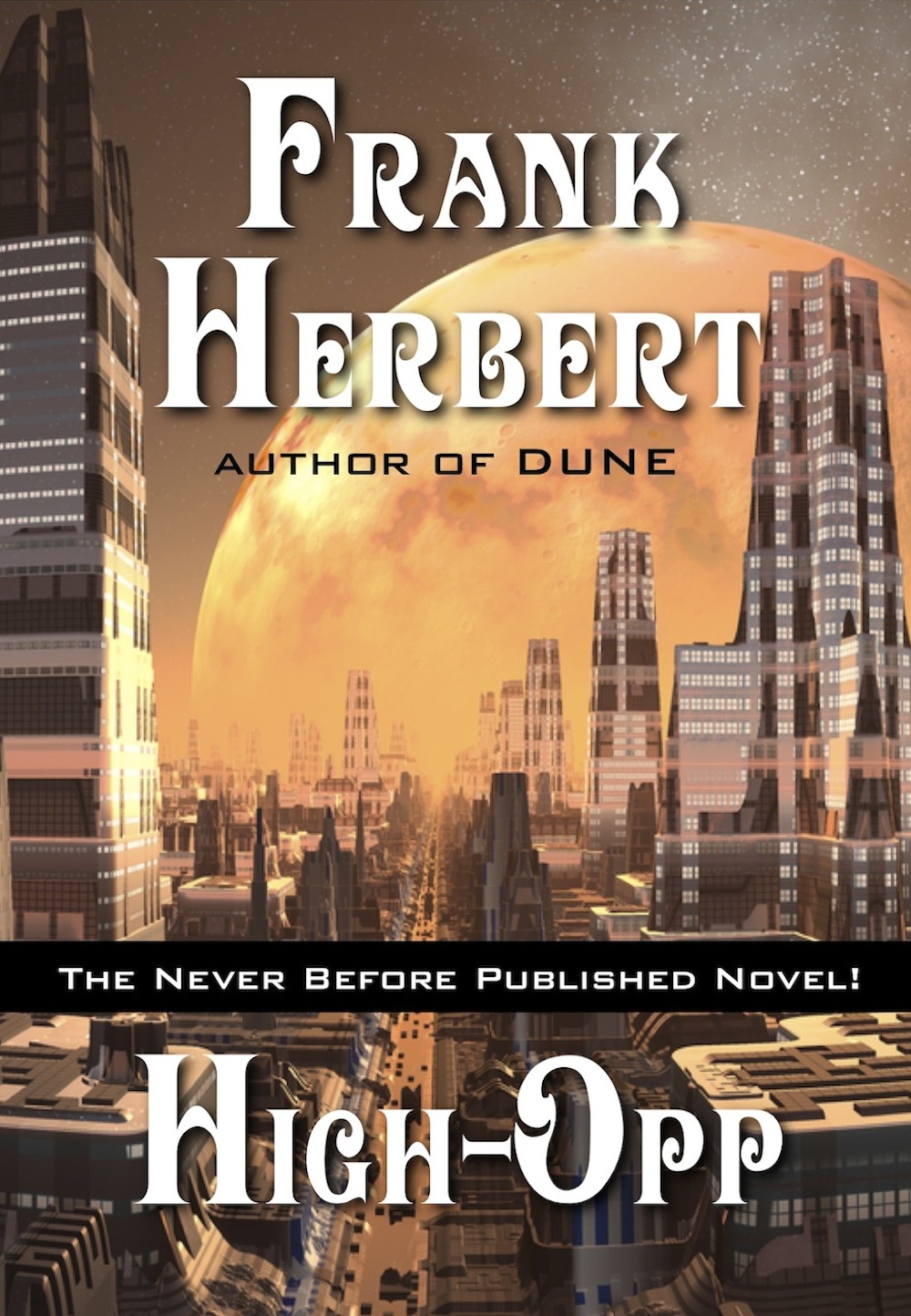
high-oppHigh-Opp, Frank Herbert (2012) Despite his success with The Dragon in the Sea, Frank Herbert had trouble selling another novel, and it wasn’t until Dune, published by Chilton, a publisher best-known for car repair manuals, that he had another book in print. During that period, he wrote a number of novels, all of which were eventually trunked. High-Opp is one of them. And, to be honest, it’s easy to see why no publisher back then would go for it. It’s also the book which contains the “fap gun” – Herbert should probably have considering renaming his future firearm. The world of High-Opp is run by opinion polls, although they’re presented pretty much as global referendums. Of course, the entire system is fixed, with a political class (all related to each other) holding all the top spots. A fast-rising star is brought low as part of a plot to overthrow those in charge, since he’s been identified as an ideal candidate to lead a rebellion by the head of BuPsych, who wants to effect a change of leadership. But he’s no tool to be used, and decides to actually smash the system. He wins the day and they make him emperor. This book is a curiosity and little more. I’m not surprised it’s taken more than half a century to see print.

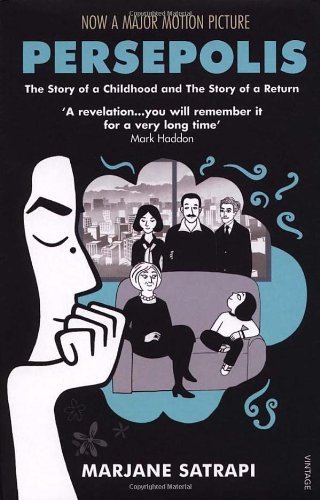
persepolisPersepolis, Marjane Satrapi (2003) This was made into an animated film in 2007, which I’ve not seen. That must be an odd experience, pretty much as if the graphic novel itself had suddenly come to life. Satrapi was royalty, her great-great-grandfather was the shah of Iran overthrown by Reza Pahlavi in 1921, but she grew up during the Iranian Revolution in 1979, and its her childhood during those turbulent years, and her family’s coming to terms with the new regime, which forms the first third of Persepolis. The Satrapis were Westernised, secular, well-off and political – and lost a lot of friends and relatives, first to Pahlavi’s secret police, then to the Ayatollah’s regime, and to the war with Iraq. Marjane Satrapi rebels, which puts her at risk from the authorities, so her parents send her to a French-speaking school in Vienna. There she experiences both friendship and racism, and at one point ends up living on the streets. She returns to Iran several years later, and once again has to learn to live in a fundamentalist Islamic state. There’s a telling scene when her friends ask her if she ever had sex while in Vienna, of course she replies, after all she’s nineteen and it’s not unusual in the West… but her friends, for all their secular views, are horrified. Persepolis is, of course, autobiographical, and while the art may be deceptively simple the story is not. Recommended.


Leave a comment

Another month, another book haul

… Although I think it’s been longer than a month since my last book haul post. Which may explain why so many books appear in this one. Except my book haul posts always seem to feature a large number of books… I really must cut back on the number I buy. I managed to read nine books in one weekend during February, which took less of a chunk out of the TBR than I’d have liked since I’d bought so many damn books that month. Ah well. The following are the usual mix of subjects and genres and stuff.

2014-03-07a

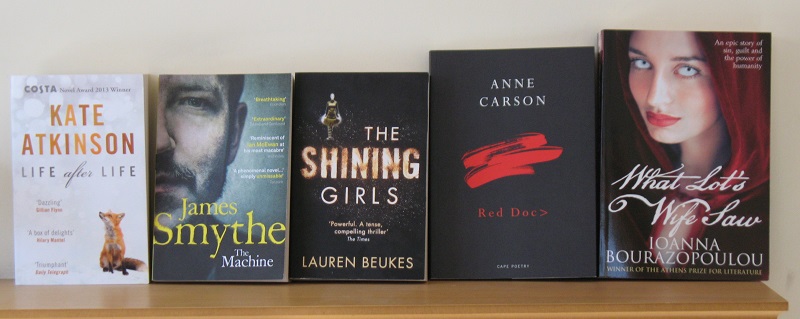
My Hugo reading – a bunch of 2013 titles I bought to round out my ballot for best novel. I’ve already read Life After Life, The Machine, The Shining Girls and Red Doc> (see here). Only What Lot’s Wife Saw to go (and also Kim Stanley Robinson’s Shaman, which I bought last year when it was published).

2014-03-07b

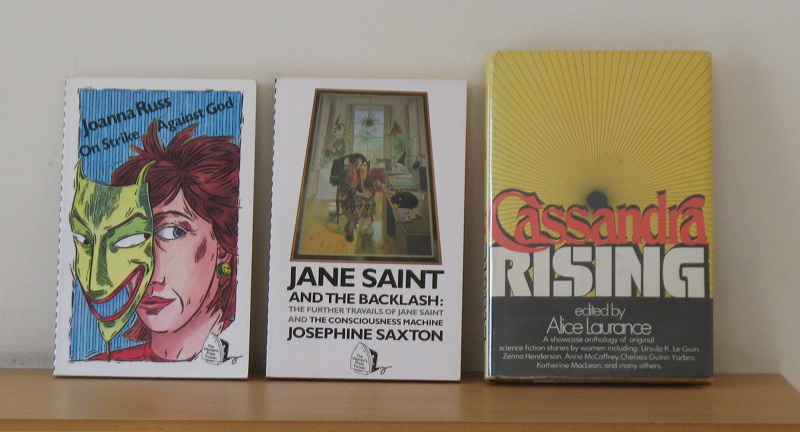
Some books for SF Mistressworks. Cassandra Rising is a SFBC women-only sf anthology, and the only copy of it I could find happens to be signed by half the contributors. Oh well. Jane Saint and the Backlash is the sequel collection to Saxton’s The Travails of Jane Saint, which was also published by The Women’s Press. On Strike Against God isn’t, as far as I’m aware, genre, but I’ll decide whether it’s suitable for SF Mistressworks once I’ve read it. All three books were bought on eBay.

2014-03-07c

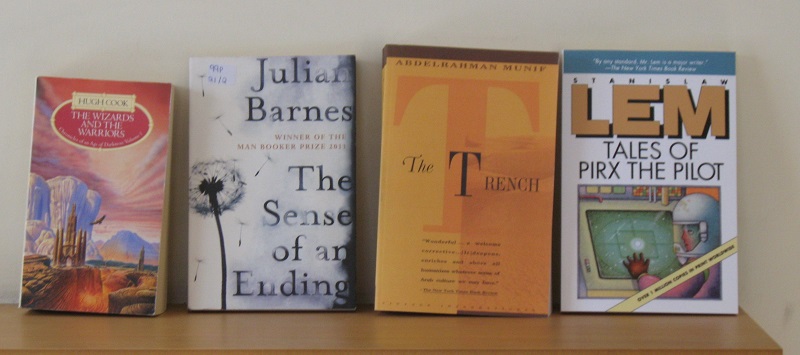
An assortment of paperback fiction. I want to read more Lem, hence Tales of Pirx the Pilot. Which reminds me, I must get a copy of the film adaptation – I found a website the other day that sells Russian DVDs (many of which have English subtitles). The Trench is the sequel to Cities of Salt, a novelisation of the US exploitation of the Saudi oil reserves, which I enjoyed (see here). The Sense of an Ending was a charity shop find; it was shortlisted for the Man Booker Prize. The Wizards and the Warriors is the first book of the Chronicles of the Age of Darkness, which I’ve heard isn’t too bad – now I have the first three books I’ll see what they’re like.

2014-03-07d

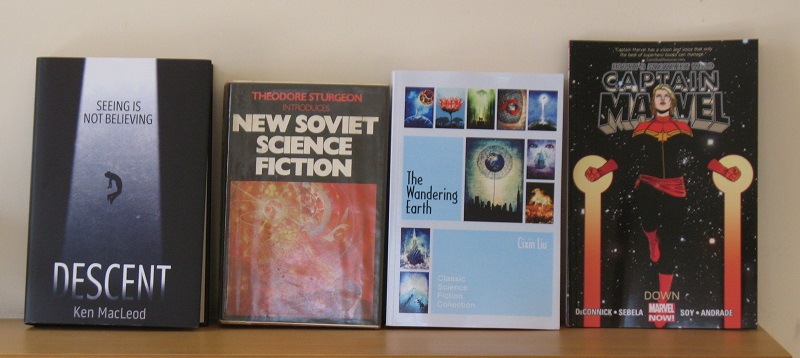
An assortment of hardback fiction. And a graphic novel. The stories of Captain Marvel 1: In Pursuit of Flight (see here) and this second volume, Captain Marvel 2: Down, have pretty much the same inspirations as Apollo Quartet 3, Then Will The Great Ocean Wash Deep Above. It’s as if Kelly Sue DeConnick took the two narratives of my novella and wrote her own versions of them – except, of course, the timing makes that impossible. Both feature a character called Helen Cobb, clearly based on Jerrie Cobb. The first Captain Marvel graphic novel is about the Mercury 13, and the second partly takes place at the bottom of the sea in a ship and plane graveyard. A very weird coincidence. Sadly, the story is mostly typical superhero fisticuffs, and the art is pretty poor. Cixin Liu’s fiction has been recommended to me many times, so I decided to pick up a copy of The Wandering Earth, a collection of his novellas translated into English for the first time. Browsing on eBay one day, I discovered that Macmillan had published a series of Soviet sf books back in the 1970s. New Soviet Science Fiction is an anthology, but the series also featured several novels. I smell a collection coming on. Finally, Descent is Ken MacLeod’s latest novel.

2014-03-07e

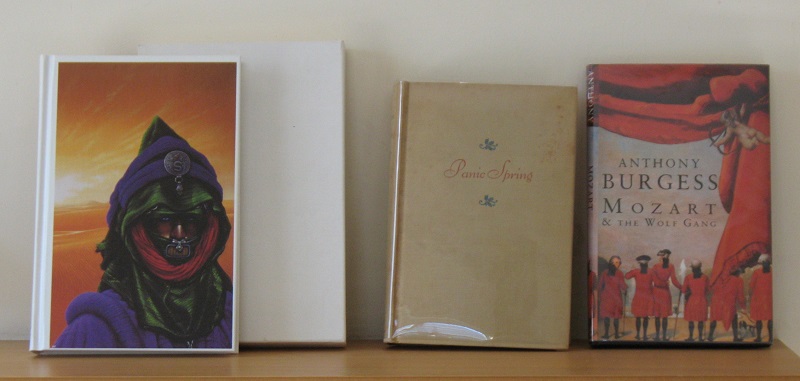
Some collectibles. Mozart & the Wolf Gang is a signed first edition. The other two books are among the most expensive I’ve ever bought – I won’t say how much each cost, it’s a little embarrassing. Panic Spring is Lawrence Durrell’s second novel, which was published under the name Charles Norden as his first did so badly. This is the US first edition, sadly, not the UK. Eye is a collection by Frank Herbert and copiously illustrated by Jim Burns. There were 175 slipcased, signed and numbered editions published, and now I have one of them.

2014-03-07f

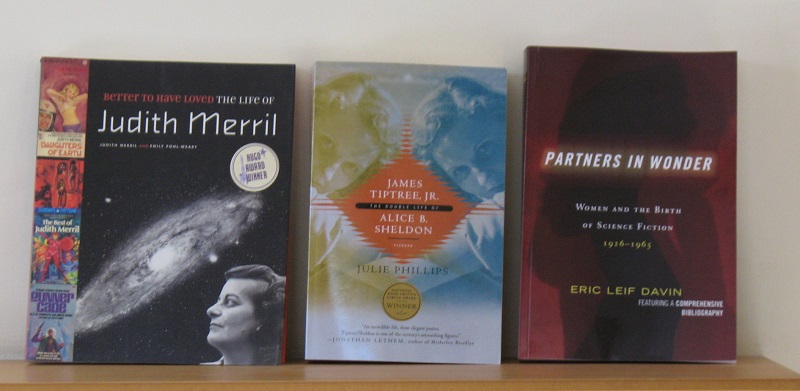
Research material for Apollo Quartet 4, All That Outer Space Allows. The final novella of the quartet will be about Apollo astronauts, of course it will… sort of. But it’ll chiefly be about an astronaut’s wife, and women science fiction writers – hence a pair of biographies of the latter: Judith Merril’s, Better to Have Loved; and James Tiptree Jr’s, The Double Life of Alice B. Sheldon. Partners in Wonder is about early women sf writers – I might write about it for SF Mistressworks after I’ve read it…

2014-03-07g

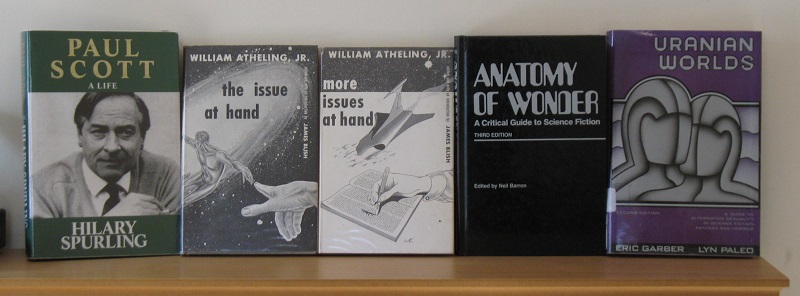
Some reference books, genre and otherwise. The Issue at Hand, More Issues at Hand and Anatomy of Wonder were all bargain purchases from Cold Tonnage. Uranian Worlds I decided to buy when I was trying to look something up online with very little success. I bought it from an Amazon marketplace seller; the book proved to be an ex-library copy, but the seller cheerfully refunded me half the selling-price. Paul Scott: A Life is a biography of, er, Paul Scott.


3 Comments

The first haul of the year

… Although, strictly speaking, this isn’t the first book haul of the year as it includes a few books I received for Christmas. But it’s certainly the first book haul post of 2014. I also seem to have gone a little mad in the past three weeks, and bought more books than usual – and some of which, I must admit, I’ve no idea why I purchased… Still, so it goes.

20140124a

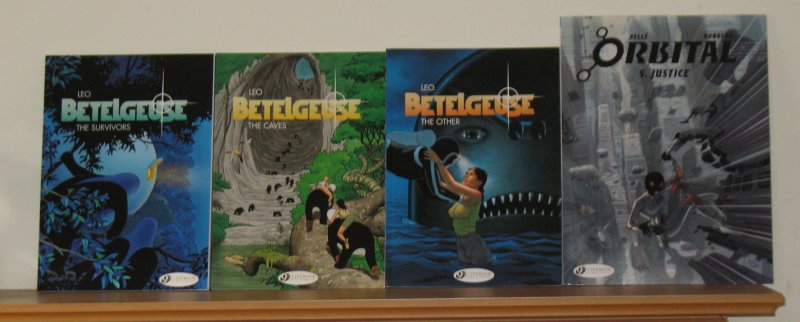
Some graphic novels to start: I liked Léo’s Aldebaran series so much (see here), I bought the follow on series, Betelgeuse: The Survivors, The Caves and The Other (and I’ve already written about them here).  I’ll be picking up the next series, Antares, soon, although it’s not yet complete in the original French. Apparently, the English versions have also been censored, with underwear added onto nude characters. Orbital: Justice is the fifth in the space opera bande dessinée series, and while it looks great and has an impressively twisty plot, it does owe a little too much to big media sf.

20140124b

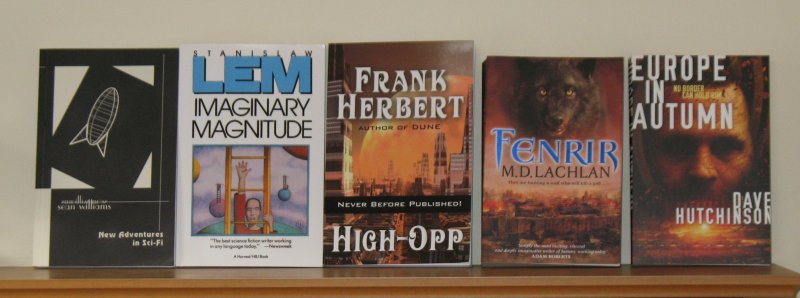
Imaginary Magnitude, Fenrir and High-Opp were all Christmas presents. I’ve already read Fenrir – while I really liked Wolfsangel, I found this one a little too long for its story, and it didn’t really pick up until two-thirds of the way through. High-Opp is a previously-unpublished Frank Herbert novel; should be interesting. Europe in Autumn I have to review for Vector; and New Adventures in Sci-Fi is an early collection by one of my favourite sf writers, Sean Williams (it was also incredibly hard to find a copy).

20140124c

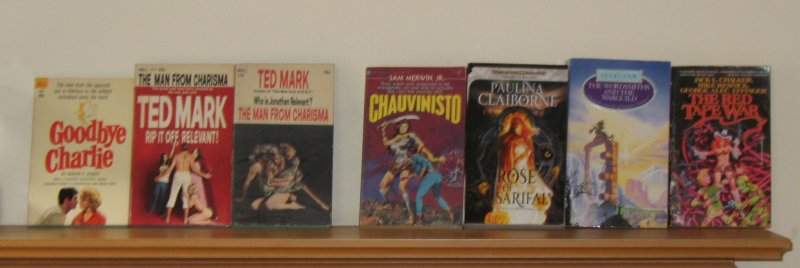
These are the “wtf was I thinking?” books. Mostly. The Rose of Sarifal is a Forgotten Realms novel, which I normally wouldn’t touch with a bargepole a good kilometre or so in length, but Paulina Claiborne is, I am reliably informed, a pseudonym of Paul Park. Chauvinisto I spotted on eBay and it sounded so awful I couldn’t resist it. I’ve been picking up the Hugh Cook fantasies when I see them, as I’ve heard they’re quite interesting. The Wordsmiths and the Warguild is the third in the ten-book series, and also the third book I now own. The Red Tape War is definitely a wtf purchase; it was very cheap. The two Ted Mark novels, The Man from Charisma and Rip It Off, Relevant!, are 1960s 007 pastiches with added rumpy-pumpy. Or so I believe. Goodbye Charlie is the novelisation of a quite silly film from 1964 starring Debbie Reynolds and Tony Curtis.

20140124d

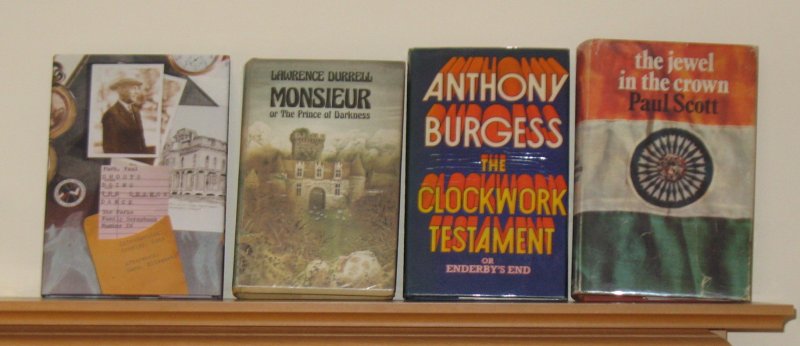
Four hardbacks for the collection. I already have a first edition of Monsieur of course, but this one is signed. The first edition of The Jewel In The Crown was a bargain (first editions are normally not cheap at ll), as was the first edition of The Clockwork Testament, the third of Burgess’s Enderby novels. (I suspect the first, Inside Mr Enderby, will continue to elude me as it was originally published under the name Joseph Kell and first editions are hugely expensive.) Ghosts Doing the Orange Dance is a new novella in signed limited hardback by one of my favourite genre authors and published by PS Publishing.

20140124e

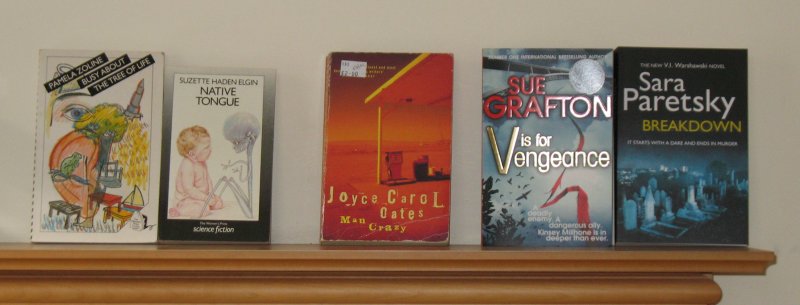
I had a Women’s Press SF copy of Native Tongue but it was really tatty, so I gave it to a charity shop. But now I have a copy in really good condition. Zoline’s collection, Busy About the Tree of Life, I will be reviewing for SF Mistressworks (that has to be one of the worst Women’s Press covers, though). Having heard so much about Joyce Carol Oates, I decided to give something by her a go, and Man Crazy was the first book by her I stumbled across. I’ve been a fan of Paretsky’s fiction for many, many years – Breakdown is not her latest, there was one published last year, but it is the one before that. I’ve also been reading Grafton’s Kinsey Milhone series for a long time. I’m up to V is for Vengeance, but W is for Wasted was published last year. Only three more letters to go. What will Grafton do after that?

20140124f

Three things that interest me: Brutalist architecture, and there’s lots of lovely photos of it in Concrete (I actually bought a copy for my brother-in-law for his birthday, and over Christmas I had a look in the book and liked it so much… I bought myself one); the Cold War, and Fear and Fashion in the Cold War, covers, er, fashion inspired by the promises of bases on the Moon and the threat of nuclear armageddon (see my The future we used to have posts for more); and finally, the works of Paul Scott, in this case his most famous work, the Raj Quartet, as the title Paul Scott’s Raj, er, indicates.

20140124g

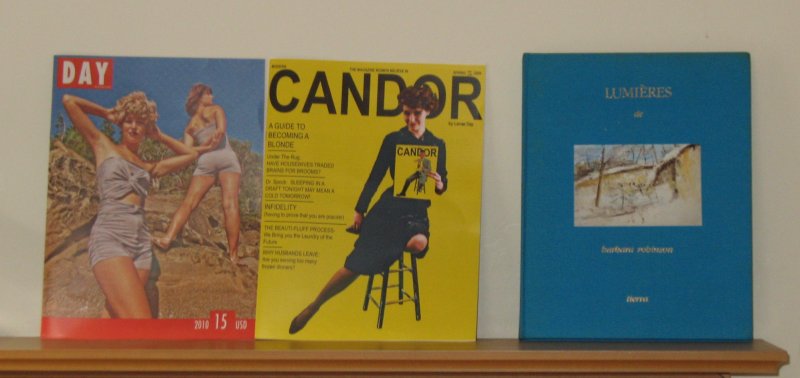
Lumières I bought on eBay for not very much because its introduction was written by Lawrence Durrell. The art in it is also very good. Lenae Day I stumbled across while researching Then Will The Great Ocean Wash Deep Above. She restages photographs from 1960s magazines with herself as the model, and accompanies them with autobiographical text. One of her shows was ‘Space Cadette’ and in it she restaged a photograph from Time Magazine of Mercury 13 candidate Rhea Hurrle preparing to enter an isolation tank (Day’s version here). So far, Day’s work has only been published as Day Magazine and Modern Candor, but she recently ran a kickstarter for her next project, based on invented 1930s movie studio Prescott Pictures – see here.

20140124h

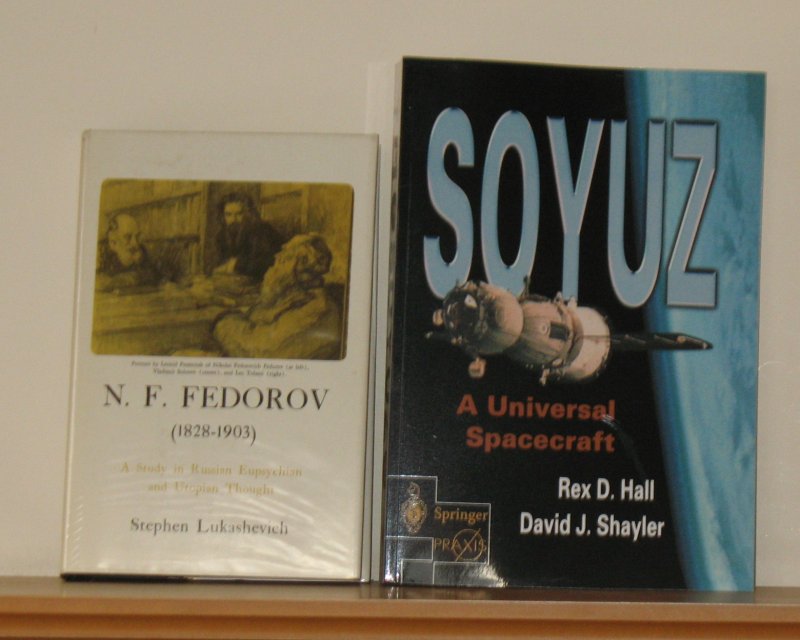
Soyuz: A Universal Spacecraft I bought specifically for research for my Gagarin on Mars story, but it’ll also go in the Space Books collection. N.F.Fedorov is research for a novel I’m working on, but it’s not going to be about what you think it might be about. Or something.


3 Comments

10 books that stayed with me

Whenever a book-related meme pops up, I love to jump on board. And apparently there’s one currently doing the rounds: “List 10 books that have stayed with you in some way. Don’t take more than a few minutes and don’t think too hard. They don’t have to be ‘right’ or ‘great’ works, just ones that have touched you”. I saw this on Liz Bourke’s blog here, and decided to have a go.

I’ve done something similar before, I think, but not for quite so many titles… Which made this one a bit harder than expected. But here they are, in the order in which the books occurred to me:

1 Ascent, Jed Mercurio (2007), a novel I hugely admire and which has inspired me in my own writing.
2 The Alexandria Quartet, Lawrence Durrell (1957 – 1960), because on reading it I fell in love with Durrell’s prose and began collecting everything he had ever written.
3 The Undercover Aliens (AKA The House That Stood Still), AE van Vogt (1950), bonkers California noir meets pulp sf, and the only van Vogt novel I’d ever recommend to anyone.
4 Dune, Frank Herbert (1965), still the premier example of world-building in science fiction.
5 Dhalgren, Samuel R Delany (1974), the sf novel I’ve probably reread more times than any other.
6 Coelestis, Paul Park (1993), one of my top five favourite novels of all time.
7 Dan Dare: The Red Moon Mystery, Frank Hampson (1951 – 1952), the scene where Hank and Pierre first see through the clouds hiding the surface of the Red Moon haunted me for years as a kid.
8 Cotillion, Georgette Heyer (1953), the first of hers I read, and her novels are still my chief comfort reading.
9 The Barbie Murders, John Varley (1980), I fell in love with Varley’s Eight Worlds, and the title novelette still remains a favourite.
10 Guardian Angel, Sara Paretsky (1992), I’ve always preferred crime fiction written by women, and Paretsky is why – this was the first of hers I ever read.

Not such a great showing gender-wise – only two women out of ten. While there are certainly a great number of women writers I admire and whose novels and short stories I love, I spent my formative years reading mostly science fiction, and sadly it was chiefly science fiction by male writers. There were exceptions – in amongst all those books by Heinlein, van Vogt, Simak, EE ‘Doc’ Smith, Harrison, Herbert, Tubb, Vance, etc, I read and became a fan of Cherryh, Le Guin, Van Scyoc, Julian May… Later, I discovered Gwyneth Jones, Mary Gentle, Joanna Russ, Leigh Brackett… and now, of course, I think most of the twentieth-century science fiction I read is by women writers.


2 Comments

Aiming Deep

I don’t normally write about television series here – in fact, I think I’ve only done so less than half a dozen times in the past. And usually then it’s about programmes I really like and think are very good – which would be, in no particular order, Battlestar Galactica, Waking the Dead, Scott & Bailey, In Plain Sight, Fringe, Twin Peaks, The X Files, Life on Mars / Ashes to Ashes, and Space Odyssey: Voyage to the Planets. (I make no apology for the last of those.) However, on this occasion, I’m going to write about something I didn’t think was very good at all.

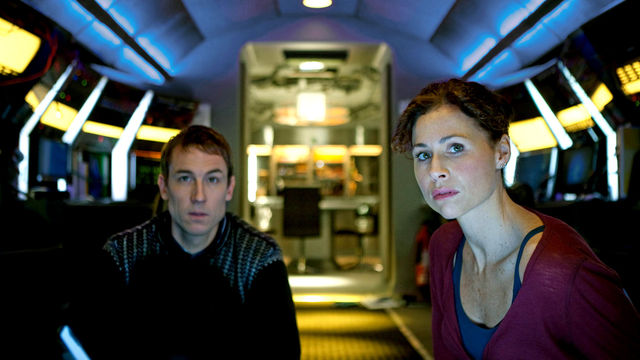
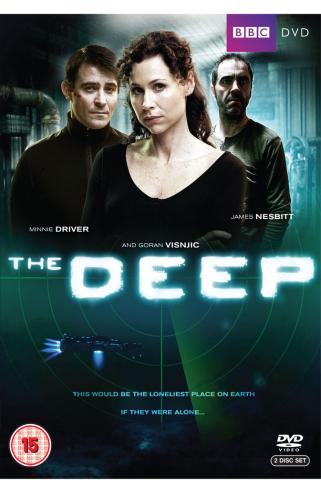
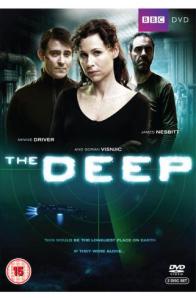
Last weekend, I watched all five episodes of The Deep, a Tiger Aspect Productions serial originally broadcast on BBC 1 during summer 2010. Much like the movie Sphere – with which it shares some similarities – there are some neat ideas in The Deep, and a setting that could be really cool…

the_deep

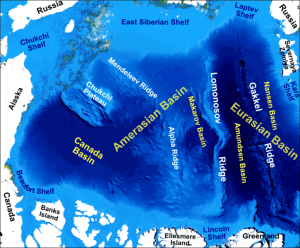
The neat ideas first: 1) exploring vent-fields beneath the Arctic icecap, and finding a thermophilic biodigester which produces biogas with unprecedented metabolic efficiency; and 2) discovering that the Russians have been secretly drilling for oil under the seabed in a UN Exclusion Zone beneath the icecap (shades of Frank Herbert’s The Dragon in the Sea?). Idea 1 provides the motive for the expedition to visit the vent-field on the Lomonosov Ridge and a satisfyingly earth-changing end-game. Idea 2 gives us the villains and the obstacles they present which the protagonists must overcome in order to win through to the end.

The setting is 2,000 feet deep in the Arctic Ocean. So the cast are confined to the interior of submersibles and/or submarines. At that depth, the pressure is around 70 atmospheres. Submarines make for really dramatic environments – they’re claustrophobic and subject to unforeseeable external hazards; and in this case, they’re high-tech too. The Deep features three such vessels: Hermes, a research submersible, which disappears with all hands at the start; Orpheus, a second research submersible which is sent six months later to continue Hermes’ research and also discover her fate; and Volos, the giant submarine the Russians are using as a base of operations for their illegal drilling. Each vessel also carries a mini-submersible, single-person but they can carry two at a squeeze.

So far so good. Orpehus arrives at the Lomonosov Ridge, discovers the wreck of Hermes, but is then disabled – and one of the crew killed – by… something. They are captured by Volos, but the Russian submarine remains silent. Aboard Volos, the Orpheus crew discovers all but two of its crew dead, cause unknown. The two survivors try to commandeer Orpheus, but she’s going nowhere because her systems are down. These are fixed by salvaging “the motherboard” from Hermes. But, oh no, the nuclear reactor aboard Volos is over-heating and will soon explode. Except there are other survivors aboard Volos, including a member of Hermes’ crew. It’s a race against time to rescue them before the Russian sub blows up.
725px-Arctic_Ocean_bathymetric_features

Which happily it doesn’t, as one of the crew does a Spock and saves the day (at the cost of his own life). Oh, and the thing that killed the Volos’ crew and disabled both Hermes and Orpheus proves to be… a giant underwater radar. Which the Russians were using to probe beneath the seabed and find oil deposits.

Only now there’s another problem. That thermophilic biodigester is really important, but all the samples aboard Volos are dead. Fresh ones are required… from the oil well at the bottom of the nearby Laurentian Abyss. Well, they call it the Laurentian Abyss, and claim it’s 8,500 feet deep; but the real Laurentian Abyss is closer to 20,000 feet deep. So they have to go and get another sample. But the captain of the Volos won’t let them go, and in fact plans to use the giant underwater radar to destroy Orpheus. But they defeat him. And go and fetch another sample of the thermophilic biodigester by lowering a one-person sub into the well itself. And then the Volos blows up. And the good guys – well, the ones that are left – escape.

There you have it: five sixty-minute episodes of nail-biting underwater drama… Except. There’s just so much that is plain wrong in those five hours that the entire serial can’t help but sink into the abyss…

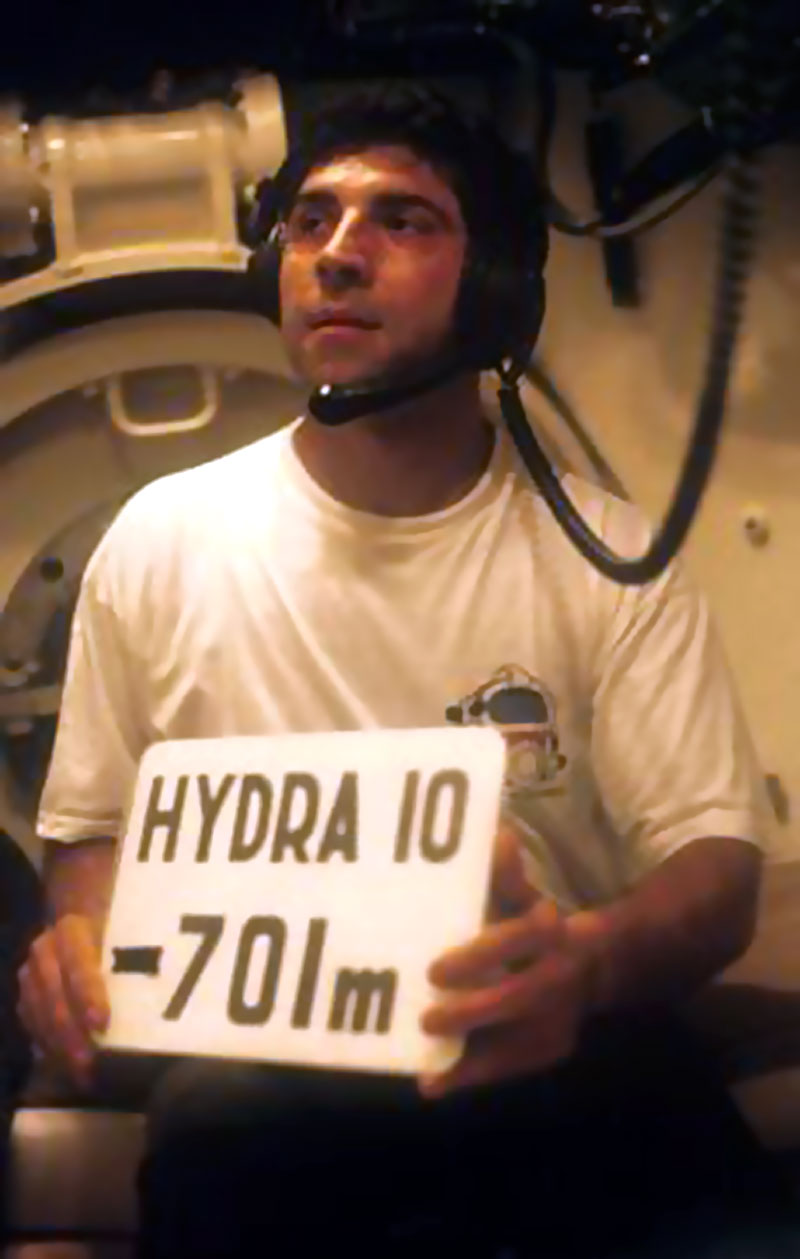
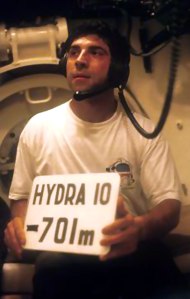
Those mini-submersibles I mentioned… They’re carried inside each of the vessels, and leave it via a moon pool. At a depth of 2000 feet, at a pressure of 70 atmospheres. So the interior of Hermes, Orpheus and Volos would also have to be pressurised to 70 atm… or be instantly flooded. We’re informed the crew are breathing “neonox”, a neon-oxygen mix, at high pressure, so, you know, it’s a little bit plausible. The current depth record is held by Theo Mavrostomos who, as part of Comex’s HYDRA 10 experiment in 1992, spent 3 hours at 2,300 feet (71 atmospheres) in a hyperbaric chamber on land. But the entire experiment took 43 days: 15 days compression, 3 days at 68 atmospheres, and 24 days decompression. There are no two weeks of compression in The Deep.
1992-Theo-Mavrostomos-HYDRA-10-COMEX-ROLEX-701M

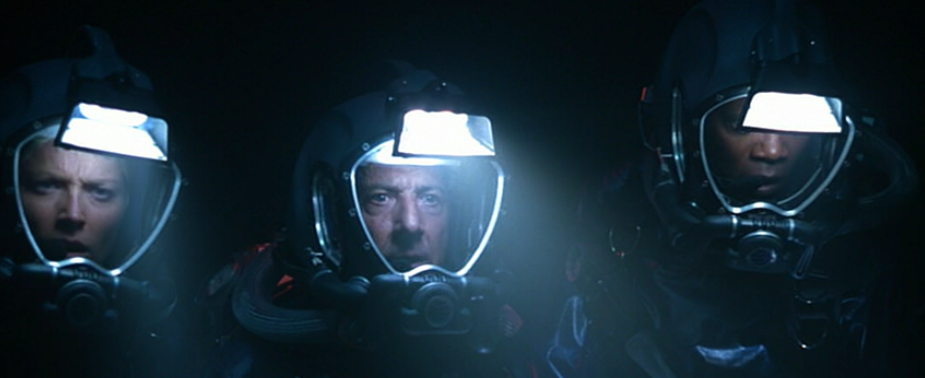
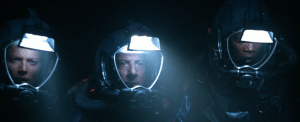
It’s borderline plausible – one man has spent 3 hours at 71 atm and survived, but that was 20 years ago. However… there’s no reason why any of the subs should have a moon pool. The mini-submersibles could just dock to a hatch. So then the interior could be pressurised to 1 atm. Just like real-life submersibles. In Sphere, the film adapted from Michael Crichton’s novel, the underwater habitat is 1,000 feet beneath the surface, but it has a moon pool. However, it’s needed because the cast go saturation diving. They go out into the water. No one does in The Deep.
sphere

And, of course, nuclear reactors don’t explode when they overheat. Nor do they require the control rods to be inserted by hand – as they must be aboard Volos (hence, the Spock scene). The US Navy has been operating nuclear-powered submarines since 1954, and the Russians since 1959. Several have been lost with all hands. None have exploded. (Incidentally, it’s never mentioned what powers Orpheus. Really really powerful and long-lasting and giant and heavy batteries, I imagine.)

Then there’s that giant underwater radar. And numerous mentions to “calling on all frequencies” by various members of the subs’ crews. Radar doesn’t work underwater. That’s why they use sonar. And radio doesn’t work very well below the surface either. Various navies have used extremely low frequency radio for communication with submarines (ie, with wavelengths of several thousand kilometres), but it’s expensive and technically difficult. Which is why acoustic transmission is the most common form of communication with vessels underwater.

And when the high-powered radar waves hit the Orpheus and shorted out its systems? That’s because it “reversed the polarity” on the motherboard. That’s what one of the characters actually says. And it seems Orpheus has one motherboard through which everything must be routed – not just for its failure to totally disable the sub, but also to allow it to be fixed in one fell swoop later. Never mind building in redundancy…

But, you cry, these are piffling! What do I care about HYDRA 10 or nuclear reactors going boom? The Deep was jolly exciting drama and those are mere trivial details. After all, the moon pool looked pretty neat, so what does it matter if no real submersible could descend to 2,000 feet with one? Or even to 8,500 feet.

As for the other niggles, they’re even more trivial. So what if one of the Russians lights up a cigarette at 70 atms pressure? So what if another character declares Volos, at 300 metres long, larger than any surface vessel – when both supertankers and US Navy aircraft carriers are all over 300 metres in length (and the largest supertanker ever built, Seawise Giant, was 458 metres long)? So what if a marine biologist is asked to do an autopsy and seems to know what he is doing, despite saying he’s only ever dissected a rabbit for his Biology GCSE? So what if the thermophilic biodigester produces nitric acid as a byproduct of its metabolic process, and the acid has been corroding all the subs’ hulls  – but the concentration would be so weak in, like, the Arctic Ocean that it couldn’t even corrode tissue paper? So what if the underwater well, from where they fetch the fresh sample, is a hole several metres in diameters and when have you ever seen an oil well that large or even a drill bit? That’s less than trivial! It is meaningless.

seawise

There were problems with the story itself, true; and with the script. Characters telling each other stuff they should already know – “We’re breathing Neonox, a mixture of neon and oxygen”, “That’s a vent-field”, etc. Not to mention a dramatic scene resulting wholly from the fact two switches had been swapped over but their labels had not been changed.

My point is that the details I’ve mentioned above could all be easily checked. And putting them right would not have affected the story (although a hatch doesn’t look as cool as a moon pool, I’ll grant). But when you leave stuff like that in, it will annoy some people and you will lose them. Why not get it right and keep them? No one’s saying it should be, “That submarine must be 300 metres long, that’s nearly as long as a supertanker or a US Navy aircraft carrier, but not as long as Seawise Giant, which was 458 metres long.” Because that would be silly. Instead of, “That submarine must be 300 metres long, that’s longer than anything you’ll see on the surface,” why not, “That submarine must be 300 metres long, that’s really big for a submarine”?

The giant underwater radar is more problematical as it’s a plot device. Something has to generate the EMP which leaves Orpheus dead in the water, something has to kill the crew of Volos. There’s a lovely line in the Wikipedia article on offshore geotechnical engineering, which goes, “For the sub-bottom stratigraphy, the tools used include boomers, sparkers, pingers and chirp.” The article explains that geophysical surveys make use of a combination of sonar and seismic refraction, so perhaps one or more of those might have been used instead of the implausible giant underwater radar.
thedeep

When I started this post a few days ago, it was with the intention of just pointing out some of the howlers in The Deep. But yesterday’s discussion on Twitter suggested to me there’s a wider point to make. When you’re writing, there’s stuff you make up and stuff you look up. And if you don’t know which is which, then perhaps you need to rethink your story. Never assume your readers won’t spot it when you’ve got details wrong. It’s perhaps forgiveable when the knowledge required is arcane or difficult to find. But the simple stuff? Characters using the Jubilee Line on the London Underground in 1940, 37 years before it was built? Characters referring to the Paras as “redcaps”, when that’s the nickname of the Royal Military Police? Why would a writer not bother to look these things up? If they’re that lazy with the details, what does that say about the story, or the novel, as a whole?

You can’t, as they say, please all of the people all of the time – but you can at least make an effort to please as many as you possibly can. If I’m writing and I want something to happen in my story but I’m not clear on the details, then I look them up. I don’t just wing it and hope no one notices. This does not mean every story needs to be fact-checked. It’s not always necessary. I wrote a story about an ATA pilot who flew Spitfires, so I researched both. I wrote another story set in an unnamed town during an unnamed decade (which sort of resembles the 1940s) – no research was necessary. If a story is set on an invented world in an invented galactic empire, then there’s not much you can look up anyway. But if it’s set in London, or Belfast, or beneath the Arctic icecap – then it’s time to get googling.

The internet is an amazing tool, so why not make use of it? Pretty much all of the information mentioned in this article, I found online. And if I could find it, so could anyone…