
Six films from six different countries, which is quite good… and even the US one is not that embarrassing. Honestly.
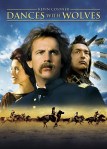 Dances with Wolves*, Kevin Costner (1990, USA), Yes, unbelievably, I’d never seen Dances with Wolves. Since it’s on the 1001 Movies You Must See Before You Die list, I’d always planned to watch it, but I had it as low priority on one of my rental lists. But then I found a copy for a quid in a charity shop… I’d been expecting a revisionist Western and, yes, that’s very much what it is… but not precisely in the way I’d expected. Costner plays a monomaniacal Cavalry officer who insists on being assigned to the furthest outpost in US territory. Shortly after settling alone there, he encounters his neighbours, a village of Lakota Indians. He visits them in the interest of peaceful relations, and gradually learns their language. He also marries a Lakota widow. But then the US Army turns up, and decides Costner is a traitor because he has gone “native”. Unfortunately, there is such a mass of cultural material generated by the US in which the Native Americans are painted as villainous savages, and the white Americans as noble pioneers, that it’ll be centuries before the US truly accepts it committed racial genocide on all the cultures which shared the North American continent prior to their arrival. So, really, we shouldn’t be calling these films “revisionist” because they depict the Lakota as actual human beings and the occupying white Americans as vicious scumbags, because that’s probably much closer to the truth than the genre usually reckons. It is also fucking shameful that science fiction bases so many of its narratives on stories of Western pioneers and their so-called courage and fortitude in colonising distant territory, when it was usually their advanced weaponry and duplicity that won the day. Dances with Wolves was not a great film, although it won a huge raft of awards, but it was a lot better than I’d expected it to be. I actually quite enjoyed it.
 Ivan’s Childhood, Andrei Tarkovsky (1962, Russia). This was a rewatch, prompted by me upgrading my Tarkovsky DVDs (which went to a good home) to Blu-rays. Ivan’s Childhood was Tarkovsky’s first feature film for a studio. The title refers to a boy who becomes a runner for the Red Army on the Eastern Front during WWII. There’s a scene in the film which captures me every time: Ivan has just arrived at an outpost, and the commanding lieutenant is not sure what to make of him, despite the boy’s claim to importance. At Ivan’s insistence, the officer rings headquarters and is properly humbled. He then offers the boy a hot bath. Evereyone who meets Ivan wants to do right by him, which by their lights means sending him to school and officer training. But he wants to stay at the front, directly contributing to the war effort. To be honest, there’s not much on this Blu-ray release which justifies the upgrade – it’s a bloody good film, if not Tarkovsky’s best, there’s the rest of his oeuvre to compete for that, and to be honest I can’t say it looks better on Blu-ray than on DVD because it’s a fifty-five-year-old film. Upgrading was a no-brainer – Tarkovsky is one of the best directors ever – and if it’s prompted me to rewatch his films (again), then it’s done more than intended. In fact, I now want to watch them again again.
 The Milk of Sorrow, Claudia Llosa (2009, Peru). My first film from Peru. And a female director too. (Incidentally, I’ve started tracking the gender of the directors whose films I watch now, but it’s embarrassingly male-heavy at present.) The Milk of Sorrow takes place in an area occupied by indigenous people – Quechua is spoken during the film more than Spanish, in fact – and the title refers to a belief that women who were abused or raped transmit their feelings through their milk to their female children. The film follows a young woman who is accused of suffering from this as she tries to avoid her mother’s fate. I had not come across Llosa before encountering this film – which was pretty much a random Peruvian film picked because I’d never seen a film from that country – but on the strength of The Milk of Sorrow I want to see more by Llosa. (And so I did, as it turns out The Milk of Sorrow was a two-disc set with Llosa’s Madeinusa, which will be covered in a later Moving pictures post). Some films are just good; some films are good and you want other people to watch them. Many of the recent Chinese films I’ve seen fall into that later category. As does The Milk of Sorrow. Highly recommended.
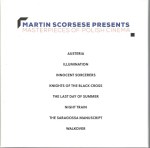 Innocent Sorcerers, Andrzej Wajda (1960, Poland). Another from the second Masterpieces of Polish Cinema box set. I’ve yet to get a handle on Wajda’s output – I really like Man of Marble and Man of Iron, although the latter feels more like a teleplay than a feature film; and the latter is also in the first box set of the Masterpieces of Polish Cinema, which is good as it’s apparently not available in the UK, to go with the Second Run DVD release I have of Man of Marble; but I was not all that taken with his best-known film, Ashes and Diamonds. In other words, I pretty much have to take each Wajda film as I find them. And this one was… fun, in a sort of 1960s black-and-white-jazz-soundtrack sort of way. A bit like a John Cassavetes film but more to my taste. There’s a young doctor with improbably blond hair, and a young man in sunglasses who looks like the protagonist of Ashes and Diamonds, and it’s all very New Wave, but filtered through a very Polish lens. As previously mentioned it’s a lot like Cassavetes’s films but also completely unlike them – it feels more polished for a start, less reliant on ensemble acting, with a bit more Godard in its DNA than Cassavetes was wont to show. The films suffers from unsympathetic characters – but then so do Cassavetes’s films – and very little happens during its 87 minutes. It’s considered an oddity in Wajda’s oeuvre, and it’s easy to understand why. Worth watching, but lacking something that might make it a film worth remembering.
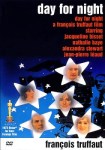 Day for Night*, François Truffaut (1973, France). I had to buy a copy of this as it’s apparently not available for rental from either LoveFilm or Cinema Paradiso. But it turned out to be an excellent film, so never mind. (It was also very cheap.) Truffaut plays a director making a film in the south of France starring a British movie star, played by Jacqueline Bisset. The entire movie is a series of in-jokes about movie-making, and the personalities involved, and it works really well. My attitude to Truffaut’s films is definitely improving. There are some great set-pieces in Day for Night, especially the one with the cat, and the cast are thoroughly convincing in their roles. The alcoholic dowager actress is fun, and the various relationships which develop among the cast and crew are amusing. Apparently, Graham Greene was an admirer of Truffaut and scored himself a walk-on part as an insurance agent. Truffaut, who admired Greene’s writing, only found out later that one of the insurance agents was Greene. As meta-cinema goes, it’s all a bit obvious – and was obvious in 1973, Vertov did it fifty years earlier with Man with a Movie Camera, for example – and some of the jokes were clearly at Hollywood’s expense, but it all seemed so genial, rather than than génial, and Bisset’s depiction of a fragile actress seemed just right for her role in the film and the “film”. My third favourite Truffaut so far.
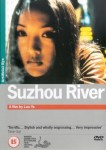 Suzhou River, Lou Ye (2000, China). Yet more Chinese cinema. I’ve yet to see any evidence to contradict my claim that China currently has one of the strongest cinemas of any nation. Admittedly, I’m seeing the films which get international releases, and not the purely domestic stuff, but China has a stable of amazing directors, active from the mid-1990s onwards, who have produced some of the best films of the past ten or so years. Which is not to say there are not some excellent historical films – I’m a big fan of Spring in a Small Town (1948), and The Goddess (1934) is also very good. Suzhou River is an earlier work, inasmuch as it was released at the turn of the century, and it shows a bit in its MTV-style cutting, but it’s still an excellent film. It also takes an interesting approach to narrative, opening with a voiceover in which the narrator explains how he came to love a young woman who plays a mermaid in a Shanghai bar. It then tells the story of Mardar and Moudan, a courier who ferries a rich man’s daughter about town, before being forced to kidnap her… Years later, Mardar returns to Shanghai, and stumbles across the mermaid, who he thinks is Moudan. There is, as previously mentioned, a few too many MTV-style jump-cuts, but in all other respects this is a very good Sixth Generation movie. I’ve found myself buying several of the Chinese films I’ve watched on rental after seeing them, and I think I’ll be looking for a copy of this one too. (Damn, I just went and bought one on eBay for a tenner.)
1001 Movies You Must See Before You Die count: 860



 It Doesn't Have To Be Right...