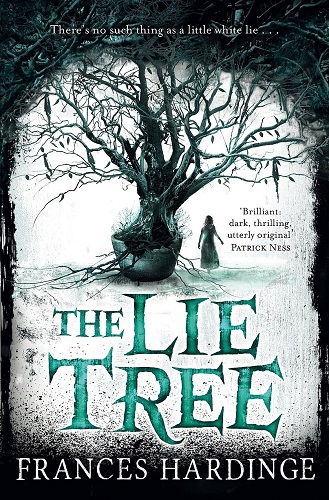
I’d heard good things about Hardinge’s fiction for several years, but I’d never bothered checking them out because, well… fantasy… YA… Not my usual, or preferred, choice of reading. But The Lie Tree (2015, UK) popped up for 99p on Kindle, and I thought it worth seeing what all the fuss was about.
And I’m glad I did.
Faith’s father, a reverend, is a celebrated palaeontologist in the 1860s, but he’s been accused of faking the fossils he discovered, so he and his family flee to the invented Channel Island of Vane to join a dig there. But all is not as it seems. The invitation was a ruse because the reverend is in possession of something that others want.
On the one hand, the title of the novel is a hint to the central element of its plot, which is not revealed until at least halfway in; on the other, it’s hard to describe the plot without spoilers. The spoiler-free version would go: Faith defends her father, uncovers a conspiracy against him, then tries to solve his murder and so learns his secret, the reason why he was invited to Vane, and uses it to take revenge on his killers.
However, a major part of the novel – although it doesn’t really kick in until around a third of the way in – is that Faith is clever, but because she is a girl it means nothing. She wants to be a scientist but her gender bars her from it. This is a novel about women as property, about chattel slavery of half of the human race, and about the means and methods open to women of the time to arrange a future for themselves and then safeguard it. Faith is a teen, and knows her much younger, and not very bright, brother, whom she loves nonetheless, is accounted more valuable than her. Even though she has the intelligence, the aptitude and the interest to follow in her father’s interests.
And it’s this element of the novel which lifts it above others of its ilk. Faith thought her father valued her because of her intelligence, but he was just using her – much as he used others to further his aims. Faith meets a woman – two, in fact, but one more so than the other – who have found a way to be intellectual without offending Victorian (male) society – I am for some reason reminded of JG Farrell’s The Siege of Krishnapur (1973, UK), an excellent novel – but it doesn’t end well. And also I’m reminded of Jeanette Ng’s Under the Pendulum Sun (2017, UK), which presents as a fantasy set in Victorian times but is actually a brilliant commentary on Victorian fiction by women, missionary colonialism and women’s rights.
The Lie Tree is really good, and I should definitely read more by Hardinge.
Two genre shortlists announced in one day, UK ones too. First, the BSFA Awards, for which I nominated works (see here), and usually vote. The four shortlists look like this:
Well, three of my nominations made it – Hutchinson, North and Williamson. The Allan and and Leckie are no surprise – the first because it’s probably the most talked-about UK sf novel of 2014 among the people who nominate for the BSFA, and the Leckie because of Ancillary Justice‘s huge success. Also, is this the first time the BSFA Award has more women than men on the novel shortlist? I think it might well be. The large shortlist does, however, suggest that the actual number of nominations to make it through were somewhat low. Which, if true, is in one respect slightly worrying, but also heartening in that it demonstrates last year was pretty damn good for UK sf novels.
Best short fiction
‘The Honey Trap’, Ruth EJ Booth (La Femme, Newcon Press) ‘The Mussel Eater’, Octavia Cade (The Book Smugglers)
Scale Bright, Benjanun Sriduangkaew (Immersion Press)
None were nominated by myself. In fact, I’ve read none of them. An all-female list, too. The less said about Sriduangkaew’s presence, the better.
Surprisingly, two of my nominations made it through – Kincaid and Strange Horizons – and while I nominated another blog post from Ruthless Culture, it’s good to see McCalmont getting some recognition.
Best artwork
Cover of The Mirror Empire by Kameron Hurley, Richard Anderson (Angry Robot Books)
Cover of Bête by Adam Roberts, Blacksheep (Gollancz)
The Wasp Factory sculpture, Tessa Farmer
Cover of Wolves by Simon Ings, Jeffery Alan Love (Gollancz)
Cover of Mars Evacuees by Sophia McDougall, Andy Potts (Egmont)
Another surprise: two of my choices made it onto the shortlist. I didn’t attend Loncon3, so I didn’t see the Wasp Factory sculpture. Blacksheep won the BSFA in 2013, for the cover of… an Adam Roberts novel (and this is Blacksheep’s third time on the shortlist with a Roberts cover). The Mirror Empire has been much discussed since its publication, although I admit I can’t see the appeal of its cover art. And I see there’s now a hardback edition of Mars Evacuees (US, perhaps?), with much inferior cover art.
Congratulations to all the nominees, and I know who I hope will win each category.
The other UK genre award announced today is the Kitschies, a juried award, which also has four categories: Red Tentacle (novel), Golden Tentacle (debut novel), Inky Tentacle (cover art) and, new this year, Invisible Tentacle (“natively digital” fiction). The shortlists look like this:
I’ve heard of the Byrne and Itäranta, but the others didn’t even ping on my radar. The Guardian is making a big thing of a self-published novel being shortlisted for the award, conveniently forgetting that a self-published novel won the Aurealis Award for Best Fantasy Novel in Australia last year and a self-published novella won the BSFA in 2013. Oh well, yesterday’s news and all that.
The Inky Tentacle
Cover of The Ghost of the Mary Celeste by Valerie Martin, X (Weidenfeld & Nicolson)
Cover of A Man Lies Dreaming by Lavie Tidhar, Ben Summers (Hodder & Stoughton)
Cover of Through the Woods by Emily Carroll, Emily Carroll and Sonja Chaghatzbanian (Faber and Faber)
Cover of The Book of Strange New Things by Michel Faber, Rafaela Romaya and Yehring Tong (Canongate)
Cover of Tigerman by Nick Harkaway, Glenn O’Neill (William Heinemann)
The only one of these I own is the Tidhar, and didn’t really like the cover (I liked the book, though). The Faber and Harkaway I’ve seen.
The Invisible Tentacle
@echovirus12 (Twitter fiction), created/curated by Jeff Noon (@jeffnoon), Ed (@3dgriffiths), James Knight (@badbadpoet), violet sprite (@gadgetgreen), Richard Biddle (@littledeaths68), Mina Polen (@polen), Uel Aramchek (@ThePatanoiac), Graham Walsh (@t_i_s_u), Vapour Vox (@Wrong_Triangle) Kentucky Route Zero, Act III, Cardboard Computer 80 Days, Inkle Studios Sailor’s Dream, Simogo
 It Doesn't Have To Be Right...