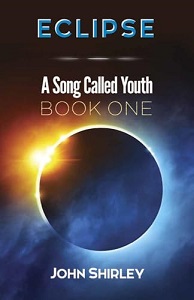
I read Eclipse (1985, USA) some time back in the 1990s, I think, or it might have been the late 1980s. It was originally published in 1985, but the edition I read this year was the 1999 revised edition. It’s the first of a trilogy, A Song Called Youth, followed by Eclipse Penumbra (1988, USA) and Eclipse Corona (1990, USA). For some reason, I never got around to reading books two and three.
I’ve read a lot of fiction by John Shirley over the years. He was one of the authors I fastened onto during the late 1980s, for reasons I no longer remember. He’s had an… interesting career (there’s a good interview with him from February this year on Boing Boing: here). His output has been large, including quite a lot of work-for-hire novelisations, but the quality has been variable. His works are mostly science fiction or horror, with the odd fantasy. His good stuff is definitely worth reading, the rest not so much.
Fortunately, Eclipse is one of the good ones. It’s part-cyberpunk, part-WW3, and part-punk rock. It’s set some time around the middle of this century. After Putin’s death, Russia invaded Europe. Meanwhile, fascism is on the rise everywhere in the West. There’s a space habitat called the Colony in orbit, and a high-tech floating sovereign city in the Mediterranean called Freezone. A private security company called Second Alliance has been contracted to police the war-torn cities of western Europe. Second Alliance is run by a cabal of right-wing Christian fascists, and is deeply racist, homophobic, anti-semitic and anti-Islamic. There is a small resistance trying to prevent them. The novel follows a handful of characters from the resistance: in Paris, in the Colony, and infiltrated into Second Alliance’s leadership.
If parts of this sound familiar, it’s worth remembering the novel was originally published in 1985. And even the revised edition is twenty-seven years old. Of course, there’s nothing new about fascism, and the US has been a bin fire since it was founded… In the real world, the Russian invasion was limited to Ukraine, and Israel has proven to be a rogue nation rather than a settling influence on the Middle East. And, of course, there was 9/11 and the War on Terror. True, a lot of Shirley’s world-building in Eclipse is fairly typical of cyberpunk post-war fiction of the 1980s, and it’s scary how close to present-day reality some of it is.
Of course, back then, cyberpunk was about the tech – the capitalism run wild, or World War 3, were just setting – and here Eclipse is a little wider of the mark. It’s probably the only thing in the book that dates it – well, that and the punk rock aesthetic, which didn’t last much past the 1990s. Nonetheless, it still reads pretty well.
 It Doesn't Have To Be Right...