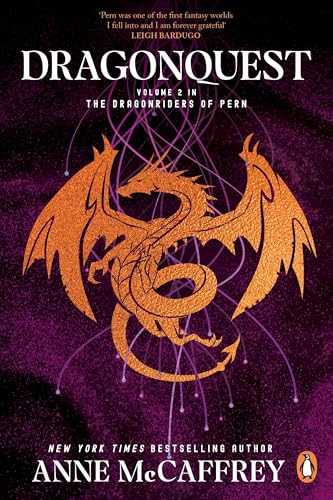
This is the second Pern novel and reading both I’ve learned whatever assumptions I’d held for many years about the series – based on reading McCaffrey’s Killashandra trilogy back in the 1980s, and reviews of the later share-cropped books in the series – were mostly wrong. Okay, so there are dragons, and a world that has fallen from a technological past to a sort of semi-enlightened (and somewhat sanitised) Middle Ages. And romance. Although not as much romance as I’d expected. In fact, the first two books in McCaffrey’s long-running Dragonriders of Pern series are pretty much straight-up science fiction. With perhaps an over-emphasis on the emotional relationship between the dragons and their riders.
These days, that’s nothing new or unusual. Although I do wonder how I would have responded to the books had I read them as a teenager in the late 1970s. Not so differently, I’d like to think – it was only a couple of years later I was reading, and admiring, CJ Cherryh’s fiction, and I was already a fan of Tiptree’s short stories, and, yes, aware “he” was a woman.
In the first book, Dragonflight (1968, Ireland), queen dragon rider and chief Weyrwoman, Lessa, had travelled back in time 400 years and brought forward five weyrs to help combat Thread, which had begun falling again after several hundred years. As Dragonquest (1971, Ireland) opens, the old weyrs don’t like the way things are run in the present and cling to “tradition”, which has brought them into conflict with the holds. This might sound slightly familiar in the current political climate.
Then the Thread begins to fall outside the timetable calculated for it, putting further pressure on the weyrs, especially Benden Weyr, the one led by Lessa, and the most respected, admired and generally all-round wonderful weyr of them all. After stumbling across some ancient technology – a microscope! a telescope! – the hold lords and the weyrs hatch a plan to send dragons to the Red Star, the neighbouring planet where Thread originates.
It’s all very dramatic, and McCaffrey handles the slow introduction of details from the legendary past into her world with admirable constraint. Having said that, the chief villain abruptly disappears three-quarters of the way through the novel, and is effectively written out of the story. A dragonrider ignores orders and makes a trip to the Red Star, which proves reckless and comes to exactly the end expected. Lessa is more in the background in this novel – if anything, Dragonquest never seems entirely sure who its chief protagonist is. On the other hand, this does mean McCaffrey can spend more time rounding out her world.
I plan to finish the original trilogy – I have The White Dragon (1978, Ireland) on the TBR – but I don’t think I’m going to dash out and read all the remaining books in the series – 24 novels to date, not all wholly by McCaffrey. I’m certainly not, however, going to diss the books any more, as I was clearly wrong on what I’d assumed about them. The two I’ve read so far are fun, well-crafted, quite plainly science fiction, perhaps a little dated in parts… but there were many many actively bad sf novels written back then, and these are not among them.
 It Doesn't Have To Be Right...