
I’ve heard it said the Grateful Dead were not actually very good live, but every now and again everything would sort of fall into place and it would be an almost transcendental experience – and it was those moments which led to their popularity. I’ve no idea if that’s true, but I do know that such moments can happen at a live performance. I remember one gig at Corporation in Sheffield – I forget the year, or who was the main act, but a support act was playing. I was standing with two guys, complete strangers, and none of us was impressed. Then the band started a new song and all three of us said, “Now that’s interesting.” (For the benefit of non-Brits, that means it was good.)
In Soul Music (1994, UK), Pratchett takes those moments – generated here by magic, and by some magical force for its own ends – to chart (see what I did there?) the invention of a new kind of music in Ankh-Morpork. A harpist from Llamedos (read it backwards) moves to Ankh-Morpork. Unable to afford a license to perform, the harper falls in with a troll and a dwarf, and the three form a band, The Band With Rocks In (because the troll is a drummer and his drums are, er, rocks). The harper’s, er, harp is broken at an unlicensed performance, but he finds a new one in a mysterious shop that mysteriously appears mysteriously. And that changes everything. Suddenly, all The Band With Rocks In’s performances are like those mythical Grateful Dead performances.
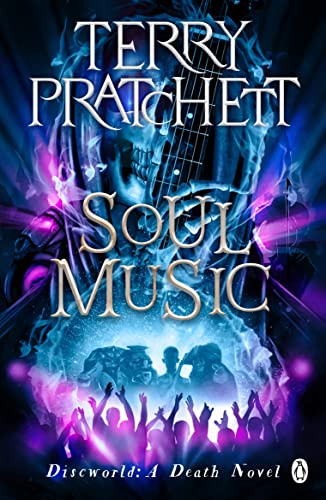
Meanwhile, Death has left his post, upset over the death of his apprentice and adopted daughter, so his granddaughter takes over the role. But she’s not especially good at it. When she turns up to the Mended Drum at which the harpist – now calling himself Buddy (referencing a pop star who died, um, 66 years ago), and the troll has taken the name Cliff (a rock joke, and referencing a pop star who, I suspect, will never die)… The harpist is supposed to die at the gig, but instead Death’s granddaughter allows him to live… which only makes the music magic more powerful…
Pratchett has a great deal of fun taking the piss out of the music industry, although many of his references are a good thirty years earlier than the year the book was published. And some of the jokes about bands on the road were already clichés when Pratchett made use of them. Neither of which means the book isn’t amusing. And the Death/Death’s granddaughter narrative makes for a good contrast – and introduces some interesting characters (and makes use of several old ones).
I find the music industry a more interesting target than some of the targets in earlier Discworld novels, but it does occasionally feel like the jokes are a little too obvious and the commentary not as pointed or insightful. Having said that, my taste in music is… niche, and quite specific, and has regularly been misrepresented in popular culture. So perhaps that got a little in the way when I read Soul Music. All the same, I enjoyed it, although I wouldn’t put it in the top five of Discworld novels (of the ones I’ve read).
 It Doesn't Have To Be Right...