
It Doesn't Have To Be Right…

… it just has to sound plausible


1 Comment

The Employees, Olga Ravn

Back in 2014, Paul Park published the novel All Those Vanished Engines (2014, USA), which comprised three linked novellas. One of these, which shared the book’s title, was originally commissioned to accompany a sound installation by Stephen Vitiello at the Massachusetts Museum of Contemporary Art in 2011. The Employees (2020, Denmark) by Olga Ravn was inspired by the art of Lea Gulditte Hestelund, a Danish visual artist, after Ravn was asked to provide accompanying text for her exhibition, Consumed Future Spewed Up as Present. Knowing this in no way affects reading The Employees, although it does in part explain some parts of a novel which takes pains to obscure its story.

The novel is told in one- or two-page chapters, each of which is the testimony of a member of the crew of the Six-Thousand Ship, so called because that’s the number of people aboard it. Just like the Three Ship that went to the Moon, and indeed the One Ship that put the first human being in space. Not all of the six thousand are human, some of them are androids – the novel is vague to their exact status, only that they are human in all ways except actually being considered human. Science fiction is normally quite happy to feature chattel slavery without commentary, so why it bothered to invent a metaphor for it will forever be a mystery.

The opening testimonies describe members of the crew, or “employees”, visiting rooms containing “objects” from Hestelund’s installation. There are also visits outside the ship to a valley, although its unclear if the ship has landed on a planet or is in space. At some point, the non-human humans object to not being treated as humans, and mutiny. This is supposed to comment meaningfully on the human, or indeed non-human, condition.

The problem is, there is nothing new here. And couching everything in terms so vague, despite the manifold viewpoints, does not render the story profound or deep. I am in general in favour of science fiction written by non-genre writers. Their unfamiliarity with the tropes and conventions of science fiction can result in something interesting to say about common sf concerns – although that “common” often means their treatment is old-fashioned or adds little to the genre conversation. 

And so it is here: The Employees, while poetically written, contains no new insights into the human condition, or even human resources. Some nice prose, an interesting structure, and a link to an art installation of a real-life artist are married to a story that tries hard to hide the fact it is thuddingly obvious from start to finish.
Leave a comment

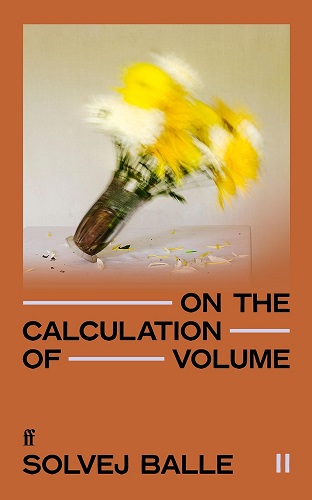
On the Calculation of Volume II, Solvej Balle

Tara Selter woke up one day, and it was the previous day. In fact, for reasons unexplained, she is reliving 18 November over and over again, much like Bill Murray in the movie Groundhog Day. In the first book – seven are planned – Tara explored the limits of her condition, spending time in Paris in a hotel, where she had slept the night before, repeatedly visiting the same friends – antiquarian booksellers like herself – again and again, even attempting to explain to them what was happening to her. She returned home, and tried the same with her husband. But she discovered the resources she used, food particularly, vanished from 18 November if she used them, and objects would disappear into 19 November if she did not keep them close to her.

In this second book, Tara decides to try and live a year on the same day. She does this by moving around Europe so that the climate matches what it would be, approximately, on each day of the year had she stayed home in her village outside Paris. It’s a neat conceit, but for it to work Balle needs to get her details absolutely spot-on and, unfortunately, in a few places they didn’t ring true.

But that’s a minor quibble. Balle commits hard to her structure, and is rigorous in working out the details of living the same day again and again, even when it comes to travelling about Europe in search of the right climate for each calendar day of the year. The travel stretches Tara’s resources and ingenuity, as she has no knowledge of the previous day wherever she ends up, and Balle considers all the pitfalls and ramifications that might result.

There is something deeply satisfying in Balle’s careful working out of her central premise, and even after only two books in of a planned seven, the series promises interesting explorations of Tara’s situation. 


Leave a comment

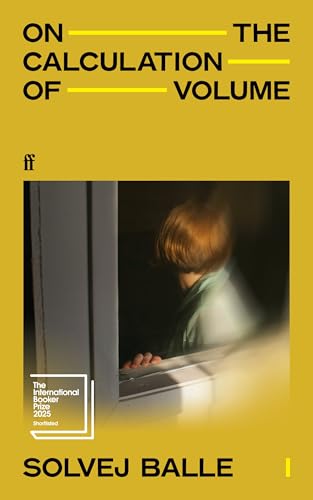
On the Calculation of Volume I, Solvej Balle

It’s probably premature to review this first volume before having read the rest – although only two have so far have been published in English, the third is due in November, the fourth in April next year… and to date only six of the planned seven have been published in the original Danish. (I should point out it’s not On the Calculation of, volume 1, but On the Calculation of Volume, part one.)

The basic premise is: antiquarian book dealer Tara Selter, resident in France, visits Paris to purchase new books for the home-based business she runs with her husband. While there, she wakes up one morning and discovers she is reliving the previous day. In fact, every day from that point on is 18 November. Just like Groundhog Day.

She returns to her husband, and explains the situation to him. But the following morning… is 18 November again for her, and she has to explain all over again. And again. And again. While she is stuck in time, he continues travelling forward day by day.

Tara tries several different ways to live – spending the day over and over again with her husband, living in his shadow as he repeats his 18 November… She discovers that any changes she makes carry over to her next 18 November – so if she takes food from village shops, their stock diminishes on the one day she inhabits. She explores the limits imposed on her as he lives the same day over and over again – some items return back to the beginning of the day with her, some are lost to 19 November, and so on.

It’s all very cleverly worked-out, and written in an appealing flat lucid prose. This first volume (did you see what I did there?) is Tara exploring the “rules” which seem to govern her situation, both in her home village and in Paris. She inevitably grows distant – first from her husband, then from other people, then from her own life. The novel – it’s short, only 166 pages – is almost entirely set-up. But then there are seven books (each one also short) in the series. Nonetheless, On the Calculation of Volume I (2020, Denmark) doesn’t feel abrupt or incomplete. It reads like the first step on a journey toward the solution of an impossible mystery (although the shadow of Groundhog Day does lie a little heavy across it).