It Doesn't Have To Be Right…

… it just has to sound plausible


Leave a comment

Short, Michael Blumlein

I’ve been a big fan of Blumlein’s fiction for years, ever since coming across one of his stories in an Interzone anthology back in the late 1980s – it was either his debut story, ‘Tissue Ablation and Variant Regeneration: A Case Report’, in Interzone: the 1st Anthology (1985, UK), or ‘The Brains of Rats’, his second published story, in Interzone: the 2nd Anthology (1987, UK). Whichever it was, it inspired me to track down everything else he had written.

Which was not easy at the time. I found a copy of his first collection, The Brains of Rats (1990, USA), which had been published by US small press Scream Press and was not readily available in the UK (I forget where I bought it; it might have been at a convention). His debut novel, The Movement of Mountains (1987, USA), which was science fiction, appeared in the UK in 1989. His second novel, X, Y (1993, USA), which was horror, was only available as a US massmarket paperback.
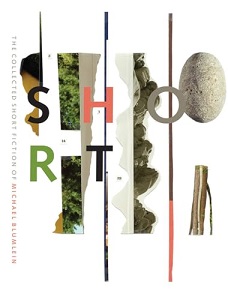
Then there was a gap – a story every year or two, a handful of novellas, but nothing at novel-length until The Healer (2005, USA). And a decade later, a handful of collections of his fiction. Of which Short (2023, USA), and its companion volume, Long (2023, USA), are the latest. Sadly, we lost Blumlein in 2019, so when these two volumes claim to be complete, they will stay that way. He was a singular talent, and almost sui generis. His stories were carefully crafted, and always thought-provoking. Some, obviously, worked better than others, and reading Short, which contains all twenty-nine of his published short stories, the differences can be stark.

Blumlein’s debut story, ‘Tissue Ablation and Variant Regeneration: A Case Report’, first published in Interzone in 1984, is remarkable. It’s also emblematic of Blumlein’s career – somewhere on the borderline between science fiction and horror, with occasional steps entirely into one genre or the other, often based around something medical, and always with very analytical prose. ‘Bestseller’, one of his more popular stories, is a case in point: a struggling writer answers a mysterious advert, and agrees to donate bone marrow for a large sum of money to an ailing billionaire. Then other parts of the billionaire’s body begin to fail, and the writer finds himself donating more and more…

Other stories read as though they were written to a specific market – ‘Snow in Dirt’, for example, was written for an anthology inspired by fairy tales. Even the stories originally published in F&SF feel like F&SF stories, and are lighter in tone than Blumlein’s other works.

Having said that, twenty-nine Blumlein stories in succession is a little overwhelming. His prose is intense and his stories are subtle. Short is a collection to be dipped into and savoured, I think. On the other hand, I now want to reread Blumlein’s novels. Fortunately, I recently purchased a copy of The Movement of Mountains (my copies of his books are in storage). 

And, of course, I have Long still to read.

Leave a comment

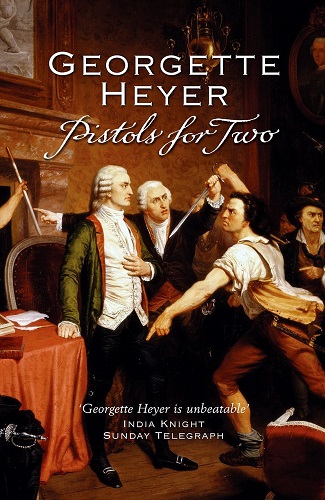
Pistols for Two, Georgette Heyer

Heyer’s only collection, until a recent one was cobbled together from this and some uncollected pieces, which is not much of a surprise as her only published stories were contemporary, and the contents of Pistols for Two (1960, UK) appeared nowhere else. They are… condensed versions of Heyer’s Regency novels. Mostly.

Pretty much every story is a young woman, either nineteen or twenty, who finds herself in a situation with a man – of the Quality, of course – a dozen or so years older, and so comes to love him or realise she has always loved him, and they agree to marry. In some cases, Heyer holds back on the history of the characters in order to male the romance more, well, cuter. The two guardians who refuse to allow their wards to marry because they were once engaged and it all went wrong but they’ve carried a torch for each other ever since. The young woman who prevails on an unknown lord to prevent the duel between her brother and a known rake, only to discover the unknown lord is the rake and he’s fallen for her.

The only one that breaks the mould is the young cit gentleman who puts up at a country inn on his way home from working in Portugal, and finds himself the intended victim of murderous thieves. Fortunately, one of his fellow guests is a Bow Street Runner.

Short stories by definition allow less room for character development, and Heyer did tend to rely on a series of stock characters. So it’s a hardly a surprise the stories in Pistols for Two feature those self-same stock characters, and the plots read mostly like incidents from a novel-length work.

On the other hand, it’s Heyer and these stories are typical of her work. If you like Heyer, you’ll like these. If you like these, you’ll like Heyer’s other works.


Leave a comment

Stag Dance, Torrey Peters

A collection of four novellas, although one probably qualifies as a short story, by the author of Detransition, Baby (2021, USA). I’d tracked down one of these – ‘The Masker’ – to a site for self-published fiction after reading Peters’s novel, but I’d been waiting for this collection.

There are four stories: ‘Infect Your Friends and Loved Ones’, ‘The Chaser’, ‘Stag Dance’ and ‘The Masker’. The first is science fiction, in which the narrator is the inadvertent patient zero of a virus which prevents the body from producing hormones. Society – in the US – has fallen apart, and people fight over manufactured hormones. This is not subtle – but that’s actually a strength of the story, and indeed the collection, not a weakness, I was reminded in parts of Ralph A Sperry’s Status Quotient: The Carrier (1981, USA) and Necessary Ill (2013, USA) by Deb Taber (the latter I can definitely recommend, and would really like to see more by her).

‘The Chaser’ is much more disturbing. It’s set at a Quaker school, and narrated by a senior whose relationship with a junior room-mate is… well, one is manipulating the other, or perhaps vice versa. And when the senior tries to distance himself, the junior begins a hate campaign. In parts, I was reminded of James Clavell’s King Rat (1962, UK) and, having attended a British boarding-school I grew up hearing stories that are… “adjacent” to this one.

The title story is… astonishing. It’s set in a pirate logging camp in nineteenth-century USA. I’ve no idea if the vocabulary and practices are correct, but they read as completely authentic. The protagonist is male and oversized and nicknamed Babe after Paul Bunyan’s pet ox, but his gender identity is not so clear-cut. One member of the camp, who is not a logger, and very pretty, is a pretend wife to several – more echoes of King Rat. This all comes to a head when the camp chief puts on a “stag dance”, where some of the loggers can pretend to be women by pinning a triangle of brown cloth to their groins. Which Babe does. When I first came across mention of this collection, it had a different title – but I can see why ‘Stag Dance’ was eventually chosen as the title piece. It’s a remarkable novella. 

‘The Masker’ is the least satisfactory of the four stories. At a crossdresser/transgender convention in Las Vegas, a young crossdresser is torn between an older trans woman and a man who uses a silicone female mask to crossdress. The trans woman, an ex-law enforcement officer, persuades the narrator to set a trap for the masker but instead they do the same for the trans woman.

The first two stories are good, and the last is okay. But the title novella is worth the price of admission alone. To be honest, I think it could have been published on its own. The other stories probably only really suffer in comparison, and might well hold up better in a collection on their own, but I can understand the urge to get something into print quickly. Peters is a name to watch, not only a good writer but writing stuff that’s straight up trans, documenting (US) trans culture… and more of them are definitely needed in the mainstream.