I knew I’d read this before, but I thought it was back in the very early 1990s. It turned out I was thinking of Hawksmoor (1985, UK) and although I’d read Chatterton (1987, UK) before, it was in 2004. Ackroyd is one of those authors whose books I don’t make an effort to search out, but will happily read and enjoy when I stumble across them… as I have done around half a dozen or so times to date. I should probably read more of them.
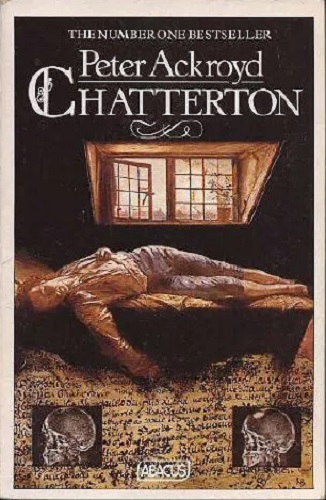
Chatterton is about Thomas Chatterton, a precocious poet and satirist, who committed suicide at the age of seventeen in 1770. He’s chiefly known for forging the poetry of an invented fifteenth-century monk, Thomas Rowley, and influencing the Romantic poets of the early nineteenth-century. Ackroyd’s novel has three narratives: Chatterton’s life shortly after he moved to London and leading up to his death; the circumstances surrounding the painting of ‘The Death of Chatterton’ some 80 years later by Henry Wallis, using Romantic poet George Meredith as a model; and in the present day, unsuccessful poet Charles Wychwood stumbles across a painting which suggests Chatterton faked his suicide, and later finds papers suggesting Chatterton forged a number of famous poem by Romantic poets.
The two historical narratives are great. Chatterton in period is convincing. Wallis, Meredith and Meredith’s wife, Mary, are even more convincing in London of eighty years later. Unfortunately, the present-day narrative (as of the year the book was published) is not so good. The characters are grotesque, mostly caricatures – not just the old couple who own the hidden-away junk shop where Wychwood finds the painting, but also Wychwood himself, and especially the ageing spinster novelist, Harriet Scrope (I mean, look at the name!), who then gets involved.
It’s a shame. It’s a fascinating mystery – or rather, it isn’t a mystery, but Ackroyd manufactures a mystery of it and does it well. But pretty much everyone involved in Wychwood’s present-day investigation is unlikeable and contemptible (with a handful of exceptions). Also, while Ackroyd’s wordplay works for the historical narratives, it feels over-egged in the contemporary narrative.
Having said all that, I’d actually remembered nothing of the novel from my previous read. So I’m glad I reread it… and it reminded me I really should read more of Ackroyd’s fiction.
 It Doesn't Have To Be Right...